fbpx

April 15, 2020

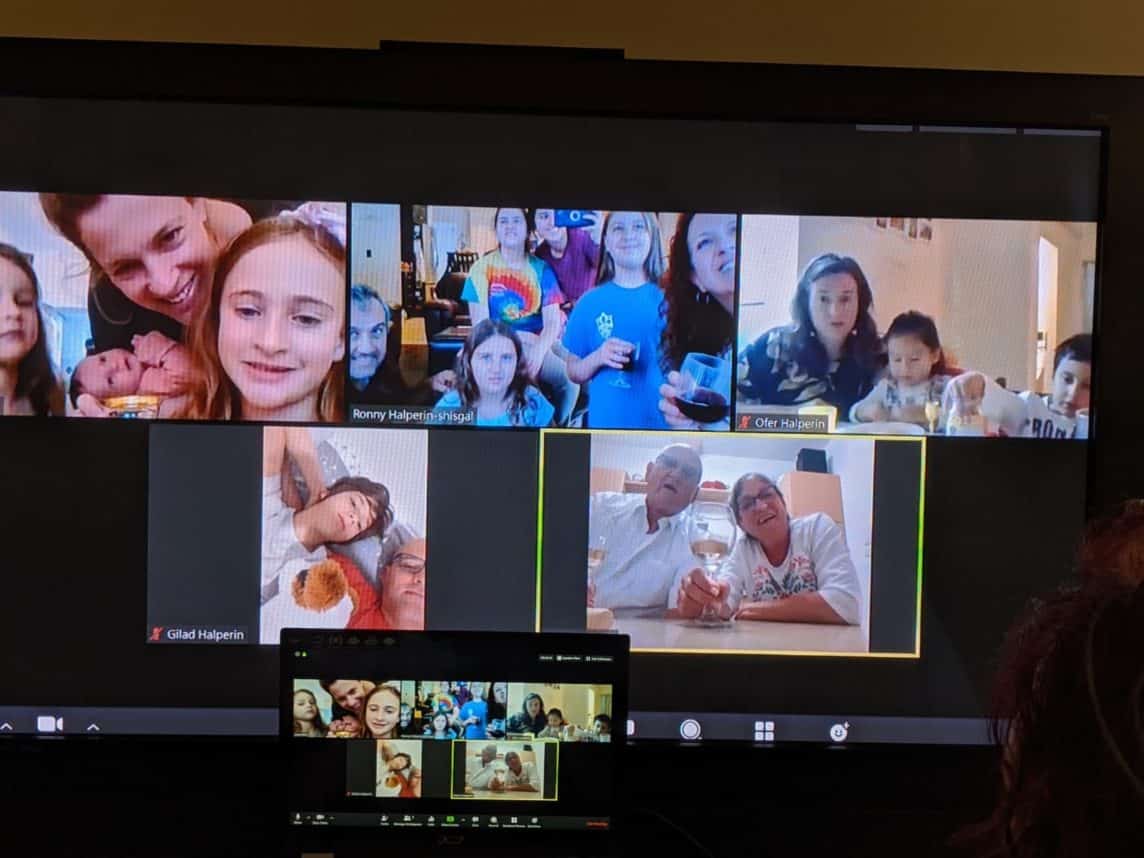
Israeli-American Council Hosts Digital Seders for 2,000 People

With the ongoing spread of COVID-19 and mandatory “Safer at Home” initiatives, many Jews around the globe found themselves isolated for Passover this year.

The Israeli-American Council (IAC) wanted to ensure that every Jew who chose to have a seder didn’t have to do it alone and organized digital seders for more than 2,000 participants.

“We wanted to make sure that those who are unaccustomed to celebrating Passover alone, or have never had a Seder before, had the option to celebrate together with the rest of the Jewish community, at a time when Jewish unity and togetherness is so important,” IAC co-founder and CEO Shoham Nicolet said. “It seems like every day is like a year. We are doing things we couldn’t do a month ago. We couldn’t reconnect people from coast to coast to celebrate together. Now, the sky’s the limit.”

Las Vegas resident Liad Nemeth and her family attended several virtual seders with the help of IAC so she could celebrate with her family in Israel and with friends in Las Vegas. She told the Journal that if it weren’t for the IAC, she wouldn’t have had a seder.

“We almost always get invited to Passover, it’s never a holiday I host,” Nemeth said. “It was weird for me…All my family is in Israel. We are usually 28 people. It’s different. Because everybody was doing it, it didn’t feel awkward to do it. It’s the new way to do it this year. It felt comfortable.”

Nemeth noted how special it was to have her two kids, 17 and 20 years old, participate in the multi-seders to set an example for the younger members tuning in for the streaming service.

“I know my kids are older but for the smaller kids [it’s important] to continue seeing that no matter what’s going on, the show must go on,” Nemeth said. “We still have to celebrate. It’s important because we live here, outside of Israel. We need to keep our traditions… Otherwise, it is just another day.”

The digital seders are part of the new IAC@Home initiative, which was created to give Israeli-Americans and the American Jewish community virtual activities to enrich Jewish and Israeli life amid the coronavirus pandemic. Participants could choose to join one of the many existing seders taking place virtually, or create one themselves using a resource kit provided by the IAC.

Photo courtesy of IAC

Those who opted to host were given a tip booklet for hosting; a link to a haggadah; directions to open a Zoom meeting and managing guidelines; a Passover activities booklet for kids; and an invitation to join a virtual meeting for seder leaders for more guidance.

IAC has also offered free online educational experiences to children, teenagers, college students, young professionals, young families, schools and adults. More than 100 programs offer community-wide virtual events like Kabbalat Shabbat services, classed on Jewish heritage and the Hebrew language, innovation, entrepreneurship and activism.

Roxanne Mofaz lives in New York City and took full advantage of IAC’s online programming. She participated in Kabbalat Shabbat services with her three young daughters and hosted a Passover seder using IAC’s kit. She virtually welcomed 10 families to her Zoom seder.

Photo courtesy of IAC

“It was an amazing experience,” Mofaz said. “It’s so wonderful that IAC created an opportunity for people not to feel lonely. The way that I look at it, it is such a mitzvah. Many of the people that participated in the virtual seder wouldn’t be able to celebrate otherwise. It was really meaningful.”

“Some participants were older people who were afraid to leave their homes. For them, it was the first time after weeks that they felt the urge to really enjoy the holiday,” Mofaz added. “It gave them a feeling of belonging. I am so grateful for that. We were able to be with other Jewish people and enjoy the chag. It wasn’t just hosting it was making the community bigger.”

Israeli-American Council Hosts Digital Seders for 2,000 People Read More »

How Did Virtual Seders Really Go?

On April 12, Journal contributor Esther Kustanowitz co-hosted a mid-morning group of more than 50 people via Zoom for a virtual Passover seder. She said they were welcome to substitute  mimosas for their four glasses of wine.

Kustanowitz was setting the tone for a lighthearted, yet substantive, virtual seder, organized by Haggadot.com.

Others who led the seder included Rebecca Missel of Custom and Craft Jewish Rituals, who shared a meditation for the fourth cup of wine; Rabbi Adrienne Rubin, an opera singer who sang Eliyahu Hanavi; and Deanna Neil, who played a four-string guitar and sang Debbie Friedman’s version of misheberach (a prayer for healing).

Poet Rachel Kann led attendees in a breathing exercise before she recited a poem she wrote as an alternative take on “Dayenu.”

It was just one of dozens of virtual seders held by synagogues and various organizations at a time when physical distancing prevented people from gathering in person with their loved ones.

On the first night of the holiday, rabbinical student Jonah Sanderson and his parents connected via Zoom from their home in Encino to his sister in Denver. Sanderson made a brisket and the family read from Passover prayers provided online by Nashuva Rabbi Naomi Levy, including prayers to be read during a pandemic. Sanderson said they read one for the
first responders and that his family had a discussion about how everyone in their family was affected differently by the coronavirus.

Archie Gottesman, co-founder of JewBelong, which provides educational resources for Jewish people of all backgrounds, held a virtual seder on April 9 that garnered more than 5,000 views on YouTube. “The virtual seder was Plan B, but it turned out to be a great Plan A, because we touched more people than maybe we would have,” Gottesman said.

At the conclusion of the Haggadot.com seder, instead of saying the traditional “Next year in Jerusalem,” Kustanowitz asked people to fill in a word in lieu of Jerusalem, asking participants to type the word into the chat window.

The first response read: “Next year in person.”

How Did Virtual Seders Really Go? Read More »

Israeli Consulate in L.A. Posts Billboards Expressing Israel-U.S. Solidarity

Showing solidarity with Israel during the coronavirus pandemic, the Consulate General of Israel in Los Angeles has placed two billboards on opposite sides of the I-10 Freeway in Baldwin Park in the San Gabriel Valley.

The billboards went on display April 2. One of them depicts a health care worker in medical scrubs and reads, “Thank you. Israel Salutes All First Responders.”

The other shows a boy and girl standing side-by-side, one draped in the Israeli flag, the other in a U.S. flag, and reads, “We Stand Together During these Challenging Times,” and “Israel stands together with the United States as we fight this global pandemic.”

Consul General of Israel in Los Angeles Hillel Newman said in a statement, “It is important to demonstrate how grateful we are to everyone working tirelessly to try and keep us safe and care for those who are ill. We hope that these billboards reflect our sincerest thanks.”

Newman told the Journal the billboards will remain on display for at least a month. “We might prolong [them],” he said, depending on the budget. He added that while nonessential businesses have closed because of the coronavirus, diplomatic missions have been exempted from the emergency order.

As a precaution, the consulate’s staff of more than 40 has been split into two shifts, alternating days to head into the consulate’s West L.A. office. That way, “If someone falls sick, [he or she] doesn’t neutralize the entire staff,” Newman said.

Newman likened his staff to the Israel Philharmonic Orchestra, which recently released a video of its members performing remotely from different locations. “I feel like in many ways that is how we are here,” he said. “In the orchestra, everyone is doing their thing — some are at work, some are at home — but they make things move and come out with a harmonious melody.”

The consulate continues to provide services and organize online gatherings and webinars through its recently launched digital series, Israel Connect.

It also has helped Israel acquire emergency equipment, including protective gear, raw materials for the production of drugs and swabs for testing kits, from California companies.

In addition, the consulate has been contacting Jewish communities to make sure they are safe and secure. “People think the consul is sitting idle because we don’t have events or one-on-one-meetings, but we have been very busy with alternative missions,” Newman said. “In many ways we have been more busy than during usual times.”

Touting how, “Israel has one of the lowest mortality rates in the world,” among countries with confirmed cases of the coronavirus, Newman said Israel is accustomed to facing hardships, whether it’s rockets from Gaza or violence in the Middle East. Israelis understand how “life can change in the blink of an eye, that life is fluid and fragile,” and are coming together appropriately, he said.

Israeli Consulate in L.A. Posts Billboards Expressing Israel-U.S. Solidarity Read More »

Polish Leaders Block Resolution That Would Have Stopped Restitution of Property Lost During the Holocaust

(JTA) — Poland’s ruling party took a stand on Wednesday against a far-right push to stop the restitution of property owned by Jews and others before the Holocaust.

Far-right activists had gathered enough signatures to present a draft resolution to the Sejm, the lower house of Polish parliament, that would prohibit the redistribution of “heirless property”— property that belonged to private individuals, many of them Jews, who were killed in the Holocaust and whose heirs, if they exist, never filed for restitution.

“It is forbidden to take any actions aimed at satisfying claims regarding heirless property, including negotiations, entering into settlements, recognizing claims and actions relating to heirless property, consenting to mediation, directing parties to mediation or payment of cash benefits,” the draft states. It also states that Nazi Germany, not Poland, is responsible for what happened in Poland when it was occupied by Germany.

Speaking for the right-wing ruling Law and Justice party, lawmaker Arkadiusz Mularczyk said the draft resolution was unnecessary, as “the problem of landless land in Poland does not really exist.”

Maciej Konieczny, a lawmaker for Left Together, called the draft anti-Semitic, adding it was “a scare campaign about Jews who are supposedly going to rob Poland.”

Why it matters: The draft underlined the significance that many from the Polish right-wing, including members of Law and Justice’s base, attach to resisting restitution.

Law and Justice has faced harsh condemnations by Israel, the United States and international Jewish groups over its passing in 2018 of a law that makes it illegal to blame Poland for Nazi crimes.

Reports in Poland about the draft’s reading did not indicate whether Wednesday’s resolution was brought up for a vote. But without Law and Justice’s support, the draft cannot pass.

The background: The draft is the latest development in a campaign designed to resist growing pressures on Poland to offer compensation for property lost during the Holocaust. The far-right petition garnered 200,000 signatures.

The campaign is in part a response to the U.S. Congress’ Justice for Uncompensated Survivors Today act, or JUST, passed in 2018. Also known as Law 447, it is a push to ensure that people who survived World War II or their heirs receive compensation for their losses.

The law requires countries holding Holocaust-era property to ensure “the return to the rightful owner of any property, including religious or communal property, that was wrongfully seized or transferred.”

Poland has given millions back in compensation for property that was owned by Jewish communities, but it is the only major country in the former Soviet bloc that has taken no action to return private property, according to the World Jewish Restitution Organization.

Polish Leaders Block Resolution That Would Have Stopped Restitution of Property Lost During the Holocaust Read More »

Jews Rethink Yizkor Remembrance Services in a Time of Virtual Gathering

For many Jews who have lost loved ones, the Yizkor (Remembrance) service is an emotional time, providing a space for grief within the joyous celebration of certain big Jewish holidays.

Originally, Yizkor was said only on Yom Kippur, but over the years, additional Yizkor services were added as incentives for bringing more people to the sanctuary — leading to greater community connection and, some hope, for additional donations in memory of lost loved ones.

This year, as many communities in Los Angeles and worldwide use technology to gather, Yizkor — recited in most synagogues on the last day of Passover — also is migrating to the virtual space. For some communities, it’s a continuation of previous in-person traditions, altered to fit a Zoom screen. For others, the opportunity/challenge of using technology in some way has prompted a significant rethinking of this ritual built around gathering and memory.

At Temple Emanuel of Beverly Hills, the plan was to do a virtual healing service that also includes the temple’s more traditional Yizkor service components, Rabbi Jonathan Aaron told the Journal.

“Instead of a typical service to end Passover, we are offering a healing service”—with poetry, prayer and meditation — “for those who are ill, caregivers and family or friends who are tending to the sick,” he said. The service contains excerpts from classical Jewish texts including Psalms and the Zohar, modern thinkers such as Abraham Joshua Heschel and others, as well as some original readings Aaron penned.

After a Yizkor sermon, Aaron said, there would be “a short service to remember all those who have died since Yom Kippur and those family members who have passed away in years past.”

Temple Israel of Hollywood (TIOH) already had a tradition of switching off hosting duties for Yizkor services for Passover, Shavuot and Sukkot with Congregation Kol Ami, Rabbi Michelle Missaghieh told the Journal.

“Due to the stay-at-home ordinance, we are continuing to share this honor [over Zoom],” Missaghieh said. She will lead a Zoom Yizkor on April 15 at 9 a.m.; on Shavuot, Rabbi Denise Eger of Congregation Kol Ami will lead a Zoom Yizkor.  “Such is the new world,” Missaghieh said.

“Yizkor is our ritual way of connecting with our loved ones beyond time and physical limits. How appropriate and necessary this ritual is in our current reality … grounding us in the past and guiding us in the present.” — Rabbanit Alissa Thomas Newborn

When the coronavirus first hit, IKAR already had started in-person grief circles co-led by members Dr. Barry Goldstein − a psychologist, mediator and coach − and Rabbi Barbara Zacky, who specializes in pastoral and spiritual care, IKAR Associate Rabbi Ronit Tsadok told the Journal. One of these groups will meet before Yizkor services via Zoom, in addition to having a separate Yizkor service that day.

Wilshire Boulevard Temple is planning a livestream with a rabbi and cantor, Rabbi Joel Nickerson told the Journal, and “trying to incorporate some voices from the community into the Yizkor service to try to provide that online space for some semblance of the [traditional] Yizkor experience.”

“In this new era, we have to be very open-minded about using technology,” said Rabbi Noah Farkas of Valley Beth Shalom, where they are using Zoom and broadcasting their Yizkor service to YouTube and Facebook Live. They also uploaded their Yizkor book and Scroll of Remembrance. They will use Zoom and its chat function “like a yahrzeit wall,” Farkas said, “using screen share for our prayers.” They also will have a conference line to make the experience accessible for those without internet. Farkas said the synagogue also is considering reading the names of those in their community who have died of COVID-19.

While the Orthodox community overall still doesn’t use technology on Shabbat and holidays, at least one modern Orthodox synagogue, B’nai David-Judea (BDJ), held its Yizkor service on Monday so it could use technology and not violate traditional Orthodox observance.

“We have never done Yizkor on chol hamoed before,” said BDJ’s Rabbanit Alissa Thomas Newborn. “We are doing Yizkor on a non-Yom Tov day so we can experience this important ritual as a community. But that is a product of the need to use technology, which we cannot do on Yom Tov. This is new because of the circumstances.”

Josh Sharfman, a BDJ member who created the Virtual Cantor website, led the service. Thomas Newborn also explained the recitation of Yizkor does not require a minyan, according to Orthodox Jewish law; only the Kaddish does, so “saying [Yizkor] in private”  − on the last day of Passover when it would have ordinarily been recited at the synagogue – “is certainly permissible.”

“When connection in the flesh is elusive, it becomes all the more important to connect with the spirit,” Thomas Newborn said. “Yizkor is our ritual way of connecting with our loved ones beyond time and physical limits. How appropriate and necessary this ritual is in our current reality … grounding us in the past and guiding us in the present.”

“In this time of social isolation, I am constantly thinking of our active adults who have lost their partners, friends, even children, and want to remember their loved ones,” Farkas said. “Many are truly isolated now, not being allowed to even leave their rooms or apartments out of lethal fear. They need Yizkor now more than ever to connect them to their community and, in memory, to their family.”

Correction: This article has been updated to reflect that IKAR’s grief group met via Zoom prior to Yizkor services. 

Jews Rethink Yizkor Remembrance Services in a Time of Virtual Gathering Read More »

Nowhere to Run

NOWHERE TO RUN TO,
but inside our own feelings.
Nowhere to turn to,
except into ourselves
where we see the thin line
between life and death.

In the lonely fight
between faith and plague despair,
each one of us turns to somewhere
to find a ray of light.

Those of us who learned to pray late
or don’t even know the meaning of prayer
crave to wake up soon from the nightmare
that only started and seems to have no end.

We are new to this level of anguish.

No generation spared.

We read the history books
and believed that we were immune,
that science always had the cure.

We make jokes about it,
because we know we will shed tears;
those of us who are left to find a path
to a redemption that’s nowhere near.

It is not in our hands, so we move,
try to help, reach out, do what we forgot
to do along the way. We prepare for
the unspeakable that will come.

We find solace in human kindness.

We express love that we forgot to tell
with words, through deeds that
give us meaning.

Sometimes we pray because there
is nowhere else to go.

Nowhere to Run Read More »

An Inside Look At Growing Up On A Kibbutz In Israel’s Early Days

Imagine a little girl who has just finished third grade, “barely over four feet high and sixty pounds,” charged with the job of tending a herd of dairy cows, “each nearly twice my height and weighing around 1,500 pounds.”

The scene, as richly evoked by Rachel Biale in her enchanting and compelling memoir, “Growing Up Below Sea Level: A Kibbutz Childhood” (Mandel Vilar Press), is emblematic of its place and time: the State of Israel in the 1950s, a country facing weighty challenges in its early years of sovereignty. That’s exactly why Biale’s book is not only a work of history and autobiography, but also a lens through which to view how profoundly Israel has changed since then.

Today, Biale is a social worker and community organizer in the Bay Area and a parenting counselor. She is the author of “Women and Jewish Law” and the forthcoming “What Now? 2-Minute Tips for Solving Common Parenting Challenges.” She also is a calligrapher and illuminator of ketubot. But the best way to understand the accomplished Jewish woman she became in adult life is to glance back at her childhood on a kibbutz on a site overlooking the Jordan River, some 238 meters below sea level.

Kibbutz Kfat Ruppin, as Biale explains, was founded in 1938 by Jews who had escaped from Germany, and included others who fled Czechoslovakia after German occupation. They were committed to rebuilding not only the Jewish homeland but the Jewish people, which explains why they were willing to let even the littlest ones live away from them in the “children’s house” and march off to work in the fields on summer mornings without parental supervision.

“Utopian dreams, leavened with not-so-subtle ideological coercion, made it possible for our parents to raise us this way,” Biale writes. “Boosting our own ideological fervor was the admiring gaze of a whole country. Up until the late sixties, Israel held up the kibbutz movement as the pinnacle of its achievements. …  We, kibbutzniks, had not just seen, but we had built and inhabited, the Promised Land.”

Her story begins with the escape of her mother and father from Europe. Remarkably, Biale’s father, Kurt Tramer, was interviewed by Adolf Eichmann himself when he applied for a coveted place aboard the river boats permitted to carry Jews from Czechoslovakia in the direction of Palestine, where the Nazis hoped “Jewish emigration would stir up trouble for the British.” Eichmann asked Tramer what he intended to be in Palestine. “A farmer,” he answered. Eichmann demanded to see his hands. “Those aren’t the hands of a farmer,” Eichmann said. “A farmer, you’re sure?” Tramer said yes. “Your problem,” said Eichmann, who stamped the application.

Biale is a gifted storyteller, and each episode in “Growing Up Below Sea Level” carries its own poignant charm. But she also is a documentarian, sharing snapshots, letters, diary entries, maps and drawings created by those who made the fateful journey from Nazi-occupied Europe to Palestine. Her mother’s journal, for example, is firsthand testimony about the sinking of the Patria, one of the ships carrying illegal immigrants to refuge in Palestine. The explosion that sank the Patria in the Haifa harbor was suspected to be an act of Arab terrorism, but Biale reminds us that the Haganah sank the ship because the British intended to send the ship and its passengers to their intended place of deportation to the island of Mauritius in the Indian Ocean.

Rachel Biale’s book is not only a work of history and autobiography, but also a lens through which to view how profoundly Israel has changed.

Biale’s mother, Anina Vohryzek, and father eventually reunited in Palestine. Kurt had served in the British army during the war and when Anina saw him in uniform, she “fell in love with him on the spot, with such intensity that I can feel that moment today,” as Anina wrote in her own memoir. They settled in Kfar Ruppin, and it was there that Biale was born in 1952. Looking back on her first memory —  climbing a jungle gym with no adults to come to her rescue if needed — she measures how much she has changed since then. “As an adult, I’m petrified — in hindsight,” she writes. “As a child, what I remember mostly is feeling free and bold.”

The same narrative technique — a flashback and a flash forward — enables readers to see how childhood shines a light on adulthood. She describes a youngster on the kibbutz who wet his bed and how she and her friends would rush to strip his bed and provide him with fresh pajamas. Then she reports on an encounter with the same young man years later, when he had started basic training in an elite combat unit. “The first night on the base,” he said with a reddening face. “I could have used you and the others from our kindergarten room.”

Biale enables us to see familiar facts through the eyes of an Israeli child. Until she was 9 years old, for example, “we were shielded from any actual information” about the Holocaust. But the broadcast of the Eichmann trial exposed her to the atrocities that “leapt across time and space and stung me with the ferocity of a thousand bees.” Suddenly, she understood why one of the women in the kibbutz had remarkably small feet and never went barefoot. “A Hungarian Jew, she survived Auschwitz and was herded onto the death march as the Red Army neared the death camp in January 1945,” Biale explains. “Esther had no shoes. She made it through alive, but not her toes.”

The commitment to pioneering the Jewish state was understood to be a fulfillment of Jewish identity in Kfar Ruppin. Although seventh-graders participated in bar and bat mitzvah ceremonies, “we did not go near a Torah; we memorized no prayers and learned no Torah-chanting trope.” Instead, each child was required to complete 12 tasks, selected from a list of 20 options that “represented entry into adult responsibilities expected on a kibbutz.” Working an eight-hour day was one choice; “taking on a dusk-to-dawn guard duty with the night watchmen” was another. Among the tasks Rachel chose was “[s]pending Shabbat at a religious kibbutz,” where she found herself “marooned until I could see three stars the next evening.”

“Growing Up Below Sea Level” is frequently illuminated by flashes of irony, which infuse the author’s reminiscences with both wit and meaning. During Biale’s service in the Israel Defense Forces, she commanded a unit of 20 female soldiers, and one of her duties was to inspect their rifles to make sure no sand had accumulated in the barrels. “Other than sand traps, those rifles really had no function,” she recalls. “They were old Czech-produced guns, which had been essential for Israel’s survival in the War of Independence in 1948. Now they were used for training, military parades, and arming female soldiers.” She does not need to say out loud that those old Czech rifles carried other and much deeper meanings for the daughter of Jewish refugees from Czechoslovakia.

Sometimes, the moments of irony are even more pointed, and they prompt us to think deeply about not only the origins but the destiny of the Jewish homeland. For example, after the Six-Day War, Biale’s father was invited to participate in a UNESCO project in Boston. Before leaving for America, the whole family joined the crowds trudging into the Old City see what then was still called the Wailing Wall. Biale suggested they postpone the visit until they returned from America, when the crowds surely would be thinner. “By the time we come back,” said her mother, “it will have been returned to Jordan as part of the peace deal. And then it will be much harder to visit.” Biale replied, “Of course. What was I thinking?”


Jonathan Kirsch, author and publishing attorney, is the book editor of the Jewish Journal.

An Inside Look At Growing Up On A Kibbutz In Israel’s Early Days Read More »

When the River Was Filled With Frogs

When the river ran red, our mother clutched her hand to her heart and forbade us from looking in the direction of its bloodied banks. We went anyway, of course, my older brother and I and some other boys. It smelled of baked dirt and it stained our hands. The fish swam close to the surface, tanning their bellies in the sun with their lips parted. At least, this is what I thought. My brother corrected me. “They’re dead,” he said. He knew about such things.

During that season of plagues, my brother and I adapted quickly to the new nature of things. It was harder for the grown-ups. They convened to discuss and to assign fault, blaming the king or the gods or the slaves. They were always talking about kings and gods and slaves.

Our mother calmed down when the river began to flush out and resemble muddy water, but it wasn’t long until another plague came upon the land.

We heard them before we saw them, awakening one night to their choral croaking.

They infested our father’s vegetable stall in the bazaar and hopped in the dark corners of our home. We found them boiling in the pots and injuriously stepped on them when walking in the dark.

This plague of frogs played on the squeamishness and irritability of the grown-ups, but to us children, it posed more opportunities than problems. When school was out, we would run to the river to swim with the frogs, paddling with them on our heads or floating on our backs with one resting on our bellies. We loved their nonchalance and their seeming willingness to be handled or experimented upon.

My brother, older than me by three years, endeavored to play the expert. “You see,” he said, “they are a close relative of mankind. Note that they have, as we do, two eyes and two nostrils, as well as fingers and toes. Very likely they are the descendants of a human who was cursed by the gods to live in the water.”

Our mother was less amused. There was a new baby in the house and she feared for him during those days of uncertainty.

Consumed in their concerns, neither of our parents noticed when my brother built an aquarium in the shady spot behind our house. He took a crate and sealed its cracks with leaves, which were pasted on with an adhesive made from mashed up dates and sap. We filled it with water and stones and algae and poured in a jar of tadpoles skimmed from the Nile’s surface.

During that season of plagues, my brother and I adapted quickly to the new nature of things. It was harder for the grown-ups. They convened to discuss and to assign fault, blaming the king or the gods or the slaves.

My brother stole writing utensils from the schoolmaster, who, like our parents, was too deep in some great national drama to be bothered by our exploits. We used these utensils to make notes and illustrations of the frogs’ life stages.

“The tadpole first hatches from an egg, and then slowly grows limbs and becomes a frog,” my brother said. “Humans pass through the same stages inside the womb.”

I asked him what this meant and he told me how we all start out as little fish that hatch from tiny, translucent pearls. Slowly we grow hands and feet. Just before birth our tails fall off.

With an air of wisdom, he told me that sometimes a person’s tail doesn’t fall off. “These people are sent to work for the king because they are unable to find wives in normal society,” he expounded. “In the palace, they are given positions of honor because their form is so unique.”

By the time our tadpoles were fully grown, other plagues started to roll across our land, one after the other. Many of these blights affected the food supply, and so our father encouraged us to hunt frogs, which were still in abundance.

In the evening, we would go out to the river as the sun set. The frogs would be singing their strange songs and licking flies out of the air. We’d take a quick swim and enjoy the cool bite of the water before nabbing some frogs and running home with them. I actually liked the feeling of the frog’s skin when it was cooked, no longer slimy but dry and brittle and warm.

Our mother barely touched hers, but rather attended to the baby, who cried throughout the day and night. Red faced and screaming, we feared the baby wasn’t faring well and that he wouldn’t make it. Our mother prayed to God for relief, but we didn’t know which god she was praying to. Back then, the air was thick with gods.

To escape the sound of the crying, my brother and I would run from the house to the river, sometimes staying out until blue dusk illuminated where we sat upon the bank. But one day, our father told us not to go out anymore. When we asked why, he was silent and we knew that it had to do with whatever was going on out there with the kings or the gods or the slaves.

When the great darkness came and there wasn’t even a moon in the sky, we were forbidden to leave the house. Although it was only a couple of days, it felt like a very long time that the world was like that, smooth and black and stuffy and hot. When the light of day returned, we were still forbidden to go outside. Our father said that the worst was yet to come, although he didn’t say what this might be. We drew the blinds and stayed in the darkness a little longer.

The restless days that ensued were a blur of stillness and darkness, when suddenly, in the middle of the night, I was roused from light sleep by the sudden cessation of sound. The baby had stopped crying. The house was flooded with a quiet like I had never experienced. It was a menacing silence — unnatural in its origins and bitter to the ears. Another plague.

I felt my brother beside me in our bed as hot as fire in the sheets. I wiped the sweat from his brow and clutched his hand.

The next morning, the light of dawn came on casually. The sound of birds could be heard. Whatever had come upon our home had moved on. My brother lay beside me, pale and cold and iridescent with little beads of moisture. I stifled my cries but heard wails of anguish from other homes.

We buried him in the ground behind our house and that was the end of the story. Our land and our people recovered. I returned to the schoolhouse, where I was taught how the events of my year were part of a larger story about slaves demanding freedom and peoples striving with one another.

I grew up, eventually taking over my father’s work at the bazaar along with my younger brother.

My mother, to this day, cannot look upon the Nile without seeing it red with blood. Similarly, I cannot look upon it without seeing it full of frogs, and when I do see it, I shiver remembering the smallness of the world then and the strangeness of childhood, when I was allowed briefly to believe that my tragedies and joys were mine alone.


Matthew Schultz is a writer living and working in Tel Aviv.

When the River Was Filled With Frogs Read More »

Can One Laugh During Pandemic Times?

By now, many of us have seen the 90-second viral video in which Israeli mom and special education teacher Shiri Kenigsberg Levi rants about the difficulty of suddenly having to home-school her children while the country is on lockdown. “I go from one child to the other — here’s science, here’s math — how am I supposed to know all of those things?” Levi says in the video. “Now our children will find out how dumb we are. It’s not right, really!”

It’s not really meant to be a comedic bit. It’s a mother letting off steam, and her stress and frustration are very real. But her delivery is hilarious and given that the video has been shared and translated all over the world and even posted to many celebrities’ personal Instagram and Facebook pages, it’s safe to say most of us can agree on this. But the question is: Why is it so funny? Why has it struck such a comedic nerve in so many people? She’s clearly upset. Like many of us, she’s had it with the stress of this new predicament of being forced to work from home while helping to facilitate her children’s new world of distance learning.

“I go from one child to the other — here’s science, here’s math — how am I supposed to know all of those things?” Levi says in the video. “Now our children will find out how dumb we are. It’s not right, really!”

Although anything that’s humorous typically has multiple layers that determine exactly why it’s funny, Levi’s rant exposes the ridiculous nature of some of the expectations parents all over the world have set for themselves when it comes to temporarily home-schooling their children. Most of us have other jobs and are trying to perform those duties from home while simultaneously helping our children learn at home. My son’s school and teachers in particular have done an incredible job at quickly and efficiently transforming the school into a distance-learning program extraordinaire. But regardless of how great a job any school does at making this transition, it’s not going to transform parents into award-winning educators.

Yet, so many of us have placed these expectations on ourselves — in many cases, unknowingly.

One of the funniest parts of the Levi video is her assessment of the music portion of her child’s distance learning. “The music teacher of my youngest sent over a musical score this morning. What am I going to do with that information?” she says in the video. “What, do I have some kind of band in the house? I can’t read music! Just one second, let me pull out my clarinet and help my son with his score.”

I may have laughed myself to tears at that one. The idea that a parent suddenly can  become a professional math, science, literature and music teacher is laughable. Levi reminds us of this. So when we laugh at her, we are laughing at ourselves — at our ridiculously high expectations of ourselves. But we also are laughing out of relief because we suddenly understand we aren’t meant to get all of it right. We’re only meant to try, to do what we can.

We are only human, after all.

Levi’s video is just one of countless videos and memes that have circulated widely in the past six to eight weeks. It seems we want, or need, to laugh now more than ever. This isn’t to say there aren’t also competing needs for tears or expressions of anxiety. However, it’s undeniable that laughter may be our dominant mode of expression in a time defined largely by self-quarantine and perpetual fear of the looming COVID-19.

However, it’s undeniable that laughter may be our dominant mode of expression in a time defined largely by self-quarantine and perpetual fear of the looming COVID-19.

Like it or not, we all are inhabiting a moment of uncertainty. It’s an uncertainty haunted and shaped — ironically — by one enormous universal certainty: death. Times like this remind us we are human and that we all move — no matter how rich or poor, how young or old — slowly and assuredly toward the one thing of which we can all be certain.

We will all die.

But there’s something especially jarring about a pandemic that forces us into our homes and makes us fearful of venturing out into the world and being close to others. It’s as if we forgot we were all, always and already, creeping slowly toward death.

And although most of us hope beyond all hope that the tide will soon turn, that a glimmer of light will appear out of nowhere to assure us all will be well, the truth is that hope is just that: hope. It isn’t certainty or clarity. It’s the desire for those things, an expression of the belief that they will be ours. But hope doesn’t provide certainty. And if hope — our only hope — is a failure before it has even begun, then where do we go next? How do we find relief or reprieve?

Numbers and statistics provide hard, fast data, facts in numerical costumes. From global medical experts and politicians to local grocers and restaurant owners who quickly have transformed their restaurants into take-out and small grocery services, everyone is crunching the numbers these days, turning and turning them as if they are the most ancient learned scholars spinning a talmudic injunction, looking for hard data that will put wings to our hope. Numbers don’t lie, we tell ourselves.

Except that sometimes, they do.

Numbers lie when they don’t tell the whole story, when they are extracted from the necessary context of the many private worlds populated by those people who make up the numbers. Positive, recovering, critically ill, dead: The numbers reflecting these statistics change and grow each day. We watch news footage of the stacked coffins in Italy. I, myself, check the Italian death and new cases counts each morning, telling myself this will give me certainty, that it will show me what to expect here in the U.S. in the coming weeks. Just the other day, as I watched Italian news footage, I caught myself absentmindedly trying to count the coffins in the background, as if the numbers would tell me something crucial, or somehow order the chaos in a way that is more palatable. There’s certainty in numbers, after all.

Except that there’s not.

I’ve often written about the role of artists, writers and filmmakers in our culture. There is a sense in which they have become the clerics and rabbis of our time. A good book, film or television show can teach us how to grapple with some of the most philosophically perplexing issues of our time. Of course, this isn’t to say the voices of authentic religious leaders no longer are necessary, but rather, there is room in this space of global uncertainty for many more voices.

We need them all.

Artists give us as much certainty as we can expect in times like this. Most importantly, they remind us that we are human, and that although the external world around us may feel like it’s crumbling and changing at breakneck speed, closing in around us in ways that threaten to stifle and strangle, our inner worlds remain intact and need to be nourished. The ideas and stories and emotions that we love and believe in need not be suppressed by fear and uncertainty as many of us feel as if we are being held hostage in our own homes. This is a time when we can draw not just on the words of faith leaders, but also on what artists of all kinds can offer us.

In moments like these, moments of extreme and crippling uncertainty, I reach for artists who make me laugh. For obvious reasons, a lot of people have begun reading or re-reading Albert Camus’ “The Plague” (1947) over the past couple of months. It’s a dark reflection on the human condition in the context of a plague that sweeps the French Algerian city of Oran. I usually prefer stories like this, stories that dive unabashedly into the darkness and face it. But not this time. This time, I want something different. I want to feel my humanity most profoundly. I want to laugh.

I want to laugh and laugh and laugh.

It’s not that I want to escape. Quite the contrary, actually. It’s that I want to be borne into the eye of this hurricane. I want to know what it’s like to experience all the emotions at once in a way that doesn’t chip away at my sense of hope. I want to laugh. I want to sit in the eye of the storm, where it’s oddly still, and I want to laugh. I want to laugh not because it takes me away or distracts me, but because it reminds me I am, indeed, human. And humans are resilient. And all will be OK in the end.

In a course I used to teach on the topic of humor and the Holocaust, I would remind students that although animals may experience sadness and joy, they don’t laugh. It’s one thing that sets apart humans from all other living things: We laugh. Perhaps no one knows this better than Jews, who have a long history of using humor to cope with the tragic and unimaginable. Jews know that when your very chances of survival are being challenged, there’s no better time to laugh. But Jews don’t have a monopoly on humor or laughing in the face of tragedy. Sure, we do it well. Really well. But laughter in the face of darkness is not always about escaping.

Although it may begin as a distraction, the end result of laughing — whether at your favorite television show or comic, your good friend’s dark joke or a ridiculous meme or viral video on the internet — is the poignant reminder that we are human and we are alive. It’s about moving from anxious restraint to giddy release. We could all use that.

Whether it’s any one of the many stressed-out parent videos that are circulating, Larry David in “Curb Your Enthusiasm,” your favorite stand-up comics or the ridiculously funny memes that are so pervasive right now, everywhere we look, there is an opportunity to laugh. Maybe your laughter will end in a bout of tears —  and that’s all right, too. Baudelaire famously remarked on laughter and tears being “equally the children of woe.” And although gallows humor — a comedic style that makes light of dark subject matter — may not sit well with everyone, the good news is that there are plenty of things to make us laugh right now, not to help us escape, but to remind us of our humanity.

Find what or who makes you laugh, and settle into it. Let yourself laugh, let yourself be human. Therein lies our greatest hope.


Monica Osborne is a scholar of Jewish literature and culture. She is the author of “The Midrashic Impulse and the Contemporary Literary Response to Trauma.”

Can One Laugh During Pandemic Times? Read More »

Biden Needs The Bernie Bros. Will He Give Them A Say in Policy?

In a flight of fancy and an almost superfluous reminder of his irrelevance, New York Times columnist Thomas Friedman suggested this week that a dream cabinet for Joe Biden should he win in November would include a rather odd choice for ambassador to the United Nations: Rep. Alexandria Ocasio-Cortez (D-N.Y.).

AOC’s lack of foreign-policy knowledge is not the main reason to mock this suggestion. When asked this week whether the camp of the presumptive nominee had reached out to her in the wake of the withdrawal of her choice for president—Sen. Bernie Sanders—from the race, the congresswoman admitted that it hadn’t. And given her continued expressions of disdain for the former vice president, she’d be well-advised not to hold her breath waiting for such a call.

A Democratic victory is going to require the kind of reconciliation between the Biden and Sanders camps that was missing four years ago.

Friedman’s nonsensical column is a reminder that a Democratic victory is going to require the kind of reconciliation between the Biden and Sanders camps that was missing four years ago. In 2016, the Vermont Socialist’s supporters were distinctly unenthusiastic about jumping on the Hillary Clinton bandwagon once Sanders belatedly conceded the Democratic race to her because they thought he had been cheated by the Democratic establishment.

U.S. Rep. Alexandria Ocasio-Cortez (D-NY) speaks during a House Oversight and Reform Committee hearing on “The Trump Administration’s Child Separation Policy: Substantiated Allegations of Mistreatment.” July 12, 2019 in Washington, DC. (Photo by Aurora Samperio/NurPhoto via Getty Images)

It’s assumed by many liberal pundits that the goal of denying re-election to President Donald Trump will be enough to unite all Democrats. While Sanders sent a strong signal to his supporters by not waiting any longer to endorse Biden, some of them aren’t getting the message. The senator’s social-media shock troops—nicknamed the Bernie Bros, which spent much of the last year treating centrists like Biden as apologists for “fascism”—are still expressing anger about the way the rest of the party fell in line following the South Carolina primary in order to stop Sanders.

The senator’s social-media shock troops—nicknamed the Bernie Bros, which spent much of the last year treating centrists like Biden as apologists for “fascism”—are still expressing anger about the way the rest of the party fell in line following the South Carolina primary in order to stop Sanders.

As Clinton proved, Democrats can’t win without the same kind of enthusiastic support and massive turnout of young and minority voters that lifted Obama to victory in 2008 and 2012. They need to reassemble that Obama coalition in which blacks, Hispanics and liberals under the age of 30 unite with working-class white voters to defeat Trump.

It remains to be seen whether or not that will happen. But the aspect of this effort that is of particular interest to pro-Israel activists is what sort of price Biden is going to have to pay to Sanders in terms of policy and appointments.

The pro-Israel camp in the form of the Democratic Majority for Israel group played a not insignificant role in helping to undermine Sanders at a point in the campaign when he was the frontrunner and Biden seemed dead in the water. The result was not just a series of primary victories for the beleaguered Biden, but also for the pro-Israel wing of his party over a Sanders campaign that had been largely taken over by pro-BDS forces and other opponents of the Jewish state.

But the dynamic of the election is such that now, rather than being chased out of the party as some pro-Israel activists would like, AOC—as well as pro-BDS anti-Semites like other fellow “Squad” members Reps. Ilhan Omar (D-Minn.) and Rashida Tlaib (D-Mich.)—are, at least for the next few months, more important than ever.

Biden cannot afford to emulate the way Clinton gave short shrift to Sanders’s supporters once she had secured her party’s nomination. If Biden wins, it will only be with the active support of the hard left and their rock stars, like Omar, Tlaib and AOC.

If Biden wins, it will only be with the active support of the hard left and their rock stars, like Omar, Tlaib and AOC.

In any normal year, the first real test of this proposition would come during the prelude to the Democratic National Convention, when the party platform would be written. In 2016, despite Sanders’s placement of opponents of Israel on the platform committee, Clinton’s camp was able to marginalize them. Nor did Clinton pay them much heed during the course of her complacent and ultimately disastrously inept campaign.

Biden, who has spent the last year trying, with mixed success to be all things to all people, understands that he can’t treat the Israel-haters and anti-Semites on the left with the same disdain as Clinton did. And with normal campaigning on hold and the quadrennial convention coronation unlikely to occur because of the coronavirus pandemic, the Democratic leader will be even more hard-pressed than before to appease Sanders and his leftist allies.

Tradition tells us that Biden will tack to the center during the general election campaign. But anyone who follows the Bernie Bros on Twitter knows that if there is one issue on which they are most vocal, it is in seeking to undermine the U.S.-Israel alliance. An enthusiastic reaffirmation of that alliance is bound to alienate the leftists Biden needs to fire up this fall.

In order to do that, he’s going to have to not just talk about Medicare for all and the expansion of other entitlements, but to make gestures on foreign policy to the Sanders camp. And the most likely sacrifice to be made on the altar of radical support for Biden may be any notion of him reaffirming some of Trump’s pro-Israel gestures on Jerusalem, his Mideast peace plan and his Iran policy.

Vice President Joe Biden visits Israel in March 2016.

It’s going to take a lot of courage on Biden’s part to resist pressure to back away from Israel, especially if Trump ally Prime Minister Benjamin Netanyahu remains in office. While the Democratic establishment would prefer to treat the Sanders camp and its Israel-hating cadres with the same contempt as Clinton, the left may wind up having more influence over Middle East policy than Biden’s centrist donors would like.

While the Democratic establishment would prefer to treat the Sanders camp and its Israel-hating cadres with the same contempt as Clinton, the left may wind up having more influence over Middle East policy than Biden’s centrist donors would like.

While Biden’s main challenge now is running for president while stuck in his basement as the virus rages on, the question is whether he will have to pay for the support of Sanders and his online trolls in ways that may offend pro-Israel Democrats.

Jonathan S. Tobin is editor in chief of JNS—Jewish News Syndicate. Follow him on Twitter at: @jonathans_tobin.

Biden Needs The Bernie Bros. Will He Give Them A Say in Policy? Read More »