fbpx

April 10, 2020

Finding Togetherness

Across the world, we are finding ourselves in a situation, if not unprecedented, then certainly unlike anything most of us have seen in our lifetimes. Grocery stores emptied of canned goods, meats, and toilet paper. No professional or college sports being played. Silent classrooms. Empty freeways in Los Angeles.

In times of emergency, people often come together. When massive wildfires rage, people open their homes to others who have lost theirs. In desperate hurricanes, there have been stories of those with boats rescuing neighbors trapped by the water. Floods of donations, in terms of goods, money, and hands-on help make their way to locales destroyed by tsunamis.

This pandemic is different—we are being forced apart. “Social Distancing” it is called, maintaining, at the very least, six feet of distance between people. Many businesses have asked their employees to work from home. Restaurants are recommended to halve their capacity to help maintain the safe distance. Many are opting to self-quarantine, hunkering down at home for a few weeks to help limit the spread of the virus. The shared activities which bring disparate groups togethers—Disneyland, Broadway, pro and college sports—have all suspended operations or cancelled games.

Some are finding ways to come together in a way that works within the recommended “social distancing.” There are videos from Italy and New York of neighbors singing together from balconies, through windows, from rooftops. Sharing their voices in song to show that they are connected despite the mandate to stay apart. Community classes are being held through Zoom. These are beautiful, and much needed, shows of togetherness in this dreary time. But, are these new bonds strong enough to last past this flu? Or will it be back to politics and arguments as usual once we can return to our regularly scheduled lives. I fear that is the most likely outcome. However, we can make the new bonds last if we take this time to learn to truly empathize with every other human. Learn to love them as we love ourselves.

The social distancing and quarantines seem a reflection of the lives we currently live: everyone is separated into his/her tribe. It’s as though the United States has turned into a massive high school with cliques and gangs. Men vs. women. White vs. black vs. brown. Liberal vs. conservative. Cis vs. trans. Young vs. old. People have split into such tiny, specific groups—when was the last time someone identified himself as simply “American” as opposed to a hyphenate?

It is natural to find companionship amongst those who have similar backgrounds and interests as we. The jocks play and enjoy talking about sports, so they hang out with others who play and enjoy talking about sports. The drama kids find their fellow theater-lovers. Jews moving into a new neighborhood find the synagogue where they will feel at home. Korean immigrants move to neighborhoods where the language and food are familiar. This is the quickest and easiest way to find a community for oneself.

Community can also be found at AA meetings, where each person has struggled with the same negative force. Or in a driver’s education class, each student anxious and excited to get on the road. Community can be found when people of disparate backgrounds are thrown together because of hardship – a trauma support group – or because of celebrations – hugging another fan when your team makes a last second basket to win the game.

In these instances, race, religion, gender, and age do not matter. What matters is a shared humanity. Hoping for a shared outcome or bonding over shared pain. Longing, excitement, sadness, joy, fear, guilt, hope: these are felt by everyone at one time or another.

The problem, then, is not in viewing ourselves as part of a tribe, but in how we view others who are not part of any of our tribes. We see other people as one-dimensional: when we ourselves accidentally cut-off another driver in traffic, it is because we are unfamiliar with the area and did not realize the exit we needed was so close. But if another driver does it to us, the driver is a selfish jerk. We are quicker to forgive ourselves, because we know the entirety of our own thoughts and lives. We do not know the fullness of another person’s life, and therefore act as though it does not exist.

We in the United States, and people throughout much of the world, live in an unprecedented time of freedom, to become a person beyond what one’s race, sex, or birth might otherwise have dictated even just 100 years ago. Certainly, living one’s own life is supported now more than ever. Yet as we hope for acceptance of our own kooky ways from others, we force them into tiny boxes in our heads.

It would be wise to learn from how we now refer to a “person with a disability” instead of a “disabled person.” With the latter, the disability is the fullness of the person. With the former, it is merely an aspect of the person. It might tell us certain things about the person, suggest a different learning style or additional accommodations, but that is it. “Person with disability” gives us not hint as to whether the person is kind, generous, vain, spiteful, annoying, humorous, trustworthy, genuine, sarcastic or anything else. We don’t, with that singular description, know the person’s hopes, struggles, darkest desires, losses, home life, or accomplishments.

We must apply that same idea to the guy who cuts us off in traffic. Maybe he, too, is unfamiliar with the area and got frazzled as he finally found his exit. And, in a much larger scale, we must think this way about other groups. Democrats must know that Republicans are not racist, sexist pigs intent on enslaving everyone different from them, but people who believe that their values and policies are the best way to make the country a land of opportunity and freedom for every single person. Baby Boomers must understand that Millennials, if they are entitled, were raised to be that way; but, more importantly, are hard workers and innovative thinkers. Not every man is a #MeToo situation waiting to happen. Not every Trans person is hellbent on some agenda. Most people want to be left alone to live their lives: find the job they like, create a family, engage in fun activities, and end the day watching Netflix.

We cannot know the fullness of every other person’s life, because that would require us to meet and have long-term friendships with every other being. Even then, it is not possible to know the fulness of another’s person’s life. But, if we can acknowledge that everyone else is three-dimensional, with the same humanity as we, then we can begin to treat each other with compassion. Perhaps, we can treat others the way we would want to be treated, knowing our own humanity. In this way, we can truly find a social “coming together” despite the medically recommended “social distancing.”

Finding Togetherness Read More »
Yad Vashem Premieres Exhibit of Sentimental Items Holocaust Survivors Clung To When Liberated

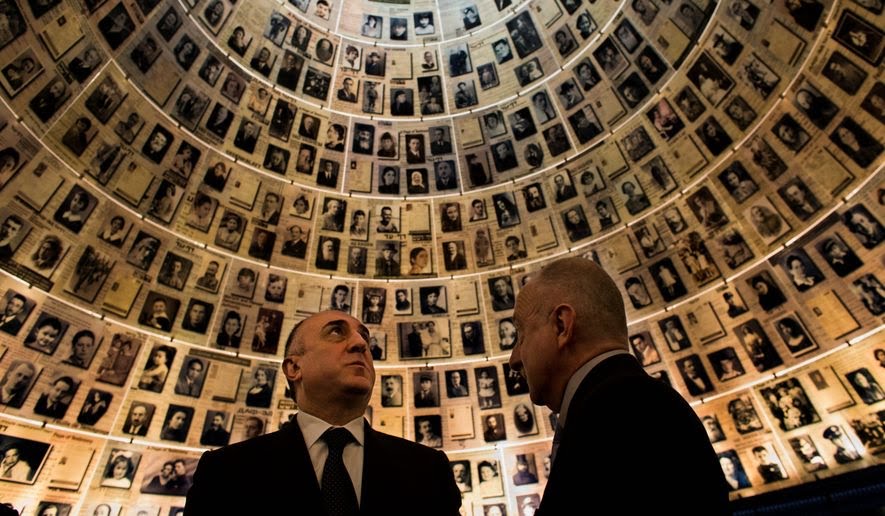
April 11 marks the 75th anniversary when the United States Armed Forces liberated Buchenwald Concentration Camp. Although Nazis attempted to liquidate the camp before the Allied Forces could discover its atrocities, when the 6th Armored Division of the US Army arrived, they found 21,000 people living there. 4,000 of them were imprisoned Jews and 1,000 were children.

To commemorate this historic moment, the Jerusalem World Holocaust Remembrance Center, Yad Vashem, has curated a unique collection of artifacts related to liberation, which are now available online.

“Thousands of Jews liberated from Buchenwald as well as from the other camps during the first half of 1945, found these inmate survivors in the worst physical and emotional condition,” wrote Simmy Allen, the Head of Yad Vashem’s International Media Section in a news update. “Many, in fact, continued to die even after liberation. The survivors had nothing but the rags they were wearing. With liberation also came the realization of the loss of their family and friends.”

For years, Yad Vashem has been collecting personal items of survivors; this collection seeks to provide insight into the phase of rebuilding Holocaust survivors went through after the war ended.

“As some of the survivors began to recuperate physically, they began seeking personal effects such as shirts, shoes and toothbrushes,” wrote Allen, noting how basic items were denied to prisoners on concentration camps. “These items had tremendously sentimental importance to them, not related to their practical purpose. These items signified restored feelings of self-worth and dignity.”

The collection includes sentimental items. Among many artifacts, it features a doll one survivor bought for her daughter after the war to replace the one she had with her in the Budapest ghetto, a sweater a child survivor took from the storehouse in Auschwitz-Birkenau, and a shaving brush American soldiers gifted to a man liberated from Bergen-Belsen.

According to Allen, “with the help of these items, these survivors began to rebuild their lives and leave behind a world in which the Nazis and their collaborators had nearly robbed them of – their humanity –  and reduce them to mere numbers.”

You can view the newly minted exhibit online here.

Yad Vashem Premieres Exhibit of Sentimental Items Holocaust Survivors Clung To When Liberated Read More »

Israeli Sitcom ‘The Baker and the Beauty’ Re-imagined in Miami For ABC

A romantic comedy about the unlikely romance between a working-class baker and a gorgeous supermodel, “The Baker and the Beauty” was a big hit in Israel, where its two seasons aired in 2013-2014 and 2017.

The Keshet Studios production has undergone significant changes in its move to American television while preserving the central idea and tone. Set in Tel Aviv in the original half-hour version with an Ashkenazi-Sephardic love story, it now takes place in Miami in a Cuban-American family’s bakery and will air in hourlong episodes on ABC.

“It’s the same general premise as the Israeli series: falling in love turns your world upside down, with the added element of constantly being followed by paparazzi,” Keshet senior vice president and series executive producer Rachel Kaplan told the Journal. “It is a universal love story about two people getting together, beyond the obstacles. There’s so much potential but constant intervening circumstances — an issue with business, her father, her desire to become an actress or travel that may take her out of town for three months, and on his side, keeping the bakery going while being pulled into her world.”

The romantic fantasy elements are still there, but Daniel, the baker played by Victor Rasuk, “is adorable and approachable, but he’s now more of an everyman” than his Israeli counterpart, Kaplan said. All the characters are Hispanic, albeit of various ancestry. “The minority aspect added to the upstairs/downstairs [aspect] of the relationship. We wanted to make Noa (Nathalie Kelley) Latino also so the aspirational quality of being in a relationship with her had nothing to do with her ethnic background.”

“It’s the same general premise as the Israeli series: falling in love turns your world upside down, with the added element of constantly being followed by paparazzi.” — Rachel Kaplan

The entire cast is Spanish-speaking, including Jewish actor Dan Bucatinsky (“24: Legacy,” “Scandal,” “Web Therapy”), who portrays Noa’s manager. His parents were born in Argentina, his Russian and Polish grandparents having fled to South America from Europe. Fluency came in handy on the set, as the series was filmed in Puerto Rico, standing in for Miami.

“We wanted to shoot something on the beach and have it be sunny and that narrowed the choices down a bit,” Kaplan said, noting that Puerto Rico was chosen “for the tax credit. There isn’t one in Florida.”

“The Baker and the Beauty” isn’t the only project that Keshet hopes to bring to American screens. “Rise and Kill First,” based on Ronen Bergman’s book about the history of the Mossad, is being adapted for HBO. The Israeli miniseries “Stockholm” is being reimagined as a movie, and the hit movie comedy “Tel Aviv on Fire” may be headed for home screens as a series. “All the Rivers,” from Dorit Rabinyan’s novel about a romance between an Israeli woman and a Palestinian man, is in development with Gal Gadot’s production company.

The cast and producers of ABC’s “The Bachelor” join the press for a cocktail hour on Wednesday, January 8, as part of the ABC Winter TCA 2020, at The Langham Huntington Hotel in Pasadena, CA. (ABC/John Salangsang)

Kaplan, who is of Russian Jewish heritage and visits Israel several times a year, explained why it has become a great source of entertainment properties ripe for remake. “It’s a small country that’s very close to ours politically and socially,” she said. “[Israelis] have a lot of the same ideologies. They laugh at the same jokes. They don’t get to make a lot of shows — there are four networks in Israel. But what they do get to make is incredibly refined and cultivated and beautifully done. They don’t have the budgets we do so they think very practically about production value. We try to replicate that here because we’re always looking to save a dime.”

Keshet Studios president and series executive producer Peter Traugott, whose father’s family escaped Germany after Kristallnacht, finds that “the cultural aspect of being Jewish has become a much bigger part of my life” since he joined the company in 2015. He loved “The Baker and the Beauty” “from the get-go” as “great wish fulfillment, a ‘Cinderella’-style romantic comedy [and] the equivalent of ‘Notting Hill.’ [But] at the time, it felt like the market wasn’t ready for something like that, so we sat on it for a while. And now, here we are,” he said.

“We’ve made countless shows, but there’s something about this one,” Traugott added. “You just want to escape for an hour and be in their world. There’s nothing controversial about it. Of course there’s drama in it, but it’s not dark or edgy. It’s just a nice world to be in. I think if the audience comes to it, they’ll stay with it.”

Kaplan noted that the majority of viewers who streamed one episode of the Hebrew version on Netflix watched the entire series. “That’s something we’d like to replicate,” she said. “We are hopeful that the show’s positive message of love will be a welcome distraction for the people quarantined at home and will inspire them to tune in.”

“The Baker and the Beauty” premieres April 13 on ABC.

Israeli Sitcom ‘The Baker and the Beauty’ Re-imagined in Miami For ABC Read More »

PA Panel Chief: Israel Using COVID-19 as Expansionist Cover

The coronavirus crisis has done nothing to slow the Israeli government’s settlement activities in the West Bank, the head of the Palestinian Authority’s Colonization and Wall Resistance Commission (CWRC) told The Media Line in an exclusive interview.

According to CWRC head Walid Assaf, over the past 10 days, applications for more than 900 housing units were submitted for approval to planning authorities, including 55 units whose construction was approved to start immediately. This was in addition to completing construction in the Rehelim settlement, south of Nablus, he said.

Speaking to The Media Line, Assaf accused the Israelis of taking advantage of the PA’s coronavirus state of emergency to expand West Bank outposts while creating new ones.

Palestinian workers try to enter Israel through a checkpoint between the West Bank city of Hebron and Beersheba, March 22, 2020. (Mamoun Wazwaz/Xinhua via Getty)

“Three settlement outposts were added in the past 15 days at three different locations: in the northern Jordan Valley, south of Nablus and close to Turmus Ayya village, near Ramallah,” he said. “Twenty-seven were built in the previous three years.”

He added that since the COVID-19 crisis began, Israel has been putting in place a series of measures to serve its “colonial project” by creating permanent sites.

“Moreover,” he said, “the Israeli Civil Administration has sent demolition notices to Palestinians, in the Aghwar region [in the Jordan Valley] in particular, and in Area C [of the West Bank], in general. At the same time, it has refused to receive any papers from the residents’ lawyer regarding the notices.”

Since the COVID-19 crisis began, Israel has been putting in place a series of measures to serve its “colonial project” by creating permanent sites.

Assaf says the Israeli military carried out home demolitions and served eviction notices while people were under strict instructions to remain inside, “which reflects the moral dimension of the Israeli occupation, in which the greatest number of demolitions in recent months has occurred in the past two weeks.”

He says that attacks by settlers against Palestinians had also increased in frequency and severity, especially near Burin village, southwest of Nablus.

“Sometimes these settlers carry out the demolition of Palestinian homes themselves in Area B, supported by their army,” he charged.

Assaf also accuses Israel of willfully encouraging the pandemic.

“Israel [recently] opened all gates of its separation wall in a move to spread the virus among Palestinians through workers [returning from jobs in Israel],” he said.

The so-called Oslo II Accord, signed in September 1995 by Israel and the PLO, divided the West Bank into three zones. Area A was to be administered by the PA. Area B was to be administered by both the PA and Israel, with the former overseeing civil affairs and the latter security. Area C, which contains the Israeli settlements, was to be administered solely by Israel.

“Instead of stopping all settlement activities in the West Bank during this humanitarian crisis, Israel has chosen to use it to complete the settlement project and the displacement of Palestinians,” Assaf continued.

“Israel has prioritized its colonial and economic interests over its [own] people’s health,” he continued. “[It] still hasn’t applied a [full] curfew [inside its own borders], and the number of cases [of coronavirus in Israel] is increasing rapidly on a daily basis.”

Bashar Azzeh, a leading analyst and member of the National Council of the Palestine Liberation Organization, told The Media Line that, according to information made available by the CWRC, Israel had crossed all red lines in terms of human rights.

People walk near houses in the Israeli settlements of Ofra, in the occupied West Bank Feb. 6. Photo by Baz Ratner/REUTERS

“Building settlements is illegal in normal times, let alone now,” he said.

“Mankind is in crisis. Every country is working to limit the spread of the virus, which doesn’t recognize borders, while Israel is expanding illegal settlements using [Palestinian] workers, putting their lives at risk,” Azzeh charged.

“Mankind is in crisis. Every country is working to limit the spread of the virus, which doesn’t recognize borders, while Israel is expanding illegal settlements using [Palestinian] workers, putting their lives at risk,” Azzeh charged.

Settlement officials referred The Media Line to the Israeli government for a response. The Prime Minister’s Office refused to comment, and the IDF Spokesperson’s Unit said it was not authorized to speak on the matter.

Gonen Ben-Itzhak, a former official in the Mossad, Israel’s external intelligence agency, called the developments “unbelievable.”

“I said from the start that the novel coronavirus is good for the occupation,” he told The Media Line.

Awwad Qasem, head of documentation for the CWRC, told The Media Line that on March 1, plans were approved for Sha’ar Hashomron, south of Qalqilya, to become the largest Israeli industrial area in the West Bank, with about 2 million square meters for hi-tech and industry.

A Palestinian protester uses a sling to hurl stones towards Israeli troops during clashes at a protest against Jewish settlements in al-Mughayyir village near the West Bank city of Ramallah March 24. Photo by Mohamad Torokman/REUTERS.

“This represents abusive exploitation of the situation in the West Bank during the coronavirus pandemic,” Qasem said. “The whole world is defending humanity and human existence while the Israeli occupation continues with its colonialist policies on our Palestinian lands.”

Elias Zananiri, vice chairman of the PLO’s Committee for Interaction with Israeli Society, told The Media Line that Israel was exploiting the crisis to satisfy right-wing figures in the current government.

“In the end, regardless of the reasons, any steps to stabilize settlements will hammer the last nail into the coffin of… the process of ending the conflict,” he stated.

PA Panel Chief: Israel Using COVID-19 as Expansionist Cover Read More »

Brazilian TV Anchor Ousted Proposing to House COVID-19 Patients in ‘Concentration Camp’

]A Brazilian television anchor was fired after proposing on air that a concentration camp be created to house patients diagnosed with the coronavirus.

Marcao do Povo made the comment during Wednesday’s edition of Primeiro Impacto newscast, the second most-watched program on Brazilian television in the morning hours, reported Veja magazine.

“Mr. President, wouldn’t it be interesting to set up a concentration camp, with care, with the more sophisticated equipment, with the best professionals, and put there these people with problems, with symptoms? Got a symptom? Take the person there and treat him with care.”

The polemic drew media attention and the anchor’s name became a top trending topic on Twitter.

In 2017, do Povo was fired from RecordTV after calling black Brazilian singer Ludmilla a “monkey.”

“We sincerely regret that the anchor used our platform in such a way that it goes against our principles so deeply. To all who in some way may have been offended or even indignant at the presenter’s personal opinions, our most sincere apologies,” read a statement by the SBT TV network released on Wednesday. “He was ousted from his duties,” the statement also said.

“Marcao do Povo called Ludmilla a monkey and won a program at SBT. Now, he proposes concentration camps for those infected with the coronavirus. Silvio Santos is Jewish and today is Pesach, the Jewish Easter,” read one reaction on Twitter by @priskika, referring to the channel’s Jewish owner.

Brazilian TV Anchor Ousted Proposing to House COVID-19 Patients in ‘Concentration Camp’ Read More »

Barry Horowitz on His Multi-Decade Wrestling Career and Top Wrestlers of All-Time

Growing up as a fan of professional wrestling, whenever I saw Barry Horowitz wrestle, I had two immediate thoughts. First, that guy is probably going to lose the match. Second – based on his name and my pre-teenage assumptions – that guy is Jewish.

Wrestling is not often associated with Judaism, hence Barry Horowitz seeming like a rarity within his field. Yet if you read enough of my features for the Jewish Journal, you may also recall recent interviews with the likes of Maxwell Jacob Friedman (“MJF”), Scott Levy (“Raven”) and Colt Cabana, who are all M.O.T. and have all wrestled extensively on television.

Horowitz, who was initially trained by the not-universally-known-to-be-Jewish wrestler named Boris Malenko (real name Lawrence Simon), got his start in wrestling in the late 1970s and still remains ring-ready these days. Prior to landing within the WWF (now WWE) ranks in the 1980s, Horowitz was the holder of the NWA Florida Heavyweight Championship. And of course, his decades in the ring have pitted him against many of the most popular wrestlers of all-time, including The Undertaker, Shawn Michaels, Ric Flair, Bret Hart, The Ultimate Warrior, “Macho Man” Randy Savage, Bill Goldberg, Dusty Rhodes, Jake “The Snake” Roberts, Mick Foley, Triple H, and Rowdy Roddy Piper.

Bringing things up to the present, the man known as “Mr. Technical” is currently off the road from appearances and signings due to the Coronavirus pandemic. However, Horowitz does keep busy as a trainer and schooled nutritionist, and does have a Pro Wrestling Tees online store.

I had the pleasure of speaking with Barry Horowitz by phone on April 6, and the audio from that conversation is embedded below for your listening pleasure. We explored Horowitz’s Jewish roots and plenty more within that chat.

More on Barry Horowitz can be found here.

Barry Horowitz on His Multi-Decade Wrestling Career and Top Wrestlers of All-Time Read More »