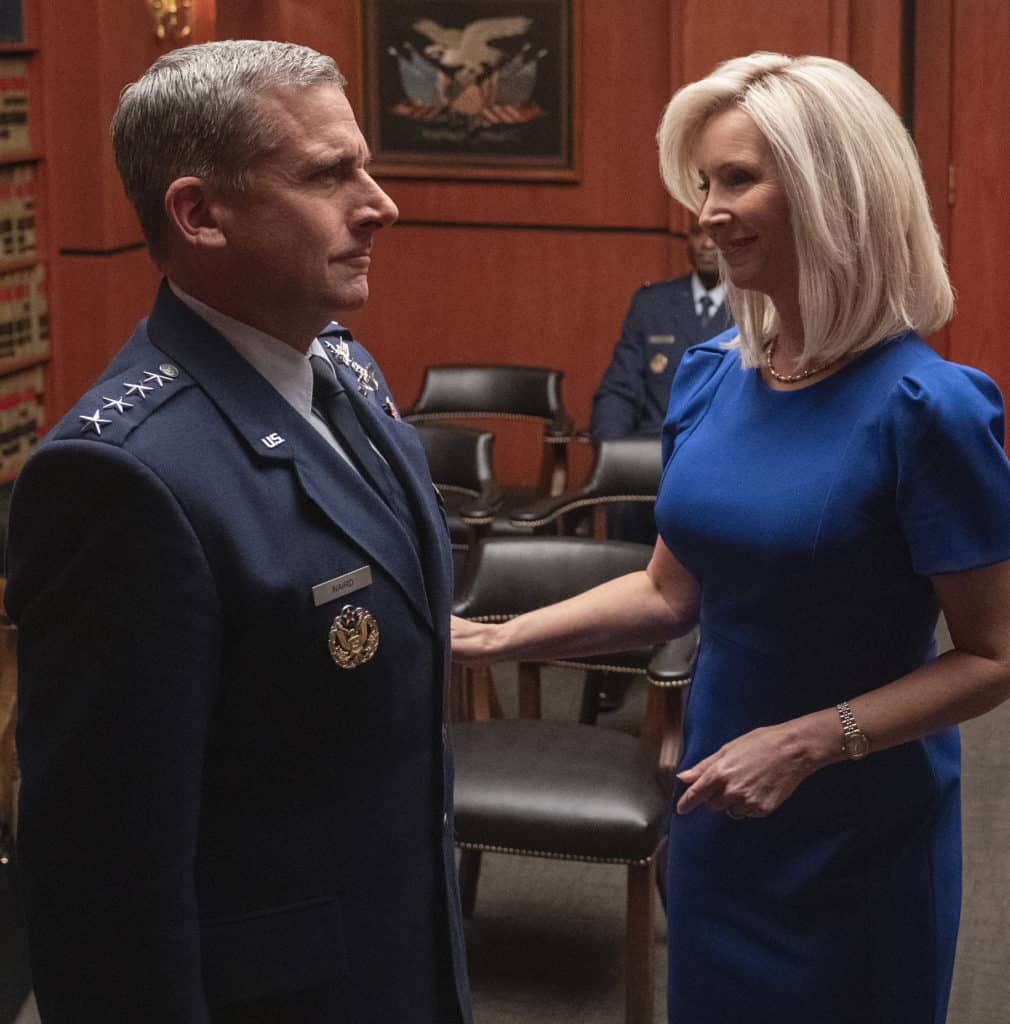
“Friends” star Lisa Kudrow will return to series comedy in the Netflix workplace sitcom “Space Force,” playing opposite Steve Carrell. The premise centers on a four-star general (Carell) who is tapped to run the titular sixth Armed Forces branch. Kudrow plays the general’s wife, who has grown tired of taking a back seat to her husband’s career. The cast also includes MOTs Ben Schwartz and Noah Emmerich. The series begins streaming May 29.
Beanie Feldstein (“Lady Bird,” “Booksmart”) stars in the comedy “How to Build a Girl” as a teenager with a wild imagination who invents a new persona for herself to get away from her humdrum life, and becomes a popular critic on the ‘90s music scene. Based on the novel by Caitlin Moran, it will be released On Demand May 8. Feldstein will play Monica Lewinsky in “Impeachment” American Crime Story,” which will premiere on FX Sept. 27.
Emmanuelle Chriqui (“Entourage,” “The Passage”) has been cast as Lana Lang in the CW’s latest superhero series “Superman & Lois,” opposite Tyler Hoechlin and Elizabeth Tulloch in the title roles. The series is expected to premiere this fall. Chriqui has completed work on “Die in a Gunfight,” about a young man who falls in love with the daughter of his father’s nemesis.
Currently on screen in the streaming releases “Resistance” and “Vivarium,” Jesse Eisenberg will go behind the camera for his next project, a family dramedy called “When You Finish Saving the World.” Eisenberg wrote the screenplay and will direct the film, which is based on his Audible Originals audiobook of the same name, due later this year.
Taking place over 30 years and starring fellow MOT Finn Wolfhard (“Stranger Things”) and Julianne Moore, the movie follows a new father, a college student and a teenager, all members of the same family.
Emma Stone, who started alongside Eisenberg in “Zombieland” and its sequel, will produce along with Moore and Dave McCary.
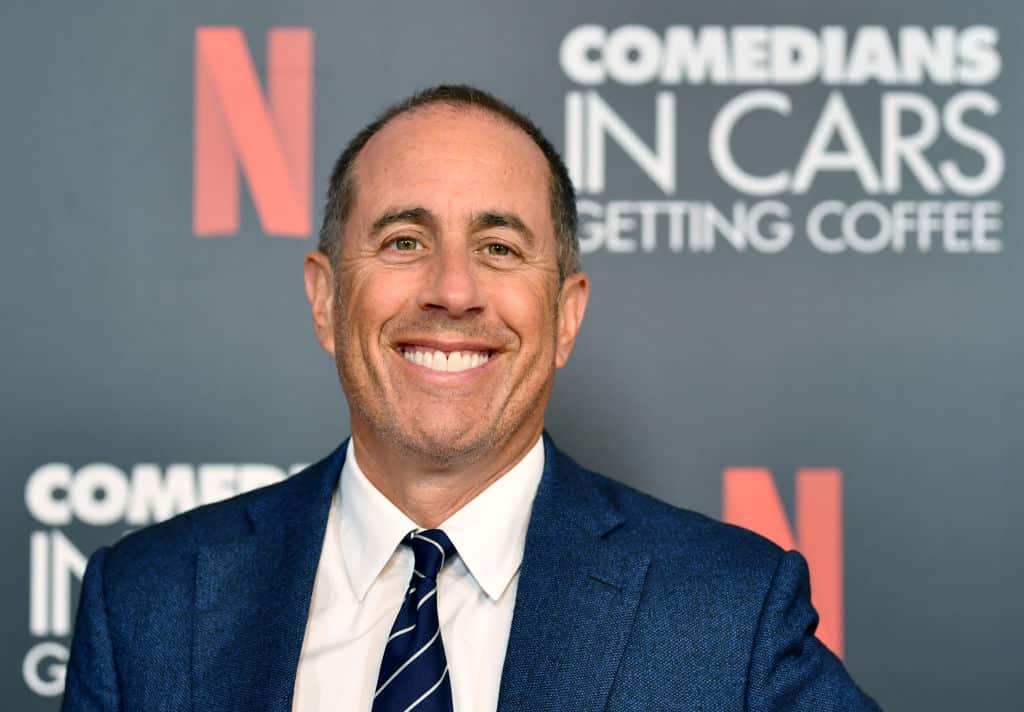
At a time when we all could use a little levity, Jerry Seinfeld will provide it in “23 Hours to Kill,” his second special for Netflix. Filmed at New York’s Beacon Theater during a run that was cut short by the COVID-19 pandemic, the special falls under Seinfeld’s deal with Netflix that included his special “Jerry Before Seinfeld” last year and the series “Comedians in Cars Getting Coffee.”
Premiering May 5, the special’s title refers to Seinfeld’s assertion that standup comedians spend all day waiting for that one hour on stage.
Seinfeld is scheduled to release an untitled book about standup comedy, his first since “Seinlanguage,” on Oct. 6.
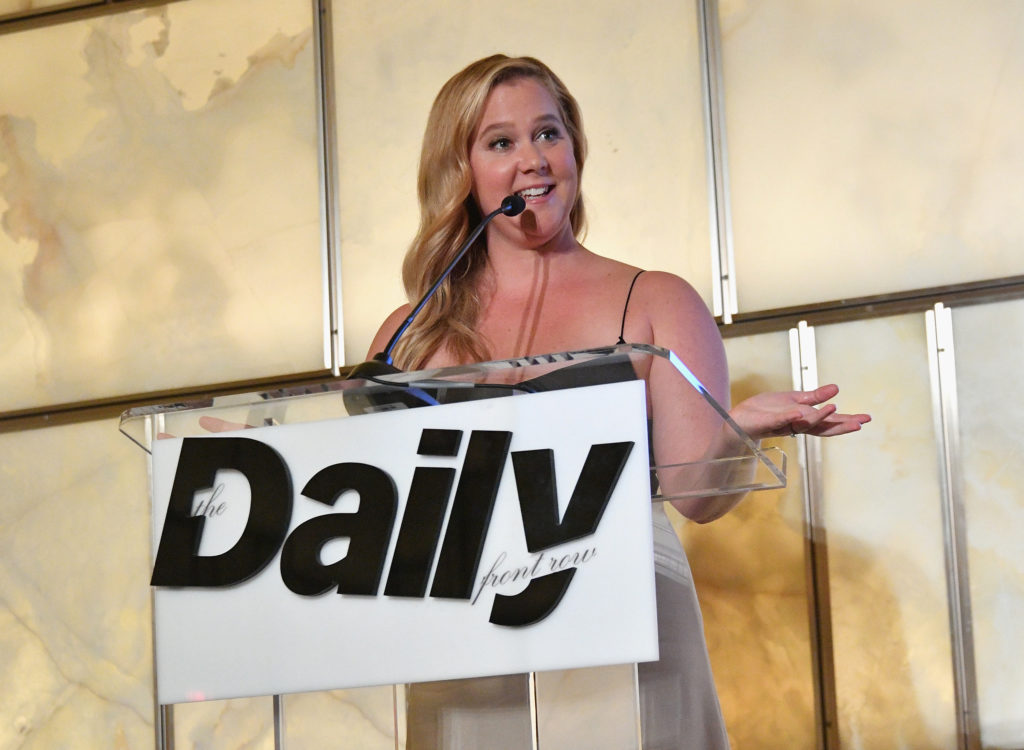
For those tired of making the same old recipes during COVID-19 confinement at home, help is on the way from Amy Schumer and her professional chef husband, Chris Fischer. The pair is teaming up with Netflix for a self-shot series tentatively titled “Amy Schumer Learns to Cook,” which will give a behind-the-scenes look at their lives while giving how-to lessons in making brunch, pastas tacos, cocktails and more.
“Amy’s boundless humor and Chris’ culinary skills show viewers how they navigate life while at home making the best of these turbulent times with some good laughs and good food,” Food Network president Courtney White said in a statement.
“Chris and I are excited to make this project with Food Network combining our two passions – for Chris it’s cooking and for me, eating,” Schumer said. “With everything going on in the world right now, we are so grateful to be able to share an entertaining and informative experience with viewers. And it is more important than ever to look out for one another, so Chris and I will be making donations to causes dear to us – The Coalition of Immokalee Workers’ Fair Food Program and select domestic violence organizations.”
Production begins this week on the series, which will premiere later this spring.
Los Angeles County officials announced on April 10 that the shelter-in-place order has been extended until May 15.
Additionally, on April 15 the county will start to require essential businesses to provide their employees with some sort of face covering as well as develop a plan to maintain social distancing measures during work hours.
County Director of Health Services Dr. Christina Ghaly said that if the shelter-in-place order had been lifted on its initial April 19 expiration date, the virus would have infected nearly 96% of the county over the next three months. She argued that current social distancing measures would reduce that number to 30% and more stringent measures would decrease that projection to less than 6%.
“What we need to do is continue to slow the acceleration of the virus and make sure we are limiting its impact on society, limiting the infections,” Ghaly said.
County Public Health Director Dr. Barbara Ferrer said, “What we can confirm is in fact the flattening of the curve in a way that’s actually saving lives and allowing us to have a chance at making sure that our health care system remains able to serve all who need care.”
The shelter-in-place order could be extended further depending on the data going forward.
On March 25, Mayor Eric Garcetti told Business Insider that the shelter-in-place order would last until at least May, saying: “I think this is at least two months, and be prepared for longer.”
As of this writing, there are 8,430 confirmed cases in the county and 241 deaths from the virus.
A second synagogue in Huntsville, Ala., was vandalized with anti-Semitic graffiti over the span of a couple days, authorities said.
Swastikas were found on the Chabad of Huntsville on April 10; the suspect reportedly was captured on surveillance footage. Local police are investigating the matter with assistance from the FBI.
Huntsville Mayor Tommy Battle said at a press conference in front of the Chabad, “We do not condone this. We are going to make sure we protect our community.”
On April 8, swastikas and other anti-Semitic slurs such as the words “Jew rats” were spray-painted on the Etz Chayim synagogue in Huntsville.
The Jewish Federation of Huntsville and North Alabama said in an April 10 statement, “During one of the holiest times of the year for the Jewish people, cowards have now attacked us twice. An attack on the Jewish community is an attack on all of us.”
They added: “It’s meant to terrify us. Make no mistake, we will not be scared out of this wonderful place we call home.”
Rabbi Eric Berk of Temple B’nai Sholom, which is also in Huntsville, issued a statement saying that he has been in contact with local police and the FBI to help protect his synagogue from anti-Semitic vandalism.
“Let us remain united in our efforts to persist through and overcome these reprehensible acts of anti-Semitic hatred,” he said. “As I’ve unfortunately had to say more than once: let us remember that an attack on any House of Worship is an attack on every House of Worship.”
Dear people who keep writing long articles telling artists to stop making stuff in Corona times, and/or shaming them for sharing their work online when the world is in such bad shape,
There is literally only one way to do pandemic times wrong: And that is, to tell others how they are doing pandemic times wrong.
If your grief is manifesting in a way that does not inspire you to make stuff, you are doing great.
May you grieve in peace, may you feel nourished in your safe cocoon as long as you need.
But the second you start writing wierdly judgemental, toxic articles posing as “think pieces” that are essentially shaming artists who are processing this differently then you, folks who are healing their broken hearts and loneliness and sense of desperation by creating and engaging with others online, with music or with writing, even through the lense of an imperfect iphone lense, even without a full orchestra and pretty costumes, even without the header post of The Atlantic or The News Yorker Magazine: if you come for us for doing it different, I will tell you, with all love and respect, that you need to sit all the way down.
If you are overwhelmed by the sheer volume of content, maybe that’s a sign you need to spend less time on social media?
If you wonder about the appropriateness of posting songs or vignettes or monologues in the face of death around us, know this: The people in historical times of great trauma still sang.
They. Still. Sang.
If you read in a history book, that one inmate in a concentration camp demanded that another stop singing or playing violin because it was inappropriate in the face of so much misery or—my personal favorite—snapped at them that they should stop self-promoting, what would be your reaction?
Here is mine: maybe, just maybe those who insisted on singing and writing developed a resilience they needed to survive. And maybe they helped others survive.
If you are currently lamenting that so much of the online living-room music content “just isn’t that good”–maybe you should reflect on your own need to sit in judgement and then reflect why humans make art in the first place?
I don’t make art so that others can applaud my perfection. Humans cannot fall in love with perfection. We can at best admire it, but never love it.
I make things because it keeps me alive.
And if there are some people who also smile because of what I made, well, that’s the creme anglais on my tarte tartin.
Years ago I made a big decision to chose authenticity and connection over perfection. My life and my career and my art-making are about a billion times more satisfying and flourishing from this vista, then from the old one.
I know. Perfection is very hard one to break up with but I swear it’s worth it.
P.S. The gatekeepers who you are so worried about looking not perfect in front of, here online with your not perfect offerings? They desperately want the authenticity and connection too. Even if they don’t know it.
Wishing that everyone finds the peace and clarity they need right now, whether that means doing absolutely nothing, or watching that godawful Tiger thing, or eating, or not eating, or recording and posting a song or a story or a monologue or a dramatic reading online every single damn day.
Israeli President Reuven Rivlin issued an apology via Twitter on April 10 after having his daughter and her family attend his Passover seder earlier in the week while Israel is on lockdown.
“Before the Sabbath comes in, I want to apologize,” Rivlin, 80, wrote on Twitter. “I have read the harsh reactions to the fact my daughter accompanied me during the holiday and I understand most of them.”
Rivlin wrote that since his wife, Nehama, died in 2019, his children have been helping him with his “personal business, as well being my contacts in work-related needs during the holidays and weekends when my office is not staffed. I understand that if people do not understand the agenda as a president, it is difficult to understand this and I am sorry for that.”
According to The Jerusalem Post, Rivlin’s daughter’s partner and two children attended the seder.
On April 9, Israeli Prime Minister Benjamin Netanyahu was under fire for having his son Avner as a guest at his April 7 seder; Netanyahu’s office said that Avner lives in an apartment in Netanyahu’s compound, although Avner’s brother Yair had tweeted that Avner lives across the street from Netanyahu.
Lahav Harkov, senior editor for the Post, tweeted that it’s “frustrating that our role models can’t meet the challenges they have set for us.”
Turns out Rivlin had family over for the Seder as well, against the rules. At least he didn't try to obfuscate and apologized https://t.co/bISaMImYBz
Pro-Israel activist Arsen Ostrovsky similarly tweeted, “So, after Netanyahu, now Rivlin too breaks #CoronaVirus rules when so many of us had to spend #Passover Seder alone? Our leaders are meant to set an example!”
So, after Netanyahu, now Rivlin too breaks #CoronaVirus rules when so many of us had to spend #Passover Seder alone? Our leaders are meant to set an example! https://t.co/WTtcm2ATkL
From April 7-10, Israelis are banned from intercity travel. Health Minister Yaakov Litzman warned Israelis on April 10 not to ease up on social distancing measures.
“A gradual opening of the economy will only be possible if we all make sure to keep the rules, despite the hardships,” he said.
If you’re looking for great Jewish and Hebrew-language films to see this Passover week, there are many great choices streaming on Netflix and Amazon Prime, but they’re not the only options.
The Laemmle theater chain is closed for the duration of the COVID-19 crisis, but it has partnered with Menemsha Films to digitally present several titles for Pesach via its digital site, Laemmle Virtual Cinema. The documentary “Streits: Matzo and the American Dream;” “Nora’s Will,” set in Mexico during a Passover seder; the Romanian drama “Live and Become;” and “Nicky’s Family,” about the British humanitarian who saved 600 children from the Nazis will each be available for rental for $1.99
The Israel Film Center offers titles like Nir Bergman’s “Saving Neta,” Eran Riklis’ septuple Ophir Award nominee “The Syrian Bride” and “A Quiet Heart” starring Ania Bukstein (”False Flag”), each for $5.99 or less.
Those of a certain age recall when Howard Baker, long-time Republican Senator from Tennessee, asked the question that was the beginning of the end for President Nixon, “What did the President know and when did he know it?” As these days turn to weeks and weeks into months, the American people increasingly will be asking not only of their President, but of their Governors and local leaders as well, “what did they know and when did they know it?” Add to that, “what did they do about it?” When voters wrestle with this question in November, they may find the answer unsettling and, perhaps, damning of leaders they previously supported. And history will not be kind.
Apologies in advance for the longer-than-usual musing below and what some will see as partisanship. But I think it’s important, with all the gubernatorial pronouncements and flailing in Washington, to revisit their respective roles and how federalism worked backwards (well, failed to work) in this instance. Also, you can skip this and go directly to the fun stuff at the end…
WASHINGTON’S INACTION
First, a recap of our Federal government failing to act for us all… By now we are all too familiar with the timeline that began with a small outbreak in Wuhan, which expanded to larger swathes of China and then leapt across national boundaries and oceans, wreaking havoc in Italy. The first case showed up in Washington State on January 20, after which a nursing home became the first U.S. “hot spot.” On January 22, the President said, “we have it totally under control,” praising China’s transparency days later, and on January 31, said:
“We think we have it very well under control…we think it’s going to have a very good ending for us…that I can assure you”
He said essentially the same throughout the last week of February, saying , it was “very well under control in our country,” and “…within a couple of days…is going to be down to close to zero, that’s a pretty good job we’ve done.”
You get the drift. “It’s going to disappear like a miracle,” we’re going to be “raring to go by Easter,” “anyone who wants a test can get a test,” etc., etc., ad nauseum. All of this while we now learn the timeline of knowledge of risk of this pandemic stretches back to January and of the inevitable risk of any pandemic stretches at least back to George W. Bush’s presidency…
PARALLELS TO PEARL HARBOR?
Some compare the nation’s late reaction to Pearl Harbor, when many warning signs were ignored. Certainly it’s a human condition to believe that calamity can’t possibly strike us. When it does, it’s a shock, while history confirms that it ought not have been. This, I suppose, is an acknowledgement that we shouldn’t be too quick to blame the President for ignoring early warning signs—just on repeated failures to acknowledge the problem once it reached our shores. Here’s an interesting perspective from Daniel Henninger, of the Wall Street Journal.
One quote from this article is particularly instructive: “But 50 states are not individually equipped to solve the science of a rampant unknown virus. A pandemic of its nature requires a national clearinghouse of knowledge and consistent central-government direction, while leaving space for decisions by lower levels of government.”
MIXED RESPONSE FROM THE STATES
The Federal government’s failure to take decisive action to tamp down the virus’s spread meant it fell upon the States to do so. One of the great strengths of our Federal system is the way in which states are given the leeway to experiment with an idea before its adoption nationwide. Some ideas work best in small trial samples before being expanded (See, for example, Romney care). But not so with viral risk.
Here, by not taking the lead, Washington passed the buck to the States. This, of course, was crazy. Diseases don’t know boundaries. And States lack the data, resources and depth of expertise of the Federal government (even in its current state of depletion), and all are highly dependent upon the opinion of one person—the State’s governor—to decide on a course of action. These governors are of varying levels of sophistication and reelection prospects. By leaving it to the governors, we exposed their citizens unnecessarily to greater risk and, by extension, exposed all the rest of us.
So how did these governors do? Well, not so well. The New York Times has been keeping count of the States and when they instituted shelter-in-place orders. What one learns is:
Puerto Rico was the first State or Territory to institute an order, back on March 15th. Poor Puerto Rico knows a catastrophe when it sees it and, sadly, got to experience the ineptitude and venality of the Federal government first-hand with the handling of Hurricane Maria.
California was the first State to institute a shelter in place order. Kudos to Governor Newsom. But even he was slow, as Santa Clara County restricted large gatherings as early as March 3 and a shelter in place four days earlier than the State did. Ohio’s Republican Governor Mike DeWine evoked “we are at war,” acting quickly and decisively. Democratic Governor Gretchen Whitmer stated, in issuing her order, “Without a comprehensive national strategy, we, the states, must take action.” (NB: sounds like a Vice Presidential candidate to me)
While Governor Cuomo rightfully is getting credit for his leadership today, New York failed to act quickly and has paid the price in burdens on the health care system and death toll.
It took weeks for Texas (on March 31, the governor indicated “this is not a stay at home strategy,” before changing course), Florida and Alabama (Alabama’s governor proudly proclaimed “we’re not California”—too bad for Alabamans, whose lives were in her hands) also were late to the game (April 2-4).
Eight States have done nothing as of this week (in two of them, some cities have acted). What in the world are these Governors possibly be thinking today?
It is instructive to note that the majority of the States that waited the longest were in “deep red” states in the South and Midwest, with Governors that implied or actually stated that they were waiting for the President to indicate his approval before they would act. It is hard not to see the cold political calculus, in which human lives apparently did not figure in significantly, that went into these governors’ decisions.
FEDERALISM TURNED UPSIDE-DOWN
Besides the administration’s unwillingness to let science direct politics (rather than the other way around), the response to the virus got caught up in the political battle of “large national government” versus “states’ rights.” Regardless of one’s view on federalism, there are certain things that only a national government can do—maintain a military and protect us (so that we needn’t all buy guns to protect ourselves), enter into treaties and trade pacts, coordinate air traffic control, etc. None of this requires a large government—just a competent one. Because States cannot restrict travel and commerce coming to their borders, what one State does has an impact on the others. And because some governors acted too late (or not at all), it affects everyone.
Curiously, the Federal government actually did assert its primacy in the utilization of our strategic and ongoing reserves of medical and protective gear. In that instance, notwithstanding long term policy and practice, Prime Minister Jared Kushner declared that these reserves belong to the Federal government. Previously, the Federal government was supposed to act as a national quartermaster, marshalling these resources to be called on by the States when needed (as laid out on the website before changed by the administration after the PM’s speech). The States have better information about their own circumstances and needs and would be the best to allocate these resources. So in this instance, when the States should be in control, their power has been taken away. This of course flies in the face of the administration’s fealty to the concept of a small national government.
We got it exactly backward. On the issue of national lock-down, it was a national issue treated as a States issue. On implementation of health care strategies and allocation of resources, it is a States issue that the federal government would like to commandeer.
Why rant about this? It’s not just that we were unprepared; not just that supplies were low; and not that we didn’t hear from the experts in the field. We knew full well and yet knowingly ignored the signs for political purity of thought, fear of antagonizing nay-sayers, and wanting to avoid offending the President, who was dilly-dallying when he should have declared a national shelter-in-place, for fear of offending him and his base.
Is this asking too much? It’s not like I’m suggesting something radical that might offend these Governors, like teaching evolution in schools…
LIVING ROOM HAMILTON
This you won’t want to miss… John Krasinski does a silly weekly show called “Some Good News.” It’s cute. But skip all the way to 10:30 for an amazing living room rendition of the opening number from “Hamilton: An America Musical,” with Lin-Manuel Miranda and the cast: