fbpx

March 11, 2020

Author Lifts the Veil on Her Family in ‘Concealed’

Although we are cautioned not to judge a book by its cover, more than one reader of Esther Amini’s memoir will fall in love, as I did, with cover photograph of a little girl in a pinafore who holds a miniature American flag.

The image is an appropriate introduction to “Concealed: Memoir of a Jewish-Iranian Daughter Caught Between the Chador and America” (Greenpoint Press). As the subtitle tells us, and the cover confirms, what one wears is a visible and powerful signifier of identity. At times, clothing can be a tool of oppression, and at other times, a symbol of self-liberation.

Amini introduces us to a place that most Americans have not heard of — the Iranian city of Mashhad, which she describes as the “the holiest Muslim city in Iran” and, fatefully, the ancestral home of her maternal and paternal families. Indeed, she introduces us to words, phrases and foods that are “uniquely Mashhadi” in origin.

Reaching back to her early childhood in Queens, N.Y., in the 1950s, Amini introduces us to her ambitious mother, “born with sword in hand,” and her aloof father, who sometimes “insisted I wasn’t visible when I was.” At that age, she tells us, she was literally trying to disappear, if only to escape her father’s wrath. “I ate little, spoke minimally, breathed soundlessly while my mother worked at becoming ever more visible, expanding to the point of bursting, no matter the consequence.” As it turns out, “Concealed” is the story of how that self-effacing little girl struggled to become the master storyteller whom we encounter in the pages of her book.

Amini was awarded an Emerging Writer Fellowship on the strength of her memoir when it was still a work in progress, and her short stories have appeared in numerous periodicals ranging from Tablet to Lilith to Barnard Magazine. Several of her stories were dramatized by the Jewish Women’s Theatre, first in Los Angeles and then at the 92nd Street Y in Manhattan, in the memorable theatrical productions called “Saffron and Rosewater.” Now she has emerged in full as the author of the published version of “Concealed.”

All of the women in her family, we are told, practiced the same concealment in Mashhad. They lived as “underground” Jews, “heavily shrouded, properly groomed, Islamicized for outside eyes.” Her father, too, “relied on duplicity to survive,” reciting the Quran in public “while inwardly praying to HaShem.” When the family arranged to emigrate from Mashhad to Manhattan, her mother literally burned her chadors before leaving for America and “speed-sorted through Saks Fifth Avenue’s dress racks,” favoring fire engine red as “her color of choice.”

The narrative shifts back forth between America and Iran as Esther Amini offers an autobiography of a
first-generation American and a biography of her immigrant parents.

Amini herself was born after the family reached the United States, and her childhood served as the point of conflict between the Old World and the New World. Her father, for example, tried to constrain the author’s life. “Cut out friends, cut out books, cut out my tongue; scrape out thought and wonder — whatever grows inside,” she writes. “Leave me hollow, an empty shell to be filled by some random Iranian husband.”

Amini is a gifted writer, as we discover for ourselves in “Concealed,” but we also learn that silence and solitude were tools of survival when she was a young woman in conflict with tradition. “I discovered I didn’t want to put the world into words — that not every sensation had a matching name, not every image or impulse could be explained,” she writes. Indeed, it was her experience as a silent listener in her own home that turned her into a storyteller.

“Caught between Mom’s flamboyant personality and Pop’s strict edicts, I felt my insides rapidly evolving from silent Iranian daughter with no real say in her future to silent daughter with a plan,” she reveals. “I decided I’d listen closely to their tangled tales and find out as much as I could about … why they fled Iran, what risks they took, and how they managed to make a new life in America.” What she heard, and what she has written, amounts to a family chronicle of remarkable candor and intimacy. She even quotes — and translates — the Persian curses that her parents exchanged: “Fathered by a dog” was answered with “May you die!”

The narrative shifts back forth between America and Iran as Amini offers an autobiography of a first-generation American and a biography of her immigrant parents. She has an eye for the telling moment, as when she describes the annual visit to Radio City Music Hall, “watching the Christmas Spectacular and strictly keeping kosher.” When her mother revealed that she was illiterate — “Because I cannot read I feel shot in the head” — Amini vowed to teach her how to read and write. The lessons at the family dining table were accompanied by a plate of Persian pastries and “a tall glass of Bosco chocolate milk.” When presented with an American treat, she would ask her daughter: “Estaire, dees ko-shair?”

The same knowing eye falls on the landscape of Iran. Amini’s mother, “ravishingly beautiful,” was convinced of her direct descent from the biblical Queen Esther and prayed for the birth of a daughter who would carry the beloved name. And so, as the last act before leaving Iran, the whole family made a pilgrimage to the city of Hamadan, the traditional burial site of Queen Esther. “My mother decided she’d throw herself on top of the buried Queen’s tomb, harness Her Majesty’s supernatural power, and aim it at her womb,” writes Amini, who was seen as the fulfillment of that prayer.

Memoir is an especially challenging genre because it calls on the author to reveal what others prefer to conceal. “Readers may wish I wrote more about certain events,” Amini confides, “but I have to weigh that wish against the wishes of those dear to me who would rather I wrote nothing at all.” Yet Amini only honors the people she writes about in her heartfelt, endearing and courageous book.


Jonathan Kirsch, attorney and author, is the book editor of the Jewish Journal.

Author Lifts the Veil on Her Family in ‘Concealed’ Read More »
Jewish Women’s Theatre Explores ‘Sex, Addiction & Love’

UPDATE: This show has now been postponed due to the coronavirus concerns. JWT hopes to run the show in May. Please check their website for updates.

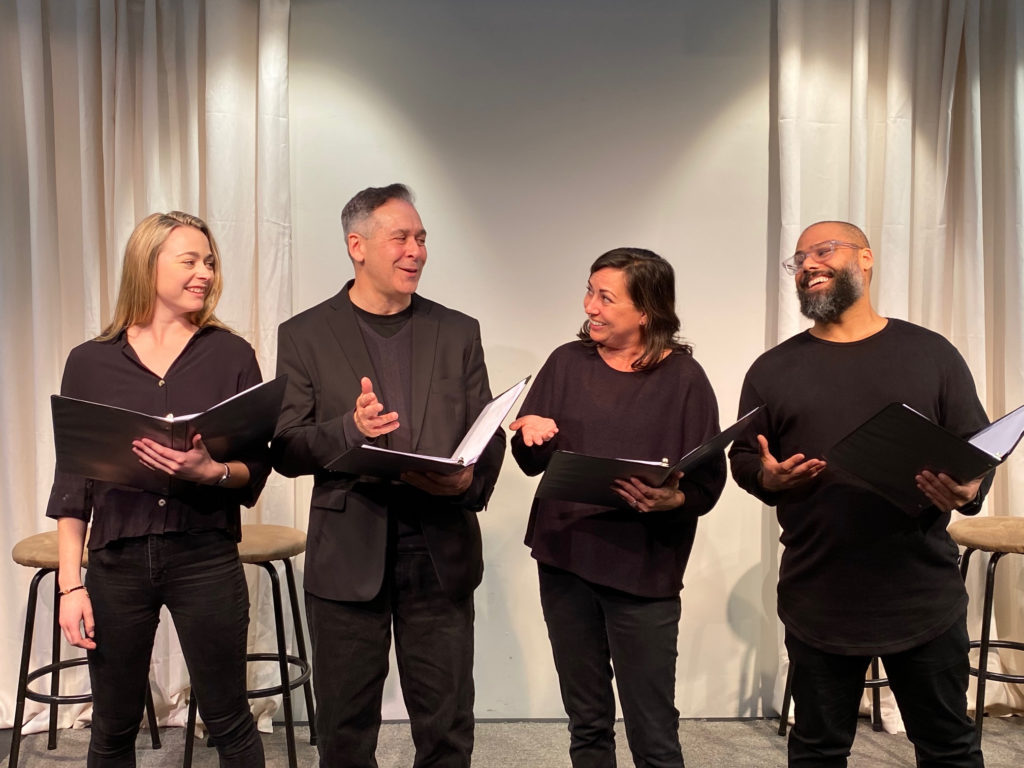
Telling a dozen stories that range from hilarious to heartbreaking and heartwarming to shocking, “Sex, Addiction & Love in the 21st Century,” the latest Jewish Women’s Theatre (JWT) production, examines these topics in a provocative, relatable way. Chosen from more than 200 submissions by Jewish writers, the pieces include an awkward teenager’s “first time,” a brief sensual encounter between two female friends and the confessions of an Orthodox woman who is a sex addict.

In other stories, a hookup app comes between lovers, a woman learns to just say no to bad sex and a father experiences a roller coaster of emotions during his son’s chaotic home birth.

“There are funny moments and serious moments. Our last show was about mental illness, a very serious topic. I wanted to do something that had a lighter approach to life and sex and love,” JWT Artistic Director Ronda Spinak told the Journal at a rehearsal. “It’s a show about the human desire to connect and love, and how that is accomplished or not accomplished. I think people are going to have a good time and remember their first loves, their unrequited loves, the good and the troubling things about their relationships, and reflect on their own lives as they relate to the stories on stage. That may cause them to have conversations they might not have had if they didn’t come to the show.”

Joshua Reuben Silverstein, a JWT veteran, comically mines his own life in the childbirth and first-time sex stories he contributed. “I think a lot of men have these fantasy-like first times. Mine was not a fantasy at all,” he said. “It was embarrassing and eye-opening about how sexualized I had been. My world became very clear when I had a naked woman standing in it.”

Silverstein, a Los Angeles native whose father is an Ashkenazi Jew and mother is an African American with Southern roots, is married to a Mexican convert. “My wife converted before she met me. She grew up with Jews and loved the culture and related to asking questions,” he said.

As JWT attendees will discover, Silverstein is a talented beatboxer, known for frequent appearances on “Drop the Mic” and “The Late Late Show with James Corden.” He also does a monthly comedy show with Joe Hernandez-Kolski on the second Thursday of each month at the Broadwater Stage in Santa Monica.

“Sex is still something people are uncomfortable talking about, especially in public. Clearly, it’s a conversation we do need to have and move past that,” he said. “I think this show speaks to the emotion and the vulnerability of what sex is for people.”

Sionne Elise, also a JWT veteran, performs in several of the stories and sings a song she composed. “Each piece is so different,” she said. “Each piece incorporates Jewish culture without being about being Jewish. The one that speaks to me the most is about the paramedic who pulls two people apart” after a car accident. “Her hands are doing her job but her heart is in a different place. It’s Shabbat and she reflects on the meaning of that. It’s an important part of the story.”

The daughter of a Russian Jewish mother from New York and a Midwestern Norwegian father, Elise wasn’t raised religious, “but my mom put all the fun Jewish stuff in my life, like Hanukkah and Passover. I didn’t have a bat mitzvah until I went on Birthright, at Masada. That was pretty fun.”

“It’s a show about the human desire to connect and love, and how is that accomplished or not accomplished.”

— Ronda Spinak

Elise, whose first name is a form of Zion, is a Bay Area native and “theater kid” who attended a performing arts high school and remained in Los Angeles after graduating from UCLA. Not long after, she landed the lead role in the critically acclaimed play “Show Pony,” about women in an ad agency. Last summer, she shot “Killer Cheerleader” for Lifetime, and she will spend this summer getting more training in New York with an off-Broadway theater company, The Barrow Group.

Looking to Cate Blanchett and Brie Larson as examples of the kind of career she would like to have, Elise hopes to work on stage, screen and in music in the future. “Music has always been more of a hobby. Theater is my passion. But I’m more interested now that the mediums are combining,” she said. “I want to be like those women who are versatile and work hard and are in control of their career.”

Spinak is already working on the JWT’s next show, “AHA Moment,” about wakeup calls and the decision to do something, or not do something, and the repercussions of that. It opens May 9 and will be followed by “For Goodness’ Sake,” about our moral compass and how it leads us to do good, or not, opening June 11.

Spinak believes the current show will entertain and stimulate contemplation and conversation. “Given the state of our country, no matter what side of the aisle you sit on, a show like this is very welcome,” she said. “A show like this takes you away from politics and all that and puts you in a place to be reflective and thoughtful. It’s the perfect time for a show like this.”


“Sex, Addiction & Love in the 21st Century” runs March 14-24 at the Braid in Santa Monica and locations across Los Angeles, including the San Fernando Valley, Mid-Wilshire and the South Bay. For tickets and location information, visit the website.

Jewish Women’s Theatre Explores ‘Sex, Addiction & Love’ Read More »

‘The Plot Against America’ Explains How Holocaust ‘Can Happen Here’ Says Producer

Set in the 1940s, Philip Roth’s 2004 novel “The Plot Against America” hypothesizes a chilling alternative history in which hero aviator and Nazi sympathizer Charles Lindbergh is elected president and the United States becomes an ultra-nationalist, xenophobic and very dangerous place for Jews. Now, 16 years later, it’s a six-part HBO miniseries, and in a climate of rising anti-Semitism, what was a disturbing dystopian fantasy seems chillingly real.

In 2013, producer David Simon (“The Wire,” “Treme,” “The Deuce”) passed on the project initially because he didn’t think it was politically relevant then, during the Barack Obama administration. “I was convinced that America was moving beyond that kind of demagoguery,” he told the Journal. “I was wrong.”

The story’s horrifying alternate reality unfolds through the eyes of the Levins, a Jewish working-class family in New Jersey. Their concern becomes palpable fear as anti-Semitic rhetoric turns into action, and Kristallnacht-like attacks, forced resettlement and murders escalate. Lindbergh himself is peripheral. “All the historical figures exist only as they’re experienced by these characters,” Simon said, referring to parents Bess (Zoe Kazan) and Herman (Morgan Spector), their sons Sandy and Phillip (Caleb Malis, Azhy Robertson), Bess’s sister Evelyn (Winona Ryder) and Rabbi Lionel Bengelsdorf (John Turturro), an opportunist who allies himself with the new administration. The rabbi comes to see the foolishness of his choice but much too late, as does the starry-eyed Bess, who falls in love with him and the glamour of the Lindbergh inner circle.

Simon initially set out to cast Jewish actors in the lead roles and did with Ryder and Spector, but made an exception for Kazan and Turturro. “When I offered Zoe the role she said, ‘You know I’m not Jewish. We were Greeks in Turkey.’ I said, ‘If you don’t know from Cossacks, who does?’ John has played Primo Levi, Barton Fink, Herb Stempel in ‘Quiz Show.’ If this guy can’t play Jewish, nobody can.”

For “Stranger Things” star Ryder, who lost her maternal grandfather and many paternal relatives in World War II, “Plot” hit close to home. “I never thought in my life that I would see a swastika except in a movie, so it’s clearly relevant,” she said.

As proud, stubborn Herman, Spector (“Homeland”) said he “deeply feels the travails of his country” and rages against them but declines to leave home for Canada despite the mounting danger. He reread Roth’s novel and several other books about the Jewish immigrant experience to prepare for the role. Jewish on his father’s side — his grandfather’s family fled pogroms and his grandmother, a Yiddish theater actress, lost family in the Holocaust — Spector was raised without religion. “We didn’t go to temple. I was not bar mitzvahed. But I read Chaim Potok and Primo Levi. I came to it through culture, through literature,” he said.

“I think Jews will read it as being about anti-Semitism. But it’s also about Muslims, immigrants, people of color, others who are vulnerable. If Jews think it’s only about Jews, they’ve missed it. It’s broader.” — David Simon

Having acted in community theater as a child, Spector gravitated back to it after college when a family friend was casting an indie film and hired him. His television roles have included “Allegiance” and “Boardwalk Empire,” but he feels that “Plot” “sits in that magical place that’s both high profile and a dream artistically, the kind of work you want to get to do and the kind of people you want to work with,” he said.

He’s currently at work on “The Gilded Age,” an HBO miniseries from “Downton Abbey” creator Julian Fellowes, playing a 19th-century railroad magnate. He’s also developing projects with his wife, actress Rebecca Hall, with whom he appeared in the films “Permission,” “Christine” and Broadway’s “Machinal,” where they met. A social and political activist, Spector said that he hears “the ticking clock of climate change in my ear every day and I think it’s incumbent on all of us to act.”

Simon, who has roots in Russia, Belarus, Hungary and Slovakia, grew up in the Washington, D.C., suburbs, the son of “a professional Jew. My father was the PR director for B’nai B’rith for 25 years and the ADL (Anti-Defamation League) before that. The joke in our family was the temple we failed to attend regularly had to be Conservative. We were not particularly observant,” he said. “But it was a household that was aware of Jewish thought and ideals. We routinely had secular Jewish leaders at our dinner table.”

While working as journalist for the Baltimore Sun, he wrote “Homicide: A Year on the Killing Streets,” which became the Emmy-winning NBC series “Homicide: Life on the Street,” launching his TV career. Married to mystery writer Laura Lippman, he’s currently writing “Dry Run,” an HBO miniseries about the Abraham Lincoln Brigade, American soldiers who fought against the fascists in the Spanish Civil War.

Simon hopes that “The Plot Against America” is a wake-up call, and that viewers come away with the realization that “it can happen here. We’ve demonstrated that in a fundamental way in the last few years. Democracy is not a certitude. It requires constant struggle and it’s never perfected,” he said. “We have fundamental structural problems in this country in terms of inequality and economic opportunity that we’re not addressing, and if anyone comes along and offers ugly, frightened rhetoric, our democracy is susceptible. I think Jews will read it as being about anti-Semitism,” he added. “But it’s also about Muslims, immigrants, people of color, others who are vulnerable. If Jews think it’s only about Jews, they’ve missed it. It’s broader.”

For Spector, it’s a plea for civility and change. “Blaming the outsider and turning on each other is one solution,” Spector said. “But the other solution is we come together collectively and demand better lives for ourselves.”

“The Plot Against America” premieres March 16 on HBO. Each episode of the series has a corresponding podcast that premieres after the episode airs on HBO. Hosted by Peter Sagal (NPR) and creator/executive producer David Simon, it’s available free on Spotify, Apple, Google Play and Stitcher

‘The Plot Against America’ Explains How Holocaust ‘Can Happen Here’ Says Producer Read More »

‘Viral’ Explores the Origin and Impact of Global Anti-Semitism

In Jewish communities across the United States, the signs are literally on the wall. Anti-Semitism is on the rise and attacks against Jews are becoming more violent. In 2014, 609 anti-Jewish hate crime incidents were reported to the FBI. By 2018, that number had risen by 40%. And it’s estimated that 75% of these hate crimes go unreported. The global statistics are just as alarming. A 2018 study by the European Union found that 40% of European Jews live in fear of being attacked. Through archival video and images and interviews with notables including former President Bill Clinton, former British Prime Minister Tony Blair, journalist and author Fareed Zakaria, political commentator and author George Will and historian and author Deborah Lipstadt, the documentary “Viral: Antisemitism in Four Mutations” explores the sources of and reasons behind anti-Semitic hate.

“We wanted to pick the most visible and clear examples of how anti-Semitism is presenting itself today,” filmmaker Andrew Goldberg told the Journal. “There are thousands and thousands of mutations. We chose four, but we could have done 400 or 4,000.” He zeroed in on the far right in the U.S., the anti-Israel far left in England, Islamist extremists in France, and the Hungarian government, where a propaganda campaign has made Jewish billionaire George Soros the scapegoat for the country’s problems. “In every case, the Jews are seen as a power working behind the scenes, controlling the economy,” he said. “It’s a spoke of a conspiracy wheel. And it never changes.”

Goldberg began the project in 2017, when reports of anti-Semitic vandalism and bomb threats escalated and personal attacks and rallies like Unite the Right in Charlottesville, Va., became more common. “It was not hard for us to see it coming. We thought it was time to make a film,” he said. “I thought there was a hole that needed to be filled. I don’t think the mainstream media particularly cares about this issue and the Jewish community doesn’t have a lot of allies in this fight. I wasn’t able to fundraise from a single non-Jewish organization or foundation.”

Goldberg spent three years on the project, continually researching and updating as more hate incidents occurred. More than 100 people worked on the film, including three full-time archivists. His biggest challenge was changing “very preconceived notions about what anti-Semitism is, how it works, where it comes from and what needs to be done about it. Those narratives vary greatly across the population and many of them are wildly inaccurate. It’s a struggle that we have as journalists to report things when people don’t want to hear it.”

“We wanted to pick the most visible and clear examples of how anti-Semitism is presenting itself today. There are thousands and thousands of mutations. We chose four, but we could have done 400 or 4,000.” — Andrew Goldberg

While growing up in Chicago, Goldberg encountered very little anti-Semitism, but he didn’t feel that being Jewish was an asset. “I didn’t feel like my friends and peers welcomed it. I was often the only Jew and I was always an outsider because of it whenever religion came up,” he said. “I didn’t think being Jewish had any value.” His maternal great-grandfather was a well-known cantor in Chicago, but Goldberg was raised in a Reform family by parents who were not religious. “My kids are more involved in Jewish education than I ever was,” he said, noting that his three children attend Hebrew school near their New York City home, and the family celebrates Jewish holidays and Shabbat. “We want them to have that.”

A genealogy buff, Goldberg traced his forebears’ Russian roots to towns in what is now Ukraine. They emigrated in the early 1900s, but their kin who remained in the town of Kremenets perished in the Holocaust, shot and thrown in a mass grave. “Viral” includes interview footage of a witness to the atrocity.

A former broadcast journalist who freelanced for ABC News and CNN, Goldberg found his way into documentary filmmaking when he was offered the chance to work on “The Armenians: A Story of Survival” in 2001. Since then, he has directed documentaries for PBS, NPR, “CBS Sunday Morning,” and has made several with Jewish themes, “Jerusalem: Center of the World” and the Emmy-winning “A Yiddish World Remembered” among them. He currently is working on a film about animal cruelty.

As for “Viral,” there are plans beyond its theatrical release. Besides a showing on PBS later this year, “We’re talking with one major educational group about distribution in high schools and colleges,” Goldberg said. “We’d really like to show it in schools with a Christian emphasis, places like that.” He believes increasing awareness and understanding is the only hope of preventing anti-Semitism from escalating further. But he’s not optimistic.

“I absolutely think it will get worse and I have no idea what will turn it around. This is an ugly world we’re living in. How can I, as a journalist and documentary filmmaker, tell someone in France what to do about Islamists? Or tell someone in Hungary what to do about the government’s propaganda campaigns that have created a Jewish bogeyman? It’s far beyond the scope of the film to come up with solutions,” he said. “But we do feel that educating the population about the problem is the most important first step.

“People need to realize it’s a problem and understand that just because visible parts of the community are doing well doesn’t mean that anti-Semitism isn’t a danger. Anti-Semitism is often the canary in the coal mine,” he said. “When it starts to emerge, you know that other problems will be coming.”

“Viral: Antisemitism in Four Mutations” opens on March 13 at the Laemmle Royal in Los Angeles and Town Center in Encino.

‘Viral’ Explores the Origin and Impact of Global Anti-Semitism Read More »

Educating the Community About Jewish Genetic Diseases

Shari Ungerleider is a firm believer that if a person is going to undergo genetic testing, they should also receive genetic counseling. She says the information gathered from testing is too complicated for a layman to break down, and if read incorrectly can result in a misdiagnosis.

Ungerleider is the project coordinator of Jewish Genetic Disease Consortium (JGDC) and her mission is to educate the medical community, Jewish community and Jewish clergy about genetic diseases.

Also working to get the word out are Nancy Lurie, chief operating officer of the Neuromuscular Disease Foundation (NDF), and Karen Arnovitz Grinzaid, executive director of JScreen. They teamed up with Ungerleider in Los Angeles in February to raise awareness about advancements in genetic testing and options for carriers of recessive diseases.

“There’s no way that an OB-GYN or a pediatrician or any other doctor can keep up with genetic science,” Ungerleider said. “Our philosophy is, refer them to a genetic counselor. If you have a patient that has a problem with their heart, you’re going to send them to a cardiologist. So every patient [that receives] genetic testing, [you should] send them to a genetic counselor.”

According to the Los Angeles nonprofit GeneTestNow, which provides information on Jewish genetic diseases, a number of these diseases are commonly found in Jewish populations. In general, all ethnic groups have certain conditions that are passed down and if two carriers have the same condition, there is a 1 in 4 chance their child can be affected.

While Tay Sachs and Gaucher disease remain the most widely known recessive genetic diseases among Jews, Lurie said genetic testing awareness has been expanded to interfaith couples, non-Jews and Persian and Sephardic Jews because they can be carriers of various types of neuromuscular diseases. That’s why, she said, it’s important for everyone, not just Ashkenazi Jews, to get tested.

“This generation is much more open to talking about genetic testing,” Lurie said. “They can learn and pass it on to the people they know best [in their community]. NDF is [educating] through the young adults. The opportunity to educate the clergy is something we really haven’t been able to do [until now].”

Among their many visits around Los Angeles, the trio made presentations to clergy at Sinai Temple and at Wilshire Boulevard Temple.

“There’s no way that an OB-GYN or a pediatrician or any other doctor can keep up with genetic science. Our philosophy is, refer them to a genetic counselor.” — Shari Ungerleider

Ungerleider is passionate about the cause because her son Evan died from Tay Sachs. Ungerleider was tested for Tay Sachs but got a false negative after her doctor misread her test results. Now she fights so that every couple planning for a family can gain access to their genetic information before pregnancy so they can know their options.

“I would never knowingly put a child through what Evan [went through],” Ungerleider said. “The question I sometimes get from people is, ‘Well, do you wish you never had Evan?’ and the answer is, ‘No, I don’t wish I didn’t have him.’ Do I wish I was able to know and spare him with what he went through? Absolutely. I would have changed that in a second. It’s a parent’s responsibility to protect them and take care of them, and that starts the moment after conception. So anything you can do to spare your child’s pain if you know, my philosophy is do it. … Genetic testing isn’t telling you what to do, it’s providing you with options.”

Grinzaid, who was a genetic counselor before she became JScreen’s executive director, told the Journal many couples are nervous about being screened.

“Having to sit with a family and give them bad news, that’s hard. I had to do that for many years,” Grinzaid said. “Sometimes I would sit down with a family and I would know that they could have had genetic testing and known about the risk ahead of time but didn’t have access to the testing. If we are able to test people and give them a heads-up ahead of time, that’s a gift.”

JScreen tests for 226 diseases. Through saliva at home spit tests, Jewish and non-Jewish couples can get tested for $149, regardless of insurance. Then, couples can meet privately with a genetic counselor to hear their options.

“We are all about prevention so they can plan ahead,” Grinzaid said. “We don’t screen minors, but [you can get tested] whenever a couple decides to do this, as long as it is before pregnancy. If you are a high-risk couple, there are options. If you are already pregnant, there are options, but there are fewer options.”

Grinzaid said that genetic advancements have grown immensely over the past eight years. However, she noted there is a misconception that if a couple is a carrier for the same disease, they have to break up because they can’t have a healthy baby. Now, Grinzaid says, there are safe options that allow the couple to stay together and raise a family. Couples can choose to undergo in vitro fertilization (IVF) with preimplantation genetic diagnosis (PGD), they can use an egg or sperm from a screened noncarrier donor or they can choose to adopt children.

The main priority is to get tested early and not fear the results. “Even if they’re completely healthy, everybody has a risk of being a carrier for genetic diseases. About 80% of people will be tested as a carrier because there are so many genes on the panel, so [don’t] be nervous about being a carrier,” Grinzaid said, noting the only problem is when both couples are a carrier for the same disease. “One thing that is reassuring is only about 3% of couples in these programs are at risk. I like to reassure them that they are probably going to hear good news.”

Educating the Community About Jewish Genetic Diseases Read More »

Farrelly Brothers Honored for Recognizing People With Disabilities in Hollywood

According to Ruderman Family Foundation President Jay Ruderman, 1 in 5 people has a disability but you wouldn’t know it if you watched a movie or TV show.

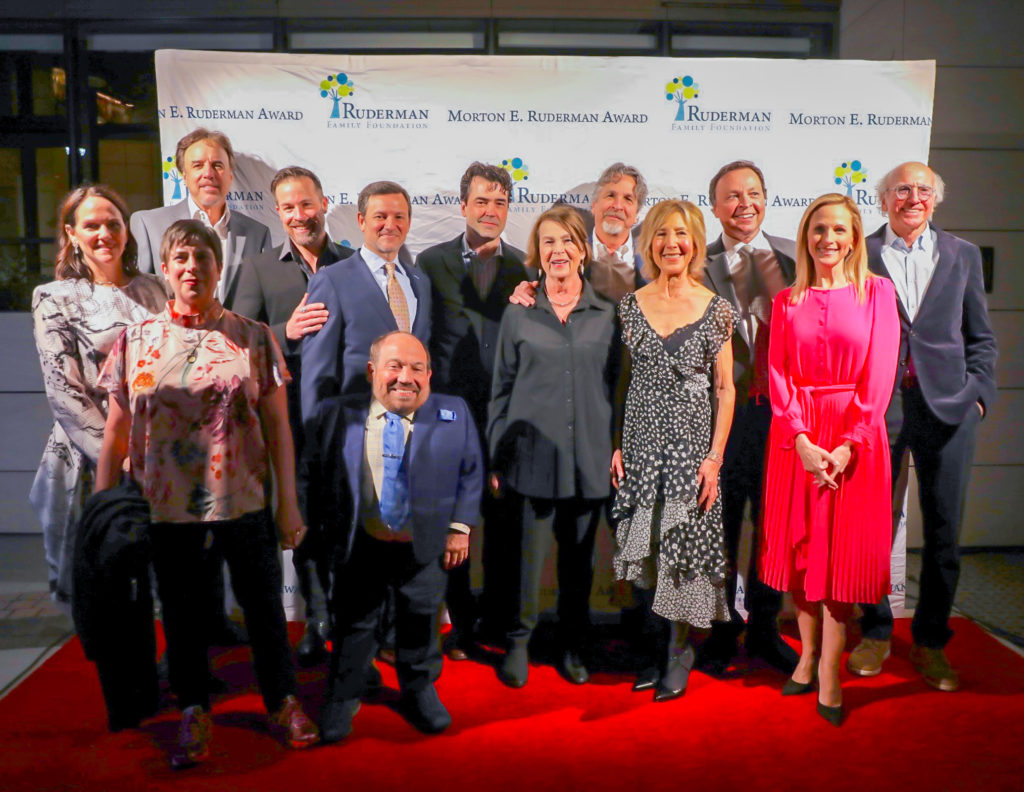
That’s why on March 3, the Foundation honored filmmakers Peter and Bobby Farrelly with the sixth Morton E. Ruderman Award in Inclusion at the Waldorf Astoria in Beverly Hills. The award honors the work the brothers’ have done to recognize people who have disabilities in Hollywood.

The Farrellys have been in the business a long time, having made the films “Dumb and Dumber,” (1994) “There’s Something About Mary,” (1998) “Shallow Hal,” (2001) “Stuck on You,” (2003) “The Ringer” (2005) and “Hall Pass” (2013). Peter co-wrote and directed 2018’s Academy Award-winning best picture, “Green Book.”

And while the brothers’ goal has been to entertain people around the world with their stories, they have also advocated for the disabled community by hiring disabled people in front of and behind the camera. Peter said that their decision to be more inclusive came after receiving criticism from one of their disabled friends after the release of “Dumb and Dumber.”

“We weren’t thinking about anything but making a movie and getting laughs and not getting fired,” Peter told the Journal during a round table discussion at the March 3 event. “After that came out, our friend Danny Murphy, who is a buddy of ours, said, ‘You know, I didn’t see a person with a real disability.’ And we were embarrassed. That’s an oversight. We will never do it again.”

Bobby noted that in “Dumb and Dumber,” there was a character in a wheelchair but he was played by an able-bodied actor.

“We haven’t done enough,” Peter said. “There are so many things that we hope to do in the future because the time has come right now. This is a population that has been overlooked.”

Currently, able-bodied actors on television play more than 95% of characters with disabilities. Since 2002, the Ruderman Family Foundation has fought systematic exclusion of the disabled community through Jewish values. They have made strides by holding professional sports leagues and Hollywood accountable.

The Foundation has created partnerships with the Sundance Film Festival, CBS and The Academy of Motion Picture Arts and Sciences. Ruderman Foundation’s 2019 White Paper report revealed more than 20% of top TV shows now include characters with disabilities compared with only 5% in 2016. This is because more industry leaders are advocating on behalf of people with disabilities.

Former first lady “Michele Obama said, ‘Most people will get to know people who aren’t like them through film and TV,’ ” Ruderman said. “It’s so rare that the disability community [sees] people like them and, if they are seeing people like them, they often aren’t authentically portrayed … [Peter and Bobby] can get people in the room that we couldn’t.”

The brothers are no strangers to people who have disabilities. “We were blessed to grow up in a neighborhood with lots of disabled kids,” Peter said. “We wanted the world to be real, so we started putting people with disabilities in [our films] because that’s the real world.”

From left to right: Bobby Farrelly, Peter Farrelly, Sharon Shapiro, Marcia Ruderman and Jay Ruderman during the award presentation. Credit: Joe Chung Photography.

On Dec. 23, 2005, a comedy about the Special Olympics titled “The Ringer” hit theaters. It took seven years to make because of pushback from the studios. The brothers, who were producers on the film, pushed to cast 150 people with disabilities in roles so their performances could be more authentic. They said they have been told by studios and producers to limit the number of disabled characters in their films because “it’s jarring” or “uncomfortable.”

Bobby said that when they were filming “Something About Mary” the studios shared concerns — not about the crude humor in the film — but how audiences would perceive people with disabilities on screen.

“They were concerned about the brother [Warren, who was based on a childhood friend] and thought maybe people were going to think we were poking fun or making them look bad,” Bobby said. “And we were like, ‘On the contrary.’ They wanted us to get rid of him. And we thought that would be wrong.”

“There’s a myth about hiring people with disabilities that they’re going to slow you down and they’re going to cost you money. We found the exact opposite. They are the most hardworking, prepared people on our set.” — Peter Farrelly

Academy Award-winning lead actress in 1986’s “Children of a Lesser God,” four-time Emmy nominee and deaf activist Marlee Matlin also attended the event. She received the Morton E. Ruderman Award in Inclusion in 2016, and told the Journal the Farrelly brothers’ ability to include people who have disabilities in comedic roles is important.

“A lot has changed, even in the years [since she received the Inclusion Award] where we are seeing more people aware of the importance of accessibility and inclusion for people like ourselves who are deaf, hard of hearing and disabled actors,” she said. “We still have a great deal of work to do but it’s not going to be impossible and I’m very excited to honor the Farrelly brothers because they get it. It helps that they do it with humor, which I think is extremely important in life.”

“There’s a myth about hiring people with disabilities that they’re going to slow you down and they’re going to cost you money,” Peter said. “We found the exact opposite. They are the most hardworking, prepared people on our set. … It [starts with] the casting people. You have to get [them] thinking that way — not just take them in roles with wheelchairs.”

The brothers said it’s hard to get your foot in the door if you are anyone in the entertainment industry but it is much harder if you have a disability because you can’t necessarily start at the bottom and work your way up as quickly as others.

Among those invited to celebrate the event and learn about how to be more inclusive were Larry David, Ted Danson, Cheryl Hines, Kevin Pollak, Danny Woodburn, Kevin Neelan, and New England Patriots wide receiver Julian Edelman.

Pollak, who was introduced to the Ruderman Foundation through the Farrellys, told the Journal that he “allegedly” is directing a film after wrapping Season 4 of “The Marvelous Mrs. Maisel” and this conversation couldn’t come at a better time.

“This is inspiring me to find roles for people with disabilities because it’s irresponsible not to once it’s been brought to your attention,” Pollak said.

Farrelly Brothers Honored for Recognizing People With Disabilities in Hollywood Read More »

Weekly Parsha: Ki Tisa

One verse, five voices. Edited by Salvador Litvak, Accidental Talmudist

The rich shall not pay more and the poor shall not pay less than half a shekel when giving the LORD’s offering as expiation for your persons.-Exodus 30:15


Rabbi Nicole Guzik
Sinai Temple

Rashi explains that the giving of the half-shekel was, quite possibly, an atonement for the individual’s sins. In offering this amount, one’s soul would be cleansed through the process. While rationally it is difficult to equate offering with the erasure of one’s misdeeds, it feels quite apparent that giving alters one’s soul.

There’s a story told about Rabbi Schneur Zalman of Liadi. He was raising money to free Jewish prisoners. Going door to door, he encountered a well-known miser in the community. When he explained the cause to the miser, the miser gave Rabbi Zalman a meager amount. The rabbi thanked the miser with a genuine smile. The rabbi motioned to leave, and the miser stopped him in his tracks. “Wait, I have more.” The rabbi thanked him for his second donation and turned away. “Wait, wait, let me give you all that you need!” The rabbi thanked him again, with the same sincere feeling as he did from the start. When the rabbi returned with the full amount, his disciples were astounded! The rabbi merely replied, “How could the miser desire to give when he never understood the joy in giving?”

Meaning, we all have the opportunity to experience the joy in offering. Our souls grow in ways we least expect. It isn’t the amount of money that changes our being. It is the act in knowing that we have contributed to this world in which we have the privilege of living.

Give. Your soul will thank you.

Rabbi Pinchas Winston
thirtysix.org

It sounds a lot like the manna, the heavenly bread that fell for the Jewish people in the desert. The amount of manna also had to be equal for every person, regardless of appetite or means. Seemingly, that is where the comparison ends.

Everyone only gave a half-shekel, regardless of their financial position, to make the point that every Jew is a “half” of a whole. We were only allowed to take an Omer of manna per person to teach that God gives us what we need to survive, even though it may seem we don’t receive enough. How could the two reasons possibly be connected to each other?

Well, if you consider why a person tends to be selfish, it is usually because they are worried that someone will take their portion or some of it. We usually have no trouble sharing something that we have enough of. Life just makes it seem as if you have to look out for yourself or you’ll end up with the short end of the stick. On the other hand, the manna says that God gives a person exactly what they need, not a bit more or less, even if it is more or less than what someone else has.

But if a person knows that everything they have — or don’t have — comes from God, then they also will know that no one can be a threat to their well-being or success. It is this perspective that allows us to see others as equals.

Nili Isenberg
Pressman Academy Judaic Studies faculty

In his book “Created Equal: How the Bible Broke with Ancient Political Thought,” Rabbi Joshua Berman writes, “Many civilizations … were based on [the paradigm that] people are not created equal; rather, that the human community is like a pyramid, with the privileged few perched at the top, and the feeble masses below them.”

How radical, then, must have been the concept of our verse in its time! Could there have been any other culture where rich and poor were counted equally? Of course, there were many individuals who were not counted. But the verse held out a higher principle that we have come closer to over the generations. Today, more and more of us feel seen and valued within our tradition. At the same time, our verse also suggests another principle: We are each only a half-shekel.

For each of us, like for the rich and the poor, there is another half-shekel waiting to make us whole. If you want to see this principle in action, there is no better place to visit than the Friendship Circle, where my son and others like him with special needs are paired with friends who serve as half-shekels to each other. So I was not surprised to learn that the collection of this money was put toward the sockets of the beams and pillars that literally held up the structure of the Temple.

Indeed, watching the children together at the Friendship Circle, we come ever closer to seeing the Temple being rebuilt in our own days.

Rabbi Shlomo Seidenfeld
Scholar-in-residence, Jewish Men’s Initiative (JMI)/Aish

The thread that unites everyone walking the planet is the yearning to live a deeply fulfilling life. It’s a desire that both drives us and frustrates us at the same time. Many years ago, I heard creative wordplay that brilliantly addressed this dynamic. It observed that in the middle of the word “life” is the word “if.” The derived lesson being, that many people only feel fully alive “if.” If they have the house, if they have the job, if they have the portfolio, etc. If, if, if. That’s not life; that’s conditional life.

On the other hand, the word for life in Hebrew is chayim and in the middle of that word are two letters that represent God, yud, yud. The subliminal implication being that as long as you are living a Godly life, as long as you are a striving and giving soul, that your life is full and dynamic. At the root of so much emotional distress is a feeling of insignificance, a feeling that one’s life is not meaningful. A delusion that deceives us into believing that those who have more, are more. The half-shekel donation to the Temple powerfully debunks this notion. Both rich and poor were obligated to offer the same amount. No more, no less.

Through it, God was conveying the empowering truth that each and every one of us is an indispensable contributor to the fabric and fate of the Jewish people. What holy currency!

Michael Berenbaum
Professor of Jewish Studies, American Jewish University

“The rich shall not pay more and the poor shall not pay less.” The Torah is demanding an equality of participation. Rich and poor should give alike in the counting of the census.

And yet, the cost of equal participation is borne unequally, for the half-shekel is of minimal significance to the rich and could be burdensome to the poor. Let us turn to context.

The half-shekel, a weight not a coin, is used for the counting of a census and in a census, there is the clear possibility that the individuals will be considered mere numbers. In Judaism, we make considerable efforts not to reduce a person to a number. For example, knowledgeable and pious Jews counting heads for a 10-person minyan recite a 10-word Scriptural prayer for deliverance lest the individual be reduced to a number.

So the Torah may be admonishing us that while we must count the number of people, we may not reduce the people to a number, a lesson desperately needed in our time. Still, the Torah is fascinated by numbers. Seventy was the number of Jacob and his descendants who went down to Egypt while Joseph was already there. The census count throughout Torah as the measure of forces ready to wage war is but another example.

And here the Torah is insistent on an equality of participation in the Temple, where for but a moment none can brag, “I gave more and he gave less.” And both rich and poor equally require expiation.

Weekly Parsha: Ki Tisa Read More »

Yemenite Soup: How to Make a Great Comfort Food

Many years ago, there was an authentic Yemenite restaurant on Pico Boulevard.

At the Magic Carpet, you could order the crispiest malawach, the freshest salads and the spiciest s’chug.

Recently, we were reminiscing about the delicious Yemenite soup the restaurant served and how it was the thing we craved the most when we were pregnant with our boys. We stared at each other in disbelief when we found out that Magic Carpet was our last stop before going to the hospital to give birth. By the time we had our daughters, the place was gone.

Now we have to make Yemenite soup at home. And our families love it.

Yemen was an important stop along the Silk Road, a trade route that connected the East and West for more than 1,500 years. Its routes were lifelines of cultural, economic, religious and political connection, featuring jewelers, artisans and the all-important spice merchants, whose wares still are reflected in the Yemeni kitchen.

At the heart of Yemenite soup is hawaiij, a unique blend of turmeric, cumin, cardamom and black pepper. Some recipes include a variation of coriander, cloves, saffron and nutmeg.

More a hearty stew than a broth, Yemenite soup was served every Friday night. The beef version calls for a slow simmer of neck and marrow bones. Less expensive and easier to obtain than beef, chicken was more commonly used.

In this recipe, potatoes, onion and tomato sauce are not negotiable. But your choice of legume is — some recipes call for garbanzos, others for white, navy or Great Northern beans.

Yemenite soup  traditionally is served with three sides — s’chug, a hot chili condiment; hilbeh, a viscous fenugreek sauce; and lachuch, a Yemenite flat bread.

Any way you serve it, this soup is hearty, rich and mouthwatering. A true comfort food.

YEMENITE BEEF SOUP
2 pounds beef shank or cheek meat or short ribs, cut into chunks
5 tablespoons hawaiij spice mix (recipe follows)
4 cloves garlic, chopped
4 tablespoons of olive oil, divided
2 onions, finely chopped
1 pound marrow bones or neck bones
1 cup tomato sauce
5 medium potatoes, peeled, cut in large chunks
2 teaspoons salt
2 cans garbanzo beans (or beans of choice)
1 bunch fresh cilantro, chopped
1 bunch fresh flat leaf parsley, chopped
8 cups water or chicken broth

HAWAIIJ

4 tablespoons cumin
4 tablespoons turmeric
1 tablespoon black pepper
1 tablespoon ground cardamom

Combine all ingredients thoroughly.

Marinate meat in hawaiij, garlic and 2 tablespoons olive oil for 30 minutes.

Chop onions finely in food processor.

In large heavy-bottom pot (or crockpot or instant pot), sauté onions in 2 tablespoons olive oil until golden.

Add to pot marinated meat, including all spices and liquid. Add bones.

Add tomato sauce.

Add potatoes and sprinkle with salt.

Add garbanzos, cilantro and parsley.

Add water or broth and bring to boil and simmer for 3 hours.

Delicious served over brown or white rice.

Makes about 18 servings.


Sharon Gomperts’ family hails from Baghdad and El Azair, Iraq. Rachel Emquies Sheff’s family roots are Spanish Moroccan. Visit them on Facebook at SEC FOOD.

Yemenite Soup: How to Make a Great Comfort Food Read More »

Jewish Teen Creates Coronavirus Website That Updates Every Minute

As more people continue to test positive for the novel coronavirus — COVID-19, people are eager to find answers to questions about the virus. Seventeen-year-old Avi Schiffmann, who lives just outside Seattle, used his coding abilities to create a website that provides updated information about the coronavirus every minute.

To date, the site, ncov2019.live, has been visited 12 million times and provides the latest statistics on confirmed cases, serious cases, deaths and those recovered; breakdowns on global cases and U.S. cases; offers tips for quarantining; travel information; and an interactive Google map indicating which countries have residents who have tested positive for the disease.

“My goal is to make the site the best place for information about the coronavirus, with multiple methods of getting data,” Avi told GeekWire in a March 3 interview. “When I first started I was viewing the whole epidemic as an outsider, and I never expected it to personally affect me.”

Avi, who is Jewish, is a junior at Mercer Island High School. When he isn’t attending classes or working on a site to inform millions, he is earning credits at Bellevue College. He told The Seattle Times that it can be stressful making sure all the information is up to date and accurate when there is so much conflicting data.

“I’ve made it so it cross-checks the information and numbers with dozens of sources,” Avi said. “People also read it and send me messages if it’s inaccurate. … It has been a little stressful sometimes.”

The programmer also relies on local verified government websites and health departments, in addition to the Centers for Disease Control and Prevention (CDC), World Health Organization (WHO), and the international Netherlands-based new agency BNO News.

The success of the website shouldn’t be a surprise to those who know him because this isn’t Avi’s first website. He says he’s been coding since he was 7 years old, developing his first website in the fourth grade. According to his LinkedIn page, he is the co-founder of StudentSpin, an online student-run magazine, and is a freelance 3-D artist.

“My goal is to make the site the best place for information about the coronavirus, with multiple methods of getting data.” — Avi Schiffmann

He has received hundreds of comments from people all around the world, despite his site being in English only, and his donation “buy me a coffee” page has already attracted more than 200 people.

He also told The Seattle Times that he hopes his website “shows that technology is useful in these world events, like for the Australian fires or Ebola outbreak. I’d also like to gain skills through all the great people I’ve met while working on this.”

The child of a physician and a biologist, Avi admitted he is nervous about the rise in cases near his hometown. He told The Times of Israel that his mother, who is a doctor, was able to get test kits for her patients only within the week. He is also critical of the U.S. government’s response to the outbreak.

“China built a new hospital in 10 days,” he told The Seattle Times. “[The U.S.] should prepare in advance for something like this. They should figure out what to do if school closes for multiple months. No one in America has been freaked out until the past week.”

The tech whiz is spending almost all of his time on the site and is determined to keep it updated for as long as people need it. He told GeekWire that his favorite quote is from Steve Jobs that reads: “The people who are crazy enough to think that they can change the world, are the ones who do.”

Jewish Teen Creates Coronavirus Website That Updates Every Minute Read More »

An Infectious Disease Specialist Discusses How to Deal With the Coronavirus

Loren Miller is a physician researcher at the Lundquist Institute for Biomedical Innovation, Harbor-UCLA Medical Center. His specialty is infectious diseases. The Journal spoke with him shortly after Los Angeles County declared a state of emergency. At the time, there were seven known COVID-19 cases in the county. As of press time, that number had doubled. Miller emphasized that this is a fluid situation. Speak to your health care provider for the most up- to-date guidance.

Jewish Journal: What are you doing differently, if anything?

Loren Miller: Probably the most important lesson is [to] keep your hands below your neck. With these viruses, you don’t know who’s contagious. Anything you touch, any surface you touch, could be contaminated with all sorts of viruses: cold viruses that cause colds and flus, bacteria, coronavirus. We know that the way you acquire these — one of the most common ways — is that your hands touch a contaminated surface and then you touch what we call your mucous membranes, which would be your eyes, nose or mouth. We know that people commonly, inadvertently, touch these parts of their bodies all the time. If you get used to keeping your hands below your neck, you can avoid touching those and acquiring all sorts of viruses, including COVID-19.

I should point out that COVID-19 is a coronavirus. We know other coronaviruses can probably live for several days on inanimate objects like tabletops, or keyboards, or you name it. So just because you don’t think anybody was around in the last few hours, doesn’t mean they can’t be contaminated.

If I really need to do something — rub my eye or eat with my hands or something like that — I’ll just wash my hands beforehand or use alcohol hand rub (hand sanitizer) because both of those things are good at killing germs.

JJ: How likely are we to see something in Los Angeles like what has happened in Italy?

LM: It’s hard to say. It could be anything from something like the SARS epidemic, where it seemed to get controlled. But I don’t think it’s unfeasible at all that it gets into the community and spreads from person to person. Right now in L.A., we don’t have any community transmission. Those people who got it were exposed during their travel. But all it takes is one person who doesn’t know that they have it. So there is a huge potential that it could spread in the community. We’ve got to remain super vigilant.

JJ: Let’s say you’re a healthy adult and you wake up tomorrow with a fever and you’re not feeling well. Should you make an appointment with your doctor?

LM: This is one of the other things that changes dramatically. A week ago, it would be, you don’t have to do anything unless you’re exposed to someone from Wuhan, China, or Italy or Korea or Japan or Iran. It’s a really hard thing because the health department literally puts out notices at least daily. That’s why I’m almost a little reluctant to [answer] because a week ago they’d be like, just stay at home. Also, a week ago they didn’t have the capacity to test. It was limited. It’s better this week but still limited. It’ll be better probably in the subsequent weeks.

The best thing to do is to contact your provider or an urgent care and get advice. Don’t go there; just call and ask what should be done. Whatever advice I tell you today could change. Places like urgent care, emergency departments, clinics, they will be following the advice of local county health departments and what to do with people with these symptoms, and that’s going to evolve over time.

Loren G Miller, MD, MPH

JJ: Some people may be thinking now is not the time to go to the doctor or the hospital.

LM: That is probably wise advice. Today, there is no known risk of community spread in the Los Angeles area, so the risk would be very, very low. Things could be different tomorrow, and I wouldn’t be surprised, for example, if elective things like mammograms or Pap smears or annual checkups, those things they’d say, “Hey, you know what? We’re just not giving them now at all.”

JJ: If you have an elderly relative, are there any additional precautions that you would advise?

LM: The first thing that should be done whether there is COVID-19 or not circulating, if you’re sick with cold-like symptoms, you should stay away from them if it’s at all possible because you could transmit it. Many older people have other medical conditions that weaken their immune system. That small cold or flu that aren’t COVID-19 could cause serious symptoms in persons with immune-impaired immune systems. It’s [best] to really avoid them until you’re recovered, until your symptoms are all gone. Sometimes it’s impossible. You are the caretaker. If there’s no way you can get some help from people who don’t show symptoms, do really good hand hygiene before you have contact with them.

Another thing if you’re sick is covering your cough. One of the easiest ways is what I call the vampire move. You put your elbow over your face. The back of your elbow is facing outward. And you cough into the crease of your elbow so you’re not spreading your germs. A lot of people recommend coughing or sneezing into tissue. Again, I would do good hand hygiene after that because sometimes your hands get contaminated after coughing or sneezing into your hand.

No one washes their hands long enough. The CDC and other experts recommend 20 seconds with soap and water. That is a long time. That’s why I’m a fan — when available — of the alcohol hand rubs. It’s much quicker and it actually kills germs better than soap and water.

JJ: You’ve got concert tickets. Do you go?

LM: The easy answer is if you’re sick, don’t go. The hard answer is, again, things change so fast. Right now, we’re not aware of any community spread in the Los Angeles area, so the risk seems to be extremely low as of today.

JJ: But the people who are quarantined, they had to have come through airports, etc.?

LM: That brings up a really important thing. Here are the two most important things about how germs are spread. People cough and sneeze into their hands and don’t clean them, or they cough onto a tabletop or doorknob, something like that. Then you touch it and you touch your eyes or your nose or your mouth. The other way is if someone else coughs directly on you. A cough goes about 3 feet. That’s as far as the germs will travel. You’d have to be within 3 feet of somebody and that would have to hit your eye, your nose, your mouth, or hit your hands, some part of your body that then you touch. In some ways, this coronavirus, if someone’s in front of you coughing, if someone is traveling and coughing and walking through the terminal, unless they’re coughing on you, you’re very unlikely to get it. Again, it’s the inanimate objects that worry me a lot.

That said, the problem is, there are places that are crowded: a standing-only concert, [or] you go to an airport and you’re queued up to get on a plane. If you’re in a social situation where you can keep your distance, that’s probably a lot safer than a very crowded venue. Supermarkets, you could argue, you’re usually not that close to people, but you are in line. There are other germs like tuberculosis and measles that can waft in the air. You can be far away from somebody and still acquire it. Coronavirus does not act like that. That’s the key thing.

If it was me — I’ve got a concert ticket for later this month — I don’t know if I’ll go because it’s standing room only at the Hollywood Palladium. I don’t think I want to go to that venue. I can’t control the people around me very well. I can’t control my distance. Again, I don’t know what the epidemic will be like then, too.

JJ: Why is getting a flu shot being recommended as part of combatting the spread of COVID-19?

LM: They’re really unrelated. It’s good to get your flu shot if you haven’t. People are worried about COVID-19 for all the right reasons. They want to keep themselves healthy and protect themselves and their loved ones from disease. If you worry about those things, you should also worry about the flu because the flu probably kills in the order of 20,000-40,000 people a year. Even if you’re young and healthy, it doesn’t mean that you can’t transmit it to someone who’s vulnerable. It’s a great protection for you and your loved ones.

JJ: What about travel?

LM: If someone is going to San Francisco and has to be in the airport, again, as of today, the risk is very, very low. Stay tuned to news outlets because it can change very quickly, and keep to the basics, which I mentioned. Keep your hands below your neck. Do good hand hygiene. You may want to limit nonessential travel, but the risk currently is very, very low.

JJ: I assume we have no idea how long this is going to last.

LM: That’s correct. It wouldn’t surprise me if this lasts a long time.

JJ: Why do you say that?

LM: Because it just takes some level of undiscovered community transmission to spread things relatively quickly before it can be contained, so it has the potential to get out of control. Do I think it will? I just don’t know. Again, it could go the way of SARS and it gets contained within a limited period of time. It could also become something that spreads in communities all over the nation. It’s just so hard to predict.

JJ: Is there some reason to think this is the new normal?

LM: I think the potential for new viruses to leap from animals to humans, like this coronavirus, has probably increased. As our human population increases, we have increased travel. We’re all so interconnected all over the globe. As travel becomes increasingly affordable, we’re going to be at increased risk for this. I don’t know if it’s the new normal, but it wouldn’t be surprising if these events happen with increasing frequency in the future.

An Infectious Disease Specialist Discusses How to Deal With the Coronavirus Read More »