fbpx

February 19, 2020

Jewish Vigilantes Take Revenge on Nazis in ‘Hunters’

The battle between good and evil plays out in two arenas in Amazon Prime Video’s “Hunters,” a 10-episode series produced by Jordan Peele (“Get Out,” “Us”). It juxtaposes the atrocities perpetrated by the Nazis during World War II with the eye-for-an-eye revenge mission of a group of mostly Jewish avenging angels, hell-bent on thwarting a conspiracy to resurrect the Third Reich in the United States. 

Set in New York in 1977 with frequent flashbacks to Auschwitz, the story follows Jonah Heidelbaum (Logan Lerman), who becomes involved with the Hunters after the murder of his grandmother, an Auschwitz survivor with a connection to their leader, Meyer Offerman (Al Pacino). Its inspiration came from creator David Weil’s childhood and the Holocaust stories told by his maternal grandmother.

“At 6 years old, it was really hard to understand the depths of such horror, such evil,” Weil told the Journal. “The closest thing I could relate it to was the comic books I loved and the superheroes I followed. It became the lens through which I saw the Holocaust. As I got older, I began to see the reality, the sobering truth and visceral nature of the atrocities. The show represents how I experienced these stories. It was also kind of a desire to create a sense of catharsis and wish fulfillment, to don that vigilante cape in the face of rising anti-Semitism, racism, xenophobia in the world and reclaim power.”

Weil raises thorny moral issues in “Hunters.” “When we hunt monsters, do we risk becoming monsters ourselves? What does killing do to the morality, the psyche and heart of the hunter? We show that cost,” he said. 

It was important for Weil to cast Jewish actors as the Jewish characters. Alongside Lerman, Josh Radnor, Carol Kane, Saul Rubinek and Jeannie Berlin play key roles, and Judd Hirsch guests as famed Nazi hunter Simon Wiesenthal. “I really wanted to see a Jewish superhero on screen and have a Jewish person play that. It felt like the right thing to do,” Weil said, adding he gladly made an exception for Pacino. 

Lerman (“Indignation,” “Fury”) immediately responded to the script, the story and the theme of vigilante justice. “It was really nice to see material that had a Jewish lead, and to represent my culture and my family,” Lerman told the Journal. “But the thing that really drew me was the central question at the core of it: Does it take evil to fight evil? I still grapple with that. I’m curious to see what the reaction will be. I hope people will be entertained first and foremost, and that there’s a conversation.”

A Beverly Hills native, Lerman grew up hearing stories about his paternal grandparents who escaped to Shanghai and Mexico before World War II and about the Holocaust survivors in his stepmother’s family. “We went to a Conservative temple, celebrated all the holidays, Shabbat every week and then we slowly [became Reform],” Lerman said. “I’m not religious [today] but very culturally connected. I love all the holidays and the traditions and the rituals. It’s something I’ve very proud of.”

Now 28, Lerman made his acting debut in “The Patriot” 20 years ago, and he has no regrets about starting to work so young. “I appreciate having experienced it at a young age because now I have a career that I’m really happy with,” he said, noting that he and his two older siblings initially started auditioning “as a distraction because my parents were getting divorced at the time. I took to it and really enjoyed it.” 

Although “Hunters” is his first television series since “Jack & Bobby” in 2004, he’s been busy acting in films including “3:10 to Yuma,” “The Perks of Being a Wallflower” and the “Percy Jackson” movies. Coming up, he appears in “End of Sentence” as an ex-convict who takes a trip to Ireland with his estranged father, and the drama “Shirley,” which won a prize at this year’s Sundance Film Festival. As a producer, Lerman has the time-travel romance “Press Play” in post-production.

Great Neck, N.Y., native Weil, was raised “culturally and religiously Jewish” in a Conservative family. “I had a bar mitzvah, we celebrated the holidays. When I was 15, we went to Lodz, Poland — where my parents grew up — Auschwitz and Israel, where some of my family went after the war,” he said. “I still go to seders and to temple on the holidays.” His fiancée is not Jewish and not converting, but raising future children with Judaism “would be really important to me,” he added.

Unlike his three athletic older brothers, Weil preferred reading, seeing plays and appearing in them. “I was Tevye in ‘Fiddler on the Roof’ in sleepaway camp and middle school. But I was always a writer first — stories, plays, screenplays. Acting was just a way to get involved,” he said. He landed a handful of acting roles after moving to Los Angeles nine years ago, but mostly worked as a private tutor while writing at night.

Now his sights are set on directing, possibly on “Hunters” if there’s a second season. “I have so many stories to tell, for five or six seasons if Amazon wants them,” he said. 

Weil recently signed a deal with Amazon for future projects. While “not as explicitly Jewish as ‘Hunters,’ I think every story will have some Jewishness to it,” he said. “I’d love to continue telling the stories of people like my grandmother. I feel like she’s here in some way every time I write a line or see a cut. She’s sitting on my shoulder and I hope she’d be very proud.”

“Hunters” debuts Feb. 21 on Amazon Prime Video.

Jewish Vigilantes Take Revenge on Nazis in ‘Hunters’ Read More »
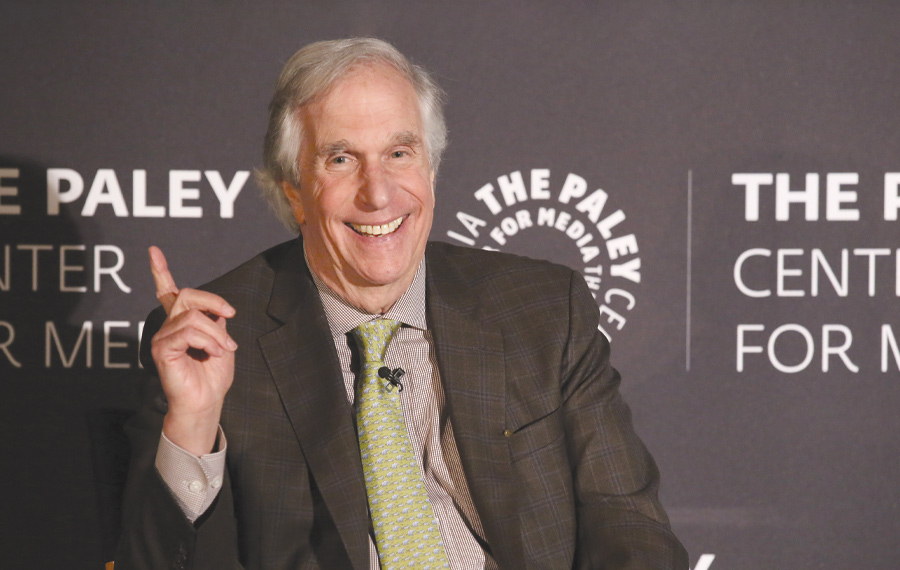
Henry Winkler Celebrated by Paley Center

Whether you know him as The Fonz from “Happy Days,” Gene Cousineau on HBO’s “Barry” or from his New York Times bestselling “Hank Zipzer” children’s book series, Henry Winkler’s fame spans generations. 

Having spent more than 40 years as an acclaimed actor, director, producer and author, Winkler has re-imagined drama and comedy while remaining a class act. 

In addition to his artistic pursuits, Winkler was recognized last year by the Los Angeles Press Club, receiving their Humanitarian Award for his work supporting children — as the honorary chairman of United Nations Friends of the Children; a founding member of the Children’s Action Network; National Chairman of the annual Toys for Tots campaign; and the Los Angeles Music Center’s Very Special Arts Festival for children who are physically challenged, to name a few. 

And on Feb. 12 at the Beverly Wilshire hotel, the Paley Center for Media dedicated an entire evening to honoring Winkler and his work. 

At the event, Winkler said his empathy for others and gratitude for his career stems from his ability to overcome adversity. As a child, his parents, who were Jewish German immigrants, called him a “dummer hund” or “stupid dog” because he was not a studious child. After 31 years of believing he was incapable of learning, he discovered he had severe dyslexia. 

Yet it did not stop Winkler from pursuing his passion for acting, earning a master’s in fine arts from the Yale School of Drama. He published the first in a series of children’s books in 2003 about a boy with dyslexia, aimed at showing parents and children that they can succeed despite a disability. The series was “Hank Zipzer” and it became a bestseller.

“How [you] learn has nothing to do with how brilliant you are. How you learn has nothing to do with how good you are at what you can do. And it does not put a limit on you,” Winkler said. 

He also revealed he cherishes every moment in his life, noting that at 27 he landed the role of Arthur Fonzarelli in “Happy Days” and at 72 he landed the role of Cousineau in “Barry,” for which he received his first Primetime Emmy  in 2018. He said the numeric significance might be a coincidence but what got him on those shows was purely work ethic. His ability “to try” for what he wanted despite not being able to read scripts made him a legend in the industry. 

“You think you can walk on water. The reality is, it is never true in real life. You think you are going on to bigger and better things and what I learned is I was on ‘Happy Days’ for 10 years and then for eight years, nine years I had a really hard time getting work as an actor.”

 — Henry Winkler

“If you stay at the table long enough, the chips come to you,” Winkler said in a nod to his Emmy acceptance speech. 

Winkler shared insider Hollywood tidbits with attendees at the event including turning down the role of Danny Zuko in the 1978 film “Grease” because he didn’t want to be typecast. “I went home and had a coke,” Winkler quipped. “John [Travolta] (who went on to play the role) went home and bought a plane.”

Discussing the concept of fame, Winkler said, “You think you can walk on water. The reality is, it is never true in real life. You think you are going on to bigger and better things and what I learned is I was on ‘Happy Days’ for 10 years and then for eight years, nine years I had a really hard time getting work as an actor. Because people said, ‘You know what? He is so funny, we love him, but he is The Fonz.’ I never got hired. That’s when I started producing.” 

To this day Winkler remains indebted to the late director and producer Garry Marshall, who gave him his first big break on “Happy Days.” 

“[Marshall] was looking for someone over 6 feet,” Winkler said. “He was looking for an Italian and he got a short Jew. Garry was my mentor, rest his soul. Garry is one of the greatest men I have ever met in my life.” 

Throughout the evening, moderator and ABC7 entertainment reporter George Pennacchio kept pausing so Winkler could give a quick hello to a friend, family member or co-worker he saw in the audience. When the audience Q&A portion wrapped up, Winkler continued to call on people and even left the stage to shake someone’s hand. 

When asked about child actors in Hollywood and how they should be cared for, Winkler said, “Let them be kids for as long as possible. Fame is unnatural to the DNA of being alive. Somehow whatever, however we got here as a creation, that was the one thing that the human being wasn’t able to handle because the pressure is earth-shattering.”

Winkler stays grounded, noting that his biggest accomplishment is his family, including his wife Stacey, his grandchildren and his children Zoe, Max and Jed.

Max is now a TV and film director, inspired, Winkler said, by Wes Anderson. And he has Max to thank for his role in Anderson’s latest film, “The French Dispatch.” 

Winkler said he received an email from Max saying, ‘Wes Anderson would like to know if you want to be in his movie.’ “He said ‘Dad you’ve got to do this.’ And I said, ‘Yes, I know.’ ” 

Winkler ended the night offering advice to the actors in attendance.

“If you want to be an actor, if it is burning a hole in you, you do what you think is right and you do it your way in order to get in the door,” he said. “Then, when you get in the door you better be able to deliver the goods ’cause you don’t get that many shots. I sure did what I thought I [needed to do] to get where I wanted to go. I am becoming the actor now that I dreamt of being then.”

Henry Winkler Celebrated by Paley Center Read More »

Dershowitz and Shrum Debate Impeachment, #MeToo and BDS

Harvard Law School professor Alan Dershowitz and Democratic strategist and Director of the Center for the Political Future and professor of political science at USC Robert Shrum engaged in a heated debate over Dershowitz’s role serving on President Donald Trump’s impeachment defense team.

The duo faced off at the Saban Theatre on Feb. 17 in a wide-ranging discussion organized by the Republican Jewish Coalition and hosted by Rabbi David Baron. 

“I worked hard for the election of Hillary Clinton. I worked hard for the defeat of President Donald Trump in an election, but I strongly, strongly, strongly opposed his impeachment,” Dershowitz said to applause in front of the 800-strong crowd. “I believe that a duly elected president should be removed from office only when there is a broad-based consensus and bipartisan support for impeachment and removal.” 

Dershowitz went on to condemn CNN for its coverage of his statements during the impeachment trial, saying the cable network took his remarks out of context. “My question to you,” Dershowitz asked the audience, “Should I sue CNN?” The response was a standing ovation.  

Shrum, a former Democratic strategist who worked on Al Gore’s 1988 presidential campaign and John Kerry’s 2004 campaign, called Trump the “single most reprehensible person ever to sit in the Oval Office as president of the United States.” The crowd booed. 

Responding to Dershowitz’s claim that his defense of the president was a defense of the U.S. Constitution, Shrum said, “You did not defend the Constitution of the United States. You kicked the Constitution of the United States into the gutter.”

As Dershowitz and Shrum went back and forth, the moderator, former Ninth Circuit Judge Alex Kozinski, remained mostly quiet, leaving it to Baron, whose congregation, Temple of the Arts, meets at the Saban, to walk onstage and ask the speakers and crowd for
more civility.

At the end of the tense 75-minute back and forth, Dershowitz and Shrum shook hands. “We can violently disagree, but I think we have some common respect for each other.” — Robert Shrum

Baron moderated the second and third parts of the evening, featuring Dershowitz and Shrum discussing the #MeToo movement and “Rising Anti-Semitism and Anti-Zionism.”

Dershowitz spoke about his personal experience with #MeToo, including accusations against him involving an underage girl. His book “Guilt by Accusation: The Challenge of Proving Innocence in the Age of #MeToo” was released recently. Dershowitz said that after the accusations, his upcoming talk to promote the book at the 92nd Street Y in New York City was canceled. 

Shrum noted the irony of three men onstage discussing the #MeToo movement without any women present. “I would not roll back this movement,” Shrum said, adding the public should be careful before making up its mind about somebody based on one person’s account. “One accusation does not prove a whole case,” he said.

Shrum and Dershowitz did agree on one thing: They both oppose the boycott, divestment and sanctions (BDS) movement. Dershowitz called it an “anti-free speech movement.” He said he supported the right of people to speak out but drew a distinction between advocacy and action, saying BDS fell into the latter category. 

Shrum is not Jewish but he has had Jewish clients, including former Israeli Prime Minister Ehud Barak, with whom he worked on his 1999 prime ministerial election campaign. “I entirely disagree with BDS,” Shrum said. “I do not and cannot imagine supporting it under any circumstances,” adding that he disagreed with rhetoric comparing Israel to apartheid-era South Africa. 

“I think BDS is wrong on the whole notion that somehow or other we are going to dictate a policy of a state like Israel, single them out, make them the bad people,” he said. “South Africa deserved to be singled out. Israel does not deserve to be singled out.”

Toward the end of the evening, the speakers returned to the topic of Trump and the 2020 election. Shrum said, “My view is Trump can’t win the election, but the Democrats can lose the election,” eliciting more boos from the crowd. 

Dershowitz condemned the Democratic Party for what he called its leftward views on Israel. He singled out Democratic presidential candidate Bernie Sanders (I-Vt.) and his supporter Rep. Alexandria Ocasio-Cortez (D-N.Y.). 

He said, “Let me announce here today, I have never ever in my life voted against a Democratic candidate for president [but] I will not vote for Bernie Sanders.” 

Shrum downplayed the influence Ocasio-Cortez and her followers have had on the Democratic Party, saying, “I think the press is fascinated with AOC. I think she is a bit player in the Democratic Party. I do not think she will become a major force in the Democratic Party.”

At the end of the tense 75-minute back and forth, Dershowitz and Shrum shook hands. “We can violently disagree,” Shrum said, “but I think we have some common respect for each other.” 

However, as the speakers headed offstage, the audience chanted “Four more years!”

Dershowitz and Shrum Debate Impeachment, #MeToo and BDS Read More »

Why Rachel Steinman Is Talking About Mental Health

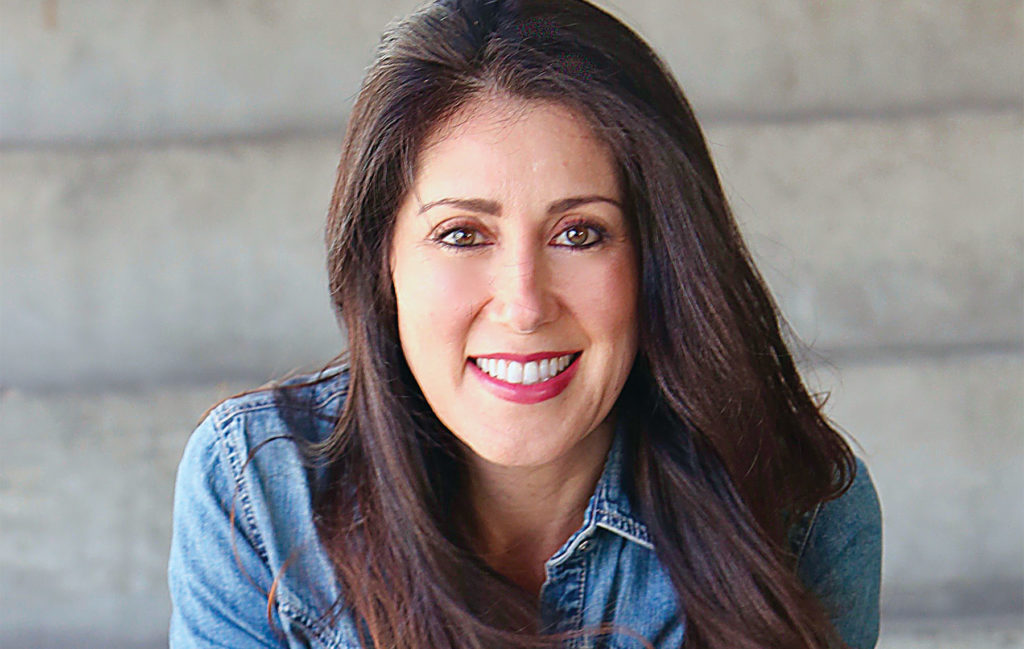
When she was 16 years old, Rachel Steinman’s maternal grandfather died by suicide by jumping from his Wilshire Boulevard high rise. While Steinman, a Studio City resident, remembers the word “depression” being mentioned, mental health was never really discussed in her family. At the time — during the late ’80s — that was pretty standard. Today, however, Steinman is talking. As a presenter for the National Alliance on Mental Illness (NAMI), she is talking openly about her family members’ struggles with mental illness. And through her podcast, “Dear  Family,” she is talking to others about the subject of mental health.

“My goal is to inspire others to reach out for help if they need it,” she said, “to find love and compassion for themselves and their family members who are dealing with mental health, and obviously to eradicate suicide.”

Steinman, 49, didn’t originally set out to be a mental health advocate. The Los Angeles native began her career as a teacher. She received her master’s degree in education from UCLA and worked at several local schools, including Sinai Akiba Academy. For several years, she stepped away from teaching to be a stay-at-home mom to her two children. Then, when she was 40, her grandfather’s third wife died. Steinman went through their apartment and discovered her late grandfather’s manuscript.

“My grandfather was a successful business owner,” she said. “He had kids, grandkids, a wife who loved him. For 24 years, I wondered why would someone do something like that who had everything?” The ghost-written manuscript titled “The Survivor,” helped pull back the curtains.

“In all my research, I was realizing the need to rid that stigma and shame surrounding mental illness, especially with the increase in anxiety in our kids. Just having the language and having these discussions [are] so important.” — Rachel Steinman 

“He had survived his father’s suicide, his brother’s suicide, his [first] wife’s suicide,” Steinman revealed. “My mom’s mother died by suicide. My mom has bipolar [disorder] but she wasn’t diagnosed until her 60s. I looked at my grandfather’s manuscript and decided I [didn’t] want to pass this generational trauma on to my daughters.”

Steinman also has a brother who has been diagnosed with attention-deficit/hyperactivity disorder (ADHD) but who wasn’t diagnosed until well into adulthood. In high school, she said, he was the golden boy. But he also was constantly getting in trouble. “It had to do with his ADHD,” she said. In law school, he began self-medicating with crystal meth and “ended up living out of his car until his car was repossessed and he was homeless.”

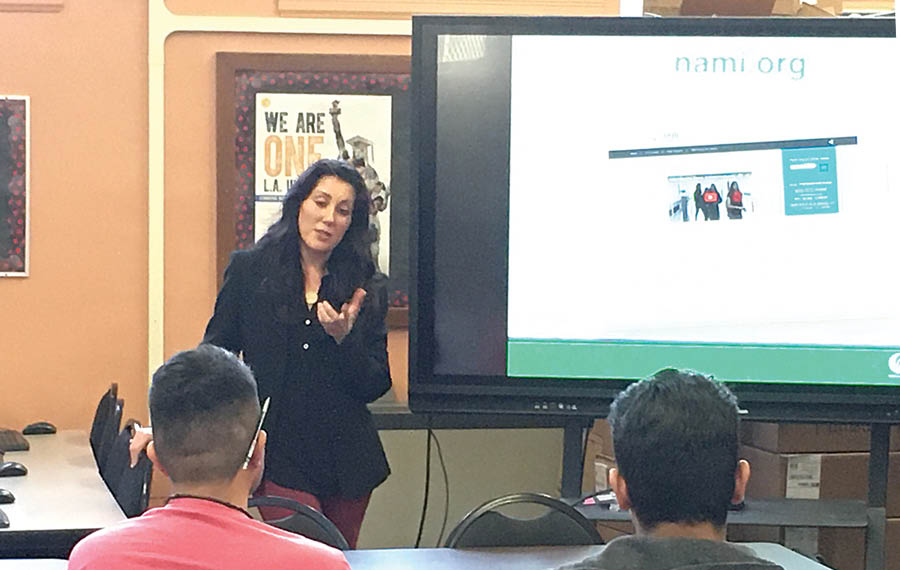
Steinman presenting at a local high school

In sum, Steinman said, “I had a lot of family trauma.” Fortunately, her brother has been clean and sober for many years. He owns a successful custom motorcycle shop and cafe in Brooklyn, N.Y., where he hosts regular AA meetings. And Steinman’s mother is receiving treatment for bipolar disorder.

The manuscript answered a lot of questions for Steinman but there were missing pieces she was eager to fill in. Doing research, she eventually penned what she calls a braided memoir that alternates between her story and her grandfather’s. That book has not yet found a publisher. Steinman, however, found a calling. 

“In all my research, I was realizing the need to rid that stigma and shame surrounding mental illness, especially with the increase in anxiety in our kids,” she said. “Let’s be honest. Teen pregnancy is down. Drunk driving is down. But anxiety and suicide is through the roof. Just having the language and having these discussions [are] so important.”

As Steinman started talking more openly about mental health and writing about the subject — she penned a popular essay titled “Anthony Bourdain and My Grandfather” (celebrity chef Bourdain died by suicide in 2018) — she was invited to be a guest on several podcasts. She loved the intimacy of the medium and last year she launched “Dear Family.”

“I wanted it to feel like you were eavesdropping on a family conversation or two best friends who feel like family,” she said. Guests on the weekly podcast have included actors, writers, business people and mental health experts.

“It can be a hard conversation when I approach someone I have in mind,” Steinman said. “I have definitely been turned down by people who weren’t ready to be so public or who wanted to keep it private completely.”

She also began the volunteer NAMI gig last year, speaking mainly to students at area high schools and teaching them about the signs of mental illness and where they can turn for support.

“The greatest thing of all is that my mom and I are closer than we have ever been,” Steinman said. “We are able to talk about things so openly. My mom is my hero now. She is the ultimate survivor. She is still battling every day. It’s not something that goes away.”

Why Rachel Steinman Is Talking About Mental Health Read More »

New York City’s Latest Tactic to Combat Anti-Semitism: An Ad Campaign Featuring Diverse Jewish New Yorkers

NEW YORK (JTA) — New York City is hoping that a new ad campaign will make Jewish New Yorkers feel comfortable despite a recent spate of anti-Semitic attacks.

The campaign, launched Wednesday by the city’s Commission on Human Rights, consists of four ads each featuring a photograph of a different Jewish New Yorker and a bold proclamation: “Jewish New Yorkers belong here. Anti-Semitism does not.”

The ads will appear online and in three Orthodox publications — Hamodia, Jewish Press and Mishpacha Magazine — but feature Jews from diverse backgrounds.

“I think it’s undisputed right now that Jewish communities, both those who are visibly Jewish and those who are not, are feeling particularly vulnerable and are looking for allies, for solidarity, for support and we hope that this campaign addresses some of those concerns and that fear,” said Dana Sussman, a deputy commissioner who helped develop the campaign.

Sussman appears in one of the ads. The other New Yorkers featured are Yosef Rapaport, a Hasidic Brooklyn resident and community activist; Laura Shaw Frank, a Bronx resident and Orthodox feminist; and Marques Hollie, a Manhattan resident and queer Jew of color.

Rapaport said he had agreed to participate in the campaign after criticizing the city for excluding visibly Jewish New Yorkers from previous ads on other topics.

“I’m active on social media and I also sometimes rightfully or wrongfully complain when New York City has promotional material ads for all kinds of stuff, tourism and all, showing the diversity of people, [but] they hardly ever show Hasidic children, men or women,” he told the Jewish Telegraphic Agency in a voice message on the WhatsApp messaging platform. “Now that they asked me it was kind of difficult for me to say no.”

Rapaport said he hoped the campaign “will have the desired effect of making us visible, that we belong.”

In addition to running the ads in the three Orthodox publications, the commission will also promote the images on social media and in digital ads on the New York Jewish Week website. The campaign cost $50,000, city officials said.

Shaw Frank wrote in an email to JTA that she had been concerned about recent anti-Semitic attacks and that participating in the campaign “felt like something concrete I could DO, instead of just feeling helpless.”

The commission has run similar campaigns to combat racism, Islamophobia and discrimination against the LGBTQ community. The city is also responding to the recent spate of anti-Semitic incidents in other ways, including by launching an education campaign in schools and creating an Office for the Prevention of Hate Crimes.

Hollie said he hoped the campaign would yield benefits even beyond combating anti-Semitism.

“The Jewish people are a racially and ethnically diverse group of people,” he said in an email. “My hope is that this campaign will not only remind the public about this, but also remind us that our community is multi-faceted and that we, collectively, are pillars of support for one another in times of joy as well as times of adversity.”

New York City’s Latest Tactic to Combat Anti-Semitism: An Ad Campaign Featuring Diverse Jewish New Yorkers Read More »

A Digital Library is Changing Judaism (For the Better)

Who is rich?
One who is happy with their lot. 

Who is wise?
One who learns from every human. 

Care for the stranger.
Give people the benefit of the doubt. 

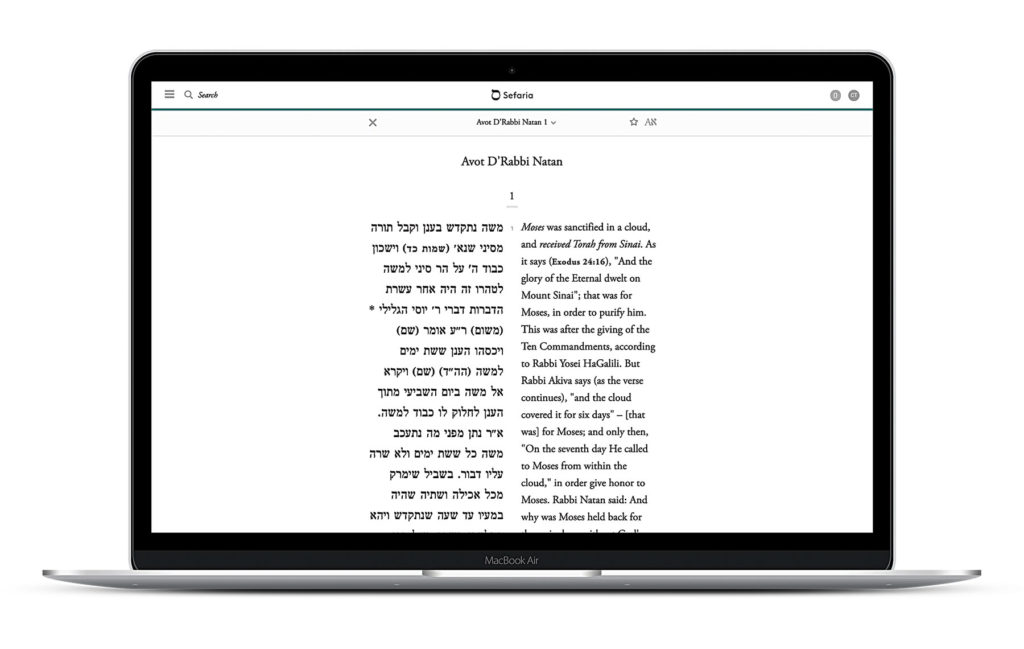
These and many other familiar Jewish ethical precepts live in the chapters of Pirkei Avot (literally the “Chapters of Our Fathers,” commonly translated as “Ethics of Our Fathers”). Thanks to Jewish online library Sefaria and IKAR Associate Rabbi David Kasher, Avot D’Rabbi Natan now is available as a companion to and commentary on Pirkei Avot. (To find Avot D’Rabbi Natan while perusing verses in Pirkei Avot on Sefaria, click on the “Tanaitic” section in the sidebar.) 

The Sefaria leadership expects the translation of Avot D’Rabbi Natan to be popular, as Pirkei Avot is the site’s most visited text after the five books of the Torah.

“Jewish wisdom is having a moment,” Sefaria’s Director of Education Sara Wolkenfeld told the Journal. “Something powerful about Pirkei Avot is that it has these broad sweeping statements about the human condition. It happens to be Jewish wisdom, but there is something that makes it speak to people and you don’t need a strong grounding in the textual tradition.”

Sefaria, home to a rich library of interlinked works in Hebrew, Aramaic and English, launched its beta site in 2012 and incorporated as a nonprofit in 2013. In 2018, the online virtual library had visits from more than 1 million users hailing from almost every country in the world. 

In 2019, co-founder Brett Lockspeiser was selected to the Forward 50 list of influential American Jews and in January Sefaria was named by Ha’aretz as one of the top 10 developments of the last decade. Recent Sefaria additions include the source sheet collections of famed commentator Nechama Leibowitz — the first female commentator in the core Sefaria library — and commentaries by Rabbi Shlomo Luria and Rabbi Yitzchak Caro. Recent Daf Yomi (daily Talmud study) participants are using Sefaria’s offerings, especially the William Davidson Talmud with Rabbi Adin Even-Israel Steinsaltz’s complete English and modern Hebrew translations, to find their ways into the text.

The Sefaria team uncovers gaps in what is available and what is needed by talking with the content team and learners in diverse learning spaces, Wolkenfeld said. “We think a lot about how Sefaria’s technology might support, improve and transform teaching and learning. We noticed that there are a lot of great texts in our tradition that don’t exist in translation …. The texts that are missing are an opportunity.”

“[Sefaria’s] having tradition accessible and translated on the internet … [is] one of the most important things happening in Judaism today. One of the great articulations Sefaria has given us is the understanding that our tradition is hyperlinked.” — Rabbi David Kasher

“[Sefaria’s] having tradition accessible and translated on the internet … [is] one of the most important things happening in Judaism today,” Kasher said. “One of the great articulations Sefaria has given us is the understanding that our tradition is hyperlinked. The way our texts have been composed is how we now experience the internet. All of Torah is linked and Sefaria is this cool computerized way of experiencing it, and enables Avot D’Rabbi Natan to be a constant companion to Pirkei Avot itself.” 

Kasher was on sabbatical in Israel when he decided to take on the translation project for Sefaria. “Every teacher of Jewish texts in the U.S. has to be a translator because not all the texts are translated,” he said. Having never translated an entire work before, Kasher said he was “fascinated by that process,” considering it a “way to get to know a text very deeply.” It took him a year to do the translation. 

“You’re trying to be a bridge between one culture and another, one language and one time period to another,” Kasher said. “The purpose of a modern translation is to be able to speak in the language, not just the grammar but the expressions of this current moment. The goal, he said, was to create a text that people “can just read through it, [and feel like the] language is the language of your time and falls easily into your ears.” 

Kasher called Pirkei Avot “one of the great superstars of our textual tradition. It has been studied and pored over with the same kind of devotion as the Torah itself. It’s one of the classic study pieces in all Jewish communities because it deals with the basic questions: What’s the path a person should choose? How do we live? Whether we keep Shabbat or kosher or ever go to synagogue, we are interested in the basic questions of what it means to live a good life … it’s all condensed into this concise and beautiful, but small and opaque, text,” he said. “To have this resource, this expanded discussion of Jewish ethics from the famous rabbis who brought us the Talmud, that’s a tremendous asset.” 

Asked for an example of the kinds of ethical questions tackled by Pirkei Avot and Avot D’Rabbi Natan as its commentary, Kasher points to the biblical commandment prohibiting lying, noting that it’s about giving false testimony. But, he said, Aaron was known for being one who “loves and pursues peace,” even if it meant lying to two people who were fighting by telling each that the other wanted to reconcile, using deception to create a peaceful outcome. 

“Whether or not it’s ever OK to lie gets us into more complicated ethical territory, and comes up again and again in Avot D’Rabbi Natan,” Kasher said. “What does it mean to tell the truth and are there values higher than truth? How should we or should we not manipulate language? How can we trust what people say? How precise do we have to be with our words and statements?” [These are some of] the central ethical questions in human life and in our public conversations, and that’s the kind of conversation Avot D’Rabbi Natan allows for.” 

The study of ethics is particularly relevant to this moment in history, Kasher added.

“In so many of our public spheres there’s a total disregard for or even an affront to basic ethics of social conduct. This is a time when it would be worth thinking about what it means to live well, both in the sense of good and righteous living. The resources that stream forth from our own tradition are particularly nourishing.”

A Digital Library is Changing Judaism (For the Better) Read More »

Jewish Republican Leader Fundraises for Candidate Who Once Said ‘Israeli Lobby’ Controls GOP

WASHINGTON (JTA) — Norm Coleman, the chairman of the Republican Jewish Coalition and a former senator from Minnesota, is fundraising for a candidate for Senate in that state who once said the GOP is “controlled” by the “Israeli lobby.”

Coleman will host a Feb. 27 fund-raiser for Jason Lewis in Washington. Lewis, a congressman from the state from 2017-2019, hopes to win the GOP primary to face off against incumbent Democratic Sen. Tina Smith.

CNN’s KFile last year uncovered audio from a talk radio show Lewis hosted in 2013 in which he discusses the opposition among some in the pro-Israel community to President Barack Obama’s nominee for defense secretary, Chuck Hagel, a former GOP senator from Nebraska who once referred disparagingly to the “Israel lobby.”

Lewis on the radio show alleged that dual Israeli-American citizens in Congress and in government influenced Israel policy. He named John Bolton, then a former U.N. ambassador, among them, although Bolton is neither a citizen of Israel or Jewish.

“They do have, they do control of the Republican Party right now,” Lewis said then. “The Republican Party is essentially a neo-conservative party that believes in unending support for Israel. A blind loyalty towards Israel is the linchpin of being a good Republican. And when you get those sort of dual loyalties, what happens if it’s not in America’s best interest?”

Lewis also refers to a “very strong American Jewish lobby” to explain U.S. support for Israel but says he does not see that “as a negative.”

Andrew Kaczynski, the CNN reporter who runs KFile, on Feb. 15 posted on Twitter an announcement that Donald Trump Jr. would be speaking at the event.

Coleman, who is hosting the event, lashed out at Kaczynski on Twitter, and said that Lewis in his two years in Congress “was a staunch and consistent champion of Israel.”

Jewish Republican Leader Fundraises for Candidate Who Once Said ‘Israeli Lobby’ Controls GOP Read More »

How to Cook the Ultimate Jewish Chicken Soup (with Bok Choy)

There’s no substitute for homemade chicken soup at any time but particularly when sick.

This is the soup I make when I’m under the weather. It’s incredibly curative. But as always, flavor first. Even when my nose is stuffy and my taste buds are compromised, I still know a good soup from a mediocre one. And this is delicious. 

When I need extra decongesting, I add a touch more ginger and garlic, both of which have natural antibiotic and antiviral properties. The bok choy is high in calcium, which will calm nerves and help induce sleep, but I use it because it adds a soothing, almost “milky” taste, if that’s possible from a vegetable. 

I cook the bok choy only minimally because I like it when it still has a little crunch to it. The cilantro leaves at the end add not only a vibrant green color and a great taste, but the chlorophyll helps to build blood cells, which is useful when you’re down and out.

Precise measurements are not needed. Eyeball it.

Bok Choy Chicken Soup a.k.a Sick Soup

8-12 cups chicken broth
1 boneless breast of chicken, uncooked
Extra-virgin olive oil
1 small onion, chopped
Salt, to taste
2 cloves garlic, finely chopped
1-2 cloves garlic, peeled, left whole
8 heads baby bok choy, sliced horizontally in 1/2-inch strips
2 inches fresh ginger root, unpeeled
Fresh cilantro leaves, to taste

Bring chicken broth to boil and reduce heat to simmer. Add chicken breast to broth, cover pot, and cook until just cooked through, about 20 minutes.

Turn off heat. Remove chicken and, when cooled, shred with fingers. Return to broth. (If certain people don’t want meat, add shredded chicken only to bowls of people who want it.)

Coat bottom of medium pot with olive oil and place over medium heat.

Sauté onions and chopped garlic.

When translucent, add broth and bring to a boil.

Test for saltiness and adjust to taste.

Using a microplane, grate garlic cloves and ginger to taste in each serving bowl. (I add a little nugget of each, about the size of a pinky to middle fingernail.)

Add bok choy to soup pot and boil for a few minutes until just cooked but still bright green.

Top generously with fresh cilantro leaves.

Serves 8.


Elana Horwich is the author of “Meal and a Spiel: How to Be a Badass in the Kitchen” and the founder of the Meal and a Spiel cooking school.

How to Cook the Ultimate Jewish Chicken Soup (with Bok Choy) Read More »

Weekly Parsha: Mishpatim

One verse, five voices. Edited by Salvador Litvak, Accidental Talmudist.

But if the slave declares, “I love my master, and my wife and children: I do not wish to go free,” his master shall take him before God. He shall be brought to the door or the doorpost, and his master shall pierce his ear with an awl; and he shall then remain his slave for life. -Exodus 21:5-6


Dini Coopersmith
Educational director, Women’s Reconnection Trip, reconnectiontrips.com

When I initially saw this verse, I groaned inwardly. What could I possibly write about a Jewish slave that would be relevant? And then I learned this message of the Nesivos Shalom, the writings of Rabbi Noach Berezovsky, zatzal: Sometimes, he says, we get so entrenched in the material world that we lose our identity as a Jew, an Israelite and go back to being a “Hebrew” — a slave to our physical desires. 

This Hebrew has the opportunity to recapture his essence on Shabbat, a spiritual day of meditation and holiness. “And on the seventh (Shabbat) he can leave and be free.” But if even after seven years of Sabbaths, he still has not been inspired by a life of meaning, and instead says, “I love my master, my wife and children”  — I like being a slave to my physical urges and have no wish to redeem myself, at that point, his ear is pierced, an indication that he has abdicated his right to return to his lofty status as a Jew. 

But even so, his situation is not hopeless. That “he will remain a slave for life,” say the commentaries, does not mean forever. It is 50 years — the Jubilee year. Shabbat remains a day of inspiration for us all, even after many years of disaffiliation, disenchantment and materialism. God never gives up on us. Perhaps, after many more cycles of Sabbaths (7×7), this Hebrew will wake up one day, finally experience the power of meaningful connection with the Almighty, and re-establish himself as a Jew!

Rabbi Peretz Rodman
Head of Israel’s Masorti Bet Din

An indentured Israelite (here, “eved” means “servant,” not “slave”) offered freedom might face a horrible prospect: If his master had given him a wife, she and any offspring would remain the master’s. From an economic perspective, not so unfair. 

For the servant, though, this law is draconian: Take your pick — lifelong servitude or fidelity to your family. Unless you resented the forced marriage, your dilemma is cruel. Remain and forfeit your independence and freedom forever (unlike the six-year term of indenture). Or leave and sever ties with your wife. How would she be treated? Children you’d fathered would answer to another man lacking the same paternal connection. What would their lives be like? 

One possible solution: Accept freedom, work to amass capital, and buy your wife’s and children’s freedom. That would take time. That might never happen; after all, you had been forced into indenture because of poverty, so something about your land or assets or abilities might well be deficient. 

The later reworking of this law in Deuteronomy addresses these concerns. It requires a manumission gift, stated in language critical of the earlier practice: “When you set him free, do not let him go empty-handed” (Deuteronomy 15:3). He is given assets of unspecified value — which could be applied to the purchase and freeing of his family. 

We are heirs to a tradition of amending harsh law for the benefit of those most disadvantaged, and that tradition begins already within our Torah, whose essence is chesed (kindness).

Rabbi Chaim Tureff
Rav Beit Sefer of Pressman Academy, director of STARS Addiction Recovery

From the literal text, it might make perfect sense that the slave wants to stay with his master. He has a wife, children, a place to stay, and according to our tradition, he is treated fairly well. The understanding of his pierced ear is due to the fact that he is enslaved because he stole, one of the holy Ten Commandments received at Mount Sinai. Since the ear heard, “Thou shall not steal” and committed this transgression, the ear is pierced. 

There is a deeper issue here that we can all relate to. We are each enslaved to something that we don’t want to walk away from. It is easier to remain status quo as opposed to making the change. 

Making a change in our lives is a difficult but rewarding proposition. Working with recovering addicts, this is a constant theme. I have a job, a partner, a place to live and at the moment things don’t seem bad. Why rock the boat? Why not stay in my position as opposed to wandering out of my own path and going into the unknown, i.e. sobriety? 

The verse teaches us that just because something is comfortable or what we are used to doesn’t mean it is what is best for us. On the contrary, we are here to grow, improve and push ourselves. As Rabbi Nachman of Breslov said, “The day you were born is the day God decided the world could not exist without you.” Such a world needs more than a slave to the status quo. 

Rabbi Jason Rosner
Temple Beth Israel of Highland Park

Maimonides, writing in the 12th century C.E., attempts to place the Torah in historical context. These verses discuss an adult male Hebrew debt slave. His master assigns him a wife and they have children. Upon his manumission, his family would remain property and he would be separated from them, but his feelings are taken into account. 

Maimonides argues that the Israelite version of slavery in the Torah is a leap forward from the slavery practiced in the second millennium B.C.E. (which would have forced the family to separate). He states that the Torah was designed to gradually curb some of the more brutal aspects of the Near Eastern society of the period (“Guide for the Perplexed,” 3:32). God’s goal is to move humankind away from slavery and sacrifice, toward prayer and contemplation. 

The Torah suggests intermediate steps such as considering the feelings and emotional attachments of slaves and replacing child-sacrifice with animal-sacrifice. Maimonides expands the ethical minimum for slaves: They should be well fed and not given useless or endless work in the manner the Egyptians used to oppress the Israelites (“Mishneh Torah,” Slaves 9:8). 

Modern society no longer condones slavery (or animal sacrifice) and these verses could be read as an embarrassing liability rather than progress. Seen through our eyes, this attempt to improve the legal condition of slaves remains an endorsement of the institution of slavery. And just as we look back at previous societies, future generations will look back at us. How will we be viewed? 

Rabbi Shana Chandler Leon
Spiritual leader, Congregation Ner Tamid, San Francisco

The door to freedom is open. The Jewish bondman stands on the precipice, his destiny again in his hands. But he does not move. His heart is torn in two, as he declares: “I love my wife and children; I do not wish to go free.” This family — imposed by the master and bred in captivity — is more precious than his liberty. 

We cringe at the ritual of the pierced ear and bemoan the perpetuity of the enslavement, but at the heart of this verse lies undeniable, astonishing pathos, sacrifice and devotion. A slave I might still be, says the “eved ivri,” but I am a willing slave to love. 

Countless families in the antebellum South faced the same unbearable choice when one of their number was offered “freedom.” Some, like our ancient ancestor, chose to remain yoked to the plantations for love of their spouses and children. But the physical and psychological scars lasted generations, maybe even “l’olam,” forever. 

From the slave markets to the Trail of Tears, from Japanese internment camps to the separation of migrant families at the border in our own historical moment, the cry of those in servitude pierces the soul. Let there be a reckoning of the soul. May compassion reign and mercy flow like water, for no one should ever have to choose between freedom or family. A life of forced servitude is a life without dignity, and a life torn from loved ones is not a free life at all. 

Weekly Parsha: Mishpatim Read More »

The Guy Who Plans to Buy 2.3% of The Planet

The fires this season in Australia have claimed the lives of 29 people to date. 15 million acres of woodland have burned in Australia. Not to mention the 4.6 million acres that have burned in America and over 2 million in Brazil. It is estimated that in Australia alone, between 500 million to one billion animals have died, including approximately half of the entire Koala population.

In many cases, governments are either helpless or completely uninterested in the problem. And although it is clear that 90% of the fires are caused by people, it’s not clear if there’s something that could be done to change the situation. One thing is for certain: around the world many nations are seriously struggling to preserve nature and wildlife.

In 2015, Prof. Uri Shanas of Haifa University came up with a groundbreaking idea – what if private people got together to buy a big chunk of nature, and committed to preserve it. With several partners, Uri created TiME – This is My Earth, an organization that strives to purchase and preserve 2.3% of Earth’s entire territory.

We’re happy to have Prof. Shines on the podcast today to discuss the initiative. Learn more about his work here. 

RSS Subscribe

The Guy Who Plans to Buy 2.3% of The Planet Read More »