When it comes to Israeli father-and-son athletes Haim and Aviv Gozali, the family that fights together stays together.
Haim, 46, and Aviv, 18, aren’t your traditional athletes. They are mixed martial arts (MMA) fighters who competed Nov. 14 in the Bellator 234 MMA Heavyweight event in Tel Aviv’s 10,000-seat Menora Mivtachim Arena.
The duo spoke with the Journal before the fight.
Haim, known as “Batman,” a welterweight fighter and former military police soldier in the Israel Defense Forces, has been fighting professionally since 1998, and lightweight fighter Aviv, also known as “The King,” currently has a 3-0 winning streak.
Haim said he was fighting professionally before the term MMA was used. Living in Israel, he started watching American fighting matches and ninja movies and wanted to take his interest to the next professional level.
“I saw the UFC (Ultimate Fighting Championship), and I said, ‘OK I want to do that.’ So I flew to New York and started training. It’s been more than 20 years now.”
In addition to his collection of medals compiled over 20 years, Haim earned a fourth-degree black belt in Brazilian jiujitsu, became head of the Renzo Gracie Israel Academy in Bat Yam, was the first Israeli MMA fighter to compete inside Madison Square Garden, and was the first Israeli to compete in an Abu Dhabi Combat Club (ADCC) event in 2007. He now serves as president of ADCC Israel.
“When I was in the army, I was 18 years old,” Haim said. “I was working in border patrol. Back then I was just learning karate, not jiu jitsu. Martial arts has been part of my life since I was 6 years old. Everything in the army was connected. The border patrol is a special unit in the army. I felt better prepared than the average soldier.”
The fighting father said MMA was his whole life and hoped it would rub off on his son. It was a rite of passage when they fought together for the first time in 2018.
“When you’re born, you want your son to do what you do,” Haim said. “I put him in a judo class when he was 3 years old but at 6 he said he didn’t like it. Then at 7 or 8 he said, ‘Look I want to compete.’ And I said ‘Great, go train.’ He did and the rest is history. You see him today and he broke the world record for fastest submission in Bellator MMA in his first professional fight.”
During that fight, Aviv defeated 28-year-old Eduard “The Hunger” Muravitskiy and made Bellator history with a highlight reel heel hook submission 11 seconds into the fight.
When Aviv decided to become an MMA fighter, Haim told him he needed to move to the U.S. so he could receive the proper training and resources. Both MMA and UFC are based on the West Coast.
“My relationship with my father when we’re not in [the] competitive mood is we’re like brothers. Not like traditional father and son.” — Aviv Gozali
Aviv said he looked up to American UFC fighter Jon Jones because “he’s the true example of a mixed martial artist to me.”
Haim and Aviv have intense workout schedules and diets. Aviv trains in Los Angeles while Haim stays in Israel. Each day includes several workouts including martial arts, boxing or jiu jitsu in the morning followed by conditioning training in the afternoon.
Since Aviv has trained in Israel and L.A., he said, “The training in L.A. is much harder. The sparring partners are more professional and everything is different.”
They also need to lose a hefty amount of weight in a short period of time. Haim said when he was two weeks away from the fight, he had 7 kilograms (more than 15 pounds) to go so it was like losing a pound a day.
“Every fight, I’m cutting like 10 kilo, which is like 20 pounds,” he said. “SoI cannot eat whatever I want. If I’m eating chicken breast, it needs to be 200 grams (about 7 ounces) and rice needs to be 80 grams (about 3 ounces). No salt, no milk, no sweets.”
And although the father and son are fighters in the ring, outside of it they aren’t competitive at all.
“My relationship with my father when we’re not in [the] competitive mood is we’re like brothers,” Aviv said. “Not like traditional father and son.”
“In the beginning it was easy for me to fight him, now it’s a bit harder now that he has worked in the States,” Haim said. “When he is in Israel, he stays with me. When I visit him, we are together. We are always together. Nobody believes we are father and son. Everybody thinks we are brothers or friends.”
Although their family worries about them when they fight, Haim said the new generation of cousins is starting to train because of them. And both Haim and Aviv say MMA fighting requires a lot of work, self-care and determination. They work with trainers and a sports therapist so they can take care of themselves during each match. Haim said while others are training their bodies he is “training the brain.
“You have to have persistence,”he said. “It’s what I tell anyone about everything. If you love it and you want to do it, you need to have persistence. It’s the only way to have success. I’m 46 going on 47 and I’m still in MMA. It’s never too late to dream … no matter what age you are.”
The event will air in the U.S. via tape delay at 9 p.m. PST Nov. 15 on Paramount Network and can also be streamed on DAZN.
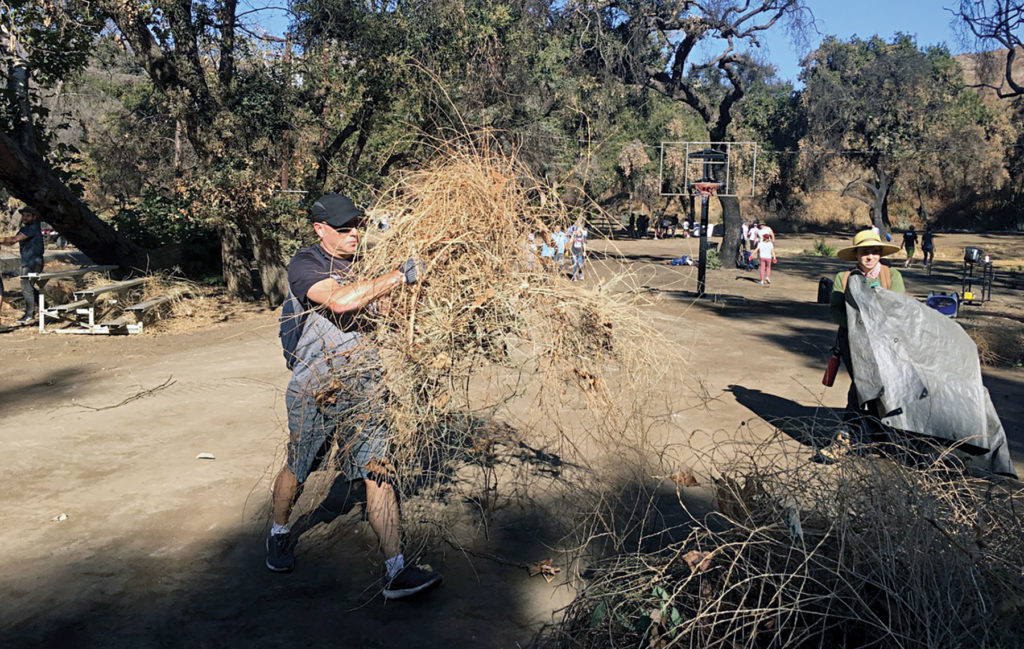
A year after the Woolsey fire devastated the Shalom Institute, home of Camp JCA Shalom, hundreds of supporters gathered at the burn site near the Malibu-Los Angeles County border on Nov. 10 to participate in a camp cleanup effort.
“It’s one thing to be writing checks,” Larry Cohen, incoming president of the Shalom Institute told the Journal. “It’s another to be getting your hands dirty.”
While the majority of the debris has been taken away, volunteers, with the help of the environmental nonprofit TreePeople, helped remove invasive plant species that have grown at the site since the fire, including castor bean, wild tobacco and mustard plant.
Teri Applebaum and her 10-year-old son, Josh, helped dig out a fence post where the ropes course used to stand. The Applebaums, who live in Fullerton, attend family camp every year. “This is a really special place for our family,” Applebaum said.
“I want to be part of the community and help restore this day camp,” said Woodland Hills resident Sebastian Djavadi. Despite never having been involved with the Shalom Institute, Djavadi came out with Cohen and Cohen’s son Adam to lend a hand. “Anything I can do to help,” he said.
The Shalom Institute has needed a lot of help in the past year, especially because it offers year-round programming. This year, it held its summer camp at the Gold Creek Center site in Sylmar, and it has relied on other organizations, including Camp Ramah, to host various day programs.
“It’s all very emotional, but it feels like camp today.” — Barri Worth Girvan
As part of the $23.5 million in the California state budget that was recently allocated toward rebuilding structures lost in the Woolsey fire and the 2017 Tubbs fire, the Shalom Institute is set to receive $6 million.
Executive Director Rabbi Bill Kaplan hopes the Shalom Institute will return to its home on Mulholland Highway in 2021. The site is located 2 miles from the Pacific Coast Highway, where a large, still-standing “Shalom” sign welcomes people to the property.
Carol Koransky, executive vice president and special counsel at The Jewish Federation of Greater Los Angeles, was among the attendees at the Nov. 10 event. “We have been here before, we will be here after and we will continue to help you grow as a family and a community,” Koransky said during the event’s musical closing ceremony.
Barri Worth Girvan, who first attended Camp JCA Shalom in 1992, enjoyed the music with her toddler daughter and her husband. She said she was pleasantly surprised to see the bleachers she helped build beside the basketball court still standing, though not much else remained.
She hopes that eventually her daughter will be able to attend the camp once it’s restored.
“We’re here to help rebuild because I want her to have a future here,” Worth Girvan said. “It’s all very emotional, but it feels like camp today.”
Harrison Brown and his fiancée Elana Lavi are already thinking about the health of their future children.
The couple attended Sinai Temple’s Ted and Hedy Orden and Family Friday Night Live services on Nov. 8, designed for those between the ages of 21 and 39. Along with participating in the usual kabbalat Shabbat services, they also took a genetic screening test, courtesy of JScreen.
A nonprofit home education and carrier-screening program focusing on Jewish genetic diseases, JScreen tests for more than 200 genetic diseases, including Tay-Sachs disease, Gaucher disease and cystic fibrosis. In couples where both partners are carriers of the same genetic disease, there is a 25% chance their child will become a carrier.
“I eventually want to plan a family and I think knowledge is power with these kinds of things,” Brown, 31, told the Journal. “Since we just got engaged, we want to ensure we make smart decisions when planning for a family. We’re lucky we had the opportunity to do this.”
Those who planned to take the test at Sinai Temple received instructions beforehand not to eat, drink or smoke 30 minutes prior to the test being administered. Once at Sinai, they were given a DNA “spit kit” to fill a tube with saliva. Some felt comfortable doing it right in front of the JScreen booth, which was set up at the entrance to the Shabbat service, while others headed to the bathroom to do the test in private.
“I eventually want to plan a family and I think knowledge is power with these kinds of things.” — Harrison Brown
Participants then handed over their tests to Hillary Kener, director of national outreach and marketing for JScreen, and were told they could retrieve their results in the coming weeks from a genetic counselor either by phone or via teleconference.
Kener told the Journal that Sinai Temple, a Westwood congregation that attracts many Iranian Jews, was a good venue for offering the tests because there is a misconception that only the Ashkenazi community is affected by Jewish genetic diseases. JScreen is also for Mizrahi and Sephardic Jews, she said.
The evening was part of an effort by JScreen, which works with Emory University in Atlanta, to ramp up its Los Angeles presence and reach those who are around the age of marrying or having children. JScreen partnered with the Neuromuscular Disease Foundation for the event, which subsidized the tests for people who registered in advance.
Zack Richeimer was among those who took advantage of the opportunity. “I am interested in doing this because I plan on marrying Jewish,” he said, “and it seems like the ethical and responsible thing to do.”
In the book, Nussbaum paints a realistic picture of what life was like in Amsterdam for herself, her friend Anne Frank and their families. The story also focuses on how one young German lawyer helped thousands of Jews escape deportation from the Netherlands during the German occupation.
Born Hannelore Klein in 1927 in Frankfurt, Germany, Nussbaum and her family escaped to Amsterdam when she was 8 years old. They moved into a neighborhood with many refugee families including Anne Frank and her family, who were old friends from Frankfurt.
Speaking with the Journal by phone, Nussbaum said, “My parents knew the Franks as they had been part of the same liberal synagogue in Frankfurt. But I don’t remember seeing the girls in Frankfurt. Margot (Anne Frank’s older sister) was a year and a half older than me and I was two years older than Anne so I was smack in between, and I did not model myself after a little talkative girl who was two years younger than I was. I modeled myself after her very dignified older sister.”
Over the years, Nussbaum saw more of Margot than of Anne, but in 1941 Anne acted in a play that Nussbaum directed in her parents’ apartment. “Beginning in 1941, we were not allowed to attend any cultural events so the Franks and my parents instituted a little reading circle to read German classics. It took place in different households and Margot, who was part of the book circle, would come to our house regularly. In the fall of 1941, we rehearsed a play, which I had brought from Frankfurt called ‘The Princess With the Nose.’ We did the play in our apartment and Anne was the lead so I would see her several times a week until we had the play under control. Anne was very lively, and she learned her lines very fast so she was very bright, clearly,” Nussbaum recalled.
In January 1942, the Nazis began the systematic roundup and deportation of Amsterdam’s Jews to the German death camps. “In the spring of 1942, it was quite obvious things were turning for the worse,” Nussbaum recalled. “We had to start wearing the yellow star. During that time, the Franks got busy building up their hiding place. And my parents got busy seeing whether they could let on to the fact that my grandmother was not Jewish and maybe conjure up a non-Jewish grandfather to match her, which meant that our family would not be fully Jewish anymore.”
When Hans Calmeyer, the German official in charge of “dubious cases,” decided in favor of their petition to be considered non-Jews, Nussbaum’s mother and sisters were allowed to shed their yellow stars, and her father, living in a “privileged mixed marriage,” was not deported. As a result, Nussbaum’s family never went into hiding.
We did a play in our apartment and Anne was the lead. She was very lively, and she learned her lines very fast so she was very bright, clearly.”
—Laureen Nussbaum
After the Franks went into hiding, the families did not see each other. “I did not think about these things. It was too dangerous,” Nussbaum said. “You did not want to know anything you didn’t have to know because there was always the danger that you would be apprehended and maybe tortured.”
Nussbaum, who now lives in Seattle, and her family did reconnect with Otto Frank, Anne Frank’s father and the sole survivor of the Frank family, after the war. “We were overjoyed when Otto came back. He was sure that his two girls had survived because he had learned they were in Bergen-Belsen and it did not have gas chambers. My then-fiancé, Rudi, was also searching for his mother,” Nussbaum said. “So Otto and Rudi would go together every day to the railroad station with pictures of their loved ones. Otto eventually found out the fate of the girls in June of 1945, and Rudi that his mother had died after the war after being liberated by the British.”
It wasn’t until after the war that Nussbaum learned of Anne’s talent. “What surprised me was that Anne was such an excellent writer. The moment I read her diary, I knew it was exceptional,” she said.
In 1947, Nussbaum and Rudi married. Otto Frank was their best man. The Nussbaums moved to the United States with their three children in 1957, eventually settling in Portland, Ore. Rudi joined the faculty of Portland State University and Nussbaum went on to earn her doctorate in German language and literature from the University of Washington.
As the years went by, Nussbaum came to realize that not many people knew the story of Calmeyer and how he had saved at least 3,700 Jews. “There were several books in German and Dutch on Hans but there was nothing in English except for a four-page citation from Yad Vashem after they had made him a righteous among the nations. So I felt compelled to write about this outstanding man,” Nussbaum said. “The man never bragged about his anti-Nazi stance. He just kept it to himself and was very interested in helping Germany after the war. He is not your typical hero.” Calmeyer died in 1972 at the age of 69.
It was in 2013, while Nussbaum was researching the book, that close friends suggested that she should weave her own memoir with the biography of Calmeyer: “Writer Ursula Le Guin, a colleague of mine, Tony Wolk and my co-author Karen Kirtley, all felt that my own story would add to the human interest of the book,” she said.
For Nussbaum, one of the key points she wants readers to take away from the book is that “people have to take responsibility. You cannot be like the Germans who said, ‘Well, we were only following orders.’ And Hans Calmeyer is an example. He was right under the eyes of the German Reichskommissar and he still found little ways to help people in life-and-death situations. We have to resist. We have to look out for opportunities even if it is against our government and the ruling convictions.”
For now, Nussbaum is living life to the fullest. “I am busy as a beaver,” she said. “I have already given five book launches and have three more upcoming ones. I have been asked to write an essay again so I am very happy that people still want my input.I am way too busy for a person of 92.”
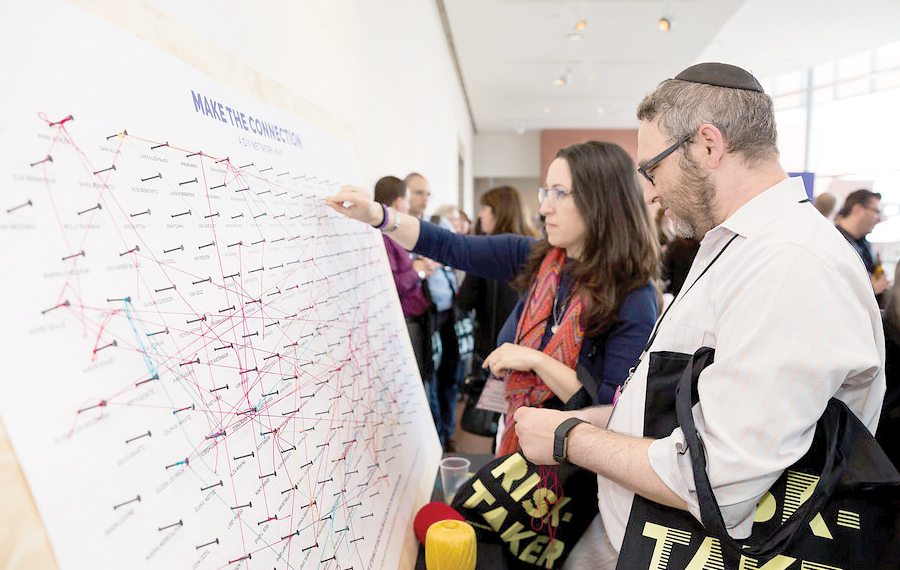
Los Angeles is home to a variety of Jewish community institutions, entrepreneurial efforts and innovative programs, but they don’t always intersect smoothly. However, UpStart’s new Change Accelerator program, which previously ran in Chicago and New York, has selected a Los Angeles cohort of seven “intrapreneurs” and is training them to make change from within.
“Entrepreneurial spirit is how this city functions,” said Danielle Natelson, design strategist for UpStart, which provides Jewish trailblazers with targeted support to encourage their ideas through implementation and beyond. The cohort is “not just influential within the walls of their institutions — they have reach outside those institutions,” she said.
She added, “This is an investment in the broader Jewish community, and the ripple effect that they get to have has potential to be really profound. The cohort we were able to attract are folks who are able to be game-changers.”
The Accelerator provides workshops and seminars based on principles of design thinking and adaptive leadership methodology. The organizations nominate the Accelerator candidates and promise that after six months of training, intrapreneurs will have the opportunity to implement what they’ve learned. Candidates need to have been in their current roles for at least a year and working in the Jewish communal landscape for three.
Cohort member Edana Appel, Westside JCC’s director of camp and family programs, said she was “excited about the chance to expand my skillset and build a network of like-minded individuals in Los Angeles.”
Having heard of UpStart’s impact in other communities, she “jumped at the opportunity to have an even greater impact on my JCC and my community.”
Appel calls the cohort “diverse in its skills but similar in each individual’s passion for their work and for learning.” She said she has gained a considerable amount of value
in learning new methodologies and having the opportunity to expand her skills in program planning.
“We need people in institutions as much as we need entrepreneurs, and we need them to work together because that’s really where the magic happens.”
— Aaron Katler
For Rabbi Scott Westle, rabbi-in-residence at Heschel Day School in Northridge, the Accelerator has provided meaningful networking with colleagues across the Jewish world.
“We share big ideas and in-the-weeds details,” Westle said. “I have enjoyed the opportunities to share with like-minded peers the challenges and opportunities of creating change in legacy Jewish institutions. My hope is that the professional skills and professional network will be a resource to create the change I wish to see … to reconceptualize Heschel as a Jewish center for all our families with even more robust offerings.”
Photo by Mika Larson Photography
Participants also have access to UpStart’s community of peers and coaches, who can provide advice and support.
“We know it can feel isolating and lonely trying to make change within an organization, lacking a community of practice,” Natelson said. “The cohort-experience components are designed to facilitate and nurture relationships to build a community of practice in Los Angeles.”
The other members of the Change Accelerator cohort are Jill Hoyt from the Avi Schaefer Fund; Tamah Kushner of Congregation Tikvat Jacob Beth Torah; Rabbi Matt Shapiro of Temple Beth Am; Aya Shechter of the Israeli American Council; and Adam Siegel of Beit T’shuvah.
“This program recognizes that the way you make change is by supporting the bold leaders who are making that change,” said Jocelyn Orloff, UpStart’s Southern California director. “The idea is that they are plugged in to the work we are doing and our network, local and national.”
One of the methods that is core to UpStart’s training programs is design thinking and human-centered design, which asks program creators to think about a program’s intended users or audience and to develop the idea with those users in mind.
“I hope I can take the concepts and modalities I am learning in the program and make them part of my professional tool kit,” Appel said. “In any Jewish organization, we are trying to serve people, so the ideas behind human-centered design should be a regular way we build and rebuild programming.”
UpStart emerged in the Bay Area in 2008 to support West Coast leaders. By 2015, there was increasing demand in the market to grow and scale to different cities, said UpStart CEO Aaron Katler. To meet this demand, UpStart merged with three fellow organizations, Bikkurim, Joshua Venture Group and PresenTense, in 2017.
Now UpStart has a network of local communities in Los Angeles, the Bay Area, Chicago, Colorado and New York. In L.A., the organization hosts workshops, provides peer support and manages the accelerators. It also co-programs the annual Collaboratory, a gathering of Jewish community visionaries in North America, including innovators, institutions and funders.
Katler said UpStart’s funders “see how important and messy the work is,” calling the partnership with funders “really important.” Nationally, UpStart has three foundations supporting its work — Schusterman, Jim Joseph and Marcus — that are “involved in thinking about the process but in a perspective of learning, not directing,” Katler said.
UpStart’s Los Angeles presence is funded by a Cutting Edge Grant from the Jewish Community Foundation of Los Angeles and by the Diane & Guilford Glazer Fund.
Katler said he hopes the Accelerator “drives real change. Our bias isn’t ‘when those institutions go away, Jewish life will be more vibrant’ — that’s not our approach,” he said. “We need people in institutions as much as we need entrepreneurs, and we need them to work together because that’s really where the magic happens. We need to train and support as many people as we can to create and renew Jewish experiences.”
For Katler, it’s all about helping to support a movement of changemakers in Jewish life. “We’re not a school or think tank,” he said. “As long as institutions of Jewish life are here, we’re going to do whatever we can to help them reach their potential.”
One night, after returning from an art opening, I had a chance to tell a couple of Italian friends what I was preparing for my first-ever “Hot Summer Tuscan Nights Cooking Class for Couples.” I was, of course, looking for their approval. My friend Barbara is from Tuscany, so I was particularly eager for her praise. I passionately described the potato recipe below and asked for advice on naming it. “They’re basically french fries,” I muttered. Barbara’s face suddenly soured. “Noooo, not French. Don’t call them FRENCH fries,” she retorted.
The Italians and the French have a centuries-old rivalry that sometimes makes me laugh. They argue about their soccer teams, their wines, their cheeses and their lovemaking. I tend to side with the Italians.
The irony is, these European Union allies have a lot in common, particularly when it comes to food, art and romance. The French just take all the credit. French toast, French kissing and the French press are actually Italian. (The Romans started to dip bread in egg and milk during the fourth century; tongue kissing originally was called “Florentine kissing” and the so-called “French” press was patented by Italians Attilio Calimani and Giulio Moneta.)
Whichever of the two cultures you favor, the fact is that the Italians cook better. And so these un-fried, un-French potatoes have been lovingly named after the peninsula that has always loved me back.
Italia, ti amo.
Little Italian Potato Sticks with Rosemary and Thyme
from “Meal and a Spiel: How to Be a Badass in the Kitchen”
2 russet potatoes, scrubbed (see note)
2 tablespoons extra-virgin olive oil
2 teaspoons dried thyme
1 teaspoon dried rosemary
2 teaspoons kosher salt
15 grinds of the pepper mill
Preheat oven to 425 F (400 F for convection oven).
Place each potato on a cutting board. Slice potatoes lengthwise into 1⁄4-inch “oval sheets.” Stack the sheets on top of one another and cut to make them 1⁄4-inch or 1⁄2-inch wide matchsticks. It’s OK if they aren’t perfect. The smaller ones will get crispier and the larger ones will be juicier. It’s a good mix. Ultimately, you want some to look like matchstick potatoes, while others should look like skinny, imperfect french fries.
Place the potato sticks on parchment-lined baking sheet.
Drizzle enough olive oil to liberally cover all sticks. Sprinkle with thyme, rosemary, salt and pepper.
Use your fingers to toss. Lick your fingers. The taste should border almost on too salty, peppery and herbal because flavor tends to burn off in the oven. If the flavor has no kick on your finger, then add more salt and herbs.
Bake for 25 to 40 minutes, checking periodically to see if sticks need to be flipped or shaken. Baking time will depend on the size of the potato sticks and your oven. Also, if you double or triple the recipe, increase baking time. The sticks should be golden, browned and crisp.
Note: This recipe is based on medium-sized, organic russet potatoes. If potatoes are larger, be more generous with olive oil and spices. Better too much oil than not enough.
Variation: Follow the same process but add salt and freshly ground pepper generously, omitting the herbs. This is equally good and pairs well with a chicken or meat that has been made with lots of herbs.
One verse, five voices. Edited by Salvador Litvak, Accidental Talmudist
[Abraham said,] “Far be it from You to do such a thing, to bring death upon the innocent as well as the guilty, so that innocent and guilty fare alike. Far be it from You! Shall not the Judge of all the earth perform justice?”—Genesis 18:25
Rabbi Ilana Grinblat Vice president of community engagement, Board of Rabbis of Southern California
My son recently took a cycling class. To accompany him, I relearned how to ride a bike. He showed me how the gear shift works — turning the gear shift toward me lowers the gear, making pedaling easier but gives each rotation less power. Turning the gear shift away from me to a higher gear makes pedaling harder but enables the bike to go further and faster.
The gear shift has become a metaphor for me on the holidays and Jewish life. Like turning up the gear shift, Judaism turns my focus away from myself and makes life harder. Without Judaism last month, I wouldn’t have had to fast, lead and attend services, build and decorate the sukkah, invite guests, etc. But Judaism also gives life more “umph” — more power and meaning. Without the hard work of the holidays, I would have missed extraordinary moments, from sitting in the sukkah to dancing on Simchat Torah.
Abraham’s confrontation with God about the Sodomites represents perhaps the first quintessentially Jewish moment in Abraham’s life — when he challenges God to live up to God’s dream of justice — reminding God that even God is not above the law. Rabbi Ed Feinstein described this moment as a “celebration of chutzpah, of covenantal audacity.” If only Abraham had exercised the same chutzpah in standing up for his son (when asked to sacrifice him)!
In this new year, both in our families and in advocating for justice, let’s embody Abraham’s chutzpah and take life a gear higher.
I like to think that Abraham, who was 58 years old when Noah died, spent some time with his elderly ancestor. Noah would have told him about the great flood, and how God destroyed all of humanity — saving only the righteous Noah and family. Abraham internalized this message. God is just. He destroys the wicked but spares the righteous.
When God informed Abraham that He was about to destroy Sodom, Abraham was surprised. In Noah’s day, God destroyed only the wicked but spared the righteous; now, it seemed that God was changing the rules. He threatened to destroy the entire population, wicked and righteous alike. Abraham protested: By Your own standard of justice set in the time of Noah, it is not right to destroy the righteous along with the wicked.
But then Abraham took a leap of faith: what he wanted from God was not justice, but mercy. Abraham did not ask God to spare the righteous of Sodom, he asked to spare the entire population — including the wicked — for the sake of its righteous residents. Perhaps those righteous people would somehow be able to influence the wicked residents to repent their evil ways.
And this is what separated Abraham from his grandfather Noah. Noah was content to accept God’s justice. For Abraham, justice was not enough. Abraham sought God’s mercy.
Cantor Michelle Bider Stone Shalom Hartman Institute of North America
Why did God choose Abraham? When God tells Abraham that he is destined to be a great nation, the Torah does not explain why. It is only in this chapter, when God shares with Abraham the plan to destroy Sodom and Gomorrah, that God reveals: “For I have singled him out, that he may instruct his children and his posterity to keep the way of the Lord by doing what is right and just (tzedakah u’mishpat).”
Abraham is chosen because he will teach humankind to be “right and just.” Abraham then challenges God on this very point, defending the potentially righteous people living in Sodom and Gomorrah. And God welcomes the rebuke.
Is it possible that Abraham understands what is required for justice more than God? Rabbi David Hartman explains that Abraham emerges in this story as God’s “worthy partner in history.” While the God of nature acts alone, the God of history is in covenantal relationship with humanity. The practice of Judaism is a partnership with God in carrying out what is right and just. But we must go beyond asking God to act justly. We must do the same. The story also teaches that we are required to speak up, to challenge and push back when we see injustice. And, like Abraham, we don’t stop seeking what is right and just until we have exhausted all options. In doing so, we keep up our part in this divine covenant.
Afshine Emrani Medical director, Los Angeles Heart Specialists
Question everything. Even God. What radical teaching! The questioning mind is the biggest gift the Jews have given the civilized world.
Questions are the basis of the scientific method. Questions are how we grow and discover the insides of cells and the distant galaxies. In our tradition, questions are as holy as are the answers.
Judaism is not the religion of surrender but that of struggle with the physical and spiritual world. Challenge authority. Challenge dogma. That is what Abraham is teaching us. His lessons: 1) If there is an absolute morality, then even God is not above it. God must act according to the code of ethics. If a prophet comes along and tells us to kill innocent people, that is a fake religion, a fake voice. We must rise up and argue against immorality everywhere. 2) We Jews hold life precious. We believe strongly in the sanctity of life. Jewish doctors all over the world fight diseases to keep Jews and non-Jews alive and well. Life over death. L’chaim! Killing should never be taken lightly. Even at war. Even as a punishment by God. 3) The entire world is made of the balance between justice and mercy. Too much mercy becomes evil. If you are kind to the cruel, says the Talmud, you become cruel to the kind. But, too much justice also becomes evil with the inflexibility to see the good in anything, any situation or any people. Question everything. Especially the things you take for granted.
It is very easy sometimes when reading the Torah to forget that God is God, you know, Omnipotent, Omniscient, etc. When Avraham questions God’s sense of justice, and then bargains for the lives of the people of Sodom and Gomorrah, this is certainly the case.
On the surface of it, Avraham’s response seems nothing short of major chutzpah. But the thinking student of Torah knows that something else is going on here, knowing that Avraham knew exactly with Whom he spoke, and that he never would have spoken to Him with any chutzpah whatsoever. Furthermore, if God is above time, why did He allow Himself to be bargained with? Why didn’t God just go with His “bottom line,” and avoid the discussion altogether?
One explanation is that we are being taught an important lesson about how to interact with God, especially during times of Divine decree. We learn from this how God is prepared to adjust His decrees, even “soften” them, if someone is prepared to step up on behalf of others and take responsibility for them. God looks for human “partners” to “help” Him perfect Creation, and nothing pleases Him more than when He finds one or two, etc. After He does, He allows them to assist in the direction of history, a great merit. This was Avraham, and by being so forthright, he proved himself a worthy associate of God. God showed him this by allowing him to bargain with Him as an “associate” for all the doomed cities.
Eight years ago, American Israeli Adele Raemer created the Facebook group “Life on the Border With Gaza: Things People May Not Know But Should.” She formed the group to give people who live within range of incoming rockets an opportunity to share their firsthand encounters of life in the strike zone.
The Israel Defense Forces (IDF) carried out what it called a “surgical strike” on Baha Abu al-Ata in Gaza City before dawn on Nov. 12, killing the Palestinian Islamic Jihad leader and triggering a retaliatory barrage of at least 150 rockets shot into southern and central Israel by militants in Gaza.
The IDF called Abu al-Ata a “ticking time bomb” who had plans to carry out rocket attacks and other terrorist activities in Israel within days.
The Iron Dome missile defense system intercepted at least 60 of the rockets. No one was reported injured in the attacks, but several homes, a factory and a highway were hit.
On Nov. 12, as rockets streaked through the sky into various parts of Israel, Raemer stayed in her home so she could monitor her page and document unfolding events. Raemer, who has lived near the Gaza border since 1975, spoke with the Journal at 10:26 p.m. Israeli time on Nov. 12. Rockets and alerts could be heard during the conversation.
Jewish Journal: What was your experience like this morning and how was it different from others you’ve experienced?
Adele Raemer: Each time it’s like a different story, but it’s basically the same thing. This time was a little bit different in that we got warning. This time at 4’o’clock in the morning, they had assassinated the terrorist [Islamic Jihad leader Baha Abu al-Ata] in the Gaza Strip. By 5 o’clock, we had been getting messages that schools would be closed, roads would be closed [and] people shouldn’t go to work. I didn’t get any alerts until I woke up at 6 because my phone was on silent. I was supposed to go to Tel Aviv today. I saw, ‘no trains, no school, country’s closed.’ So in that sense, it was very different. They realized there was no way they could assassinate [Abu al-Ata] without facing repercussions, and acted responsibly.
JJ: What does it feel like to be told to stay inside while you hear rockets going off outside your house?
AR: I was supposed to have this meeting in Tel Aviv and Tel Aviv was closed. I’m a teacher trainer so it was supposed to be with other teacher trainers all over the world. Instead of going there, we had a long Zoom meeting. The rest of the time, I moderate Life on the Border, so whenever these things happen, I stay behind to bear witness, to make videos and give interviews.
I have one eye on the TV all the time and keep track of what’s going on and seeing when alerts are happening. It’s nuts. The day is freed for you but you never get anything done because it’s too manic.
JJ: As a teacher, are you thinking about your students and the other faculty who are now affected by what’s going on?
AR: Of course. Everybody here has [post-traumatic stress disorder] and all the students and teachers who go to our school live and/or study here. Everyone, especially after Operation Protective Edge (in 2014),which was a whole summer, when I went back to class, instead of teaching the regular syllabus, we were told to teach other stuff. You can’t go back to class after experiencing something like this and start teaching the regular syllabus.
JJ: What do you want people to know about your experiences and the other voices featured on Life on the Border?
AR: Rockets on civilian populations is terrorist activity, and we live with this all the time. We have rockets approximately every week or week and a half. What other country would put up with that? When they shoot over the rockets they don’t care who gets in the way. Hundreds of thousands of Israeli civilians live in constant threat.
I have contacts on the other side. I am in touch with Gazans. I know that most Gazans want what I want: safety for their families, being able to put food on their tables. But there are these terrorists that need to be taken out before we can create a form of coexistence. When I moved here, there was coexistence. I’ve seen it. I know that it can happen. Hopefully, this is something that is on the way to happening again.
One of the more interesting and telling social experiments is to ask someone the very simple question, “Who are you?” Have the person fill out 10 sentences, each of which start with “I am.” See where that leads in terms of self-perception.
My 4-year-old daughter, Liana, apparently has a very clear identity. “Who are you?” I asked. She did not say, “Liana.” Rather, she declared, “I am Jewish. I am Eyal and Nissa’s sister. I am Charlie and Stella’s friend.” This is her identity. This is her sense of self.
Teenagers also likely wonder, “Do I define myself as a jock, a student or an artist?” Adults ask, “Who am I?” all the time. Do I define myself as a lawyer, doctor or teacher? Am I happy or sad? Do I identify myself with my work, my family, my religion, my people?
For the Jewish people, when we ask ourselves, “Who are we?” an inextricable part of our identity is Israel. For almost 2,000 years, the Jewish people prayed for a return to the Holy Land and studied the laws of the land of Israel, imagining what this almost mythical place would be.
Little more than 70 years ago, the dream became a reality.
Yet, if we take an honest assessment of our knowledge about Israel, the triumphs and tribulations, the moments of pride and even the moments of shame, how many of us really know our story?
In the past decade, article after article has been written about how education about Israel needs to change. Some argue for the need to leave the world of dogma and allow more room for questions. Others argue for a multiple voice, multiple vision and multiple values Israel education. The case for a more rigorous approach to Israel education in general also has been suggested. Regardless of where you come out on this debate, one thing is clear: The time for an Israel education revolution is now.
If we take an honest assessment of our knowledge about Israel, the triumphs and tribulations, the moments of pride and even the moments of shame, how many of us really know our story?
In contrast to Jean-Jacques Rousseau and John Dewey, who emphasized the importance of social and intellectual skills over content and information acquisition, in his 1988 classic, “Cultural Literacy: What Every American Needs to Know,” E.D. Hirsch Jr. takes a different direction and demands a critical role for what he calls “cultural literacy.” He points out that each nationality has a different cultural story, and in an anthropological sense, the transmission of information from adults to children is vital for “community acculturation.” It is “only by accumulating shared symbols can we learn to communicate effectively with one another in our national community.”
Hirsch goes on to lament the limits of cultural literacy in U.S. society: Few students know Homer’s epic poetry included “The Iliad” as well as “The Odyssey”; few students know the years of World War II and forget World War I. Going deeper, Hirsch decries how few students know the date that the Declaration of Independence was signed, can name one of the first 10 amendments to the Constitution or state how many U.S. senators California has.
It is not that young people are ignorant, Hirsch explains. They often are quite knowledgeable about many aspects of life, but “what they know is ephemeral and narrowly confined to their own generation.” Good people can debate what constitutes the specifics of cultural literacy, but we ignore cultural literacy at our own peril. Hirsch explains, “Cultural literacy is the oxygen of social intercourse. Only when we run into cultural illiteracy are we shocked into recognizing the importance of the information that we had unconsciously assumed.”
For every nation, every country, every people, cultural literacy is necessary as background knowledge to communicate effectively. If we all can agree to value cultural literacy in the United States, how true is it for the Jewish people, as well?
Ponder these rhetorical questions: How many Jews in America have heard of the Titanic yet never heard of the Altalena? How many of us know the name of the mayor in our home city without knowing the name of the mayor in our homeland city (Jerusalem)? How many of our students can tell you every statistic about LeBron James but have not heard of the legendary American-Israeli basketball player Tal Brody?
Let’s dive deeper. Do our students know about the moral complexities and historical narratives of the 1948 Deir Yassin massacre? Can college-bound students speak intelligently about the deep Jewish connection to settlements and at the same time have empathy for the Palestinian experience in Judea and Samaria?
A good educational experience is one in which the learner comes out feeling like a stakeholder, not a ticket holder.
Taking all this into account, how can we ask our young people to go to college and advocate for Israel without knowing the history of Israel? How can we ask our young people to lobby for Israel without demanding they have cultural literacy? How can we ask our young people to represent Zionism when they often do not know what Zionism represents?
At Jerusalem U’s Unpacked for Educators, we’ve met this challenge head on by creating a new Jewish holiday season during November, which often falls around the Hebrew month of Marcheshvan. Rabbinic tradition has it that the prefix is “mar,” or “bitter,” because there are no Jewish holidays during this month. This lacuna of historic Jewish holidays means there is a ripe opportunity for a new holiday, with November becoming Israel History Month.
As educators busy with running the day-to-day lives of our schools, camps and youth groups, we often relegate much of our Israel education to the big days: Yom HaZikaron, Yom HaAtzmaut and for some, Yom Yerushalayim. When we are not celebrating these big days, we often focus more of our time and energy with students on combating anti-Semitism or preparing high school graduates for the challenges they’ll experience on campus.
Learning about the history and culture of Israel may not feel like it has the same urgency as these topics, but developing a generation of Jews that has a superficial connection to Israel is devastating when the story of Zionism is so remarkable and inspiring. Zionism is the world’s most successful national liberation movement. Russian British social theorist Isaiah Berlin (1909-1997) said, “Israel has restored to Jews not merely personal dignity and status as human beings, but what is vastly more important, their right to choose as individuals how they shall live.” In a pithier way, Supreme Court Justice Louis Brandeis said on Dec. 9, 1910, “Zionism gives the Jews power to realize their dreams.”
Yitzhak Rabin
Although the value of cultural literacy is unmistakable, that does not mean education is about telling people what to think. It is about giving them tools for how to think. Professor and historian Gil Troy pointed out in his 2018 book “The Zionist Ideas” that “modern Zionists would best turn some exclamation points into question marks while preserving some exclamation points.” This means our educational battle is not a difference of opinions, but of indifference. Our battle is not antipathy for Israel, but apathy. Our battle is to ensure our young people have self-confidence in their story, without feeling like they know it all.
Although it may seem like a big ask, it doesn’t need to be. That’s why Jerusalem U’s Unpacked for Educators has created Israel History Month throughout the month of November because November is a month pregnant with educational opportunities for both literacy and connection to Israel.
Developing a generation of Jews that has a superficial connection to Israel is devastating when the story of Zionism is so remarkable and inspiring.
November is a month of both tragedy and triumph in the chronicles of modern Israeli history. These include the Balfour Declaration (Nov. 2, 1917), the assassination of Yitzhak Rabin (Nov. 4, 1995), the “Zionism equals racism” U.N. resolution (Nov. 10, 1975), the start of Operation Moses (Nov. 21, 1984) and the passage of the Partition Plan (Nov. 29, 1947).
Let’s take a quick glance at each of these days and some questions they might bring up.
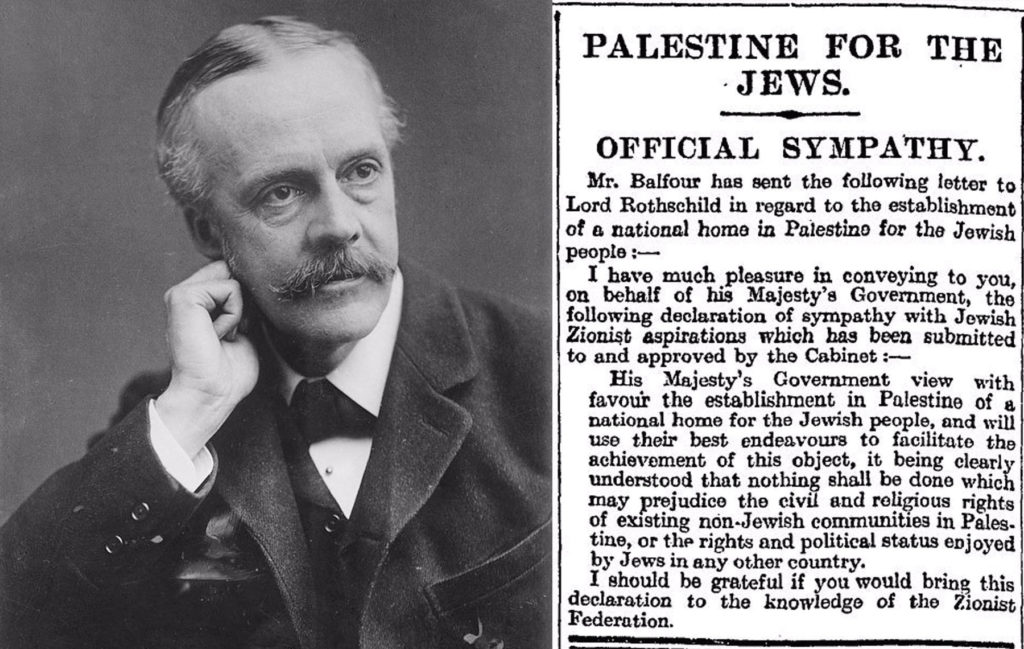
On Nov. 2, 1917, Foreign Secretary Arthur Balfour of Great Britain wrote a letter promising a “Jewish home” to the Jewish people in the land of Palestine, which the League of Nations ratified in 1922. Why does this document carry so much significance? What are ambiguities in the text? Why does it matter today?
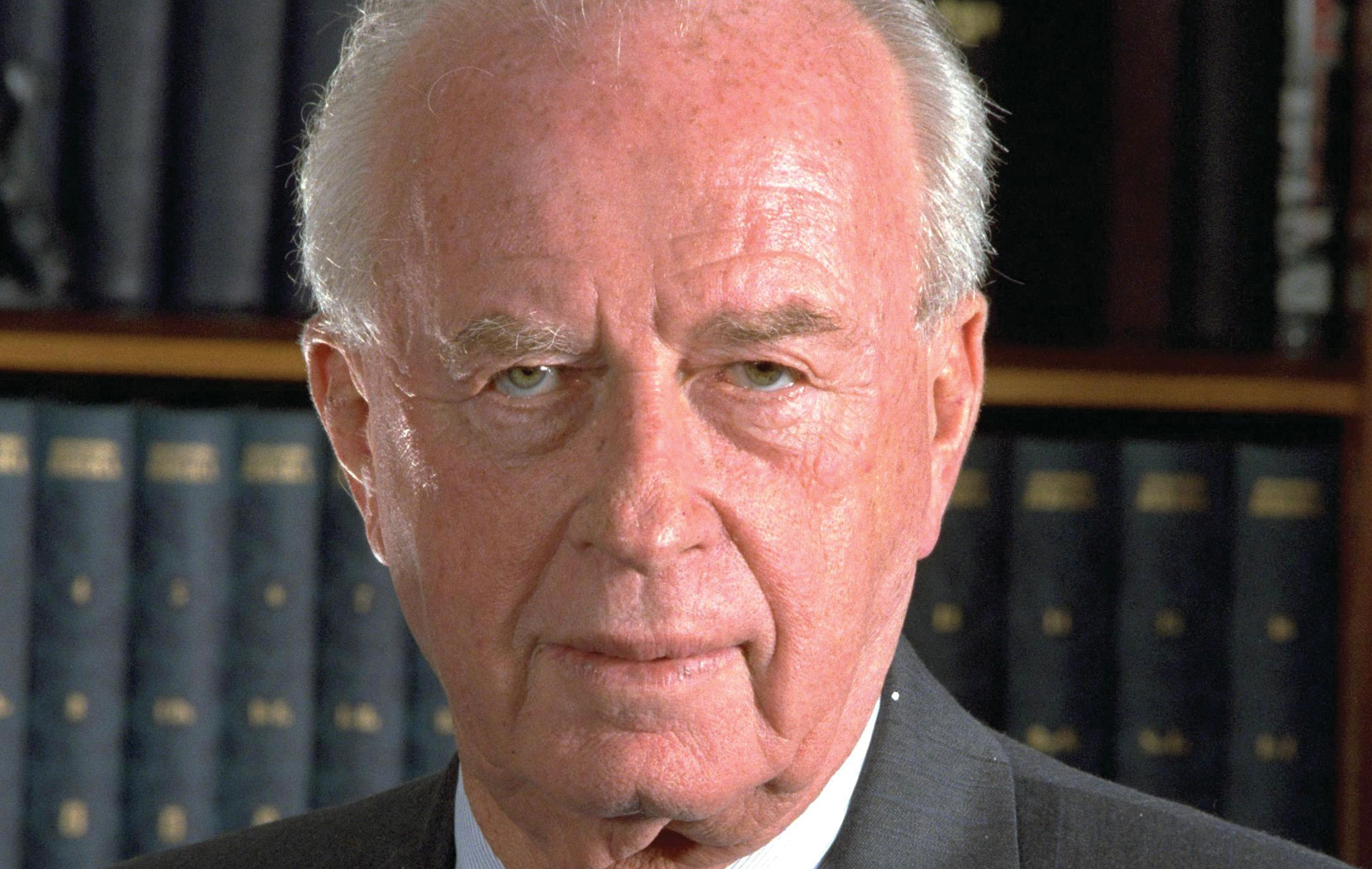
On Nov. 4, 1995, Rabin was assassinated. He was a man of paradoxes, a man of responsibility. Admired by many and abhorred by some, Rabin fought tenaciously for both security and peace, but what do we know about this man?
On Nov. 10, 1975, just 37 years after Kristallnacht, the United Nations declared that “Zionism is racism.” This was repealed in 1991, but it raises the question: Why is the United Nations so focused on Israel? Are there reverberations of this declaration today on college campuses?
Beginning Nov. 21, 1984, Israel engaged in Operation Moses, bringing thousands of Ethiopian Jews to its shores. This “ingathering of exiles” or “kibbutz galuyot” has been part of Israel’s raison d’etre from the beginning. What is Israel’s relationship with world Jewry? What does it mean to be a Jew in the eyes of the Israeli state? How far will Israel go to take responsibility for Jews worldwide? Ultimately, what is a home?
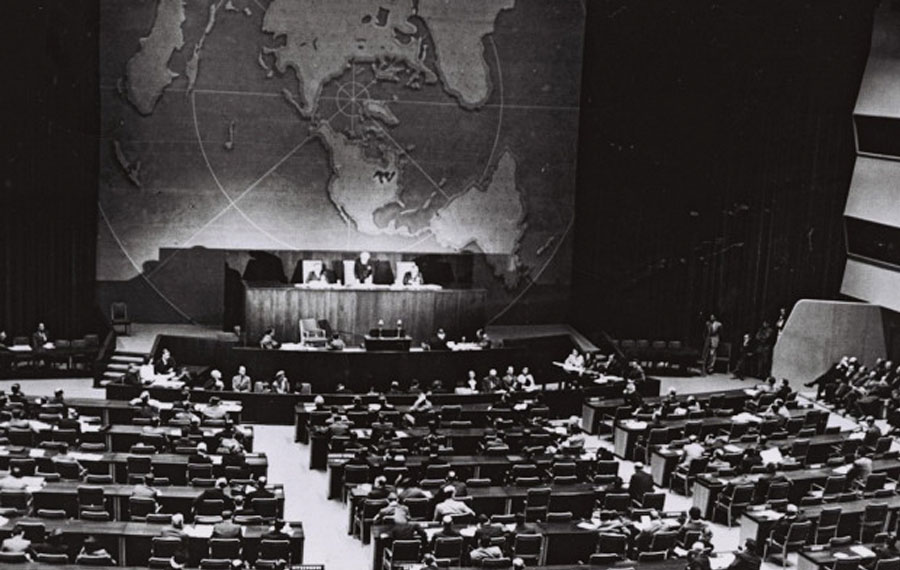
One of the most momentous days in Jewish history was Nov. 29, 1947. Just two years after the Holocaust nearly decimated European Jewry, the world voted there ought to be a Jewish state with U.N. Resolution 181, also known as the “Partition Plan.” This plan was to divide the land into two states: one Jewish and one Arab. What led up to the resolution and what were the considerations and reactions to it? How did the Jewish and Arab communities react to the resolution? Why was this resolution one of the most remarkable in the history of the United Nations?
For every nation, every country, every people, cultural literacy is necessary as background knowledge to communicate effectively.
Each of these events affected Israeli and Jewish history in different ways and form much of the basis for understanding different aspects of Israel.
We partnered with M2, the Institute for Experiential Education, to take our digital content and develop experiential learning activities. With these activities, students can explore the values and tensions inherent in the films. Some educational institutions may choose to spend a few hours on each topic, while some may choose to spend only 10 to 20 minutes. There is no right or wrong way of teaching about these events — or even which events should be taught. That’s up to each institution to decide.
Imagine how meaningful it could be to take a Hebrew language class to explore the backstory of the Balfour Declaration. For a Jewish history class to unpack the U.N. resolution that declared Zionism racism. Think about the impact it might have on a youth group to study the life and times of Rabin by watching a video about him, then reflect on the magnitude of his assassination. Consider how a whole school can leverage assembly time to celebrate Operation Moses, then have a sophisticated conversation about different ethnic groups in Israel. A synagogue could commemorate Nov. 29 each year by watching our video on U.N. Resolution 181 and learning about the values of compromise.
It is not just for formal educators, but all adults in the community. When I travel to different cities to describe the importance of Jerusalem U’s work, I inevitably hear a version of these questions: “Forget the teenagers. What do we do about the 30-year-olds who are apathetic about Israel? What do we do to engage parents who are too exhausted to spend time learning about their Jewish story? What do we do to engage the parents who influence the kids?”
Here are four suggestions to incorporate an educational connection to Israel based on Unpacked for Educators:
All pro-Israel advocacy organizations should send out weekly videos on the story of Israel so their constituents know the broader story of Israel.
Local Jewish community centers or federations can send out content each week or each month with discussion questions to have at the dinner table.
Include in your Shabbat dinners reflection opportunities to internalize the unique achievements and contributions of Zionism and the Jewish state.
Read our weekly digest of current events and use an empathic approach to dialogue and debate.
Yes, it can be daunting to fit so many topics into our curricula, and the dinner table can be riddled with all sorts of conversations — but learning about Israel and internalizing our connection to the State of Israel, the people of Israel, the challenges of Israel and the celebrations of Israel deserve our attention.
A good educational experience is one in which the learner comes out feeling like a stakeholder, not a ticket holder. This is only possible when there is cultural literacy — when we own our story.
So, this month of November and every month of November, join us in making it Israel History Month. Grab your phone, sign on to your computer, watch our videos and discuss the implications. Let’s all have strong opinions, different perspectives and even conflicting worldviews; let’s also remember we all have a seat at the table when we own our story. And when we own our story, we can answer the question, “Who am I”?
Noam Weissman is the senior vice president of education at Jerusalem U.