fbpx

October 30, 2019

The Power to Observe

When my husband Daniel and I moved to Los Angeles seven years ago, we were not fully observant Jews. We were on the path — I was doing an Orthodox conversion and he was interested in being observant again — but we hadn’t fully committed. 

We would shul hop in Pico-Robertson every Shabbat morning, looking for the right fit. At one synagogue, we talked to an Orthodox man at Kiddush about why he chose to be observant. 

“I didn’t,” he said. “I just grew up with it. If I could choose not to be, I would.” 

“Why?” Daniel asked.

“It’s too much of a hassle. I want to lead a normal life.” 

For months, those words haunted us. What were we getting into? Were we going to be miserable, too? Would we regret our decision to become observant for the rest of our lives but keep practicing simply out of guilt or obligation? 

At the time this occurred, we already had our hesitations about taking on this lifestyle. I was addicted to my smartphone and couldn’t put it down on Shabbat. I dreaded the High Holy Days season because, as an entrepreneur, I wasn’t getting paid for time off. I didn’t enjoying having to spend extra money on kosher meat. 

Daniel was afraid that observance was going to have a negative impact on his comedy career, because so many of his gigs were on Friday nights. He didn’t want to be seen as an outsider in the deeply atheist, anti-religious comedy community. 

So when we spoke to this man, it confirmed many of our fears. If we became more observant, there was no way we would like it. It was going to be as drab as secular society made it out to be. 

Since I’m a convert and Daniel is a baal teshuvah, we are lucky that we had the opportunity to shape our Jewish experience. 

While his voice resonated in the back of our heads, we weren’t completely deterred. We continued shul hopping, but we couldn’t find our spiritual home or the inspiring hook we were looking for to truly commit. Then one day, Daniel met a young Orthodox rabbi who just moved from Israel, and he invited us over for Shabbat. 

At the rabbi’s house, we had an uplifting and warm experience. He and his family seemed very content with their lifestyle. He invited us back nearly every week, answering our questions about observance and encouraging us to do more. Slowly, we did, thanks to him, along with many other families in the community who showed us how beautiful this lifestyle can be. 

I realized the importance of community in becoming and staying observant. I wasn’t finding so much inspiration in my prayer book or listening to rabbis speak on the bimah. While I loved studying Torah, that alone wasn’t enough to convince me to transition into this lifestyle. I had to see, firsthand, how wonderful it was. 

Today, because we’ve had such positive experiences, Daniel and I are observant. 

I love doing Shabbat because it’s a chance to connect to what truly matters. The High Holy Days are my favorite time of year because I get so many ways to strengthen my relationship with HaShem. I’m OK with spending more money on kosher meat because it means the animals had a painless death, plus I’m supporting Jewish-run businesses. Daniel has made his own path with his career that lets him observe Shabbat and still pursue his passions.

Since I’m a convert and Daniel is a baal teshuvah, we are lucky that we had the opportunity to shape our Jewish experience. I feel bad for the man we met at synagogue and those like him who feel they have to practice but don’t really want to practice. 

That’s not what our religion is about. HaShem wants us to be happy and find meaning in the mitzvot. Once I realized that, it completely changed my perspective. It helped me become the observant Jew I was meant to be. And today, I can confidently say that choosing this lifestyle is the best decision I ever made.


Kylie Ora Lobell is a Journal contributing writer.

The Power to Observe Read More »
How to ‘B’ Positive

Imagine you’re 32 years old and one day something seems off with your left eye. You visit your eye doctor. She sends you to another doctor and then that doctor sends you to a specialist. Five weeks later, you are blind. 

Welcome to Menachem Green’s world. He has Leber hereditary optic neuropathy (LHON). It is an inherited form of vision loss and there is no cure. This condition usually presents when a person is in his or her teens or 20s. Green told me that he’s grateful that he had more years of vision than most who have LHON. 

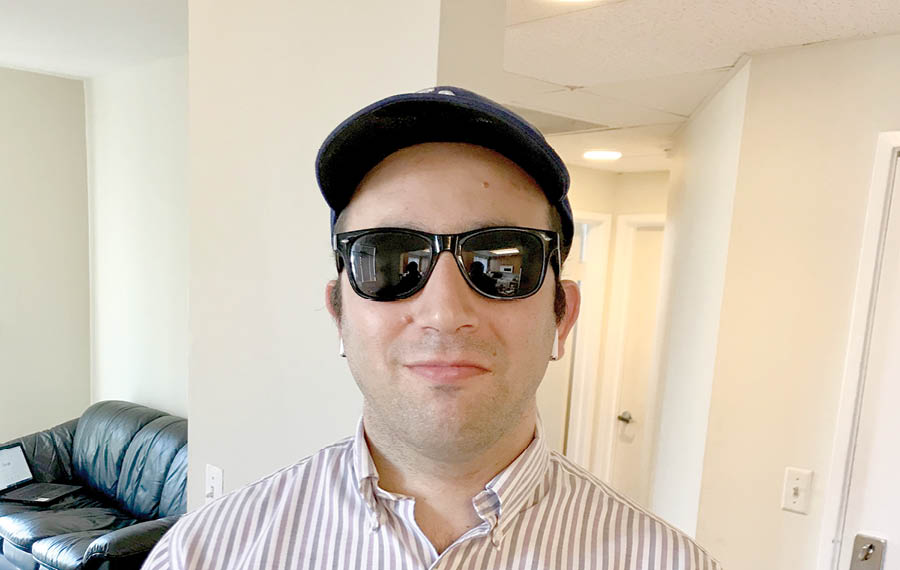
I met Green a few years ago when his vision was unimpaired and he worked at 613 The Mitzvah Store, a Jewish bookshop in Los Angeles. Then on Shabbos a few weeks ago, I was walking with my wife and I saw Green with a cane, Ray Charles-type sunglasses and a young woman. I said, “Hey, Menachem. It’s Mark Schiff.” With a big smile, he said, “The funny man. You want to hear a blind joke?” “Sure do,” I said. We traded blind jokes and then he told me a little about what happened. 

Green is handsome, has a great sense of humor and is a Torah-observant Jew. I thought about why this young man, who had nearly perfect vision just over two years ago, could be so upbeat. Was it because it was Shabbos and we are required to be joyful? 

Over the next couple of weeks, I saw Green in shul a few times and then visited him at his apartment in Pico-Robertson. His attitude wasn’t just because of Shabbos: Green is cheerful and positive. He may have lost his vision, but he hasn’t lost his spark. 

He told me he believes God will one day restore his sight, through a medical cure or through a miracle. He told me his faith in God is stronger now than before and he continues to study Torah. He is being taught something called assistive technology, which is customized to the person’s needs. His teacher also is blind.  

“He told me he believes God will one day restore his sight, through a medical cure or through a miracle.” 

Green, of course, is unable to read your facial expressions but he seems very in tune with the person he is talking with. It’s important to him not to be a downer. He said “B positive” is not just a blood type. Some friends call him every day and some stop by to help him around the house. He feels very close to them. 

Green grew up in Los Angeles. Sometimes, when the Dodgers are on TV, his mother would watch with him and call the plays. Believe it or not, he’s gone to the batting cages a few times. Why not? He’s still the same man he was when he had his eyesight. 

I asked him if he was angry about losing his vision. He said he’s more disappointed than angry. When his family found out he would lose his vision, they got very upset, but Green told them, “Sometimes God throws you a curveball and you have to learn how to hit it.” He also told me he doesn’t believe losing his vision is tragic. He said he’s been dealt a difficult hand but if you play it right, you can still win the game. 

Bosma Enterprises, an Indiana-based nonprofit that helps blind people stay self-sufficient, says that 70% of Americans who are visually impaired are unemployed. Green said he loves working and being around people. He currently doesn’t have a job. He’s receiving financial assistance but would rather have a job. He needs a break. He needs some nachas. He needs someone to take a chance on him. 

Although the world is blocked from his eyes, he knows God loves him, and his friends and family love him. Green has hope. If you asked him what he’d like his life to be like in 10 years, he would say he’d want to have his vision back, to be married, have a good job, a good Torah teacher and box seats at Dodger Stadium. Go, Menachem Green. See you at the batting cages.


Mark Schiff is a comedian, actor and writer.

How to ‘B’ Positive Read More »

CA State Building Takes Down Hanging Nazi Flag

A Nazi flag found hanging in a California state building was reportedly removed on Oct. 28 after receiving backlash.

The flag, which was red and featured a swastika in the middle, could be seen through a window in a California Department of Corrections and Rehabilitation (CDCR) building in downtown Sacramento.

This is a trashy way to represent this beautiful city, especially in a state building (1608 T Street Friday 10/25 @ 9:43pm)

CDCR Press Secretary Dana Simas told the Jewish News of Northern California (J.), “While CDCR has a zero-tolerance policy for the display of objects that are derogatory in nature, in an office that covers gang members and high-risk sex offenders we will come into contact with items that may be considered objectionable. However, we take this issue seriously and have removed the item and are looking into the circumstances for why the flag was displayed in potential view of the public.”

State parole officers told CBS Sacramento that the flag was among items confiscated from offenders “used as a teaching tool” to show officers “the type of hate displays that are circulating in jails.”

Sacramento resident Michael Johnson, who saw the flag as he walked by the building, told KTLA that the “context” behind the flag’s display through the window is not immediately apparent to the average passerby.

“It’s the first thing that a lot of people who may be coming from the airport, who may be traveling to Sacramento and witnessing the city for the first time,” Johnson said. “It’s not necessarily one of the first things I’d want them to see.”

The CDCR said in a statement to the Sacramento Bee, “Our initial review of the facts shows that the employee responsible for hanging this flag is a person of color, and has no ties or affiliation with white supremacy or Nazis. The flag was seized property from a case. This staff member and management in that office office showed an unacceptable lack of judgment that does not reflect the values of CDCR.”

Anti-Defamation League CEO Jonathan Greenblatt tweeted, “It’s shameful that a Nazi flag was found hanging in a corrections department office window in California. Glad officials are investigating. #AntiSemitism & #hate have no business in government institutions.”

CA State Building Takes Down Hanging Nazi Flag Read More »

Unleashing My Inner Marie Kondo

I keep few secrets from my husband, Jeff. The most incriminating activities that he might discover — if I were not careful — involve occasional splurges on overpriced anti-aging facial serums. Look, they’re still cheaper than regular Botox injections. 

However, from time to time I perform stealth operations on Jeff’s side of the closet. This is because the man takes the idea of clothing “sustainability” to such an extreme that it causes my left eyelid to twitch. To be fair, he can get away with dressing very casually for work, and he is always handsomely dressed for Shabbat and other nice occasions. His father, may he rest in peace, sold textiles, and Jeff learned about quality fabric from an early age.   

So, while I spend fairly freely on my wardrobe with nary a peep from the main breadwinner around here, it can be maddening to be married to someone this indifferent to material acquisitions. But everything has a limit. 

In my last purge, I deep-sixed two Pendleton shirts that had been hanging around — literally — since Jeff moved here from Chicago 35 years ago. Ditto the Oxford shirts he wore when we were first dating, only 33 years ago. Even in the protection of a semi-dark closet, colors fade as the decades fly by. 

Yet certain apparel is off limits to my Marie Kondo-style raids. For example, the Chicago Blackhawks jersey, featuring many jagged tears and indelibly stained with ground-in dirt. It’s so ragged that I bet it could fetch $300 in a trendy boutique. But this is among Jeff’s most prized sartorial possessions. 

“Certain apparel is off limits to my Marie Kondo-style raids.”

This is what happened to the jersey. Several years ago, Jeff and our youngest son, Ben, went on a Sunday hike. More than two hours after I had expected their return, there was no sign of them. Neither answered his phone. I was frantic. Looking out at the darkening sky, I called the fire department to report my missing men. Then I sat down to recite Tehillim. 

When they finally charged through the door, they looked like they had been in a skirmish outside the OK Corral. They refused to tell me what had happened, admitting only to having had “an adventure” involving an unmarked mountain path and a tumble down a hillside, leaving them lost. I was deliriously happy to see them, while silently furious at their folly of going off the trails. Meanwhile, Jeff and Ben were grinning from ear to ear, thrilled with a manly adventure normally not available to a white-collar business owner and a yeshiva student. 

Obviously, these mud-caked, torn clothes were destined for the trash. “Oh no you don’t!” Jeff protested when he saw me bagging the dirty duds. You’d think I was junking his late father’s initialed gold cufflinks. I believed that these clothes were no longer fit for dignified men, but my guys treasured them as mementos of a battle between man and the elements, a souvenir of a fabled experience shared by men who were no longer only father and son, but a band of brothers. Shaking my head in disbelief, I laundered the hiking gear in its own hot wash cycle and returned it to the closet.

During my stealth operations, I proceed with caution, ditching what seems safe: sweatpants with exhausted elastic, pajamas with air conditioning vents that were not among its original features, and dress shirts with fraying collars. When I had pointed out those frayed collars, Jeff just shrugged and said, “But otherwise they’re perfect!”  

The truth is, I greatly admire my husband’s commitment to the mitzvah of baal tashchit, of not wasting resources. In this marriage, he is the designated saver and I the designated spender. It works for us. 

Besides, it is not lost on me that a man this committed to holding onto the things he has had for years (and years and years) is also a man unlikely to trade in a wife of similar vintage for a shinier, more recent model. Knowing this does not make me any less attached to my overpriced anti-aging serums.

The Blackhawks jersey will always be safe from my purges. But what’s this? A pair of slacks with tattered pant leg hems? Yes! I’m back in business.


Judy Gruen’s latest book is “The Skeptic and the Rabbi: Falling in Love With Faith.” 

Unleashing My Inner Marie Kondo Read More »

Creating a Culture of Care at Camp

Within the past few years, our society has been undergoing a long-overdue shift in the ways we discuss and address mental, emotional and social health (MESH). Rather than stigmatizing or ignoring these challenges, I can sense new openness, transparency and accountability on an individual, institutional and societal level. 

And yet, as our understanding of these issues continues to grow in complexity and impact, we must continue to evolve our strategies for helping all those in need. This is especially important for those of us working in youth-serving organizations. 

The statistics paint a sobering picture. According to research shared by the National Council of Behavioral Health, 50% of all lifetime cases of mental illness begin by age 14 and 75% by age 24. Data from the American Foundation for Suicide Prevention in 2016 found suicide to be the second leading cause of death among youth ages 10 to 24 in the U.S. Finally, according to the National Alliance on Mental Illness, 13% of children from ages of 8 to 15 experience a severe mental disorder, and of those children, barely more than 50% receive mental-health services.

As CEO of Foundation for Jewish Camp (FJC), I have the privilege of observing firsthand how camp can positively impact the lives of young people. With this privilege, however, comes a great responsibility. The majority of campers and staff are in the precise age demographic in which the majority of mental health illnesses develop, and when our support, understanding and care are most needed. 

The majority of campers and staff are in the precise age demographic in which the majority of mental health illnesses develop.

For many campers and staff, we know camp can pose a multitude of challenges — living in close quarters, new social situations and departure from a typical routine — all of which can trigger unique mental, emotional and social health needs including anxiety and depression. Building on a pilot project for New York-area camps supported by UJA-Federation of New York’s Neshamot Fund, FJC has created a new initiative to elevate the standard and culture of care for the North American Jewish camp community.

“Yedid Nefesh: Nurturing Mental, Emotional and Social Health at Jewish Camp” is a groundbreaking new FJC program, made possible by an unprecedented $3.2 million grant from the Marcus Foundation. Yedid Nefesh,” which means “Beloved Soul,” refers to FJC’s understanding of the need for a multifaceted, whole-person approach to wellness as individual souls and as a community. Many Jewish communities sing these words at the start and end of Shabbat, so, too, must Jewish camps think about nurturing campers, staff, and their families.

This new initiative will provide funding to approximately 60 camps over three years to increase services, capabilities and awareness in addressing MESH needs in their communities. Camps will be able to add qualified mental health professionals to their staffs, enhance counselor training, integrate wellness programming into activity areas, and create cultural change within their camp communities year-round.

Jewish camp’s intense and immersive environment encourages community members to be vulnerable, enabling the spiritual and intellectual growth which makes camp so special. This is why camp is such a powerful tool for developing Jewish identity and socialization. It is also why Jewish camp is the perfect atmosphere to help campers, young adult staff and professional camp leadership build resiliency and learn to proactively address self-care.

The growing awareness and evolving complexities of mental health challenges in our society necessitates that camps be equipped with enhanced staffing and training at all levels to ensure proactive support for the mental, emotional and social health needs of every community member. 

With Yedid Nefesh, Foundation for Jewish Camp aspires to elevate the field of Jewish camp to nurture every beloved soul. Through this effort, we can build more caring, more inclusive and more resilient communities at camp — and beyond.


Jeremy J. Fingerman is the CEO of the Foundation for Jewish Camp.

Creating a Culture of Care at Camp Read More »

Angels and Kittens - A poem for Parsha Vayishlach (Aliyah 1) by Rick Lupert

Angels in the Fire 

Just when it seemed as if our community was irreversibly engulfed in the flames of bitter political divisiveness, along came a devastating fire whose relentless flames created a bridge between us, if only temporarily.

The Getty Fire broke out on Oct. 28 along the 405 freeway, forcing thousands to flee their homes as the wind-driven flames quickly spread in what seemed like a near-apocalyptic scene in the hills near the Getty Center.

Seemingly overnight, my left-wing friends stopped posting about the impeachment inquiry against President Donald Trump, and right-wing friends stopped defending Trump’s withdrawal of American troops from Syria, and both groups offered shelter to those who were forced to leave their homes because of mandatory evacuations.

As much as my heart ached that a part of my city was on fire, it was a welcome relief to finally see some unity among friends and colleagues.

The offers of help were beautiful in their no-questions-asked altruism: “Anyone displaced by the fires and needs a place to crash, please don’t hesitate to ask,” read one. Another friend who, along with his wife, owns Wiggle & Work, a co-working space for on-demand enrichment programs for babies and toddlers, posted, “If you know anyone affected by the fires who has a child ages 0-3, please let them know they can come get a break at our playground for free.”

It may seem like a given that people would have offered such help, but I think it was remarkable.

Schools, synagogues and organizations also rushed to help families that needed a place to stay. Milken Community School created displaced family forms; Valley Beth Shalom Synagogue offered counseling services; Chabad of Pacific Palisades opened its campus and made a special effort to reach out to seniors affected by the fire; Sinai Temple offered meals and respite to evacuees. All this was just the tip of the iceberg of assistance from the local Jewish community.

As much as my heart ached that a part of my city was on fire, it was a welcome relief to finally see some unity among friends and colleagues. The offers of help were beautiful in their no-questions-asked altruism.

I was particularly struck by offers from friends to host strangers overnight — not because these friends were risking their safety by inviting strangers sleep in their homes, but because their guests might be someone on the opposite side of the political spectrum.

Maybe somewhere in West Los Angeles, a Trump supporter was given a place to sleep by a Bernie Sanders loyalist, although the former might have kept his politics to himself for fear of having to sleep in the doghouse — outside.

Leaders and volunteers of synagogues that opened their doors to evacuees didn’t care whether those in need were unaffiliated or ultra-Orthodox, progressives who champion the rights of refugees or conservatives who attended a Trump fundraiser last month.

As it turned out, the better angels of our nature emerged not from clear, blue skies, but from the hideous hues of raging fires.

Can we ever reach a point where, short of a natural disaster, our humanity supersedes all of the other rigid criteria we stubbornly apply when deciding whom we embrace and whom we reject?

I’m not sure. To tell you the truth, it feels wrong, or at least premature, to get too philosophical at this point. We’re still in emergency mode. There are fires to extinguish, people to house, prayers to recite.

But let’s at least take a moment to recognize the humanity and solidarity in our community that have arisen from this burning darkness.

Whether it lasts or not, it’s a sight to behold.


Tabby Refael is a Los Angeles-based writer and speaker. 

Angels in the Fire  Read More »

Fires Give New Meaning to ‘Safe Space’

As fires were raging and people were being evacuated from their homes in Los Angeles, I kept thinking about the expression “safe space.” I thought about the millions of people without electricity in Northern California and all those who have been forced to flee their homes looking for that safe space.

But there was another reason why that expression was on my mind — I was planning to write a column about the issue of “safe spaces” on college campuses. These latest fires have given the column new meaning. 

I was struck in particular by a story last week about the editor of a college newspaper who “protected” readers by canceling an ad. The ad was for an event promoting National Review Editor Rich Lowry’s upcoming book, “The Case for Nationalism: How It Made Us Powerful, United, and Free.” It included statements such as, “Nationalism is based on love, not hate; Nationalism has created a world of peace, not war; Nationalism unifies us, rather than divides us.”

Apparently, these words were deemed too threatening to readers of New York University’s Washington Square News because, according to a statement from the editor, it may have “marginalized people of color” since nationalism connotes “xenophobia and white supremacy.”

Lowry responded to the cancellation by tweeting: “One wonders if anyone at NYU is allowed to mention that Alexander Hamilton, Henry Clay, Abraham Lincoln and Theodore Roosevelt were all nationalists, or if this would be too triggering.” In a follow-up tweet, he added: “This poisonous and lazy misunderstanding of the word nationalism — and the idea behind it — is why I wrote the book, and why people inclined to reflexively reject it should pause and actually listen.”

It is at these moments especially when I realize how the “safe space” movement on college campuses has diluted the very notion of safety.

For the NYU editor, though, the very idea of exposing students to this other perspective was seen as too dangerous and potentially hurtful. So the ad was canceled.

In a sense, it’s a compliment to our country that American college students today feel physically safe enough that they are free to focus on what makes them feel emotionally unsafe.

Much of the world doesn’t have that luxury. When we try, for example, to understand the differences between the Jewish communities in America and Israel, we can start with the fact that every Israeli is intimately familiar with the experience of running into a bomb shelter.

For millions around the world, a safe space is literal. It means a space where you’ll be protected from bombs or terror or even genocide.

In America, mass shootings and gun violence have punctured our feelings of safety and left many of us longing for a literal safe space.

The devastating fires in Northern California and now Los Angeles also remind us of the primal craving for physical safety.

It is at these moments especially when I realize how the “safe space” movement on college campuses has diluted the very notion of safety.

In another case last week, student activists at Harvard demonstrated against a news story in The Harvard Crimson. The paper had reached out to a federal agency for comment while reporting on a protest against deportations. The activists argued that talking to ICE was too hurtful to undocumented students and demanded that the paper never talk to ICE again. The reporting made them feel “unsafe.”

I’m sure the victims of the horrible fires in California have a clear and simple understanding of the meaning of a safe space.

There are similar examples at college campuses across the country. Many of these were documented by Greg Lukianoff and Jonathan Haidt in the book “The Coddling of the American Mind.” It speaks to an era when emotions are dominating rational thought.

The point here is not to downplay emotional well-being. The emotional health of college students at a time of societal upheaval and social media alienation is a serious issue that must be researched and addressed.

But that is precisely why it’s important not to water down or weaponize the word “safe.” If some students are triggered by speech they dislike, it undermines the students who have deep emotional issues that go way beyond a hurtful news story.

We’re living at a time when “feeling safe” has become an amorphous and fluid idea that touches different people on different levels. College students who are easily offended by dissenting views will have to find resiliency in a chaotic world they can’t control.

Students with serious emotional issues will need the wisdom to seek the safe space of professional help.

In the meantime, I’m sure the victims of the horrible fires in California have a clear and simple understanding of the meaning of a safe space.

Fires Give New Meaning to ‘Safe Space’ Read More »

Nov. 1, 2019

For fullscreen click here. 


Nov. 1, 2019 Read More »

Ripple Effect: Skills

One of my daughters looked at me while doing her homework and asked in utter frustration, “When in my life will I ever need to use these math equations and algebra?”

“You never know,” I say.

She rolled her eyes at me and went back to her books.

We all have skills that end up serving us in ways we could never imagine.

If you had told me that being a sergeant in the Israeli army would give me street cred with gang members in East LA, I would have laughed so hard I probably would have fallen off the chair.

Most of the kids I work with don’t have a lot of exposure to the arts in their life. Some of them are natural singers and dancers. For many, standing up in front of a crowd is not their cup of tea. In fact, it is absolutely and completely out of their comfort zone.

I tell them again and again that change happens when you step out of your comfort zone. I also tell them that they don’t have to be performers, but the experience of doing something uncomfortable can be very empowering and an important skill to learn.

“That is simply bullshit,” she says to me. “I do not need to be in the culminating show. What skill is that teaching me?  Nothing, Ms., absolutely nothing.”

Who knew that the extensive peace work I did in my twenties and thirties in the Middle East, the hours working with Palestinians and Jews in Israel’s West Bank, Jordan and more would give me the skills to negotiate with the toughest withdrawn non-cooperating youth on this planet?

“I am not reading my poetry to nobody! Do you hear me, Ms.? No fucking way!” she says, pouting.

I don’t even answer. I simply smile, knowing that she will lean in and read.  Because at the end of the day, everyone else will be reading and sharing. The audience will be loving it.  It will be a safe environment and it will be glorious.

Actually, by not saying anything, and simply letting them resist is my way of leaning in and getting  them to participate.

I remember standing outside the door of my beloved Palestinian friend’s house, her son yelling that he does not want to talk to a Jew. I remember him being adamant about not wanting me to even step inside the house. I remember her making him come outside, he sat on the porch hating me. I remember waiting for him to lean in and listen and eventually he became my best buddy.

Who knew those experiences would teach me that inside some of the sternest NOs, lives a yes that is waiting for the opportunity to come out?  If we are blinded by the NO, we might never have the magic of the Yes.

“I have absolutely no skills,” he told me.

“I’ll never get a job.”

“That’s not true,” I told him.

“I am a homie who did time and too much drugs, Ms.”

“Okay,” I tell him, “It’s all about how you tell the story.”

“What?” he asks.

“You were in the gang for years. That sucks, but you learned how to be a team player. Right?”
“Hell, yeah,” he said. “I am also loyal as fuck.”

“Cool,” I say.

“I also can problem solve, not gonna lie, but I solved some serious shit, Ms.”

“Cool again,” I say.

“I would say you got over real obstacles in your life,” I add.

 “You need to take the skills you have and use them for good. You have everything you need right here,” and I put my hand on his chest.

He looks at me with tears in his eyes.

“I know you see it, Ms., but I don’t think anyone else will.”

“They might not,” I tell him, “but we will help them see it.”

We put together a lovely résumé, stretching the skills he has in one place to fit the boxes he needs in another place.

“Wow, Ms.,” he says.

“You sure that’s me?” he asks when he sees the words on the paper.

“Yup,” I say.

“What are you going to tell people when they call you for a reference?” he asked me.

“The truth,” I say, “my truth,” and I smile.

“What does that mean?” he asks me.

“You know how to do everything that is written on that résumé.

It doesn’t matter how or where you learned it.

You just need to work hard and do your job.

Once they hire you, they will see how amazing you are,” I tell him.

I sang the praises of this man on each phone call that I got, but, because of his record, he didn’t pass the background check.

I changed my tactic and I started by saying he has a record, but he has amazing skills. I plead, “PLEASE give him chance.”

Then I start second-guessing myself.  Can he do this? Will he be okay? How can I vouch for him? And I panic a bit.

Here is the thing, sometimes it’s not okay. I have had that happen.  I sent someone to work somewhere and it was a bad fit. Sometimes the skills we think we have cannot help us. That’s okay. But sometimes it works, and the skills we learned in one place prepare us and help us move forward and things click.  My guy got a job. A friend of a friend hired him. He is doing great!

I recently got a phone call telling me how amazing he is and thanking me for the referral. I hung up the phone and cried.

I cried from relief that it all worked out.

I cried for joy for my guy who so desperately wants to change.

I cried because there were 2 other referrals that didn’t work out so well, and I had started to doubt that what I am doing is okay.

I cried, because crying is a skill  I do well. I realized that we need to always try and make the effort and believe in the possibility of the best, because that is clearing the path for that best to occur.

“Ms.,” he asked me.

“Do you really think I have all these skills”

“Yes, sir,” I say.

“Well, then I believe that too.”

“Good,” I say.

“You make me the best me,” he says.

“No, I don’t,” I say.

“You have it all.  I just invited it out.”

“Well, it’s all out and ready to go,” he said.

I cried, because, thank god someone was waiting and willing to let him try and I am so incredibly grateful, because he is now doing well and becoming everything he can be with a skill set that was just waiting to be found.


Naomi Ackerman is a Mom, activist, writer, performer, and the founder and executive Director of The Advot (ripple) Project a registered 501(c)3 that uses theatre and the arts to empower youth at risk to live their best life.

Ripple Effect: Skills Read More »

Can a Nice Jewish Family Celebrate Halloween?

If you think Halloween is spooky, you should see what’s lurking in Jewish liturgy! Evil eyes, spirits of fallen angels and even perhaps the first witch, Lilith. Ghoulish crossover aside, many Jewish families don’t celebrate Halloween because of its Pagan origins, it seems to fall in between Christmas (definitely don’t celebrate) and Valentine’s Day (it’s ok to get a card but don’t mention Saint Valentine). 

I tend to view Halloween as the only true neighborly holiday on the American calendar and one that epitomizes good old-fashioned Americana culture. Strangers open their doors to people they can hardly even see, let alone recognize, to give them candy without asking anything in return. Each year I’m more and more surprised that people are still willing to do this. It’s like for a few hours one night a year everyone decides to be part of a trusting and welcoming society. Well, all except those who turn off their lights and pretend they’re not home…

This is why I’m of the strong opinion that it’s important for Jewish families to participate in Halloween. I want people to know that my home has a mezuzah outside and that means a nice normal family lives inside. Of course, there are many other ways to be neighborly and I do understand that for some Jewish families it truly is against their beliefs to celebrate Halloween. For so many of us though, it’s more like an unspoken reality. We dare not mention it in our Jewish schools or synagogue but we know what everyone’s doing Thursday night!

I think handing out candy and carving pumpkins doesn’t equate to believing in ghosts and definitely not in making idols of them. Celebrating Fall is an inherently Jewish custom, the harvest season is at the heart of our Sukkot festival. So maybe this year, to increase your trick-or-treaters Jewish knowledge, you can decorate your house with: the ghost of Tevye’s dream, or the ayin ha’rah above your door! You may also look at the Target Dollar Spot to see if they have anything you can fashion into ‘Lot’s wife as a pillar of salt’. And if you really want to go Biblically scary, just put a giant evil snake tempting your visitors to eat from the apple tree! 

As a Jewish mom, I take my responsibility for drawing the proverbial line very seriously. My three year old asked me what a ghost was the other day and I quickly answered that they were ‘spooky things’ (because how do you explain the un-dead to a preschooler?), but when he asked me about witches I had an answer for that! I told him that some people believe that you can make things happen by stirring potions into a big boiling pot, but as a Jewish family, we don’t think that’s true. We believe you can only make things happen by doing them yourself. I told him what my rabbis have always taught me, that God gave us the most magical power of all – we can make good or bad things happen just by being ourselves. 

So if you’re like me and you’re feeling that annual tinge of Halloween/Jewish guilt I hope we can resolve to relax a little and to have a Happy (Kosher candy) Halloween!


Marion Haberman is a writer and content creator for her YouTube/MyJewishMommyLifechannel and Instagram @MyJewishMommyLife page where she shares her experience living a meaning-FULL Jewish family life. Haberman is currently writing a book on Judaism and pregnancy titled ‘Expecting Jewish!’ to be released Winter 2019. She is also a professional social media consultant and web and television writer for Discovery Channel, NOAA and NatGeoand has an MBA from Georgetown University.

Can a Nice Jewish Family Celebrate Halloween? Read More »