fbpx

August 28, 2019

Why ‘The Marvelous Mrs. Maisel’ Doesn’t Address Anti-Semitism

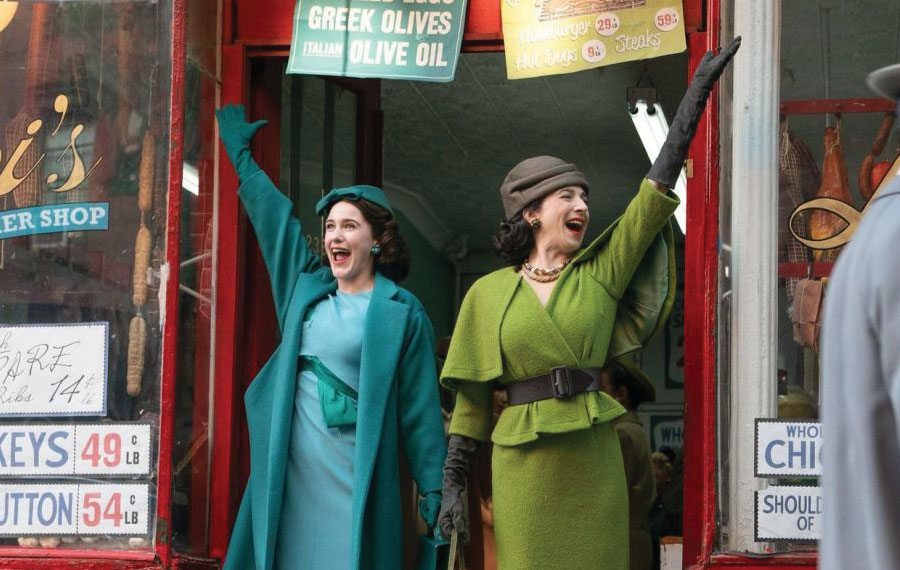
“The Marvelous Mrs. Maisel” is the most Jewish series on television. If you’ve seen it, you know that the show is a romp about a Jewish comedienne in the 1950s. You also know that the titular character never faces anti-Semitism.

As Midge Maisel (Rachel Brosnahan) tries to make it in stand-up, she encounters blatant sexism and acknowledges Jim Crow racism. But as a show that depicts a 1950s Ashkenazi family, hatred of Jews is missing from the landscape.

This realization is almost as irksome as the scene in the pilot in which someone orders pork chops at a kosher butcher. Was Mrs. Maisel’s era actually the haven from hatred showrunner Amy Sherman-Palladino depicts? In some ways, yes.

Fresh off the complete devastation of the Holocaust, the next decade became the one when Judaism began to be accepted as an American faith.

The 1955 bestselling book “Protestant-Catholic-Jew” by Will Herberg normalized Judaism as a part of America’s religious heritage. Depicting the United States  as a “triple melting pot” comprising three major faiths, the groundbreaking book encouraged the public to include Jewish immigrants as a part of America’s proud history of offering refuge from religious persecution. Jews were like the Pilgrims, with brisket instead of turkey.

Some of the most virulently anti-Semitic folks have never met a Jew. Their hate is a symptom of ignorance. In the 1950s, through pop culture, scores of Americans met Jews for the first time.

As Mrs. Maisel would have gained celebrity, so did other Jewish figures, normalizing Judaism and making anti-Semitism less common. Before and after Bess Myerson became the first Jewish Miss America in 1945, Hank Greenberg rocked the baseball world. Joshua L. Liebman, a Reform rabbi, wrote “Peace of Mind” in 1946, which stayed on The New York Times bestseller list for more than a year. 

It didn’t hurt that in the ’50s, the ultimate pop-culture villain had come to rise: the Nazis. Today, it seems Hitler’s regime is the go-to figure of evil in movies and political debate. After World War II, no one wanted to be compared with America’s sworn enemy. 

Because anti-Semitism was so characteristic of the Third Reich, it drew a new stigma. Discriminating against Jews became un-American. According to the 1950 “American Jewish Year Book,” “Organized anti-Semitic activity, which began to decline after the war, continued at a low ebb during the year under review.”

“Mrs. Maisel doesn’t mention anti-Semitism because the subject was not much discussed in polite company.” — Jonathan Sarna

But that didn’t mean anti-Semitism vanished.

“In the 1950s, there were still clubs and hotels that excluded Jews, and professions that Jews had trouble entering,” Jonathan Sarna, Joseph H. and Belle R. Braun professor of American Jewish History at Brandeis University, said. “Quotas limited Jews’ choices when they applied to college. That was why the American Jewish community established a new university named Brandeis in 1948.” 

In 1958, the Liberty Lobby arose, which was a deeply anti-Semitic political advocacy group created by Holocaust denier Willis Carto.

 “It was the Jews and their lies that blinded the West as to what Germany was doing. Hitler’s defeat was the defeat of Europe and America,” wrote Carto in one of his letters, which were presented as evidence in a federal civil lawsuit. The Anti-Defamation League credits the group with keeping anti-Semitism alive so it could be absorbed into the new incarnation of the Ku Klux Klan in the 1960s.

Back in the day, Liberty Lobby had a daily radio show that at its conclusion, offered listeners a copy of its “America First” pamphlet. President Donald Trump’s administration gave fresh life to that slogan. “From this day forward, a new vision will govern our land; from this day forward, it’s going to be only America first. America first,” Trump said in his 2017 inaugural address.

After a slew of neo-Nazi marches, synagogue shootings and anti-Jewish vandalism, one could wonder if the resuscitation of this ethnocentric slogan comes along with its hateful anti-Semitic heritage.

However, when Mrs. Maisel worked makeup counters by day and comedy clubs by night, these ideologies were fringe, not in the Oval Office. Considering that landscape, it may seem less mystifying that a show about Judaism in the 1950s could be realistic and not prominently feature anti-Semitism.

In truth, “The Marvelous Mrs. Maisel” fails to fully portray the challenges faced by 1950s Jews. 

“Even in the bubbles of the Upper West Side, the Catskills and the hipster night clubs that define Mrs. Maisel’s life, she would keep running into reminders that she and her family were, ahem, different,” historian Gil Troy, who teaches at McGill University in Canada, said. “Certainly, at the makeup counter, she would have to endure some Upper East Side WASPy-snootiness.”

The opulent lifestyle Midge enjoys, filled with countless hats, elaborate breakfast feasts and a diligent maid, is historically accurate. Many of the show’s details properly portray the lives of Jews in the 1950s.

“It was not just in terms of their security and social acceptance that contemporaries viewed the postwar era as a golden age for American Jews; prosperity characterized the period as well,” Sarna wrote of 1950s Jewry on the My Jewish Learning website. “Jews had become fundamentally middle class, their proportion in non-manual occupations exceeding that of the general population.”

In the 1950s, there was an uptick in Jewish journalists, authors, engineers, architects and college teachers. In “The Marvelous Mrs. Maisel,” the comedienne’s father, Abe Weissman, works as a mathematics professor at Columbia University. This represents the era well. 

But anti-Semitism remained the way for gentiles to assert their power over Jews, regardless of how wealthy and educated they became.

“At any given moment, a cabbie, a store clerk, a waiter, even in the insular bubbles, could push back and try to take down a Jew — especially an obviously outspoken, wealthy Jewish woman,” Troy said. On the show, male comedians and promoters constantly are trying to cut down Midge for being a woman. In reality, the people who wait on her hand and foot also had the power to bring her down to size for being a Jew. “In a bizarre way, it was an equalizer that transcended class, but it was clearly a power play,” Troy said.

But it’s also likely the subject of mistreating Jews is taboo on the show because in that era, discussions about anti-Semitism were.

“Mrs. Maisel doesn’t mention anti-Semitism because the subject was not much discussed in polite company,” Sarna said. “Most of all, Jews in the 1950s worried that they would be labeled as communists and stigmatized because of the [Julius and Ethel] Rosenberg trial. That is why so many Jews, even ex-communists, prudently joined synagogues and temples, and made sure to purchase U.S. Savings Bonds.”

In 1959, being accused of “dual loyalty” was a legitimate fear in Jewish society. Jewish Americans addressed it by actively trying to prove their love for the United States — not complaining about how gentiles treated them.


Ariel Sobel is a screenwriter, filmmaker and activist, and won the 2019 Bluecat Screenplay Competition. 

Why ‘The Marvelous Mrs. Maisel’ Doesn’t Address Anti-Semitism Read More »

Elul Reminds Us It’s Time for a Personal Audit

Summer comes to an end and fall begins — for the Jewish calendar, that means we are entering the month of Elul. It not only represents the call to prepare for the upcoming High Holy Days, Rosh Hashanah and Yom Kippur, but it is a reminder of our relationship with God, which we often ignore or neglect throughout the year. 

It is the sixth month and the name itself has a powerful meaning. The Hebrew spelling, Aleph-Lamed-Vav-Lamed, is an acronym for a verse from the Song of Songs, “Ani L’dodi v’dodi Li,” which means, “I am my beloved and my beloved is mine.” It may seem like a strange description for a relationship with God, but like all beautiful relationships, there has to be a presence, nurturance and a form of communication. 

The love poetry of Song of Songs is not only the romance and eroticism between a man and woman, but the rabbis read it on two other levels. First, as the mystic relationship between Transcendent Divinity, Kadosh Baruch Hu, and Imminent Divinity, Shechinah, and second, as the covenantal relationship between God and man/woman. Each one of us has this connection, though we may not consciously pursue it. Every year, we are given another opportunity to discover its potential or to reinvest in shaping a deeper, richer union. 

Elul therefore is a period with the incredible aura of love, kindness and acceptance as we work to prepare for the High Holy Days. Rosh Hashanah is a time of judgment, demanding deep introspection and evaluation of who we are, how we have behaved and who we need to become. Elul is the spiritual alarm clock waking us from our slumber, as we often sleepwalk through life. It reminds us our virtual vacation is over and it is time to go home, to the source of our being, to our authentic and true self, and to the arms of our beloved, HaShem. 

The multifaceted character of the Divine becomes even more pronounced during this time. We not only return to our beloved, but also the unconditional love of the Divine Father and Mother, the Sovereign who rules, the Judge who levies justice, and the Shepherd/Shepherdess who guards and protects His/Her flock. For 21st-century man and woman, these are foreign concepts to relate to. But in a world where we fight for control, Judaism asks of us to relinquish the impossible and to surrender to what may be the unthinkable so that we can be elevated in new and holier ways.  

Every facet of our everyday lives demands preparation. The High Holy Days also demand of us to do the soul work required so that we “return” (teshuvah) more fulfilled and more connected to family, friends, our true selves, and the Holy One. Teshuvah, the theme of these days, begins with inner work called cheshbon ha-nefesh, “the accounting of the soul,” an inner audit, making a list of the areas of our character or the sins or the neglect that require recognition and accepting responsibility. Elul calls us to review our lives so that we can make meaningful change for our future.

Elul is the spiritual alarm clock waking us from our slumber.

The shofar is blown in the synagogue during Elul as another reminder to awaken your spirit. The raw sound captures our deepest shame and guilt. However, God wants us to “turn from our wicked ways and live.” Each day of the month, take time to assess, meditate or explore with another person to gain greater insight into how you have inadvertently or purposively hurt another or even hurt yourself, thereby pushing God away.

It is the love and kindness that makes it possible to face our misdeeds and own our arrogance. Forgiveness awaits. We must begin by forgiving ourselves our humanness and our frailty, knowing we make mistakes and sometimes give in to the evil inclination. In a month of deep love, take the opportunity to prepare and work for change.


Rabbi and Cantor Eva Robbins, author of “Spiritual Surgery, A Journey of Healing of Mind, Body, and Spirit,” is on the faculty of the Academy for Jewish Religion California. 

Elul Reminds Us It’s Time for a Personal Audit Read More »

An Open Letter to Tlaib and Omar About Their Recent Behavior

Dear Congresswomen Rashida Tlaib and Ilhan Omar,

How could you do this? How could you let us down? I can’t count the number of progressive Jews who have come out to support you over the last few months. We have heard and accepted your apologies for some ill-chosen words and perhaps your lack of understanding about what pushes our buttons. We have defended you when you were attacked for your religion, the color of your skin, your womanhood and were questioned about your loyalty to the United States. We have defended you when you were told to go back to whence you came. We defended your right to have your own visit to Israel/Palestine that wasn’t part of the congressional delegation so that you could go where you wanted to go, see what you wanted to see and speak with whom you wanted to speak. 

Many of us who have supported you believe in and fight for the establishment of a strong and vibrant Palestine alongside a peacefully bordered Israel. We will continue to defend your dignity as members of Congress, as Muslims, as women and as Americans, even when you act in ways that cause us to question your motives. You make it difficult — and for some, impossible — to stand by your side when you participate in attacks on our dignity.

This is why we are so stunned and disappointed that you would have the insensitivity (I really want to attribute it to ignorance or naivete but your action seems too purposeful) to tweet an anti-Israel and anti-Semitic cartoon by Carlos Latuff, who gained some of his reputation by coming in second in the Iranian Holocaust cartoon competition (to be fair, he claims his work is not anti-Semitic nor denies the Holocaust). I really thought I understood the righteousness and moral character of your struggle and believed that, as a Jew, I owed you my voice. Was I wrong?

I have been involved in Muslim-Jewish dialogue for a long time. I’ve seen anger cause blindness, deafness and ill-selected words. I’ve felt it myself, at times, but somehow I’ve managed to get myself back to the dialogue table if, for no other purpose, than to tell my Muslim partners what hurts me and so I could hear and absorb what hurts them. I know that the only path to true peace and understanding is to honor each other’s narratives. Along the path to that holy place, many symbols will appear that mean one thing to one group and something else (or nothing at all) to the other.

 I really thought I understood the righteousness and moral character of your struggle and believed that, as a Jew, I owed you my voice. Was I wrong?

Take the Israeli flag that was so demeaned in the cartoon you tweeted. Yes, the basic design is two stripes of blue on a white background with a Star of David in the middle. The colors are purposeful, designed to exude the essence of a Jewish prayer shawl (a tallit). The star is, reportedly, the symbol that King David had on his shield. Of course, that star was appropriated by the Nazis to make it easier to target us for the genocide they attempted. I understand and sympathize with your association of that star and that those blue stripes with the oppression of the Palestinian people — and I don’t take that away from you because I have no right to do that. In precisely the same way, you have no right to take from me that these are both symbols of pride and, especially when used alongside caricatures, are very old anti-Semitic tropes.

I do not understand what you intend to accomplish on the road you are taking and who you deem expendable along the way. For the moment, I am a casualty of your … callousness? Unkindness? Blindness? Lack of information? Unfamiliarity? Thoughtlessness? I don’t want to seem patronizing, but you need to work in a coalition. I and others are ready to be in that coalition. I urge you to check with us first before you blithely tweet. We need to do the same with you. You can’t afford to lose those of us who have stepped up to help you in the recent past. 

You’ve lost me … for now. I’m standing by the side of the road, waiting for a change in direction so I can walk with you again.


Rabbi Neil Comess-Daniels is the rabbi of Beth Shir Shalom, the progressive Reform synagogue in Santa Monica.  

An Open Letter to Tlaib and Omar About Their Recent Behavior Read More »

Your Son Should Come With a Warning Label

As a wife and mother of young children, I learn lessons daily on topics ranging from marriage to suppositories.

Having children younger than 4 doesn’t exactly pump passion into your marriage. In fact, there are times when you feel more passionate about the suppositories.

Sex experts offer intimacy solutions including edible underwear (I’d rather eat pasta), but there’s one thing that makes a man truly sexy: He does the damn housework.

Recently, my husband, who, thankfully, helps with housework, our two young children and I attended a Shabbat meal with two other couples and their kids. For the first hour, everyone was frazzled as the children whined and fought, and no one ate except for one man who reclined and slowly chewed like a happy otter floating belly-up in a river.

I looked at his wife, who was hunched over the floor attempting to change a diaper. The poor woman looked as if she were wrestling a baby alligator.

Her older child, a toddler, ran toward her and threw a bowl of lukewarm cholent at her head.

Her husband, the well-fed otter, took a break from his amazing uselessness to ask if anyone had seen the hot mustard.

I had attended this couple’s wedding. I had watched as the groom’s parents walked him down the aisle to become a Jewish husband. He would never be right about anything again.

As the husband shirked responsibility while his overwhelmed wife struggled, I recalled how she’d told me he didn’t do any housework. Their oldest child was 2 and the man had changed a diaper once, and only because his thoughtless wife had been in labor.

He was the kind of man who stepped over a mess on the floor as though he were stepping over a fallen tree in a forest. There’s nothing to be done about fallen trees, nor, he reckoned, food, toys or unopened boxes from Amazon.

Is there a future mother-in-law anywhere who would pull her son’s fiancée aside and say, “Listen, I’ve done all I can?”

I wanted to confront that man’s parents with a direct message: “Your son should have come with a warning label.”

How are we to know if our partner will uphold his or her responsibility in helping with domestic chores? Is there a future mother-in-law anywhere who would pull her son’s fiancée aside and say, “Listen, I’ve done all I can. He still doesn’t know how to do laundry but soon that’ll be your problem. Because of you, I’m not losing a son, as much as I’m gaining a parking space and my sanity.”

Not all women are tidy but women see the world from a much wider angle, which explains our amazing capacity for nuance, leadership and our intolerance for messes — whether domestic or political.

Many of my friends complain that their husbands are completely inept at housework, which  affects their marriages. For the most part, these are ambitious women who have demanding careers. Their degrees weren’t meant to be put to use cleaning up after adult men who are capable of helping. Also, there’s nothing less sexy than having to clean up after a man.

I’ve always believed that women would have become presidents and CEOs 100 years ago if they had only had the time, instead of having been forced to wash men’s underwear. Sadly, not the edible kind.

Judaism has a lot to say about marriage. The ketubah, or Jewish prenuptial agreement, stipulates that a husband must give his wife sexual pleasure.

I know many women who would swap out that stipulation and replace it with a contractual obligation their husbands do more housework.

I’ve been blessed that my husband embraces responsibility. There are times when a mess bothers me more than him, but he’s smart enough to support my outrage, rather than invalidate it.

I’m thankful that he didn’t need to come with a warning label. He needed only to have come into my life much sooner. I’m not one for administering suppositories when the kids get sick.


Tabby Refael is a Los Angeles-based writer and speaker. 

Your Son Should Come With a Warning Label Read More »

Aug. 30, 2019

Click HERE to see full-screen version.

Read more of our archives here. 

Aug. 30, 2019 Read More »