fbpx

August 14, 2019

If You’re Hungry During a Fast, Don’t Tweet: 12 Summer Lessons for Mid-August

Mid-August is a bad time for politics. Mid-August is a bad time for work. And yet, here we are, working and thinking about politics. To lighten the mood, this column will feature only short, simple and friendly comments. And a few important lessons.

No. 1: If you get hungry during a fast, don’t tweet. Israel’s minister of transportation is our proof. On Tisha b’Av, as he was fasting, Bezalel Smotrich insulted Prime Minister Benjamin Netanyahu, then used foul language as he criticized a court decision. His friends distanced themselves from him, and the prime minister pondered the possibility of firing him. 

No. 2: Smotrich erred in tweeting while hungry; his colleague, former Minister Ayelet Shaked erred while trying to be smart. She went on the air to condemn Smotrich, but while condemning him she also condemned President Donald Trump. Smotrich, Shaked said, is “a little bit like Trump. We have no control over his tweets.” So, lesson No. 2. would be: If you’re an Israeli leader aspiring to be prime minister, don’t compare Trump to something condemnable (not even if the comparison has merit). 

No. 3: Regarding Trump, I check how Wikipedia defines white supremacy. Here it is: “white supremacism is the racist belief that white people are superior to people of other races and therefore should be dominant over them.” 

Then I thought about Elizabeth Warren, Beto O’Rourke and Andrew Yang, each of whom called Trump a “white supremacist.” Yang said, “If someone acts and speaks in a certain way, then you have no choice but to say that’s what he is.” 

Is that really true? Is there really “no choice”? I think there a choice, for two reasons. 

First, because although some of his words and actions warrant strong disapproval, Trump hasn’t yet reached the threshold beyond which he should be called a white supremacist (I also assume he is not a white supremacist). 

Second, because calling the president of the United States a white supremacist is unhelpful in any way, shape or form (that is, except in a Democratic primary battle). 

No. 4: Why not call a spade a spade? In this case, because Trump isn’t necessarily a spade, and because calling him a spade pushes him onto a camp that is legitimized by having a U.S. president in its midst. 

So, what’s the lesson here? Should we assume that Yang was also fasting? 

No. 5: As speculation and conspiracy theories swirl over the apparent suicide of Jeffrey Epstein, let me offer my theory: Oftentimes, the likely explanation for such events — more frequent even than the “the Clintons” — is negligence, laziness and foolishness.  

No. 6: Lesson No. 6 was mentioned at the beginning of this column: August is a bad month for politics. This means that you’ll be forgiven for ignoring the whirlwind of Israel-election news until Sept. 1. 

To be honest, most of what happens until then is garbage time, anyway. And if you need proof of that, just look at what the master of politics — Netanyahu — is doing. He saved most of his campaign funds for the past three weeks of the campaign, and barely spends anything on the campaign even though his rivals do.

No. 7: The state of the race, if you’re still interested, is stable. That is, we are likely to end up exactly where we started. Netanyahu cannot form a coalition; Gantz cannot form a coalition. The difference will be the level of fatigue. (The lesson: One race should be enough.) 

No. 8: The Cohen Center for Modern Jewish Studies at Brandeis University published a new study titled “Beyond Welcoming: Engaging Intermarried Couples in Jewish Life.” There’s good and bad news in this study (for those wanting a robust Jewish future in America). Good: The community is very welcoming. There are no real barriers blocking interfaith couples from becoming active members in the community. Bad: They don’t really seem as if they want to belong. 

Christian Practices of Interfaith Couples: 

Source: “Beyond Welcoming: Engaging Intermarried Couples in Jewish Life,” Michelle Shain, Leonard Saxe, Fern Chertok, Graham Wright, Shahar Hecht, Theodore Sasson, August 2019.

No. 9: The juiciest nugget I found in this study is this: Jews are less likely to be satisfied with Jewish in-laws, and more likely to be satisfied with non-Jewish in-laws.

I’m sure this reminds you of some bad joke.

No. 10: A serious take from this study (it is a serious study): The authors recommend creating “non-religious entry points” for interfaith couples because “the results of this study make clear that most intermarried couples feel distant from religion and religious ritual.” What would be the substitute for religion? “Programmatic options that are secular in focus, including those related to Jewish cultural heritage and social justice” is what the authors prescribe. In many ways, this recommendation encapsulates the great question modernity poses to Judaism: Can it survive in a secular world?  

No. 11: It can — in Israel. At least, that’s the conclusion I reached (with colleague professor  Camil Fuchs) when I was studying Israeli Judaism in depth. A few months ago, I wrote a cover story about our findings for this newspaper, and in a few weeks the book we published in Hebrew will be also available in English. We can then have a debate about our conclusions.  

No. 12: The catch phrase of the week belongs to comedian-actress Sarah Silverman. It is short, and very useful. It is: “Righteousness porn.”

Here’s how Silverman explained it: “It’s like, if you’re not on board, if you say the wrong thing, if you had a tweet once, everyone is, like, throwing the first stone. It’s so odd. It’s a perversion. It’s really, ‘Look how righteous I am and now I’m going to press refresh all day long to see how many likes I get in my righteousness.’ ”

Admittedly, August is a bad month for righteousness.


Shmuel Rosner is senior political editor. For more analysis of Israeli and international politics, visit Rosner’s Domain at jewishjournal.com/rosnersdomain.

If You’re Hungry During a Fast, Don’t Tweet: 12 Summer Lessons for Mid-August Read More »

Meet Israel’s First Out Transgender Nurse, Maya Orabi

Maya Orabi’s voice raises an octave as she describes the wedding gowns she will wear for her upcoming nuptials. “The first is a very modest dress for under the chuppah,” she says. “The second is much more sexy. I like dressing sexy.”

That Orabi and her dress designer boyfriend, Kobi Ezra, are getting married in a traditional Jewish ceremony is remarkable because, as Orabi explains in a single breath, “I’m an Arab Muslim transgender who’s marrying a Jewish straight guy.”

Two years ago, Orabi came out as a woman. Six months later, she began hormone therapy and a few months after that underwent breast augmentation surgery. Three months ago, she went under the knife again for lower-body gender reassignment surgery, a process that confined her to bed rest. Next month, she’s getting married. The packed timeline doesn’t faze her. “I do things fast,” she says.

Orabi and Ezra met when she modeled one of his dresses. At the time, he had no idea she was transgender. When he eventually introduced her to his parents, traditional Jews of Iraqi origin, they were shocked. “They didn’t really know what transgender meant,” Orabi said. However, they soon grew to love her and have since become surrogate parents in lieu of her own, from whom Orabi is estranged.

Born into a conservative Muslim household in the northern Israeli town of Acre, Orabi was given the name Tamer. She refers to Tamer in abstract terms and always in the third person. “I’m not in denial about that persona but it’s not real. Maya was inside Tamer all along,” she says, recalling buying the dress from the henna wedding ceremony of one of her sisters. “She never knew this but I tried on that dress. It was beautiful. I want it for my own bachelorette party.”

“They think they lost their only brother but they don’t understand that they’ve earned a sister. Maybe one day they will.”

Orabi’s usually buoyant tone grows wistful when she speaks of her three sisters. “They think they lost their only brother but they don’t understand that they’ve earned a sister. Maybe one day they will.”

Orabi’s father told her that if she wanted to go to college, it would have to be in the deeply conservative Palestinian town of Jenin. Orabi was tenacious about pursuing her degree, knowing it was her ticket to freedom. Coming out was the first thing she did after she graduated as a registered nurse four years later.

Israel’s first transgender nurse, Orabi began working in Ichilov hospital’s neurosurgery department. She also volunteered with the Israeli LGBTQ+ youth organization, in particular helping Arab youths struggling with their sexual identity. She simultaneously pursued modeling as a side hustle. Her dream is to be as successful as Canadian model Winnie Harlow, who also has vitiligo — skin characterized by pigmentless patches. “I love this illness,” Orabi says. “It reminds me of all the hardships I’ve been through and where I am today. It is hope.”

Post-surgery and in the run-up to her wedding, Orabi has put the volunteering and modeling on hold and taken a less stressful job with a private nursing company. But she knows she’ll be back. “It gives me lots of happiness to be involved in lots of things. This is my personality,” she says. “And if I succeed in preventing one [transgender] girl from turning to prostitution, then I’ll have done my best work.”

Meet Israel’s First Out Transgender Nurse, Maya Orabi Read More »

The Importance of Temple Mount’s Place in Jewish History

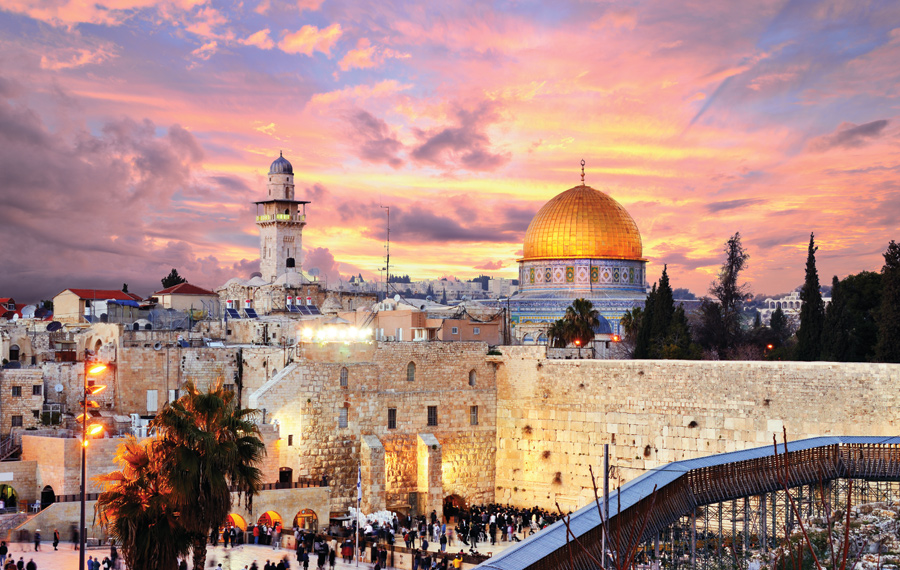
On the Temple Mount sits the foundation stone — the navel of the world — a hunk of rock from which the universe spilled forth at God’s command.

All things were there in the beginning — in Jerusalem when Jerusalem was not Jerusalem — when it was merely a fixed point in the void.

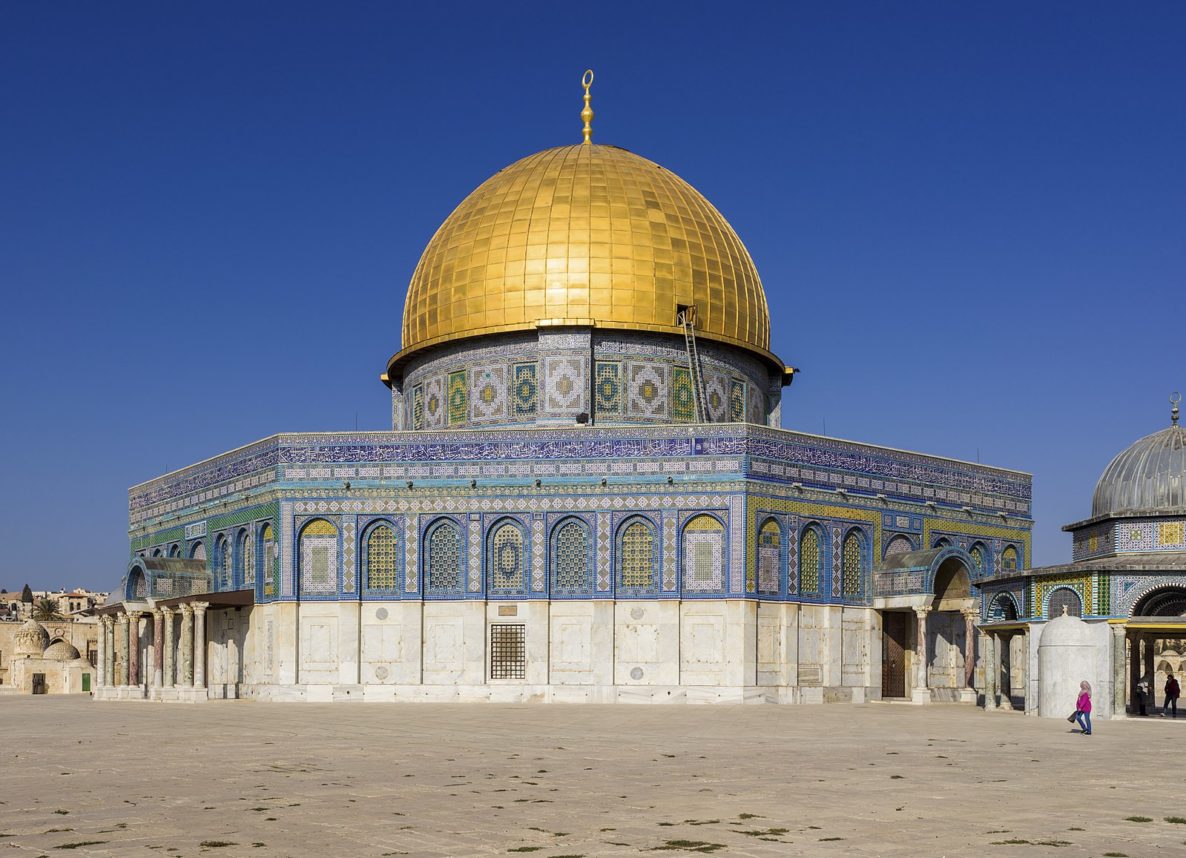
Anyone who has seen the Al-Aqsa Mosque, which rests atop the Temple Mount, can attest to the power of this location. The idea that this is the center of the universe is not mere mythology — it is suggested viscerally by the layout of the site itself. Utterly flat and paved over with ancient stone, Al-Aqsa is cast into relief by the Temple Mount like a sculpture on a plinth. The result is forceful and singular.

The Torah calls the Temple Mount “the place that God will choose,” although in truth, it is the place that God chose again and again and again. The place where soil was gathered and sculpted into the form of Adam. The place where Noah offered his sacrifice after the flood. The site of Isaac’s brush with filicide. The place where Jacob, dozing with a rock for his pillow, saw busy angels riding heavenly escalators up and down. The place where Christ was circumcised. The place to which Mohammed, riding atop the Buraq — a  winged mule — landed before his ascent to heaven.

The Temple Mount was also, of course, home to the Holy Temple.

Beit Ha’Migdash.

A wonder of the ancient world.

A site of history and spilled blood. 

A portal to heaven.

A target on Judah’s back. 

A talmudic saying has it that one who has never seen the Temple has never seen a beautiful building. Hyperbolic? We’ll never know.

Simple and imposing, it consisted of a walled courtyard and a building with three interior chambers, each one narrower and holier than the last. Walking past the menorah, the altar for burning sacred incense, and the table of the showbread (mystic loaves, which stayed fresh and warm for a week before they were eaten), one at last arrived at the place where the Ark of the Covenant was kept, resting atop the foundation stone. The Kadosh Ha’Kadoshim (Holy of Holies) was entered only by the high priest, and only on Yom Kippur.

In the Temple’s courtyard, where people would assemble in song and prayer, animal sacrifices were burned on an outdoor altar, creating a pleasing scent for the Lord.

Had it not been scrubbed from the Earth, we would know all of this in the same way that we know, to one extent or another, what the Colosseum looks like and what used to go on there.

But the Temple was destroyed. Twice. Once by the Babylonians. 

 “The idea that this is the center of the universe is not mere mythology — it is suggested viscerally by the layout of the site itself.”

There’s no shortage of good reasons for the Jewish people not to build a Third Temple. To say nothing of the ethical reasons (doing anything to “evict” the Al-Aqsa Mosque from its place on the Temple Mount is, of course, morally unthinkable), the Jewish religion has long had a set of internal religious reasons why the Temple could not, should not and would not be rebuilt in our time. The absence of a Messiah, for instance. Or debates about the exact dimensions of a “cubit.” 

Excuses, excuses.

I suspect that the real reason for the many obstacles is to provide a cover for Jews so that they can put off doing something that they don’t want to do but which they are religiously obligated to desire.

This kind of dual thinking, desiring the restoration of the Temple in principle if not in fact, is nothing new in Jewish thinking. Maimonides claimed that God let the Temple be destroyed in order to urge Jews toward the more spiritually sophisticated forms of worship. Rav Kook famously suggested that the future Temple would have sacrifices only of grain.

There are, however, individuals with fewer reservations. At the Temple Institute in Jerusalem, preparations are well underway to construct a Third Temple as soon as possible and by any means necessary.

In addition to drawing up detailed architectural plans, they have readied the necessary equipment: lyres, horns, an altar, priestly garments, a menorah, a washbasin. 

The knives have been sharpened. The priests trained.  

The artifacts they’ve fashioned are impressively faithful to history. That said, they are also quite tacky. 

This owes in part to the aesthetic shortcomings of the Temple Institute itself. But it is not entirely their fault.

Too much time has passed between then and now, and the accoutrements of the Temple speak in a sartorial language that we no longer understand. The colorful gems on the priestly garments — which must have once looked quite impressive — now appear silly, like a child’s costume. 

This disparity reaches its climax when the Ark of the Covenant is revealed. Behind a glass window, a red curtain whirs open as royal fanfare blares from a speaker. Behind the curtain sits the Ark — gleaming deliriously — two golden pigeons squatting upon its cover. If this isn’t camp, I don’t know what is. 

Perusing the Temple Institute’s models and plans, one begins to grasp the aesthetic travesty of an ancient holy place reconstructed with the architectural tools that late capitalism has bequeathed us. A mass of steel and glass with touches of “local” stone — this is the unique ugliness of a Scientology Center or a Mormon Temple — prophetic grandeur fused with office park drabness.

But the Temple Institute is nothing to be scoffed at. The museum may be an almost comical oddity, but one would be foolish to dismiss these individuals. In Israel, the fringe is often a staging ground for ideas which, while unspeakable today, will find their way into the mainstream in a few short decades.

The Temple itself, also, is nothing to be scoffed at. Nor the sacrifices. So often written off as a bit of barbarousness from the past, there is something poignant about the ancient practice of sacrifice — which speaks to a material intimacy with the infinite that has been lost to time. 

But at the Temple Institute, I am unmoved. Seeing it all live, in three dimensions, I am submerged into the Bible’s very own uncanny valley. 

It’s not that there isn’t beauty in the dream of the Messianic Age. There is. 

It is a prayer for the end of history and the end of strife. But some futures are meant to remain distant lights. Though we never draw close, they guide us rightly as we wander. 

The restoration of the Temple is one such lamppost on the horizon.


Matthew Schultz is a writer living and working in Tel Aviv.

The Importance of Temple Mount’s Place in Jewish History Read More »

Jewish Women Bring Lawsuit Against Charlottesville Neo-Nazis

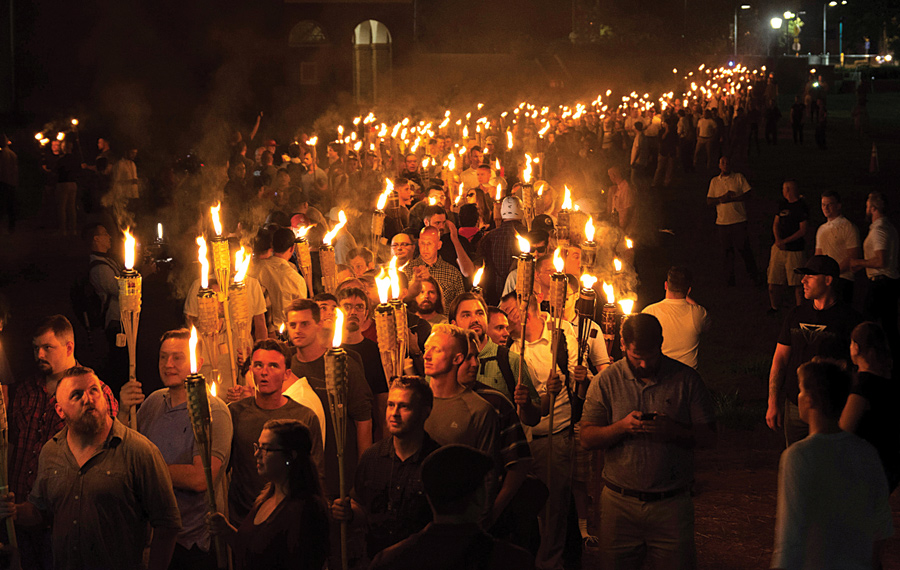
On the night of Aug. 11, 2017, hundreds of white supremacists descended on the streets of Charlottesville, Va., for a torchlit rally at the University of Virginia (UVA), unleashing a weekend of terror through the “Unite the Right” rally. The next morning, then 20-year-old James Fields Jr. plowed his car into a crowd of counterprotesters, killing 32-year-old Heather Heyer and injuring 19 others.

What was branded as a “rally” was really more of a rallying cry for hundreds of neo-Nazis and white supremacists to raid the college town with semi-automatic weapons and launch an all-out race war over the planned removal of a Robert E. Lee statue.

On Oct. 12, 2017, 10 plaintiffs filed a lawsuit in the Western District of Virginia against more than two dozen of the rally’s organizers. The case, Sines v. Kessler, alleges the organizers meticulously plotted a violent conspiracy months in advance of the rally. The plaintiffs represent a group of 10 counterdemonstrators. Elizabeth Sines was a second-year UVA law student at the time. Jason Kessler was the lead organizer of the rally and obtained the permit for
the event.     

Helming the plaintiffs’ case is Roberta Kaplan, the lawyer who made history when she defeated the Supreme Court’s Defense of Marriage Act in 2013, paving the way for marriage equality in all 50 states. Now she’s seeking to combat the leadership behind America’s growing white supremacist movement and possibly bankrupt them into obscurity.

The case is set to go to trial in the summer of 2020. Other defendants include Richard Spencer, who coined the term “alt-right”; Matthew Heimbach,  the founder of the now-defunct hate group the Traditionalist Worker Party; and Andrew Anglin, the publisher of the neo-Nazi site The Daily Stormer. 

The 112-page complaint provides a glimpse into the chat room discussions the defendants and alleged co-conspirators engaged in months before the riot. According to the complaint, conversations in a private chat room called Discord spoke extensively of specific weaponry to bring, including semi-automatic rifles with shields and armor. Also discussed was whether it was “legal to run over protesters,” dubbing the tactic of plowing through a crowd as a “protester digester.” 

Kaplan told the Jewish Telegraphic Agency in June that she sees this case as a once-in-a-generation lawsuit, similar to 1925’s so-called Scopes Monkey Trial in Dayton, Tenn., when high school science teacher John Thomas Scopes was accused of teaching evolution in violation of a Tennessee state law.

Amy Spitalnick, executive director of Integrity First for America, a nonprofit backing the suit, told the Journal, “This case is really indicative of the broader crisis of extremism, anti-Semitism, white nationalism and racism that we’re facing right now.”

While the case is focused on holding the defendants accountable for their actions in Charlottesville, Spitalnick said it “also has the potential to dismantle the infrastructure and leadership at the center of this extremist movement.”

In a 2017 interview on Washington Post blogger Jonathan Capehart’s podcast, Kaplan said Charlottesville was not about free speech. It was about racially motivated violence thinly disguised as a First Amendment protest. “If Nazis or KKK (Ku Klux Klan) or white supremacists just want to stand peacefully on a street corner and hold up a sign saying they hate Jews or they hate black people … that is protected speech,” Kaplan said. “I have no issue with that. But that’s not what happened here.” 

That point was emphasized in a federal district court’s 62-page decision issued in July 2018 that rejected the defendants’ motion to dismiss the case on the grounds of First Amendment rights. Senior U.S. District Judge Norman Moon wrote, “The Court concludes Plaintiffs have adequately pled specific factual allegations” and that “much of this conduct was not protected by the First Amendment.”

“This case is really indicative of the broader crisis of extremism, anti-Semitism, white nationalism and racism that we’re facing right now. I don’t think that our defendants like the fact that they’re being sued by Jewish women.”

 — Amy Spitalnik

Kaplan and co-counsel Karen Dunn are preparing their case based on two statutes that date to the Reconstruction era: the Civil Rights Act of 1866 and the KKK Act of 1871, which were created to protect minorities from racially motivated violence in the South.

Kaplan’s team has won a number of court orders since filing the case.  On Aug. 9, a federal court sanctioned the defendants for not complying with orders to subpoena their phones and social media accounts.

One of the defendants, Chris Cantwell, recently lost his attorney after making violent threats  against Kaplan. Cantwell told his followers on the instant messaging app Telegram, “After this stupid kike whore loses this fraudulent lawsuit, we’re going to have a lot of f—ing fun with her.”

“I don’t think that our defendants like the fact that they’re being sued by Jewish women,” Spitalnick said. “That’s something they’ve made clear.”

In the two years since the “Unite the Right” rally, Charlottesville proved not to be an anomaly but a flashpoint foreshadowing a much larger crisis in America’s white nationalist epidemic.

According to a February 2019 Southern Poverty Law Center report, the past two years have seen record numbers of hate groups emerge, and the Anti-Defamation League (ADL) has recorded a surge in right-wing extremism, such as the attack at Pittsburgh’s Tree of Life synagogue in October 2018, which left 11 Jews dead, and the Aug. 3 massacre at a Walmart in El Paso, Texas, in which 22 were killed and was, according to the ADL, the third-deadliest act of right-wing extremism in 50 years. 

Both the Pittsburgh and El Paso attacks followed a similar pattern of shooters using online forums to find a community of like-minded people. Each subsequent attack has the potential to inspire the next, with chat rooms becoming a breeding ground for violent extremists.

Those two days of hate in Charlottesville have spawned further violence in the two years since.

Sines v. Kessler couldn’t be more urgent.


Peter Fox is a contributing writer for the Forward and Tablet magazine. Follow him on Twitter @thatpeterfox. 

Jewish Women Bring Lawsuit Against Charlottesville Neo-Nazis Read More »

111-Year Old Nonprofit Bnai Zion Launches New Website With Modern Look

Bnai Zion, a U.S. nonprofit that funds capital projects in Israel, announced on Aug. 13 that the organization revitalized its image “to meet the expectations of today’s philanthropist,” Bnai Zion said in a statement to the Journal. The nonprofit added, “Brand changes include a revamped website, contemporary visual identity and updated mission statement. The rebrand reflects the evolution of Bnai Zion and its vision for the future.”

“Technology changes and shifts, and the expectations of benefactors have brought new approaches for nonprofits,” CEO of Bnai Zion Cheryl Bier said. “As a 111-year old organization, Bnai Zion is no stranger to progress. We have experienced many different generations of donors, each with its own needs and expectations. This rebrand is a response to the experiential and engagement-focused generation of benefactors who recognize our work today.”

The cleaner website design and improved functionality will allow today’s generation of philanthropists to navigate the organization’s projects more clearly and simply. The new logo incorporates a modern design, while simultaneously “building on its history and familiarity among supporters,” Bnai Zion explained. The non-profit also ensures to connect its projects more closely with the rise of anti-Semitism in the U.S.
“With anti-Semitic incidents jumping more than 50% over the last two years here at home, donors of all ages want to support the Jewish people and Israel,” Bnai Zion President Stephen Savitsky said. “It is one reason we expanded our messaging online to include the message that the best way to combat anti-Semitism is to build a strong, vibrant Israel.”
The new website will be updated regularly to introduce project launches, press coverage, events and donation information. The site went live on Aug. 13 and can be accessed here

111-Year Old Nonprofit Bnai Zion Launches New Website With Modern Look Read More »

Searching for the Exotic Adventures in Life and in Judaism

The more exotic the better. That was my philosophy about traveling. Anything that might sound the least bit familiar wasn’t on my list of destinations.

When my late husband, Jerry, and I booked a Mediterranean cruise in 1982 for our second honeymoon, I was excited about seeing the Greek Isles, Egypt and Ephesus, the Greek and Roman ruins in Turkey. There was also a stop in Israel, but that was of no consequence to me. I am Jewish and thought back then Israel was “familiar.” Code for uninteresting. And there was something else. I always thought of Judaism as overwhelmingly solemn and sad. Such unspeakable evil had been committed against the Jews for so long that the idea of experiencing joy when so many had suffered — and who are still fighting to protect their homeland — seemed impossible to me. If it hadn’t been on the itinerary, that would have been fine with me.

The Greek Isles were not exotic to me, but bland. 

The next stop on the cruise was Port Said in Egypt. I could hardly wait to start the day. I knew it would be exotic.  

When we left the ship, we were hit with a blast of hot air. We ran to the air-conditioned bus that would take us to Cairo. After we took our seats, we learned the air conditioning was broken. Oh, joy.  

As we drove down the hot, dusty road in a sweltering bus with sand blowing in our faces, we saw tiny old women dressed in burkas carrying buckets of cement on their heads. In the heat. They were helping to build a two-story house. With buckets of cement on their heads! I felt like I had time-traveled back centuries ago when life was truly primitive. Except this was 1982, and these people were still living this way. 

It was a long ride to the Egyptian Museum (now referred to as the Old Egyptian Museum). I had been guzzling down water and needed to find a restroom. 

 Once there, I entered a stall. What I found was not a toilet but a hole in the floor, the walls and floor reeking of urine. Now I was hot and dusty, and felt dirty. 

The main attraction was the great display of King Tut artifacts. When the tour ended, though, I was ready to sit down, relax and have a good meal.

Two hours back in the suffocatingly hot bus, we arrived at what was then known as the Mena House Hotel. It was close to the pyramids, so tourists would have easy access to the site.

I don’t remember what I ordered for lunch, but it was inedible. 

After lunch, we rode camels and had our passports stolen by our guide, which were retrieved later — for a price.

Suddenly, “familiar” was exhilarating. My preconceived ideas had been all wrong. I was amazed and inspired by what the Jews had accomplished. And I no longer felt Judaism was sad and solemn. I didn’t get what I came for. I got a whole lot more.

I was looking for exotic. Somehow, these weren’t the experiences I had imagined.

The next day, we arrived in Israel. The bus was new, clean and air-conditioned. It even had a bathroom. As we drove to Jerusalem, I looked out my window expecting to see endless miles of sand and more primitive conditions, but instead I saw grass and sprinklers. I was awestruck.

Our tour took us to the Christian sites first, which were fascinating, but nothing resonated since I wasn’t a Christian. 

And then we arrived at the Western Wall. Some Orthodox men were deep in prayer; further down, a woman’s fingertips grazed a ridge in the stone. The emotion welling up in my chest caught me by surprise. We stood there on hallowed ground and for a few moments neither Jerry or I said a word. We wrote prayers on snippets of paper and tucked them into crevices in the Wall. We bought trees in the names of loved ones to keep Israel green. We soaked up our Jewish history.

The King David Hotel had been recommended for lunch. We learned it was Israel’s Independence Day, and after a delicious lunch, we interlocked arms with hotel guests and danced the horah around the pool in celebration. I’ve danced the horah a million times, but to dance it in Israel on Independence Day was a singular experience.

Suddenly, “familiar” was exhilarating. My preconceived ideas had been all wrong. I was amazed and inspired by what the Jews had accomplished. And I no longer felt Judaism was sad and solemn. Of course there are solemn occasions, but now the joy and richness, light and life of what Judaism represents had risen to the forefront of my mind. 

I didn’t get what I came for. I got a whole lot more. 

I wanted to return to Israel the very next time I traveled internationally. Still, on the plane ride home, I found my mind wandering to even more exotic locations: Bora Bora, a cruise to the south of France, a safari in Africa.

After we arrived home, I made a luncheon date with a girlfriend, suggesting all the usual places. She said, “Why don’t we go somewhere different for a change?”

I said, “Like where?”

“My friend, Bonnie, raved about an Ethiopian restaurant.”

“Ethiopian? What kind of food do they serve, exactly?”

“I don’t know, but she said it was very good.”

Much as I like to try new things when I travel, I go back to the tried and true when I’m home. I was reluctant but agreed to go. We drove 40 minutes to get there. 

We entered the restaurant. “White tablecloths. Encouraging,” I said.  I noticed customers eating with their hands. What fun.

Then I looked at the menu. “Everything’s spicy. There’s nothing I can order.” 

Then a man at the next table said, in an unfamiliar accent, “I’m eating a delicious beef dish which isn’t spicy at all.” 

“Thank you,” I said. “Where are you from?”

“Yemen.”

“I travel a lot but I’ve never been to Yemen. No wonder I didn’t recognize your accent,” I said.

“Since we’re trying new things, let’s get their vodka cocktail. It’s made with unforbidden blueberries,” I grinned.

As we drank our vodkas and got to know our new friend from Yemen, I smiled and thought to myself, “I don’t have to travel 16 hours to find exotic. It’s right here at home, in Los Angeles.”


Lynn Brown Rosenberg is the author of the memoir “My Sexual Awakening at 70.” 

Searching for the Exotic Adventures in Life and in Judaism Read More »

Israeli Minister Calls for Allowing Jews to Pray at Temple Mount

Israeli Public Security Minister Gilad Erdan called for changing the policy at the Temple Mount on Aug. 13 to allow Jews to pray at the holy site, the Times of Israel (TOI) reports.

Erdan called the current policy barring non-Muslims from praying at the Temple Mount an “injustice” on Israel’s Radio 90, saying that “we need to work to change it so in the future Jews, with the help of God, can pray at the Temple Mount.”

However, he acknowledged that such a change “needs to be achieved by diplomatic agreements and not by force.”

Erdan’s remarks come after Muslim worshippers rioted in front of the Temple Mount over the weekend in response to Jewish worshippers visiting the holy site as part of Tisha B’Av, resulting in 14 people injured. The Israeli police allowed Jewish worshippers to visit the holy site on Aug. 11 in response to “an uproar from right-wing ministers and lawmakers,” according to TOI; the Jewish holiday coincided with the Islamic holiday Eid al-Adha.

According to Jewish Virtual Library, the Temple Mount is the site where Abraham almost sacrificed his son Isaac and the building of the First Temple at around 1000 BCE. After the 1948 War of Independence, Jordan had taken control of the Temple Mount; Israel reclaimed the temple in the 1967 Six Day War.

The Temple Mount is currently under the jurisdiction of the Islamic Waqf religious committee and Israeli security is charged with enforcing the Waqf’s decisions. Non-Muslims are typically barred from entering the site “in the hope of minimizing bloodshed and preventing a holy war,” although there have been myriad Palestinian riots at the Temple Mount over the years largely stemming from Palestinian leaders claiming that non-Muslims will be allowed to pray at the Temple Mount, according to Jewish Virtual Library.

Israeli Minister Calls for Allowing Jews to Pray at Temple Mount Read More »

How Learning From the Rosebush Impacted Summer Camp Appreciation

This week, the Jewish calendar presents us with a powerful emotional contrast from which I hope we can all find deep meaning and renewed inspiration. 

I learned a powerful insight about the Hebrew month of Av during a recent visit to Eden Village Camp, an organic and sustainable farming Jewish specialty camp located in Putnam Valley, N.Y. Eden Village dedicates a small plot in its garden to be representative of each of the 12 Hebrew months. For Av, it grows rosebushes to signify the “thorns” of destruction, commemorating the mournful fast day of Tisha b’Av (the ninth day); and the comfort of the rose “bud,” representing the celebratory, traditional Jewish day of love on Tu b’Av (the 15th day). 

This living, breathing “calendar” illustrates the creative, intentional Jewish learning made possible at camp. In addition, for this week in particular, the garden presents an important reminder for the challenging times in which we find ourselves: even the most heartbreaking and difficult circumstance carries within it the promise of renewal.

I felt the sharp duality and contrast represented by the rosebush while visiting camps last month in Southern California. In particular, while walking quietly through the Camp Hess Kramer site in Malibu, consumed and destroyed by the wildfires last November, one could feel the pain of all those deeply connected to area camps Hess Kramer, Gindling Hilltop and JCA Shalom. And yet, imagine the great comfort visiting those three camps operating so successfully on rental sites only seven months later, creating intentional and joyful Jewish experiences almost without missing a beat! 

Losing one’s camp to destructive fires necessitates new thinking and new approaches. In conversations over the past few months, it was clear that the challenging circumstances faced by the California camps led to profound innovation and the expansion of adaptive capacity. Additionally, the Jewish Federation of Greater Los Angeles deserves much credit for immediately providing reassurance, guidance and incredible financial resources to help ensure camps operated successfully this summer. 

Renting part of a college campus, the Wilshire Boulevard Temple Camps found ways to create a central outdoor gathering place, separate and distinct from the rest of campus. Nearby, a secluded (and powerfully emotional) prayer space was created featuring sacred remnants recovered from the fire-ravaged Malibu sites. Makeshift signage displayed in the cafeteria reminded visitors that this college campus had been transformed into their special summer home.

Other area camps I visited this summer displayed creative, open-minded, and inventive solutions to their own challenges and opportunities. 

Havaya Arts, a high-quality specialty camp in only its second summer operating at the University of Redlands, rotates its campers through a variety of locations across the beautiful campus to inspire their artistic expression and their Judaism from several perspectives. Finally, URJ 6 Points Sci-Tech Academy, housed on the Cal Lutheran campus in Simi Valley, temporarily hangs science-themed mezzuzot — with magnets — on their dorm “bunks.”

Consider how camps address the growing field-wide challenge of retaining college-age counselors. During my visit to JCA Shalom Day Camp in West Hills, I met a high-performing counselor who had spent two, two-week sessions working at JCA Shalom’s overnight camp, followed by working the remaining weeks at the organization’s day camp, where he could spend evenings with his family preparing for his move out of town. 

When long-established models aren’t taken for granted — and when we are open to exploring new approaches — benefits accrue for all. 

May we each find inspiration and strength in the resilience, agility and creativity demonstrated by those camp communities — especially by the camp professionals and lay leaders — dedicated to continuing their (and our) holy, vital work.


Jeremy J. Fingerman is CEO of Foundation for Jewish Camp.

How Learning From the Rosebush Impacted Summer Camp Appreciation Read More »

Obsess Over Which Feminists Are Jewish, Not Which Rapists

“You know, a lot of sexual harassment stuff is in the news of late,” said “Curb Your Enthusiasm” creator Larry David during his 2017 “Saturday Night Live” monologue. “And I couldn’t help but notice a very disturbing pattern emerging, which is that many of the predators — not all, but many of them — are Jews.”

America’s favorite grump isn’t the only one who noticed. Two years into the #MeToo movement, when Jeffrey Epstein’s years of allegedly sexually exploiting teenage girls came to light, so did — overwhelmingly — the fact he was a Jew. (Epstein was found dead in his jail cell Aug. 10 after an apparent suicide). Anti-Semites took delight in pointing out that Epstein, Harvey Weinstein, Woody Allen and Brett Ratner are Jewish. But so did journalists.

In 2017, online magazine Tablet ran a piece titled “The Specifically Jewy Perviness of Harvey Weinstein” – for which the publication had to issue an apology – but not before white supremacist leaders Richard Spencer and David Duke had applauded it. 

Attempts to claim sexual abuse as a characteristic of Judaism are vile, whether they come from a Klansman or an opinion writer. 

Yet, Jews and anti-Semites alike actively seek to highlight the Jewishness of sexual abusers. In contrast, we hardly emphasize the Jewish roots of feminists who have made movements such as #MeToo thrive.

Jewish women have pioneered the campaign for gender equality and its struggle against sexual violence.

Jewish women have pioneered the campaign for gender equality and its struggle against sexual violence. While predators such as Weinstein and Epstein might have preyed on many women, Jewish feminists have protected far more.

Gloria Steinem, the spokeswoman for the American feminist movement, is a Jew. Yet few people focus on that. The first women’s rights attorney, Gloria Allred, brought justice to countless women by taking on an A-list of abusers, including Bill Cosby, Anthony Weiner, O.J. Simpson, Roman Polanski, Rush Limbaugh, Roy Moore and even Donald Trump. Yet no one attributes the lawyer’s advocacy to her Jewish heritage.

It’s odd how little Jewish women are credited — or at least credited as Jews — for the strides made toward gender equality and ending sexual violence.

Our right to vote? Thank a Jewish woman. Ernestine Rose founded the suffragettes, and rejected Susan B. Anthony and Elizabeth Cady Stanton’s racism when she became an abolitionist partner of Sojourner Truth. Decades later, Betty Friedan’s “The Feminine Mystique” spring-boarded the second wave of American feminism in the 20th century. Bella Abzug carried that wave into public office, imploring women to become legislators. Norah Ephron and Joan Rivers brought women’s voices into comedy. “Dr.” Ruth Westheimer started a candid conversation about sex, while Ruth Bader Ginsburg fought to end discrimination on the basis of it.

These are just some of the Jewish feminist pioneers with name recognition. They stand on the shoulders of hundreds of lesser-known activists fighting sexual violence through art, writing, scholarship, organizing, health care and politics. 

I wonder if the lack of acknowledgment of Jewish feminists compared with Jewish rapists is fueled by anti-Semitism, the perception of women’s achievements as less notable than men’s failures, or a culture that sees women somehow “less Jewish” than men. The alienation of women showing up as Jews to feminist movements because of anti-Semitism scandals from Women’s March Inc can’t help. But even the original Women’s March on Washington, D.C.,  was co-founded by a Jewish feminist — Vanessa Wruble — who continues to mobilize against sexual assault as the executive director of March On.

Jewish men can be predators who must be loudly condemned and brought to justice. The worst abuse I’ve ever received in my life has been at the hands of Jewish men. But as a Jewish woman, I have led two marches against sexual violence and connected more than 50 sexual-exploitation survivors to the aforementioned Allred to fight their abusers.

So I pose the question: Who is truly acting out their Judaism? Me, or the men who’ve hurt me?


Ariel Sobel is a screenwriter, filmmaker and activist, and won the 2019 Bluecat Screenplay Competition. 

Obsess Over Which Feminists Are Jewish, Not Which Rapists Read More »

Finding Personal Peace During Painful Times

It’s hard to be a human, especially right now. During a time like this, we need to touch base with core spiritual principles. Here are seven spiritual tips to find a sense of equanimity and balance when all around you is chaos.

1. Gather your people; don’t engage in fights

Gather your people — the ones who help you keep perspective or who remind you of what is true. Call a friend and make a date for lunch or a walk.

Community makes everything more bearable. 

Online, make sure you follow people whom you trust, are uplifting and honest. 

If being online is difficult, set your privacy settings to see only posts or tweets from people you follow.

Avoid negative people. Create an online community filled with truth-tellers and inspiration.

Stop trying to change people or engage with people who push your buttons. As Maya Angelou said, “When people show you who they are, believe them.”

2. Don’t dwell on catastrophe; work with what you know now

Our minds are always scanning the environment for danger. However, engaging in “what if” scenarios isn’t helpful or healthy.

Stay with what you know, moment by moment. Instead of going from, “we lost this court case” to “this will be the end of democracy,” pull back from the brink and focus on the here and now. 

3. Don’t abandon your core values

Remind yourself of what you believe. Write down what you know to be true.

Mine: I believe justice will prevail. I believe people are generally good at heart. I believe truth eventually will emerge. I believe good people working together can accomplish anything. Kindness heals.

Keep your values in front of you. The Shema contains the wisdom to keep our most cherished beliefs constantly before us.

4. Fill your cup; seek out inspiration

Challenging times call for religious or universal teachings that hold powerful truths. 

Some verses that roll around in my mind: “Justice, justice shall you pursue” (Deuteronomy 16:20) and “Let justice well up like water, righteousness like an unfailing stream.” (Amos 5:24).

However you find comfort or truth, now is a good time to seek out spiritual wisdom.

5. Remember inspirational leaders who survived difficult times

“Everything can be taken from a man but one thing: the last of the human freedoms — to choose one’s attitude in any given set of circumstances, to choose one’s own way.” — Viktor Frankl 

Remember the people who came before you and how they endured painful times.

I always think of Frankl, who survived Nazi concentration camps and subsequently wrote “Man’s Search for Meaning.” I wonder how he saw kindness, even at Auschwitz. If he could find it there, I can, too. 

6. Take time for beauty

Rabbi Abraham Joshua Heschel, who escaped Nazi Germany, and whose family was murdered, went on to write about living a life of awe and wonder. 

We must find ways to include the horror and the marvelous.

Yes — this is a scary news story, but look at these flowers just beginning to bloom.

Our core democratic values are being assaulted, but this piece of cello music is glorious.

It is essential to consciously seek out balance from the awful. Seeking awe is a spiritual practice.

7. Find humor

Every day, find laughter. Laughing is essential for lifting your soul. 

Laughter provides needed relief. Watching old “Seinfeld” episodes or clips of adorable dogs and cats, babies laughing — search for this. Follow people on social media who make you laugh.

I hope you have found these tips helpful. Let me know.

Rabbi Jill Zimmerman is a rabbi-at-large in Orange County. She is a spiritual entrepreneur and social activist. You can find her online. Interested in more spiritual tips? You can subscribe here to Rabbi Jill’s newsletter.

Finding Personal Peace During Painful Times Read More »