When Carolyn Kangavari was 13 and visiting the senior home where she regularly volunteered, one of the residents started having difficulty breathing. Kangavari immediately called 911 and a short time later, paramedics arrived. Fortunately, the woman ended up being OK.
Today, after earning a master’s degree in social work from the University of Southern California, Kangavari still is involved in critical life-saving work, as the new Los Angeles executive director of Friends of United Hatzalah, the largest volunteer-based medical service in Israel.
Founded in 2006 by Israel native Eli Beer, the organization has more than 6,000 volunteers who respond to nearly a quarter of a million calls each year throughout the country, often bridging the time between an emergency and the ambulance arrival. All volunteers are trained and certified emergency medical technicians, paramedics or physicians, and are as diverse as the population of Israel: women, men, Jews, Christians, Arabs, Druze and Bedouins. They treat anyone and everyone. Because of their numbers and use of motorized ambucycles, their average response time is three minutes
or less.
“It’s like the Uber of saving lives,” Kangavari said of the free service.
For Kangavari, the daughter of Persian Jews who fled Iran in the early 1980s, whom she characterizes as “very giving people,” the job is a calling.
“For me, there’s nothing bigger than saving lives in Israel,” she said. “Even the first time I went there as a little girl, as soon as we landed, it felt like home.”
Kangavari, who belongs to Nessah Synagogue in Beverly Hills as well as the Sephardic Temple in Westwood, has relatives in Israel. However, it’s her years at Harkham Hillel Hebrew Academy, and YULA Girls High School — where she vividly recalls singing “Hatikvah” every day — that contribute to her abiding love for the country and its people.
“Securing our ancestral homeland is the best social work I can do,” she said. “It’s important to give Israelis a sense of security and comfort by building its infrastructure. After all, they live in greater hardship than we do here, and we can never forget that they are fighting the fight to preserve our history and our dignity.”
The community aspect of United Hatzalah was compelling to Kangavari. “What’s so beautiful is it brings all these people together for one mission: to save lives,” she said. In addition, “communities feel stronger because they know they have volunteers close to them. They feel more resilient, more powerful.”
Kangavari recognizes that Angelenos have many wonderful and worthwhile organizations to support. She recently helped lead a Birthright trip to Israel and she regularly volunteers to pack and deliver food for Tomchei LA. But she is confident United Hatzalah is a cause that will speak to Angelenos.
One of her goals in the coming weeks and months is to “spread as much awareness as possible.” To that end, she will be speaking at synagogues and to student groups, attending parlor meetings at private homes, and connecting with existing supporters in the Los Angeles area. A fundraising gala is tentatively scheduled for late February 2020.
“This is such a dream for me,” Kangavari said of her new role and mission. “The real heroes are the people protecting Israel — saving lives every day. I feel like this is the least I can do. To be able to be part of that is so special to me.”
The Santa Clarita Aquatic Center, GlowZone, Sky High, Scooter’s Jungle, Boomers and Knott’s Berry Farm. These were just some of the locations 45 local Jewish kids with special needs attended during their weeklong camp from Aug. 5-9, thanks to Friendship Circle Los Angeles (FCLA).
Established in 2003, FCLA provides a full range of social, recreational, educational and Judaic experiences for Jewish children with special needs.
Seventy-four volunteers worked with campers ages 5-25, taking them on various field trips, traveling on buses, singing Jewish songs and helping them form new friendships.
“[We had] more volunteers than campers [because] some campers are best suited to have two volunteers to make the day a little bit easier for them, whether it’s because they’re in a wheelchair or because they need two sets of eyes looking out for them to make sure they maximize their ability to enjoy every activity,” FCLA Development Director Gail Rollman told the Journal. “We want to make sure that every kid is safe.”
To ensure that safety, Rollman said, “We always have several behaviorists with us. We also have to make sure not only do we have the executive directors of the [organization] — [Rabbi] Michy and Miriam [Rav-Noy], who head Friendship Circle — but the director of the camp and the volunteers.
“We want [the kids] to feel like they’re typical kids,” Rollman added. “Many of them have siblings who are already going to camp and they see them having a good time. Our kids like feeling a sense of belonging, feeling included. [Camp] is like a rite of passage in the summer. [It’s] a time to explore, to broaden your horizons.”
Rollman said FCLA also wants its teenage volunteers to see that kids with special needs are really just like them. “They all want to have a good time, they want to celebrate their Judaism, they want to make friends. We want the volunteers to also learn more about what it’s like to have a special need. The volunteer should grow as a teenager and learn more about those who are different from them, but also find out and realize that we’re all the same.”
“Reaching out, giving someone a high-five, a fist bump, a shake on the hand and a hug, it connects you to someone. Physical touch is something that everyone understands, whether they can communicate verbally or not.” — Jacob Shofet
An FCLA volunteer for four years, 17-year-old Jacob Shofet said, “Because I have the pleasure of being a more seasoned volunteer, Rabbi Michy pairs me up with [buddies] who are lower functioning. At times, it can be challenging. One of the best techniques that I’ve learned from our behaviorist is [that] physical contact works wonders. Reaching out, giving someone a high-five, a fist bump, a shake on the hand and a hug, it connects you to someone. Physical touch is something that everyone understands, whether they can communicate verbally or not.”
Jacob said he hoped his special needs buddy understands that he’s not alone. “Someone told me this metaphor, [that] sometimes it feels like they’re stuck behind an aging brick wall and every once in a while the bricks become loose and you’re able to catch a glimpse of what they want, who they are. It’s your job to shake the foundations of this wall and to really be able to reach out and set them free.”
Chana Leah Schuraytz, who has been volunteering with FCLA for 10 years, said, “I want my buddy to enjoy a camp experience like any other child. I try to make sure that every activity is accessible to him in a safe way in order to achieve that goal. I want him to be tired at the end of the day, but a ‘good tired,’ and to be excited to come back the next day.”
Each year, the camp has a Jewish theme. “This year, the theme [was] based on charity and giving to other people,” FCLA Program Director Miriam Rav-Noy said. “We [had] a food drive and [the kids] made charity boxes. … That’s been really nice, to give the kids something that they can walk away with as a tangible experience in their Judaism.”
Having volunteers and kids from all Jewish affiliations, Rav-Noy added, “is such a beautiful thing to see everybody coming together in this common goal. Seeing volunteers stepping out of their comfort zones and really going the extra mile and going above and beyond to be able to connect with their buddies — it’s just priceless.”
Melissa Simon is a senior studying journalism at the University of Wisconsin-Madison and a Jewish Journal summer intern.
Manning Haskal is an experienced swimmer but even he might have a hard time treading water while gripping all his medals from the Pan American Maccabi Games in Mexico City.
The 15-year-old from Los Angeles won eight gold and three silver at the games, which took place from July 5-15.
The Pan American Maccabi Games are an affiliate of the Maccabiah Games, affectionately nicknamed the “Jewish Olympics,” the worldwide competition that’s officially the third largest sporting event in the world.
During the games, Manning won gold medals for individual events in the 1,500- and 400-meter freestyle, 400 individual medley (IM) and the 200 freestyle, and anchored the U.S. 4×100 relay and the 4×100 medley relay teams, which both finished first. Additionally, he won the 3,000 open-water competition at Lake Tequesquitengo. There, he took home two gold medals: one in the 15-17 age group and the other for placing first across all competing age groups (15-99). He won silver medals in the 200 backstroke and 200 IM, and anchored the U.S. 4×200 relay team.
Manning said one of his biggest influences in the games was a swimmer from Mexico named Manuel. Competing in the open-water event, Manning said Manuel helped him.
For Manning, though, competing in the games was so much more than just about winning medals. “The experience was by far the best part,” he told the Journal. “The swimming was fun and that’s why I went but I think the biggest takeaway was meeting people and making friends from around the world. All the ones from South America spoke really good English. It was really easy to communicate and we all just kind of clicked.”
Manning said one of his biggest influences in the games was a swimmer from Mexico named Manuel. Competing in the open-water event, Manning said Manuel helped him. “He even stopped and started having me follow him and he started teaching me how to swim in open water,” Manning said. “That was really great.”
Manning lives in Encino and attends Buckley School in Sherman Oaks. His interest in swimming began when he was around 8 years old and joined the Hollywood YMCA.
“Manning started swimming under an amazing woman named Sharon Goldberg, who everybody calls Goldie,” his mother, Sarah Byrnes, told the Journal. “He loved it and was always happy even when he wasn’t fast or winning. Eventually, all his determination and his true passion for the sport propelled him forward.”
Manning really came into his own after joining his first club, called Gators, when he was 11. It was during this period that he started shaping himself as a long-distance swimmer. “I wasn’t too good at anything else and long distance just kind of clicked with me,” he said. “I didn’t get tired too easily. It just kind of worked out perfectly. I could hold a certain pace for a really long time.”
Manning is the first swimmer to qualify for state championships in Buckley’s history. He has set several school swimming records and was named MVP of the Prep League Championships. He also swims competitively year-round with the Los Angeles Swim Club.
For the past three years, Manning has been a volunteer coach with the Tri Valley chapter of the Special Olympics swim team. “I really love it,” he said. “I started in seventh grade for my bar mitzvah. I would repeat the sets that the coach would give us and I started going more frequently over the years. I now go once a week and coach for 2 1/2 hours. It is really fun just being able to be on the other side of the pool.”
Manning, whose father is Israeli, said his ultimate goal is to travel to Israel and compete on its national team and maybe even one day, on the Olympic team.
“Yes, I would totally support him,” Byrnes said. “He’s talked to me about if he wasn’t good enough to swim for the U.S. in the Olympics, would he be good enough to represent Israel in the Olympics as he has dual citizenship.”
At USC’s Keck School of Medicine’s HEAL (Humanities, Ethics/Economics, Arts and the Law) program, Director Pam Schaff and artist-in-residence Ted Meyer are forging a quiet revolution in medical training known as narrative medicine.
The training was created by Schaff’s mentor, Dr. Rita Charon, director and founder of the Program in Narrative Medicine at Columbia University. Narrative medicine uses art to integrate individual narratives into clinical practice, research and education by increasing empathy and reflection in the doctor-patient relationship.
Schaff knew she wanted to be doctor while she was in high school, but she also loved literature. Raised in a Conservative household, she was drawn to Judaism’s emphasis on “learning, scholarship, on education, questioning tradition.” She was a pre-med English major at Pomona College and went on to graduate from the Icahn School of Medicine at Mount Sinai in New York in 1980.
Schaff moved back to Los Angeles and established a private pediatric practice in Tarzana before being approached to teach a class one day a week at USC’s Keck Introduction to Clinical Medicine (ICM) program on a voluntary basis. In 1996, she closed her private practice to become the director of the ICM program.
By 2007, Schaff was the associate dean of curriculum at Keck and the director of HEAL. She embraced narrative medicine, reinvigorating HEAL by moving away from structured museum or gallery visits, creating instead a gallery program on campus.
Her life, Schaff said, has been informed by “tikkun olam, the idea that it’s my responsibility to take care of whatever little corner of the world I can make better. For me, that contribution is as a physician and an educator.”
Meyer, 62, was born with Gaucher Type 1 disease, a rare genetic disorder for which, at the time, there was no treatment or cure. A disease most commonly inherited by Jews, symptoms include joint pain, anemia, fatigue and low platelet count.
“I was really angry,” Meyer said. “I blamed being Jewish for my pain and suffering and isolation. I learned early on Jews struggle and my struggle was going to be harder still.” Meyer endured decades of pain, including multiple hip replacements until about 20 years ago when a new drug was developed to replace the enzyme his body wasn’t making.
“Before the new drug, I was doing art that featured tormented figures — contorted skeletons and work that reflected my pain and isolation,” Meyer said. “With this new drug, I became like a normal person.”
Not long after the new medication began doing its work, Meyer met a woman in a wheelchair at an art gallery. “She told me, ‘You need to keep doing work about health and mobility because that’s part of you,’” Meyer said. So he asked if he could print her scar.
One body print (where Meyer rolls paint onto the subject’s body and then presses paper onto the paint to create the print) led to another. The prints became part of Meyer’s renowned ongoing “Scarred for Life” project, which includes pairing the prints with his subjects’ own narratives.
“It never occurred to me [the work] would have the effect on people it does,” Meyer said. “For a lot of people it wasn’t just art. It was closure to a major traumatic experience in their life.”
Go back a century or two and medical education was not only about science. In the past 50 years, that’s been a renewed thrust: involving the humanities in medical education.”
— Pam Schaff
Schaff, who had heard about Meyer and was looking to enhance the HEAL program, received funding in 2016 to create a gallery on campus and hire an artist-in-residence. She reached out to Meyer who had just completed a residency at UCLA curating patient art in the medical school lobby.
“Go back a century or two and medical education was not only about science,” Schaff said. “People recognized that there were ways of knowing and understanding that couldn’t be found in science. In the past 50 years, that’s been a renewed thrust: involving the humanities in medical education.”
And for Schaff, Meyer’s ideas “made complete sense. These artist-patients could speak to their condition and life experience, and in that setting, our students could hear stories that they would never hear when they go to the hospital and take a history.”
In what is now tied to the first- and second-year medical school curriculum at Keck, HEAL provides a yearlong program that includes four invited artist shows and talks. There’s also a fifth program each year that’s a group show: pairing healthy artists with medical school research faculty so the artists can interact with the researcher, then create a piece highlighting the researcher’s work, coupled with a narrative by the artist.
Earlier this year, Meyer curated a show for students featuring work by Elizabeth Jameson, who has multiple sclerosis (MS). Jameson spoke about her string of progressive diagnoses, her current deterioration and taking ownership of her MRI, which she used as the basis of several paintings and prints highlighting her brain lesions.
Second-year USC medical student Vedang Uttarwar said Jameson’s work left a lasting impression. “I think it was great to see another side of MS,” he said. “I think the paintings captured the kind of struggle she’s going through. As students, we’re so focused on the sciences; so oriented to objective solutions to problems we see in medicine. It gave me a new perspective on relieving the symptoms she’s facing.”
Uttarwar said he’s seriously considering going into neurology and credits the program with influencing his thinking. “I think events like that can really promote people choosing their specialty.”
Meyer said much of the credit goes to Schaff. “I often say that Pam’s belief that art and humanities makes better doctors and her understanding of my vision for the project has made it all possible,” he said. “I want to bring the person out from behind the disease and have students see the whole person. Doctors who see the artistic totality created by pain and illness will think about the totality of treatment long term.”
Ted Meyer’s “Scarred for Life” currently is on display at the American Association of the Advancement of Science in Washington, D.C., through October.
A previous version of this article incorrectly stated that Schaff became director of HEAL in 2012.
Mitch Paradise is a writer-producer and educator in Los Angeles.
Jewish summer camp is intended to be a space of Jewish and personal exploration. Many of today’s Jewish adults fell in love or had their hearts broken at camp. But as awareness of sexual harassment and consent increases, parents and educators are faced with the challenge of how to create safe spaces for children, especially at summer camp, where campers assert their independence and the counselors who act as their role models are often teenagers themselves.
Moving Traditions, which has specialized in teen programming since its founding in 2005, is meeting this challenge head-on through its CultureShift camp initiative and a new SRE (Safety Respect Equity) Coalition grant to create training videos for camp staff.
While Moving Traditions had already been working with camps since 2015 on issues around harassment and consent, “#MeToo really raised the alarm for the Jewish community and the wider world that we can’t ignore them anymore,” said
Moving Traditions founder and CEO Deborah Meyer.
“What makes camp so special and unique is our intentionality, from the songs we sing, the activities we provide, to how we speak to one another,” said Dr. Aviva Levine Jacobs, director of camper care at Camp Ramah in California and a Moving Traditions camp advisory board member. “CultureShift addresses that intentionality around sensitive topics that touch all of our lives.”
“Starting with smaller conversations among staff members at several camps, [we] realized it could go very deep very quickly,” said Rabbi Daniel Brenner, Moving Traditions’ director of education. “The lightbulb was, ‘Wow, this has direct and immediate application in the camp environment, even more than in the regular year.’ ”
In April, 15 leaders from nine camps participated in a two-day “train the trainer” institute. The online CultureShift tool kit includes a 75-page handbook for different camp audiences and includes research, role-playing exercises and resources for when mental health or medical staff need to be involved. These tools will be evaluated and revised in the fall and another training session is planned for January 2020.
While Moving Traditions had already been working with camps since 2015 on issues around harassment and consent, “#MeToo really raised the alarm for the Jewish community and the wider world that we can’t ignore them anymore.”
— Deborah Meyer
“Moving Traditions works to foster self-discovery, challenge sexism and create long-lasting connections to Judaism, helping teens develop an ethical framework, how to form positive relationships, build meaningful community,” Meyer said. “Sex, sexuality and respect are essential elements to creating a moral and meaningful life, so we have felt really called to help teens look at issues that are central to their joys and challenges, drawing on their own values and addressing the things they care about most.”
Local CultureShift supporter Brian Shirken said, “As parents, [my wife and I] have seen how important it is for our kids to engage in mutually respectful relationships and to understand the nuances of this issue in today’s society. CultureShift will definitely increase the awareness and activism of all kids and parents around this issue and enable them to engage in an informed manner and behave in an appropriate manner.”
“For so many camp counselors, this is their first job. [We need to] educate them about what’s appropriate in the workplace,” Meyer said. “Parents want to hear that this conversation [about consent] is happening even if it’s not clear what the policy or guidelines should be. Many parents and directors want to hear that their staff isn’t turning up the volume on peer pressure and objectification. Eighteen- and 19-year-olds are modeling behavior through humor, teasing and practical jokes as much as through speeches on how to behave. How are the counselors modeling behavior and understanding that part of their job is turning down the sexual pressure? That’s really key.”
Brenner noted that consent conversation is a particular challenge with boys, who “thought they were being told what to say or being patronized. We started thinking about alternative ways to talk about consent with teen boys. Teens need to hear a counter-message in an environment they feel is safe for men to be in and speak in.”
The collaboration between Camp Ramah in California and Moving Traditions began in 2016-2017 as “a shared conversation around best practices regarding working with teens around issues of gender, modesty and sexuality,” Jacobs said.
In the summer of 2017, Brenner modeled the implementation of a mapping exercise around gender norms, stereotypes and assumptions for the Ramah staff. Ramah adapted the guidelines related to sex and sexuality at camp and held training for staff members working with teens.
Even before working with Moving Traditions, Jacobs said Ramah convened a “split gender circle” during staff week, inviting veteran staff members to share stories around the topics of “creating a healthy culture at camp around body image, language, inclusion, sexual intimacy and more.”
The National Ramah Commission also partnered with Sacred Spaces, an organization that works to prevent institutional abuse in Jewish communities, to offer more clear and explicit guidelines to safeguard against sexual harassment or abuse in the workplace, Jacobs said.
Brenner said that Orthodox camps also were represented in every city with CultureShift training. “It’s not safe to assume that gender-segregated camps are not experiencing sexism and sexual harassment. There is the same number of stories of throwing out staff for inappropriate behavior.”
“We hope that by utilizing the resources that CultureShift provides, we are shifting culture at camp to align most closely with our core values of creating a makom (place) where staff and campers alike feel first and foremost safe, comfortable and in an environment less mired with sexual pressure, rigid gender norms and body shaming than the outside world,” Jacobs said.
“This is a long process, not an overnight change,” Meyer said.
Added Brenner, “We’re starting where we see the greatest need and impact: These excellent summer camps that are open to how to do this better.”
Have you noticed that the fancier the restaurant, the larger the plates and the smaller the food? In recent years, if the lighting is subtle and there is a white tablecloth, you’re sure to find a garnish of tiny baby plants atop at least one of your courses. And unlike many restaurant trends — foams and brussels sprouts, your time has passed — the microgreen craze of recent years turns out to be a really good thing.
Microgreens and herbs are essentially 7- to 10-day-old versions of leafy greens and vegetables that have been recognized as up to 40 times more nutritious and denser in vitamins and minerals than their more mature versions. Numerous studies have shown that microgreens pack a hefty nutritional punch of vitamins such as C, E, K and even lutein and beta-carotene, two antioxidants that are thought to stave off macular degeneration.
Like the full-grown versions of greens and vegetables, miniscule microgreens vary in flavor and nutrient content, but unlike their older siblings, it doesn’t take much convincing for anyone to love eating them — even kids. They’re colorful, ranging from vibrant green to purple, delicate yet intensely flavorful, and they provide textural contrast in salads and sandwiches.
So, if microgreens are so tasty and good for you, why do they remain the purview of fancy restaurants, cafes and chefs’ tables and why isn’t everyone eating them?
First of all, microgreens can be difficult to find. Even though they are far more popular now than they once were, they’re not available everywhere and certainly not at any time of the year. Also, depending on the variety, even if you can find them in a well-stocked grocery store, a flat of microgreens could cost up to $30, while even a small bag of them in a health food store, enough for only a few salads or garnishes, is generally at least $6 to $10. And, on top of the high price and potential lack of availability, the delicate greens are
likely to go bad quickly on supermarket shelves and due to humidity in the packaging could even be a breeding ground
for bacteria and mold.
Luckily for microgreen fans, two MIT-educated engineers developed a solution: grow your own. Camille Richman and her co-founder Daniel Goodman met as researchers at the MIT Media Lab, where they were building and operating large-scale, indoor, controlled-environment farms growing a variety of crops year-round in Boston. Both got excited about the power and potential of indoor agriculture to provide fresh produce to folks no matter where they lived or what the season. The pair worked on the “Food Computer” project, a small-scale version of these farms where they ported various climates into greenhouses in order to see the effects on the crops.
According to Richman, the idea was to be able to crowdsource data on what environments induce various changes in crops such as volume, flavor and appearance. Working on that project got Richman and Goodman excited about smaller-scale, hyper-localized food production and taking advantage of the relatively controlled environments in homes to produce food where it’s going to be eaten, year-round, conveniently and affordably. Three years ago in Sacramento, they started their own company called Hamama to make that happen.
Born out of a stint working in Israel while she was a student at MIT, Richman first encountered the word “hamama” at Kibbutz Ein Shemer, where she started a program through MISTI (MIT International Science and Technology Initiative) to send MIT students to the kibbutz every year. The objective of the program, where Richman was a guest educator, was to work with Israeli middle and high school students on ecological problems affecting the region through hands-on projects in aeroponics and hydroponics, 3-D printing and biology. Hamama means “greenhouse” in Hebrew, “bird” in Arabic and “open” in Hawaiian (there is a Hamama Falls in Hawaii).
Numerous studies have shown that microgreens pack a hefty nutritional punch of vitamins such as C, E, K and even lutein and beta-carotene.
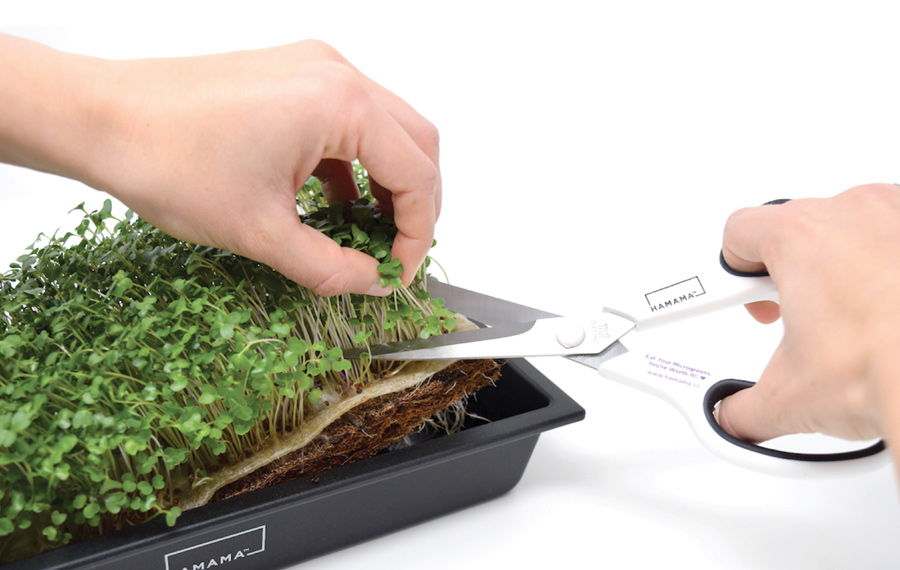
After returning from Israel, Richman and Goodman invented and patented a unique invention called a seed quilt, an all-natural, coconut-fiber base with various seeds embedded within a paper cover that enables microgreens to effortlessly be grown at home. The beauty of the seed quilt is that it takes care of all the environmental controls passively, without the need for any complex equipment. All customers have to do is add water once (the kit comes with a planting box with a designated water “fill line”), place a seed quilt in the water, and, in a week, start to harvest microgreens like broccoli, kale, radish, salad mix, arugula and others.
Hamama’s seed quilts do all the work of growing microgreens by controlling the watering, humidity and light. The quilt wicks up water gradually throughout the week so you don’t even have to remember to water. The paper cover blocks light access at the start, when the seeds require more darkness during the germination phase, after which the seedlings push up the paper cover, converting it into a humidity dome.
After the cover has been pushed or peeled off, plants have access to the less humid and brighter ambient environment, so after seven to 10 days, delicious greens can be harvested as needed for smoothies, sandwiches and salads. The seed
quilt grows regardless of light or temperature, and the company boasts tens of thousands of growers in all 50 states year-round, including Alaska in the winter and Arizona in the summer. In fact, Hamama has become so popular that recently the partners acquired 10 times the ware-
house space at their headquarters in
Sacramento.
Currently, Hamama offers nine varieties of microgreen seed quilts (broccoli, cabbage, radish, salad mix, spicy salad mix, kale, clover, arugula and fenugreek) as well as a wheatgrass seed quilt. After trying three varieties, I fell in love with the ease and convenience of this ingenious product. Not only do growing your own microgreens produce the freshest, tastiest harvest for the best price, they couldn’t have been easier to grow. After watering them once at the start, I harvested a week later and, because the kits don’t contain soil, pesticides or fertilizers, you can trust that your greens are safe to eat.
After talking to Richman about Hamama and telling her that the company had me at its wonderful name, she asked my favorite way to eat microgreens. Aside from throwing handfuls of them into smoothies and using them in place of lettuce in salads, my all-time favorite use of the spicy salad mix (my favorite seed quilt thus far) is to pile a bunch of microgreens on top of one of the bestselling sandwiches in the embassy café: thick slices of tomato, avocado and a smear of cream cheese (tofu cream cheese works fine) between two slices of brown, seedy bread with a drizzle of olive oil, salt and pepper. I think you’ll agree there is no tastier way to get your greens.
Hamama seed quilts and kits are available for shipping year-round here.
Yamit Behar Wood, an Israeli-American food and travel writer, is the executive chef at the U.S. Embassy in Kampala, Uganda, and founder of the New York Kitchen Catering Co.
One verse, five voices. Edited by Salvador Litvak, Accidental Talmudist
What is Tu b’Av and how do we make it meaningful?
Leah Abergel Hebrew Discovery Center
Tu b’Av. “Love can conquer all.”
On the 15th of Av, only six days after the saddest day of the year, Tisha b’Av, we celebrate our resilience and our ability to recover from all tragedies which have befallen us.
Tu b’Av is a celebration of love. Have you ever heard the expression “Love can conquer all?” In ancient times this was a day devoted to matchmaking. Creating couples just six days after we commemorate the worst tragedy in our collective history — the destruction of our holy Temples and our subsequent exile —demonstrates our ability to focus on the future rather than dwelling on the past. Marriage requires giving in, letting go and bouncing back time and time again to keep the commitment to our spouse.
Marriage is a new beginning. The core foundation of marriage is commitment and love. Our relationship with our creator is also composed of these two basic elements, and Klal Israel is referred to as God’s beloved bride.
After the tragedy, we renew our commitment by seeking out marriage. We build our homes — our mini temples — as a reflection of our commitment to our creator, our love for him and our anticipation of the redemption and the third and final Temple. In Judaism, it is the commitment that leads to a lasting love. God is committed to us and he loves each and every Jewish neshamah like an only child born to parents at a ripe age, and even more than that. So, in the end, “Love can conquer all.”
Rabbi Mordecai Finley Ohr HaTorah Synagogue, Academy for Jewish Religion
According to the Talmud (Ta’anit 30b-31a), six edicts were issued on the 15th of Av. The sixth one seems the most obscure — the prohibition of bringing any more wood to be burned at the altar of the Temple. I had questions: Where was this wood offering commanded in the first place, what were the original starting and stopping dates of bringing the wood offering, and why did it change? (One can find the answers to these historical questions in, among other places, the online Biblical Encyclopedia, under “Festival of Wood Carrying.”)
We learn that Tu b’Av was not only the day to stop bringing wood, but was also the “Yom Tov Shel Korban Ha-Etzim” “The Holiday of the Wood Offering.” I’ll call it “The Lumberjack’s Jamboree.”
Think about all those people going into the forests, chopping wood, loading wagons, transporting the lumber to Jerusalem, loading up the woodsheds, storing the wood — all of this to keep the altar flame alive. That’s why we had the Lumberjacks’ Jamboree — to honor these often taken-for-granted stalwarts who kept the fire burning.
Who are the “Lumberjacks of the Altar” today? Well, for one, Shabbos regulars. People who show up out of devotion to keep the synagogue vibrant, not because there is something going on, but because the room has to be continuously lit with the warmth of human spirits and voices, bar/bat mitzvah or not. Let’s use this day to honor the devotion of human energy that is ultimately what keeps our tradition alive.
Miriam Yerushalmi CEO SANE, author of “Reaching New Heights” series
Tu b’Av, the 15th of the month, is a day of the full moon, a day of completion. The Talmud (Taanit 26b) says, “There were no greater festivals for Israel than the 15th of Av and Yom Kippur. On these days the daughters of Jerusalem would go out and dance. … And it says, ‘Go forth, daughters of Zion, and gaze … on the day of the gladness of his heart.’ ”
What distinguishes the daughters “of Jerusalem” from those “of Zion”?
“Jerusalem” means yirah shalem, complete awe. The daughters of Jerusalem dancing joyfully are symbolic of doing mitzvot with a full and happy heart, thus serving HaShem completely, with mind and body. The daughters of Zion, who simply gazed, represent a lower level of service to HaShem.
Chassidus teaches that the difference between rote service and more complete service of HaShem is comparable to attending a wedding as a guest versus participating joyfully in your own child’s wedding. How do we achieve this “full moon” service? The Shema tells us, “Veahavta es HaShem elokecha … vehayu hadevarim ha’eileh … al levavecha (And you should love HaShem your God … then these commandments … will be on your heart).”
First, pray — this arouses our love for HaShem and opens our heart to His Torah. Then learn Torah, thereby bringing God’s light down into your heart. Now you can serve Him with sheleimus, completion! Like the daughters of Jerusalem, you can have a full, vibrant relationship with G-d and all His creations, including yourself — not only on Tu b’Av, but always!
David Sacks Torah podcaster, torahonitunes.com
The Talmud calls Tu b’Av and Yom Kippur the two happiest days of the year. We know why Yom Kippur is so happy — our mistakes are forgiven. But Tu b’Av? How can Tu b’Av compete with the holiest day of the year?
The answer is that there’s a secret hidden in Tu b’Av that hasn’t been revealed yet.
As Rabbi Moshe Wolfson explains, Tu b’Av is a “save the date” the rabbis placed on the calendar for the future celebration of Mashiach.
That’s remarkable because it means that every year on Tu b’Av, we celebrate an event that hasn’t occurred yet.
While it’s true that the redemption hasn’t occurred as of the year 2019, keep in mind that HaShem is not limited by time, and sees all future events as well.
That means that HaShem already sees the future redemption that He’s promised to bring. Pretty cool!
When I shared this idea with Reb Shlomo Carlebach, he agreed. He said that the light of redemption was already here. All we need to do now is make vessels to hold the light.
And how do we make vessels? With mitzvahs!
The rabbis teach that the greatest vessel of all is peace. When the Jewish people love one another and become one, we’ll finally be able to hold that awesome light that’s just waiting to come down.
And when it does, there will be no need to pick a time to celebrate … we’ve already saved the date.
Rabbi Marc D. Angel Director, Institute for Jewish Ideas and Ideals
The Jewish spirit is irrepressibly optimistic. Even in the face of tragedies and defeat, we maintain hope for better times. If we cry today, we will laugh tomorrow.
The ninth day of Av is the saddest day on the Jewish calendar, commemorating the destruction of our Temples in ancient Jerusalem and the subsequent exiles and sufferings of our people. But just a week later, our sages established a festive day—Tu b’Av (15th of Av). That was a day for young men and women of marriageable age to meet, in the hope of finding their life’s mate. It was a day celebrating love, marriage, and the establishment of new families. Even before the tears of Tisha b’Av had a chance to dry, a day of celebration and hopefulness was ordained. Enough crying! Time to plan for a brighter and happier time.
The Talmud states that the two happiest days on the Jewish calendar are Yom Kippur and Tu b’Av. Yom Kippur is considered to be joyous because it offers us purification, atonement for our past shortcomings, confidence for spiritual renewal. It allows us to confront our sins and failings … but turns our focus to the future. So, too, with Tu b’Av. We can’t forget the mourning and fasting of last week’s Tisha b’Av but we can turn our focus to the future with optimism. The deeper our sufferings and repentance, the higher our joy and redemption.
The mystery of Jewish survival is hidden within our ever-hopeful, ever-confident smile.
For the children who cannot understand why their parents won’t come in the night when they call.
For the children who have stopped calling.
For the woman who sleeps in bloodstained underwear because there are no tampons.
For the woman whose husband promised to kill her and the police asked what she had done to provoke him and they laughed and here she is, searching for safety and told she does not merit asylum.
For the woman who was told all her life that she was a boy and then a man and her best friend was left in the street torn by knives and by flesh and here she was locked up without the medicine she needed and now she is dead.
For the boy who was told that it would happen to his sister unless he did it to someone else and now he is here and does not know where his sister is.
For the man who has raised his sisters and brothers since he was 14 and death squads took his parents and now he is under armed guard in the country that trained and armed the death squads.
We cry for Rabbi Shmuel and Rabbi Yehiel of Cologne who refused the Crusader’s baptism and so they exchanged an embrace and holy kiss and threw themselves into the Rhine L’Kidush HaShem, for the sake of The Name.
And we cry for the lovers who joined a caravan of hope, riding north to attain the right to marry only to be told asylum is not for them.
We cry for the mothers of old Jerusalem who watched their children wither, sucking futilely at a breast turned to an empty sack and no food, so hungry they were tempted to eat a child’s corpse.
And we cry for the mothers who scraped tools and hands against a poisoned earth turned barren so they brought their children over land and river to where there is food in season and out of it and now their children are taken, to where they do not know.
We cry for the butchered of Cordoba and Seville where streets were stained with the blood of murdered Jews.
And we cry for the girl who ran for her freedom because she had torn a rapist’s seed from her belly and now is called criminal.
We abstain from food and remember those from whom food is kept.
We abstain from water if we can and remember those who must choose between thirst and washing.
We cry today until we too are parched and empty.
We cry until despair and cynicism and immobilizing fear are washed away.
Source of Mercy and Justice, we pray for strength
So that tomorrow we rise and we witness and we act until the last prisoner is free, the last fence torn down.
Rabbi Robin Podolsky teaches at Cal State Long Beach, writes for Shondaland and blogs.
California State Superintendent Tony Thurmond called for the 2020 Ethnic Studies Model Curriculum (ESMC) to include Jews in an Aug. 14 press conference with the California Legislative Jewish Caucus, the Jewish News of Northern California (J.) reports.
Various Jewish groups have criticized the proposed ESMC for failing to address anti-Semitism and promoting the Boycott, Divestment and Sanctions (BDS) movement. Thurmond said during the conference that Jews need to be included in any ESMC because they’re “being attacked at this time in synagogues” and “acts of hate are happening against the Jewish people.”
Thurmond also told the J. on Aug. 13 that the ESMC needs to be more balanced in its presentation of Israel and didn’t like that the ESMC referred to the creation of Israel as the Nakba, or catastrophe.
“As far as I’m concerned, there should be no reference to the creation of anyone’s homeland as being catastrophic,” Thurmond said. “There’s no place for that in public education.”
Thurmond added that the Jews’ contributions to “civil rights and human rights” should be highlighted in the ESMC.
On Aug. 12, the State Board of Education (SBE) announced that the current ESMC draft “needs to be substantially redesigned.” The SBE has the final say over proposed curriculum, whereas Thurmond can only provide recommendations, according to the J.
Sen. Ben Allen (D-Los Angeles) and Assemblymember Jesse Gabriel (D-San Fernando Valley), the chair and vice chair of the California Legislative Jewish Caucus, respectively, said in a statement to the Journal on Aug. 13, “We appreciate the strong support we have received from state leaders in response to our concerns about the flawed draft curriculum. While there is much more work to be done, we are confident that the State Board of Education is committed to developing an inclusive and accurate ethnic studies curriculum.”
The Anti-Defamation League similarly said in a statement, “ADL welcomes the California Board of Education’s acknowledgment of the deeply problematic material in the model ethnic studies curriculum. We support including ethnic studies in high school curricula and we are eager to see it succeed. We look forward to hearing more about necessary and substantial revisions.”
I love to move from city to city, through the hills, across the plains, stuck in snarling traffic or flying down the highway. I love the winding roads through emerald green forests, and the long, flat stretches through the vast, white deserts.
And mostly, I love to take taxis because I love to talk to the drivers — like Gila, who wears turquoise rings, smells like coconuts and brays when she laughs; or Yossi, who knows all the words to every song by Tina Turner; or Ahmed, who prays five times a day facing Mecca and speaks fluent Yiddish.
I love that in an Israel that is often divided between religious and political differences, we get to share space.
I love how all the taxis smell the same — like cherry air freshener and cigarettes. I love how all the drivers complain about the cost of living, love their families and can’t wait for their next cup of coffee. And mostly I love how each person on the road has such different stories about who they are and what they’ve seen and where they want to go.
Above all, I love that I get to share some of these stories with you.
From Tel Aviv Central Bus Station to Jaffa Port
“Taxi?” the man with the gold teeth asks.
“Yes. Jaffa Port, please.”
“Seventy shekels.”
“Nu. B’emet. Oh, come on. We’re 10 minutes away.”
“Fine. I’ll do it for 60.” I roll my eyes and start to walk away.
“I’ll take you for 40,” another driver says. “I can see you aren’t a sucker.”
“Sagur. Deal.” I get in the taxi.
“Where are you from? You look Swedish but you are too short to be Swedish,” he says.
“I’m from L.A.”
“I could fall for you,” he says. “Women bring down the world. Samson from your Bible, right? And the president of Israel, too. And Bill Clinton.” He sighs. “You look a little like the Swedish girl I saw in the Sinai many years ago when I was still too young to not know better. She was sitting there — without a shirt, without a bra, just … wow, wow, wow. I was staring and walking and staring and walking, and boom, I fell down the stairs and broke my leg. My friend laughed and said, ‘Well, you got something special, and now you pay for it.’ ”
I laugh.
We are close to the water now. “Do you see that place?” he says. “That’s where the Dolphinarium was. Do you know it?”
I know it. I know about the kids blown to bits inside the nightclub in a horrific terror attack in June 2001.
“Those kids should have kids by now,” he yells out the window, shaking his fist. “They should have three kids each and be living in Ramat Gan. My God. Kids. They should be doctors and teachers and lawyers and maybe some would be getting divorced, but my God, they should be alive.”
“Yes, they should.”
“And now they’re tearing it down. Right. Left. It’s all bull—-. The government is bull—-.” He lights another cigarette. “Jew, Arab. It’s all bull—-.”
He takes a call and yells at someone.
“I’m sorry,” he says, hanging up. “It’s all bull—-.”
We curve around a hill. The old houses of Jaffa hug the terrain, the sky a deep blue.
“Look at this place,” he says. “It’s all bull—, but it’s my home.”
We get to the port and I hand him 50 shekels.
“Keep the change,” I say.
“Why? We said 40.”
I smile. “You gave me something special and I paid for it.”
He laughs with all his teeth showing, and gives me a high-five. “Everything comes from above,” he says. “Even the bull—-. But especially mornings like this.”
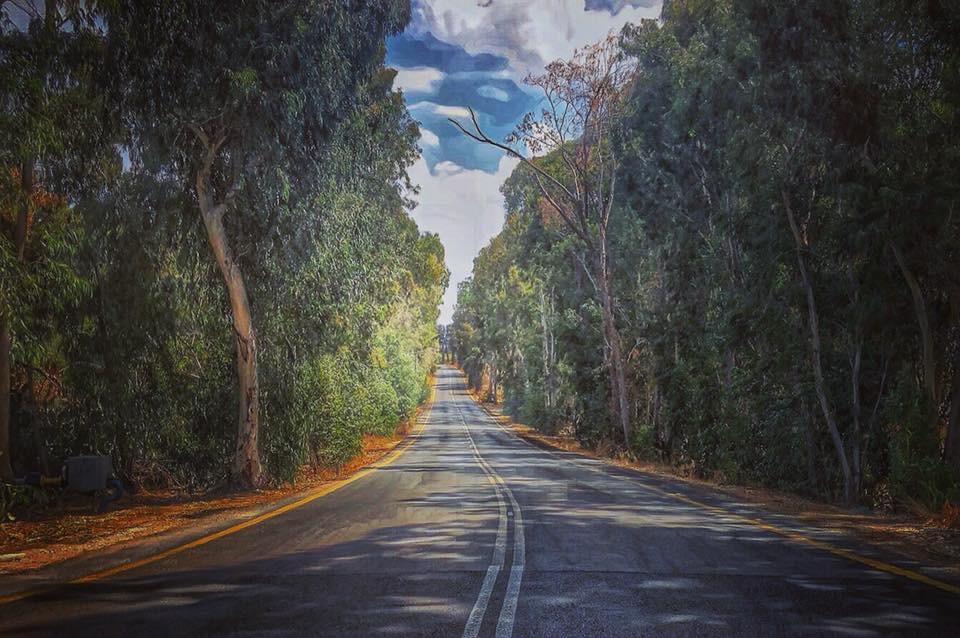
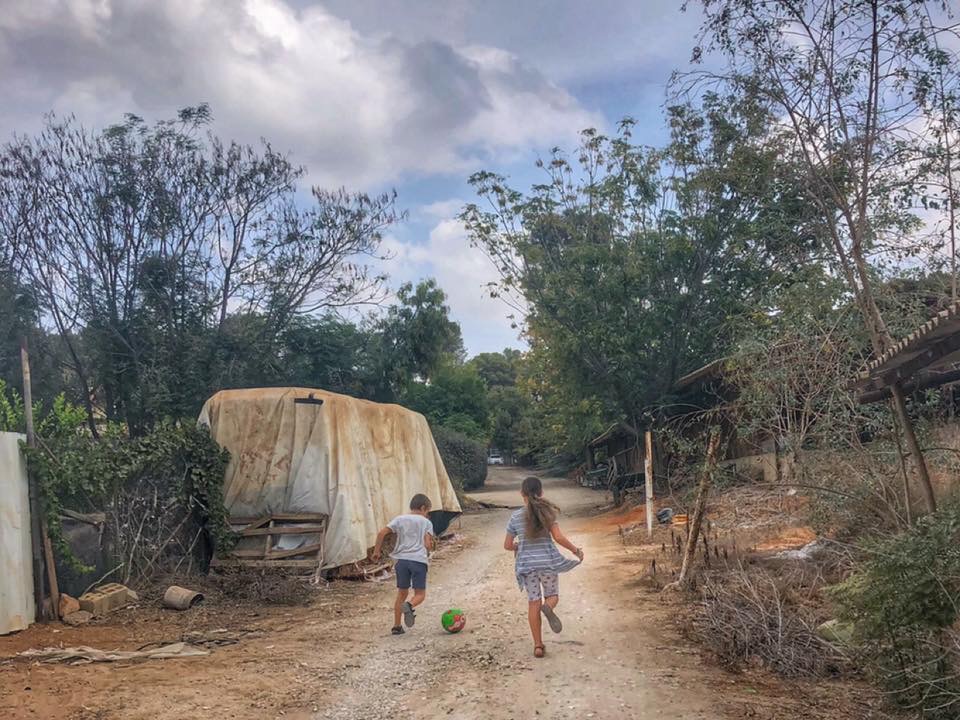
A small road in central Israel.
From Sheikh Jarrah in East Jerusalem to Kibbutz Gezer in central Israel
In the taxi with Raed, he says to me all the things I want to hear about peace and coexistence. “We all have to live together,” he says.
“You’re right,” I answer.
“It isn’t easy in Jerusalem,” he says. “We don’t meet each other. Even if we are sitting at tables next to each other at the same restaurant.”
“Why is that?”
“Because the Jews are afraid to mix with us.”
“Why do you think that is?”
“Because they’re afraid we’ll sleep with their women and marry them and have babies with them.”
I start to interrupt.
“Wait,” he says and holds up his hand. “I had a girlfriend — a beautiful Jewish Israeli girl. She was even in the army. I had no problem with this. I brought her home on some weekends and she would stay with me. My parents took it fine, even though she was working at a checkpoint near my cousin’s village. They didn’t care. She was nice. So it was OK. In our culture, it’s fine for me to marry someone who isn’t Muslim. OK, my sister can’t. She has to marry a Muslim, but men can marry Jews, Christians. It’s fine.”
“Because Islam is passed through the father, right?”
“Yeah. It isn’t that way for Jews, though.”
“I know. My dad isn’t Jewish. My mom is. So I’m Jewish.”
“Right. OK. So I go out with this girl and it’s fine with my family, but her family? Wow. They were so angry. We weren’t going to get married or anything. I liked her. She liked me. But they hated the idea that she went to sleep with me at night and woke up with me in the morning. And her family weren’t even those crazy extremists who beat up Arabs. They vote for the left: Avoda B.S. Meretz, Shmeretz. They’re all happy to be left wing and eat our hummus and talk about coexistence until their kids are playing with our kids or their daughter is dating one of us.”
“I guess they’re afraid.”
“Yes. But why? I’m a nice guy. I met her father. I tried to shake his hand. He wouldn’t look me in the eye. Do you know how that feels?”
I do know. I’m Jewish and I’ve traveled in countries where it isn’t always comfortable to be a Jew, and I tell him that.
“It hurts,” Raed says. “It makes me not want to even try to talk to people from your side because you’ve drawn lines and you’ve made sides. OK. Not you, but most Israelis, when they look at me, they see a dirty Arab. I’m sorry but I have to say the truth. Don’t they remember what it was like to be a ‘dirty Jew’? ”
I don’t know what to say, except, “I’m sorry this is happening. I want it to be different.”
“Me, too. I saw something I’ll never forget. There was an attack by the Damascus Gate. A cop was stabbed and the guy who did it was shot. There was blood everywhere. Red blood. All over. And I couldn’t tell where the Jewish blood stopped and the Arab blood began. We all bleed the same color. So why does it matter so much where we come from? We all are born the same way and we die the same way, too.”
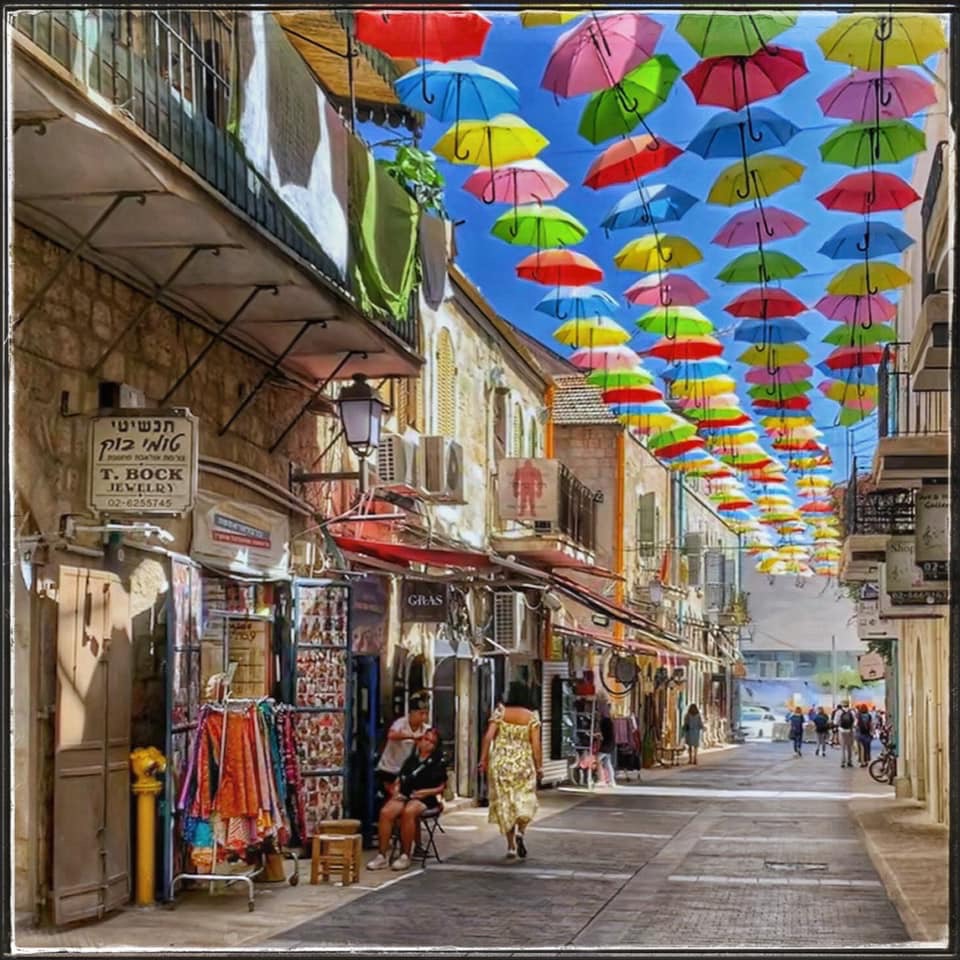
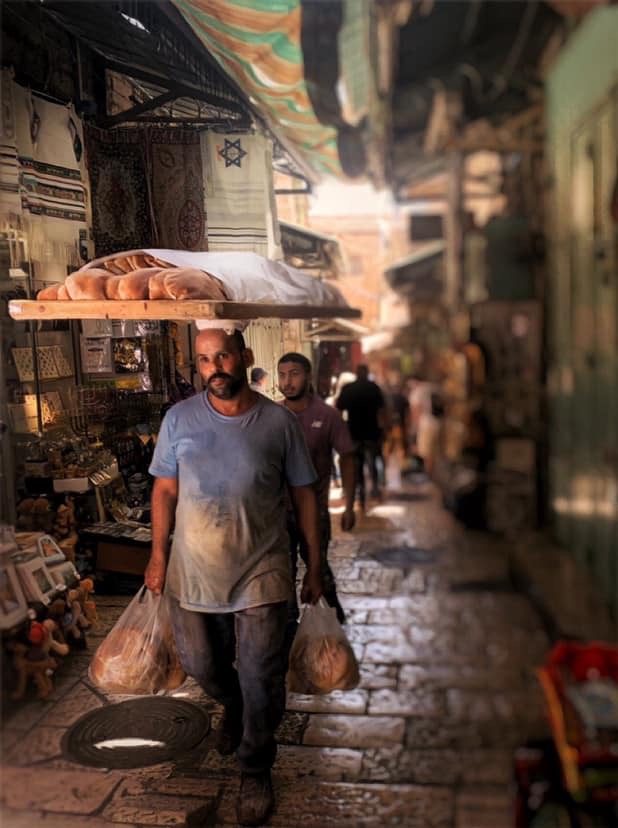
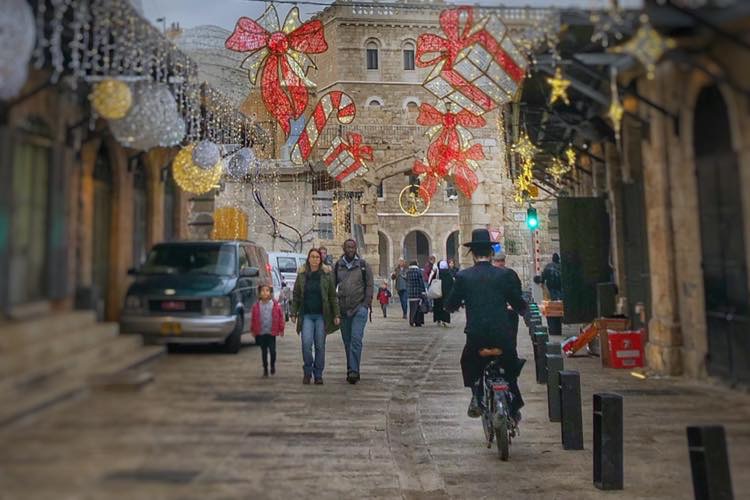
David Street in the Old City of Jerusalem.
From Latrun Junction in the Ayalon Valley to Jerusalem
The driver is really, really happy. The radio is on. “Infected Mushroom.” He’s bopping along. “What’s today?” he asks me. “Sunday? Monday?”
“Sunday.”
“OK. So I still have to wait two days for my weed.”
I laugh.
“Do you smoke, kapara?”
“Not really.”
“Too bad. It’s great for parties, you know?”
He tells me about the desert, about dancing all night at raves, about this girl he loves with pink hair and tattoos all up and down her arms. He’s wearing a yarmulke, and there’s a sticker on the dashboard with a picture of the Rebbe.
I check the news. My stomach drops when I read the headline: 1 Israeli killed, 2 critically injured in a terror attack.
“Oh, my God.”
“What?”
“There was a terror attack.”
“When?”
“This morning.”
He sighs. “This is why I don’t listen to the news. I don’t smoke weed because it’s fun. I mean, OK, it’s fun. But I smoke because I have to, I swear. I even have a doctor’s note. After what I went through in Gaza, I have to smoke.”
“I’m so sorry.”
“When I hear the news, I can’t function. I get so thin because I won’t eat. You wouldn’t believe it. I mean, I look good, but I feel like hell. I just stay in my house and turn off all the lights and I don’t watch TV and I just check the windows. No one can get near me. The only thing that helps is smoking.”
“That sounds so awful and I’m so sorry.”
“What a mess,” he says. “You know, when I was a kid, before Gaza became what it is, my dad used to take me there for shopping and for hummus and we would go to the beach. He would carry me on his shoulders and then he would put me down and sometimes I played with the Arab kids while he smoked cigarettes.”
“It was different, wasn’t it?”
I love to move from city to city, through the hills, across the plains, stuck in snarling traffic or flying down the highway.
“Yeah, it was. It’s a mess now,” he says again in English. “And then when I was a soldier, I was a commando on the beach and we had to shoot and I remembered that I used to be there playing, and maybe I shot one of the kids I played with.”
He lights a cigarette. “What a mess. Now I smoke weed and I put on tefillin and I pray just to get by. I can’t listen to the news. It’s too much.”
“I understand.”
“But this is my country and I need to know what’s happening to my country.”
He fiddles with the dial and switches the station.
A dirt road on a moshav in central Israel.
From Herzl Boulevard in Rehovot to my home on the moshav in central Israel
The taxi driver calls me Saraleh because he can see my name is Sarah from the Get Taxi app. He also can see I used a profile picture where my hair is blown out all shiny, and he says, “It still looks like you in the picture but I can see you had a busy day today and didn’t do your hair. But thank God you’re busy. Being not busy is the worst. I retired 10 years ago and I almost lost my mind until I became a taxi driver, HaShem Yishmor — God protect you.”
My 9-year-old son coughs.
“Here, have a candy,” the driver says. “It’s a candy for coughs.”
“We don’t take candy from strangers,” my son replies.
“It isn’t really candy. It’s medicine for your cough.”
“We don’t take drugs from strangers, either,” my 11-year-old daughter says.
“I’m not a stranger. Right, Saraleh? Tell your kids. We are all Israeli. We are all family.”
We all take a candy. They’re sealed. I make a mental note to talk about this with my kids at home.
“Stay busy, Saraleh,” he says. “Remember, being busy is better than good hair.” He rubs his bald spot and laughs. “And don’t forget to give Uncle Pinchas 5 stars and a tip.”
From Ramle in central Israel to the Mount of Olives in Jerusalem
The taxi driver has a tattoo on his right bicep of St. George slaying the dragon. His name is also George. And he also has an Israeli flag decal stuck on the dashboard.
I’m leaving the shuk in Ramle with my groceries, and the whole backseat of the taxi smells like mangos and fresh mint.
“I like your tattoo,” I say, and I show him the Coptic mermaid on my arm.
He asks if I’m Christian.
“No, I’m Jewish.” “I’m a Christian. You’re lucky you’re Jewish.”
“How so?”
“This is your country. OK, I know outside of Israel it’s different but you can come here. This place will take you in no matter what.”
“That’s true,” I say. “This place is home.”
“You’re lucky,” he says again. “I wanted this place to be my home but it isn’t. I have no home. I was born here in Ramle and I am an Israeli but because I am not Jewish, Israelis look at me like I am an Arab and not a real Israeli. But most of the Arabs don’t accept me as a real Arab because they are Muslim and I am a Christian, so they call me a Zionist. Do you see? I want this place to be my home but it isn’t.”
“I’m sorry.”
“You wouldn’t believe how hard I’ve tried to make it home. When I was in high school, I even begged the army to let me join. I sent letters. I even went to the offices in Tel Aviv. They said they have no record of me even applying. I wanted to join so badly to fight for this country and defend it but they don’t want me. Why? Because even though I am an Israeli, all they see is an Arab.” He sighs. “And now? I’ll tell you the truth. The first chance I get to leave this place, I am gone. Why should I stay where I’m not wanted? I would rather wander in the desert.”
We stop at a traffic light. He reaches over and peels the Israeli flag decal from his dashboard, crumples it, rolls down the window and throws it out.
A hot wind blows through the car.
From Rothschild Boulevard in Tel Aviv back home
I think this must be the last taxi out of Tel Aviv on erev Yom Kippur. The streets have mostly emptied and already a few bicyclists are on the Ayalon freeway speeding toward the sunset.
That’s the thing about Israel. The whole country grinds to a halt on Yom Kippur. A stillness falls. Shops shutter, the radio goes silent. There’s nothing on TV unless you pay extra for satellite television. But the other thing about Israel is this place isn’t monolithic. There are people who fast. And people who don’t. There are people who pray. And people who won’t. Sometimes, people can’t.
And while the cars hold their parking spaces for 25 hours, in places like Tel Aviv, out come the bicycles. It’s amazing to see. From old men in neon orange short-shorts to little girls in pink helmets, to fathers and mothers chasing their kids who are riding three-wheelers, to teenage boys in Maccabi Tel Aviv jerseys trying to keep up with their pretty girlfriends, the highway becomes the Tour de France.
But that means we have to get off the road before sunset, before the holy day begins.
“Are you fasting?” the driver asks. “Eh,” he says, before I can answer. “Fast if you want. Don’t fast if you don’t want. Let me tell you a story. Every year on Yom Kippur, me and my army buddies would barbecue on the beach. Every single year. I brought the steaks. Sometimes chorizos after Yossi got back from Argentina. We drank beer and listened to music and smoked cigarettes from noon until three stars. Except one year, Yossi got a little religious on us and he said, ‘Halas, let’s go to synagogue this year.’ So we did. We all went.”
“How was it?” I ask.
“Ahh … first, ask me what year it was?” “What year?” “1973, kapara. 1973. Do you know what happened on Yom Kippur in 1973?” Do I know what happened on Yom Kippur in 1973?
While most of Jewish Israel — including these army buddies — were in synagogue on the holiest day of the year, Egypt and Syria launched a strike against Israel.
Do I know what happened on Yom Kippur in 1973?
There are men who held their friends in trenches and watched them die. There are women who never saw their husbands after their last kiss. There are babies who were born just a few months later with no fathers.
Do I know what happened on Yom Kippur in 1973?
We were almost brought to our knees. We almost lost that war. We almost lost everything. Even the right to fast on Yom Kippur. Or not fast. The right to stay insynagogue or ride bikes down the Ayalon.
“Wow,” I say.
“So. You see? We never fasted again. We never went to synagogue on Yom Kippur. And every year since, we meet on the beach and barbecue like we did every year before that one terrible Yom Kippur when we went to synagogue like everybody else.”
“Wow,” I say again.
“Eh,” the driver says as he slows for the exit. “That’s just how it is. Israel depends on our diversity. It’s why we keep surviving.”
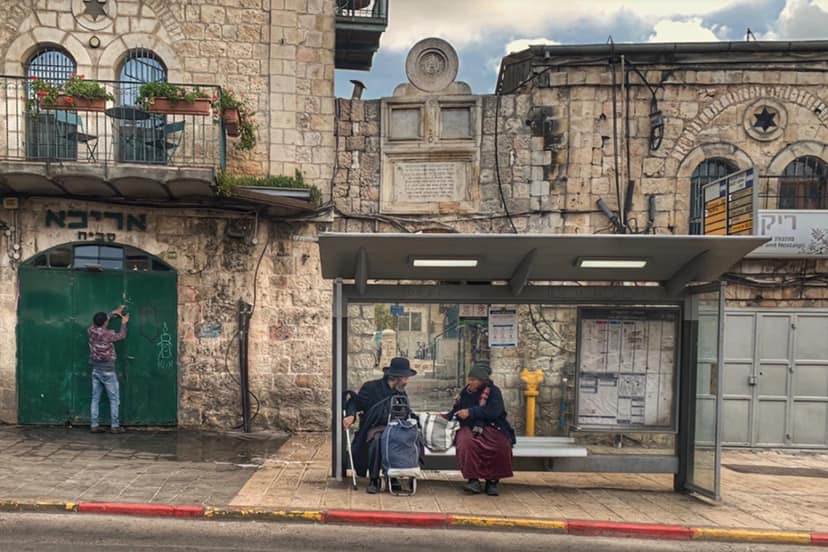
Agripas Street outside Shuk Mahane Yehuda in Jerusalem.
From Damascus Gate in the Old City of Jerusalem to the Jerusalem Central Bus Station
“I went to high school in the Old City,” Mahmoud tells me in Hebrew when we pull out of the taxi stand by Damascus Gate. “It was the school just inside the gate, near Al Wad by the mosque.”
“What was the school like?” I ask.
“Just a school. It was closed half the week, though.” “Why?”
“The army would come in and shut it down.”
“Why?” I ask again.
“Do the years 2000-2004 mean anything to you?”
“Oh.” The bloody, terrible years here when every siren was followed by another and another, when Jerusalem smelled like smoke and burning flesh.
“Yeah,” he says. “It was the [Second] Intifada and the army would come in and just shut us down, and so, instead of sitting in the classroom and learning math and history, we would all go up on the roof and chuck stones off the sides; not little pebbles but real stones.” He shakes his head.
I feel my stomach twist. Stones thrown from that distance could pulverize your skull and turn you into pink and grey and red, sinew, bone and blood if you were underneath. They were children and the stones were the heaviest weapons they could find.
“It was messed up,” he says. “Stupid kids all of us, and we did stupid stuff. But I was angry. My big brother was shot in the back by soldiers and he couldn’t walk or eat and had to pee through a tube.”
I think of my kids and their childhood spent with no real uncertainty, no barbed wire, no forced closures, no anger, no reasons to climb a roof and throw things.
And then I also think of how we spent a summer sleeping in bomb shelters and running over parched earth, and how, like every Israeli, we all know someone who was killed or injured in a terror attack or war.
“It was hard,” he says. “The soldiers would also come into the classroom and just look at all our faces and, if they didn’t like one face, they’d pull the kid out even if he didn’t throw stones. Even if all he did was just sit there without blinking. That made them mad, when we would stare back at them with no fear.
“But I don’t blame the soldiers. They had their job and we had our job and I really just blame the school for letting them in and letting them shut us down, and letting us have all that free time to do stupid and terrible things. Someone should have been the grown-up and made us stop. But no one did.”
He takes a sip of coffee.
“How’s your brother now?” I ask.
“He’s still alive, but not really. He’s just a ghost in a dried-out husk with a tube for peeing.”
We sit in silence for a while and he offers me a sip of his coffee. I take it. It smells like earth.
“Those kids should have kids by now,” he yells out the window, shaking his fist. “They should have three kids each and be living in Ramat Gan. My God. Kids. They should be doctors and teachers and lawyers and maybe some would be getting divorced, but my God, they should be alive.”
From King George Street in Jerusalem back home
I am sharing a taxi with this woman on a frigid, moonless night in Jerusalem.
She is on her way back from working late in the ultra-Orthodox neighborhood of Mea Shearim. I am heading out of the city, exhausted. The last bus had come and gone, belching down King George Street, probably an hour before. We are stranded but I have enough for a taxi, and I ask if we can drop her off.
“No, it’s OK. I’ll walk,” she says.
“No way. It’s freezing and it’s late.”
A taxi pulls over and we get in. She gives him directions and I shut my eyes.
I had never met her before but we are both American, which means we’re landsmen, which is as close as family some days, and we talk about her work and about the friends we have in common and about the things she cares about.
“I just read a horrible article about the Yemenite kids who disappeared,” she says. “I want to believe it isn’t true, but …”
All those Yemenite babies who vanished when they were born. Their parents were told they were born blue, but there were no bodies and no graves, and a mother never forgets the cry her child makes when he is born pink and healthy.
This was years ago and Israel had a terrible track record of treating non-European Jews as less than human in the 1950s. Evidence is inconclusive. Maybe these babies really died. But many people believe these kids were taken away and adopted out to Ashkenazi families that couldn’t have children and would do anything to be parents. Some speculate that the babies went to grieving and childless Holocaust survivors. That’s the best-case scenario, and it’s still the worst.
“It’s awful. The worst,” I say. “I don’t even want to imagine.”
We drop her off.
The taxi driver doesn’t charge her for the ride. “And don’t worry,” he says. “I won’t charge extra for you. It was nice of you to make sure she got home.”
“Thanks.”
“It’s Israel. We take care of one another.”
I smile and close my eyes. The taxi driver clears his throat. “Pardon?” I ask.
“The girl we just took home. What she said about the babies. It’s true,” he says.
He looks at me in the rearview mirror.
“I’m a Yemenite,” he says. “And my aunt had two babies. Two beautiful little girl babies. And the doctors told her one of them died when she was born. She grieved for her dead child and she threw her whole heart into raising her living one. That girl — my cousin — got older and got her draft notice for the army and she went to the army and she saw a girl who had her exact same face. And they had the same birthday, too. But her name was Weiss or Gold or something Ashkenazi, not Yemenite like her name should have been.”
“What happened?”
“My cousin tried to talk to her but the girl pushed her away and told one of the officers that she was harassing her, and so they moved her to a different unit and we never knew what happened to her. Her twin sister.”
“That’s heartbreaking. I’m so sorry.”
“Sometimes the truth is too horrible to face. She couldn’t face it. My aunt never got over it. Neither will I. Please tell people so they know, too.”
I shiver.
And it’s Israel, and we take care of one another. So I’m telling you, just like he asked.
From home to the Terem emergency clinic in Modi’in
It’s 6:30 a.m. and my son’s arm is red and swollen and tingly from a bug bite he got yesterday at a friend’s house. I call Uncle Pinchas the taxi driver, and as soon as he answers, he says, “What’s wrong?” because it’s 6:30 a.m.
I tell him I need to get to Terem Urgent Medical Care with my son, so he says, “I’m already on the way.”
He rolls up 10 minutes later in his pajamas with his flag from Independence Day still waving from the window, and he drives us 15 minutes to Terem, and while my son and I wait for the doctor, he goes to get us coffee because everyone needs coffee, especially when your kid is in Terem, HaShem Yishmor — God protect you.
By the time we are finished with the doctor and everything is OK (except my son has That Kind of Jewish Mother who freaks out about bug bites), Uncle Pinchas the taxi driver is sitting in the waiting room still in his pajamas reading Israel Hayom and muttering to himself.
He hands me the coffee and tells me to drink it in the waiting room because I shouldn’t spill on myself in the taxi — HaShem Yishmor.
My son wanders over to the vending machine and stares at it longingly.
Uncle Pinchas folds his newspaper, gets up and says, “What do you want me to buy you?”
“No, it’s cool,” my son says.
“But you are like a son to me,” Uncle Pinchas says, and he buys him a Snickers bar, the breakfast of champions.
“But don’t eat in the taxi because you could choke — HaShem Yishmor,” Uncle Pinchas says.
He drives 15 minutes back to the moshav through the sweet morning.
“Thank you for taking such good care of us,” I say when we arrive.
“Of course, you are like family to me,” Uncle Pinchas the taxi driver says. “That’ll be 480 shekels.”
From Jerusalem back home
It’s evening and the driver is laughing.
“What?” I ask, my one earbud still in an ear while I listen to the Red Hot Chili Peppers.
“That guy. Menachem.” He points to the driver in the taxi next to us. “He makes me laugh.”
He rolls down the window.
“Shalom! Ma koreh? How are you?” he shouts in Hebrew, his “k” hard and his “o” guttural.
Menachem in the other taxi, waves. “Kif Halak?” he replies in Arabic as he adjusts his black yarmulke.
We drive off.
“Do all the taxi drivers know each other?” I ask.
“Of course. We are family. We all look out for each other. When Menachem’s wife died, I came for shivah, and we break the fast together at least once every Ramadan.”
“Wow, that’s great.”
“La. It’s just reality. We have to be gentle with each other. At the end of the day, everyone just wants to get home.”
Sarah Tuttle-Singer is the new media editor at The Times of Israel and the author of “Jerusalem, Drawn and Quartered: One Woman’s Year in the Heart of the Christian, Muslim, Armenian, and Jewish Quarters of Old Jerusalem.” She also speaks with audiences left, right and center through the Jewish Speakers Bureau. Sarah is a work in progress.