fbpx

November 14, 2018

Israeli Tech Hits Silicon Beach with Fusion L.A.

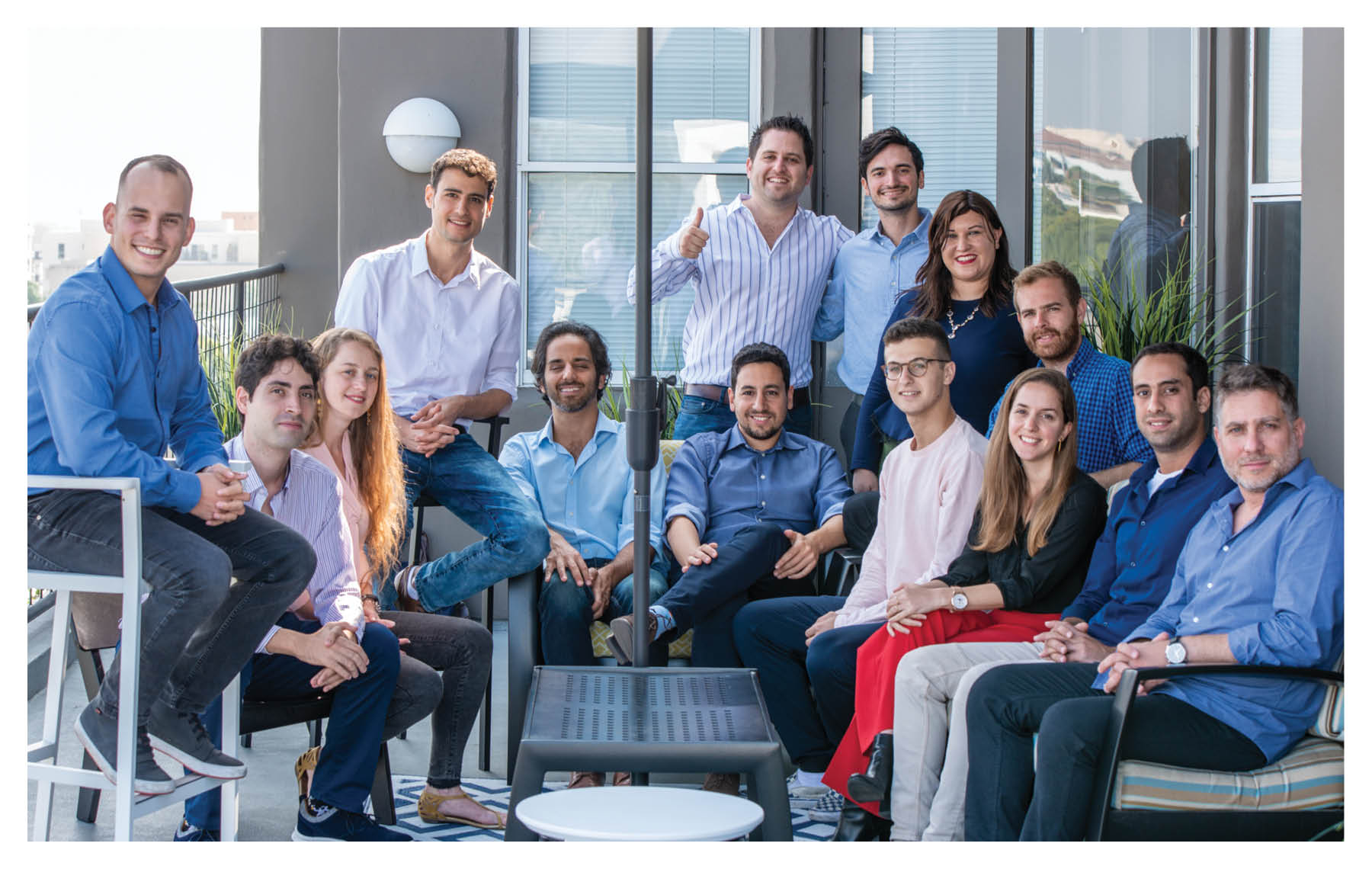
Photo by Moshe Levis Photography

Given their growing tech ecosystems, it seems only natural that Israeli startups and Los Angeles’ Silicon Beach should come together — and that’s exactly what Fusion LA is doing.

Over the past 12 months, the accelerator program that helps Israeli companies gain traction, raise capital and work with industry leaders in the U.S. has brought 20 Israeli companies to Silicon Beach, the coastal strip between LAX and Santa Monica that is home to more than 500 tech startups. The most recent eight startups were highlighted in an exclusive reception last month at SPACES in Santa Monica, hosted by Fusion LA Israeli co-founders Yair Vardi and Guy Katsovich. More than 80 investors and technology executives from Silicon Beach attended the event, which featured food, drinks and a showcase of brief pitches from the founders of a slew of Israeli-based startups. 

Katsovich said two of the startups, Farm Dog, a digital agriculture solution to help farmers use fewer pesticides; and Zero Energy Solutions, which helps commercial real estate companies save money on energy through their Climate Intelligence platform; are ready for investors.

“The grand vision is to be the launchpad for early-stage tech companies out of Israel,” Katsovich said. “We want to utilize the talent of Israeli founders and have them do business here in the United States, specifically Los Angeles.”

Katsovich visits Israel every few months to seek out tech companies. He brings their people to L.A. on tourist visas, where they then take part in a three-month program led by Vardi. During the program, Fusion LA helps participants meet investors, entrepreneurs and executives who help them adapt their companies’ branding, marketing and sales strategies to the U.S. market. 

“Coming to the U.S. is all about building relationships and long-term commitment,” Katsovich said. “Half of our companies we’ve invested in have already set up shop here. They have a founder that’s moved [to Los Angeles] or some business development representative. This is something we put an emphasis on.”

“There are companies that have been around for four or five months. It’s really about how we succeed in L.A. together, helping each other out. That aspect I love.” — Liron Brish

Iftach Cohen, co-founder and CEO of Zero Energy Solutions, which is headquartered in Tel Aviv, said he is about to open a U.S. subsidiary. “The reason I joined this specific program is for their networking,” Cohen said. “For me, [this event] is an opportunity to say what [we’re looking] for and what we are delivering.”  

Katsovich and Vardi invest $20,000 in each of the companies in exchange for 5 percent equity in each of them. Moving a business to another country can pose significant challenges, so they look for smart, talented and assertive people to work with, among other things. 

Liron Brish, CEO of Farm Dog, was born in Israel and grew up in Texas and New York before heading back to Tel Aviv for six years. He moved to Los Angeles a month and a half ago, something he had planned to do before connecting with Fusion LA.

“Moving to California was difficult for me internally, but being able have a soft landing and folks that I can call great friends right off the bat was very helpful,” he said.

“There’s been great camaraderie between all the different startups,” Brish added. “My company’s been around for about three years. There are companies that have been around for four or five months. It’s really about how we succeed in L.A. together, helping each other out. That aspect I love.”

Vardi said, “We’re proud to see many familiar faces and new professionals who recently joined our community as mentors and friends of the program, investing their time and money to help Israeli founders scaling their companies in the U.S. market. The L.A. tech ecosystem is booming with over $10 billion in venture capital investments in the past two years. It’s exciting to be part of boosting Israeli innovation in SoCal.” 

Israeli Tech Hits Silicon Beach with Fusion L.A. Read More »

Israeli Consul General Bids Farewell to L.A.

In pedestrian averse L.A., Sam Grundwerg, the Consul General of Israel in Los Angeles, walked 10 miles on Rosh Hashanah and six miles on Yom Kippur to address congregations at the city’s spread-out synagogues.

The feat speaks to the stamina, as well as the Orthodox observance of Grundwerg during his abbreviated term of almost two-and-a-half years, rather than the customary three- or four-year terms. 

Grundwerg, who officially finished his term on Nov. 15, said he chose to leave early so his three teenage children could finish their schooling back in Israel. 

He already has a new position lined up. Last month, Grundwerg, 45, was appointed chairman of Keren Hayesod-United Israel Appeal, Israel’s official fundraising arm around the world, except in the United States, where the Jewish federations have assumed the task. In 2017, Keren Hayesod’s annual budget was $162 million, of which $140 million went to various programs and projects, including aliyah and absorption, strengthening Israeli society and programs for Jewish youth in the Diaspora.

This new assignment for Grundwerg, personally approved by Prime Minister Benjamin Netanyahu, represents a capstone in a varied and upward career.

Born a third-generation American in Miami Beach, Fla., Grundwerg was raised in an Orthodox and fervently Zionist family. At 17, he studied at a yeshiva in Israel for a year, then volunteered in the Israel Defense Forces (IDF), serving as a tank gunner.

He then returned to Miami where he spent the next 10 years studying finance and earning a law degree at the University of Miami. Following graduation, he worked in both fields before making aliyah in 2009. In 2010, he was appointed director general in Israel for the World Jewish Congress.

Recently, at his home in West Los Angeles, Grundwerg spoke with the Journal about his tenure here. 

As consul general, he has closely observed the changing relationship between Israel and Diaspora Jewry, which he considered inevitable. “In a way, it was easier for Diaspora Jews to support a weak, fledgling Israel than [today’s] strong, powerhouse Israel,” he said.  

While he stressed that he respects the concerns of American rabbis about the power that Israel’s Orthodox wield over establishing laws governing marriage, divorce and the very definition of who is a Jew, and the Knesset’s recent approval of the nation-state law, “by definition, Israel is a Jewish and a democratic state, but the two aspects are not completely compatible,” he said.

An ardent sports fan, Grundwerg paraphrased legendary American football coach Vince Lombardi, saying, “Israel can never be the perfect Jewish democratic state, but we can be the most best and most excellent Jewish democratic state.”

Grundwerg also spoke of the importance of his personal relationships with Jewish community leaders and public officials in Los Angeles.  “I am extremely proud of what we have accomplished, with a strong staff team,” he said. He singled out his outreach and close relationships with the Latino community, aided by the fluent Spanish of his wife, Julia, a nurse born in Puerto Rico into a family of Syrian immigrants that lived for many years in Argentina.

Among the achievements during his tenure that he mentioned was his outreach to L.A.’s growing Asian community, noting that its members, like Hispanics and Jews, share basic values such as family devotion.

He described his relations with the local news media as “pretty good,” although he cited having hassles with the Los Angeles Times about its reporting and editorials on Israel.

On a more positive note, Grundwerg highlighted the 70th-anniversary celebration of Israel’s statehood that was held at Universal Studios under the banner, “Hollywood Salutes Israel.” The event was a celebration of Israel’s historical stages, featuring American and Israeli film and sports stars.

Grundwerg also introduced talk-show host Conan O’Brien, TV presenter Bill Nye and TV travel host Laura MacKenzie to Israel.

But perhaps his most impressive coup in intercultural relations was his hosting of some 60 leaders of the Los Angeles Muslim community, including basketball legend Kareem Abdul-Jabbar, for the Iftar break-fast meal during Ramadan. He held the event at his residence — which is officially designated as Israeli territory — spreading out a large prayer rug in the living room.

Looking forward, Grundwerg said he currently harbors no ambitions to go into politics. However, after a pause, he added, “But you never say never.”

Israeli Consul General Bids Farewell to L.A. Read More »

Newly Elected Minnesota Rep. Omar’s Campaign Says She Supports BDS

Screenshot from Twitter.

Newly elected congresswoman Ilhan Omar (D-Minn.) has now come out in support of the Boycott, Divestment and Sanctions (BDS) movement, despite her stated opposition to it in the primary.

At an August forum, Omar said that BDS isn’t “helpful in getting that two-state solution.”

“I think the particular purpose for [BDS] is to make sure that there is pressure, and I think that pressure really is counteractive,” Omar said. “Because in order for us to have a process of getting to a two-state solution, people have to be willing to come to the table and have a conversation about how that is going to be possible and I think that stops the dialogue.”

However, Omar’s campaign told the Muslim Girl on Nov. 12 that Omar actually does support BDS.

“Ilhan believes in and supports the BDS movement, and has fought to make sure people’s right to support it isn’t criminalized,” the campaign said. “She does however, have reservations on the effectiveness of the movement in accomplishing a lasting solution.”

When TC Jewfolk pressed Omar on her apparent flip-flop, Omar replied that while she supports BDS, she has “reservations” about the long-term effects of BDS in finding a solution to the Israel-Palestinian conflict. She added that this is what she said at the forum.

The Anti-Defamation League tweeted:

As the Journal has previously reported, Omar tweeted in 2012 during Hamas’ rockets attacks against Israel, “Israel has hypnotized the world, may Allah awaken the people and help them see the evils of Israel.” Omar has since claimed that the tweet wasn’t anti-Semitic, tweeting, “Drawing attention to the apartheid Israeli regime is far from hating Jews.” She later tweeted:

As a member of the Minnesota House of Representatives, Omar voted against an anti-BDS bill because she didn’t want to abrogate “the ability of people to fight toward that justice and peace.”

Additionally, in January. 2016, Omar reportedly called for the University of Minnesota to divest from Israeli bonds.

Omar, along with newly congresswoman Rashida Tlaib (D-Mich.), who supports a one-state solution to the Israel-Palestinian conflict, will become the first two Muslim women to be elected to Congress.

Newly Elected Minnesota Rep. Omar’s Campaign Says She Supports BDS Read More »

Three Reactions on Fires from Social Media

As the fires continued to rage through Southern California, members of the Jewish community took to social media to share their thoughts and feelings. Below are three of those posts. 

(Editor’s note: Some posts have been edited for length and clarity.)

Our House
Zack Lodmer, Director, Silicon Beach Engagement at Jewish Federation of Greater Los Angeles

My dad taught me how to play baseball in the front yard. I taught my son how to play baseball on that same yard. 

Our basketball and soccer teams had epic pizza parties in the expansive back portion of the house. I practiced and practiced in every nook and cranny, transforming from a little 6-year-old, squeaking on the licorice stick a la Ferris Bueller, into an accomplished clarinetist. 

My sister dressed me up as Ms. Hannigan when I was 3 years old and we put on the entire play of “Annie” in the living room (she was the titular star of course). 

I invited droves of friends for Passovers, Shabbats, Yom Kippur Break Fasts, birthdays, and more. My son’s pidyon ha-ben took place on the magnificent, spacious porch. 

My sister and her husband danced on the lawn, their first day as husband and wife, only three months ago. A few years ago, my parents sprawled out on that lawn and gave an interview to the L.A. Times on the benefits of organic gardening. 

The sounds of Simon and Garfunkel and the Beatles filled the house, emanating from the stunning baby grand piano and echoing in every corner of this Cape Cod-style masterpiece. 

One time my dad represented Muhammad Ali’s sister in a legal matter. Muhammad graciously had lunch with us and gave us a signed pair of gloves as a token of his appreciation. We took a picture with him. And we framed it, with the signed gloves, and displayed it in the game room. My kids never really noticed the champ’s gloves because they were too busy playing Monopoly, making drawings, erecting entire cities out of Legos, and having pillow fights. I was always worried they’d knock over the framed Muhammad Ali stuff, but I’m proud to say they never did. We had hard talks around the kitchen counter. 

We learned, we grew, we supported each other, we cried, we held each other and we celebrated victories, big and small. Everyone who walked in those doors walked into a sanctuary of peace, love and prosperity. From the exquisite food to the warm hugs to the impressive-but-accessible artwork, to the cozy blankets, to the beachy vibes. 

This house was more than a house. This home was more than a home. It was a landing place for out of towners. It was a therapy couch for the downtrodden. It was a convening place for an entire community. It was a testament to how life could be, and it was an example of how life should be. It was literally the best place on earth. My parents started with nothing. And while a house is ultimately just some things, in some walls, I suppose … their living space was an expression of two beautiful souls living life beautifully, uniquely and inclusively. As this house is gone, a big part of me is gone, too.


Camp Hess Kramer
Rabbi Ken Chasen, Leo Baeck Temple

I know you will be rebuilt. I know you are the people and not the buildings.

But before I can get there, I have to linger in a lot of sweet memories created when you were as you used to be.

When I thought I would never again enjoy the great gift of working a full summer at Jewish camp, you gave me that gift twice … in my 30s, just before I became a rabbi.

Of all the camps I have been blessed to be a part of, the only one I was ever given the honor of serving as resident director is you.

The amazing young people on the CHK staff then are now grownups, so many of whom send their own kids to you, to discover their Jewish souls in the same places we once walked and sang and ate and laughed and cried.

They are now cherished friends, rabbinic colleagues, and congregants of mine. We have rejoiced together under the chuppah and mourned together at the grave. You gifted them all to me.

For 16 years, I have brought my congregation to you for Religious School Retreats and Confirmation Retreats, creating new memories with countless young people who have loved discovering your beauty and your joy.

Our temple’s Religious School was scheduled to return to you this past weekend. We were the first to lose the chance to re-meet you as we have always loved you, but there will now be so many more. I am so sad for all of them.

I know you will be rebuilt. I know you are the people and not the buildings — and I am more grateful for that today than ever. But before that rebirth begins, I need to say that I will miss you as you were — and will treasure the endless list of precious moments you helped us create and hold for the rest of my life.

#camphesskramer
#KramerNeverStops
#wearecamp 

Evan Rosenfeld
Staff member and camper of Camp JCA Shalom
The Jewish summer camp in the hills of Malibu where I spent 12 formative summers as a camper and 2 years as a staff member (@CampJCAShalom) has been damaged by the #WoolseyFire. No word on the severity of the damage, but it appears significant. I am heartbroken and without words.

Three Reactions on Fires from Social Media Read More »

Fire Forces Bar Mitzvah Change of Venue

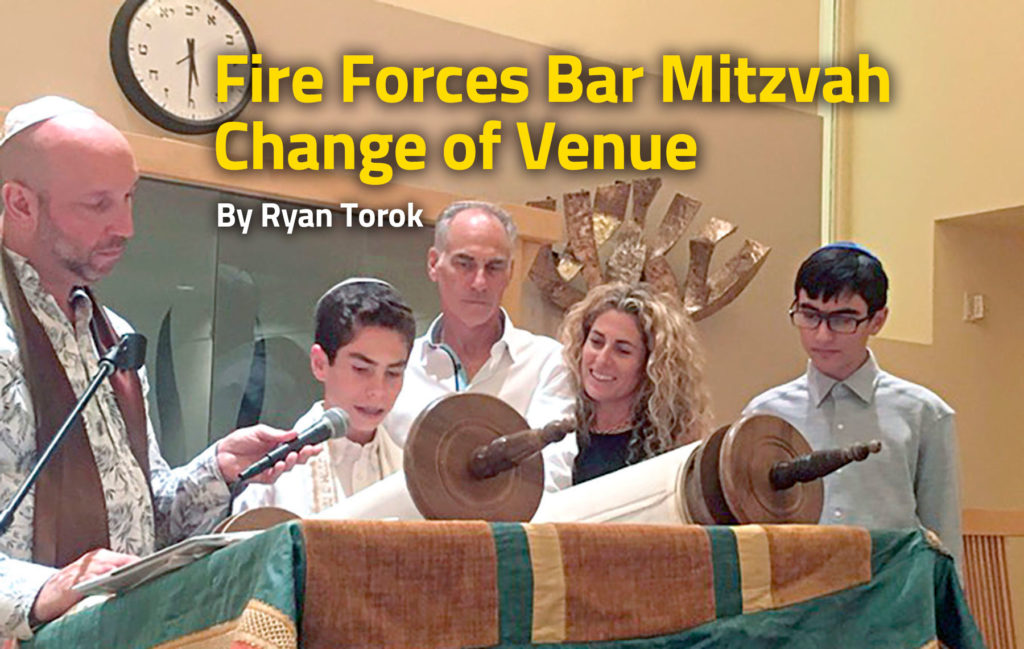
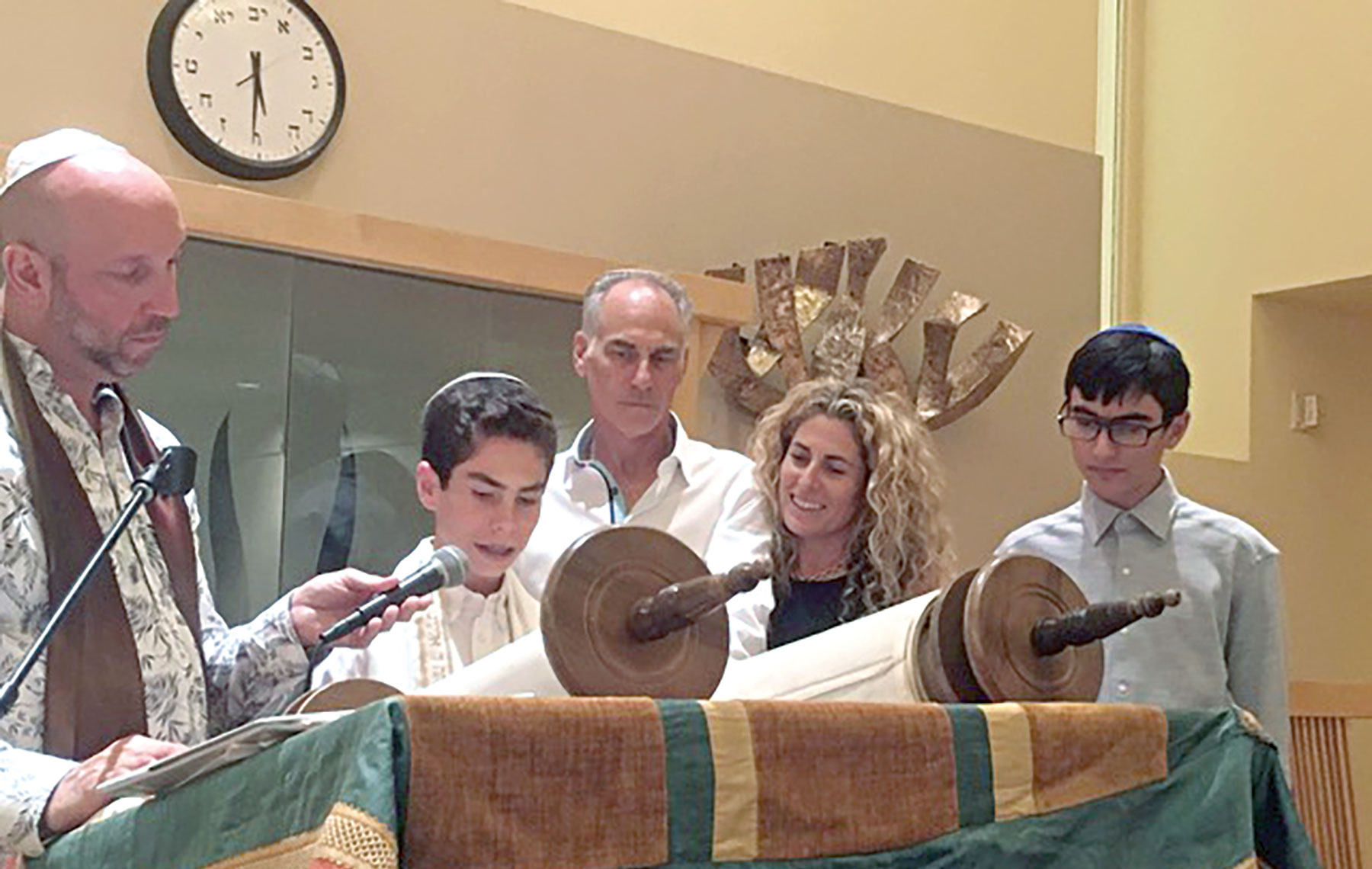
Jace Kletter reads from the Torah as MJCS Cantor Marcelo Gindlin (far left) and (from left) Jeff, Josie and Jett Kletter look on. Courtesy of Jeff Kletter

When the Kletter family evacuated their Malibu Canyon home on Nov. 10 due to the Woolsey fire, they expected to return there shortly thereafter. 

The family of five comprises parents Josie and Jeff, their children, Jett, Jace and Jessa, plus their dog, Jasko — “the J crew.” Josie joked during a phone interview that they were accustomed to evacuations during fires followed by prompt returns home. So when they got the call at 7 a.m. Nov. 9 to leave, Josie put together a small grab-and-go box of important documents and photos and told the kids to grab whatever they could, leaving behind supplies needed for Jace’s bar mitzvah, scheduled for the next day at Malibu Jewish Center and Synagogue (MJCS).

“Everything that was ready to go to the synagogue for his service and for his party — the centerpieces, the candy, everything you can imagine — was all staged and ready in our garage,” Josie said. Unfortunately, that’s exactly where everything stayed. 

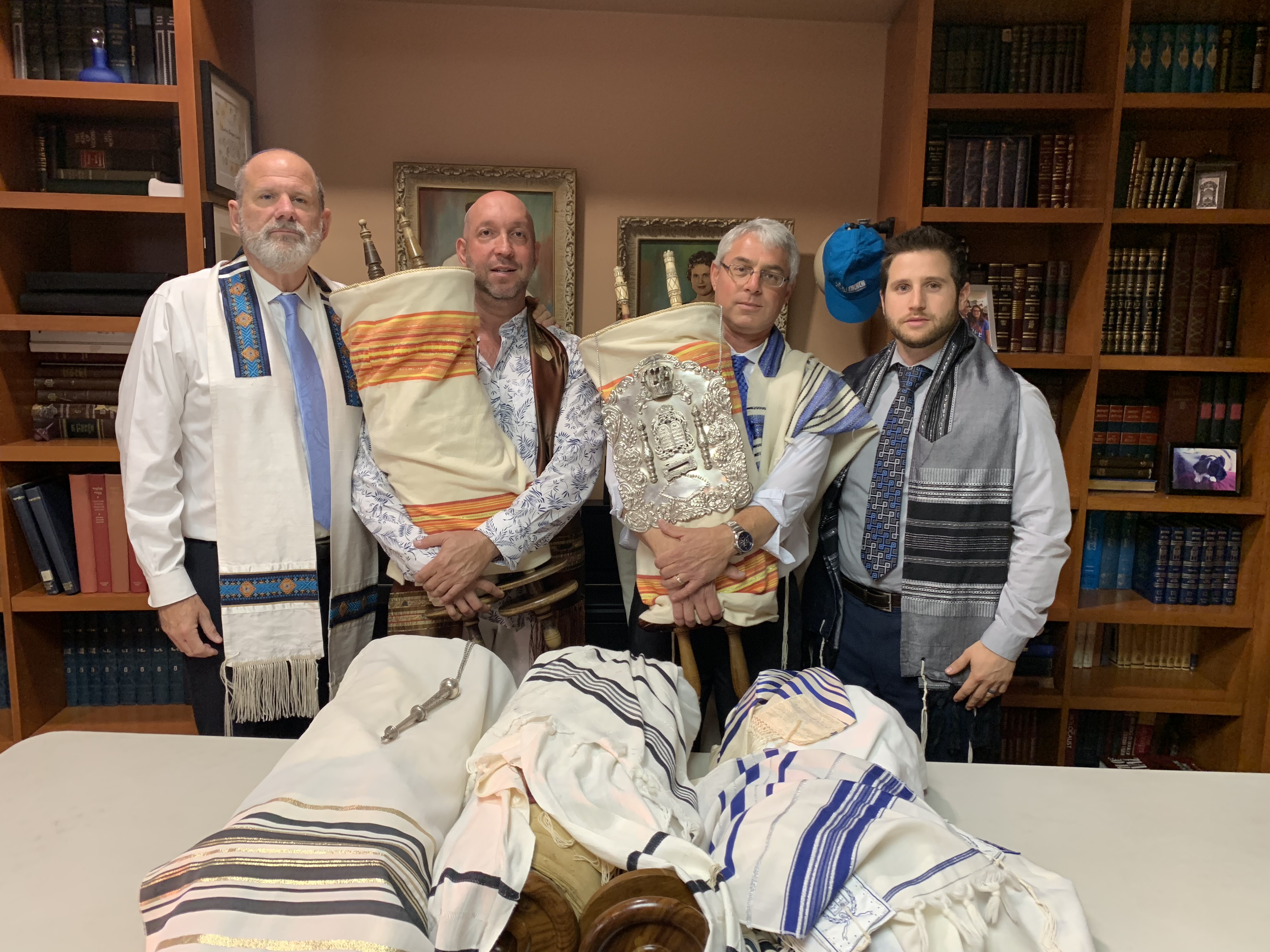
Unable to return to their home, the Ketters rented an Airbnb in Marina del Rey, and Pacific Palisades synagogue Kehillat Israel (KI), which had already taken in MJCS’s Torah scrolls for safekeeping, encouraged the Kletters to hold Jace’s bar mitzvah in their shul. 

“They welcomed us with open arms and gave us their small sanctuary and even their social room for a reception,” Josie said, and on Nov. 9 the family notified the 120 invited guests that there had been a venue change and said they understood if people couldn’t make it. 

From left: Kehillat Israel Cantor Chayim Frenkel; Malibu Jewish Center and Synagogue (MJCS) Cantor Marcelo Gindlin; MJCS Rabbi Michael Schwartz; and Kehillat Israel Rabbi Daniel Sher, pictured with MJCS’ evacuated Torah scrolls at Kehillat Israel. Courtesy of Kehillat Israel.

Jace was up for the improvised plan. His Torah portion, Vayetzei, follows Jacob’s experiences with Laban. “I was happy to do it,” Jace told the Journal, “because if I did it later, I believe I would have to learn a new portion and I’m not good at learning stuff quickly.” 

Ironically, Josie had opted not to hold Jace’s bar mitzvah on his 13th birthday, Nov. 22, because she was concerned no one would show up over Thanksgiving weekend. But on Nov. 10, around 25 people attended Jace’s service at KI, followed by a small reception in the social hall.

“He really enjoyed it. It was an intimate group. He was very polished and confident,” Josie said. “I think with his Torah portion being what it was, it fit with the circumstance.” She added, “Everyone was feeling stressed and lost. It gave everyone a few minutes to focus on something positive.”

“When my students read Torah, I say the world can fall apart and you finish reading. The world was literally falling apart but Jace continued reading. We choose life. We have to continue.” — Cantor Marcelo Gindlin

That included MCJS Cantor Marcelo Gindlin, who lost his home in a man-made fire last year, and MJCS Rabbi Michael Schwartz, whose rented home was destroyed in the Woolsey fire. The two officiated Jace’s rite of passage.

“When [my students] read Torah, I say the world can fall apart and you finish reading,” Gindlin said.  “The world was literally falling apart but [Jace] continued reading. We choose life. We have to continue.”

Though it was not the crowd the family had expected for Jace’s big day, nor the fancy party with all of Jace’s friends and the cool DJ, nonetheless, Josie said, “it was such a meaningful experience. It sure is one Jace will not forget.”

“I’m so exceptionally proud of him,” his father, Jeff, added. “He is such a bright young man. He has grown up into being a good citizen of the world. A mensch. That’s what my dad used to say: ‘You have to be mensch. You have to do what you’re going to do and there’s no point in complaining.’ ”

Fire Forces Bar Mitzvah Change of Venue Read More »

Three Beloved Camps Destroyed in Fires

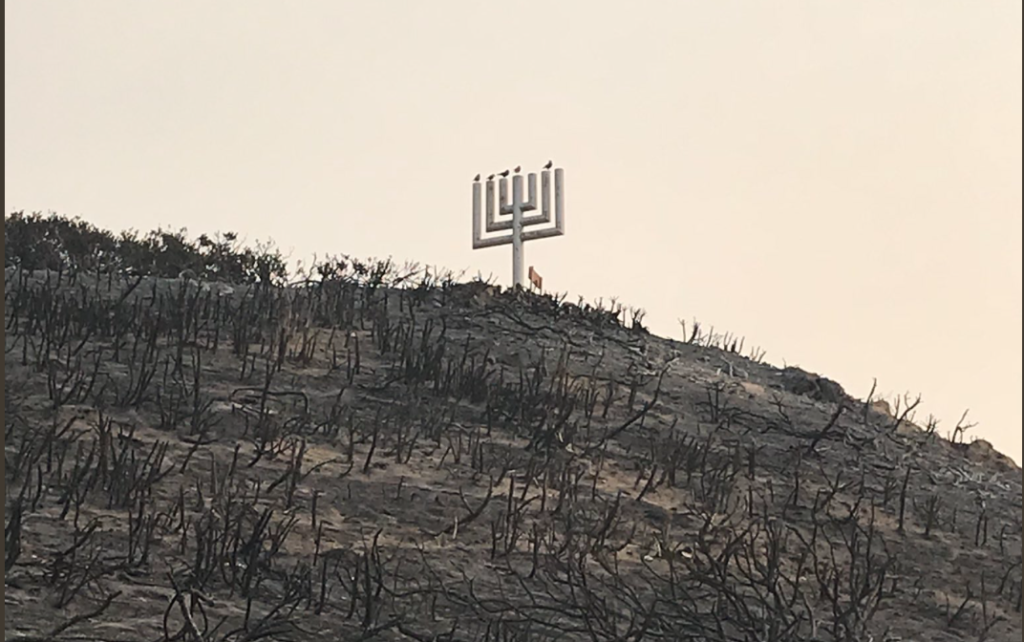
The Jewish community has been reeling from the Woolsey wildfire in Malibu, Thousand Oaks and nearby areas, which destroyed much of Wilshire Boulevard Temple Camps, the Shalom Institute in Malibu and Ilan Ramon Day School in Agoura Hills.

Speaking with the Journal, Shalom Institute Executive Director Rabbi Bill Kaplan and Wilshire Boulevard Temple Senior Rabbi Steve Leder described the damage to their respective organizations as significant. 

“There is only about half of the property [remaining],” Kaplan said. “It’s in pretty bad shape. Some buildings are completely gone.”

Among the buildings destroyed were the Emma Stern Center, which provides lodging for guests of the Jewish education center and camp, the Shalom Institute’s Shemesh Farm for special needs young adults, the changing room by the pool, the conference center, the barn, yurts and bridges to all the different areas. 

“There’s a fireball that went through there,” said Kaplan, who had not been able to access the site as of Nov. 12. “There’s probably not much remaining.”

Wilshire Boulevard Temple’s Camp Hess Kramer and Gindling Hilltop Camp also suffered severe damage.

“Camp is a mindset, not necessarily a physical place. Knowing we have a loving, caring community that wants us to succeed is amazing, uplifting and inspiring. ” — Rabbi Bill Kaplan

“I can tell you that at the upper camp, everything except for two cinderblock staff housing units has been destroyed — that’s at Hilltop,” said Leder, who also has not been able to visit the camps. “And at Kramer, the conference center, most of the dining hall and two cabins survived. Everything else is gone and we don’t know the extent of smoke damage to surviving structures, so they may be uninhabitable.”

Leder said he was not surprised when he learned the fire, which began Nov. 8, had reached his Malibu camps. “Well, I expected it, to be honest, from the beginning. Fire has just barely missed our camps five times in the past. When I saw what was going on in Malibu, I fully expected a complete wipeout.”

Leder added that the most important thing is that everyone was safely evacuated and that the Torah scrolls were saved. “Now we are making sure our staff who lived on-site have places to live and know we will take care of them and their families,” he said.

Leder was attending a groundbreaking for a new structure at Wilshire Boulevard Temple’s Koreatown campus on Sunday when he heard the fire had reached his camps. He said he was struck by the juxtaposition of celebrating the beginning of a new structure at the synagogue and mourning the loss of old ones.

“We broke ground on the Rem Koolhaas[-designed] Audrey Irmas Pavilion, which I think will be maybe the most important piece of American-Jewish architecture of this century, at the same time we were learning we lost the camps,” he said. “My grandmother had this Yiddish expression: ‘God doesn’t give with both hands.’ I had that feeling, that sweet and sour part of life.”

The Woolsey fire began to blaze in the Simi Valley area the afternoon of Nov. 8 and by Nov. 12 had destroyed nearly 92,000 acres from West Hills to Malibu. As the flames approached the Shalom Institute, home of Camp JCA Shalom on Mulholland Highway, Kaplan’s focus was on evacuating staff living at the camp as well as the animals — horses, steer, donkeys and bunnies — there. Many of the animals were sheltered at the Ventura County Fairgrounds while Kaplan worked to find temporary homes for his staff.

“We are a family. We are kind of like ‘Kibbutz Shalom,’ ” he said. “It is a caring, loving community of people. It’s a loss of a facility and a loss of a culture. A work culture. That part is the most challenging. And not knowing what we’re expecting. But we’re figuring it out. Our team is great and we’re moving forward very quickly.”

Both Leder and Kaplan plan to hold their summer camps in 2019 at temporary locations and hope to rebuild their respective camps better than before. 

“Camp is a mindset, not necessarily a physical place,” Kaplan said. “Knowing we have a loving, caring community that wants us to succeed is amazing, uplifting and inspiring. We are going to get through this.”

“We will end up with better camps as a result of this,” Leder said, “and that is not to dismiss the sadness of all of us who have memories of things that have happened there, in those buildings, but I’m reminding everyone the fire doesn’t destroy memories, Jews are good at rebuilding. That’s what we do.”

Jay Sanderson, CEO of The Jewish Federation of Greater Los Angeles, pledged Federation support for the camps. It has opened up its Valley Alliance office on Ventura Boulevard in Woodland Hills to organizations in need, including the Shalom Institute.

“And obviously, we’re working directly with the camps that are gone, working directly with Camp JCA Shalom and Wilshire Boulevard Temple,” Sanderson said. “To the credit of the management of the camps and the leadership of Wilshire Boulevard Temple and the Shalom Institute, there was no loss of life, either animal or human.”

Last Saturday night, much of the Wilshire Boulevard Temple camp community came together for a Havdalah service at the synagogue’s West L.A. campus. Los Angeles Mayor Eric Garcetti was among those who attended. And on Sunday, much of the Shalom Institute came together at de Toledo High School in West Hills for updates about the fire.

“There was lot of mourning going on, certainly around the loss of these camps,” said Sanderson, who was among those who spoke at de Toledo. “Everybody needs to be assured these camps will come back better and stronger. It’s a very sad thing to see a place you love so much burned to the ground.”

Update, Nov. 19: “Among the buildings and areas lost to the fire at Hess Kramer are Baruh Hall, Gildred Hall, the climbing wall, Leadership Library, the dance platform, and the ark, along with several staff residences and all but two of the cabins. At Hilltop, all structures were lost with the exception of two cinder block staff housing units,” according to the Wilshire Boulevard Temple website.

View photos of the destruction at the Shalom Institute as well as updates about the site here. 


How to Help Victims:

The Jewish Federation of Los Angeles has launched a hotline for those affected by the fires. Support can be anything related to housing, food, legal questions, insurance questions or just someone to talk to you.

“If somebody belongs to a synagogue a rabbi has connection to them. If they don’t belong to synagogue we only hear from them if they let us know,” Federation CEO Jay Sanderson told the Journal. “It’s a wildfire emergency hotline. Someone will answer it between 8 a.m. and 8 p.m. seven days. As long as it is needed.”

Anyone who calls will speak to a staff member from the Federation. This includes members of the Jews in Need initiative who are trained in specific issues.

The non-profit also launched The Wildfire Relief Fund, where 100 percent of all money raised will go to victims of the fires and institutions that have received significant damage.

“We will be working with those institutions to help them raise additional funds, to help them with their planning go forward. Whatever they need we are going to help them,” Sanderson said.

To donate, visit www.jewishla.org. The hotline number is: (323) 761–8100.

Three Beloved Camps Destroyed in Fires Read More »

We All Care About Gun Violence, But There’s No Easy Solution

The video was heartbreaking.

A father, Jason Coffman, spoke before the cameras of his 22-year-old son, Cody, who had just been murdered in yet another mass shooting, this time in Thousand Oaks. “I am speechless and heartbroken,” he said through tears. “I cannot believe that it’s happened to my family. I just want him to know that he is going to be missed.”

They will all be missed: In Pittsburgh, where 11 people died in the hail of bullets in a shul; In Florida, where 17 people were killed at Marjory Stoneman Douglas High School; In Texas, where 10 people were killed at Santa Fe High School; and at other schools and public places too numerous to list here. Mass shootings have become so common that one of the victims in Thousand Oaks, Telemachus Orfanos, had survived a previous mass shooting — at the country music festival in Las Vegas last year in which 58 people were murdered.

Mass shootings can happen anywhere. Mass shootings,  unfortunately, are unstoppable.

Thousand Oaks is listed as the third-safest city in the United States by Niche, a service that ranks livability of communities across the country. California is the most heavily gun-controlled state in the country, too, with laws including “may issue” statutes that enable authorities to summarily reject concealed-carry permits, ammunition purchased through a federally licensed firearms dealer, 10-round limitations on magazine size, and a 10-day waiting period for firearm purchases, among other limitations. The Brady Center to Prevent Gun Violence says California has the nation’s toughest gun laws.

Yet California has also seen, in the past five years alone, mass shootings in San Bernardino (14 dead), Rancho Tehama Reserve (five dead), Isla Vista (six dead) and Santa Monica (five dead).

The problem of mass shootings isn’t limited to California, of course. It isn’t even limited to the United States. A study of mass shootings across the world from 2009 to 2015 shows that on a population-adjusted basis, Norway experienced the world’s highest mass shooting death rate (the Anders Breivik massacre of 2011 ended with 77 dead), followed by Serbia, France, Macedonia, Albania, Slovakia, Finland, Belgium and the Czech Republic. The United States, by this metric, ranked 11th globally. 

“California is the most heavily gun-controlled state in the country.”

We’ve heard from many of those on the political left that “thoughts and prayers” aren’t enough in the wake of mass shootings. But neither is emoting that “something must be done” without actually attempting to determine the correlation between proposed legislation and possible outcome. Banning sales of AR-15s might sound good in theory but the weapon used in the Thousand Oaks mass shooting was a handgun. Requiring universal background checks wouldn’t have stopped the Thousand Oaks shooter, either — California already has them. 

But isn’t doing something better than doing nothing? It depends on the “something.” Mass shootings have been prevented or minimized by good citizens with guns, too: A former NRA instructor used his own AR-15 to shoot the perpetrator in the Sutherland Springs church shooting in Texas in 2017. And law enforcement’s use of guns is usually the key factor in ending mass shootings once they start.

Perhaps it’s too narrow to talk about mass shootings in the context of gun violence. While mass shootings provide political flashpoints, the truth is that mass shootings are a tremendous statistical outlier. School shootings in the United States have actually been in steady decline since the 1990s. Perhaps we truly ought to talk about minimizing gun violence more broadly through gun control policies.

The problem here is that there is no obvious correlation between severity of gun laws and overall murder rates. If we truly care about people dying, we should worry less about method of murder than number of murders — and by that metric, states that heavily regulate gun ownership are no better than states that don’t. As professor Eugene Volokh of the UCLA School of Law has written, “states with more gun restrictions on average have very slightly higher homicide rates, though the tendency is so small as to be essentially zero.” And as for the idea of gun buybacks and bans, as statistician Leah Libresco wrote last year in The Washington Post, neither the United Kingdom nor Australia “experienced drops in mass shootings or other gun-related crime that could be attributed to their buybacks and bans.” In fact, the United States has approximately 400 million outstanding weapons in public hands — and the murder rate has dropped precipitously since the 1990s. 

All of this suggests that there is no silver-bullet gun control solution to stopping mass shootings or homicide more broadly. That’s because there isn’t. 

Now, that doesn’t mean there’s nothing we can do to mitigate risks at the margins, both with gun control measures and with other measures, too. On the gun control side, we should start by enforcing existing laws: Too many shooters have fallen through the cracks thanks to flaws in state reporting systems or failures by individuals to take lawful measures to prevent dangerous individuals from accessing firearms. David French of National Review also has suggested gun violence restraining orders: statutes aimed at allowing spouses, siblings, parents or a person living with a potentially threatening person to petition a court for an order to temporarily remove Second Amendment rights from that person. That law is already on the books in California — obviously, it didn’t stop what happened in Thousand Oaks, even though the police were called to the home of the gunman’s mother back in April.

“We must acknowledge that heated rhetoric has a tendency to raise the general temperature —  and that a boiling pot spills over the edges more than a lukewarm one.”

We also have to harden existing vulnerable targets. Synagogues across America have been doing this for years — and it does, in fact, help minimize risk. In 1999, a white supremacist mass shooter scoped out the Simon Wiesenthal Center on Pico Boulevard and Roxbury Drive as a shooting target; he was dissuaded from attacking because of the presence of guards. Instead, he drove to the unprotected West Valley Jewish Community Center. Shooters tend to choose targets where they believe they will be most successful in wreaking havoc. The Thousand Oaks bar was a gun-free zone — until a shooter invaded the premises armed with a gun. 

On the media side, we must stop giving outsized attention to shooters, who revel in precisely that attention. At the site I run, Daily Wire, we stopped doing so earlier this year, citing social science studies that found that “media contagion” could make mass shootings more common by catering to potential shooters’ desire for fame. Malcolm Gladwell has posited a slow-motion “riot” of mass shootings in which “young men no longer need to be deeply disturbed to contemplate horrific acts.” As a society, we’ve decided that it’s more important to home in on mass shootings than to downplay shooters, hoping that our attention will focus the minds of our political opponents. It isn’t working.

“We should start by enforcing existing laws: Too many shooters have fallen through the cracks thanks to flaws in state reporting systems.”

When it comes to social policy, we must emphasize the presence of fathers in the home, too. Of the 27 deadliest mass shooters in American history, just one was raised with a biological father in the home since childhood. Violent crime has been consistently linked to family instability in every country in which such measures have been available.

We should also de-escalate the rhetoric on matters both political and moral. Not all mass shootings are politically driven — they’re often driven by the mental illness of a disturbed individual. And while we cannot blame politicians for radicals taking their words to the level of violence without their intent or consent, we must acknowledge that heated rhetoric has a tendency to raise the general temperature — and that a boiling pot spills over the edges more than a lukewarm one. Responsible rhetoric would be a welcome change from our current rage. (I plead guilty in this respect, and I have tried to work to change how I address issues on precisely this basis.)

In the end, though, no set of policies can completely insulate us from tragedies. The only thing we can do is attempt to build a social fabric together: a place in which we trust our neighbors, in which we are aware of rising threats, in which we rely on one another in times of grief but build with one another in times of strength. If we tear one another apart over tragedy — if we suggest that our political opponents don’t care enough about those who die in acts of evil — we become complicit in fraying precisely the social fabric so necessary to the preservation of both a free and safe society.


Ben Shapiro is editor-in-chief at Daily Wire, host of the podcast “The Ben Shapiro Show” and author of The New York Times best-seller “Bullies: How the Left’s Culture of Fear Silences Americans.”

We All Care About Gun Violence, But There’s No Easy Solution Read More »

Yehuda-Goldberg, Humans of Israel, Jewish Journal, Entrepreneur

Yehuda Goldberg: The Entrepreneurial Educator

American-born Yehuda Goldberg always felt he missed out by forgoing the chance to spend a year in Israel after high school. On the other hand, he said, there wasn’t really a program for him. Despite having been born and raised in a pro-Israel, Modern Orthodox family, he wasn’t ready to sit and learn Gemara for 10 hours straight in a yeshiva. Goldberg was a conscientious, enterprising teenager who had founded two digital marketing startups while still in school — so he wasn’t looking to come to Israel to party like many kids his age. Bereft of choices, Goldberg went straight to college. 

Sixteen years later, Goldberg, 34, is looking to right that wrong with the next generation. He said skipping a gap year and going straight to college is a growing phenomenon among Modern Orthodox North Americans who feel that going to Israel would delay their careers. So together with American-Israeli Rabbi Shlomo Chayen, last September Goldberg opened Torah Tech, an alternative gap year program with the tagline, “Torah in a real-life setting.” Whereas many post-high school yeshiva programs in Israel actively nurture an insular “bubble” in which 18-year-olds can focus solely on Torah study and spiritual growth, Torah Tech provides an environment that mimics the life their graduates are likely to go on to lead. 

“We’re immersing them in a framework that they can take with them for the rest of their lives,” Goldberg said. He bristles at the term yeshiva. “We’re a career development program. We’ve denied acceptance to boys looking to go to yeshiva.”

Nonetheless, his students are expected to turn up at 7 a.m. for morning prayers and Torah study at the beit midrash  (study hall), which, in keeping with the school’s ethos, is situated along with 65 startups in a shared workspace in Israel’s high-tech epicenter, Tel Aviv. A business-centric beit midrash affords the students the chance to really live the value of Torah v’Avodah (Torah and work), Goldberg said. Professionals from the surrounding startups often join the boys for their daily prayers and study sessions. Because the program is kept purposely small, there’s also a social responsibility to show up on time to comprise a minyan — the 10 men required for prayers. This inaugural year has 10 boys enrolled and Goldberg has pledged that the student intake will never creep much above 30. 

“Yehuda Goldberg opened Torah Tech, an alternative gap-year program with the tagline, ‘Torah in a real-life setting.'”

Three times a week, the students attend tailor-made internships — the “tech” part of the program — that include cancer research at Tel Aviv’s renowned Ichilov medical center, 3-D prosthetics, self-driving cars, big data, as well as non-high-tech internships such as photography. This year’s crop was at the top of its classes and already has been accepted to high-ranking colleges including Johns Hopkins for pre-med. 

After a nine-hour day at their respective jobs, the boys return to the beit midrash for evening prayers and a study session billed as a “Chavurah With Professionals” led by C-level executives. Goldberg is the founder of the Judah Agency, a digital marketing firm that has handled ad campaigns for brands including Microsoft, Cisco, Verizon and Toyota. 

“We’re showing them that here’s someone who runs a $100 million [venture capital] fund and yet he finds the time to sit and learn,” Goldberg said referencing a teacher and member of his board of directors, Aleph VC’s General Partner Aaron Rosenson. “This is how life works. The hatzlacha (success) comes from Torah.” 

The choice to situate Torah Tech in Tel Aviv, while deliberate, is not always celebrated by parents who associate it with being a party city. But Goldberg disabuses them of those notions, saying, with the highest concentration of Jews in Israel, a separate beach, an ongoing religious renaissance, Tel Aviv is fast becoming the most desirable place for young, observant Jews to live today. 

Yehuda Goldberg: The Entrepreneurial Educator Read More »

Messing ‘Stands’ With Milano on Not Participating in Women’s March

Actress Debra Messing has said that she “stands” with actress Alyssa Milano in refusing to participate in the Women’s March over their leaders’ warmth toward anti-Semite Louis Farrakhan.

Milano told The Advocate on Oct. 30 that  she wouldn’t participate in the Women’s March because “none of them have come forward against him [Farrakhan] at this point.”

On Nov. 8, Messing quote tweeted The Advocate story about Milano and wrote, “I stand with you @Alyssa_Milano.”

https://twitter.com/DebraMessing/status/1060732528661737473

The Women’s March issued the following statement on Nov. 8:

The Zioness Movement said in a statement, “Zioness rejects the divisive examples of Linda Sarsour, Tamika Mallory and others who claim to be ‘leaders’ of women, while they continue to support anti-Semitic, homophobic figures like Farrakhan and make consistent efforts to demonize the Jewish community in progressive spaces. We refuse to be intimidated by their attempts to exclude progressive Zionists from spaces like the Women’s March.”

Messing ‘Stands’ With Milano on Not Participating in Women’s March Read More »

Jews Need New Allies in Shaping Political Future

The Nov. 6 elections were a battle between soccer moms and NASCAR dads. 

These are the voters who represent the two opposing forces in American politics in the early 21st century, two groups of our fellow citizens whose cultural, ideological and philosophical leanings now define the front lines of the nation’s partisan warfare. Both labels are caricatures of complex and multifaceted segments of the electorate, but such glib and overly generalized stereotypes can help us understand how America’s civic discourse has become so polarized and broken.

The term “soccer mom” became popular in the early 1990s, when smart Democrats like Bill Clinton and Dianne Feinstein realized that they could convince economically upscale and socially moderate suburbanites who had historically voted Republican to cross party lines to support their candidacies. More women made this switch than men, and married voters tended to lean toward the GOP more than their single counterparts. As a result, the image of an economically successful woman driving her children to after-school activities led to the creation of the characterization “soccer mom” to describe this emerging voter bloc

Not to be outdone, equally smart GOP leaders like Newt Gingrich and George W. Bush identified another voting cohort that could be convinced to prioritize social and “value-based” issues over their economic interests. Among these working-class and blue-collar voters, attending stock-car races was a more common recreational pursuit than children’s soccer. And because more of them were men than women, the term “NASCAR dad” was born.

There are also plenty of soccer dads and NASCAR moms who made the pilgrimage from one party to the other. But the gender gap that has characterized American politics for most of the modern era intensifies when voting decisions are made on social and cultural issues rather than economic matters. As a result, the growing difference in the way working-class men and college-educated women prioritize their political thinking has been the driving force behind the increased polarization of the electorate.

For most of the 20th century, the most reliable indicator of partisan voting behavior was income. Economically successful voters tended to be more fiscally conservative and therefore supported Republican candidates in large numbers. Working class Americans were understandably more redistributionist in their economic outlook and more likely to support Democrats. (Jewish voters have been a notable exception to these partisan leanings; more on this later.)

But over those years, cultural attitudes played a significant role in voting behavior as well. The Cold War, the 1964 Civil Rights Act, Vietnam, Watergate, Roe vs. Wade, and the September 11 terrorist attacks, just to name a few seminal events, drove large numbers of voters to reconsider the primacy of economic issues in deciding their party allegiances. Similarly, issues such as crime and abortion rights, and more recently stark divides over immigration, climate change and same-sex marriage, have had a similar impact. 

These trends began long before Clinton and Bush, but the accelerated efforts of the two parties to capitalize on these shifts reached an inflection point in the early years of this century. In the 2004 presidential election, income was supplanted as the most effective way of predicting a voter’s loyalties by religiosity — the frequency with which an individual attended religious services.

This was a seismic shift for all sorts of reasons. The first was mobility: Many voters might aspire to greater economic success (or worry about suffering economic reversals) and could adjust their political thinking based on these eventualities; but very few of us can imagine a circumstance that would lead us to reconsider our beliefs on whether abortion should or should not be legally permissible. This change has led to a greater resistance to compromise and collaboration. It’s one thing to split the difference on a disagreement over tax rates or government spending, but it’s a lot more difficult to find common ground between those with opposite opinions on whether two people of the same gender should be able to marry. 

“The idea of voters de-emphasizing their own economic interest in favor of social issues when casting their ballots is a puzzle that much of the political community is still working to understand. “

As a result, the partisan battle lines have hardened. The increasing sophistication of gerrymandering, the growing likelihood that residents in a mobile society will choose ideologically comfortable communities in which to live, and the advances in communications technology that protect us from information and opinion that challenges our pre-existing world view all conspire to drive us even further into our respective political comfort zones. But the most impactful driving force behind this transformation may have been the emergence of social and cultural matters as the litmus tests of American politics..

The 2018 midterm election marked the emergence of another demographic divide: education. For most of modern history, an individual’s level of economic success has been based on their level of educational achievement. And for most of modern political history this meant that college-educated voters tended to prefer Republican candidates. (Jewish Americans were an exception on this front as well.) 

While Barack Obama won college-educated voters by a narrow margin in 2008 and Hillary Clinton won the same group by a slightly larger margin in 2016, the “college gap” exploded in this year’s election. Voters with a college degree supported Democratic congressional candidates by a 20-point margin. More than three-quarters of Republican House members now represent districts where the population of voters with a college diploma is below the national average.

When gender and education levels are combined, the gap becomes a chasm. The difference between how white female college graduates voted last week as opposed to white men without college degrees is an extraordinary 54-point margin. To provide some context, this is larger than the split between white and Latino voters.

This dichotomy is a challenge for both parties. When Republicans lose all those college-educated women, they lose the suburbs — and they lose the House. But if Democrats cannot make more inroads with working-class voters, they will continue to come up short in the red states that they would have needed to retake the Senate this year — and perhaps to win an electoral majority in 2020. 

In eminent historian Thomas Frank’s book, “What’s the Matter With Kansas? How Conservatives Won the Heart of America” (published in 2004), he worries that Republicans have deceived blue-collar Kansans — and their like-minded colleagues in other states — into voting against their own economic interests by distracting them into a conversation about traditional values and cultural concerns. Frank seems to be saying that economic policy should be more important to voters than social and cultural questions, which had been the case for many years until about the time he wrote this book.

For many people, that’s still true. But as we discussed earlier, there are now even more voters — in both parties — who don’t necessarily base their votes solely on jobs and taxes. The only difference is the side of the fight they’ve chosen. It’s hard to argue that a wealthy pro-choice Democrat is any less of a values voter than a pro-life construction worker who votes Republican. 

Perhaps Frank’s book would benefit from a sequel. We could call it: “What’s the Matter With Beverly Hills?” or “What’s the Matter With Santa Monica?” The answer is that there’s absolutely nothing wrong with these economically successful and socially progressive voters, no more than there is anything inappropriate about blue-collar residents of Rust Belt states who have also decided that economic issues are not the most important influencers on their vote.

(It is worth noting that the state of Kansas on which Frank focused his attentions elected a Democratic governor and House members last week. Which goes to show that geographic realignment may happen more quickly than cultural change.)

The idea of voters de-emphasizing their own economic interest in favor of social issues when casting their ballots is a puzzle that much of the political community is still working to understand. But for American Jews, this is a familiar dynamic. The late Milton Himmelfarb of the American Jewish Committee once said, “Jews earn like Episcopalians and vote like Puerto Ricans,” an observation which would not have attracted so much attention if it weren’t referring to a political circumstance that was then so unusual.

Over the years, though, it now appears as though the rest of the electorate is following the example of Jewish voters. James Carville, Bill Clinton’s iconoclastic strategist, famously said, “It’s the economy, stupid.”.But large numbers of voters are now joining American Jews in rejecting Carville’s premise. The challenge for our community in this new era is to show the same tolerance and respect for those who adhere to other cultural traditions as we hope to receive from them. 

“The challenge for our community in this new era is to show the same tolerance and respect for those who adhere to other cultural traditions as we hope to receive from them.”

To be clear, this does not mean embracing everyone who disagrees with us, especially when they exhibit that disagreement in hateful or even violent ways. The tragedies of Charlottesville and Pittsburgh remind us that the vile animosities against our community know no generational or geographic boundaries.

On the UCLA campus this weekend, from Nov. 16–18, Students for Justice in Palestine (SJP) is scheduled to hold its national gathering. The organization’s members have articulated the ugliest and most repulsive anti-Semitic polemics, providing a timely reminder of the omnipresent challenges that our community must fight to overcome. The fact that a public university is allowing these hatemongers on its campus is an outrage and a perversion of the University of California’s “Principles Against Intolerance,” if not the First Amendment of the United States Constitution.

But let us use the SJP menace as a reminder of the necessity for a community that represents only 2 percent of the nation’s population to forge and strengthen relationships with those who agree with us on some matters — but perhaps not all. My friend Aziza Hasan, director of the NewGround organization, which focuses on building relationships between Muslims and Jews, was a featured speaker at the candlelight vigil in Westwood that commemorated the victims of the Tree of Life synagogue. Evangelical and fundamentalist leaders throughout the country voiced similar statements of solidarity in the aftermath of that horrific event. Theirs were the words and actions of friends, even if some of those friends disagree with mainstream American Jewish thinking on questions relating to either settlements or contraceptives.

In such a hyperpartisan U.S. political environment, many in this country’s Jewish community see a more worrisome threat emanating from those who disagree with us on domestic social issues than those who dispute our beliefs on Middle East policy. The advances and successes that American Jews have achieved place much of our community squarely on the side of the suburban soccer parents described in this article’s opening paragraphs. But there are plenty of NASCAR dads and moms who will not only advocate for the safety and security of Israel, but stand with us when we face down the haters of Charlottesville and Pittsburgh. The question is how willing we are to stand with them.

Just as the overwhelming majority of Muslims are not terrorists, equally large numbers of Christian conservatives are not white supremacists. The question is whether the American Jewish community is able to look past important policy differences with many in these communities in order to forge friendships with those who share our beliefs on even more important questions of democratic values and human dignity.

The partisan divisions in American politics run deep and are getting deeper. According to a new Axios poll, increasing numbers of party loyalists on both sides have come to believe that members of the other party are ignorant, spiteful, evil and worse. More than 60 percent of Democrats believe that Republicans are racist, bigoted or sexist. 

But, surely, we should be able to differentiate between what is evil and what is incorrect. 

Those voters who support a candidate different than mine or prefer different Supreme Court justices than I do may be misguided. They may be ill-informed. More likely, they are well-intentioned citizens who simply have a different idea than you or I of how our country can best address its many challenges.

Terms like “evil” are best applied to those who shoot up synagogues and those who mindlessly parrot Nazi battle cries and epithets. If we resist the temptation to devalue that term through overuse, we ensure that calling out true evil will still mean something when we need it to most.


Dan Schnur is a professor at USC’s Annenberg School of Communication and Journalism, and UC Berkeley’s Institute of Governmental Studies. He is the founder of the USC-L.A. Times statewide political survey and the former director of the American Jewish Committee’s Los Angeles region.

Jews Need New Allies in Shaping Political Future Read More »