fbpx

November 14, 2018

Rethinking Jews’ Place in America

Unlike any other anti-Semitic incident, the Tree of Life Congregation tragedy has destroyed American Jews’ assumptions about our place in American society. We believed that deadly acts of anti-Semitism had been relegated to another era, only to see the rebirth of violent hate in Pittsburgh’s Squirrel Hill neighborhood and beyond. Now, caught up in a suddenly tense and hostile political climate, America’s Jewish community is struggling to find its political voice. 

As a community, we hold to a series of core beliefs. We envision our Judaism and our Americanism to be in consort with each other. We believe each generation builds upon the last. And we see the pursuit of these value propositions advancing the perfectibility of humankind. 

Following World War II, globalism would redefine America’s place in the world. As a central player in promoting regional models of collective action, the United States would form military alliances and economic trade arrangements designed to connect this nation with the world. The genius of the Marshall Plan and the success of NATO had symbolized the post-war American model of global engagement. Many of us also became globalists. We asserted our role in advocating for human rights on the world stage, beginning with Soviet Jewry and extending to endangered communities well beyond the Jewish world.

Because of our economic and social standing, and the individual and collective achievements of Jews, we have taken pride that Jewish Americans disproportionately contribute to this nation’s cultural messaging, imprinting its social behaviors and helping to frame its political conversations.

The Trump presidency has brought about a fundamentally disruptive moment in this nation’s political culture. Not only are we experiencing strikingly different policy options and directions, but the current cultural artifacts of politics — namely how this president operates — dramatically challenge the existing norms of political behavior and action. As our society is shifting from a period of American liberalism to political populism, deep fissures are dividing Americans in general and Jews in particular. Jewish political differences may never have been more pronounced than they are today, as Jews debate and disagree over how to define their vision for America and their own self-interests.

Amid this fundamental political sea change that appears to be underway, with new strains of anti-Semitism and anti-Zionism emerging to test America’s social fabric, America’s Jews are experiencing a new type of angst. After decades of being seen as political outsiders, Jews in recent times have become defined as part of the United States’ power class — or, within some circles, the “oppressor class.” On the left, political forces embrace the “intersectionality” movement and interject their anti-Zionist convictions as they dismiss Jews as privileged white political actors. By embracing the boycott, divestment and sanctions (BDS) movement, the political left has targeted Israel as a strategic gateway to its war on the Jews. On the political right, we see patterns of both blatant and subtle anti-Semitism. The liberal Jewish establishment is blamed for promoting “anti-white policies” such as immigration and diversity. The alt-right and others see egalitarianism, globalism and multiculturalism as Jewish-inspired, liberal initiatives that run counter to American nationalist norms and values. 

“With new strains of anti-Semitism and anti-Zionism emerging to test America’s social fabric, America’s Jews are experiencing a new type of angst.”

A debate has arisen within the Jewish community over which of these political assaults, from the right or the left, should be considered more potentially damaging to America’s Jews and our interests. In arguing such questions, advocates seek to minimize the impact of one side over the other, suggesting that there are degrees to the new politics of hate, as if anti-Jewish behavior is somehow less threatening or damaging from one political extreme than another.

Are the political climate and social fabric of this society coming undone, and in the process are Jews finding themselves increasingly disconnected from the changing mores and values that define the changing American character? What are the contributing ingredients to this new condition?

Pittsburgh may have awakened us to this new and uncomfortable reality. The loss of historic memory and a devaluing of the past give credence to our opponents. The radicalization of our nation’s politics and the invention of political myths are contributing to this new political order. In an age when the rhetoric of hate has taken center stage, this must be seen as problematic to the Jewish condition. 

Today, there is a growing political uncertainty among some of us. The impact of the Pittsburgh attack represented more than an assault on individual Jews. It brought to light the question of our collective well-being. Many Jewish voters entered their voting booths on Nov. 6 still dealing with the aftermath of the most deadly anti-Semitic shooting in American history.

We need to remind ourselves that, historically, Jews have not fared well in political regimes built around extreme nationalism and hate rhetoric. Identity politics, which has become the mantra for some, may produce some short-term victories; but ultimately it must be seen as highly problematic for the Jewish community. 

The biggest potential story of 2018 may still be unfolding. In the aftermath of Trump’s remake of the Republican Party, where will prominent conservative thought leaders and writers such as Bret Stephens and Max Boot find a political home? Unhappy with their party’s white nationalistic rhetoric and anti-immigrant focus, what political pathways are ahead for Jewish Republicans who differ with the president? 

One needs to ask a similar question to Jewish Democrats who, in some cases, are increasingly concerned about the progressive wing of their party and, more pointedly, its anti-Israel, pro-BDS sentiments.

 Over time, are we likely to see a fundamental, political realignment involving disillusioned Jewish Republicans and Democrats? Where do American Jewish activists find a new political base in this uncertain climate?

In both real and symbolic ways, has Pittsburgh distorted and destroyed our assumptions about ourselves and our beliefs about America? We had understood this nation to represent a different proposition: here, anti-Semitism would have no space and we envisioned our Judaism in consort with our Americanism.

At this moment, we are a people in search of our political identity.

There is a heightened awareness among Jews of the growth of extremist expressions challenging not only the existing democratic norms of the nation but also how minority communities, including Jewish Americans, are being categorized and threatened. As we have seen, the fallout from this type of politics has also invaded today’s Jewish public space, where Jews are battling against one another.

Who today can speak to the collective priorities of American Jewry? A new and dangerous divide seems to have replaced the once robust voices of an energized polity. As this American Jewish journey unfolds, how we manage this moment represents a critical test about our character and credibility and our future roles as Americans.


Steven Windmueller is the Rabbi Alfred Gottschalk Emeritus Professor of Jewish Communal Service at HUC-JIR, Los Angeles. 

Rethinking Jews’ Place in America Read More »
Love Your Neighbor: AJL Recommends Children’s Books for Turbulent Times

List No. 1: Standing Up for One Another
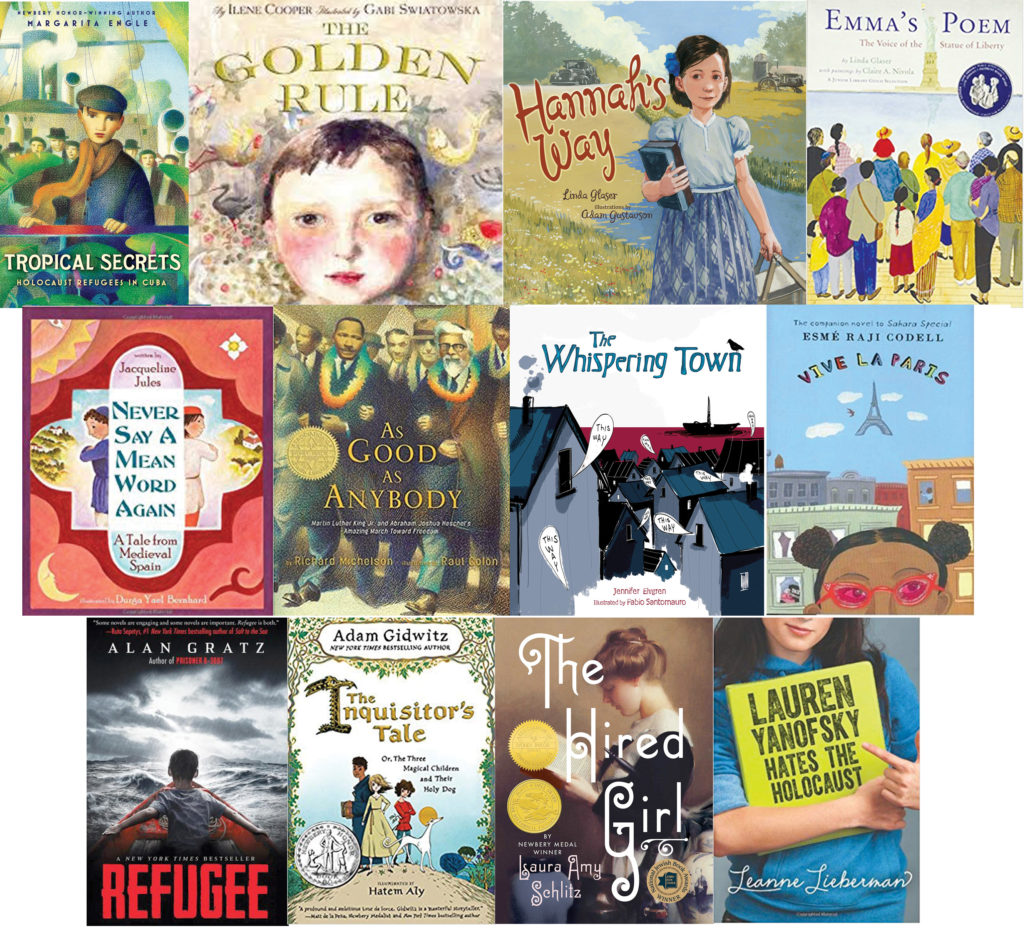
In response to the mass shooting at the synagogue in Pittsburgh and to rising anti-Semitism in the United States, librarians and experts on children’s literature from the Association of Jewish Libraries (AJL) are offering a series of “Love Your Neighbor” book lists for young readers. The compilers say their intention is to target a non-Jewish audience of children and teens.

Heidi Rabinowitz, a children’s librarian from Florida and a past president of AJL, spearheaded the project, writing that “Books read in youth impact future outlooks, and it is our hope that meeting Jews on the page will inspire friendship when readers meet Jews in real life.” This first list focuses on books that hopefully will build empathy and understanding of the Jewish experience. It features stories of Jews and non-Jews standing up for one another, working out differences, and confronting prejudice. Further lists will include books about Jewish diversity, synagogues and clergy, and cross-cultural friendship.

The AJL website offers the list in printable PDF format. Future lists will be printed soon and should prove useful to teachers and librarians across the country, particularly those who are unfamiliar with Jewish resources. Rabinowitz said, “There’s no knowing whether books like these would have made a difference if read during the childhood of the Pittsburgh shooter, and we can’t guarantee that reading them to today’s kids will prevent future tragedy. But as ‘Pirkei Avot,’ (Ethics of the Fathers), tells us, we are not obligated to complete the work of combatting anti-Semitism, but neither are we free to desist from it. We’ve got to do what we can. As librarians, we know that the right book can make a difference, especially when read during the formative years of childhood.” 

Picture books

“The Golden Rule“ by Ilene Cooper, art by Gabi Swiatkowska, ages 4-8 (Abrams Books)
This book is a gentle reminder of a timeless rule for parent and child: Do unto others as you would have them do unto you. A boy and his grandfather discuss the rule’s universality and how to put it into practice.

“Hannah’s Way by Linda Glaser,” art by Adam Gustavson, ages 4-8 (Kar-Ben)
After Papa loses his job during the Depression, Hannah’s family moves to rural Minnesota, where she is the only Jewish child in her class. When her teacher tries to arrange carpools for a Saturday class picnic, Hannah is upset. Her Jewish family is observant, and she knows she cannot ride on the Sabbath. What will she do? A lovely story of friendship and community.

“Emma’s Poem: The Voice of the Statue of Liberty” by Linda Glaser, art by Claire A. Nivola, ages 4-8 (Houghton Mifflin)
In 1883, Emma Lazarus, a Jew deeply moved by an influx of immigrants from Eastern Europe, wrote a sonnet that gave a voice to the Statue of Liberty. The statue, thanks to Emma’s poem, came to define us as a nation that welcomes immigrants. A true story.

“Never Say a Mean Word Again: A Tale From Medieval Spain” by Jacqueline Jules, art by Durga Yael Bernhard, ages 4-8 (Wisdom Tales Press)
Inspired by a powerful legend of conflict resolution, “Never Say a Mean Word Again” is the compelling story of a boy who is given permission to punish an enemy. A surprising twist shows how an enemy can become a friend.

“As Good as Anybody: Martin Luther King Jr.” and “Abraham Joshua Heschel’s Amazing March Toward Freedom” by Richard Michelson, art by Raul Colon, ages 6-9 (Knopf)
Here is the story of two icons for social justice, the Rev. Martin Luther King Jr. and Abraham Joshua Heschel, how they formed a remarkable friendship and turned their personal experiences of discrimination into a message of love and equality for all.

“The Whispering Town“ by Jennifer Elvgren, art by Fabio Santomauro, ages 7-11 (Kar-Ben)
This is the dramatic story of neighbors in a small Danish fishing village who, during the Holocaust, shelter a Jewish family waiting to be ferried to safety in Sweden. Worried about the family’s safety, friends devise a clever and unusual plan for their safe passage to the harbor. Based on a true story.

Chapter books

“The Inquisitor’s Tale, or, The Three Magical Children and Their Holy Dog” by Adam Gidwitz, art by Hatem Aly, ages 9-15 (Dutton)
France, 1242. A Christian peasant girl, a Moorish boy raised as a monk, and a Jewish boy, on the run to escape prejudice and persecution and save precious and holy texts from being burned, embark on a quest that drives them forward to a final showdown.

“Refugee” by Alan Gratz, ages 9-13 (Scholastic)
A Jewish boy in 1930s Nazi Germany, a Cuban girl in 1994, a Syrian boy in
2015 — all three go on harrowing journeys in search of refuge. This action-packed novel tackles topics both timely and
timeless: courage, survival, and the quest for home.

“Vive La Paris” by Esme Raji Codell, ages 9-12 (Hyperion)
Paris has come for piano lessons, not chopped-liver sandwiches or French lessons or free advice. But when old Mrs. Rosen, who is Jewish, gives her a little bit more than she can handle, it might be just what Paris needs to understand the bully in her brother’s life … and the bullies of the world.

“The Hired Girl” by Laura Amy Schlitz, ages 10-14 (Candlewick)
Fourteen-year-old Joan’s 1911 journey from the muck of the chicken coop to the comforts of a Jewish society household in Baltimore takes readers on an exploration of feminism and housework; religion and literature; love and loyalty; cats, hats and bunions.

“Lauren Yanofsky Hates the Holocaust” by Leanne Lieberman, ages 13-18 (Orca)
Jewish teen Lauren is sick of Holocaust memorials. But when she sees some of her friends — including Jesse, a cute boy she likes — playing Nazi war games, she is faced with a terrible choice: betray her friends or betray her heritage.

“Tropical Secrets: Holocaust Refugees in Cuba” by Margarita Engle, ages 12 to adult (Henry Holt)
Daniel has escaped Nazi Germany with nothing but a desperate dream that he might one day find his parents again. But that golden land called New York has turned away the ship full of refugees, and Daniel finds himself in Cuba. The young refugee befriends a local girl with some painful secrets of her own. Yet even in Cuba, the Nazi darkness is never far away.


The Love Your Neighbor series of book lists was created by the Association of Jewish Libraries to grow readers’ understanding of the Jewish religion and its people. Visit jewishlibraries.org for forthcoming book lists in the series. 

Love Your Neighbor: AJL Recommends Children’s Books for Turbulent Times Read More »

A Scarred Family Learns to Heal in ‘Exit Wounds’

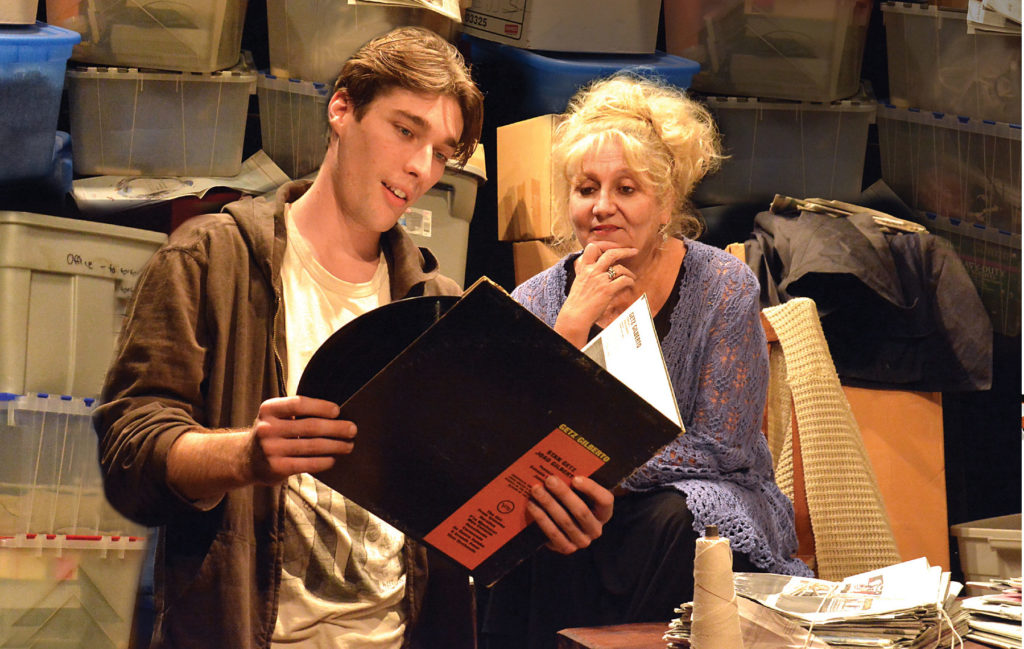
Three generations struggle with the fallout in the aftermath of a horrific tragedy in Wendy Graf’s play “Exit Wounds,” which has its world premiere Nov. 16 at The Grove Theater Center in Burbank.

Unable to process her overwhelming grief after her son commits a violent act, Linda Sadowski (Suanne Spoke) becomes a hoarder, cut off from the world and estranged from her other son Matt (Marshall McCabe). Matt’s alienated, troubled teenage son Danny (Dor Gvirtsman) is caught in the middle, suffering the repercussions of his father’s fear and his grandmother’s grief. 

Graf said she was inspired by both a fascination with what happens to the families of those who commit terrible mass crimes and the idea that family members tend to see one another through the lens of others in the family. She also incorporated the theme of tikkun olam, including the talmudic saying, “If you save one person, you save the world” in the script. 

“It’s such an inspiring message, especially in these times we’re living in,” Graf told the Journal after a rehearsal. Although the play isn’t about being Jewish, the Sadowskis are Jewish, and Graf “always writes from a Jewish standpoint,” she said.

“My first play, ‘The Book of Esther,’ was about the search for Jewish identity. ‘Lessons’ is the story of a rabbi who has given up her faith and a man who never had it who has a bar mitzvah at 70.” “Leipzig” follows a Kindertransport survivor suffering from Alzheimer’s. 

“I like to end my work with questions rather than answers.” — Wendy Graf

Graf cited an old Japanese custom in which the cracks in a broken vase or dish are filled with gold “because it’s important to recognize the cracks. I thought of this [Sadowski] family as a broken plate. The cracks will always be there.” The play’s ending isn’t wrapped up neatly, but it is redemptive. “I like to end my work with questions rather than answers,” Graf said.

“Exit Wounds” is being presented in repertory with Suzanne Bradbeer’s “Confederates,” both finalists in the Moss Hart & Kitty Carlisle Hart New Play Initiative that drew 1,243 entries. Either Graf or Bradbeer will receive a six-week, off-Broadway run in March. 

Tony-winning producer (“Porgy & Bess,” “Hair’), director and playwright Christopher Hart (Hart and Carlisle’s son) is directing both plays. 

“We hope it will be an annual program,” he said, reminiscing about his parents and their contributions to the “golden age of the theater.” He’s writing a book about growing up with them and their friends, including his father’s agent Swifty Lazar, aka  “Uncle Irving,” the subject of his play “Swifty.” 

Although Hart’s parents were big supporters of Israel, they were not religious Jews. “I didn’t get religion until I ran into anti-Semitism at school,” he said. As one of two Jewish boys at a Santa Barbara boarding school, he said he was beaten and had “kike” written in his books. He went to synagogue on Friday nights “because if I was going to take s—, I was going to stand up. I wasn’t going to hide from it,” he said.

Hart hopes that “Exit Wounds” audiences “feel what these characters have gone through and ask questions about what they would do under the circumstances. It’s a situation that needs to be thought about and talked about,” he said. “I can’t imagine anyone not being moved by it.”

Dor Gvirtsman acknowledged the difficulty of playing an emotional role like Danny, but he relishes the journey. “I’m always attracted to roles where, over the course of the show, the character changes,” he said. 

No stranger to playing Jewish characters, Gvirtsman played Danny Saunders in “The Chosen” earlier this year and Peter van Daan in “The Diary of Anne Frank” in high school. 

“I actually wanted to be a psychologist when I was young,” Gvirtsman said. “I’ve always been curious about what makes people work.” However, his love of acting was stronger. “I realized it was my favorite part of every day.” He attended the California State Summer School for the arts after his sophomore year, went on to study at USC and received further training at Shakespeare by the Sea after graduation. 

Gvirtsman, who recently shot a TV pilot for a sitcom set in a special education class, hopes to have the opportunity to work in all mediums, “like Andrew Garfield and Daniel Radcliffe are doing,” he said.

Born in Israel, the son of Sabra parents who moved to Silicon Valley when he was 4 1/2, Gvirtsman was raised in a “very Reform” home. “I never grew up going to synagogue, other than the year all my friends had bar mitzvahs,” he said. After his own bar mitzvah, he began to keep kosher. “I thought it was hypocritical to do all this preparation and not keep the connection,” he said. 

He stopped keeping kosher last year. “Now, as an adult, I have more ways to interact with my faith. I do pray privately especially on Yom Kippur,” he said. “I associate Yom Kippur with a lot of themes in this play.” 

The shocking acts of violence that have become commonplace today “remind me why [plays like this] must be done, why we must confront this,” Gvirtsman said. “Theater forces us to do that, to focus on the humanity of it. I think that’s incredibly valuable. Learning about other people is the best tool we have,” he said. “We have an enormous capacity for empathy if we choose to tap into it. There’s so much that we have in common and so much we can learn from each other.”


“Exit Wounds” runs Nov. 16-Dec. 16 at the Grove Theater Center in Burbank. 

A Scarred Family Learns to Heal in ‘Exit Wounds’ Read More »

Berlin-Based Klezmer Musician Heads to Pico Union Project

“Nightmare visions you can dance to.” 

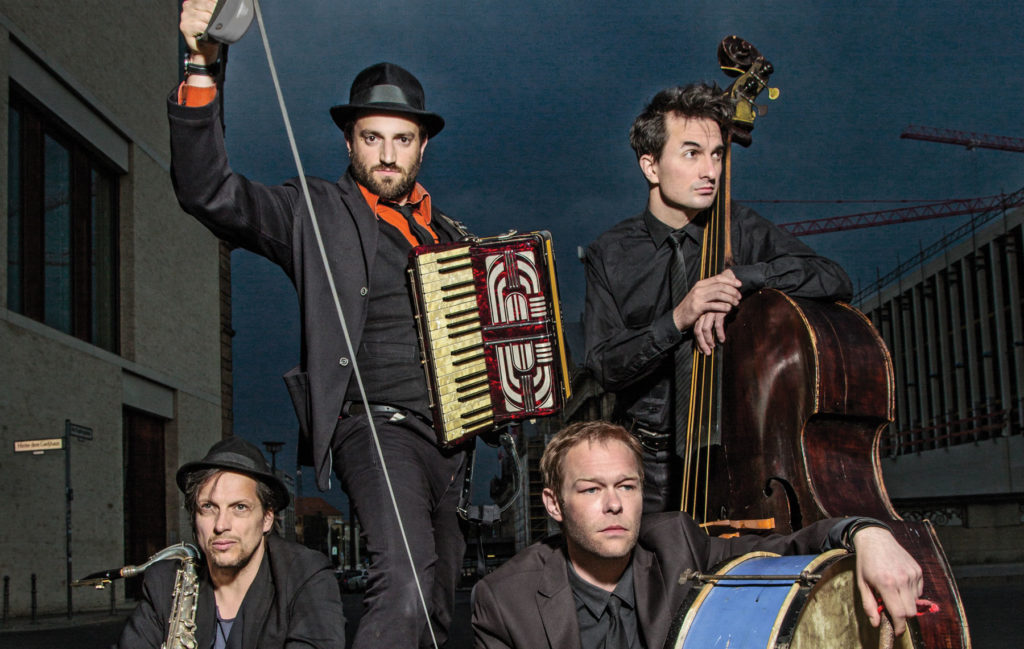
That’s what Ron Kadish, Daniel Kahn’s publicist, says about “The Butcher’s Share,” a new album by the klezmer group Daniel Kahn and the Painted Bird. The group currently is touring the U.S. and will play at Pico Union Project (PUP) on Nov. 18. 

Some of the lyrics in “The Butcher’s Share” — a play on sher, a Yiddish square dance — are indeed dark. One ballad is called “No One Survives”: “And in the end, no one prevails / Everyone falls, everyone fails.” Another is a tango-like horah that refers to Shoah survivors as “broken and stained” remnants. The album’s lyrics may be a bitter pill to swallow at times, but the music — with its irresistible musicianship, soulful vocals and catchy rhythms— is totally absorbing. 

Kahn, 40, sings in Yiddish and English, and the album’s songs run the gamut from haunting strains steeped in pain and loss to idealistic ballads drawn from reimagined Genesis stories. More than a few (including the title song, “The Butcher’s Share”) are not only danceable klezmer melodies, they’re also witty jabs at the human condition, showstoppers that evoke tears and laughter, that would fit neatly in a subversive musical from 1920s Berlin.  

In fact, Berlin is where Daniel Kahn has lived for the past 13 years, and his work has been shaped by Yiddish-speaking social activists of the early 1900s, radicals who called themselves Bund, anarchists or Marxists. 

In a phone conversation from his home in Berlin, Kahn told the Journal that Yiddish was not part of his early home life. Instead, he was brought up in a “suburban, Reform, liberal, assimilated, Americanized Jewish family” in the Detroit area.

“It was really much later that I discovered Yiddish on my own,” Kahn said. “I got into [it] by hearing singers like Michael Alpert and Adrienne Cooper, really being inspired by their work. You can say that I emigrated to Yiddishkayt.”

Some of the songs in “The Butcher’s Share” resonate with Jewish history. “Children in the Woods,” with text and music by Kahn, is a haunting poem/song about burying children’s bodies among the “broken branches of a tree.” Like many of Kahn’s songs, it touches both a specific and universal nerve. It’s about those murdered in the Shoah, of course, but it could also be about any disaster in which innocent lives are lost. 

The 1890s political ballad, “Arbeter Froyen” (Working Women), sung movingly in Yiddish and English by Sarah Gordon, Sasha Lurje and Lorin Sklamberg, is eerily current. It extols women’s hard work “in factories and homes,” exhorting listeners to fight for women’s “freedom and justice and equality.” 

As counterpoint to the serious themes, there’s the music itself, the bust-out, upbeat energy of klezmer, and of all the other buoyant, irresistible modern musical styles threaded in the songs.

“Klezmer has always been in conversation with other music,” Kahn said. “European music, American music, early jazz. Since the 1980s, it’s been in constant conversation with more radical contemporary music forms like hip-hop, punk rock and modern jazz.” 

The current U.S. tour features songs from “The Butcher’s Share,” but the sizable group, which includes brass, reeds, percussion, strings and several singers, will play other songs, and there will be “projected visuals and artwork by Eric Drooker, a wonderful graphic artist,” Kahn said. “[Drooker has] done New Yorker covers and he did the album cover and all the artwork in the booklet [of our songs], so we use his images in the show.”

Yeva Lapsker runs those visual presentations. “Yeva’s my wife,” Kahn said. “We met while we were both in the YIVO [Yiddish Scientific Institute] program in New York. YIVO has a wonderful Yiddish language and culture program.” It’s where he said, “I fell in love with Yiddish songs and with the stories. I fell in love with their complex humor, their revolutionary spirit, their deep melancholy and exuberance. It just kind of infected me, captured me.” 

In 2005 Kahn moved to Berlin, where he and Lapsker have become part of a “tight-knit community of artists who often work with each other” in producing theater and music that incorporate Yiddish culture as subject matter and uses Yiddish as one of its languages. 

Yiddish, he said, “has a lot of appeal, and it’s growing. Every day I’m encountering more young people who are inspired to take up this Yiddish heritage, this history, this culture and make it an important part of their own identity, and this includes both Jews and non-Jews. You can say that the world of secular Yiddish culture is small for a culture, but it’s pretty large for a family.” 

Is that why Kahn and Lapsker remain in Berlin?

“I remain here not only because of the Yiddish culture scene,” Kahn said, “I remain here because of the culture in general. I work at the Maxim Gorki Theater, which is a diverse environment of people from all backgrounds. That there is a space there, at the Gorki, for Jewish history and Jewish perspectives to be part of the conversation, is really inspiring to me.

“And a lot of the work on [“The Butcher’s Share”] is a result of being in that environment. The questions about belonging and migration and borders and human decency, the ascendancy of the new face of fascism in Europe and in the United States, is a conversation that is not limited to Jewish culture, but I do think that Jewish voices should be at the forefront of the fight against xenophobia, racism, nativism and fascism, what we’re seeing today.”

Kahn said that one of the reasons he moved to Berlin in 2005 was because of President George W. Bush’s administration. “I thought that the political and cultural conditions [in the U.S.] couldn’t get any worse” he said. “I guess I was being overly optimistic.”


Daniel Kahn and the Painted Bird perform Nov. 18 at the Pico Union Project. For tickets and details, visit www.paintedbird.net.  

Berlin-Based Klezmer Musician Heads to Pico Union Project Read More »

‘Green Book’ Latest Stop on Marinov’s Unusual Journey

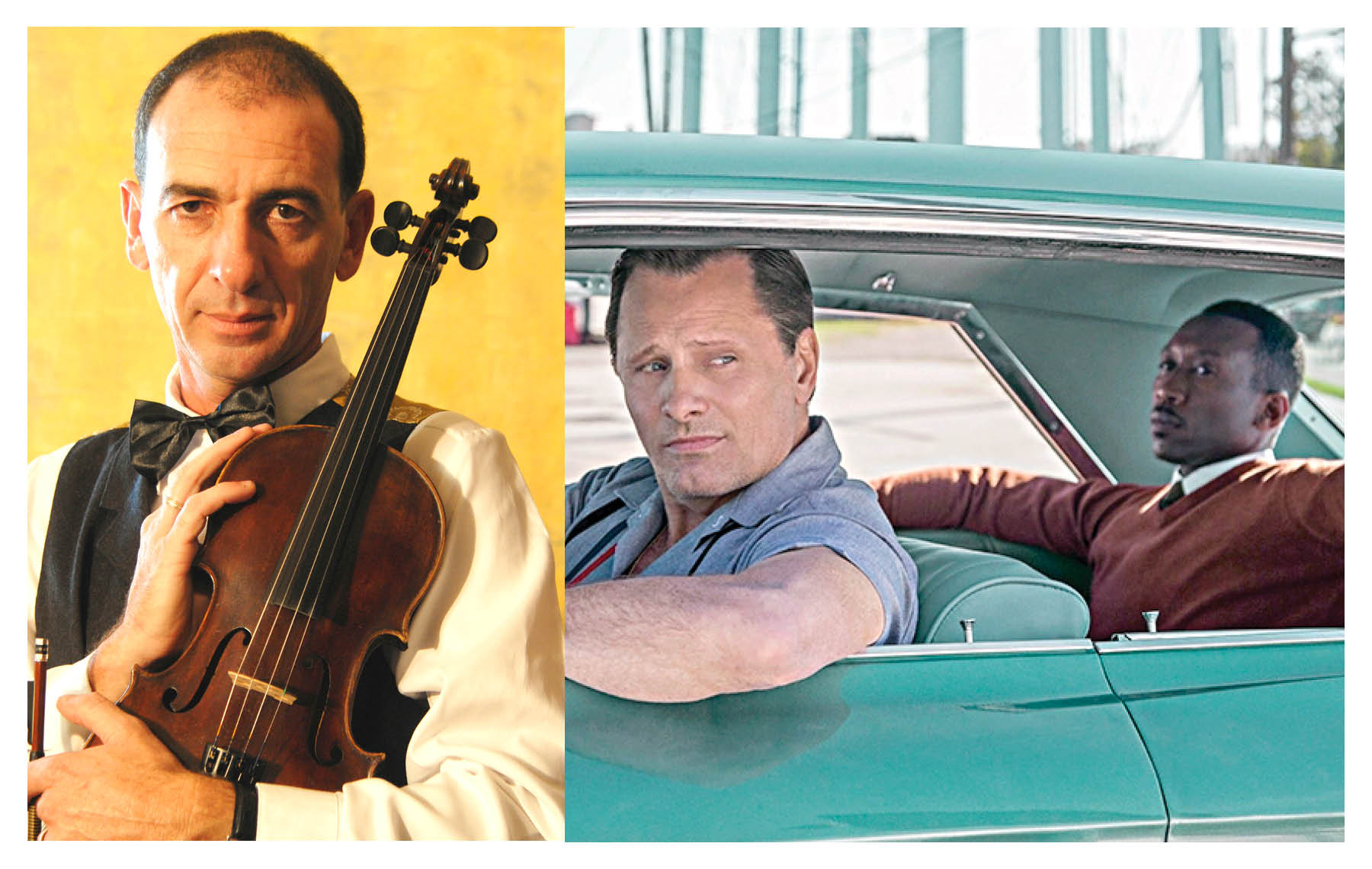
From Left: Dimiter D. Marinov, Viggo Mortensen (left) as Frank “Tony Lip” Vallelonga and Mahershala Ali as Don Shirley

Already winning rave reviews in advance of its release, the film “Green Book” is about a black pianist and the white driver/bodyguard he hires for a concert tour through the segregated South in 1962. Mahershala Ali as the worldly, wealthy Donald “Doc” Shirley and Viggo Mortensen as Bronx bouncer “Tony Lip” Vallelonga are mismatched, bickering travelers in a true story that holds up a mirror to the prejudices that still exist in America. The film’s title refers to a segregation-era road guide to “Colored Only” motels.

“This is a story of how two people who are complete opposites, even hate each other, reach across, listen and come together,” said Dimiter D. Marinov, who plays Oleg, the Don Shirley Trio’s cellist. Marinov had trained as a violinist and performed all over the world in his youth. He learned to play the cello for his “Green Book” audition in just five days. That kind of focus and determination has served him well throughout his life.

Marinov, 54, who grew up in Communist Bulgaria, spent 3 1/2 years as a political prisoner and defected to the United States in 1990. The son of an Orthodox Jewish father and a Christian mother who were not married, Marinov was given up for adoption. “I knew my mother but didn’t know she was my mother until much later,” he said. “I met my father when I was 21.”

Marinov began playing the violin at age 5 and joined a traveling youth symphony at 11. He studied at a prestigious music school and toured the world, performing with Leonard Bernstein in New York in 1979. He was recruited as a courier to carry letters from behind the Iron Curtain to the West, and although he didn’t know what was in them, he fell under suspicion. “In a Communist country, there are a lot of snitches,” he said. 

During his compulsory military service, Marinov spent time in military jail as a suspected spy. After completing his service, he stowed away with a friend on the Orient Express but was caught in Yugoslavia and jailed. Of his 3 1/2 years in prison, Marinov said it was “a nightmare. They broke all my fingers.” 

“This is a story of how two people who are complete opposites, even hate each other, reach across, listen and come together.” —Dimiter D. Marinov

Following his release, Marinov found work cleaning a theater, and a professor he met helped him get into Bulgaria’s national theater academy. He subsequently joined the touring group Mystery Voices with a goal in mind. “I needed to get out and find a new life,” he said. 

On the last stop of the group’s tour of the United States in Knoxville, Tenn., Marinov got in a taxi with his violin and $50 to his name and headed downtown. Through a series of fortuitous circumstances, a couple named Michael and Peggy Shirley helped him seek political asylum. Marinov stayed with the Shirleys for three years while learning English and working as an airbrush artist. He became a U.S. citizen in 1996. 

Marinov took a circuitous route back to acting and music, with jobs in San Diego as a handyman, barista and pizza delivery man before working with the San Diego Repertory Theatre. There also were stints establishing his own coffee shop, pizza parlor and catering business, and he spent some time in 2006 running a restaurant in Costa Rica.

Moving back to the States, Marinov decided to try his luck in Hollywood on the advice of a friend, and he aced his first two auditions: a Nikon commercial with Ashton Kutcher and the movie “Act of Valor.” It was the first in a long line of Russian bad guys he has played, most recently on the television shows “The Americans” and “Barry.” Being a polyglot — he speaks Russian, German, Spanish, Bulgarian and English — has served him well. 

“Of all the roles I’ve done, [‘Green Book’] is the most special to me because of the character, the story and the message,” Marinov said. “I hope it will take me to the next level.” 

Marinov has written a musical about his life that juxtaposes it with Marlene Dietrich’s, and he is awaiting the release of “Russian American,” based on the true story of a Jewish doctor who runs afoul of the Russian mob in Brooklyn.

While he is not a practicing Jew, Marinov said he feels a connection to the faith of his father, noting that he performed at the JCC in San Diego and spoke at a Museum of Tolerance event honoring Bulgaria’s efforts to save Jews during the Holocaust. 

Today, Marinov lives in Carlsbad with his wife and two sons, the youngest named Michael in honor of Michael Shirley, his Knoxville savior. 

“I never expected or asked for anything. I came here to do it myself,” Marinov said. “I worked for everything I had. Believe in yourself, work hard, stay focused. And if it’s meant to be, it will happen.”


“Green Book” opens in theaters on Nov. 16.

‘Green Book’ Latest Stop on Marinov’s Unusual Journey Read More »

Four Israeli Police Officers Injured in Jerusalem Stabbing Attack

Medics at the scene of a suspected attack near a police station in Jerusalem. Photo by Midabrim Communications

Four police officers were wounded in a stabbing attack in Armon HaNatziv in Jerusalem Nov. 14 around 10:00 p.m.

The Jerusalem Post reported that the attack took place inside the police station in the south Jerusalem neighborhood. The attacker managed to lightly injure the officers before being neutralized and arrested.

The suspect, a 20-year-old Palestinian man, apparently pulled a knife the security check and struck one of the police officers in the head. Police officers at the scene shot the attacker, leaving him with a minor injury, Haaretz reports.
Haaretz also said that the alleged terrorist was transferred to the hospital with minor wounds on his chest. All three officers were transferred to Shaare Zedek Hospital for minor treatment.
Magen David Adom paramedic Elad Pass told Haaretz that “when we got to the site, we saw three men who were fully conscious, suffering only minor injuries. We gave them first aid and took them to the hospital, fully conscious and in stable condition.”
According to The Times of Israel, the attacker has been arrested and security has been heightened in the area.

Police spokesman Micky Rosenfeld said officers searched the neighboring areas to ensure there were no other persons involved in the attack.

This is a developing story.

An update was made to the story at 5:45 p.m. PT adding that an additional officer was injured and updates regarding the attacker. 

Four Israeli Police Officers Injured in Jerusalem Stabbing Attack Read More »

The Quintessential Make-Ahead Dessert for Our Favorite American Holiday

We still haven’t caught our collective breaths in the aftermath of the horror in Pittsburgh, the heartbreaking shooting in Thousand Oaks, the approaching caravan of desperate refugees, the fallout from the midterms and the devastating fires in the most beautiful state in our republic, but open one eye to the calendar and gasp, because the holiday of gratitude is upon us. I’ve no clue what kind of sadistic time warp took hold and vanquished the months of September and October, but now, after all this, triggered and broken in spirit, we are expected to cook and plan to be thankful for all our blessings? Well, yes — most definitely yes. 

American Jews celebrate Thanksgiving almost without exception as it brings together the very Jewish concepts of gratitude, hope and community. I can’t think of a better time, given the current climate of sorrow and stress, to take a breather in the form of a long weekend. Cooking is an incredible stress buster — you can’t worry and fret too much when you are caught up in the concentration required to put together a big meal. 

As a chef in an American embassy overseas, I feel a responsibility to make sure that our diplomats and Marines get a taste of all their favorites. I change some side dishes each year but what I’ve noticed is that Thanksgiving is the “comfort food” holiday, and what’s comforting to most of us is familiarity. Although I know some families that keep some beautiful traditions that don’t involve turkey, stuffing and copious amounts of gravy, they are few and far between. My experience working at a foreign outpost feeding Americans is that while I can add some new dishes to the standards, I cannot subtract any traditional favorites. The good news is that I’ve found that this is just as comforting to the cook as it is to the diners. 

Most years, I cook eight 22-pound turkeys, 60 pounds of stuffing, 50 pounds of mashed potatoes, 30 pounds of sweet potato casserole, 30 pounds of green bean-mushroom casserole, 50 pounds of macaroni and cheese, 3 gallons of gravy, 2 pounds of cranberry sauce as well as hundreds of pies and biscuits. And because I’m Jewish, I still ask the other chefs, “Do you think we’ll have enough food?”

“Of all the pies I bake for my customers, it’s apple pie that practically carries with it a money-back guarantee to bring people to tears of joy.”

My Thanksgiving cooking prep schedule from last year is available online at jewishjournal.com/culture/yamits-table/227459. It has never failed me despite the fact that I have and a fully functional working restaurant kitchen humming in the foreground. 

I’d also like to pass along my foolproof all-American apple pie recipe, as high on the comfort food factor scale as any dessert recipe could be. Of all the pies I bake for my customers, not only on Thanksgiving but throughout the year, it’s apple pie that practically carries with it a money-back guarantee to bring people to tears of joy. Not only is it comforting in its rustic simplicity, its nostalgia-inducing aroma works wonders to spread good vibes to anyone who enters your home. Even better, it’s so easy to put together in advance and freeze unbaked. Then all you must do is bake it from frozen on the morning of Thanksgiving and let it sit on your counter welcoming all who enter with the incomparable aroma of apples, cinnamon and nutmeg. Serve this beauty, still warm, with a jug of caramel alongside and watch as even non-dessert eaters accept a piece gratefully. 

Because gratitude is such a profound component of happiness, tuning in to appreciation while drinking wine, watching a game and eating comfort food is so essential right now. Even though November sneaked up on us — I can’t help but thinking that this year, Thanksgiving is coming just in the nick of time.

BEST EVER APPLE PIE
Perfectly Flakey Pie Crust (makes 1 double crust pie or 2 single crust pies)
2 cups plus 4 tablespoons all-purpose flour
1 teaspoon salt
2/3 cup neutral tasting vegetable oil
4 tablespoons ice water

In a bowl, combine flour and salt. Add in oil and stir with a fork until most of the flour is absorbed. Add ice water and stir just until the dough forms but do not overmix or the crust will be tough.

Divide dough in half and, using a rolling pin, roll out each half between 2 pieces of wax paper. Roll out dough into a circle that is approximately 2 inches larger than a 9-inch pie pan, using the pan as a guide. Lay dough on pie pan, tucking excess dough under itself making it even on all sides. Keeping the rolled-out top dough between the wax paper, place bottom and top dough in refrigerator while you make the filling. 

Apple Pie Filling
8 large Granny Smith Apples (or other baking apples), peeled and sliced 1/4-inch thick (approximately 7 cups)
2 tablespoons lemon juice
1/2 cup brown sugar
1 tablespoon maple syrup
1 1/2 teaspoons cinnamon
1/4 teaspoon freshly grated nutmeg
4 tablespoons cornstarch
1 tablespoon margarine (or butter)
1 egg white
1 tablespoon sanding sugar for sprinkling on top (optional)
Preheat oven to 425 F. 

Peel, core and slice apples in 1/4-inch slices. In a large bowl, add remaining ingredients except the butter and egg white, and toss to combine. Remove pie shell from refrigerator and pour apple mixture into shell. Place margarine on top.

Brush crust of pie shell with egg white. Gently peel back wax paper from other pie dough and lay it on top of the apples, trying to leave the same amount of surplus on all sides, and then tuck the edges of the top dough under while pressing to seal top and bottom crusts. Either crimp edges together or use the tines of a fork to seal the edges.

With a sharp knife, cut 4 slits in a sunburst pattern all around the top of the dough to release steam. Brush top crust with egg white and sprinkle with sanding sugar.

If baking pie immediately, place sheet pan on bottom rack to catch drippings, and bake pie 15 minutes at 425 degrees and then 50 minutes at 325 degrees. If the edge of the pie starts to become too brown, place a piece of foil loosely on the top to shield it from over browning. 

If freezing pie, wrap very well in plastic wrap or foil and place in freezer. To cook from frozen, preheat oven to 425 degrees with a sheet pan on the bottom rack (to catch the juices from the apples as the pie bakes). Place pie on sheet pan for 20 minutes. Reduce oven temperature to 325 degrees and bake for approximately 65 more minutes or until a skewer inserted into the middle of the pie goes in easily and juices are bubbling. 

Let pie cool for at least 2 hours before cutting into it. Serves 10.


Yamit Behar Wood, an Israeli-American food and travel writer, is the executive chef at the U.S. Embassy in Kampala, Uganda, and founder of the New York Kitchen Catering Co. 

The Quintessential Make-Ahead Dessert for Our Favorite American Holiday Read More »

Weekly Parsha: Vayeitzei

One verse, five voices. Edited by Salvador Litvak, Accidental Talmudist

“Jacob kissed Rachel, and he raised his voice and wept.” –Genesis 29:11

Yafa Benaya
Arevot Women’s Beit Midrash, Sephardic Educational Center

Jacob is a deeply conflicted introvert who lacks the ability to express emotion. Could anything or anyone tap into the emotional side of this seemingly stone-cold individual?

At a well covered by a heavy stone, Jacob discovers his feelings. It begins when he gazes at Rachel for the first time. Something about her inspires him to “roll the stone from the well’s mouth,” a metaphor of sorts for Jacob pushing away the stone-cold barrier that lies between him and his emotions. Beneath this stone, he discovers water.

“Water wears away stone,” says Job (14:19). In ancient traditions, water represents the soothing feminine aspect of our emotional depths. When we plunge into these waters, we discover our souls.

The uncovering of the tender, feminine waters hidden beneath the stone leads to Jacob’s next action: he kisses Rachel, which brings him to tears. Through these tears, for the very first time, he raises his voice and cries. From the water beneath the well to the water of his tears, Jacob’s encounter with femininity washes away all of his stony rigidity. In its place, Jacob finds the soft voice of his soul, pleading for a place to call home. The man whose emotions were like stone, who indeed once “took a stone and put it under his head” to rest (Genesis 28:11), finally finds the true resting place for his heart — Rachel.


Tzvi Freeman
Chabad.org

From the womb he had been locked in bitter struggle with a brutish twin brother. He was wounded, but he could not feel his wounds. The flight from his home and family had left him scarred, but he could not see his scars. 

In Rachel, his cousin and soulmate, he saw himself, all of himself, as one who unexpectedly notices his reflection in a mirror and reels back at what he sees. For there, in that innocent daughter of a corrupt father, that pure soul lost in a decadent society, that rose among the thorns, there he recognized the angst deep within his own heart. He kissed her forehead and his tears burst forth like a geyser. 

Jacob, the Zohar tells us, bore the face of Adam. As Adam contained every soul of humanity, Jacob contained every soul of the Jews. 

If so, his tears are our tears. They are the tears shed by our souls that have descended from their home of pure, blissful light to enwrap themselves within the meat and bones of a human frame, within a brute beast that knows nothing more than its own pleasure and refuses to look up at the stars in wonder and awe.

And in those tears lies our redemption. For in that bitter cry the soul finds herself united with her Beloved once again, and from there she draws the strength to marry heaven and earth, soul and body, beauty and beast. 

For that, after all, is why we have come to this world.


Rabbi Cantor Hillary Chorny
Temple Beth Am

A few weeks ago, I was taking a shared Lyft ride from a late-night shivah minyan. Someone was already in the back seat, so I hopped up front next to the driver — a middle-aged African American woman who looked like she’d had a long day. We rode in relative silence. 

At some point, I was bored enough to comment on the weather, saying that I’d missed it during the decade I’d lived away from L.A. “Where’d you live?” she asked politely. “D.C., a couple years in Jerusalem, New York …” She perked up. “Jerusalem? What brought you to Jerusalem?” I explained that I’m a rabbi and my studies had taken me there. She nodded. More silence. Then she said, “Say, have you ever heard of [a large Jewish camping organization]?” Surprised, I replied that of course I knew it. As it turned out, she managed their office for three years and we knew plenty of the same people. We joked, chatted and swapped stories for the rest of the ride.

R’Tanchuma describes the specific type of kiss that Isaac gave Rebecca as a kiss of kinship. Today, we do this with our words: signaling, or (among Ashkenazim) “bageling,” to establish the common ground of shared experiences. It’s easy to live out a lonely existence, to pop in the earbuds on a Lyft ride and explore this city without connections. But what if you went about your life in search of those very connections?


Rabbi Scott Bolton
Congregation Or Zarua, New York

The last time I saw a Jewish bride kiss a Jewish groom was at a wedding I performed on a Saturday night. What a kiss! What love! 

I reminded the couple that the Talmud (in Tractate Brakhot, “Blessings”) says that the quietly pious one, no matter how religious or dedicated he may be in his heart and soul, has nothing over the one who expresses his love of God outwardly. If our love is left on the level of vision and theoretical ideas, we miss the point of coming together with the one we love. Kiss. Embrace. Hold hands  — even when you are a little annoyed. Sit closer. Look into each other’s eyes. Sit next to one another. Recall the moment under the wedding canopy and actively renew your loving relationship. 

Jacob, the man, lifted his prayerful voice. Jacob, the man, cried tears and, as the Talmud says, “the Gates of Tears always remain open.” To make this world a true marriage between Am Yisrael and the Holy One, between all of humanity and God, we need to bring our visions of love to the level of expression. Our voices should rise in prayer, and we should remember the permission we have to cry. The next generation is in the balance, just like it was with our ancestors Jacob and Rachel. And we know that, according to the prophet, she cried too.


Rabbanit Alissa Thomas-Newborn
B’nai David-Judea Congregation

It’s arguably the most romantic moment in Torah. Jacob sees Rachel at the well, removes a heavy rock from its opening, and kisses her. But why does the verse tell us that, immediately after doing so, he raises his voice and weeps? 

Rashi explains that Jacob saw in a prophecy that Rachel would not be buried with him, and so he cries. This answer contextualizes our verse in Jacob’s greater story, but it also points to a truth we all face: when we love deeply, we can lose deeply. 

Love makes us lift our voices, perhaps even find the Divine voice within ourselves and another. But in the end, we are still human. And so, Jacob weeps because his love makes him acutely aware of what he has to lose. It would follow then, that loss (or distance from Rachel in the grave) would dissuade him from love. But after our verse, he does the exact opposite! 

He spends years laboring for the very love that made him weep. Why? To model a profound wisdom: whether we have had our hearts broken, mourned a loved one’s death, or are currently afraid of getting hurt, loss cannot keep us from living and hoping. And so, as we hear Jacob’s voice rise up (and yes, also weep), may we each be so courageous and blessed to open our hearts to the vulnerable love Jacob knew. For it is a holy privilege to love each other fully in the time we have.

Weekly Parsha: Vayeitzei Read More »

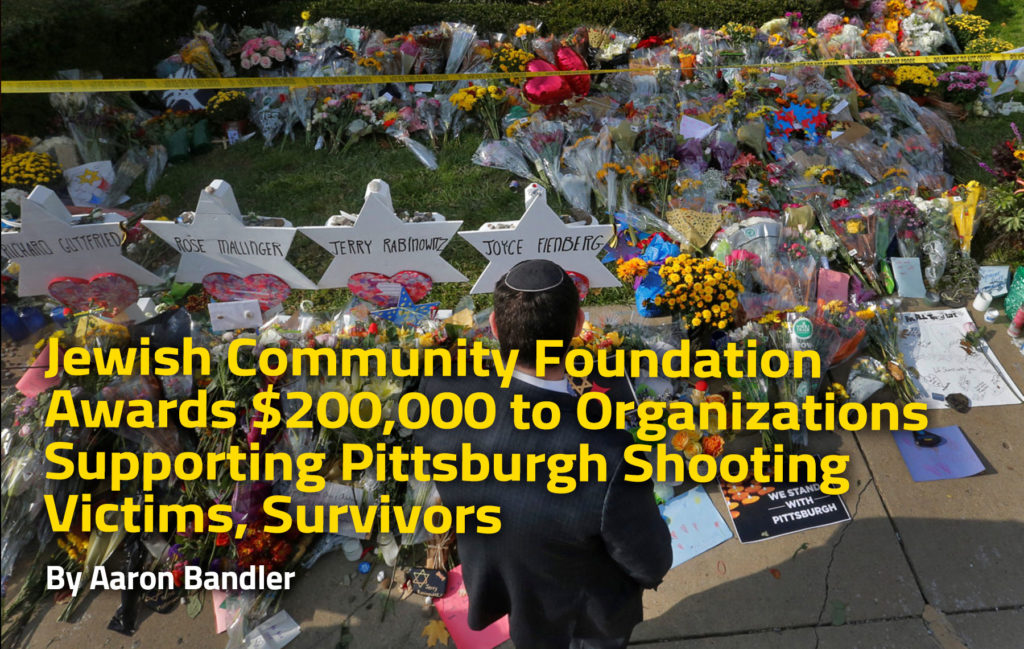
Jewish Community Foundation Awards $200,000 to Organizations Supporting Pittsburgh Shooting Victims, Survivors

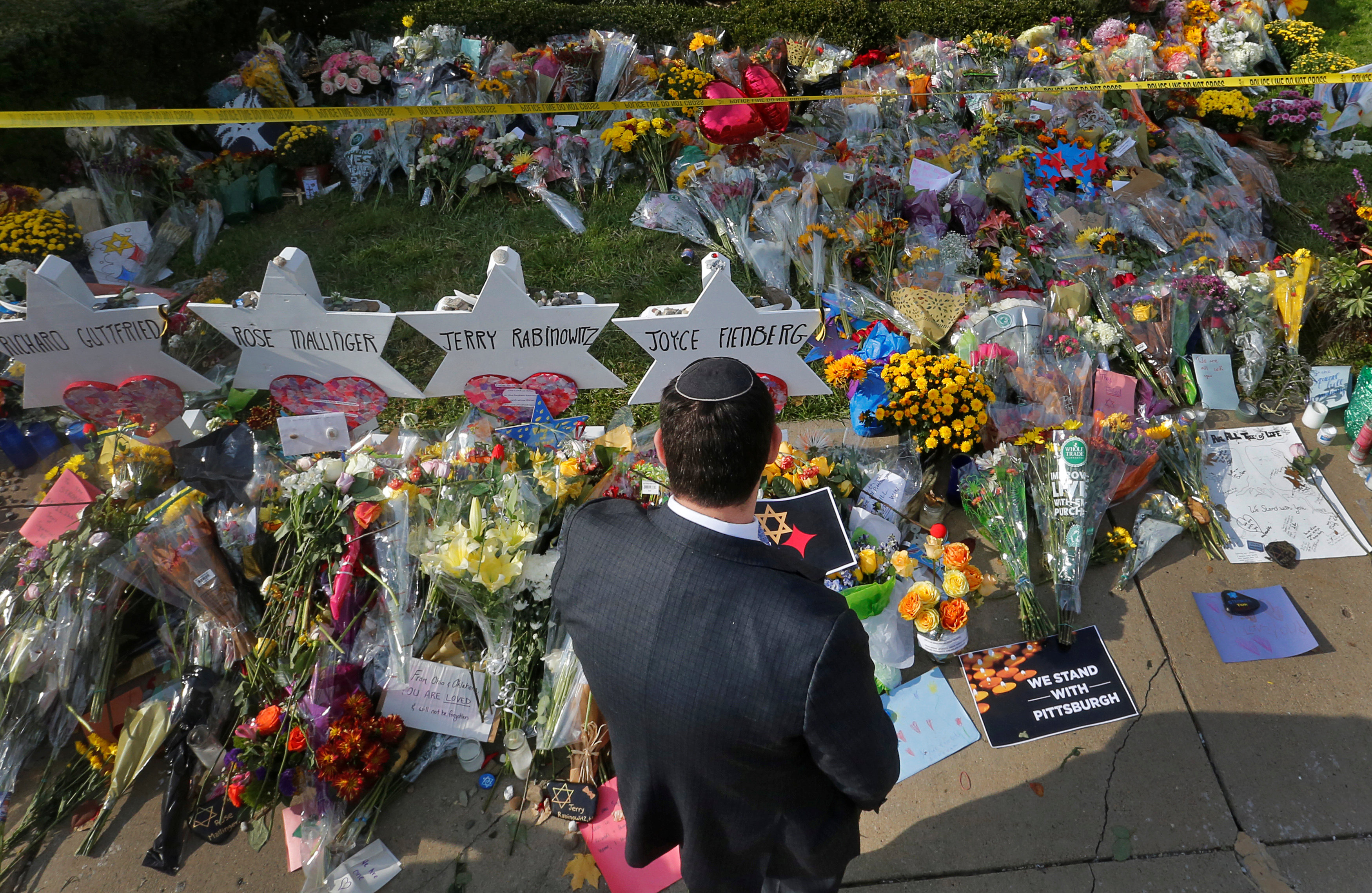
A man prays at a makeshift memorial outside the Tree of Life synagogue following Saturday’s shooting at the synagogue in Pittsburgh, Pennsylvania, U.S., October 31, 2018. REUTERS/Cathal McNaughton

The Jewish Community Foundation of Los Angeles announced on Nov. 12 that they are awarding $200,000 to four organizations that provide support to the victims and survivors of the shooting at the Tree of Life synagogue in Pittsburgh.

According to a press release from the Foundation, the four organizations that will receive the grants include the Victims of Terror Fund and the Community Security Initiative – both of which are programs of the Jewish Federation of Greater Los Angeles – as well as the Anti-Defamation League and Hebrew Immigrant Aid Society (HIAS).

“Our Board of Trustees, believing positive action is the best response to this terrible and senseless tragedy, approved these emergency grants to organizations that will provide direct aid to victims’ families, as well as to support causes working proactively to prevent such despicable and evil acts from occurring in the future,” Foundation President and CEO Marvin Schotland said in a statement. “With the sharp rise in anti-Semitism and premeditated violence, we must join together so that all Americans, regardless of religion, race or ethnicity, are safe and free to worship—fundamental principles of our society.”

Each organization will receive $50,000.

The shooter, 46-year-old Robert Bowers, singled out HIAS in his social media posts, writing right before the shooting: “HIAS likes to bring invaders in that kill our people. I can’t sit by and watch my people get slaughtered. Screw your optics, I’m going in.”

HIAS provides aid to refugees that enter the United States.

Jewish Community Foundation Awards $200,000 to Organizations Supporting Pittsburgh Shooting Victims, Survivors Read More »

Jews are Signing Up to Pray Daily for for Ruth Bader Ginsburg

The love and affection for a most unlikely heroine — Supreme Court Justice Ruth Bader Ginsburg — apparently knows no bounds. 

The 85-year-old justice, dubbed the Notorious RBG, has had books written about her and documentaries made on her work. Currently, there’s an exhibit on her life and work at the Skirball Cultural Center; little girls dress up as her for Halloween, and you can even purchase an RBG bobble-head doll.

What else is left? 

A Tehillim (reciting of psalms) spreadsheet.

On the evening of Nov. 7, Justice Ginsburg fell and broke three ribs while working in her Supreme Court office and was hospitalized the following day. 

The following morning, Tamar Fox, who lives in Philadelphia, set up a Tehillim spreadsheet for people to read a verse every day. Within a short period of time, 150 people had signed up. 

The directions on the spreadsheet asked participants to pray for Ginsburg, whose Hebrew name is Yitta Ruchel bas Tzirel Leah, “twice each day until she is back on the bench.”

Fox told the Journal she started the spreadsheet “because I figured other people would also be worrying about RBG and wishing her well. Since I can’t make her a meal or help in person, this seemed like something manageable.”

“I started the Tehillim spreadsheet because I figured other people would also be worrying about RBG and wishing her well. Since I can’t make her a meal or help in person, this seemed like something manageable.” — Tamar Fox

A big fan of Ginsburg, Fox added, “She’s a fearless crusader for women’s rights. I am terrified of what could happen if she is unable to serve on the court anymore.”

One of the first people to sign up to recite Tehillim was New Jersey resident Zahava Stadler.

“One of the things I appreciate in Judaism is that it gives you ways to respond to difficult situations,” Stadler told the Journal. “When I heard about Justice Ginsburg being in the hospital, I wanted to do something. And one thing that Judaism offers when someone [is sick] is that you can recite Tehillim. Justice Ginsburg is so Jewish (her grandchildren call her Bubbe!) that it seemed right to respond in a Jewish way.”

Los Angeles writer Rebecca Klempner said she also signed up because Ginsburg “is an enormous inspiration to American women and girls. When I prayed, I included her in my requests for healing. I even put some coins in the tzedakah box on her behalf. When someone shared the spreadsheet and asked for people to say Tehillim, I thought, ‘What a great way to give back to a woman who gives so much to our country.’ ”

Ginsburg, who has vowed to remain on the Supreme Court until she is 90, was back at work just one day after her fall. 

Never underestimate the power of prayer. 

Jews are Signing Up to Pray Daily for for Ruth Bader Ginsburg Read More »