In November 2014, I moderated a panel on the future of American Jewry at 30 Years After’s fourth biennial Civic Action conference at the Skirball Cultural Center. Only this time, the topic was the future of Iranian-American Jews, and a heated conversation began that, for me, actually foretold the future of our community with tangible clarity.
Simon Etehad, former president of Nessah synagogue, passionately argued that Iranian-American Jews ought to focus more on their Jewish identities than their Persian or American ones. Writer and Jewish Journal contributor Gina Nahai said she saw nothing wrong with our community practicing Persian and American customs.
At one point, Etehad said something I’ll never forget. His voice resonating with frustration, he demanded to know why, at that time of the year, there were so many Halloween decorations on the front lawns of local Iranian Jews and so few sukkahs.
His question was met with thunderous applause from half of the audience. Nahai then reminded everyone that our community was Persian, so why would we want to shed the proud, millennia-old heritage that made us so distinct? Besides, we were in America now.
Her response, too, was met with wild applause from half of the room, which consisted of roughly 800 Persian Jews between the ages of 21 and 60.
There you had it. Two Persian Jews, both immersed in their local community in Los Angeles, albeit in different ways, literally arguing over whether Persian Jews had any business putting up fake skeletons on their front lawns when they should have erected sukkahs.
I was enthralled by both the audience’s embrace or rejection of their assertions. Half of the Persians in the room wanted something like Halloween because they believed they could compartmentalize their identities —Iranian, American and Jewish — while still not losing anything. The other half was clearly concerned that such an ancient Jewish community was at risk of losing itself by embracing very non-Jewish practices.
“Iranian-American Jewish families who enthusiastically embrace very non-Jewish, but very American, traditions like Halloween should ask themselves whether their kids exude as much excitement over Jewish traditions.”
I had to admit that I never once heard of my ancestors dressing up like vampires. My paternal grandfather was famous for the joy he derived from setting up his sukkah in Tehran each fall, and my great-grandparents were too busy suffering in Iran’s Jewish ghettos to pass out candy to children in costumes.
Before I began to observe Shabbat roughly six years ago, I attended a Halloween party on a Friday night, hosted by one of my young Persian Jewish friends. It was October 2008, and I came dressed as Sarah Palin. Since I would always be home with family on Friday nights, I felt a little strange to be pushing my way through hundreds of other young Persian Jews who, like me, had clearly chosen Halloween over Shabbat. I knew that their butts also should have been back home, fighting over rice.
And then I realized that the young party guests had enjoyed Shabbat dinner with their families and then left for the party. They, like me, had tried to dip a toe into both worlds.
But at the end of the day, we don’t pass down costumes, but customs.
Our children learn by watching our values in action. They can either see us sweating over getting the sukkah just right (or lamenting that we don’t have room for one) or watch us struggle to put fake witches on the front lawn.
For Iranian-American Jewish families who enthusiastically embrace very non-Jewish, but very American, traditions like Halloween (which I used to love as a kid), I implore that they ask themselves whether their kids exude as much excitement over Jewish traditions.
I don’t know if it’s too late. Perhaps more than a toe has been dipped; perhaps the entire foot is now in the cauldron.
Is there anything more Jewish than a debate about debates? I guess there could be a debate about the debate about debates. But while many recognize the cultural significance of debating within Judaism, an overlooked yet vital aspect of this Jewish “national sport” is the ethics of how to debate.
In an old Jewish joke, two disputants come to the local rabbi to settle a dispute. The rabbi hears the first disputant’s case and declares, “You’re right!” The rabbi then hears the second disputant’s case and declares, “You’re also right!” The rabbi’s assistant jumps in and says, “But rabbi, they can’t both be right!” To which the rabbi replies, “You’re right, too!”
The spiritual ancestor of this joke is actually 2,000 years old, and it comes from a Hillel vs. Shamai debate in the Talmud (Eruvin 13b).
For context, Hillel was basically the LeBron James of Talmudic sages, and every “Hillel” you know — college organizations, schools, Passover seder sandwich, etc. — is named after that one famous Hillel. Shamai, on the other hand, has a name that, if familiar, is known for having lost nearly every one of his more than 300 debates with Hillel. Shamai’s consolation prize is one street in Jerusalem. It is, admittedly, a very nice street.
So back to our text, Hillel and Shamai spend three years debating a Jewish legal issue that doesn’t even get named, because, as you’ll see, the content of the debate isn’t at issue. Hillel’s team argues that the law is in accordance with their opinion, and Shamai’s team argues that the law is in accordance with their opinion. Finally, in a rare occurrence (talmudically speaking), the Divine Voice emerges from the heavens and proclaims, “These and these are both words of the Living God!” You’re right, and you’re also right! But being a practical people, we need an answer as to whose opinion we should follow. So the text tells us that the law is decided in accordance with Hillel.
“What would happen at our schools, synagogues and Shabbat tables if we practiced Hillel’s ethics of debate?”
The question is, why? If, from the Divine perspective, both Hillel and Shamai are speaking the truth, why do we follow the rulings of Hillel? The Talmud gives an answer, but I’d ask you to think about your own experience in participating and/or witnessing debates first. What makes you side with one party over the other? The logic? The volume of the voices? What is it?
Here’s where the Talmud offers an explanation of Hillel’s superiority that provides a blueprint for our own debates, be they religious, political, or on mundane topics such as Kobe Bryant vs. LeBron James.
The Talmud mentions nothing of Hillel’s rhetorical ability or his intellectual stature. Rather, Hillel beats Shamai for three reasons, according to our passage. First, Hillel was kind. I imagine this means that whichever side you were on, Hillel would treat you with respect. Second, Hillel had the incredible and all-too-rare quality that Moses was famous for, namely humility. I imagine that this means he would truly try to understand the other side of a debate, rather than digging in his heels and insisting that his position was the only legitimate one.
Finally, and to me, this is the most amazing quality, Hillel not only would teach Shamai’s position in addition to his own, but Hillel would explain Shamai’s position first, showing deference to the person with whom he disagrees on almost everything. Hillel would sincerely try to understand the other side, and present it with integrity, even when he disagreed with that position. And, because of these qualities, Hillel was the winner. Our tradition presents a plan for how to emerge victorious, and it’s the opposite of how many of us — myself included, too frequently — approach the topics we might debate.
What would happen at our schools, synagogues and Shabbat tables if we practiced Hillel’s ethics of debate? If we were kind, humble and sincerely sought to understand and articulate — without cynicism — the position of the other side? Would we become weaker in our resolve to fight for what we believe is right? Or would we have a better grasp of the issues and a clearer articulation of our own core values?
Rabbi David Saiger is the upper school rabbi at Milken Community Schools.
Last week, sitting under the majestic neo-Renaissance ceiling of Cipriani’s downtown Manhattan restaurant, I listened to speeches about unity, richness in diversity, heroism and humility. It was somewhat otherworldly, and not just because the soaring marble columns and magnificent murals made me feel like I was part of a Raphael painting. It was surreal because what was being discussed was so far removed from the current political and cultural landscape.
I was at the Asia Society’s fifth annual Game Changer Awards dinner, where the Game Changer of the Year Award went to PepsiCo CEO Indra Nooyi. Nooyi won because of her vision of “performance with a purpose” — companies do well by being responsive to the needs of the world around us.
“You are the single candle that lights 1,000 candles,” Nooyi told the well-heeled crowd, paraphrasing Buddha.
Other 2018 awardees included a team of Afghan girls who have made waves at international robotics competitions; Mira Rai, a record-shattering runner from a small village in Nepal; and the Thai rescuers who saved a dozen teenage soccer players and their coach from a flooded cave.
As each Asian country showed its heroism and ingenuity, I began thinking: Asia, bravery, innovation, hope — why isn’t Israel part of this glorious evening?
“Bridges could indeed be built through the international language — the transcendent power — of music.”
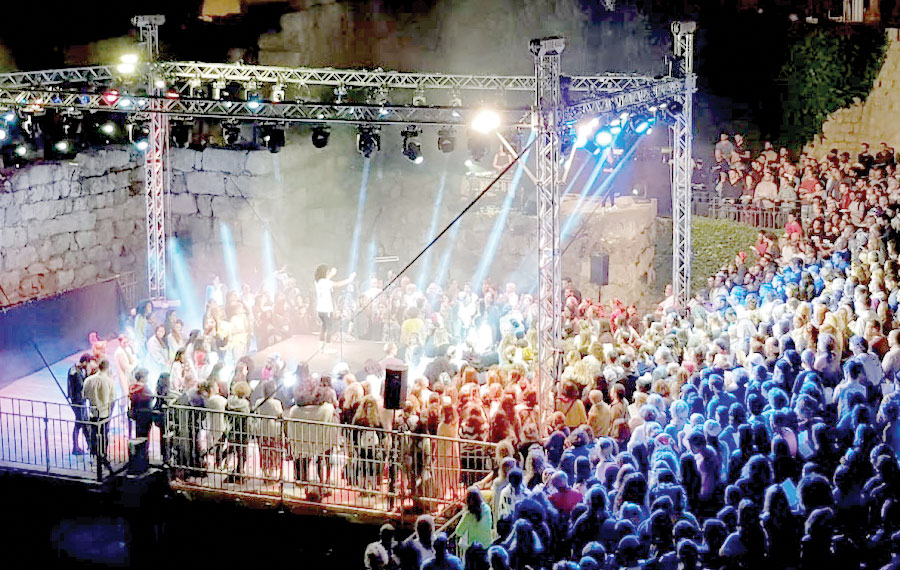
And then, right after the filet of Dover sole, there was Israel, represented by the group Koolulam, whose mob-singing performances have gone meta-viral in the past 18 months. One of their more impassioned events was at the Tower of David in Jerusalem this past June. In honor of the historic visit of Indonesia’s religious leader Sheikh Haji Yahya Cholil Staquf, Koolulam invited 1,000 people to sing one song — Bob Marley’s “One Love” — in three languages and in three-part harmony.
The gorgeous video of the event has been viewed more than 300,000 times. Bridges could indeed be built through the international language — the transcendent power — of music.
Koolulam, which calls itself a “social-musical initiative,” has now organized more than a dozen performances across Israel, including events with Holocaust survivors and their children and grandchildren, and with doctors and cancer patients at a children’s hospital.
That evening, Koolulam’s three founders took to the stage, beaming. co-founder Michal Shahaf Shneiderman stated Koolulam’s message: “Musical harmony can inspire harmony in humanity.” I had watched several of their videos and had been transfixed by conductor Ben Yefet, whose body and dreadlocks seem to fly through the air composing notes and radiating a magical light.
All of a sudden, Yefet and Or Taicher, the other two co-founders, were standing right in front of me. Taicher told me that he had been looking for a way to combat online hate when he saw a video of worshippers packed into the plaza in front of the Western Wall, singing in unison on Yom Kippur. The idea of using music to unite was born.
Taicher also told me that they were headed to Johannesburg for their first international gig. The idea of Koolulam bringing Israel’s light around the world through music — a traveling torch of hope — what more could “light unto the nations” possibly mean?
I turned to Yefet. “Can I give you a hug?” I asked shyly. “Of course,” he answered shyly. It was a hug of light, hope, magic and miracles. I wanted to take in all of his amazing spirit and bring it home to my son.
I began to see Israel’s underlying connection to Asia. It’s not just a shared emphasis on family and a shared pursuit of excellence. It is a connection of the heart, which leads to unfathomable bravery.
The glorious evening ended with a performance by Koolulam. Yefet bounded back onto the stage and told the crowd of high achievers: “We can’t control life but we can control our perception of it.” He then led them in a three-part harmony of singing, clapping and swaying.
Tonight We are young So let’s set the world on fire We can burn brighter Than the sun.
Karen Lehrman Bloch is an author and cultural critic living in New York City.
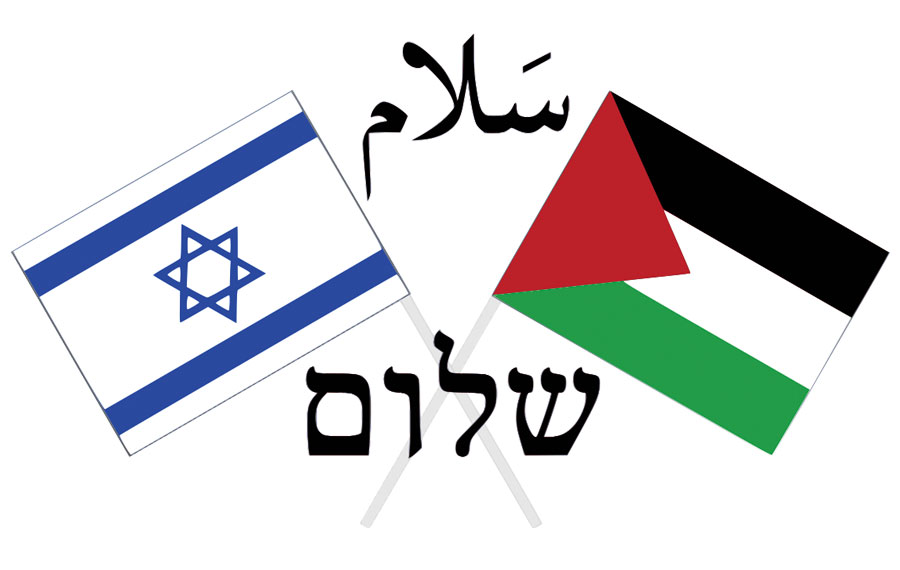
When it comes to the complicated Israeli-Palestinian conflict, there’s one simple fact that pretty much everyone agrees with: The attempts at a “two-state solution” have been a stunning failure.
It’s certainly not for lack of trying. Since the famous handshake in 1993 that launched the Oslo Accords, it’s safe to say that no global conflict has taken up more political and diplomatic energy.
It’s astonishing that after the investment of so much energy, the parties are even further apart today than they were 25 years ago.
For many Israelis, this status quo is unacceptable. Last week, I met two activist groups with distinct initiatives for breaking the logjam.
My friend Dan Adler introduced me to the first initiative, called The New State Solution (NSS). I had heard and read about them, and knew that their idea was starting to gain some traction.
The basic premise of the New State Solution is to focus on what’s possible. Since making any kind of deal in the West Bank has proved virtually impossible, why not focus on Gaza first?
“The basic premise of the New State Solution is to focus on what’s possible. Since making any kind of deal in the West Bank has proved virtually impossible, why not focus on Gaza first?”
Their idea is to take advantage of the renewed cooperation between Israel and Egypt to create an expanded Palestinian state in Gaza, using parts of the Sinai that now are controlled by Egypt. Their plan calls for implementing a massive humanitarian and economic build-up in Gaza that would shift the center of gravity of the conflict and create a “win” for all parties.
The co-founders of the initiative, Israel Defense Forces (IDF) veterans Benjamin Anthony and Brigadier General (Ret) Amir Avivi, believe that what the conflict needs, more than anything, is a “paradigm shift.” They know their idea is not perfect and faces challenges (among them: Will Egypt agree to give up land?), but they believe it is the most realistic of many bad options. You can see all the details on their website (newstatesolution.org).
The second group I met is the Israel Policy Forum (IPF), which was founded in 1993 and “works to shape the discourse and mobilize support among American Jewish leaders and U.S. policymakers for the realization of a viable two-state solution consistent with Israel’s security.”
Like most American and Israeli Jews, the IPF has not given up on the two-state solution, for the oft-stated reason that staying in the West Bank threatens the future of Israel as a Jewish and democratic state. In recent years, the IPF has teamed up with Commanders for Israel’s Security (CIS), a nonpartisan movement of retired IDF generals and security experts that works to “extricate Israel from the current impasse” as a first step toward an eventual agreement.
The IPF approach is the reverse of the NSS approach. Instead of avoiding the incredibly difficult problem of extricating Israel from the West Bank, it is doubling down. It believes its comprehensive “security first” approach will manage the security risk and offer an acceptable trade-off.
What has added urgency is talk of “annexation” among current government coalition members. In a recent study, CIS concluded that “as a determined political annexationist minority accelerates moves toward annexation — both creeping and legislated — the ensuing shockwaves threaten to undermine Israel’s security, its Jewish-democratic character, its relations with its neighbors, its relationship with the Diaspora, and the attitude of the international community toward the country.”
All of this reminds me of the most honest and concise description I’ve ever heard of the Israeli-Palestinian conflict, from my friend Yossi Klein Halevi: “Staying in the West Bank is an existential threat to Israel; leaving the West Bank is an existential threat to Israel.”
Notwithstanding the complexities, these two groups are charging ahead to try to break the status quo. Whether by focusing on Gaza or doubling down on the West Bank, they realize that a dark clock is ticking louder and louder.
“In the absence of negotiations, is there anything that Israel can do on its own immediately to help preserve its future?”
The fundamental problem in recent years has been an inability to get the parties to the negotiating table and a general sense that any potential deal would be dead on arrival.
Maybe this is why the IPF has been promoting “interim steps” that Israel can take to safeguard the viability of a two-state solution, such as limiting settlement construction in the main settlement blocks and improving the economic and humanitarian situation on the ground.
When I met the representatives from IPF, I glibly suggested that their interim plan would be like a “pre-state solution.” I have no idea whether they will use that term, but the point I was making was this: Many of us are simply exhausted with waiting for the parties to get together and negotiate. As the years go by, the price of waiting keeps getting higher. We can’t wait forever.
So, the question becomes: In the absence of negotiations, is there anything that Israel can do on its own immediately to help preserve its future?
I heard two distinct answers last week. Whether it’s the New-State Solution or the Pre-State Solution, they both said the same thing: We’re tired of waiting.
U.S. President Donald Trump holds an umbrella as he departs to tour hurricane damage in Florida from the White House in Washington, U.S., October 15, 2018. REUTERS/Jonathan Ernst
A new poll conducted by the Mellman Group on behalf of the Jewish Electorate Institute (JEI) found that American Jews overwhelmingly disapprove of President Trump, 75 percent to 25 percent.
The poll, which the Journal has obtained, shows that while American Jews narrowly approve of Trump’s handling of United States-Israel relations by a margin of 51 percent to 49 percent, they largely disapprove of Trump’s handling of domestic issues, such as immigration, health care, the Supreme Court and gun control.
American Jews also disapprove of Trump’s handling of United States-Palestinian relations, the Jerusalem embassy move and the Iran nuclear deal.
Ninety-two percent of Jews consider themselves pro-Israel, but only 32 percent said they support the Israeli government’s policies. Fifty-nine percent of American Jews said they were pro-Israel but disagreed with some or many of the Israeli government’s policies.
Additionally, 74 percent of American Jews said they would vote for a generic Democratic presidential candidate over Trump, while 26 percent said they would vote for Trump. American Jews also said they would support a Democratic congressional candidate over a Republican congressional candidate in the 2018 midterm elections by the same margin.
Overall, 68 percent of American Jews identify as Democrats, 25 percent identify as Republicans and 7 percent identify as independents.
The poll was conducted from Oct. 2-11 among 800 Jewish voters.
I left for the airport as soon as I got the call. My friend Yosefa, a brilliant tattoo artist, educator, and fellow Kohenet, was on her deathbed, dying of a brain tumor. I booked the next flight from Philadelphia to Seattle in time to do shemirah, to guard her body and soul after her death.
Hours later, after a long plane ride and a taxi ride that felt even longer, I came to a suburban house with candles softly glowing on the porch, and a mezuzah on the door. It was past four in the morning.
I removed my shoes and went upstairs to Yosefa’s bedroom, where two other women we knew through the Kohenet Hebrew Priestess Institute were reading psalms aloud, wrapped head to toe in blankets to warm themselves against the cold air flowing in to keep Yosefa’s body cold. The two had been waiting all night, and had given up hope of my coming. We shared joyful whispered hellos, and then they left to take a break before the ritual purification, or taharah, and the funeral. They instructed me to wake Yosefa’s husband around 6 a.m., then I heard the door close and was alone with Yosefa.
A small bedside lamp lit her face. Yosefa lay covered by a light blanket, peaceful, one leg bent, with an enigmatic smile, and her scalp bare from chemo. Her arms were still warm. I wrapped myself in quilts, and read psalms aloud. The psalms were too somber, so I switched to songs and prayers from Jewish Renewal and the Kohenet siddur, quietly singing my favorite songs and prayers, walking around the room as the curtains billowed in the brisk November breeze.
I felt Yosefa’s spirit in that dark room, a sense of her energy and sweetness. She looked greatly at ease. My friends had been praying, and I felt their energy, and that of peaceful prayers and psalms. All I witnessed before me was peace, and release, and a sense of flying joy that was not my own. I stood, and prayed, and sang.
Soon after 6 I woke her husband, and I left as he went to her side. It was so hard to leave Yosefa’s side. Hard to leave that palpable energy, the growing light, the flowing curtains, my soft sung psalms and prayers. But if anyone deserved to be bathed in Yosefa’s love it was her husband, and so I woke him, and left as he entered their bedroom one last time, and shut the door quietly behind me.
I went downstairs and lay on their living room couch, warming up, waiting for a ride back to the hotel. I had worked all day and been up all night, and it was well past dawn. I floated, tired, feeling hollow and surprised and connected, held in love and mystery and gratefulness.
Kohenet Ellie Barbarash, MS, CPEA, lives and works in Philadelphia as an occupational safety specialist and educator. She is a member of the Philadelphia Jewish Reconstructionist Chevrah Kaddisha, and a Gamliel Institute student.
Kohenet Ellie Barbarash
_____________________
Gamliel Courses
The next course in the cycle of core courses offered by the Gamliel Institute will be Course 4 – Nechama/Comfort. It will be offered online during the Fall from October 9th to December 25th on Tuesday evenings, for 90 minutes each week for 12 weeks. The classes will begin at 5 pm PST/8 pm EST. Primary instructors will be Dan Fendel and Edna Stewart, with guest instructors.
The course planned for Winter 2019 is Course 2 – Chevrah Kadisha: Taharah & Shmirah. Plan ahead! You can register online now.
___________
Gamliel Café
Gamliel Students are invited to a free informal online session, held monthly. On the third (3rd) THURSDAY of each month, different person(s) will offer a short teaching or share some thoughts on a topic of interest to them, and those who are online will have a chance to respond, share their own stories and information, and build our Gamliel Institute community connections. This initiative is being headed up by Rena Boroditsky and Rick Light. You should receive email reminders monthly. The next scheduled session of the Gamliel Café is October 18th. More details will be sent out soon.
Gamliel students should be on the lookout for information on a series of Gamliel Continuing Education Courses, advanced sessions focusing in on different topics. These will usually be in groups of three ninety minute sessions (three consecutive Wednesdays) offered roughly twice yearly, with different topics addressed in each series. The goal is to look at these topics in more depth than possible during the core courses. The first course took place in Fall 2017, focusing on Psalms, and the second was on The World to Come and the Zohar.
The next course will be November 28th, December 5th, and December 12th. We will continue to look at death as seen in the Zohar, taught by Beth Huppin.
Registration is required, and there will be a tuition charge of $72 for each three session series. Contact us for information, by email info@jewish-funerals.org, or call 410-733-3700, or simply register online at www.jewish-funerals.org/gamreg/.
You can also register for prior courses and access them via recording.
____________________
Taste of Gamliel Series
The 2018 Taste of Gamliel series has concluded, but it is not too late if you want to access the recordings. You can Register for the 2018 series, Your’re Gonna Miss Me When I’m Gone: Jewish Practices of Remembrance, or any of the series from prior years, and view them in recordings. There are usually five sessions in a series, and each session is approximately 90 minutes.
The 2019 series is being planned now. Registration for Taste of Gamliel is mandatory to access the sessions. The Registration fee of $36 for each series helps us defray the out of pocket costs.
Those registered will be sent the information on how to connect to the sessions. To register, click here: register.
_____________________
DONATIONS
Donations are always needed and most welcome to support the work of Kavod v’Nichum and the Gamliel Institute, helping us to bring you the annual conference, offer community trainings, provide scholarships to students, refurbish and update course materials, expand our teaching, support programs such as Taste of Gamliel, the Gamliel Café, and the Gamliel Continuing Education courses, provide and add to online resources, encourage and support communities in establishing, training, and improving their Chevrah Kadisha, and assist with many other programs and activities. There is a matching donation program in progress so your dollars go further. See the website for details.
c/o David Zinner, Executive Director, Kavod v’Nichum,
8112 Sea Water Path,
Columbia, MD 21045.
Kavod v’Nichum and the Gamliel Institute] are recognized and registered 501(c)(3) organization, and donations may be tax-deductible to the full extent provided by law. Call 410-733-3700 if you have any questions or want to know more about supporting Kavod v’Nichum or the Gamliel Institute.
Please note: this blog depends on you for content. Without you it cannot publish new material. If you have an idea for an entry you would like to submit to this blog, please be in touch. Email J.blair@jewish-funerals.org. We are always interested in original unpublished materials that would be of interest to our readers, relating to the broad topics surrounding the continuum of Jewish preparation, planning, rituals, rites, customs, practices, activities, and celebrations approaching the end of life, at the time of death, during the funeral, in the grief and mourning process, and in comforting those dying and those mourning, as well as the actions and work of those who address those needs, including those serving in Bikkur Cholim, Caring Committees, the Chevrah Kadisha, as Shomrim, funeral providers, in funeral homes and mortuaries, and operators and maintainers of cemeteries.