A new report from the Jerusalem Center for Public Affairs (JCPA), which has been obtained by the Journal, highlights some of Students for Justice in Palestine’s (SJP) reported ties to Islamic terror groups.
The JCPA report notes that the National SJP organization was established in 2010 by American Muslims for Palestine (AMP), the U.S. Palestinian Community Network (USPCN) at the 2010 World Social Forum; AMP is chaired by Hatem Bazian, who is also the founder of SJP. Bazian has called for an “Intifada” in the United States and has referred to Israel as the “slave master.”
Additionally, at least a couple of AMP’s board leaders have ties to the Holy Land Foundation, an organization that was convicted in 2008 for providing material support to Hamas, the report notes.
Similarly, the USPCN’s founders include people who worked for the Islamic Association for Palestine (IAP), which was one of the groups listed as an unindicted co-conspirator in the Holy Land Foundation trial, according to the report. At their conferences, the USPCN has hosted Raed Salah, who heads the Northern Islamic Movement in Israel, an organization that is affiliated with Hamas.
The 2010 forum was sponsored by the Boycott National Committee; the organization’s ties to terror can be seen here.
National SJP has also provided a platform at their conferences for Rasmea Odeh, who was convicted by an Israeli court for a 1969 Jerusalem supermarket bombing that killed two students, as well as Khader Adnan, a leader of Islamic Jihad, which is designated as a terror organization by the U.S. State Department, per the report.
The report also notes that SJP has been involved in a number of incidents on college campuses throughout the country, including members of UC Irvine’s SJP getting arrested “for violent verbal disruptions of a presentation by Dr. Michael Oren, former Israeli ambassador to the United States” in 2010, according to the report. Another example of a SJP incident occurred in 2013, when SJP’s Northeastern crashed a Holocaust remembrance event with chants of “Free Free Palestine!”
National SJP is scheduled to host their annual conference at UCLA on Nov. 16-18.
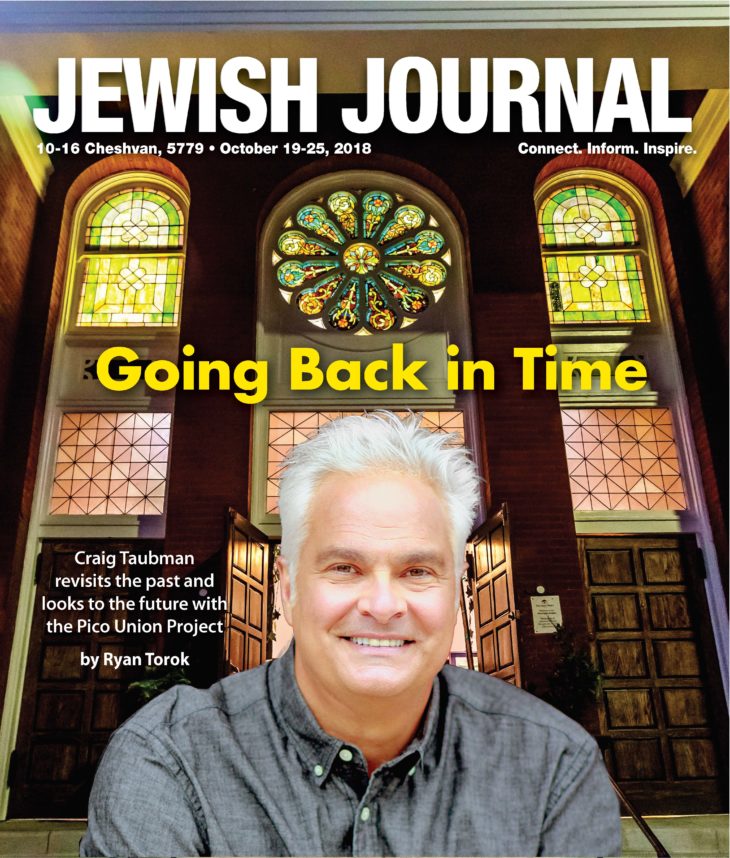
For musician Craig Taubman, eclecticism has always been the name of the game.
For more than 15 years, Taubman led the popular Friday Night Live service at Sinai Temple with Rabbi David Wolpe. His independent label and music production company, Craig ’N Co., has put on interfaith concerts including Faith Jam and Let My People Sing. He has published the annual High Holy Days collection “Jewels of Elul,” featuring spiritual wisdom by faith leaders, thought leaders and celebrities.
His latest venture, launched in 2013, is the nonprofit Pico Union Project (PUP), which is redefining what it means to be a faith-based organization. PUP is a hub of artistic, spiritual and social service programming operating in the oldest remaining synagogue in Los Angeles. The Greek revival structure is located at 1153 Valencia St, on the corner of 12th Street, just west of the Staples Center in downtown Los Angeles.
According to its website, the PUP “is dedicated to the Jewish principle to ‘love your neighbor as yourself.’ It elevates this teaching into practice in a historic building by bringing diverse cultures together.”
On a recent afternoon at the PUP, the scent of fresh vegetables fills the air of the two-story building and light pours through the stained-glass windows. On the first floor in the main sanctuary space, there’s a flurry of activity as fresh produce, including apples, cantaloupe, zucchini and asparagus, is packed by volunteers from the Westside and Valley and then donated to neighborhood families. On a stage at the end of the room, a world music band is performing high-energy grooves, banging away on bongo drums and providing an appropriately kinetic beat to the activities. Upstairs, in a conference room, children are doing yoga, stretching their bodies in downward-facing dogs and warrior poses.
“This is community,” Taubman, 60, says. “It’s service to the community and of the community.”
Taubman performing during Shabbat Table, a program of the Pico Union Project. Photo by Linda Kasian
PUP evokes a time when the Jews were based in the downtown and Boyle Heights areas. Sinai Temple, then known as Sinai Congregation, commissioned the construction of the building in 1909. The congregation remained there until 1925 when, following the westward migration of Jews in Los Angeles, the community moved to the mid-Wilshire district, just east of Hancock Park. It then relocated to its current home in Westwood in 1960.
In 1926, the Welsh Presbyterian Church bought the building, leaving the Stars of David in the stained glass windows intact. In the wake of dwindling membership, the church put the building up for sale in 2013.
At the time, Taubman was not looking to get into the property-owning business. The Jewish Historical Society of Southern California (JHSSC), which conducts tours of historic Jewish landmarks, pushed Taubman to buy the building because of Taubman’s personal and professional history at Sinai Temple.
“ ‘You’re Mr. Sinai to me, you’re the guy who can get stuff done,’ ” Taubman recalled JHSSC founder Steve Sass telling him. “‘Why don’t you check it out?’ I was in the heat of Friday Night Live and community activism and I was the crazy guy who would run with it.”
Buying the church in 2013 for an undisclosed amount represented a milestone for Taubman, who began his career writing commercial jingles and children’s music for the Disney Channel and eventually became a central figure in the non-Orthodox community in Los Angeles.
“I’m — what’s the expression? Post-denominational,” he said. “I’m a chameleon. Wherever I am, I feel comfortable.”
Taubman grew up on the Westside in a Conservativehousehold, with Camp Ramah and United Synagogue Youth forming his identity. His first job, at the age of 15, was as the music teacher at Sinai Temple, where he also had his bar mitzvah.
“I’m definitely a product of the Conservative movement,” he said.
He recalled riding his bike from his family’s home in Brentwood to the Westwood congregation, where he taught 100 kids in the mitzvah choir. “I had my guitar and I left it in the music room at Sinai Temple, because I couldn’t ride my bike with a guitar on my back,” he said.
“Taubman’s work has not come without challenges. For one, the Pico-Union neighborhood is not a likely place for a Jewish organization in Los Angeles.”
He attended UCLA, then studied in Israel for three years at Hebrew University. While there, he performed for then-Prime Minister Menachem Begin, collaborated with other Israeli entertainers and met David Broza, whose music inspired Taubman. He went on to build a reputation as a prolific Jewish songwriter, making Jewish music more accessible for day schools, camps and synagogues.
“He really crafted his own work,” Taubman’s wife, Louise, said. “He came up with good ideas. People believed him.”
Similar to his inventive approach to Jewish music, Taubman has brought innovative thinking to the PUP. In addition to Vida Sana, which is Spanish for “Healthy Lifestyle” and is the PUP’s bimonthly farmers market feeding people in the community, the PUP hosts weekly Arabic classes organized by the Markaz, a Middle Eastern arts center; stages concerts by Jewish and spiritual musicians; and operates the Sanctuary@Pico Union, which holds High Holy Day services.
Those who volunteer at the PUP and attend services at the Sanctuary@Pico Union connect to Judaism through social justice and music, and are drawn to Taubman’s personality.
“He is Mr. Gregarious,” television writer and producer Norman Lear said in a phone interview. “I’ve never seen anyone more gregarious and more tuned into life. It’s remarkable what he does there [at the PUP].”
Kathy Finn, the secretary-treasurer of United Food and Commercial Workers 770, met Taubman years ago when he worked with her special needs son, Quinn Lohmann, on a musical project. She said the PUP appeals to her because of its focus on Tikkun Olam.
“I’m not a religious person and I don’t believe in God,” Finn said. “The thing that kept me connected to Judaism is the social justice aspect of it.”
Sanctuary@Pico Union is a beneficiary of the Jewish Community Foundation of Los Angeles, which provides grants to Jewish organizations and projects in the community.In 2016, the program received a $200,000 grant from the foundation.
“I’m — what’s the expression? Post-denominational. I’m a chameleon. Wherever I am, I feel comfortable.”
— Craig Taubman
Although Taubman said grant dollars have been fundamental for running the PUP, he also has sought alternative funding sources. Sid the Cat, a concert booker, has been holding concerts featuring secular bands at Taubman’s venue — not necessarily in line with the mission of the PUP to be a religious organization committed to promoting the idea of “Love your neighbor as yourself” — but enabling Taubman to do the programming that furthers his vision of promoting inclusivity through song, story, food, art and prayer.
Lear, known for the TV shows “All in the Family” and “One Day at a Time,” was among the approximately 400 people who attended High Holy Day services at the Sanctuary@Pico Union last month.
“When we speak about the brotherhood of man, love thy neighbor, all those ways of putting it, what is better than walking into a place of worship and seeing all kinds of people there, whether they be Asians, African-Americans, South Americans, Latinas or Jews?” Lear said. “Everybody’s there. You can’t make that representation better.”
Taubman’s work has not come without challenges. For one, the Pico-Union neighborhood is not a likely place for a Jewish organization in Los Angeles. According to the L.A. Times “Mapping L.A.” project, more than 85 percent of the approximately 42,000 people in the surrounding area is Latino. Education levels are low — fewer than 7 percent of residents ages 25 and older have a four-year degree, and median incomes average under $27,000 per household.
After launching the PUP, Taubman said he struggled to connect with the people of the area. He held poorly attended arts and yoga classes before realizing he didn’t know how to bridge the gap between him and his new neighbors. The turning point came three years ago during a Thanksgiving food drive. The PUP provided more than 500 turkeys to people in the community.
“‘Ooh, now there are people,’” Taubman said, recalling the turkey drive. “It ends up that the food was the bait. Food was the calling card but it was then an invitation to do all the other stuff.”
Vida Sana is the manifestation of Taubman’s realization that food unites people. Last month’s Vida Sana kicked off with a demonstration led by Seeds of Hope, a food justice organization and a ministry of the Episcopal Church.
Stephanie Hansma, a member of Oasis L.A., a Pentecostal community that rents the PUP space for services every Friday and Sunday, sat in the pews as Steve Trapasso and Erica Nieves, program coordinator and assistant program coordinator at Seeds of Hope, led a bilingual presentation on how to prepare a healthy summer salad. As Trapasso explained how folic acid in the arugula has benefits for pregnant women and how the vitamin A in tomatoes keeps the eyes lubricated, Hansma told the Journal she valued the opportunity to learn how to lead a healthier and more nutritious life.
“When we speak about the brotherhood of man, love thy neighbor, all those ways of putting it, what is better than walking into a place of worship and seeing all kinds of people there, whether they be Asians, African-Americans, South Americans, Latinas or Jews.” — Norman Lear
“The church is beautiful to come to and visit if you have a couple of hours to entertain,” she said.
Seeds of Hope, which also provides the produce to the PUP for its Vida Sana farmers market, is one expression of interfaith action at the PUP. Rev. Nathaniel Katz, associate rector of All Saints’ Episcopal Church in Beverly Hills, chairs the board at the PUP.
Katz, 38, who is Jewish on his father’s side, said he has found an unlikely second spiritual home at the PUP.
“For the first time in my life, I can be an Episcopal priest but also tie my work here into my Jewish heritage,” he said. “I can’t think of any other places where that’s possible, but it can be here. To me, this is what religious life in L.A. looks like.”
Multifaith organization Pico Union Project, operating in the oldest synagogue building in Los Angeles, is located at 1153 Valencia Street, on the corner of 12th Street, just west of the Staples Center in downtown Los Angeles. Courtesy of the Pico Union Project
As the day progressed, the light through the stained glass windows began to dim and the crowds thinned out. The stacks of produce that had been piled on tables alongside the wooden pews had dwindled, along with the bags of new and donated kitchen supplies the PUP collected as part of a High Holy Day kitchen drive.
Taubman, dressed in cargo shorts, had spent much of the drive walking his dog, Theo (named for the late actor Theodore Bikel), around the room, chatting with people and making sure everything was running smoothly.
Now he sits in one of the pews, taking a breath.
“[The PUP] represents everything I love,” Taubman says. “It represents the Jewish community. It represents tradition. It represents hope. It represents the Jewish commitment to Tikkun Olam and being an active and participatory member of a community.”
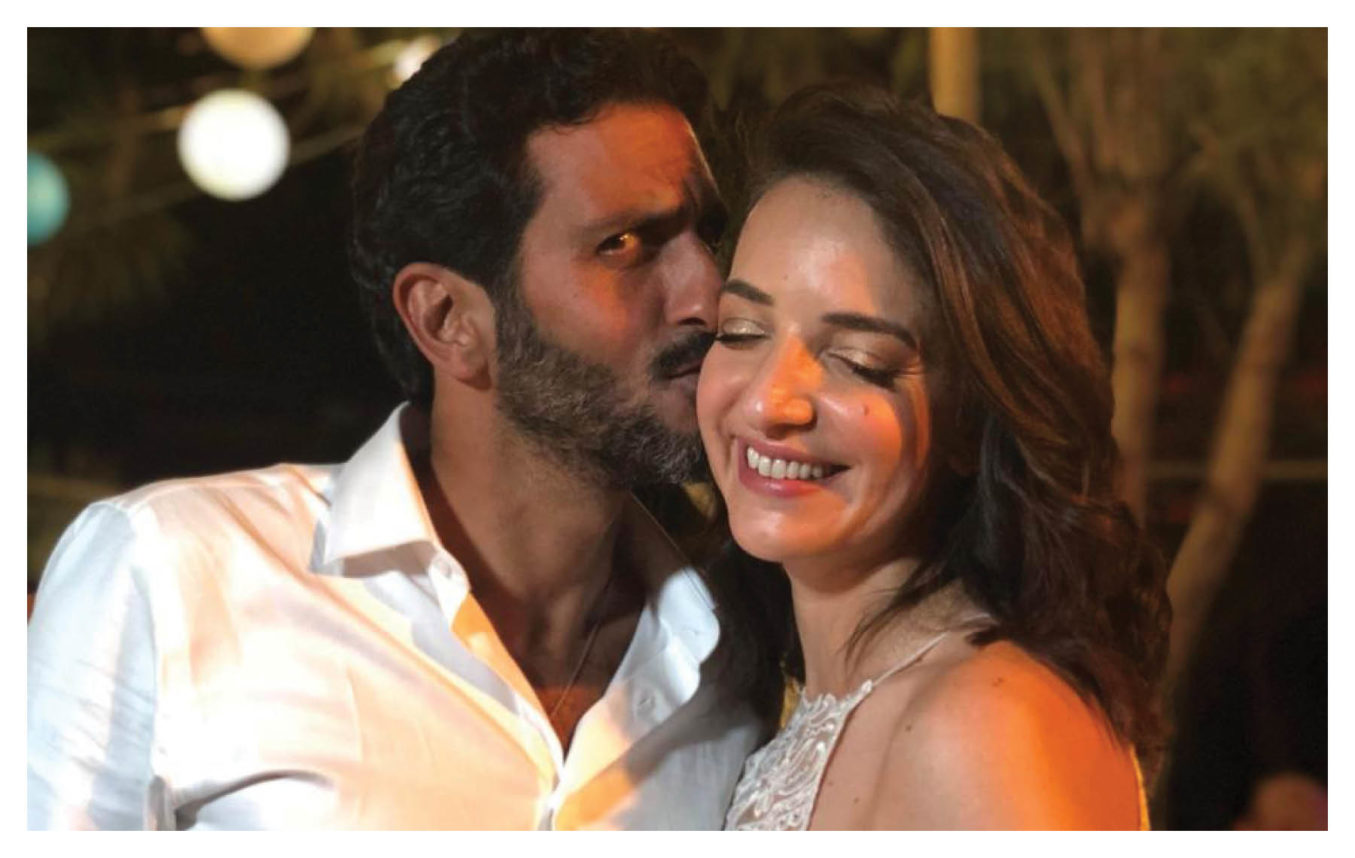
Two Israelis get married. An everyday occurrence but in this case, both Israelis are celebrities; one a TV journalist and personality, the other, an actor. So the wedding is national news. Also, one, Lucy Aharish, is a Muslim — the other, Tzachi Halevi of TV’s “Fauda” fame, is Jewish.
Intermarriage in Israel: The fewer you have them, the more noise you have. A Jew and a Muslim cannot legally marry each other in Israel. But Israelis long ago found ways to circumvent laws they dislike, especially laws that attempt to impose rabbinic dictates on them. A Jew and a Muslim rarely marry each other in Israel.
After the celebrated wedding, a Member of Knesset from the Likud Party released an ugly comment, denigrating the couple. A pushback was quick and harsh. Aharish is a charming and beloved public figure. She is sharp-tongued, patriotic, pretty and honest. It is easy to understand how an Israeli-Jewish actor fell in love with her. Still, a debate ensued about the issue of intermarriage, revealing a wide array of views. And at the heart of this issue, a paradox.
Here is it:
The sector that most opposes intermarriage — the religious right — is also the sector that most opposes separation from the Palestinians in the West Bank. In fact, the sector opposes intermarriage but also opposes creating the conditions that reduce the incidence of intermarriage.
On the other end of the political spectrum, the people least concerned about intermarriage are those most inclined to separate from the Palestinians, hence reducing the interaction of Jews and non-Jews between the Jordan Valley and the Mediterranean.
Interesting, isn’t it? If you are concerned about intermarriage — or better understand that although marriage is a complicated, personal decision, but that for Jews, a high number of intermarriages is a problem — wouldn’t you strive to have a clear Jewish majority in a well-defined territory? The inconsistency of the religious-right position is noteworthy. And even more noteworthy is the reason for it.
In fact, there are two reasons. The first is that the religious right doesn’t understand the society in which they live. The second is that objection to “intermarriage” in Israel is more about nationality than it is about religion.
“Objection to ‘intermarriage’ in Israel is more about nationality than it is about religion.“
Beginning with the first undercurrent that creates the paradox, members of the religious right do not understand that for many centrist, leftist and mostly secular Israelis, intermarriage is hardly a demon. Consider this: Self-defined “totally secular” Jewish Israelis prefer that their relative will marry a non-Jew over him or her marrying a Charedi Jew.
Consider this: A clear majority of Israelis support the idea of establishing civil marriage in Israel knowing full well (at least, most know) that this creates a legal path to intermarriage. In other words, one of the reasons why the religious right doesn’t see the contradiction between greater Israel and objection to intermarriage is its assumption that most Israelis will behave like a member of the religious right, that is, refrain from intermarriage even in a highly diverse society. This is a false assumption. Jewish Israelis, given the opportunity, will intermarry in high numbers.
The second undercurrent makes the religious right’s assumption seem somewhat more rational. Consider this: According to a recent survey by Jewish People Policy Institute, Jews in Israel have a much higher objection to a “close relative” marrying an Arab than to a “close relative” marrying a non-Jew that is not Arab. The difference is stark — not merely a few percentage points. The percentage of Jewish Israelis who would be “shocked” if a relative married an Arab is double the percentage of Israeli Jews who would be “shocked” if their relative marries a non-Arab gentile. In other words, objection to intermarriage — common among most sectors of Jewish Israelis — is much more about national identity that it is about religious norms.
With these numbers in mind, the religious right’s position seems less contradictory. It is not worried about intermarriage in a greater Israel — in which many Muslim Palestinians reside — because it knows that Jewish Israelis object to marriage with Arabs, not for religious reasons, but for national reasons. Alas, such objection depends on specific circumstances. It depends on circumstances of ongoing national conflict. In other words: for the religious-right position to have merit, the conflict with the Palestinians must never be resolved.
Or else.
Intermarriage in inevitable. Some leftist-secular Israelis might not care to have such an outcome, but religious-right Israelis do care. Hence, an unresolved paradox.
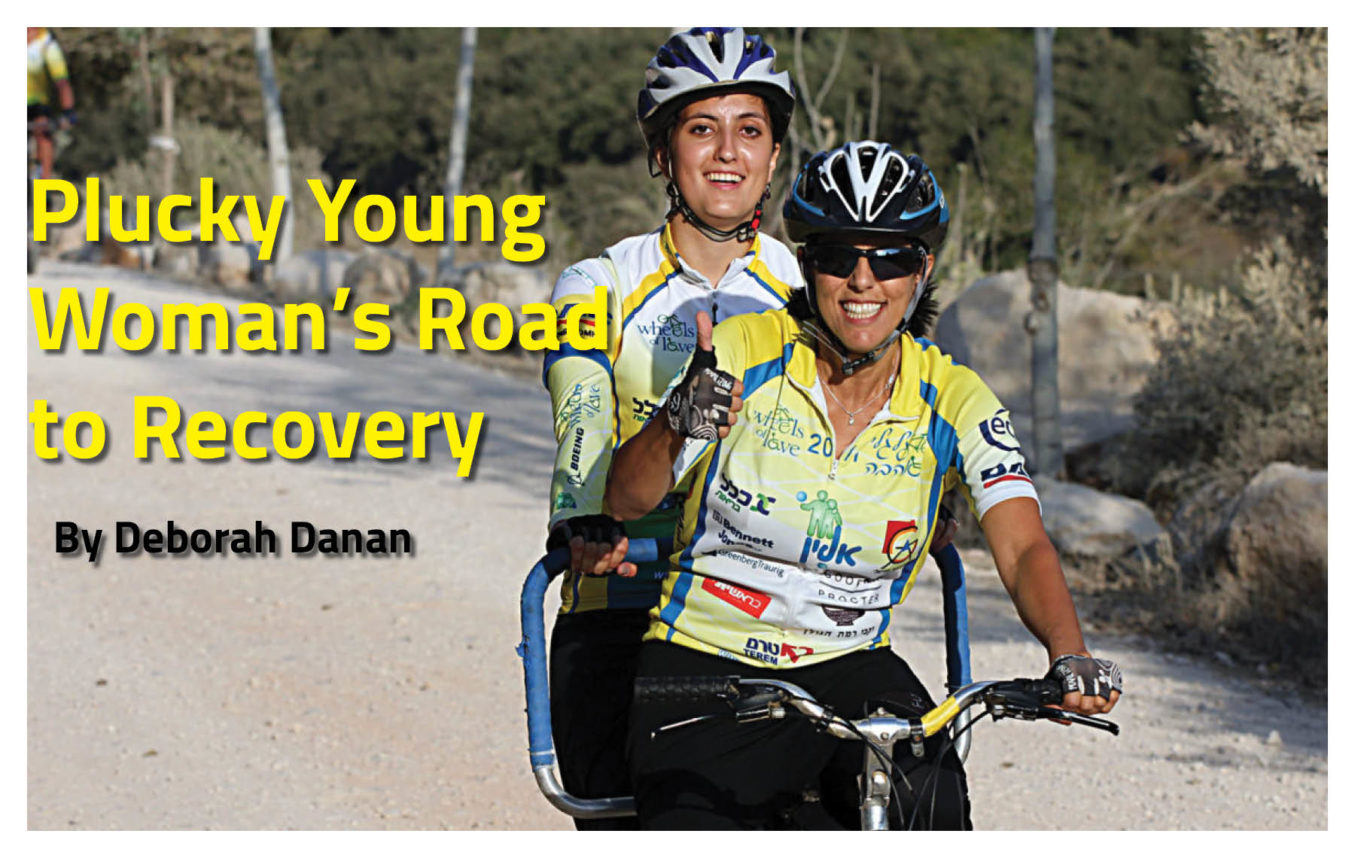
Adina Elbaz sits behind her ride partner, Rocky Brody. Photo courtesy of Wheels of Love, ALYN Hospital
Adina Elbaz had just celebrated her 16th birthday when she was hit by a minibus on her way to school. Sustaining major head trauma, Elbaz lost the ability to walk, talk and breathe unassisted. Doctors weren’t sure she would survive.
Elbaz, now 22, said she is grateful she has no recollection of the accident. “Thank God I have no [psychological] trauma,” she said, “so I have no problem going [back] to the place [where] I was hit.”
She is also grateful for the friends and family who sat vigil by her bedside for several months on end, and the people who took care of her five siblings while her parents took care of her.
Elbaz is especially grateful to ALYN, a pediatric rehabilitation hospital in Jerusalem. She spent a month in the intensive care unit at Hadassah Medical Center in Jerusalem before being transferred to the neurosurgery department where most of the patients were octogenarians.
Moving to ALYN was a great blessing, Elbaz said, and leaving it many months later was a bittersweet experience. “I had a hard time accepting that I had to leave my home, to go into the real world,” she said.
“I feel like this must have been God’s plan for me.”
The nurses at ALYN were “cute and warm and fun” and did not wear uniforms, she said. They would gently reprimand visitors who said anything mildly negative while in the room with Elbaz, even when she was still in a coma. She had been at ALYN several months when, no longer requiring a feeding tube, she could eat the dinner cooked by the wife of her father’s study partner while he and her father learned Torah at her bedside.
She recalled one occasion when she rolled the meal’s tinfoil wrapping into a ball and played catch with her father and his study partner. A doctor spotted them and retrieved a tennis ball from her office. Before long, nurses, doctor, patient and visitors were playing catch. “At some point, the ball got stuck in the ceiling. It might still be there,” Elbaz said, laughing.
Perhaps most startling of all is Elbaz’s attitude toward the man who was driving the car that struck her. She has not met him but wants to. “I feel really bad for him,” she said, noting that he is an older man who lost his 16-year-old son in a car accident.
“Maybe he feels guilty,” she said. “I want to show him that, yes, I do have my issues today but I’m doing well. I want to calm his conscience. I don’t feel it was his fault in any way. I know it was meant to happen. I don’t know why, but if it wouldn’t have been him it would have been someone else.”
The experience has prompted Elbaz to pursue neuroscience. In November, she will begin undergraduate studies in biotechnology. But before starting classes, she’ll take part with her tandem bicycling buddy Rocky in ALYN’s “Wheels of Love” fundraising drive — an annual 5-day cycling tour that draws some 600 cyclists from all over the world.
The first year of the tour she rode a tricycle for a few minutes at the finishing line. She recalled her physical therapist telling her that one day she would be riding a bicycle, to which Elbaz responded, “Yeah, right.”
Now, six years later, Elbaz can ride a bicycle.
In the year and a half she spent at ALYN relearning how to talk and walk and eventually how to ride a bike, Elbaz never once asked the universe, “Why me?”
“I feel like this must have been God’s plan for me,” she said. “For what I need to achieve in this world and to be a better person.”
Rosh Hashanah, Yom Kippur, Sukkot, Shemini Atzeret and Simchat Torah are over. We went from fast to feast. I ate enough to last a year. These holidays are tough for normal people, but for overeaters, they are insane.
I have been blessed to have kept off almost 50 pounds for about eight years. It is the single hardest thing I’ve ever done. The fat man inside of me is relentless. He is a liar, cheat and con man, and he will do anything to get me ballooned back up. He thinks it’s funny when I can’t button my pants. He loves me fat, out of shape and sick. I know this because I must deal with him daily.
Yesterday, I swore off peanuts. Today, I’ve already had three fistfuls. I later grabbed a Lärabar and said to myself, “Eat it slow.” It was gone in two bites. Then I went back for a second one. I’m hopeless. When I go to supermarkets, I might lob some “no-no” into my cart and, with the help of God (which I really mean), toss it before I get to the register, but not until I push the item around the store, talking to it. “You’re not going home with me.” “You’re not.” “I’m the boss.” Thank God people think I’m on the phone and don’t know I’m having a conversation with a bag of Skinny Pop.
A lot of people ask me how they can lose weight. I give them my phone number and tell them to call me. Ninety-nine percent of the time, they don’t call. Last week at shul, a guy told me he was diabetic and bread was his downfall. He knows what his downfall is but can’t stop.
A rabbi told me he wanted to pay someone to be all over him about his eating habits. That used to be called a “mother.” Now it is a highly paid food coach.
‘I’ve kept off the weight because it’s not about the weight; it’s about health. I’m trying to get healthy, not skinny. Skinny is the gift of getting healthy.”
There are no permanent fixes. If you want to keep weight off, get ready for the fight of your life — or join the Hare Krishnas. I’ve never seen a chubby Hare Krishna. Heart attacks, stents, open-heart surgery, erectile dysfunction, diabetes and strokes most of the time do not lead to people changing. Fear wears off. People tell me they want to change but usually stipulate they don’t want to do anything too drastic. When did having a surgeon cut you open down the middle stop being considered not drastic? (I just got up for more nuts and ate them. I’m such a lost soul.)
I’ve kept off the weight because it’s not about the weight; it’s about health. I’m trying to get healthy, not skinny. Skinny is the gift of getting healthy. Getting healthy is for people who want to get healthy, not for people who need to get healthy. You must want it and want it badly.
Mark Schiff before and after his weight loss journey.
Most people who need things never do anything about them. It’s the people who want to do it who are driven to do it. They’re the ones who succeed. Those are the people who understand that if they don’t change, they will die. Those are the ones who make the changes. I’ve been to funerals of people who died of lung cancer and heart attacks, and as soon as they were over, you can see some of their friends lighting up on the way back to their cars.
I know beyond a shadow of a doubt that if I go back to my old habits, I’m history. I made a deal with myself that when the time comes and I must give back my body to my creator, I want to return it, to the best of my ability, the way it was given to me. That means in good shape. I want to know that when the day comes, and it will, that I did all I could to prevent it. If not, that voice inside of me will have a field day berating me on my deathbed: Please, God, no more nuts today!
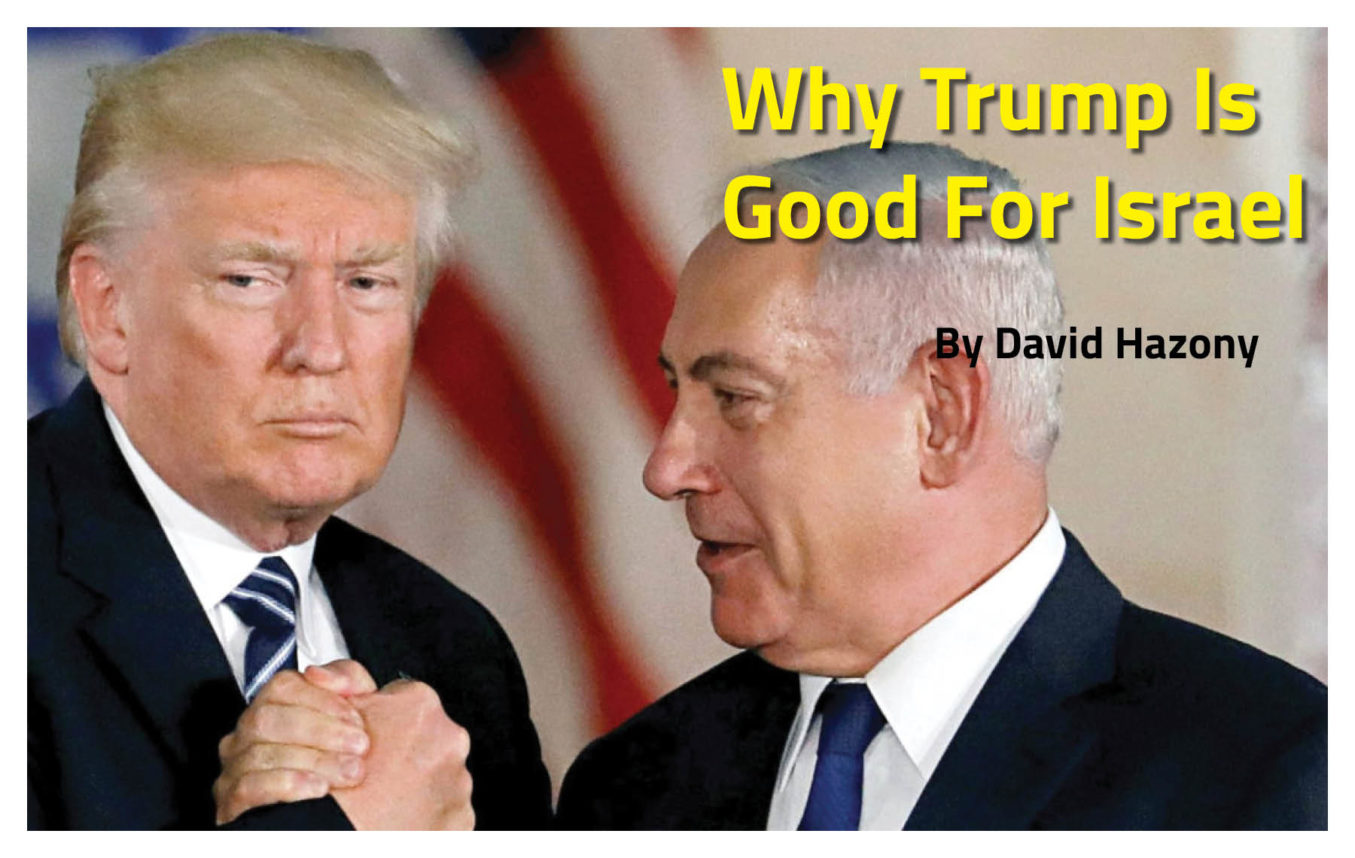
I know the risk I take when I say anything positive about President Donald Trump in today’s climate of self-congratulatory partisan idiocy. My friends in Washington, D.C., who dared weigh things on their merits, who wrote things like “regardless of what you think about him in general, on this one issue he may be right,” have been assaulted like a bad implant swarmed by antibodies.
As an Israeli, I will be forgiven for caring less about newly minted Supreme Court Justice Brett Kavanaugh, dog whistles, white supremacists and what happens at the U.S.-Mexico border than I do about foreign policy and, especially, Israel policy.
And in that arena, Trump, in his brash style, his flouting of norms, his calling allies to order and enemies by name, his willingness to use power unpredictably to advance clearly defined interests, his intuitive and accurate grasp of regional and global power maps, and his rebuilding of American military might and sovereign will — he has not made America weak, and certainly has not made Israel weak.
Very much the opposite.
When I was in high school in Boston in the 1980s, I was surrounded by teachers and friends who were convinced that Ronald Reagan was the worst president in American history, and that words and actions toward the mighty Soviet Union were “crazy” and going to result in “everybody dying in a thermonuclear war.”
Nothing drove them more nuts than American victory in the Cold War. To this day, they scramble to attribute the fall of the Soviet Union to anything other than Reagan.
So write it on the balloons at your next gala dinner: Donald Trump is, so far at least, very good for Israel.
What does Israel really need?
Well, what does any small country need when it’s trying to succeed in a volatile neighborhood? It needs geostrategic tailwinds from powerful allies. It needs enemies and friends alike to think the country should not be messed with. It needs help carving out a strategic “safe space” so it can navigate complicated and changing power constellations, and the room to let its economy grow.
Yes, advanced weapons and money help. But more important is the clarity: the consistent, unambiguous public backing, in words and deeds, from the most powerful country on Earth.
“What does Israel really need? Yes, advanced weapons and money help. But more important is the clarity: the consistent, unambiguous public backing, in words and deeds, from the most powerful country on Earth. In this, Trump is helping Israel more than his predecessor did.”
In this, Trump is helping Israel more than his predecessor did, and maybe even more than the ones before did.
Former President Barack Obama was, at best, an unreliable ally. He never failed to remind Israelis that he kept up the aid money. But he knew and we knew that the actual importance of that $4 billion has shrunk dramatically when seen as a percentage of Israel’s budget or its GDP (now around 3 percent and 1 percent, respectively). Today the money is the least important component of the United States’ strategic support. The U.S. could cut it off tomorrow without much of a blip on Israel’s balance sheet, much less the instant holocaust that American Jews usually assume would follow.
Yet on the things that counted, Obama worked against Israel’s strategic needs. He cut a deal with Israel’s most dangerous enemy, Iran, that delayed its nuclear program (which it didn’t really need), but gave the regime instead what it desperately did need — billions of dollars and a U.S. commitment to turn them into a “very successful regional power” (Obama’s words). Obama waffled on Syria, fueling its instability and expanding Iran’s reach. And let’s not forget his unprecedented slam-the-door-behind-you abstention on the anti-Israel U.N. Security Council Resolution 2334 in December 2016, after the moving vans had arrived on the White House lawn. These were not the acts of a friend.
Trump’s support has, by contrast, been unambiguous where it counts: The words and actions that tell everybody which way the winds are blowing.
This is why moving the American Embassy to Jerusalem was so valuable, as were closing the Palestine Liberation Organization office in Washington, restoring sanctions on Iran, and main-taining intolerance for U.N. hostility and Palestinian pay-to-slay policies. Taken together, these actions have sent a clear signal to the world, one that makes my children safer.
And we have seen the results. Did anybody notice how Russia entered into an uncomfortable alliance with Iran to prop up Syrian President Bashar Assad, and yet has been forced by the new reality to tolerate Israeli air strikes against Iranian military assets across the country? Did anybody notice that these airstrikes ramped up immediately after Trump’s cancellation of the Iran deal? I’d love to be in that room where the Russians are trying to explain to the Iranians why they keep letting Israel do that.
That’s why I’m a lot less worried about a Trump peace plan than I was about the Oslo Accords and the other very bad ideas American diplomats have tried in the past.
Things have changed. The Palestinians, whose cause went global in the 1960s because the Arab states and the Soviet Union needed a propaganda weapon against the West, now have lost both of their backers: The Soviets are gone, while Egypt and the Gulf States have understood the power of the Israel-U.S. alliance. For them, the Palestinian cause has outlived its usefulness.
Yes, you still have hordes of hung-over students shouting, “Apartheid!” and cheering on while Hamas sends fire balloons across the border. But in terms of real power, the Palestinians are today isolated, flat-footed, flailing for money, internally torn, rudderless, with leaders who do nothing to advance either their economic or national aspirations, who only perpetuate their misery.
In such a context, we can imagine the impasse being broken. For in most conflicts, peace happens only when one side loses, or senses it’s about to. Most peace deals are little more than a resignation to prevent the indignity of a checkmate. It’s not likely in this case, but it’s far from impossible.
So, as much as you want to incorporate Israel into your narrative about how horrible Trump is for everything, in the case of Israel, it just sounds like a silly, desperate talking point. And it surely doesn’t help the prospects of peace.
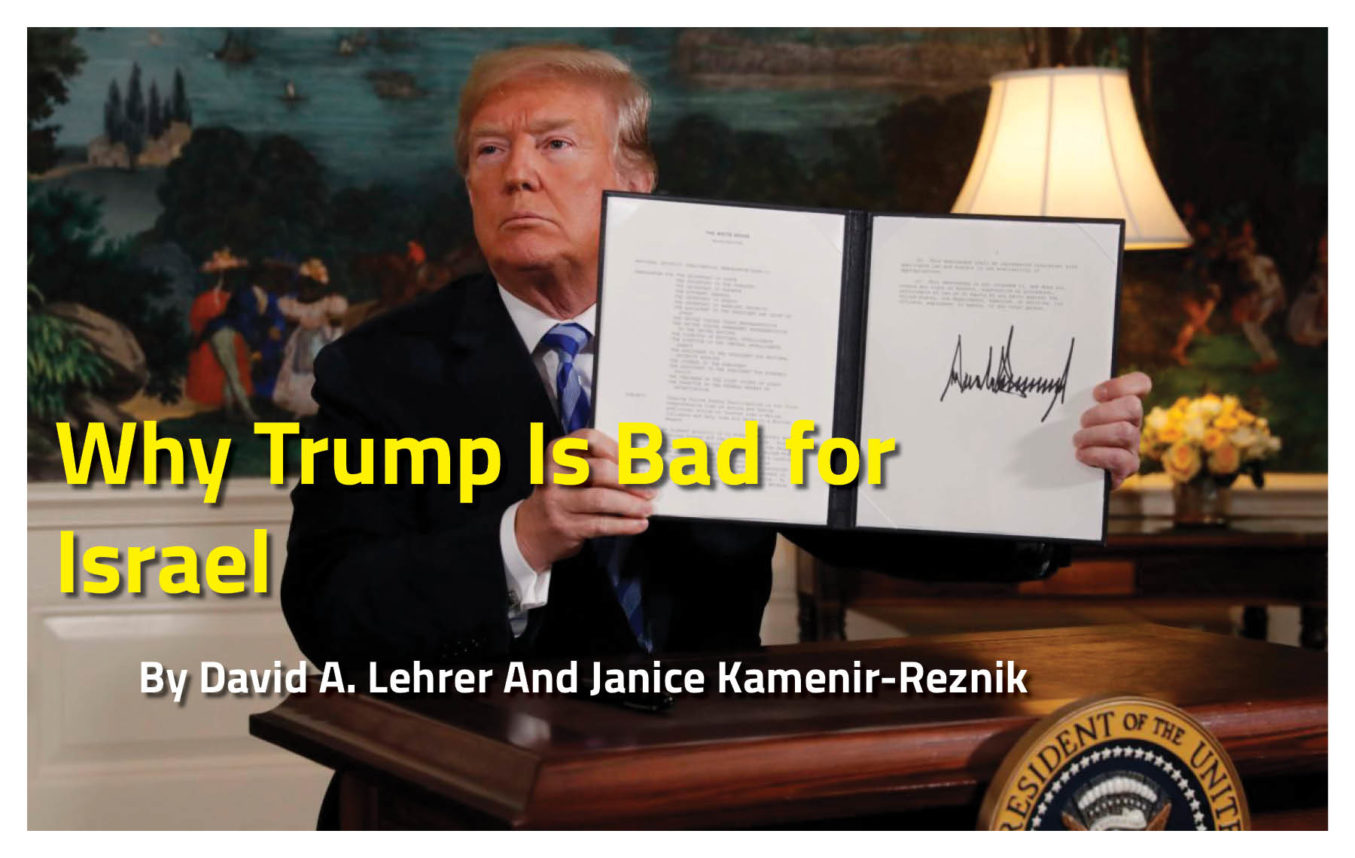
U.S. President Donald Trump displays a presidential memorandum after announcing his intent to withdraw from the JCPOA Iran nuclear agreement in the Diplomatic Room at the White House in Washington, U.S., May 8, 2018. REUTERS/Jonathan Ernst
There are few policy arenas in which President Donald Trump has been more successful in his misdirection of the nation’s attention than the Middle East. For many in the Jewish community — including many in its leadership — there is a reticence to speak up about the outrages of the Trump administration, in large measure because of the president’s perceived “support” for Israel.
After all, he recognized Jerusalem as the nation’s capital, he moved the American embassy to Jerusalem, he has been a staunch advocate for Israel in international bodies, and he embraces Israeli Prime Minister Benjamin Netanyahu while making virtually no demands on him. It looks so appealing.
But the reality is that much of what Trump has done vis-a-vis Israel is, in fact, a superficial performance — rhetorically, diplomatically and symbolically — that is at odds with the very policies that will help the Jewish state in the long term. In fact, his policies put the nation, and what exists of an international order striving for calm, in greater peril than it has been in many years.
Community Advocates, in partnership with Jews United for Democracy and Justice (“JUDJ”), four major synagogues (Valley Beth Shalom, Temple Israel of Hollywood, Stephen Wise Temple, Leo Baeck Temple), and the Jewish Center for Justice recently hosted an event at Valley Beth Shalom in Encino featuring Dennis Ross, former Middle East envoy and special adviser for Persian Gulf and Southwest Asia in several administrations.
Ross is among the most knowledgeable experts in the world on the diplomacy of the Middle East. He has served as the point man in negotiations between the Arab states, Israel and the United States in every administration since President George H.W. Bush (under Bush, Bill Clinton, George W. Bush and Barack Obama). He facilitated the 1994 Israel-Jordan peace treaty; he brokered the 1995 Interim Agreement on the West Bank and Gaza Strip and the 1997 Hebron accord, and intensively worked to bring together Israel and Syria in a peace deal. He is also the author of several authoritative books on the region and the peace process.
If one wants a thoughtful, fact-based, nonpartisan analysis of what is transpiring in the Middle East, what the future portends and what the real-world implications of policy decisions are, there is no one who knows more and has more experience in the region than Dennis Ross. He is the best of the Middle East mavens.
In describing Trump administration policies toward the region’s issues, Ross spoke of a “crisis of values” and “a real Russia problem.” Trump has made the situation far worse than it has been in decades.
“Trump’s world view — much like his domestic agenda — in its simplicity and absence of grounding in facts is dangerous to everyone involved. “
For example, Russian President Vladimir Putin recently announced plans to provide Syria with S300 surface-to-air missiles as well as sophisticated electronic counter measures, which the Trump administration has not objected to. Those moves, combined with “malign Iranian activities,” has put Israel in a nearly impossible, precarious and potentially existentially dangerous position. Ross observed that until now, “the Russians have given the Israelis a free hand to carry out operations (in Syria) and they (the Israelis) have carried out more than 200 operations in Syria against Iranian and Shia militia targets. They no longer have a free hand and the Iranians have been given a free hand. … The Israelis won’t allow themselves to be put in a position where they are threatened in almost an existential way by what the Iranians are introducing into Lebanon and Syria. … so far, they have had to manage the Russians entirely on their own. Do you think it’s an accident that Prime Minister Netanyahu has made nine visits to Moscow to see Putin?” (emphasis added)
Ross made clear how the Trump response to Russia’s actions in Syria, to essentially absent himself from the conflict, differs from his predecessors and places Israel in peril. “Historically, there was a relationship that we had where we kind of said to the Israelis ‘OK, you are responsible for dealing with the threats in the region, we will provide the material support, but when it comes to the Soviets and others outside the region that might threaten or inhibit you, that’s on us.’ That was the historic posture of Republican and Democratic presidents alike — and I know that since I served in most of those administrations. That has not been the case now.” (emphasis added)
Ross laid out the steps that the administration should take to counter Russia, Iran and the Shia militias — none of which is happening. Rather, Trump has offered a vague pledge, “‘I’ll call Putin at some point.’” Ross sarcastically observed, “well, that’s reassuring.” The way to deal with Putin, Ross advised, is not to follow the Trump playbook. “He (Putin) is a transactionalist … you have to speak his language, you don’t tout him with incredible offers.”
Trump’s missteps aren’t just related to Russia and the Middle East:
We have walked away from a ‘rules-based international order. … [Trump sees] no value in multilateral institutions. … the essence of what Trump said to the U.N. is that national sovereignty trumps everything else. Well, we’ve seen what that means — that means that governments can do whatever they want to their own people and national sovereignty precludes anyone from the outside being able to intervene and do anything about it.
The whole import of ‘Never Again’ was that it wasn’t supposed to be a slogan, it was supposed to be a principle. But when the principle is national sovereignty, you can forget ‘Never Again.’ ”
Ross couldn’t have been clearer. He sees Trump as a huge threat to whatever equilibrium might exist in the Middle East by his inexplicable inaction vis-a-vis Russia. That failure of will increases the likelihood of escalation as the Israelis defend their interests against the Iranians, the Shia militias and the Syrians; all without the United States neutralizing the Russians.
In its simplicity and absence of grounding in facts, Trump’s world view — much like his domestic agenda — is dangerous to everyone involved. As Ross observed, “what we are contending with now is really an assault on our values; by the way, it’s not just an assault on our democratic values, it’s an assault on our Jewish values.”
Last week saw further confirmation of the Trump administration’s denigration of the values that are intrinsic to the survival of the Jewish state: American moral leadership.
In his dismissal of taking action against the Saudis in the Oct. 2 disappearance of journalist Jamal Khashoggi, Trump betrayed a disdain for America’s leadership role in the world if it might exact a price on our economy — “they’re [the Saudis] are spending $110 billion purchasing military equipment … that doesn’t help us” — he responded when asked about Khashoggi.
A far cry from President Harry Truman recognizing Israel in 1948 despite threats of retaliation from the Arab states, or President Richard Nixon sending arms to Israel in 1973 notwithstanding the Saudis’ imposing a painful and costly oil embargo on us.
President John Kennedy once urged Americans “to bear any burden, meet any hardship, support any friend, oppose any foe to assure the survival and the success of liberty.” Trump is brazenly rewriting our 60-year-old American creed.
Symbolic gestures, such as moving the embassy to Jerusalem, might bring momentary satisfaction, but too much is at stake to think in such short-sighted terms. Looking at the big picture, as Ross so eloquently stated, leads to the inevitable conclusion that Trump’s failure of will with the Russians isn’t good for Israel, for the international order, or for the prospects for a moderately peaceful world.
I used to enjoy grocery shopping as a pleasant, even relaxing diversion. It was a break from work, a chance to run into friends from shul, even a chance to think. But now, with almost every purchasing decision fraught with environmental, social and politically correct decisions, grocery shopping is stressing me out.
Cereal makers boast about using deforestation-free palm oil and using recycled cardboard to manufacture their boxes. Should I sleep better at night knowing my Cheerios box was reincarnated from a lasagna box?
Aiming for a socially responsible and culinarily diverse diet, I buy Cheerios and “Quinoa Krispies,” a concoction that includes whole, hard-to-digest grains, seeds, nuts and twigs. Are those twigs? If not, there’s an uncanny resemblance.
I admire the earnestness of the entrepreneurs named Lou or Annie who make “do-gooder” foodstuffs. They live in places such as Eugene, Ore., and stamp their own fresh-faced images on the packaging. They wax rhapsodic about their cookies or crackers and of their passion for steel-cut oats, sprinkling a few philosophical bromides to the mix. Although my family categorically rejected these creations, I discovered that some of them, when tossed into the blender with a hint of filtered water, made an excellent substitution for spackling paste, though it dulled the blade something awful.
You no longer need to patronize Whole Foods for virtuous shopping. Virtually all supermarkets today sell fair-trade coffee, locally grown organic produce, wild-caught seafood with sustainability ratings, recycled bath tissue paper that promises green revolutions whose packaging features exclamation marks (so you know they mean it) and compostable dog toys, the better to reduce your pet’s carbon paw-print.
Great. Now, not only do I need to look for reliable kosher hechshers, but also “Ethical Accreditation” seals of approvals as if my pasta went to college.
“The more earnest the messaging on the product, the more expensive it probably is.”
I respect the desire to eat healthfully and live sustainably, but all these exhortations wear me out. I don’t need my brand of milk or eggs to change the world. I just want to eat my twiggy cereal and drink my fair-trade coffee at breakfast in peace. Give peace a chance!
Besides, shopping for foods that are politically, socially, environmentally and gastronomically correct remains an unsustainable practice for people of middle-class means. The more earnest the messaging on the product, the more expensive it probably is. For example, on a six-ounce package of whole-grain crackers, Lou promised that his crackers were made “with love” and that he is utterly committed to a better relationship with the planet. He wants to make crackers that matter! For twelve bucks a pound, they should matter! I can buy fresh salmon for that kind of money!
Last week, I went to Whole Foods because my Chinese acupuncturist wants me to eat sprouted mung beans, still unavailable at my regular supermarket or my kosher market. A sign by Whole Foods’ produce section proclaimed, “The more you know, the better.”
Wrong! When shopping becomes an exercise in competing socio-political sloganeering, the more you know, the more your brain cells want to implode. Spare me the biodiversity rating of every bunch of broccoli, the bioavailability of every vitamin, or the fact that the organic oranges were trucked from only 30 miles away. I’ll take the cheaper, non-organic oranges that were trucked from 150 miles away, trying to ignore the guilt-trip implied by the banner shouting, “Grown locally for reduced fossil fuel consumption!” As my Nana would have said, “Stop dreying my kop!”
And have you ever wondered why the fewer ingredients a product has, the more it costs? A new brand of organic spices at Whole Foods required a small billboard to list what the spices don’t include, such as sugar, preservatives, corn starch, gluten, tree nuts, wheat, gluten or polyester. Reading the sign, I felt a case of gluten-intolerance coming on.
I consider myself an enlightened consumer. I have a soft spot for spunky and earnest entrepreneurs who are devoting their lives to making meaningful carbohydrates. But sometimes, I pine for the good old days, when food shopping was simpler, and I didn’t have to shop till I dropped.
Judy Gruen is the author of “The Skeptic and the Rabbi: Falling in Love With Faith” (She Writes Press, 2017).
This week, the government of Saudi Arabia came under heavy, justified fire for its apparent murder of a Saudi citizen living in the United States, Jamal Khashoggi. Khashoggi was a critic of the current Saudi regime; he went to the Saudi consulate in Turkey in order to receive paperwork for a marriage license. He never emerged, according to the Turkish government. Allegedly, a Saudi team killed him, chopped him up and spirited his body out of the embassy.
Meanwhile, Turkey, the country dumping the information about Saudi Arabia, finally released an American pastor after two years in custody. The current Turkish regime is led by Recep Tayyip Erdogan, a fervent Islamist close to the mullahs in Iran. In recent years, Erdogan has dismissed, detained, or suspended nearly 200,000 government workers suspected of not being loyal to him. His thugs beat up protesters on American soil last year, and Erdogan has long sought to arrest and jail dissident cleric Fethullah Gulen, who lives in the United States.
Just to Turkey’s south, Syrian dictator Bashar Assad continues his longstanding destruction of the Syrian people, with the help of both the Iranian and Russian regimes. Hundreds of thousands of dead Syrians, the complete destruction of large cities, the targeting of civilians with weapons of mass destruction — Assad has all of that and more on his hands.
Moving east from Syria, we enter Iraq — a country which, in the aftermath of the U.S. defeat of ISIS, has actually been moving toward progress. The truth is that thanks to American patronage, Iraq has begun to stabilize. Still, the country contains deep sectarian divides between Sunni, Shia and Kurds. Iraq is a story of progress, and progress is tentative.
“It takes a unique level of moral perversity to equate Israel’s government and principles to those of its neighbors.”
Moving west from Syria, the situation becomes far more grim. Lebanon is now in the middle of a proxy war between Saudi Arabia and Iran, with the Shiite terror group Hezbollah battling it out with both Christian and Sunni parties. Hezbollah currently has the upper hand, and has been rearmed in the south of the country with Iranian weaponry.
Iran continues to spread its regional sway in the aftermath of former President Barack Obama’s attempts to rectify relations with the mullahs. Iran’s growing power continues to manifest from Afghanistan to Lebanon, and now Iran is in the midst of a brutal and bloody proxy war with Saudi Arabia in Yemen as well. Iran’s economy continues to stagnate, leading to serious and extended protests throughout the country, but the Islamic theocracy continues to stifle the freedom of its citizens.
Iran continues its support of the Palestinian government, which is dominated by terror groups ranging from the Palestinian Authority to Hamas to Islamic Jihad. There have been no serious efforts toward moderation or peace by the Palestinian government, and terror continues to blossom in the Gaza Strip, where Hamas and Islamic Jihad mobilize tens of thousands of people at the border, creating havoc necessary to provide cover for terrorists to storm the fence with Israel.
These are Israel’s neighbors. It’s important to note that simple fact when reading the outsized outrage often focused at Israel in the world press, which routinely declares Israel the great human rights violator in the region, and the instigator of violence in the world. Israel isn’t perfect, by any stretch of the imagination. But it takes a unique level of moral perversity to equate Israel’s government and principles to those of its neighbors — or to forget that the area in which Israel operates remains one of the most backward places on the planet.
Ben Shapiro is editor-in-chief at The Daily Wire, host of the podcast “The Ben Shapiro Show” and author of The New York Times best-seller “Bullies: How the Left’s Culture of Fear Silences Americans.”