

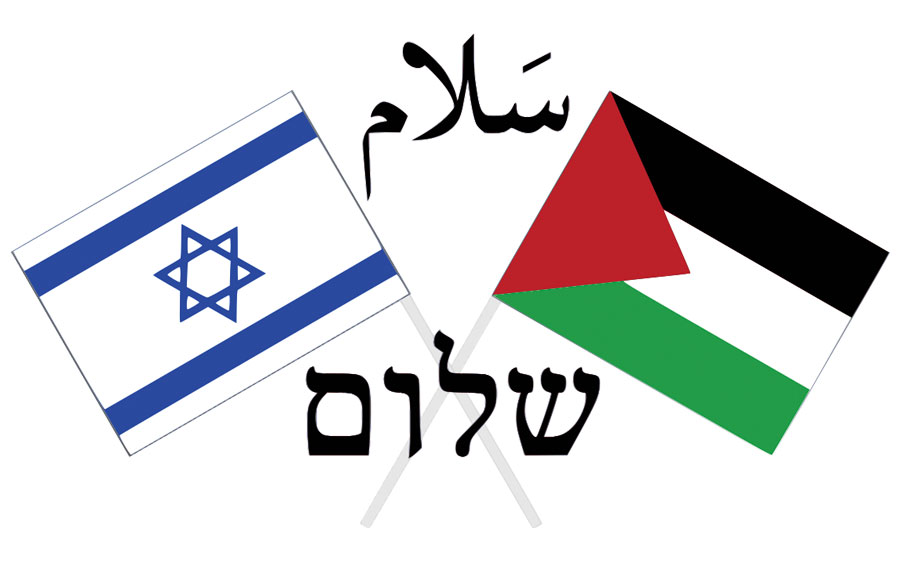
When it comes to the complicated Israeli-Palestinian conflict, there’s one simple fact that pretty much everyone agrees with: The attempts at a “two-state solution” have been a stunning failure.
It’s certainly not for lack of trying. Since the famous handshake in 1993 that launched the Oslo Accords, it’s safe to say that no global conflict has taken up more political and diplomatic energy.
It’s astonishing that after the investment of so much energy, the parties are even further apart today than they were 25 years ago.
For many Israelis, this status quo is unacceptable. Last week, I met two activist groups with distinct initiatives for breaking the logjam.
My friend Dan Adler introduced me to the first initiative, called The New State Solution (NSS). I had heard and read about them, and knew that their idea was starting to gain some traction.
The basic premise of the New State Solution is to focus on what’s possible. Since making any kind of deal in the West Bank has proved virtually impossible, why not focus on Gaza first?
“The basic premise of the New State Solution is to focus on what’s possible. Since making any kind of deal in the West Bank has proved virtually impossible, why not focus on Gaza first?”
Their idea is to take advantage of the renewed cooperation between Israel and Egypt to create an expanded Palestinian state in Gaza, using parts of the Sinai that now are controlled by Egypt. Their plan calls for implementing a massive humanitarian and economic build-up in Gaza that would shift the center of gravity of the conflict and create a “win” for all parties.
The co-founders of the initiative, Israel Defense Forces (IDF) veterans Benjamin Anthony and Brigadier General (Ret) Amir Avivi, believe that what the conflict needs, more than anything, is a “paradigm shift.” They know their idea is not perfect and faces challenges (among them: Will Egypt agree to give up land?), but they believe it is the most realistic of many bad options. You can see all the details on their website (newstatesolution.org).
The second group I met is the Israel Policy Forum (IPF), which was founded in 1993 and “works to shape the discourse and mobilize support among American Jewish leaders and U.S. policymakers for the realization of a viable two-state solution consistent with Israel’s security.”
Like most American and Israeli Jews, the IPF has not given up on the two-state solution, for the oft-stated reason that staying in the West Bank threatens the future of Israel as a Jewish and democratic state. In recent years, the IPF has teamed up with Commanders for Israel’s Security (CIS), a nonpartisan movement of retired IDF generals and security experts that works to “extricate Israel from the current impasse” as a first step toward an eventual agreement.
The IPF approach is the reverse of the NSS approach. Instead of avoiding the incredibly difficult problem of extricating Israel from the West Bank, it is doubling down. It believes its comprehensive “security first” approach will manage the security risk and offer an acceptable trade-off.
What has added urgency is talk of “annexation” among current government coalition members. In a recent study, CIS concluded that “as a determined political annexationist minority accelerates moves toward annexation — both creeping and legislated — the ensuing shockwaves threaten to undermine Israel’s security, its Jewish-democratic character, its relations with its neighbors, its relationship with the Diaspora, and the attitude of the international community toward the country.”
All of this reminds me of the most honest and concise description I’ve ever heard of the Israeli-Palestinian conflict, from my friend Yossi Klein Halevi: “Staying in the West Bank is an existential threat to Israel; leaving the West Bank is an existential threat to Israel.”
Notwithstanding the complexities, these two groups are charging ahead to try to break the status quo. Whether by focusing on Gaza or doubling down on the West Bank, they realize that a dark clock is ticking louder and louder.
“In the absence of negotiations, is there anything that Israel can do on its own immediately to help preserve its future?”
The fundamental problem in recent years has been an inability to get the parties to the negotiating table and a general sense that any potential deal would be dead on arrival.
Maybe this is why the IPF has been promoting “interim steps” that Israel can take to safeguard the viability of a two-state solution, such as limiting settlement construction in the main settlement blocks and improving the economic and humanitarian situation on the ground.
When I met the representatives from IPF, I glibly suggested that their interim plan would be like a “pre-state solution.” I have no idea whether they will use that term, but the point I was making was this: Many of us are simply exhausted with waiting for the parties to get together and negotiate. As the years go by, the price of waiting keeps getting higher. We can’t wait forever.
So, the question becomes: In the absence of negotiations, is there anything that Israel can do on its own immediately to help preserve its future?
I heard two distinct answers last week. Whether it’s the New-State Solution or the Pre-State Solution, they both said the same thing: We’re tired of waiting.
































