fbpx

October 3, 2018

Letters to the Editor: Latino Production of ‘Anne Frank,’ Kavanaugh and Graham and Watching High Holy Days Online

Latino Production of ‘Anne Frank’

I’m writing to respond to Arthur Christopher Schaper’s letter saying that he “cannot believe anyone would compare Jews fleeing the Holocaust with undocumented immigrants in the United States” because “They were never criminals. … Their citizenship was unjustly stripped away …” (‘Anne Frank’ Casting Insults Holocaust Victims,” Sept. 14).
First, we should acknowledge that the Nazis were operating within the laws they wrote. When Anne Frank hid — and when non-Jews hid Jews — they were breaking laws and becoming criminals. These laws were indeed unjust — and the right thing to do was to break them. That is an important lesson from the Holocaust. This lesson was reinforced on our shores. The United States turned away Jewish refugees during the Holocaust, such as from the MS St. Louis. The captain was said to have considered running the ship aground for them to escape, but was deterred by the Coast Guard. The lesson isn’t that the refugees did the right thing by abiding by the law, but that the U.S. did the wrong thing by sending many of those on board to their deaths. Today, the U.S. is slashing asylum admissions and refusing to process asylum claims at the border the way it used to. The people we turn away are again fleeing our enemies — MS-13, ISIS and other mass murderers. As before, we express fears about floods of migrants or enemies coming across among them — but the real reason may be antipathy toward their race or religion. If you were a Jewish refugee in 1939, knowing what we know now, would you want to stay on the St. Louis? Or risk becoming an illegal alien? Many refugees we are now turning away face a similar decision.
Toby Muresianu, Via email

Kavanaugh and Graham

Judge Brett Kavanaugh’s pathetic pitch to exonerate himself and Sen. Lindsey Graham’s (R-S.C.) amateurish outburst now can join other famous remarks on file in the Library of Congress, such as President Richard Nixon’s “I am not a crook,” the “Have you no dignity, sir?” tossed at Sen. Joseph McCarthy during the House Un-American Activities Committee hearings, and President George W. Bush’s “Great job, Brownie” in the midst of the Hurricane Katrina disaster. They will, unfortunately, stand the test of time.
Hal Rothberg, Via email

Brett Kavanaugh exhibits no pattern of deviant behavior toward women throughout his very public adult life; quite the contrary. One member of the Senate Judiciary Committee is a proven liar; why is he qualified to judge Brett Kavanaugh? We’ve been told Sen. Dianne Feinstein (D-Calif.) held onto Christine Blasey Ford’s allegations until the confirmation vote was imminent because Ford wished to remain anonymous. This strains credulity. Lastly, the veracity of accuser Ford needs to be investigated. Expert examiner Rachel Mitchell questioned Ford in front of the Senate Judiciary Committee. She notes nine significant problems with Ford’s testimony and that Ford’s allegations are “even weaker” than a “he said, she said” case.
Julia Lutch, Davis, Calif.

Symbolism of Israeli and American Flags in the Sanctuary

When I walked into a synagogue during the High Holy Days, I saw that it was full of people praying and singing amazing songs, but when I looked ahead to the Aharon Hakodesh, I noticed there was no American or Israeli flag on each side. This is a mistake. We must recognize the tens of thousands of American soldiers who liberated the Jews from the hands of the Nazis, and the tens and thousands of Jewish soldiers who risked and gave their lives to create the state of Israel.

After 3,000 years, we finally have a home again, and we finally have a country outside of Israel where we can practice freely. We must remember every single day that we will never again be refugees. The minimum respect that the soldiers deserve is that we remember them every time we pray.

My name is Joshua Kaufman. When I was taken to Auschwitz with my family, my new name was 109023. I am almost 91 years old, a survivor of Auschwitz, Birkenau, the death march to Dachau, and Müeldhorf. One day when they needed an extra hand in the gas chamber, I volunteered to work. I saw the horrors with my own eyes and did things with my own two hands. I survived three wars as an Israeli soldier: 1956, 1967 and 1973. I spent five years in the Suez Canal with Ariel Sharon. Today, I live in beautiful Los Angeles with my wife, four daughters and four grandchildren as a proud, free, hopeful and strong Jew.

I want to know that when I die, the appreciation will be passed onto the next generations. The Torah is our tree of life, and the flags are necessary reminders to be grateful. It is not God alone but the actions of man that we also need to remember.

This is my wish, for all synagogues to proudly display an Israeli and American flag in the main sanctuary.
Joshua Kaufman, via email

Publicly Shaming People Isn’t a Jewish Value

Rabbi Neil Comess-Daniels published a diatribe against Stephen Miller in his High Holy Days sermon (“Using the Bully Pulpit on Rosh Hashanah,” Sept. 21). Publicly shaming another human being goes against Jewish values. The Talmud says publicly embarrassing someone, causing the blood to drain from their face, is akin to murder.

While we have a responsibility to help correct another Jew’s behavior, we are to do so in a constructive and sensitive manner.
Loren Greenberg, Los Angeles 

Watching High Holy Days Services Online 

Many thanks for “Yom Kippur ‘On Air’” (Sept. 28). It’s about time these wonderful online High Holy Days services got some public notice. Not only are they great (as the article asserts) for those who can’t attend in person due to illness, family caregiving responsibilities, etc., they’re also an option for those who can’t find a (theologically compatible) place to go without tickets or membership costs that are beyond their means. And readers might want to know that many congregations also stream Shabbat and weekday services. Some (like Beit HaLev and Sim Shalom) even stream some very uplifting and meaningful services without a full onsite congregation.
Therese Egrafed, via email

Sen. Mazie Hirono and #MenToo

Wikipedia defines “misandry” as “dislike of, contempt for, or ingrained prejudice against men (or of the male sex).” Unequivocally, this defined the simplistic and hateful attitude of Sen. Mazie Hirono (D-Hawaii) when she, in her own “Spartacus moment,” warned all men to step up and shut up. What seems shameful to me is none of us condemned this unacceptable behavior, or wondered how someone that prejudiced could be in public office.
Steve Klein, via email


Don’t be shy. Send your letters to letters@jewishjournal.com Letters should be no more than 200 words and must include a valid name and city. The Journal reserves the right to edit all letters. 
Letters to the Editor: Latino Production of ‘Anne Frank,’ Kavanaugh and Graham and Watching High Holy Days Online Read More »

The Kavanaugh Fiasco: Just Win, Baby

I was never this cynical. If anything, I’m more of a romantic. I like to believe people, even politicians. I’ve met some amazing politicians who work very hard and have strong convictions. I know they don’t have an easy job.

So why am I totally disgusted with the political spectacle of the Brett Kavanaugh Senate hearings? For a number of reasons, but one in particular.

I feel I’m watching a UFC Championship fight. Two combatants locked in a cage ready to do whatever it takes to crush his or her opponent.

Whenever I see one of these combatants try to convince me it’s not a cage I’m seeing but a conversational salon, I roll my eyes. Who are they kidding?

Before the hearings even started, before anyone had even heard the name Christine Ford, one side had already announced that the candidate in question was evil and must be crushed by any means necessary.

In fact, you can go back a few years and note that the other side would not even allow a hearing in the first place. Why? For the same reason the latest candidate was called evil: because one must do whatever it takes to win. Nothing else matters.

The crazy thing is, I’m not saying anything new. We’ve always known that “partisan politics” is a contact sport where people fight over power. So why is it disgusting me so much all of a sudden?

Maybe because I don’t recall it ever being so viciously and shamelessly blatant. It’s possible that the stakes are seen as so high—a majority in the Supreme Court for years—that combatants have thrown every scruple and principle out the window. Except for one, of course: Win at all cost.

Our politics have descended all the way down to the UFC cage. Actually, they’re lower. At least with UFC, no one is pretending to have a conversation. They’re only there to fight. The politics of the Kavanaugh hearings is UFC without the honesty.

Behind the fancy suits and righteous blather, it’s hand-to-hand combat. Everyone knows it: Find any weapon you can, destroy whomever you must. The newest standard is now the lowest standard.

There are exceptions. There still are noble politicians who want to do the right thing and put decorum and decency ahead of winning. The problem is that their voices are drowning in the chaotic din of the arena.

Perhaps the saddest part of this whole fiasco is that I’m not sure any of this upsets the combatants.

When you’re in the cage, looking at your enemy, there is only victory, and it is priceless.

The Kavanaugh Fiasco: Just Win, Baby Read More »

Movers & Shakers: Wells for Niger, Dems Fundraiser, AJU ‘Promise’

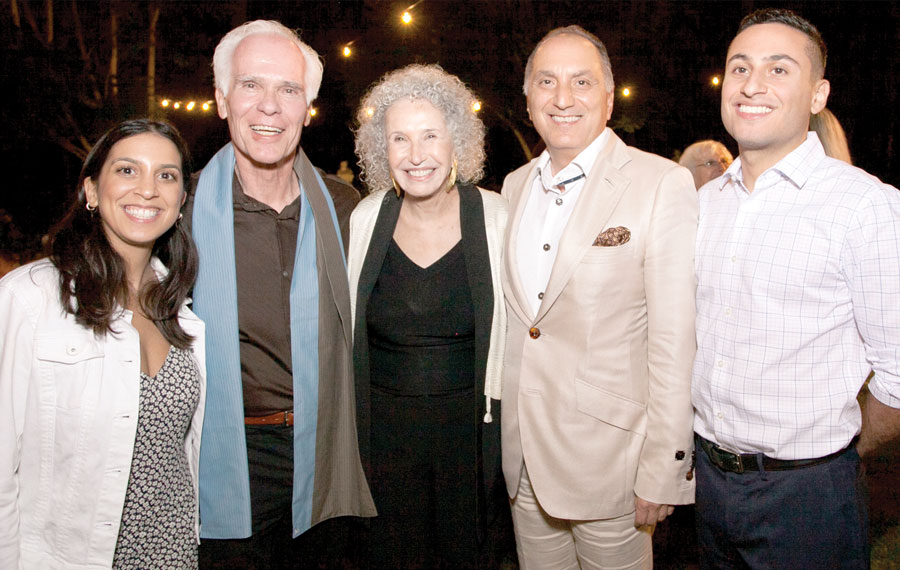
Former Los Angeles County District Attorney Gil Garcetti and philanthropist Stanley Black were among about 200 people on Sept. 23 who celebrated the 10th anniversary of Wells Bring Hope, a Los Angeles nonprofit that works to bring clean drinking water to villages in the West African nation of Niger.

Wells Bring Hope was founded in 2008 by Bel Air resident Barbara Goldberg, who was inspired by Garcetti’s photographs showing the plight of women and girls in West Africa who walk miles every day for water. The organization supports the drilling of wells in Niger, among the poorest countries in the world, in partnership with World Vision, an international Christian organization, and with Panda Restaurant Group, which operates Panda Express. The corporate sponsor underwrites Wells Bring Hope’s operating expenses, allowing 100 percent of donations to fund wells, according to the organization’s website.

The more than $200,000 raised during the event, held at Black’s home, will fund close to 40 wells, adding to the more than 500 wells the organization has drilled the past 10 years, Goldberg said. One well costs $5,600, serves a village of about 1,000 people and is a perpetual source of water, she said. 

“It’s an endless supply of water,” Goldberg said. 

Black has been a supporter of Wells Bring Hope for six years and has hosted the group’s annual fundraiser the past five years. 

Goldberg said the organization is a model of collaboration between different religious groups. It was founded by a Jew (herself); inspired by an agnostic (Garcetti); serves Muslims (the people of Niger); and partners with Christians (World Vision) and Buddhists (Panda Restaurant Group co-founder Andrew Cherng).

“Is that not the most ecumenical nonprofit you can imagine?” Goldberg said.

In addition to raising money for Wells Bring Hope, the event honored Black for his years of philanthropic work and support of organizations throughout Los Angeles. L.A. City Councilman Paul Koretz, who was among the attendees, presented a City Council declaration making Sept. 23 “Stanley Black Day.” 

Organizations supported by Black, who was born and raised in Los Angeles and has enjoyed a successful real estate career, include Los Angeles ORT College, Vista Del Mar Child and Family Services, Cedars-Sinai Medical Center and the Los Angeles Jewish Home.

Sukey Roth, Garcetti’s wife, also attended the event. The two are the parents of L.A. Mayor Eric Garcetti, who was not in attendance but sent a congratulatory video. Also attending were businessman and philanthropist David Delrahim and his family. Delrahim is a board member of the Los Angeles chapter of the Jewish National Fund and is a supporter of Wells Bring Hope.

Additional attendees included Gilda and Robert
Marx
; Bob and Leslie Spivak; Ronnie Kassorla; photographer Michael Becker; Madeline Gussman; and Bernardo Puccio and Orin Kennedy, whose love story is the subject of the upcoming documentary “An Ordi-
nary Couple.”

Goldberg said the event underscored how far the organization has come the past decade.

“The highlight was reaching a goal of 500 wells in 10 years, serving over half-a-million people, bringing safe water to them,” Goldberg said. “We were cele-
brating that.”


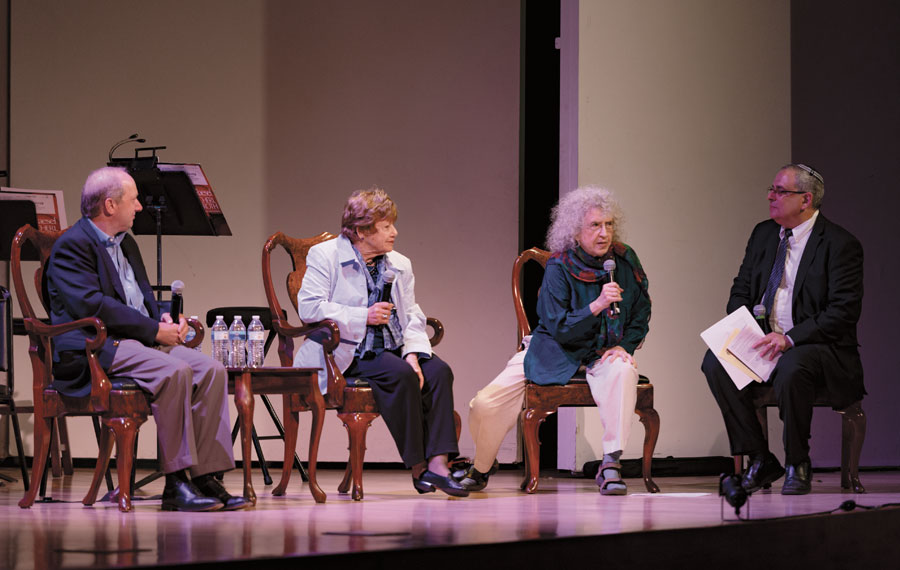
From left: Before the staging of “The Promise: A Zeisl Concert,” E. Randol Schoenberg, Barbara Zeisl Schoenberg, Amielle Zemach and Mark Kligman participated in a Q-and-A about the historic production at American Jewish University’s Gindi Auditorium.

“The Promise: A Zeisl Concert,” a ballet about the biblical love story of Rachel and Jacob, was staged on Aug. 26 at American Jewish University’s Gindi Auditorium.  

The production originally was commissioned in 1954 by what was then the University of Judaism, and created by its Head of Theater Arts Benjamin Zemach and Austrian émigré composer Erich Zeisl. Due to a lack of funds, however, the production was not performed during that period.

The version performed at AJU featured the Los Angeles Jewish Symphony (LAJS) and its Artistic Director Noreen Green, along with members of Los Angeles modern dance company Bodytraffic and actor Fred Melamed as narrator.

The evening kicked off with Mark Kligman, a professor and chair of ethnomusicology at the UCLA Herb Alpert School of Music, conducting a Q-and-A with attorney E. Randol Schoenberg, Zeisl’s grandson; Barbara Zeisl Schoenberg, Zeisl’s daughter; and Amielle Zemach, the daughter of Benjamin Zemach. The speakers explored the historic relationship between Zemach and Zeisl and the return of the ballet to its originally intended home at the AJU after nearly 60 years.

LAJS, the UCLA Lowell Milken Fund for American Jewish Music and AJU’s Whizin Center organized the production.


From left: Jimmy Kimmel, DJ Khaled and Los Angeles Mayor Eric Garcetti headlined “1 Night, $1 Million, 10 States, 100s of Victories,” a fundraiser for the Democratic parties in 10 states.

Los Angeles Mayor Eric Garcetti and comedian Jimmy Kimmel are using their name recognition and chemistry to bolster the Democratic Party in the upcoming midterm elections.

On Sept. 25 at the Avalon Hollywood club, the two headlined “1 Night, $1 Million, 10 States, 100s of Victories,”
which sought to raise $1 million for Democratic parties in 10 states, with
each receiving $100,000 to elect Democratic governors and legislators this November.

“We are taking a unique and strategic approach to these midterms,” Garcetti
said in a statement. “State Democratic parties are where it all comes together — they’re working to flip Congress, and secure victories in 2020 and beyond by winning state legislative seats and registering voters,”

Ultimately, the event raised $1.5 million for the state Democratic parties of California, Iowa, Nevada, New Hampshire, Michigan, Minnesota, Oklahoma, Ohio, Pennsylvania and Wisconsin. 

“Nothing is more important than taking back control of this country,” Kimmel said.

According to Yusef Robb, a senior adviser to Garcetti and the Democratic Midterm Victory Fund, which hosted the event, there were 800 attendees. Tickets ranged from $100 to $100,000.

Garcetti, who is rumored to be considering a 2020 presidential run, has Kimmel’s support. “I am here because I will go anywhere he asks me to go,” Kimmel said. “He’s a great mayor and a great person.”

When Garcetti took the stage, chants of “Eric 2020” filled the space, prompting him to try to quiet the audience so it could listen to remarks from state Democratic leaders.

Eric Bauman, chair of the California Democratic Party, was among the attendees.

A performance by DJ Khaled, who performed a medley of hip-hop hits, closed out the evening.

When Khaled ran late getting started, Garcetti and Kimmel bantered to kill time. Garcetti asked who in the
crowd was single, to which Kimmel added:  “Pair up and make little baby Democrats.” 


Want to be in Movers & Shakers? Send us your highlights, events, honors and simchas. Email ryant@jewishjournal.com

Movers & Shakers: Wells for Niger, Dems Fundraiser, AJU ‘Promise’ Read More »

The Zionist Dilemma on College Campuses

Of all the challenges that confront those of us who identify ourselves as Zionists, perhaps none is so poignant and so heartbreaking as the fact that “Zionism” has become a fighting word on the college campus, the very place where open-mindedness should be enshrined as a core value.

That’s the focus of “Anti-Zionism on Campus: The University, Free Speech and BDS,” edited by Andrew Pessin and Doron S. Ben-Atar, a new title in the Anti-Semitism Series of the Indiana University Press. Pessin, a philosophy professor at Connecticut College, and Ben-Atar, a playwright and history professor at Fordham University, have collected more than 30 contributions from scholars and students who have studied and experienced the dilemma they write about.

“Those in the academy who support Israel, or who merely don’t despise Israel, are finding it increasingly difficult to speak up without risk of verbal attack, social and professional ostracization, setbacks to their careers, and sometimes even physical threats,” Pessin and Ben-Atar write. “As a result, the Israel-friendly (or merely non-anti-Israel) voice on campuses around the world and in the global ‘republic of letters’ is rapidly being silenced. The implications of this phenomenon, not only for Jews but also, we believe, for free speech, for the academy, and for Western values in general, are chilling.”

They alert the reader to a parade of horribles: “Protests and disruptions confront not only Israel-related campus events but also Jewish events, including talks by famous people about their Jewish heritage, campus Shabbat dinners, and Hillel student meetings,” the editors sum up. “More and more, individuals are being targeted, smeared, falsely accused of saying or doing objectionable things, shamed, singled out for public condemnation and rage, and subject to hateful and threatening messages.”

Each chapter is a case study, detailed and nuanced, of a particular incident of anti-Zionist excess. For example, Jeffrey Kopstein, describes the scene when some 50 protesters stormed the screening of an Israeli film for an audience of 10 students at UC Irvine, screaming, “Long Live the Intifada,” first trying to break into the room and then blocking the door in order to trap the audience inside. A pro-Israel advocacy group “decided to double down and rescreen the film on campus with a much larger community and official presence,” including 30 uniformed officers, bomb-sniffing dogs, physical barriers, and strict security protocols.” The second screening was not disrupted, but Kopstein — a UC Irvine political science professor who witnessed the various anti-Zionist incidents that took place at the campus — laments that the necessity for elevated security was “[h]ardly the description of an atmosphere conducive to non-politicized learning.” 

His dilemma — the painful effort to balance freedom of speech and academic integrity — is a theme that runs throughout the collection. Another veteran of campus confrontation is UCLA emeritus professor Judea Pearl, who writes about the invitation he received to participate in a campus debate about the boycott, divestment and sanctions (BDS) movement, sponsored by the Los Angeles Review of Books. 

“[S]hould I bestow academic credibility onto an ideology that accuses me of crimes as ridiculous as ethnic cleansing, apartheid, and colonialism when I do research at my alma mater, the Technion, in Israel?” he writes. “It would be like hosting a balanced debate between supporters and detractors of the Flat Earth Society or, God forbid, the Americans for the Restoration of Slavery.” 

Pearl, a world-renowned computer scientist and the father of the murdered journalist Daniel Pearl, decided to participate in the debate in the hope of proving the BDS movement to be wrong on the strength of argument and evidence, the tools of authentic scholarship. His chapter summarizes the case he made against BDS, but he widens the focus to propose how colleges should deal with the excesses of anti-Zionism: “Selective neutrality should be the instrument with which the university administration distinguishes those who contribute to the respectful campus climate and productive discourse from those who disrupt such a climate.” And he concludes with a one-sentence prescription for achieving peace in the Middle East: “Two states for two peoples, equally legitimate and equally indigenous.”

“When Palestinian leadership gathers the courage to utter the magical words “equally indigenous,’ ” he concludes, “peace will become unstoppable — not even BDS will be able to stop it.”

My alma mater, UC Santa Cruz, is the focus of a chapter by Tammi Rossman-Benjamin. As a lecturer in Hebrew and Jewish studies, she was the target of what she calls “a sustained campaign of harassment, intimidation, and defamation” that was carried out by anti-Israel activists, including one of her own former students. When Rossman-Benjamin tried to invoke the protection of the 1964 Civil Rights Act, the student claimed that the civil rights investigation “is actually being used to stifle Palestinian-related speech on campus,” and her adversaries complained that her civil rights complaint “violated the First Amendment rights of Muslim, Arab, and pro-Palestinian students” and “created a ‘hostile environment’ for them.” All of her claims were ultimately dismissed by the authorities.

“My story may be extreme,” she insists, “but it is not unique.”

What is to be done? The whole point of “Anti-Zionism on Campus” is that it takes courage to speak out in defense of Israel on campus today. “[C]ampus anti-Israelists are in it for the long haul,” writes Pessin in an epilogue titled “Inconclusive, Unscientific Postscript: On the Purpose of the University, and a Ray of Hope.” He continues: “It remains unclear whether those who do not believe that Israel is an unqualified abomination will be able to stay in it for the long haul as well. It is a hard battle to fight, and the personal costs are great.”

His words are intended to inspire — and, perhaps, to shame — the reader to speak up for his or her convictions in the face of anti-Zionism wherever it is found. When compared with what others have already given to the cause of the Jewish state, and what the citizens of Israel continue to give, it is not much to ask of anyone who proudly calls himself or herself a Zionist.


Jonathan Kirsch, author and publishing attorney, is the book editor of the Jewish Journal.

The Zionist Dilemma on College Campuses Read More »

Israeli Film ‘Longing’ Explores Fatherly Love and Loss

In the opening minutes of Israeli filmmaker Savi Gavizon’s “Longing,” middle-aged bachelor Ariel Bloch gets news that’s not only shocking, it’s a double-punch to the gut. Meeting his ex-girlfriend Ronit at a café, he’s told that he fathered a son 20 years ago. Then he learns that the boy, Adam, is now dead, killed when his car plunged off a bridge. Reeling from the news, he begins a quest to learn more about the young man he never had the chance to meet.

The answers he gets are complicated: Adam was a talented musician and poet, but he was also angry and troubled, with a history of defacing property, dealing drugs, stalking his French teacher, and getting his 15-year-old girlfriend pregnant. How Ariel deals with and processes these revelations as he meets people in Adam’s life and learns about himself in the process is at the core of Gavizon’s dark comedy.

Starring Shai Avivi as Ariel, Assi Levy as Ronit, and Neta Riskin as French teacher Yael, “Longing” was nominated for 13 Ophir Awards—Israel’s Oscar — with Gavizon’s script winning the award for best screenplay.

“This is a story about parenthood, about the desire to be a parent and the afflictions that come with it: identification and honor,” he told the Journal. “This is a journey that creates near-laboratory conditions for the examination of the hidden aspects of parenthood.”

The divorced father of two children, Maya, 25, and Yoav, 20, the Tel Aviv-based writer-director of “Nina’s Tragedies” and “Lovesick on Nana Street” explained his inspiration for his latest film.

“A few years ago, when I got divorced, my kids became the anchor in my life. I developed an obsession to be with them as much as I could. On their days with me, I didn’t allow them to go to their friends and surely not to sleep over. They had to stay with me. Instead of being a good father to them, I was a good father for me,” he said. “Issues of awkward parenthood began to bother me and these issues looked for their story to be told. These issues, I think, resonate in the heart of every parent.”

Bringing the story to the screen posed several challenges. “The essence of the story is the journey of the main character from cold to hot and from loneliness to being surrounded by people, from thinking about himself to [recognizing] others. So I had to design him as a very cold, selfish and lonely person.” It is a very hard step to begin with, he explained, so it was important that he cast the right actor. He chose Shai Avivi because of “his talent, warmth, gentleness and lovable quality that makes people relate to him, even as a difficult to like character.”

“Longing” artfully treads the line between darkness and light, deftly blending comedy and tragedy. “I’ve always wanted to create a film which is comprised of absurd situations, because they allow access to deep emotions without falling into the trap of sentimentality and cliché,” Gavizon said. “Perhaps this is why I’ve allowed myself, for the very first time, to be led to the very end by a singular pain and a singular passion. ‘Longing’ is a tragicomedy, paved with more absurdity than any other screenplay I’ve written to date.”

“‘Longing’ is a tragicomedy, paved with more absurdity than any other screenplay I’ve written to date.” — Savi Gavizon


As a director, he said the most significant challenge he faced was directing this film in an entirely realistic fashion, in order to provide “a solid emotional platform for those moments that touch on the extreme and the ridiculous.” He explained that classic comic drama usually starts funny, and gradually becomes serious and painful, but in this case, “I chose to do it in the other way around. The movie starts very sad, and becomes more and more absurd and comic. ‘An Extremely Sad Comedy’ is probably a title that suits ‘Longing’ better than any of my other films.”

While the the story he tells is very extreme and charts a dangerous path, Gavizon and his cinematographer, Assaf Sudry, kept the film’s visuals modest and functional. “But if you look carefully,” he said, “you can see the manipulation we made with color and light. It was very important for me not to leave the texture of the things as they are. It’s not really realistic texture. Assaf was the perfect guy to do it.”

Although Gavizon did not base any of the film on real people, he was inspired to include a real Taoist ceremony his girlfriend told him about after returning from a trip to Singapore. “When a son dies, [Taoists] try to find for him a girl who also died, and they marry them in a ceremony. They believe that this marriage will [allow] them to be together, wherever they are,” he said.

“I thought that it might be interesting and unique to create a story with these circumstances, [set] in a Western society. But what interested me more about this marriage was the parents; I was attracted to their psychological need to continue being parents and less in the mystic and metaphysical side,” he said. “I think this ceremony goes one step deeper and darker than the Jewish way that I know to mourn and deal with death.”

The Haifa native, who is not religious, said he does “study Judaism from time to time, and I have religious people in my family. I’m surrounded by Jewish culture and tradition. I have no doubt that these facts directly and indirectly affect my work.” Right now, he added, “I’m busy wondering what my next film will be about.”


“Longing,” now in theatrical release, will be available digitally and on DVD on Oct. 12.

Israeli Film ‘Longing’ Explores Fatherly Love and Loss Read More »

The Female Shangri-La of Carl Laemmle

Once upon a time in Hollywood, before Harvey Weinstein’s name became shorthand for sexual predator, there was a studio where female directors and screenwriters ruled the roost and no aspiring actress had to prove her talents on the boss’ casting couch.

That was way back in 1912, when Carl Laemmle founded Universal Studios — the first of the major studios in the Los Angeles area. Universal employed 30 female directors and 45 female screenwriters.

In those days, Universal was known in the trade as the Female Shangri-La or the Manless Eden, according to journalist and producer Kathleen Sharp, who has written extensively on the early movie industry. In contrast, of the 100 top-grossing movies released in 2017, five were directed by women and nearly 90 percent of screenwriting credits went to men.

Carl Laemmle was born in 1869 as Karl Lämmle in the German town of Laupheim, which had an active Jewish community. He was the 10th of 13 children, eight of whom died in childhood.

At 17, Laemmle set sail for America and settled in Chicago. He spent his first few years as an errand boy for a drugstore and as a farmhand. He eventually rose from clerk to manager at a clothing store. Nevertheless, he wrestled with a nagging feeling that the promise of a land where he had been told the streets were paved with gold was eluding him.

One day, on his way home from work, he dropped in at a nickelodeon, housed in a dingy theater, where patrons with a nickel in their pockets could watch short, one-reel episodes of that amazing new invention — moving pictures.

Seeing the nickelodeons were always full and, having saved some money, Laemmle bought one, then more, moving to New York and becoming a distributor of the one-reelers. Then, to meet the demand, he started producing his own short-shorts.

Laemmle was only 5-foot-2, with a round, childish face and ever-present spectacles perched on his nose, but he was by no means a pushover.

At the time, inventor Thomas Edison held a monopoly on moving pictures and fought ruthlessly to preserve it. Over the years, Laemmle engaged in 289 lawsuits with Edison and Eastman Kodak and in 1912 joined with other small independents to form Universal.

Laemmle turned the women already on his payroll into directors and writers. They were given a crack at writing and directing short reels and feature-length movies.

Laemmle moved from New York, where the men who financed the fledgling movie industry held sway, and pioneered its eventual trans-continental move to sunny California. He bought a 320-acre site in the then-isolated and sparsely populated San Fernando Valley. It’s where his pro-feminist proclivities developed, because to survive and expand, he needed to make more films. However, it was difficult to lure established directors to the barren studio site or to meet their relatively high salary demands. So Laemmle turned the women already on his payroll into directors and writers. 

These newly transformed artists included actresses, seamstresses, costume designers and other female employees who were given a crack “at writing and directing short reels and feature-length movies,” according to Sharp, author of the book “Mr. and Mrs. Hollywood: Edie and Lew Wasserman and Their Entertainment Empire.” 

In addition, Laemmle named the strapping Laura Oakley, an actress and opera singer, as police chief of Universal City. Oakley’s job description included interviewing and picking talented actresses, thus obviating the need, even if there had been a desire, for a casting couch.

Over the next 20 years, Laemmle, backed by his “Universal Women,” released some 400 films, including such hits as “The Hunchback of Notre Dame,” “The Phantom of the Opera” and the Expressionist “The Man Who Laughs.”

In the late 1920s, Universal heir apparent Carl Laemmle Jr. became the studio head and produced such movies as “Dracula,”  “Frankenstein” and the groundbreaking 1930 anti-war film “All Quiet on the Western Front,” the first talkie to win Best Picture.

The senior Laemmle puzzled and annoyed his fellow Hollywood moguls —Louis B. Mayer, Adolph Zuckor, William Fox, Harry Cohn and the Warner brothers — not only for his partiality to female directors but also by wearing his Jewish identity on his sleeve. He led seders at his house, was a close friend of Edgar Magnin, “The Rabbi to the Stars,” who frequently referred needy cases to Laemmle, and, most importantly, threw himself into the task of bringing German-Jewish filmmakers and other artists, imperiled by Hitler’s rise to power, to the United States. Laemmle assured the admission of some 300 famous and unknown Jews by signing affidavits, taking personal responsibility that none would ever apply for public assistance. Among those he saved was a Hebrew teacher from Swabia, Herman Einstein, whose son Sanford (Sandy) Einstein, now a retired publicist and promoter for rock bands, launched a one-man campaign to burnish Laemmle’s name and reputation.

In addition, Laemmle petitioned everyone, from President Franklin D. Roosevelt on down to issue more visas to Jewish refugees, despite the objections of the State Department and many American consular officials overseas. In one particular case, Laemmle implored Roosevelt — to no avail — to allow the Jewish passengers of the German ship MS St. Louis to disembark its fleeing Jewish refugees at a U.S. port.

Laemmle persistently tried to engage his fellow Jewish moguls in his effort to rescue German Jews. He was consistently rebuffed with the declaration, “We are Americans,” and therefore had no obligation to help foreign Jews.

However, Laemmle shared one habit with the other Jewish Hollywood moguls, which was to put every needy relative on the studio payroll. For instance, MGM was widely known as “Mayer’s Ganze Mishpoche” (Yiddish for Mayer’s Whole Family). As for Laemmle, who was addressed by everyone, including his own family, as “Uncle Carl,” he was celebrated by Ogden Nash, the American poet best known for his light verse, who wrote:

Uncle Carl Laemmle Has a very large fammelee

Uncle Carl’s family loyalty was focused on his son, Carl Jr., whom he groomed from childhood to take over as studio head when he reached 21. His choice was not a fortuitous one as Junior’s lavish spending habits, coupled with the deepening Depression, forced Universal into bankruptcy in 1936.

Carl Laemmle has not been forgotten by the citizens of Laupheim, where he was born and whose institutions he generously supported as he came into money. The grateful residents named a major street the Karl Lämmle Strasse in the 1920s, which was renamed in 1933 as the Adolf Hitler Strasse. The original name was reinstated after Germany’s defeat in World War II.

Last year, the city of Stuttgart near Laupheim and the main city in the Swabian region of southwest Germany, opened an exhibit on local son Carl Laemmle’s life and accomplishments. The local paper previewed the opening with
an article headlined, “A Swabian Jew Invents Hollywood.”

The Female Shangri-La of Carl Laemmle Read More »

A Need for RespectAbility

RespectAbility’s 2018 nationwide Faith and Disability Inclusion survey confirmed something the organization’s President Jennifer Laszlo Mizrahi already suspected: Most Jews don’t know any rabbis or staff members who have disabilities. 

In the survey, only 15 percent of Jews with disabilities and less than 10 percent of Jews without a disability connection said they knew of a person with a disability who is in a leadership role. 

These statistics were borne out after RespectAbility — the nonprofit that fights stigmas and advances opportunities for people with disabilities  — surveyed more than 4,000 people of different faiths, including more than 900 individuals who self-disclose as a person with a disability. In Los Angeles, 183 Jews with disabilities took part in the survey, while 79 Jews who do not have a disability connection were included. 

“This lack of role models in the Jewish community and the feeling that people with disabilities are not being invited to be a part of a leadership process is a new piece of information,” Laszlo Mizrahi told the Journal in a telephone interview. “I’ve been seeing this in my work, but we weren’t able to quantify it until this survey.”

Incidences of autism are among the things that popped up a lot in those surveyed in Los Angeles, but the major disabilities noted in the survey were issues surrounding mental health, Laszlo Mizrahi said.   

Twenty-one percent of the Jewish respondents either had a mental health issue or had someone in their household with one. It’s something that Laszlo Mizrahi said she was aware of anecdotally.

“The majority of  [Jewish] people [in the survey] have an invisible disability,” she said. “It’s a mental health disorder, a learning disability, social anxiety. It’s so stigmatized that [people] generally don’t feel comfortable outing themselves, which is why in the Jewish community, for example, we’re seeing this huge suicide rate. It’s because they’re still in the closet [about their illness] and they’re not necessarily getting the support that they need to thrive.”

To try to remove that stigma, RespectAbility is looking at establishing model practices in Los Angeles that can be replicated in other communities.

“When [viewers] start to see people with disabilities [being successful] on TV, in videos, in film or in the news media, they’ll understand that people with disabilities can be successful,” Laszlo Mizrahi said. 

“There’s a lot of evidence that proves that people with disabilities can be enormously capable of a wide range of things. We wanted to focus on the strengths of people with disabilities and what they can contribute.”
— Jennifer Laszlo Mizrahi

RespectAbility is involved in the Emmy-winning reality show “Born This Way,” about seven young adults with Down syndrome, which was created by board member Jonathan Murray. Murray, together with  Oscar-winning actress Marlee Matlin, who is deaf, is also executive producer of the documentary “Deaf Out Loud,” which follows three predominantly deaf families raising their children in a hearing world. 

“Shows that have disability representation on both sides of the camera are going to be more authentic,” Laszlo Mizrahi said. “Honestly, I’m still thrilled to see a show like “Superstore” or “The Good Doctor” that have actors without disabilities playing very positive role models.” 

Laszlo Mizrahi said she would always like an actor with a disability to be auditioned for those roles, but is happy for any positive portrayal.

She noted that 1 out of every 5 people has a disability, meaning that 1.2 billion people on the planet live with some from some form of disability. “People with disabilities are financially the poorest people on Earth,” she said. “Then, if they have what’s called multiple minority status (a minority with a disability in the United States), they really are the poorest of the poor.”

Laszlo Mizrahi has dyslexia and has been involved in giving back since she was a teenager with her synagogue’s youth group. Among other things, she founded and led the Israel Project for 10 years, started the community service program at the DC JCC and has submitted testimony on employment for people with disabilities in all 50 states and at the federal level. She said she always felt that when there’s a problem that needs to be solved, you can’t just sit around and complain. You have to act.

RespectAbility was founded five years ago by Laszlo Mizrahi and fellow Jewish philanthropists Donn Weinberg and Shelley Cohen. “Our initial thought was to hook our wagon to what somebody else was doing and amplify it,” she said, but then they discovered most groups focused on one particular disability, and she and her co-founders wanted to address all disabilities. 

They also wanted to form an “opportunity” agenda, she said. “There’s a lot of evidence that proves that people with disabilities can be enormously capable of a wide range of things. We wanted to focus on the strengths of people with disabilities and what they can contribute.”

RespectAbility has hired what Laszlo Mizrahi calls a “tiny but mighty staff,” and also has created a young leaders program, most of whom have some form of disability. 

“These young people are going to change the world,” she said. “If you just let young people with disabilities give their opinions and ask for their talents, they can be extraordinary contributors to solving all kinds of problems.” 

She added that the success of people with disabilities can be summed up by the slogan: “Nothing About Us Without Us.” “Let those people with authentic experience be a part of the solutions,” she said, “and we’ll see so much more success going forward.”

A Need for RespectAbility Read More »

Kafka and the Cat Lady

The story of Eva Hoffe is a sad one. In essence, it is a long, sordid history of broken promises. It begins with Czech-Jewish writer Franz Kafka. Before passing away, he entrusted his friend Max Brod with a large collection of his manuscripts, instructing Brod to destroy them.

He did not.

Brod, in turn, left them to his secretary (and alleged lover) Esther Hoffe, with the instructions that she transfer them to a public archive in her lifetime.

She did not.

Thus they ended up in the hands of Esther Hoffe’s last living daughter.

For decades, Eva battled the Israeli courts for her right to Kafka’s manuscripts, stored in vaults in Tel Aviv and Zurich and (according to some individuals I asked) in a small, brown suitcase hidden somewhere in her squalid apartment.

Had Eva won her case, she would have sold the manuscripts for millions of dollars. But she lost. And then, in August, she died at the age of 85.

Reading of her death, it wasn’t her manuscripts that I thought of first. Rather, it was her cats. Before I knew of her as the keeper of Kafka’s lost work, I knew her as the cat lady of Spinoza Street.

It was years ago that I met her for the first time. This was back when I first moved to Tel Aviv. I didn’t know many people and would sometimes spend my afternoons wandering around the city — mentally mapping the streets and trying to get my bearings. It was during one of these walks that I happened into Trumpeldor Cemetery.

Minutes from the hectic commercial center of Tel Aviv, the quiet and dignified cemetery felt a world apart. The names inscribed on the graves sounded familiar to me. Nordau, Ahad Ha’Am, Arlozorov, Dizengoff, Bialik, Tchernichovsky – the politicians, poets, and leaders of Israel. Until then, they had been nothing more than street names to me.

As I continued my walk, I saw a familiar face pass by — an older woman with a scowl and a hunched back.

Back then, I was working at a small nursery school on Spinoza Street. My days were spent shaping Play-Doh, building with Legos, and taking the kids out to the small back garden to run around.

The woman I saw in the cemetery was familiar to me as the pair of peering eyes that sometimes glanced at us from a window high above our nursery school’s back garden. 

Franz Kafka
Photo from Wikimedia Commons

I had never spoken to her, but I knew of her through local lore. It was Eva Hoffe, the much-maligned cat lady of Spinoza Street, and the unlikely keeper of Franz Kafka’s unpublished manuscripts.

She turned and saw me looking at her. It appeared that she recognized me as well. Slowly she made her way over to me. “You work at the preschool,” she said.  “I can hear you very well from my apartment. The children make a lot of noise.”

The truth is, we could hear her too. More specifically, we could hear her cats.

She paused a moment, weighing what she wanted to say. I assumed it would be something unpleasant. My boss had never missed an opportunity to characterize her as a child-hating and crotchety neighborhood burden.

 “You make a lot of noise,” she repeated. “But you make the children laugh. It’s lovely to hear to them laugh.”

This caught me off guard, but before I had a chance to respond, she took my arm and began pulling me with her. “Come,” she said, gesturing to a grave. “This is Max Brod. Today is his memorial. He was a friend of my mother’s.”

We stood in silence a moment as we looked at the grave. I don’t remember how much I knew then of her legal battles for Kafka’s manuscripts, or of the significance of her mother’s relationship with Brod. She didn’t bother explaining. After a beat, she said goodbye to me and walked away.

The next week at work, I saw Hoffe taking out her garbage during the students’ outdoor playtime. 

We exchanged waves. My co-worker, Jenna, cocked her head at me. I explained how we had met and added that Hoffe was, surprisingly, a very sweet lady.

Jenna rolled her eyes.

This was to be expected. Those who worked at the nursery school thought of Eva the way my boss did. She had even managed to influence the thinking of the class mothers.

The issue was her cats. Back then, Eva’s shrieking cats could be heard from her windows at all hours. She must have had at least 20 of them in there, all fighting and bristling and mewing plaintively to be fed.

My boss so disliked having Eva as a neighbor that she led a small but determined campaign against her. She encouraged the class mothers to lodge complaints with the municipality about the cats, telling them to say that the presence of so many animals in a confined space had a detrimental effect on the health and well-being of their children (a complete falsehood). “Without more voices,” she would say, “nothing will be done.”

After a certain number of calls had been lodged, the city would come and clear out the cats, after which Eva would begin to collect them again.

At times, I would defend Eva’s right to her cats, but I was always met with the same response, which was that it wasn’t ethical to keep all those cats cooped up in there. I would tend to agree, but somehow I sensed that cat-activism was not the motivation behind the campaign. It was something else. My boss’ ire was aimed at Eva herself and the appeal to “think of the cats!” was unconvincing.

As I learned more about Eva’s case, I began to defend her right to her manuscripts as well. And for the same reason. The state’s case didn’t convince me.

The state argued that the Hoffe family had no legitimate right to Kafka’s manuscripts. Brod had specifically requested that they be placed in an archive. In disobedience to his wishes, the Hoffes had decided to cynically profit off of them through private sale.

But if the state was truly concerned with honoring the wishes of the manuscripts’ rightful owner, why not look to the source — to Kafka himself — who wanted them destroyed?

As a writer, I am always disturbed when the posthumous requests of authors regarding their own work are disregarded. The dead have few advocates, and the long-dead have none. The question of destroying the manuscripts was not part of the equation in the Hoffe case. As such, it seemed to me that this was a matter of two illegitimate parties battling over a piece of property which belonged rightfully to a fire pit.

Before I knew of Eva Hoffe as the keeper of Kafka’s lost work, I knew her as the cat lady of Spinoza Street.

If that was the case, why not rule according to “finders keepers” and let poor Eva keep her ill-gotten heirloom? The state of Israel surely had no greater claim.

Had she won her case, she would have made millions through the sale of the manuscripts. The highest bidder most likely would have been a national archive anyway. Israel would have lost a literary treasure, but Eva would be luxuriating in a gorgeous mansion, her cats strutting about happily, crystal dishes of food in every room and a servant making the rounds tending to the litter boxes.

But she lost and the work contained in the vaults was ordered to be transferred to Israel’s National Library.

In lieu of a truly legitimate claim to the manuscripts, one question considered in the case was that of stewardship. Again and again, it was pointed out that Eva Hoffe was unqualified to care for historical documents — especially if some were kept in her own home.

This same argument was thrown around on Spinoza Street by those who wanted to rob Eva of her cats.

I am a cat owner myself and have always loved the way the strays stalk the streets of Tel Aviv. There are those who complain about Tel Aviv’s cat “infestation,” but for me, they stir up a sense of wilderness and mystery. If every street hides a story as interesting as that of Eva Hoffe’s, surely the cats are the keepers of those stories. This is, I believe, as it should be.

On more than one occasion I asked my boss if she ever considered the possibility that Eva’s cats were not mistreated. That they were noisy because they were cats and because cats make noise. After all, we worked at a preschool.  Anyone who has ever worked with children knows that, in addition to their charming laughter, they make plenty of noises far less pleasant, often resorting to screaming, yelling and crying. This in no way reflects on the warm and loving environment we provided for those children day after day.

A woman so devoted to cat ownership, I argued, is surely devoted to their upkeep and health as well.

“How can you know for sure?” my boss would ask me.

I didn’t know for sure. Nor did I consider it my place to try and find out.

Some stones are better left unturned.

And so it was that I found myself defending the right of an old woman to be ornery and mad, of cats to live in squalor, and of great works of literature to go lost.


Matthew Schultz is a writer living and working in Tel Aviv.

Kafka and the Cat Lady Read More »

Moving Traditions’ New B’Nai Mitzvah Traditions

A teenager’s role in the modern b’nai mitzvah ceremony appears clearly defined: study, perform then party. Planning for the event falls to the parents. But should this be the case?  

“Our job is not just the logistics and writing the checks,” Lori Tessel, a mother of two and member of Temple Beth Am in West Los Angeles, told the Journal. “Our job is to experience the learning process together and deepen our connection to Judaism during this journey alongside our kids. That elevates the process for the entire family.” 

Moving Traditions, a Jewish youth education organization, agrees. The Jenkintown, Pa.-based organization has partnered with more than 400 institutions across North America, trained nearly 1,500 educators and impacted the lives of more than 20,000 teens. Its innovative b’nai mitzvah program carves out space for parents, too. 

Two years ago, Moving Traditions received a cutting-edge grant from the Jewish Community Foundation of Los Angeles totaling $200,000 over three years to bring its pilot b’nai mitzvah program to Los Angeles. It supplements staples like the recitation of the haftarah, speechmaking and the party, with weekly sessions to facilitate honest discussions about faith and adolescence among synagogue educators, clergy, teens and parents.

At Temple Beth Am, Moving Traditions partner Rabbi Yechiel Hoffman helps lead b’nai mitzvah education for 20 to 30 families a year. Hoffman has seen the benefits of the training he and his colleagues received from Moving Traditions at the outset of Moving Traditions’ pilot launch in 2016.

As pre-teens get older, communication gets more difficult. When the Jewish community can create a framework for dialogue and a space where they can hear each other and have empathy for one another, that’s crucial.” — Rabbi Daniel Brenner


“[Moving Traditions] helped us make the process much more powerful than just planning for an event,” Hoffman said. “Parents need support systems for each other and not just for party planning tips or navigating synagogue policy.” 

Now, Moving Traditions is readying a national launch to expand to Chicago, Denver, Boston, New York and Philadelphia. 

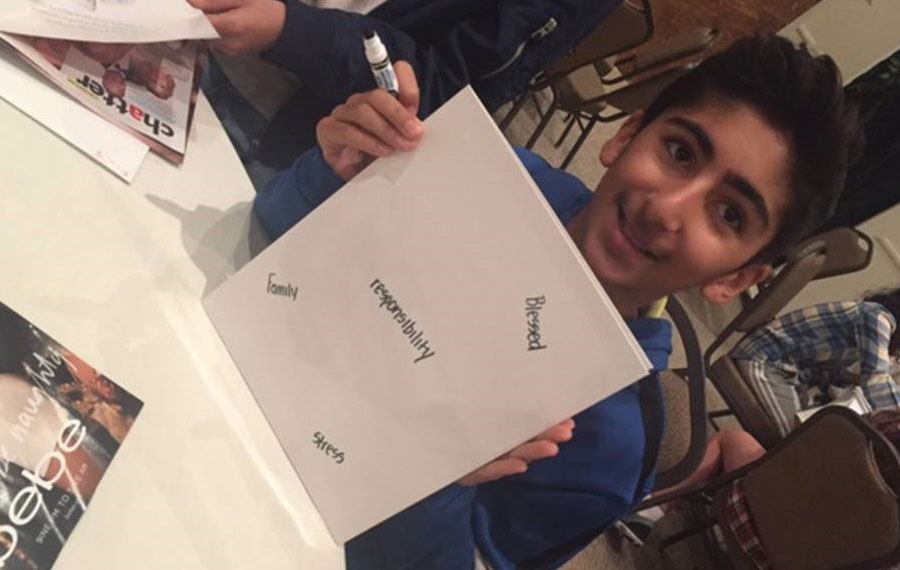
One of the highlights of the program is a six-part podcast Moving Traditions has produced for families. In weekly sessions, teens broach a range of topics with clergy, educators and parents about varied pressures surrounding the b’nai mitzvah process. Parents often are present to engage in free-flowing, open conversation with their teens; parent-only cohorts also discuss their concerns separate from their kids. 

“The parent cohort is a huge benefit,” said Tessel, whose 12-year-old son, Elliot, will celebrate his bar mitzvah in May 2019. “I’m having conversations with parents that I normally don’t get to talk to. We have spiritual conversations about what it means to raise a teen and what the ceremony means to us.”

That type of praise from parents has become increasingly familiar to Moving Tradition’s Chief of Education Rabbi Daniel Brenner, who held a Los Angeles training for clergy and educators in August to help implement the program at their synagogues. 

“That feedback makes you stop and realize this is something that’s connecting in a way parents really need,” he said. “As pre-teens get older, communication gets more difficult. When the Jewish community can create a framework for dialogue and a space where they can hear each other and have empathy for one another, that’s crucial.”

“The most rewarding part has been learning how to hold conversations with my son about values, what they mean to me and to us,” Tessel said. “We talk about that moment on the bimah. We talk about how getting there isn’t a means to an end. It’s the beginning of your life’s journey of Jewish practice — a journey we’re on together.”

Moving Traditions’ New B’Nai Mitzvah Traditions Read More »

Bolton Tells Reporter That ‘Palestine’ Isn’t A State

John Bolton, President Trump’s national security adviser, declared that “Palestine” is not a state in an exchange with a reporter on Wednesday.

The reporter asked Bolton during a press briefing if it was “productive” for him to refer to “Palestine” as a “so-called state.” Bolton interjected that it was “accurate” to call it that.

“It’s not a state now,” Bolton said. “It does not meet the customary international law test of statehood. It doesn’t control defined boundaries. It doesn’t fulfill the normal functions of government.”

Bolton added, “It could become a state, as the president said, but that requires diplomatic negotiations with Israel and others. So calling it the ‘so-called State of Palestine’ defines exactly what it has been, a position the United States government has pursued uniformly since 1988 when the Palestinian Authority declared itself as the State of Palestine.”

Bolton also noted that both Republican and Democrat administrations have been against the United Nations recognizing “Palestine” as a state.

https://twitter.com/DavidRutz/status/1047543350277103617

Additionally, Bolton stated that Iran has “pursued a policy of hostility toward the United States:

Bolton Tells Reporter That ‘Palestine’ Isn’t A State Read More »