fbpx

October 3, 2018

Bari Weiss Likens Her Work to Smashing Idols

Hours after Christine Blasey Ford’s and Judge Brett Kavanaugh’s testimonies before the Senate Judiciary Committee transfixed the nation, New York Times op-ed writer Bari Weiss told a Sinai Temple audience she could personally relate to the political divisions roiling the United States.

“I’m the daughter of a Trump-curious man who was forbidden from voting for him because my mom withheld sex,” Weiss said, eliciting laughter from the approximately 100 people in attendance.

Weiss appeared on Sept. 27 for a discussion with Sinai Temple’s Max Webb Senior Rabbi David Wolpe. During their hour-long conversation, the journalist and the rabbi discussed Ford’s allegations of Kavanaugh’s sexual assault, President Trump’s impact on the nation’s discourse, anti-Semitism in the U.S. and abroad, and how Weiss, 34, became an opinion writer at one of the nation’s most prominent newspapers.

Wolpe said he saw people’s reactions to Kavanaugh’s and Ford’s testimonies as evidence of how polarized the country has become. “I don’t know of anyone on the right who was convinced by her testimony, and anyone on the left who was convinced by his,” Wolpe said. “Everybody was reinforced by what they went in for.”

Weiss had a slightly different perspective: “I was struck by the fact that a lot of people I talked to actually said they were sympathetic in both directions.”

Weiss has been an op-ed writer and editor at The New York Times since joining the newspaper in 2017. Prior to that, she was an op-ed and book review editor at The Wall Street Journal. She also worked at the Jewish online magazine Tablet. Her opinion pieces at The New York Times have included one headlined “When Progressives Embrace Hate,” in which she denounced anti-Israel activist Linda Sarsour.

Transitioning last year from The Wall Street Journal to The New York Times, she said she went “from being the most left-wing person at a conservative editorial page to one of the most conservative people at a liberal editorial page.” 

Weiss’ politics are not easy to pinpoint. Though she has won conservative readers for her willingness to criticize left-wing progressives and for her support of Israel, she is no fan of the president. 

When Wolpe asked: “I don’t think there is a figure in my lifetime that has garnered anything like the kind of attention [Trump] has — why?” 

Weiss responded: “Because — and I’m sorry to the Trumpers in the room — it is absolutely shocking this man is the most powerful man in the world.” 

Weiss, who was raised in Pittsburgh and attended Columbia University, did not always envision herself becoming a journalist.

“I’m not someone who from a young age imagined myself being a writer, or had dreams of being a novelist, or anything like that, but I was always very driven by ideas and by values, and that is the reason I got into journalism,” she said.

“I am used to being politically homeless, which I think is a very, very Jewish position.”

She said she found her voice at Columbia University. She entered college identifying with the political left but revised her thinking after experiencing Israel bias among those who also considered themselves in the left wing.

“All of a sudden the progressive Zionism I thought was normal and standard … I was told [that] to be a Zionist is to be a racist,” she said.

Weiss, who had once thought of pursuing a career in the rabbinate, likened her columns to sermons. “They’re just called op-eds,” she said. 

Weiss and Wolpe also addressed contemporary challenges facing the Jewish people.

Weiss said Jewish life in Europe was “dead or dying.”

“I don’t know a Jew in France that doesn’t have an apartment in Tel Aviv or Ramat Gan or Jerusalem,” Weiss said, adding there is a need to take anti-Semitism in America seriously, “both on the far right and the far left.”

“On the far right it’s very easy to see, I think. It is often more dramatic. It is people marching with tiki torches in Charlottesville [Va.] saying, ‘The Jews will not replace us,’ ” she explained. “… On the left, it is a bit harder because, frankly, it is people we are friends with. It is people in our communities and it is people who are trying to convince us that, because they are cloaking it in the language of anti-Zionism, it is not as threatening.”

Weiss said she believes Judaism and journalism share a commitment to the truth. She pointed to the biblical story of Abraham smashing idols before starting the world’s first monotheistic religion as a metaphor applicable to her career.

“The smashing of the idols is smashing the cultural mores of the time to tell a deeper truth about the world,” Weiss said.

And throughout her career, Weiss said, she has experienced the loneliness of “telling the truth as I see it.”

“I am used to being politically homeless, which I think is a very, very Jewish position.”

Bari Weiss Likens Her Work to Smashing Idols Read More »

‘Lost Bread’ and Found Wanderers

Why are Israelis so happy? Why does the United Nation’s World Happiness Report consistently rank Israel above the United States and parts of Europe on the happiness scale? Despite wars, insecurity and economic hardship, Israel, it appears, seems to be a very good place to live. 

I got a little insight into “Israeli happiness” while eating the best French toast I’ve ever had, at Kirsh Bakery and Kitchen in New York City last week. 

Anat and Dan Kirsh took one look at each other 20 years ago in Tel Aviv, where they were employed at Café Basel, she as a waitress and he a bartender, and fell madly in love. They went on to discover that they had other things in common as well — a love of homemade-caliber food and customer service, the restaurant business and New York City. Both diehard Tel Avivites and graduates of virtually every food industry job — from dishwashing to general managers of high-end establishments from one end of Tel Aviv to the other — the pair plotted and planned and worked toward the goal of opening their own place. 

When a friend told them of a vacant carpentry shop in a historic building in Jerusalem, it was love at first site. There, in 2006, Zuni Café was born — a restaurant and 24/7 diner specializing in French and American comfort food, with a nod to Anat and Dan’s mutual obsession with New York and his mother’s European-style baking. Zuni was a huge overnight success, particularly with American ex-pats who stopped by to get a taste of home, but also with local Israelis who became obsessed with, of all things, the French toast. 

Dan took his childhood memories of his mother’s pain perdu — “lost bread” —  made with day-old bread battered and pan-fried in butter, and gave it an upgrade with mascarpone cream and mixed berries. It was an instant hit in the café.

All manner of French toast then made it onto the Zuni menu, including savory options such as lox and crème fraiche, and spinach and cheese topped with a sunnyside-up egg. Next thing you knew, Zuni became just as famous for its French toast as its brasserie-style comfort food and cocktails.

In 2012, with an experienced team in place at Zuni and two young children in tow, the pair decided to pursue their dreams in New York. At first, they considered launching a chain of kiosks specializing in French toast made with their signature milk bread and a variety of toppings, but bigger things were in store for them.  In 2016, they founded Kirsh Bakery & Kitchen, a full-service café and restaurant in the Upper West Side neighborhood they now call their New York home.

“Israel is home, and it always will be.” Anat told me, “but I live in two dimensions — here and Israel. Tel Aviv is my very favorite city in the entire world — the feeling of being home, of belonging. As much as I love New York, there is no place like Tel Aviv.”

The couple brought their two young children to New York to start their business, but they return to Tel Aviv at every opportunity, taking turns managing Zuni and Kirsh. While we talked about the distinctions between Tel Aviv and New York, and the differences and similarities between the palates of Israelis and Americans, Anat told me that her children were studying in Israel. She said her children feel comfortable in Israel and the U.S. because the family has solid friendships and communities in both countries. 

Although they plan to continue living in New York as their restaurant business grows, the Kirshes plan to continue maintaining a home in Israel. This struck me as the key to why Israel ranks so high on the happiness scale: Community — close family ties, the shared experiences of mandatory military service, and strong ties to a shared faith — tends to make the average Israeli feel a sense of belonging that leads to more satisfaction and perhaps a greater sense of security.

While Americans and Europeans often move away from family and the friends they grew up with, Israelis tend to keep in touch with them and live almost communally, where the support of loved ones is an integral part and focal point of their lives. 

At Kirsh Bakery& Kitchen, while I ate my upgraded “lost bread” and traded restaurant stories with Israelis — who, like me, have become ex-pats in another land to seek their fortune — I was filled with gratitude that we live in an age when air travel is affordable and we are able to touch base with our homeland and even straddle the two countries, something our parents weren’t able to do. It’s good to know we come from a land where happiness reigns despite obvious day-to-day struggles and worries. 

 J.R.R. Tolkien wrote a poem with the refrain “All that is gold does not glitter, all those who wander are not lost; The old that is strong does not wither, deep roots are not reached by the frost.” 

I wholeheartedly agree. It won’t take but a bite of Kirsh’s French toast to convince you that those who wander are not all lost.

So, here is its recipe.

If you happen to be in New York City, pick up a loaf of its milk bread to make this. Otherwise, I’d recommend using day-old challah cut into 1 1/2-inch-thick slices. That’s what this Israeli is going to do when she gets back to her kitchen in Uganda, while missing both the U.S. and Israel.

ZUNI CAFÉ MASCARPONE FRENCH TOAST

For the mascarpone cream:
14 ounces heavy cream
1 tablespoon powdered sugar
6 extra-large egg yolks
1/2 cup granulated sugar
2 tablespoons Myers rum (optional)
16 ounces Italian mascarpone cheese

For the French toast:
6 ounces heavy cream
1 extra-large egg
1 tablespoon powdered sugar
8  1 1/2-inch-thick slices of one-day-old milk bread or challah
3 ounces butter, for frying
4 ounces mixed-berry confiture (or chocolate)

To make mascarpone cream, place heavy cream and powdered sugar in a mixing bowl and whip with an electric mixer until stiff peaks form. Set aside in the refrigerator. 

In a double-boiler, place egg yolks, granulated sugar and rum. Whisk for 5 minutes without stopping, or until you have a light-yellow, fluffy foam consistency. 

Take egg mixture off the heat and fold in half the mascarpone cheese. Once incorporated, gently fold in the other half without overmixing. Do the same with the whipped cream from the refrigerator, folding half the whipped cream into the cheese mixture and then gently folding in the other half until fully combined. Refrigerate until ready to use.

To prepare the batter for the toast, whisk together heavy cream, egg and sugar. Place the bread slices into the batter one at a time, soaking each slice for 3 minutes while turning over in the batter until bread is soaked through. Continue with remaining slices.

Melt butter on low flame and pan-fry slices for 6 to 8 minutes each, constantly turning from side to side until each is cooked through and golden brown. Place slices on paper to soak up excess fat before serving.

Serve sprinkled with powdered sugar, chilled mascarpone cream and berry confiture. Serves 4.


Yamit Behar Wood, an Israeli-American food and travel writer, is the executive chef at the U.S. Embassy in Kampala, Uganda, and founder of the New York Kitchen Catering Co.

‘Lost Bread’ and Found Wanderers Read More »

Table For Five: Bereshit

Weekly Parsha: One verse, five voices. Edited by Salvador Litvak, Accidental Talmudist

The Lord turned to Abel and to his offering. But to Cain and to his offering He did not turn. — Genesis 4:4

Tova Hartman
Dean of Humanities, Ono Academic College

Does life have to be a zero-sum game? It is hard to understand why God could not accept two different types of offerings — both Cain’s “from the fruit of the soil” and Abel’s “choicest of the firstlings of his flock.” Various commentators, uncomfortable with God’s acceptance of Abel’s sacrifice at the expense of Cain’s, have wrestled with this issue, and have exaggerated the disparity between the two offerings as they tried to justify God’s behavior. On the face of it, the text does not suggest any animosity between the brothers with their different ways of life, and each brother seems to offer sincere gratitude to God in his own way. Why, in the face of difference, does God have to reject one? 

Unfortunately, this is only the first of aggrieved pairs that permeate Genesis. Two siblings cannot be equally loved and accepted. The love of one is at the expense of the rejection of the other: Isaac and Ishmael; Esau and Jacob; Rachel and Leah; the sons of Rachel (Joseph and Benjamin) and the sons of the other wives. Esau explicitly resists this world-view, declaiming to his father (Genesis 27:38), “Have you but one blessing, Father? Bless me too, Father!”—but in response, his father can only weep, making him subservient to his younger brother. 

Must all pairs be tragic? Is life really a zero-sum game? I cannot fathom why the God of Genesis patterns this tragic world of relationships, where being loved means someone else is rejected.


Rabbi Chanan (Antony) Gordon
Motivational speaker

We all know the basic facts from the Torah: Cain’s offering was from the poorest of his produce while Abel’s was the choicest of his flock. God embraces Abel’s offering, but not Cain’s. The trouble begins with, and our “teachable moment” is, Cain’s reaction when he sees Abel’s offering accepted by God while his is rejected. This is the moment that led to the first homicide. 

The Torah is not a history book. Rather it is an instruction for living couched in a narrative that we mere mortals can appreciate. Seen in this light, before pointing fingers at Cain’s reaction, perhaps it is more meaningful to ponder a question that may serve as a lifetime of instruction for us, i.e., how do we conduct ourselves when we are dissatisfied with our situation? 

When we feel rejected, rather than find fault with our own behavior, it is far easier to shift the blame to someone else. In the case at hand, Cain blamed his brother for supposedly copying his idea of making an offering to God, and murder followed.

It takes courage to acknowledge that more often than not, the person we need to face is the reflection in the mirror. As long as we seek to blame others for our own frustrations, we will never change. That is a true tragedy since the only person we can ever change is ourselves. 


Rabbi Aryeh Markman
Executive Director, Aish LA

Winston Churchill once said, “Success has been defined as the ability to go from failure to failure without losing enthusiasm.” Torah teaches that man is fallible and God gave us the gift of renewal to become even greater than before the fall from grace. 

Cain missed the opportunity of rectifying his rejected offering and instead, in a jealous rage, murdered Abel. The Ramban, the great 14th-century commentator, writes if Cain had realized his mistake with his mediocre gift to God, and repented, he would have added an exaltedness even beyond that of Abel. If only Cain would have repented! God was waiting. On the flipside, if Cain didn’t remedy his mistake, it would eventually destroy him. 

A mistake that motivates us to make a noticeable improvement in our behavior and arouses us to doing even more mitzvot is beyond laudatory. We have an inborn drive to perfect ourselves by overcoming failure through learning from our past, becoming even greater because of it. 

Life is a series of second chances. While we think it’s natural to give up because we feel all is lost and not retrievable, it’s not what being human is about. We were programmed to make the big comeback, to correct our actions, to purify ourselves. God will answer in kind, and we will become the magnificent creation we were destined to be. 

Aren’t those the stories we read to our children and the movies and books we entertain ourselves with? Our lives are waiting to be reclaimed.


Rabbi Susan Nanus
Wilshire Boulevard Temple

In a society where people are under so much pressure to perform and fulfill unreasonably high expectations — and depression, anxiety and mental illness are on the rise among high school and college students — the story of Cain and Abel has profound resonance. Whether it’s getting into the “right school,” being hired for the “right job,” or in Cain’s case, offering the “right sacrifice,” rejection has become a cruel and crushing evaluation of a person’s total self-worth. 

The results are disastrous, as the Torah so brilliantly presents. For whatever reason, Cain’s offering is not satisfactory, but instead of accepting God’s decision and reflecting on what went wrong, Cain immediately becomes upset and depressed. God reminds Cain that everything is fixable and that anger and resentment will only make things worse, but if stature and success become our dominant values, we find our lives unbearable when we don’t achieve them. As with Cain, we can become so filled with rage and jealousy that we pick up a gun, a knife or a rock and strike out at others … or sometimes ourselves. 

We all have the potential to become Cain — overwhelmed by insecurity, jealousy, competition and even deep desires for revenge. In the very first parshah, the Torah reveals these seething emotions. The Torah’s answer is a value system where justice and compassion are the currency of wealth; charity and kindness are the symbols of stature; and loving our fellow human and remembering the stranger are the highest signs of success. 


Nina Litvak
AccidentalTalmudist.org

Was Cain’s sacrifice rejected because he didn’t offer his very best to God? Abel offered his fattest sheep, whereas Cain offered produce that was average. However, the Lubavitcher Rebbe, Menachem Mendel Schneer-son, points out that Abel didn’t offer his very best either. He could have offered a cow, which is more valuable than a sheep. And according to one opinion, the produce Cain offered was flaxseed, a very valuable crop. 

Cain chose his very best species, and didn’t worry about the quality of the specimen. Abel didn’t choose his best species, but made sure the specimen was the very best. Each approach seems reasonable, and there was no way to know which was the right way to do it. 

God accepted Abel’s offering, and rejected Cain’s, indicating that He would rather receive the best of a lesser species, than a lesser sample of the best species. Cain could have received the message and resolved to do it differently next time. He didn’t have to take it personally. Unfortunately, Cain let his emotions guide him. It was easier to blame Abel than to take responsibility for his own mistake. Cain’s sin wasn’t giving an inferior sacrifice; it was allowing his hurt feelings to dictate his behavior. 

If Cain had simply brought his next offering the way God wanted it, I suspect God would have been even more pleased with his sacrifice than with Abel’s, because it would have demonstrated humility and growth. Instead, Cain gave in to rage, with tragic results.

Table For Five: Bereshit Read More »

Fly: A Poem

It started last night when a fly flew at my face and I flinched.

I feared.
I forgot. 

I forgot that within that winged creature of the cosmos
lied my familiar.

I forgot myself in a single swat
and suddenly all the stars started buzzing
and I realized that they, too, were my familiars —
my flesh made of theirs.

Blinded by the layers of casino lights,
I couldn’t see the majority of them,
the majority of my own kin,
and I began to wonder if
that hidden part of myself
that forgot itself enough to swat
at its own spirit
had run off somewhere
with those hidden stars —
if that hidden part of myself
had gotten lost in the light. 

And I felt less than whole. 

I felt a fool, fearful of my own features,
a menace to my fellow creatures,
and I shut my eyes and clenched my fists.
I prayed to God to make me disappear, too,
so I might find where those missing parts of myself went.

And just when I was about ready to lose faith
the fly came circling about my skull
and a little voice began to speak from a place

between silence and noise:

“The stars in the sky. … Do you see them in the daylight?”
“I do not,” I said.
“Yet they all remain there in the sky, do they not?”

And suddenly I felt less fractured
and a little less fearful as my mind
turned off and I fell asleep beneath a sky full of stars,
thinking of all the light we cannot see but surely remains;
thinking of all the parts of myself, unknown to me,
that by God, surely still remain,
and shall remain forevermore. 


Hannah Arin is a junior at Pitzer College pursuing a double major in religious studies and philosophy.

Fly: A Poem Read More »

Bluntness, Forgiveness, Better Conversations

A day before Yom Kippur, I asked Yossi Klein Halevi for forgiveness. He graciously granted it, and then we had a conversation about why I made him upset. It was a conversation worth repeating at the end of a holiday season and the beginning of the long slog of a new year.

Halevi is one of my favorite people and writers. I consider his book “Like Dreamers” to be a work of rare quality. But he was not quite happy with my review of his most recent book, “Letters to My Palestinian Neighbor.” He felt it was somewhat testy. And I must admit that he is right. “In the cynical world of politics,” I wrote about Halevi’s spiritual self-portrayal in the book, “such a posture can be a surprise maneuver that catches everyone off guard — or it can be a naïve posture that catches no one.”

He thought that I made him look naïve, and he is not naïve. In fact, there are very few things on which he and I do not agree. So what was the point of the testiness? I gave Halevi an answer that I will now share with you, not because I know it is a good answer but rather because I am still undecided. My answer is basically: Halevi’s tone in the book annoyed me. He says many right things, but his tone is considerate and understanding. Too soft for my taste.

It is worth having a conversation about the tone of articles and the level of understanding needed as one writes about Israelis and Palestinians. Halevi told me, by way of example, that he thought my tone in a story I wrote about Gaza for The New York Times was much too harsh. Indeed, it was. Purposefully so. I wrote that “I feel no need to engage in ingénue mourning” over the death of Gazans who attempt to infiltrate Israel. “Guarding the border was more important than avoiding killing, and guarding the border is what Israel did successfully.”

Do I lose control of my message when I write in a fashion that seems blunt? Does Halevi lose something when he wraps his own message in compassion?

Halevi said such tone might work with Israelis but will not get me to where I want with other important groups of readers, such as liberal American Jews or Palestinians. He believes that it is crucial to reach out to the Palestinians, despite all we know about their national movement. As he told me when I was writing this column, we need “to stretch our capacity for empathy without, crucially, giving up our narrative.”

So, this conversation is not just about tone. It is about sensibility. It is also about differences of culture, about the impact of writings on the readers, about the advantages and disadvantages of detached bluntness versus embracing empathy. It is worth asking: Do I lose control of my message when I write in a fashion that seems blunt? Does Halevi lose something when he wraps his own message in compassion? The answer to both questions is probably yes. The answer to both questions is probably that we need both the softer language and the harsher one in our conversation — certainly in the conversation about the never-ending Israeli-Palestinian conflict.

I have no choice but to admit that Halevi has a much better way of communicating with crowds that I cannot reach. Crowds that will not even listen to me. When my story on Gaza was published, I received more than a few threats, was called a Nazi by dozens of readers, was caricatured as blood-thirsty, and my attitude was described as “barbaric.” Did I convince anybody? It is hard for me to tell. But maybe convincing people that Israel must do what it does in Gaza was not my intention. Maybe my intention was to convince the readers that Israel will keep doing what it does no matter what they think. 

As I already hinted, a lot of it is about temper and about having patience. Halevi seems to still believe that with a message crafted in the right way, he can win over Israel skeptics and possibly even Palestinians (even though some Palestinians responded dismissively). I did not lose hope as much as I lost patience. Do I really need to be more understanding of Palestinians’ sentiments as I argue that recognizing Jerusalem as Israel’s capital is the right move? Do I really want to be more understanding as I speak about the charade of Palestinian “right of return”? Yes, Halevi said. You must do this to be effective. You must do this to re-engage with both Palestinians and most readers of his book — that is, American Jews. 

What’s the bottom line? I admitted that I am not sure. For now, I will make it easy for myself and argue that both gentleness and bluntness are needed. Gentleness — for Halevi for to get the message through. Bluntness — for me to make sure that Halevi’s gentle message isn’t misunderstood.  


Shmuel Rosner is senior political editor. For more analysis of Israeli and international politics, visit Rosner’s Domain at jewishjournal.com/rosnersdomain.

Bluntness, Forgiveness, Better Conversations Read More »

Another Israeli-Palestinian Peace Plan Ready to Clash With Reality

Palestinian President Mahmoud Abbas, also known as Abu Mazen, might hold the world record in reaching agreements with the wrong people at the wrong time. In the mid-1990s, he drafted an agreement for Israeli-Palestinian peace. His counterpart was Israeli Minister Yossi Beilin.

Alas, Abbas was then still under the boot of his boss, Yasser Arafat. He had no power to deliver. As for Beilin: Half a year after the pact’s draft was ready, Beilin and the labour government of which he was a member was ousted and replaced by the first government headed by the Likud’s Benjamin Netanyahu. The Beilin-Abu-Mazen agreement remained on the shelf. 

More than 10 years later, Abbas came close to reaching an agreement with Prime Minister Ehud Olmert. But two reasons prevented the agreement from materializing: First, Abbas never said yes (recently, Olmert attempted to paint this negative response in a more positive light by insisting that Abbas “never said no”). And second, by the time these two reached something close to an understanding, Olmert was no longer relevant. He was a weak prime minister, on his way out. He had no chance of getting the agreement he wanted passed in the Knesset. So, again, what the parties had agreed on remained on the shelf.

At times, Abbas seems to misread the political headwinds. An understanding with Beilin was no more than an intellectual exercise. An understanding with Olmert was no more than an illusion. Last week, on his way to making his annual speech at the United Nations, Abbas had more great meaningless meetings. He met Olmert, now a convicted felon with no political future, in London. He then met with opposition leader Tzipi Livni in New York. And yes, Livni is still a player in Israel’s political arena but is unlikely to have the power to make crucial decisions for Israel under any foreseeable political scenario. 

The two men he must talk to — Netanyahu, and President Donald Trump — did not get the honor. Both signaled that they are ready to sit down and talk. Trump even mentioned a possible “two-state solution.” Netanyahu was smart enough to respond positively to Trump’s unclear message, by reminding observers that a “state” can mean many things. “Everyone defines the term ‘state’ differently,” he said. “I am willing for the Palestinians to have the authority to rule themselves without the authority to harm us,” Netanyahu said on Sept. 26 after meeting with Trump in New York. So he did not rule out the option that such self-rule will be called a state.

What was Abbas’ response to these messages of a relative conciliatory tone? He said that the Palestinians now see the United States “with new eyes.” They don’t consider the U.S. to be a fair mediator for peace. “This administration has reneged on all previous U.S. commitments and undermined the two-state solution,” Abbas said. For Netanyahu’s Israel, Abbas reserved even harsher words, not the words of a leader preparing its people for negotiation and reconciliation.

Twenty-five years after the Oslo Accords — a plan for peace that Israelis and Palestinians drafted on their own in the early 1990s — there is now another plan for peace, one drafted by Americans. Since the beginning of the peace process, whenever the parties seemed to lose their footing and get off track, Americans felt the need to come to the rescue. Plans were drawn during the Bill Clinton years, the George W. Bush years and the Barack Obama years. To the presidents’ credit, their intentions were always good and their plans got neither better nor worse results than the initial plan drafted by Israelis and Palestinians —  that being no results. All sides seem to be much better at planning for peace than at making peace. 

Much like the Palestinians, Israel wants peace on its terms. It wants peace along with Jerusalem. It wants peace without refugees. It wants peace as a Jewish state.

And now there is another plan authored by a team of Americans that Trump assembled to write the “ultimate deal.” And don’t worry: While he still thinks that Israel and Palestine peace is a “real-estate deal”; while he one day preaches for a two-state solution and the next says a one state is also a possibility; while he still believes that “we’re going to make a deal” — his team knows better than all that. The plan is nuanced, it is coherent and it is basically ready to be released. Ready for failure.

It could lead to a Palestinian state. And yet, Netanyahu seems confident that the plan is compatible with the concept of “letting them rule themselves without the ability to harm Israel.” In other words: Ask not will they have a “state” — ask what you mean by a “state.” Call it a “state,” call it a “giraffe” or a “tiara,” Israel does not much care as long as it preserves its ability to defend the border and prevent it from becoming another Palestinian enclave of terrorism such as Gaza. The Palestinians want a flag? They can have a flag. They can have a government, a border, a president, they can make decisions, develop their towns, grow their economy, maintain internal security. They can have a lot more than they have now. All this is in the plan, but for a price the Palestinians don’t seem willing to pay.  

The plan is still under wraps because there are currently no credible buyers. The three-pronged maneuver by Trump’s administration was met with tough resistance. What were Trump’s tools? Using the Arab world to make the deal of the century a regional deal rather than an Israeli-Palestinian deal; using economic sanctions and enticements to make the Palestinians cooperate; shatter some of the orthodoxies that became an obstacle to any progress in all previous peace processes. 

Arab leaders were asked by the Trump administration — senior adviser Jared Kushner, adviser on Israel Jason Greenblatt and their team — to get on board and guarantee support for the plan. They were informed of some of the principles, and some of them responded somewhat positively. But a commitment was not granted. Trump was hoping to pressure the Palestinians, assisted by the Egyptians and Saudis. But these hopes met the reality of a Middle East where commitments are rare, and their fulfilment even rarer. 

The Palestinians were hit in the pocketbook by the administration and then told that they can get a lot more than they lost if only they’d accept certain terms and go back to the negotiating table. 

And of course, the boldest and most visible acts were those aiming to kill a few unrealistic dreams once and for all: Jerusalem was recognized as Israel’s capital, and the United Nations Relief and Works Agency for Palestine Refugees was cut off from funds whose ultimate objective is to perpetuate and exacerbate the problem of Palestinian refugees. 

Abbas responded to all three moves with one powerful sentence: “Jerusalem is not for sale and the Palestinian people’s rights are not up for bargaining.” “Jerusalem” is the battle cry that can deter Arab leaders from jumping on the Trump bandwagon. “For sale” is to clarify that the Palestinians will not let economic hardships or economic incentives divert them from their ultimate goal. “Rights” is to signal that Trump was wrong to boast that Jerusalem and the refugees are now off the table. It might be off Trump’s table, and off Netanyahu’s — but that’s exactly why Abbas sees no point in negotiating with these leaders. That’s exactly why he called for “the convening of an international peace conference based on the relevant U.N. resolutions and the internationally endorsed terms of reference and parameters.” He called for the conference, to hint that, for him, the Trump plan is off the table.


All sides seem to be much better at planning for peace than at making peace. 

Not that Israel is in any rush to sign an accord with the Palestinians. It is not. Much like the Palestinians, Israel wants peace on its terms. It wants peace along with Jerusalem. It wants peace without refugees. It wants peace as a Jewish state. It wants peace that the other side is not willing to grant. 

Yes, Netanyahu knows that one day, somehow, the Palestinian issue will need a remedy. But he does not see this problem as urgent. Not when the neighborhood is preoccupied with Iranian aggressiveness, Russian interventionism, Syrian bloodshed, Islamic radicalism. 

Netanyahu is quite confident about the Trump plan. But he is not overly confident because of two reasons: the erratic nature of the president, and the dynamics of negotiation, if these ever materialize. Trump dislikes failure, and by declaring a deal between Israel and Palestine to be his goal — a goal he still says is likely to be achieved — he put himself in the hands of Abbas and Netanyahu. They can make him fail. They can make him seem like a loser. 

The prime minister is aware of the danger that Trump, because of this commitment that he had made, might fall in love with the idea of peacemaking, and that such emotion proved problematic in past rounds of negotiations (former Secretary of State John Kerry and the Iran deal is recent example). The prime minister also knows that negotiation is something that could lead to many unexpected results: What if his coalition crumbles? What if his only choice is reliance on opposition parties who want him to be more accommodating toward the Palestinians? What if the public suddenly begins to pressure him to give more? What if Israel is diplomatically outmaneuvered? 

Of course, there is no danger of any of this happening as long as Abbas prefers to make deals with imaginary leaders of imaginary states, rather than real leaders of real states. If Abbas’ game is a waiting game — forget about Trump and wait for a more sympathetic U.S. president in 2020; forget about Netanyahu and wait for his legal troubles to take him down — the Israeli prime minister is also in no rush. As his U.N. speech on Sept. 27 showed, the Palestinians are relatively low on his agenda. They are a nuisance, not an existential threat. They are a diversion, not the real Middle East game of power. In fact, a main worry for Israel is the risk that the U.S. will get diverted from these important topics onto playing the game of a futile peace process. 

Netanyahu’s and Abbas’ speeches on Sept. 27 at the U.N. were merely a preseason practice. As is always true in this arena, the next couple of months could be dramatic. Abbas is slated to speak within a few weeks to the leaders of the PLO — his home crowd. This will be his more important speech, where he will present his strategy for the future. If he has a plan featuring truly bold moves, this will when he announces it. 

What can he do? He can go as far as dismantling the Palestinian Authority (PA). That is, cutting off his own nose to punish Israel. In such a case, the burden of having to take care of the Palestinian population in the West Bank will fall on Israel’s shoulders. But Israel’s main worry is not such a move. It’s a much likelier move of cutting all Palestinian Authority funds to Gaza. 

Most observers of the Abbas U.N. speech — not many Americans were watching, as most viewers were riveted by the Christine Blasey Ford-Brett Kavanaugh hearing on Capitol Hill — focused on his denunciation of Trump, his denigration of Israel’s nation-state law (a law that Netanyahu brilliantly defended), his insistence on the need to reverse the U.S. policy on Jerusalem. The Palestinians themselves focused no less attention on Abbas’ impatient message to the leaders of Hamas. 

“We made a deal,” Abbas said at the U.N. “The Palestinian government assumes its responsibilities in Gaza as it has in the West Bank. Then we build our state on the basis of one law, one authority, one system and one legitimate weapon. We do not accept a state of militias.”

The deal — unfortunately — has one unresolved problem. Hamas, in the words of Abbas, “did not agree to implement it.” In other words: Hamas would not let Abbas control Gaza. In fact, as part of the ongoing strife between these two Palestinian factions, Hamas parliamentarians convened in Gaza two weeks ago and declared that Abbas’ presidency is unlawful.

Gaza is a bomb to which Abbas holds one safety latch. Almost every day, thousands of Gazans engage in violent demonstrations near the Erez crossing to Israel. The economic situation has again reached a low, stoking rage among the residents of the strip — rage against Israel, against Hamas, against the PA. Abbas can turn this rage into a weapon by deciding to cut $96 million that the PA sends to Gaza each month. He can turn this rage into a weapon that is most likely to fire the opening shot in another Israel-Gaza war.

Twenty-five years after the Oslo Accords — the anniversary was just two weeks ago — it is not easy to remember that Gaza is where it all started. I was there the day Arafat crossed the border to take over the territory — and then when he moved to Jericho, his second stop. 

In Gaza, the history of the peace process easily can be condensed. Step one: euphoria and the beginning of a Palestinian rule. Step two: violence and terror. Step three: an Israeli pullout. Step four: Hamas take over. Step five: continuous eruptions of violence. All this, in twenty-five years. All this, with only a fraction of time when the situation looked hopeful.

The Palestinians got their first chance at making Gaza a better place and ruined it in an Intifada. They then got a second chance, when Israel left, and turned to internal violence. Then Hamas got a chance. It had the territory all to itself, and decided to use it as a launching pad for war against Israel. And now Abbas wants it back.

The likely result: another war. We seem to always be ready for that.


Shmuel Rosner is senior political editor. For more analysis of Israeli and international politics, visit Rosner’s Domain.

Another Israeli-Palestinian Peace Plan Ready to Clash With Reality Read More »

24-Year-Old Jewish Man Murdered in Chicago on Simchat Torah

Eliyahu Moscowitz, a 24-year-old Jewish man who was a mashgiach (kosher supervisor) at a Jewel-Osco supermarket in Chicago, was murdered on Monday night, Simchat Torah.

Moscowitz, who was from a well-known Chabad family in Chicago, was taking a walk at around 10:20 pm along Loyola Park’s bike path in the Rogers Park neighborhood when a masked gunman fatally shot him once in the head.

A day earlier, 73-year-old Douglass Watts was also fatally shot in the head while walking his dogs in the same neighborhood. The shell casing found at the scene matched the shell casing at Moscowitz’s murder, leading police to believe that it was the same gunman in both cases.

Moscowitz and Watts don’t appear to have known each other and nothing was taken from them. Because Moscowitz was Jewish and Watts was gay, a hate crime has not been ruled out.

“To all the residents of the Rogers Park community, your city is standing with you, supporting you, at this moment,” Chicago Mayor Rahm Emanuel said at a press conference. “I know firsthand the Rogers Park community is strong, is resilient and is a supportive community. We need those core values and the Police Department needs those core values at this time.”

However, Rogers Park residents are in a state of fear after the shootings.

“When you walk around the neighborhood over the last couple of days, everyone seems on edge,” Grace Hussar, a 34-year-old resident, told the Chicago Tribune. “No one is lingering. There’s like this air of panic because nobody knows who did it.”

The police will be holding a meeting on Wednesday to update the residents on the investigations.

Surveillance footage from Watts’ murder shows the alleged gunman with a scarf and hat covering his face. Police are suggesting that anyone with information on the alleged gunman go to www.cpdtip.com or call 312-744-8200.

24-Year-Old Jewish Man Murdered in Chicago on Simchat Torah Read More »

For Rifka Lebowitz, Money Is Her Mitzvah

As a child, Rifka Lebowitz’s answer to the question, “What do you want to be when you grow up?” was vastly different than those of her eight siblings, who expressed, among other things, desires to be a lawyer or a mom: “I always knew I wanted to help people with their money,” she said.

It would be many more years before she would arrive at her current career as a financial consultant.

When she was 15 years old, Lebowitz was an avid reader of the Financial Times but had to wait until she was 18 to legally buy company stocks for the first time. Her parents, who had moved their family from Glasgow, Scotland, to Jerusalem’s ultra-Orthodox neighborhood of Har Nof when she was 8, were opposed to her studying for a degree because it would be in a co-ed environment. So, Lebowitz ended up taking a course in portfolio management at Bar Ilan University, in which, ironically, only men had enrolled. 

Years later, when she was a mother of two and pregnant with her third child, Lebowitz earned a bachelor’s degree in business and finance. The stories she recounts from her years in the banking industry are the stuff of sexist legends. She had already been employed at a national bank for a number of years as a licensed investment adviser when she was tasked with training a junior employee for his own license. That employee was subsequently promoted to branch signatory — a prestigious position in the Israeli banking world. Furious, Lebowitz demanded to know why she was overlooked in favor of her trainee. “The branch manager said to me, ‘Oh, you’re female. You do not want this promotion. You want to be with the kids in the kitchen.’”

“It genuinely hurts me when I see people struggling financially. I’m like, ‘Come on, let’s figure this out together.’ ” — Rifka Lebowitz

That exchange and a plethora of Kafkaesque experiences that unfortunately are ubiquitous in the Israeli banking world prompted Lebowitz to author a book for people making aliyah, called “Smarter Israeli Banking.” Published in 2017, the book was hailed as a banking bible, and this past summer Nefesh B’Nefesh, the nonprofit that assists people in making aliyah, gave copies of the book to 1,000 new immigrants upon their arrival in Israel.   

Lebowitz maintains that, financially speaking, life in Israel is better today than ever before. Hackneyed jokes like “How do you make a small fortune in Israel? By coming here with a large one,” don’t elicit so much as a smirk from Lebowitz.

Such notions may have been true in the recession years of the 1980s and even the 1990s, but the same cannot be said in 2018. “You look around and people are driving better cars, the malls are full, and the airport is always packed with Israelis going away [on vacation],” she said. While people may complain of constantly being in overdraft, their expectations from life are far higher than in the past.

Lebowitz helps people hone in on what those expectations are and how they can achieve them — without breaking the bank. Her Facebook group, “Living Financially Smarter in Israel,” has more than 24,500 members and has had a major impact on the lives of the Anglo community.

“It genuinely hurts me when I see people struggling financially. I’m like, ‘Come on, let’s figure this out together,’” she said.

Her theory is that as long as people have the right knowledge and abilities and there aren’t any extenuating circumstances such as illness, there is no impediment to being in control of their financial destinies. She says many of her clients are stuck simply because they lack the confidence to change their situation but once they shift their mindset, the money invariably follows. 

“People think I sit on people’s budgets and tell them not to buy coffee every day but that’s really not the focus,” she said. “The focus is a much broader understanding of, and a healthier attitude toward money and an understanding of what sort of life they want to lead and how they can get there.”

For Rifka Lebowitz, Money Is Her Mitzvah Read More »

When Literary Heroes Are Anti-Semites

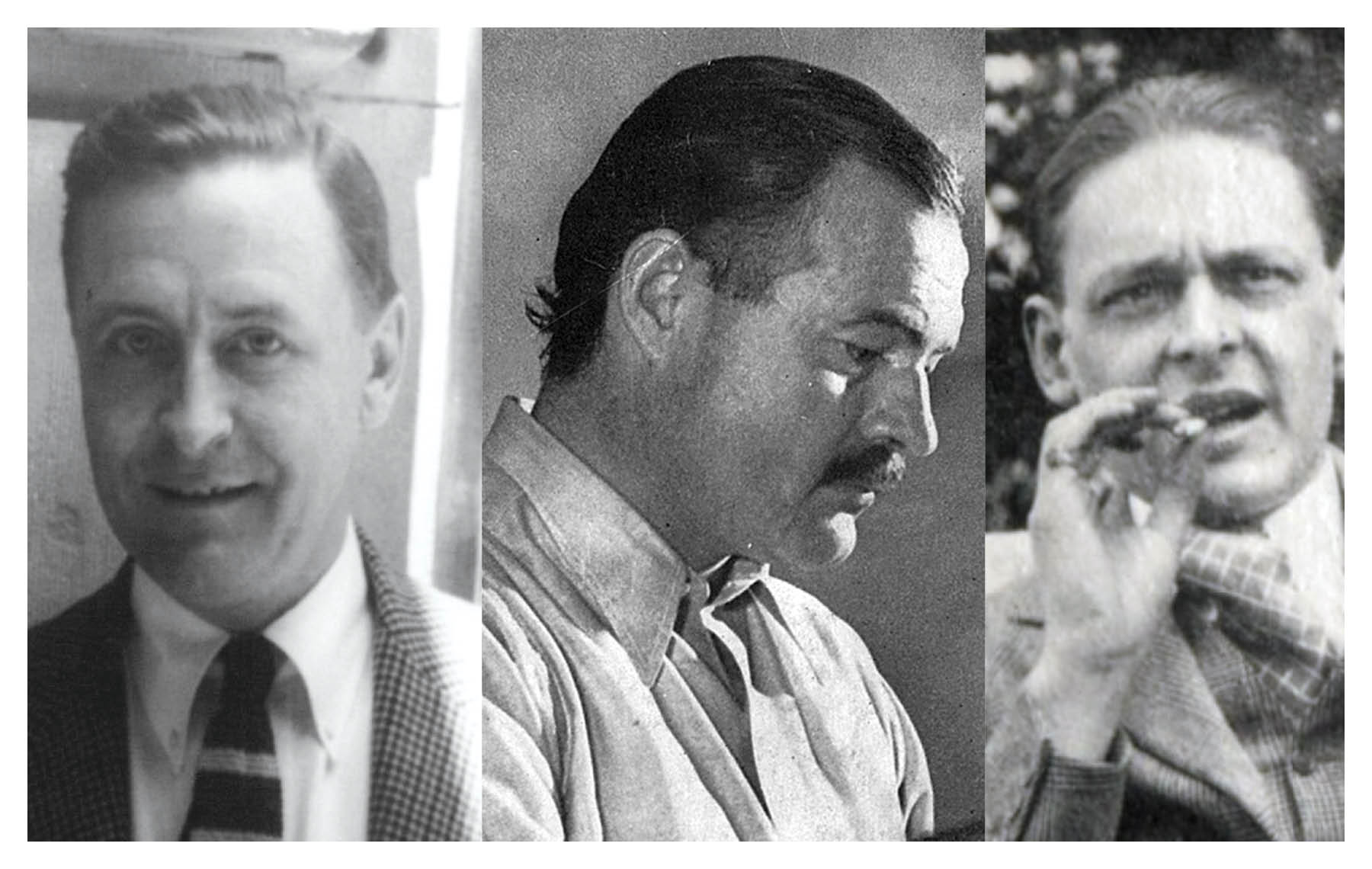
F. Scott Fitzgerald, Ernest Hemingway and T.S. Eliot

In the middle of Hannah Gadsby’s provocative new Netflix stand-up comedy special, she launches into a diatribe against Pablo Picasso. To be clear: She really hates him. Not for his early figurative work, his temporary overreliance on the color blue or even his unapologetic appropriation of African art. No, she despises him because he treated women badly. Which he did. No argument there. But what Gadsby, who has a background in art history, argues is that her target’s considerable and universally acknowledged artistic accomplishments are entirely — not partially, mind you, but entirely — vitiated by what she takes to be his misogyny. The implication being that we should immediately rip down our Picassos and deposit them in the trash. 

This got me thinking about a problem I’ve had since I was 18 and read “The Great Gatsby” for the first time. I was luxuriating in Fitzgerald’s prose, in thrall to his storytelling ability, understanding as if for the first time what bracing heights the English language was capable of scaling, when the character of Meyer Wolfsheim slithered on to the page and a queasy feeling overcame me.

Wolfsheim was grotesque and Jewish. This was not good. Would a more appealing Jew soon appear to take some of the stink off Wolfsheim and let me get back to enjoying the novel? Perhaps the Buchanans would have a tennis date with the Feldmans from nearby Great Neck, Long Island. But the Feldmans never showed up. Wolfsheim remained the only Jew in the book and this made me apprehend Fitzgerald in a different, more complex way.

The issue soon arose again in Hemingway’s “The Sun Also Rises,” when I encountered the character of Robert Cohn. Although not an oily gangster like Wolfsheim, the Princeton graduate Cohn is whiny, annoying and presented in pointed contrast to the gentile hero.

Soon after, upon discovering poet T.S. Eliot, my head began to hurt. “Burbank With a Baedeker: Bleistein With a Cigar,” anyone? 

The rats are underneath the piles.

The jew is underneath the lot.

Wolfsheim, Cohn & Bleistein: The names scan like a law firm of literary anti-Semitism, created by writers whom the callow version of me hoped to emulate. And it got worse. Whereas the anti-Semitism of Hemingway and Fitzgerald was of the country club variety, and Eliot’s ontological (therefore more dangerous), I soon discovered that French writer Louis-Ferdinand Celine and Nobel Prize-winner Knut Hamsun of Norway not only were virulently anti-Semitic but embraced Nazism. In other words, there was a continuum, a spectrum of aesthetic jew-hating. What to make of the work generated by these flawed authors when the quality is unimpeachable but the creator’s morals of the gutter? 

Would that the problem be confined to literature. Consider painters. Degas, Cezanne, Renoir, 19th-century French masters I was taught in undergraduate art history classes to venerate, turned out to be anti-Dreyfusards. In their era, where a person stood on the Dreyfus case was an indication of their attitude about Jews in general. Emile Zola was a champion. The aforementioned Impressionists were not. Who would have thought that Renoir, painter of rosy-cheeked, Parisian bourgeois life, avatar of sunlight, leisure and beauty harbored hatred for his Jewish countrymen? How can I ever look at another one of his candy-colored canvases? But I do. That I don’t admire him the way I used to has to do with the development of my own taste, not his views of my co-religionists.

Wolfsheim, Cohn & Bleistein: The names scan like a law firm of literary anti-Semitism, created by writers whom the callow version of me hoped to emulate.

Which brings me to Mel Gibson. 

Gibson is appalling. I feel about him the way Gadsby feels about Picasso. This was not always so. I admired “Gallipoli,” “The Road Warrior” and “The Year of Living Dangerously.” Thought “Braveheart” deserved all the love it received. But after Gibson had a few drinks and revealed what he really felt about Jews (To refresh your memory: “The Jews are responsible for all the wars in the world”)  — that was it for Mel and me.

Then there’s Leni Riefenstahl, an actual Nazi. I can watch her films and appreciate their artistry, but that is probably because while watching her films, I’m not looking at her smug Aryan face. Also, she’s dead. How can I watch the films of Hitler’s pal, but not those of Mel Gibson? The “Breathing the Same Air Theory” posits that once someone is no longer living, the moral opprobrium we heap upon them is allowed to lapse if we so choose. 

My friend Tom recently asked me why is it that we insist our artists be good neighbors. Indeed, the cultural conversation has been reframed in a way that forces us to examine our assumptions about artists we admire. And the verdicts are in: Roman Polanski, done. Kevin Spacey, don’t ask. Louis C.K.? Although the comedian has pockets of support, his attempted comeback has been greeted in mostly withering fashion. Some who have banished these men from their personal queues feel virtuous for taking a stand against the violation of agreed-upon mores; others just feel lingering revulsion. But at what cost? 

When we engage with a work of art, what is it we’re seeking? Insight, transcendence of our day-to-day lives, certainly, but perhaps, most of all, we’re seeking connection to the mind, the heart, the soul of another. This is why we who value artistic achievement revere those who create work that strongly affects us. Engaging with a work of art is to discard the protective carapace and open one’s being to that of the creator (lower-case c) so when we discover something reprehensible — misogyny, violence, anti-Semitism — it not only knocks the artist off the pedestal on which we’ve placed them but causes a sense of betrayal similar to that which can be felt at the hands of a lover. Then we re-assess.

What Polanski did, and what C.K. and Spacey are accused of doing, was reprehensible. But I’ll watch “Chinatown” again, watch C.K.’s comeback with interest, and continue to admire Spacey’s work in “L.A. Confidential” and the first season of “House of Cards.” But what of the anti-Semites? I’m still a fan of “The Sun Also Rises,” although if I had known Hemingway when he lived in Paris, I probably would have wanted to punch him in the nose. Fitzgerald? I re-read “Gatsby” every few years and only esteem it more. My admiration for “Four Quartets” even enables me to rise above Eliot’s anti-Semitism, which verges on the demented, although that didn’t stop him from participating in a fruitful correspondence with Groucho Marx, of whom he was a big fan. 

See, it’s personal. That’s how we relate to a painting, a poem, a movie, a pop song, a novel or an opera — I have to mention opera because it’s impossible to conclude a rumination like this without invoking Nazi avatar Richard Wagner, whose work has been performed by the Israel Philharmonic. Imagine the conversation those musicians had! If we conjure a socio-political prism through which every work of art must be viewed, rather than curators of our experience, we become the commissars of that experience and run the risk of a considerably blander world. 

That said, I can live without seeing “Lethal Weapon” again.


Seth Greenland is the author of five novels, including his most recent, “The Hazards of Good Fortune,” (Europa Editions, 2018). Greenland is also a playwright and screenwriter and has worked as a writer-producer for the Emmy-nominated HBO drama “Big Love.” Born in New York City, he currently lives in Los Angeles. sethgreenland.com 

When Literary Heroes Are Anti-Semites Read More »

Is College Obsolete?

For more than a decade, the question has been raised in blaring headline after blaring headline: Are College Degrees Becoming Obsolete? Given the current enrollment numbers, it doesn’t seem as though American colleges and universities are going to disappear overnight. But consider these two facts: 1) University enrollment has been declining for eight years; 2) Traditional higher education is being challenged by work-training programs that arm students with very specific skills that businesses say they need now. 

This fall, there are an estimated 19.9 million students enrolled in two- and four-year schools. That’s down from the peak enrollment of 21 million in 2010. Higher education institutions need to rethink their role in preparing students for the workforce, according to one respected expert in the field. 

“There’s a rising demand for talent, and colleges and universities are a major engine of talent. I continue to argue that they will be for the foreseeable future, but their position is much more precarious than it was a few years ago,” said Jamie Merisotis, the president and CEO of the Lumina Foundation, whose mission is to make post-high school learning opportunities available to all.

“What we’ve seen is an ecosystem emerging here of post-secondary learning where colleges and universities are a key element, but not the sole element. Workplace-based learning, direct-to-consumer programs, etc., all of those things are sort of part of this emerging ecosystem,” he said. 

“In this knowledge-based economy, working and learning have to be tightly connected.” — Jamie Merisotis

So how is higher education going to position itself as relevant in this new universe? “The system has to respond to that,” Merisotis said, “or else we will create an entirely new system that largely leaves higher education in the dust, and that would be bad.” He believes that because of its origins, higher education continues to see itself as largely a “temporal” entity — first you go to college, then you go to work.

“But what we now know — and WorkingNation has been really, really good at pointing out — is that in this knowledge-based economy, working and learning have to be tightly connected. By and large, the system of higher education still sees itself as educating and then somebody else is dealing with the rest of it. And that’s deeply problematic from the consumer perspective.” 

Merisotis added, “What the consumer wants to know is, do I know more than I did before? Do I have a credential that demonstrates that I know more because that’s what I need in order for my employer or my future employers to be able to recognize that so that I can advance personally? And I think higher education is increasingly going to run into headwinds if it’s not careful.”

Merisotis is not a fan of the phrase “lifelong learning,” but he believes that what you learn at work allows you to learn new things outside of work. “Lifelong learning to me is a concept that works really well for educators, but it doesn’t work really well for anybody else. That doesn’t sound very attractive to people, like, ‘Oh, my God. I’ve got to learn my whole life?’ My visual is, it’s like a rachet. You keep ratcheting up. You’re working and you’re learning. By learning more, you get to work in a different way.”

Merisotis believes the decline in enrollment in higher education can be attributed partly to the increased training options out there. Another pressure is soaring tuitions.

“The price is unsupportable for a growing proportion of the population. The indicators of the price pressures are things like very high debt levels, and the shift of students, particularly higher-income students, from private institutions to public universities,” he said. “There’s a sort of broader market effect that you can see of people saying, ‘Is this really worth it?’ ”

Given that businesses of all industries — from health care to data analysis to cybersecurity — claim they can’t find enough skilled workers to fill their open jobs, and that there are low and moderately priced training options available, more and more families are likely to be asking themselves that very question.


Ramona Schindelheim is the senior business correspondent and executive producer for WorkingNation, reporting on jobs, the future of work, and innovations and solutions for filling the skills gap.

Is College Obsolete? Read More »