fbpx

September 26, 2018

Love for My Daughter vs. Fear of Yoga

The website for “Home for the Weekend — a yoga retreat in Idyllwild taking place in early November — could not be more charming. Soft-focus photos of a lovely log cabin (with rocking chairs on the porch!) trade places with pictures of gently flexible young women in yoga poses, a campy Idyllwild road sign and the majestic San Jacinto Mountains.

The reassuring copy of the website echoes the holistic vibe of the visuals. Participants are promised an experience that will return them home to themselves. There are hiking trails. One can gaze at the stars. There will be breath work and meditation. And, of course, there are the two yoga sessions per day, led by a trio of certified young yogis — Erin Ward, Leah Schlackman and Emma Goldman. No grungy hippie hangout, “Home for the Weekend” is upscale enough to provide catering provided by Honey Hi, the pre-eminent sustainable food eatery in Echo Park.

What Jewish woman could resist the prospect of returning home to herself after the monthlong rampage of holidays beginning with Rosh Hashanah and ending with Simchat Torah? 

And so I signed up. 

I enjoyed approximately five hours of happy anticipation only to find myself beset by galloping anxiety, my mind working overtime. What was I thinking? Me? An overly analytical New Yorker stuck in a high-altitude area with a cohort of cosmic (and skinny) Los Angeles millennials? 

After the initial glow of imagining myself sleeping a log cabin came the dread: What about the daytime? I would have to wear yoga pants in public, twist my body into painful contortions and eat overly virtuous food!

Would there be booze? Would there be anyone my age? Should I shlep a stash of coffee from Zabar’s? Where was the nearest hospital?

And that is how I found myself, during the week between Rosh Hashanah and Yom Kippur, sitting in a downtown Manhattan yoga studio known, minimalistically, as The Studio, wooden blocks beneath my butt, straps bound around my hips, shoulders thrust back. My daughter Emma — yes, the same one running the Idyllwild retreat with her pals Erin and Leah — trusses my upper arms behind my back, tight and yet tighter. Sitting in front of me, Abbie Galvin, a master restorative yoga instructor, nods her approval. As Emma pulls the straps, I envision myself as a carved figurehead on a ship from days of yore, chest defiantly greeting the wind, hair streaming behind me, sailing fearlessly into the future.

“Would there be booze at the yoga retreat? Should I shlep a stash of coffee from Zabar’s?

“So good!” exclaims Abbie, watching my face intently. “Look how you open up! How does that feel?”

Feel is exactly the right word. Since I entered Abbie’s realm, my hyperactive mind has put itself on snooze mode and I am awash with feeling. New feeling. Something profound has shifted within me. Though my limbs have been rearranged — and held in place — I feel comfortable and calm. Both lungs work in concert, drawing in air competently and evenly; a team effort. My shoulders relax, relieved of a great burden. A long-ago feeling of security blankets me.  

“Fantastic,” I report, with a smile. “I feel great.”

The private restorative yoga session with Abbie was an early birthday gift from Emma, who has studied with Abbie for years and intends to incorporate her restorative practice into “Home for the Weekend.” Noting my reaction to her upcoming retreat, Emma decided to take matters into her own hands and enlist Abbie.

The rest of the hour flows like warm honey. Abbie reads my body and posture, interpreting, gently correcting, guiding. Emma assists, lifting my hips, adjusting my shoulders, fixing the angle of my chin. 

“Wait a second,” I say to Emma as we bound down the stairs at the end of the hour. “This is yoga?”

“Yep,” says my yogafabulous daughter, my teacher, beaming with pride and happiness at my enthusiastic embrace of her practice. We walk together down the Bowery, Great Jones Street and West Fourth Street chattering.

“Feel less nervous?” Emma asks me as we enter Think Coffee. “Yes!” I sing out. She looks at me intently. “You know, you can take another private session with Abbie if you freak out anytime between now and November.”


Shira Dicker is a writer-at-large and publicist captivated by contemporary culture.

Love for My Daughter vs. Fear of Yoga Read More »
Jewish Revisionist ‘Merchant of Venice’

Regarded as one of William Shakespeare’s greatest plays, “The Merchant of Venice” has also been a painful thorn in Jewish sides, its antagonist Shylock epitomizing the stereotype of the miserly Jew and perpetuating anti-Semitism for more than 400 years. 

Sarah B. Mantell’s new play “Everything That Never Happened,” a world premiere production at the Boston Court Pasadena, seeks to right the wrongs Shakespeare wrought. 

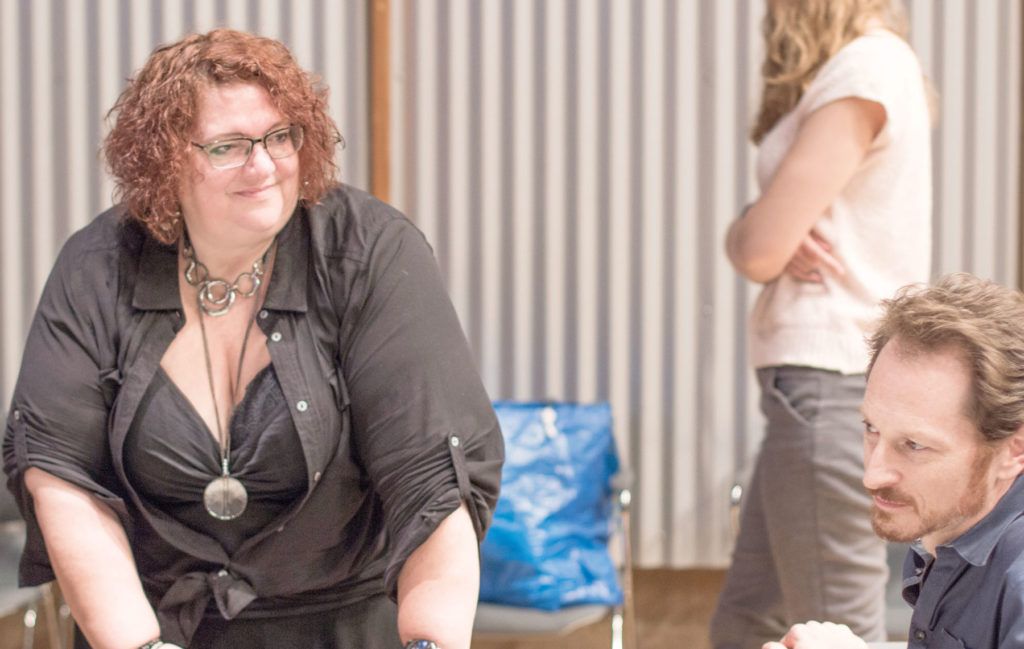
Focusing on four “Merchant” characters: Shylock, his daughter Jessica, her lover Lorenzo and the servant Gobbo, the play “treats them as if they were real, three-dimensional human beings, not stereotypes,” director Jessica Kubzansky told the Journal during a break in rehearsal. “What I love about this play is that the characters [are] real people, with rich, complex desires.”

A self-described “Shakespeare freak,” Kubzansky loves the Bard and has often directed his plays. “I worked on ‘The Merchant of Venice’ a few times in a workshop, struggling how to make it make sense for me as a Jewish person, as a human, as a woman. There’s plenty of misogyny as well as anti-Semitism in the play,” she said. “Every time, I bumped up against things that I couldn’t reconcile, so I said no. But this play is richly beautiful and complex and full of love, and that’s redemption from the Shakespeare [that] was just about punishing and
stereotypes.”

Kubzansky compared the revisionist characters to those in the original. In “Merchant,” “Shylock is a vengeance-focused Jew with no human quality. In this play, he’s a beautifully human man with passion and pain and vulnerability,” she said.

Shakespeare’s Jessica “hates her father, she spends money profligately, she uncaringly climbs out the window and goes away with Lorenzo. She has no difficulty with the choices she made,” Kubzansky continued. “In this play, she loves her father and is very aware of the cost of leaving your religion and culture” to marry a Christian man. “It’s complicated and painful.”

This resonated with Kubzansky, because her sister married out of the Jewish faith, much to the dismay of their parents. “It was a big, hairy deal in my family. It’s all resolved but there was a time when it was very, very difficult,” she said.

“This play is richly beautiful and complex and full of love, and that’s redemption from the Shakespeare [that] was just about punishing and stereotypes.” — Jessica Kubzansky

Shylock is portrayed by Leo Marks, who has a Jewish father but wasn’t raised in the faith. He said he’s been thinking more about his Ashkenazi heritage as a result of doing the play. “I’ve been reading this great book called ‘Shakespeare and the Jews.’ ”

Marks said “The Merchant of Venice” “has a lot to answer for, and [“Everything That Never Happened”] takes it to task in a really smart, fierce but also funny, deeply human, thoughtful way,” he said. 

“This play imagines Shylock as a deeply loving father. He’s making his way in a world that’s not easy for him and he’s faced with really tough choices,” Marks said. “He’s not this otherworldly creature who wants revenge. He’s humanized. [Mantell] is saying, ‘Why do we accept these stories about Jews and let them define us? Why not tell our own stories?’ And that’s what we’re trying to do.”

Kubzansky called the play “as poetic as Shakespeare in its own way. It’s really funny, until we punch you in the gut.” 

She imagines that if Shakespeare did a rewrite today, “he’d write it like this. He was a product of his time and he was writing to the stereotypes. This play completely reframes the story, and shows how beautiful, funny and painful it is to
be human.”


“Everything That Never Happened” runs through Nov. 4 at the Boston Court Pasadena.

Jewish Revisionist ‘Merchant of Venice’ Read More »

Heart and Humor in Neil Simon’s ‘Broadway Bound’

The West Coast Jewish Theatre honors the legacy of the late playwright Neil Simon with its latest production of “Broadway Bound.” 

Set in Brighton Beach, Brooklyn, in 1949, the comedy focuses on brothers Eugene and Stanley Jerome, aspiring comedy writers who live at home with their unhappily married parents and staunch socialist grandpa. The third play in Simon’s “Eugene Trilogy” after “Brighton Beach Memoirs” and “Biloxi Blues,” it’s the most autobiographical of Simon’s works.

“It’s the one that was closest to his heart,” WCJT Artistic Director Howard Teichman, said after the opening-night performance. A self-described “huge fan” who has previously directed six of Simon’s plays including “Lost in Yonkers,” “The Sunshine Boys” and “The Prisoner of Second Avenue,” he’d already begun rehearsals before Simon’s death on Aug. 26. 

“It affected us deeply. We were so shocked, though we knew that he wasn’t well,” Teichman said. “We all made a commitment to honor his memory by working even harder in this. [He] is the greatest American playwright. Being a Jewish theater, he is our writer, the writer of our souls.”

“I think it gave us a responsibility to stick to the script and tell the story the way he intended — to honor him and his wonderful story,” Josh Reiter, who plays Eugene, said. 

“[Neil Simon] is the greatest American playwright. Being a Jewish theater, he is our writer, the writer of our souls.”
— Howard Teichman

For Reiter, whose credits include Simon’s “The Star-Spangled Girl,” this role is a dream come true. “It’s really fun to play Eugene and respond to all the craziness around me and break the fourth wall to speak to the audience,” he said. 

A native of a Virginia suburb of Washington, D.C., Reiter had been in Los Angeles only for three weeks when he was cast. He quickly developed a brotherly bond with Matthew Nye, who plays Stanley.

“The first time I saw him, I grabbed him and gave him a noogie,” Nye said. “I am that character. I’m a young Jewish comedy writer. I grew up in a one-bedroom apartment with my dad. We were basically ‘The Odd Couple,’ ” he said.

“The thing that resonated most with me was Eugene’s relationship with his mother. It reminds me of my relationship with my mother,” Reiter said, mentioning a touching scene that includes a lovely foxtrot. “It’s one of those times when
you get to connect and learn something new about someone you’ve known your whole life.”

Raised in a “Conservative-leaning-toward Reform” Jewish home, Reiter became less involved with Judaism in high school but while in college, found his way back to it and his Jewish identity. He’s now “looking at different synagogues. I’m on the hunt,” he said. “This theater and the people I’ve met here have given me a great start.”

Nye was raised in Hollywood, Fla., by parents who were “very proud Jews but even prouder hippies. We didn’t read the Torah much. And religion was never forced upon me. I started to learn about Judaism later,” he said.

Toronto native Teichman came to L.A. in 1979 to attend UCLA, and has been running the WCJT for 10 years. “There’s a big spectrum of what it means to be Jewish, from ultra-Orthodox to ultra-Reform, and as a theater, we try to bring the kind of works that will be relatable for all kinds of Jews and also people who are not Jewish,” he said. “We want to find that universal quality. That’s our mission.”


“Broadway Bound” runs through Oct. 28 at the Miles Memorial Playhouse, 1130 Lincoln Blvd., Santa Monica. (323) 821-2449. wcjt.tix.com.

Heart and Humor in Neil Simon’s ‘Broadway Bound’ Read More »

Healing and Hope After Tragedy in ‘26 Pebbles’

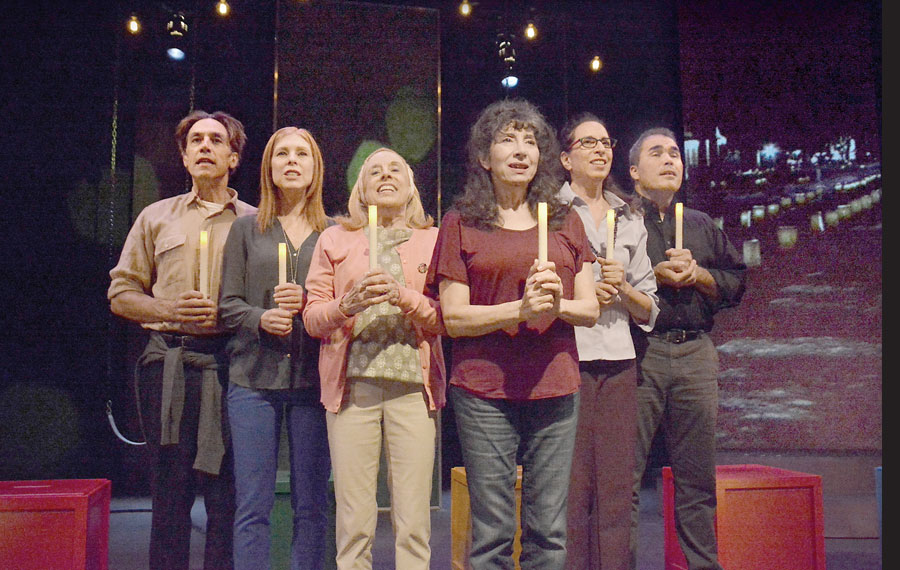
On Dec. 14, 2012, 20-year-old Adam Lanza entered Sandy Hook Elementary School in Newtown, Conn., with a rifle and a handgun and fatally shot and killed 20 children and six adults before killing himself. The story of how the community coped with and came together after this unspeakable tragedy plays out in playwright Eric Ulloa’s “26 Pebbles,” based on actual interviews with Newtown residents. 

Set six months after the massacre, the play unfolds in a classroom with six actors playing multiple roles. The seats are colored blocks and swings, and video projection images set the scenes. The characters’ devastating testimonies illustrate how life in their quiet, lovely New England town was shattered in an instant, and how they slowly came to heal as families and as a community. 

“Eric purposely concentrated on the aftermath — how people dealt with it and healed from it,” director Jules Aaron told the Journal. “It’s ultimately very uplifting, and that’s what drew me to the play.” 

“[The play] reminds me to be more patient and forgiving,” actor George Villas said. Aaron said, “My threshold for understanding and tapping into my compassion is something that these characters have helped me with. I can’t remember a cast becoming this close and connecting to each other this much, and that’s because of the material. They do a prayer circle every night before they go on.”

Each performer seamlessly morphs into their characters, using changes in voice, posture, gestures, accessories and hairstyles to make the distinction between them. At first, Aaron needed a flow chart to wrangle them all. “Eric eliminated two female characters in the last rewrite, thank God,” he said.

“I take credit for some things but the actors did a lot, too,” the director continued. “It was a highly documented event and they did reams of research. These are real people, but I told them they had to make the characters their own.”

Donning a yarmulke and with a sweater draped around his shoulders, Villas plays Rabbi Shaul Praver of Newtown’s Temple Adath Israel. In one of several moving speeches, he says, “Newtown doesn’t want to be remembered as the town of tragedy. We want to be remembered as a bridge to a new and kinder world. … It’s about the red blood that flows out of all of our veins. It’s about the clear tears that flow out of our eyes. We are all the same.”

Villas said he experiences “a period of decompression you have to go through afterward because there’s so much emotion you have to tap into. It’s draining because it requires so much emotional investment. But these kinds of stories need to be told to hopefully serve as a reminder that the world needs to change.”

Sandy Hook, sadly, was not an isolated incident. “The gun laws in our country are ludicrous and flagrantly inappropriate for what is happening on the streets. This is just one example of dozens and dozens,” Aaron said. “The play has something really important to say, especially in times like these.”

As a gun control advocate, actress Jean Kauffman was eager to be a part of the play. “We are all one moment away from it happening to us. We are all vulnerable,” she said. But she emphasized that the play’s theme is about a community coping and coming together, not social politics. “It lets the audience come to their own conclusions. There are no easy answers.” 

“Newtown doesn’t want to be remembered as the town of tragedy. We want to be remembered as a bridge to a new and kinder world. It’s about the clear tears that flow out of our eyes. We are all the same.”

— George Vilas as Rabbi Praver

A self-described “High Holiday Jew” who recently attended services at Adat Ari El in Valley Village, Kauffman is one of three Jewish actresses in the play. Both she and Aaron spoke of the play’s connection to the concept of tikkun olam.

“As a Jewish man, I find a real connection to that and to how we take care of our own,” Aaron said. “With the show coming in the middle of the holidays, we didn’t plan it that way but it’s kind of fitting.” While he has experienced a lot of loss resulting from illness, he has not been touched personally by gun violence. “But, boy, am I aware of it,” Aaron said. “I’m not connected with a congregation, but I pray every night for friends and for things to change.”

Kauffman hopes that theatergoers will take away “how important it is to love one another, to support people who need it, that we do need more gun control and that we need to address the issue of people who are mentally ill.”

“We talk about healing and adjusting and reconnecting after a horrific tragedy and finding connection and love and forgiveness,” Villas said. “You hope the audience connects and something triggers them emotionally. Art does that when it’s good. This is one of those experiences, and as an artist I get to experience that rare thing that happens every so often. I hope that people will come to the play and see that for themselves.”  


“26 Pebbles” runs at the Reuben Cordova Theatre at Beverly Hills High School through Oct. 15. Tickets, $38. theatre40.org.

Healing and Hope After Tragedy in ‘26 Pebbles’ Read More »

I’m a Teenager Who Craves Conversation

Before Americans became divided, people turned to advice columns or blog posts for conversation starters. These days, people seem to be looking for conversation stoppers. Expressions such as “bias” and “offense” infiltrate our conversations as vague statements that serve to dissuade discourse.

At a summer program on international relations, I asked a Lebanese participant about the Israeli-Palestinian conflict. I was caught off guard when he told me that my argument was shaped by “media bias.”

The conversation shifted away from what was going on in the region and into an argument about whether Western media favors Israel. He used millennials’ hyperawareness of “media bias” to evade uncomfortable dialogue.

He continued arguing that Israel is committing genocide against Palestinians and others, including “his people.” He also called the conflict a “tragedy of white supremacy.” 

White supremacy? That’s a real conversation stopper. King Leopold of Belgium was seen as an example of white supremacy during the “Scramble for Africa.” He monopolized the Congo and ordered his men to tie natives to trees and slash them so that they bled to death in front of their children. Recently, violent white nationalists protesting in Charlottesville, Va., displayed a horrid modern-day example of white supremacy. 

But a democracy trying to survive in a region surrounded by oppressive governments? I don’t think so. 

Nuance hardly seems to matter anymore. Instead, it is OK to trivialize terms with profound significance if it means halting uncomfortable dialogue. 

One example is the misuse of words such as “misogynist” and “sexist.” Sexism describes discrimination based on gender. Misogyny is contempt for women, and the attempt to prevent them from succeeding in roles traditionally attributed to men. 

Journal columnist Karen Lehrman Bloch addressed this issue in her Aug. 17 column, “Dear Alexandria Ocasio-Cortez.” In response to Ben Shapiro’s request for a debate, Ocasio-Cortez tweeted, “Just like catcalling, I don’t owe a response to unsolicited requests from men with bad intentions.”

Bloch wrote, “You and your millennial cohort were never taught real feminism. … You were taught to see anything you don’t like as sexist.”

I see no similarity between a man calling after my friends and me and a political pundit seeking to hear ideas from all parts of the political spectrum. Shapiro complimented her as the “future of the Democratic Party.” A man giving credit to a female minority candidate and suggesting a debate is not the same thing as a man hollering objectifying catcalls at women. 

Clearly, Ocasio-Cortez has ideological disagreements with Shapiro. But rather than expressing those disagreements, she halted the conversation by accusing him of sexist catcalling.

As a feminist, I am humiliated on behalf of the feminist movement. We were given the opportunity to engage and be heard by those with different views. Our response? The distorted use of the word “sexist” that exploits its validity. 

Here’s a potential conversation stopper: If a man says something to me such as, “Don’t wear that, you’ll distract boys,” I could raise my voice and call him sexist. If I want him to understand why I should be able to dress how I want without comment, I would formulate sentences in a calm manner and express my views. 

I adore my generation. Some of the most passionate people I’ve met are teens fighting for causes they believe in. I hope our interest in global politics emboldens us to seek a deeper understanding of what we argue. I hope we avoid using ambiguous terms as arguments. If we want to articulate our opinions, I hope we will learn to justify the narratives we use and modify our approach to create productive discourse.

Our beliefs and views should be used as conversation starters, not conversation stoppers.


Charlotte Kramon was a Jewish Journal intern this past summer.

I’m a Teenager Who Craves Conversation Read More »

Blessed by Movement

At the beginning of summer, life changed in the Upper East Side apartment I share with my 9-year-old son, Alexander. Although it was a positive change, a change I’ve been wanting for years, it was still fairly dramatic for him.

I promised Alexander all sorts of things to help make the transition easier. “We’re going to finish decorating,” I told him. “And we’re going to make it beasal” — a word he uses to mean uber-cool. “We’re finally going to get a puppy. And we’re going to make this into a party apartment — with all of your friends coming over and hanging out.” 

During a thorough apartment detox, I came across a small tile that the super had found behind the stove. The tile was sky blue, engraved with Arabic calligraphy. Though I had no idea what it said, it was too beautiful to throw away. I set it aside on the kitchen counter and prayed it said something positive.

Meanwhile, Alexander wasn’t dealing well with the transition. His anger and sadness made me sadder than I had ever been — how could I hurt my son? — even though I knew that it was all for the best. When he escaped to a gorgeous camp in Westchester every day, I tried to make the apartment more beasal for his return. 

Weekends were hardest for him. Most of his friends had gone to sleepaway camps. We took trips, but the thing that helped us the most was a Saturday afternoon basketball class in Central Park run by Ameen, a sheikh at the local mosque. The weekly class allowed Alexander to be challenged by boys much older, and he gained new confidence. 

Ameen and I would sit and watch the boys play — an array of ethnic diversity amid the natural diversity of the park. Each week, Ameen looked into my eyes as though he was examining the health of my soul. He knew exactly what to say to calm me and to make Alexander glow. 

School started, and with it Alexander became more sensitive and vulnerable again. I tried to compensate by having over a steady stream of his friends. But that wasn’t always comforting. Kids can say mean things, most often when they don’t know what to say.

On Yom Kippur, after returning from services, we heard a faint knock on the door. “Hi, I’m Waseif from Yemen,” a strikingly beautiful woman said. “We moved in next door. In my culture we bring food to our new neighbors.” Before I had a chance to say, “So do we,” Waseif handed me a box of cookies. Then her 14-year-old son, Reese, came to the door and said hey to Alexander; soon her daughter, Anaya, a 7-year-old firecracker, waltzed in. Two puppies followed. 

“On Simchat Torah, we bless the movement, the transition, the essential cycle of life — one door closes and another one opens.”

Suddenly, our apartment was filled with warmth, light and joy. The boys bonded over technology; Anaya entertained us with her gymnastic moves; and Waseif and I talked as though we had known each other our entire lives.

Then I remembered the tile.

“Please,” I asked Waseif, “what does this mean? I found it here, in the kitchen, after my ex-husband moved out.” Tears welled in her eyes. “Baraka,” she said. “It means blessing…. Like your B’racha.”

Stunned, I had to verify this with my Egyptian friend, Marwa. She confirmed it and added: “We have a saying: ‘Al Haraka Baraka. In movement there is blessing.’ ”

For the next few days, there was a lot of movement between our apartments. Waseif taught me how to apply makeup “like Cleopatra.” Alexander gave Anaya some of his stuffed animals. Reese helped me fix a bed issue. 

We finally came full circle with a challah sandwich. Alexander is hard to please for packed lunches, but I recently had made him a challah and turkey sandwich that was a big hit. I was making him another when Reese asked for one too. 

“Have you ever had challah?” I asked. He shook his head, shyly. “Well, you don’t have to eat it if you don’t like it.” He loved it.

There is, indeed, blessing in movement, in finding peace and serenity in unexpected places, in opening our hearts and souls to let in light.

On Simchat Torah, we bless the movement, the transition, the essential cycle of life — one door closes and another one opens. But we only find it, as Waseif said, when we are ready to see it.


Karen Lehrman Bloch is an author and cultural critic living in New York City.

Blessed by Movement Read More »

And in Other Campus News … A Year In Review

Another academic year is upon us, and if you’re feeling dejected about the treatment of Israel on American campuses, here’s a list of lesser-known student activity from last year that can help:

At Duke, a student group calling itself Students for Justice in Syria (SJS) held a protest against Syrian President Bashar Assad and the civil war in in that country, which has resulted in nearly 400,000 deaths. SJS created a mock “Refugee Experience” display, wherein students had a chance to experience the discrimination faced by asylum seekers who are seeking to flee the violence-stricken country. 

The student government at Vassar passed a resolution condemning Italy and the European Union for refusing to allow nongovernmental agencies to help rescue desperate Libyans fleeing that country by sea, leaving these refugees and migrants at the mercy of the Libyan coast guard and cruel smugglers. 

In response to “Diversity Days” at the dining commons at Oklahoma State, a group of students protested a planned “Cuisine of Bolivia” menu, citing human rights violations by Bolivia, which is the first country to legalize work by 10-year-olds, with Bolivian government officials arguing that “children like to work.”

A fundraiser was held by the Free Iran! student group at UC Irvine to help support human rights organizations in Iran. More than $6,000 worth of alcoholic drinks was sold at the event, with organizers claiming that they wanted to show solidarity for a 24-year-old Iranian man who was chained to a tree and suffered 80 lashes for having consumed alcohol at a wedding when he was 14 years old. 

In advance of the World Cup games in Russia, students at Emory University in Atlanta published an editorial in student-run The Emory Wheel against Russia’s multitude of human rights abuses, including imprisonment of dissidents. Protest signs included the faces of Crimean filmmaker Oleg Sentsov, who is on a hunger strike after bogus charges of terrorism led to his 20-year sentence, and human rights activist Oyub Titiev, who is facing falsified drug possession charges and is on trial in Chechnya.

At Columbia, a campus talk by the Consul General of the People’s Republic of China was disrupted by more than a dozen students who stood up from their chairs, raised rainbow flags, and condemned a decision by Hong Kong authorities to hide LGBT-themed books at public libraries. The students were promptly escorted out of the lecture hall by campus security, enabling the diplomat to continue his remarks on China-U.S. relations in the wake of a potential trade war. 

Nearly 50 protestors gathered outside of the Faculty Club at UCLA, where a luncheon was being held for the new Prince Alwaleed bin Talal al-Saud Chair in International Sovereignty Studies, an endowed position sponsored by Saudi Arabia. Angry students declared that in establishing the program, the kingdom is only seeking to validate its position that other countries should not interfere in its internal affairs, including the arrests of women’s rights activists and beheadings of criminals, whose headless bodies are then dangled in public as a warning sign to others. 

Impressed by all of these events because they signal a critical shift away from college campuses’ seeming obsession with Israel — and Israel alone? I was impressed, too. I was very impressed that I managed to make it all up and convince some readers that it actually happened. 

Why is all this imaginary? Perhaps because at some point, students thought to themselves:

Syria? It’s sad, but what can we do? It’s the government against its own people.

Saudi Arabia? It’s unfortunate, but we have no business meddling in its sovereign affairs, especially if its faith endorses beheadings (Sura: 5:32-34). To each his own. 

Italy? I visited last summer and didn’t even see any asylum seekers! But the fresh cheese was incredible. 

Russia? OK, it’s awful, but before looking at what it does to their own people, we have to talk about what it did right here in the United States. 

And so on and so on. 

I don’t know what it’ll take for college students to condemn any country other than Israel, but it would have to be unprecedentedly tragic and immoral. And that, perhaps, is the  most tragic hypocrisy of all.  


Tabby Refael is a Los Angeles-based writer.

And in Other Campus News … A Year In Review Read More »

The Sins God Can’t Forgive

If Harvey Weinstein went to synagogue on Yom Kippur hoping God would forgive him for his hideous sins against women, he’d be out of luck. Sorry, pal. God may be all-powerful, but he’s not powerful enough to forgive us for the hurt we inflict on others — whether it’s a horrible sexual assault or a hurtful comment.

This is not a new idea. I’m guessing most of us already know that if we hurt someone, the only one who can forgive us is the person we aggrieved. God can’t do it for us.

Still, it does feel awkward to acknowledge a limit to God’s power. After all, this is the Creator of the world, the almighty God of miracles who redeemed us from slavery and gave us the Torah at Sinai. How can there be any limit to this limitless divine power?

I brought this up when I spoke at Kol Nidre at the Beverly Hills Community Synagogue, and it stirred some discomfort. If we hadn’t yet received forgiveness from anyone we may have hurt this year, I said, all those appeals to God in the Yom Kippur prayer book wouldn’t be of much help.

For 25 hours on this holiest of days, I couldn’t get that thought out of my mind. It was as if God was telling me: “If you sinned against your parents, your siblings, your children, your friends, your colleagues or anyone else this year, please don’t come to me. I can’t forgive you, David. You’re on your own.”

“Learning how to stay humble when we’re sure we’re completely right is a difficult and holy act— one that I’m still working on.”

I felt alone with a God who was sending me to a place other than where I was. I kept thinking throughout the day of the people I may have offended this year, and I felt guilty that I hadn’t taken care of all that before entering Yom Kippur. From the reaction I received to my talk, I don’t think I was the only one.

As the day wore on, though, my guilt was replaced by gratitude. I realized more than ever the genius of the idea: God takes human relationships so seriously that he nullifies himself to help us work on them. How blessed we are, I thought, to be part of a tradition that doesn’t let us off the hook when we hurt one another; a tradition that compels us to repair our relationships without leaning on our Creator.

But what damages our relationships in the first place? As I mentioned in my talk, a big part is our obsession with “being right.” That certainty can blind us to hurtful language. If the price of being right is to hurt others, isn’t that too high a price?

I spoke about “being right” versus “doing right.” If my kid makes a mistake and I’m consumed with being right, I’m more likely to respond with anger. If my kid makes a mistake and I’m thinking of doing right, I’m more likely to respond with kindness.

Being right feeds our egos; doing right feeds our souls.

So many of us have “been right” this year about so many things. The chaos of our politics and the breakdown of decency and democratic norms have triggered enormous anger and emotion. I’ve seen how some of that anger has infiltrated relationships. When I asked a large audience on Yom Kippur, “How many of you have had nasty arguments this year over politics?” most hands shot up. What made those arguments so nasty? Maybe each side was sure they were completely right.

“God takes human relationships so seriously that he nullifies himself to help us work on them.”

Learning how to stay humble when we’re sure we’re completely right is a difficult and holy act— one that I’m still working on. But if conveying even strong views with humility can reduce the amount of toxic and hurtful language in our community, it’s more than worth it. 

Hurtful language jeopardizes the most valuable asset we have— our relationships. As Rabbi Steven Leder of Wilshire Boulevard Temple said in a holiday sermon, “When you are in pain, when you are lost, when you are afraid—double down on your relationships.  Cherish them.  Nurture them…Do not let the centrifuge of life’s stresses whirl your family and your friendships apart. Double down. Make things right with the people you love.”  

I can only thank God for giving us perhaps the most powerful lesson of our tradition: What counts more than anything for our Creator is how we treat one another. If you ask me, that may be God’s finest moment.

The Sins God Can’t Forgive Read More »

Yom Kippur Yizkor: Lessons From Monty Hall

Editor’s note: Below is a condensed version of a talk Sharon Hall gave before the Yom Kippur Yizkor service at IKAR. 

Ten days before my mother [Marilyn Hall] died last year, my sister, brother and I were gathered at her bedside singing the Beatles catalog. She strained to look at us as we  harmonized and she seemed to smile when we broke into “Here Comes the Sun.” One of her nurses pulled me aside and said, “You need to let her go. All the attention has her attention and she can see that you don’t want her to leave and she doesn’t want to disappoint you. So figure out a way to say goodbye.”  

This was a gut punch. I couldn’t do it. Neither could my siblings. I said, “Mom, we know that you’re still going to be the helicopter mother you’ve always been, you’ll just be
here in spirit. Pick your sign to let us know you’re still around. Are you going to be a random white feather? Flashing lights? Ringing bells?” She nodded her head and we leaned in.

“Lights,” she said weakly. And so it was settled. My mother’s presence would be known when lightbulbs flickered. 

A few days later, at her shivah, we asked Hillel Tigay, our chazzan at IKAR, to play some Beatles music during our silent prayer. My Orthodox cousin from Israel turned to his sister and asked, “Is this a shivah or a summer camp?” At that very moment, a string of fairy lights embedded in a hedge of ficus trees, lights that had not worked in eight years suddenly came alive. The bulbs flickered in glittering syncopation. Our entire family freaked out. We told the guests about my mother’s deathbed agreement. We were all in awe. If my Israeli cousin could have crossed himself, he would have.  

In the ensuing days and months, I became strangely attached to that hedge. There were more flashing-light moments. It was like a party trick. It got a little weird. I would embrace the ficus branches like Kevin Costner in his cornfield, trying to conjure her. 

Talking to the ficus had become my ritual. It wasn’t scary or depressing. It was about light and chlorophyll and oxygen and life. Even with no lights, it was a practice that created a space to see and feel Marilyn Hall’s presence — not her absence.    

“Many told me that dying on a Yom Kippur Shabbat was reserved for holy men. Now, Monty Hall was an amazing guy, but I think he chose that moment to go because he was trying to dodge Yizkor.

My father [Monty Hall] died exactly one year ago. On Shabbat. On Yom Kippur. Right after Rabbi [Sharon] Brous’ sermon. My phone blew up. I made my way past 1,300 Jews in white when it all faded to white. I don’t remember how I got to my father’s house to meet the mortuary van. I don’t remember much at all about that day.  

Monty and Marilyn Hall (Photo provided by Sharon Hall)

Many reached out to tell me that dying on a Yom Kippur Shabbat was reserved for holy men, for the pious and exalted. Now, Monty Hall was an amazing guy for lots of reasons, but if you want to know the truth, I think he chose that moment to go because he was trying to dodge Yizkor. 

My father was allergic to grief. He was from the “buck up” generation. I never heard him recite the Kaddish out loud. It barely escaped his lips as a whisper. He couldn’t metabolize his grief over the death of his beloved wife of 70 years. We understood but we were frustrated that this final chapter would be filled with denial and anger, and for him was devoid of spirituality.  

So when I was asked to stand here today, I thought, yes! I want to embrace this ritual. I want to take my dad’s yahrzeit as a day to make space for grief.

So, Dad, we’re not going to dodge Yizkor. You made this day all about you and so you will never miss it again. And you’ll get to see Mom, because at IKAR, Neilah always ends with a light show.


Sharon Hall is a television producer, mother of two sons, wife of Todd Ellis Kessler, and proud daughter of the incomparable Marilyn and Monty Hall.

Yom Kippur Yizkor: Lessons From Monty Hall Read More »

Sept. 28, 2018

Sept. 28, 2018 Read More »