fbpx

September 26, 2018

Walking With the Jews Who Created Christianity

A distinguished Christian scholar has written a fascinating book about a crucial moment in Jewish history and about one Jew in particular, perhaps the most famous Jew of all — Jesus of Nazareth.

“When Christians Were Jews: The First Generation,” by Paula Fredriksen (Yale University Press), offers a glimpse in tight close-up of the Jewish community in Jerusalem in the first century of the Common Era, when “the Jesus movement,” as Fredriksen puts it, was a sect within Judaism that regarded Jesus as the long-promised Messiah of the Hebrew Scriptures. Thus, she argues provocatively, the Christian Scriptures can be seen as “a genre of Jewish scriptural improvisation.”

Fredriksen is the Aurelio Professor of Scripture emerita at Boston University and a member of the Faculty of Humanities at Hebrew University in Jerusalem. She has written often on the linkages between Christianity and Judaism, and her previous books include “Jesus of Nazareth, King of the Jews” and “Augustine and the Jews.” Indeed, she wrote her new book in Jerusalem, and she was inspired by setting her own feet on the ground where David and Jesus once walked.

“Simply being here, being able to walk to and in the Old City, to stand near the Kotel and, when local politics allowed, to pace the Muslim area built upon the ruins of Herod’s magnificent temple, charged my imagination and filled me with sadness and wonder,” Fredriksen explains. “What a beautiful, blood-soaked, beloved, contested piece of the planet Jerusalem is.”

Throughout her account, Fredriksen parses the Christian Scriptures to tease out “the intra-Jewish religious arguments” that they embody. When she invokes the founding fathers of Christianity, Fredriksen pauses to note: “All of these men were Jews.” Above all, she reminds her readers that Paul —who cut the ties between Judaism and “the Jesus movement” and thus can be regarded as the actual creator of Christianity — boasted proudly of his Jewish identity: “Circumcised on the eighth day, of the people of Israel, of the tribe of Benjamin, a Hebrew born to Israel.”

Her knowing attention to detail often turns the Christian version of the life story of Jesus on its head.  For centuries — and, thanks to Mel Gibson, even in our own times — the encounter between Jesus and Pontius Pilate as depicted in the Gospels has been a source of deadly Christian anti-Semitism. Pilate is shown to blame the Jews of Jerusalem for demanding the execution of Jesus. “As history,” Fredriksen argues, “the scene cannot fit into what else we know had to have been the case — namely, that Jesus’ popularity is what led him to his cross.”

Nor is it plausible, as the Christian Scriptures suggest, that the Temple priests contrived to frame Jesus because they regarded him as a dangerous subversive. “After all, just southeast of Jerusalem, at Qumran, an entire community was busy producing their own biblical commentaries, developing their own halakhic practices, disdaining the current temple, reviling its priesthood, and anticipating the Endtime arrival of an entirely new temple, which at least implied the destruction of the current one,” Fredriksen writes. “Against them the Jerusalem priesthood never so much as lifted a finger.”

“What a beautiful, blood-soaked, beloved, contested piece of the planet Jerusalem is.”
— Paula Fredriksen

Paul may have looked beyond Judaism when he brought the Jesus movement to Rome, but even he carried the threads of Jewish tradition into Christianity. The earliest followers of Jesus expected the world to end in their own lifetimes, and they embraced what Fredriksen describes as “the contours of late Second Temple Jewish apocalyptic eschatology.” Jesus is explicitly described in the Christian Scriptures as the direct descendant of King David precisely because his fellow Jews expected the Messiah to carry David’s blood in his veins. 

“The figure of Jesus was draped in the antique robes of Davidic traditions; and those traditions were thereby ‘updated’ by being conformed to the figure of Jesus — his death as ‘King of the Jews’ and his postresurrection anticipated return,” Fredriksen writes. “It is through this process that Jesus became ‘Christ.’ ” 

Even as Christ, however, Jesus was expected to bring a version of the end of the world that owes much to Jewish messianism. “Not only would life be restored to the dead; the ten tribes of Israel, ‘lost’ to the Assyrian conquest in the eighth century B.C.E., would be restored to the nation, ‘gathered in’ with the exiles of Israel,” Fredriksen summarizes. “The false gods of the nations, subdued in their turn, would themselves acknowledge the God of Israel. … And the mother city of the wide-flung Jewish nation, Jerusalem, restored and resplendent, would shine in the End as the place of God’s presence, the seat of his Kingdom.”

The best evidence that Christianity began as a “small messianic sect” within Judaism is that the authors of the Christian Scriptures “retrofitted” the life of Jesus to recall specific passages of the Hebrew Bible, an exercise that would have been meaningful and convincing only to their fellow Jews. “All Israel had been awaiting such a messiah, they proclaimed,” Fredriksen writes. “Moses and the prophets together witnessed to the significance of Jesus and the messiah. … Finally, finally, and in their own days, these prophecies had already been — and would soon be — fulfilled.”

Exactly here is where “the Jesus-community,” as Fredriksen puts is, branches off  from its Jewish theological roots. The Jews who expected Jesus to return in apocalyptic glory during their own lifetimes died off. “The single biggest problem was that the End, stubbornly, continued not to come,” the author writes, and “[t]ime continued to continue.” Subsequent generations of believers in Jesus now sought to convert the gentiles among them and to bring their “good news” to Rome and beyond. Thus did the first Christians explain the delay in the Second Coming: “’The gospel must first be preached to all nations’ before the End can come.”

Surely it is no coincidence that Fredriksen is able to conjure Jerusalem in ancient times while seated at a desk in modern Jerusalem, but it is deeply ironic. Both the Jewish world and Jerusalem in particular are the seat of conflict today, and Fredriksen shows us that it has always been so.


Jonathan Kirsch, author and publishing attorney, is the book editor of the Jewish Journal.

Walking With the Jews Who Created Christianity Read More »

Trump OK With One- or Two-State Solution in Israel

After announcing his support for a two-state solution in the Israel-Palestinian conflict in a Wednesday press conference with Israeli Prime Minister Benjamin Netanyahu, President Trump reiterated his support for a two-state solution in a subsequent press conference but added that he could be persuaded toward a one-state solution.

Trump stated that he was an optimistic that a deal could be forged on the matter. He noted that a two-state solution could be difficult — “it’s a real-estate deal,” but a two-state solution would allow for “people governing themselves.”

“By saying that, I put it out there,” Trump said. “If you ask most of the people in Israel, they agree with that. But nobody wanted to say it. It’s a very big thing to put it out.”

However, Trump added a caveat that he would be fine with a one-state solution if both sides were agreed to it.

“If the Israelis and the Palestinians want one state, that’s OK with me. If they want two states, that’s OK with me,” Trump said. “I’m happy if they’re happy. I’m a facilitator. I want to see if I can get a deal done so that people don’t get killed anymore.”

Trump later added, “If they’re both happy, I’m OK with either. I think the two-state is more likely.”

Trump OK With One- or Two-State Solution in Israel Read More »

Movers & Shakers: Bel Air Affaire, Garden Party, High-Tech Tashlich

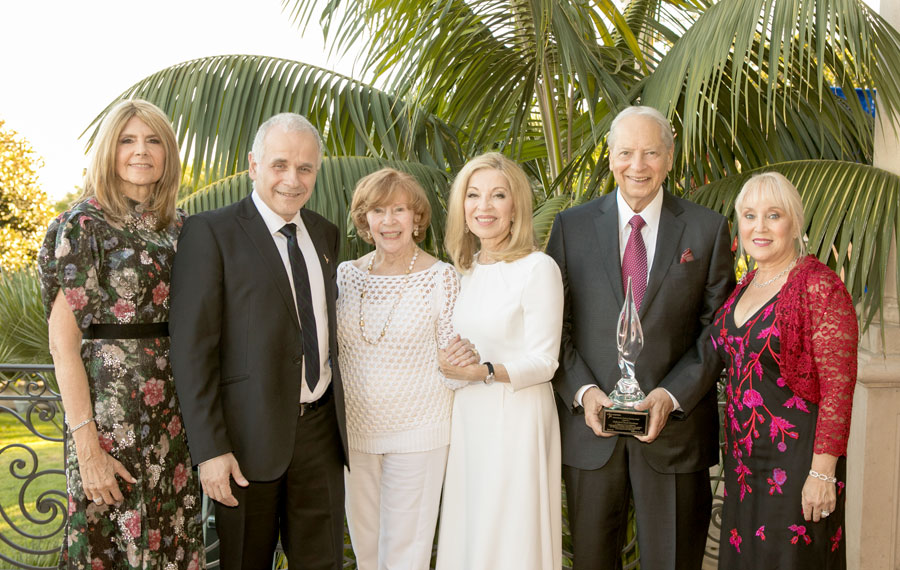
At its 10th annual Bel Air Affaire, American Friends of the Hebrew University (AFHU) honored Hella and Chuck Hershson with the 2018 Humanitarian Torch of Learning Award for their leadership in the organization and their support of the school.

The Sept. 15 event, held at the Los Angeles home of Brindell Gottlieb, also raised $950,000 to support scholarships for Hebrew University students.

Event chairs included AFHU national and western-region board members Renae Jacobs-Anson and Helen Jacobs-Lepor.  Honorary chairs included western region vice chair Patricia Glaser and her husband, Sam Mudie, as well as May Ziman and her husband, Richard, the western region chairman.

Hebrew University President Asher Cohen attended.

Funds raised by AFHU are used to support scholarly and scientific achievement at the Hebrew University, to create scholarships, to maintain and build new facilities and to assist the university’s recruitment of new faculty.


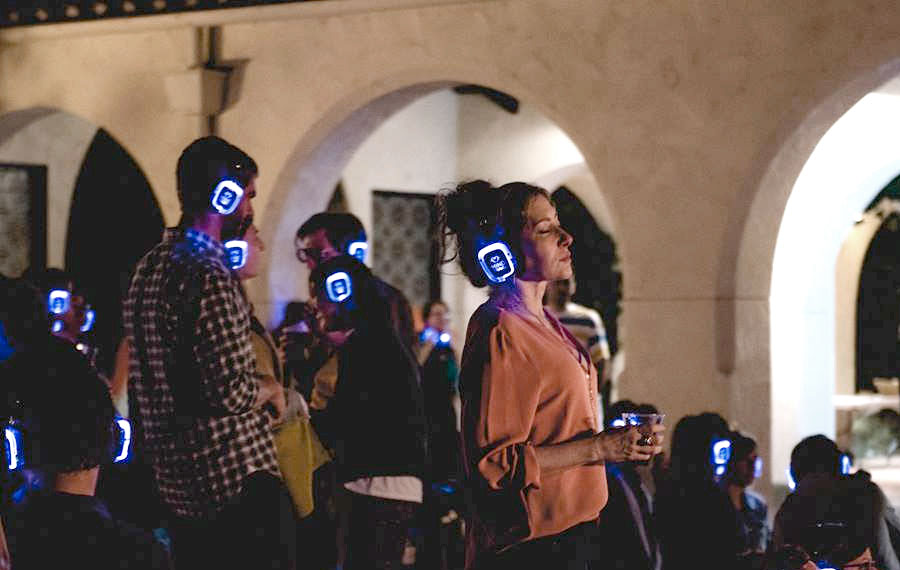
East Side Jews’ Days of Awesome tashlich pilgrimage — “Down to the River” — was an evening to tune in to reflection, storytelling and community
at Lewis MacAdams Riverfront Park.
(Photo by Kelly Dwyer)

About 150 young professionals at a Sept. 15 tashlich service organized by the East Side Jews group silently made their way to the edge of the Los Angeles River in Elysian Valley and, while wearing headphones, cast small stones into the water.

The High Holy Days ritual, held at Lewis MacAdams Riverfront Park, was part of the organization’s seventh annual Down to the River event in its Days of Awesome series.

“It was an amazing site to see 150 people, all silent along the riverbank, throwing stones,” Joel Serot, events manager at the Silverlake Independent Jewish Community Center, which founded East Side Jews, said in an email. 

Participants were given headphones so that, as they made their way to the river, they could listen to an immersive musical composition by Murray Hidray and listen to  words of reflection from Wilshire Boulevard Temple Rabbi Susan Goldberg, who was at the event, speaking to them live.

The participants’ casting of stones replaced the ritual’s traditional tossing of breadcrumbs, which symbolizes letting go of mistakes of the past year.

“This is a more environmentally safe alternative and was a big part of our goals to continue to protect our community’s amazing public spaces like the L.A. River,” Serot said.

The early evening event also included food, storytelling and community activities, with Amie Segal leading a body-movement exercise, Thurston MacAfee reading a story of redemption, and the Nathan Serot Quartet playing jazz. Additionally, the art installation AtoneTent showcased the talents of East Side Jews artists-in-residence Betsy Medvedovsky and Katya Apekina, and Nikki Nachum led what was described as an “animal card reading.”

Havdalah and song concluded the event, which was co-organized by alternative Jewish community The Living Room.


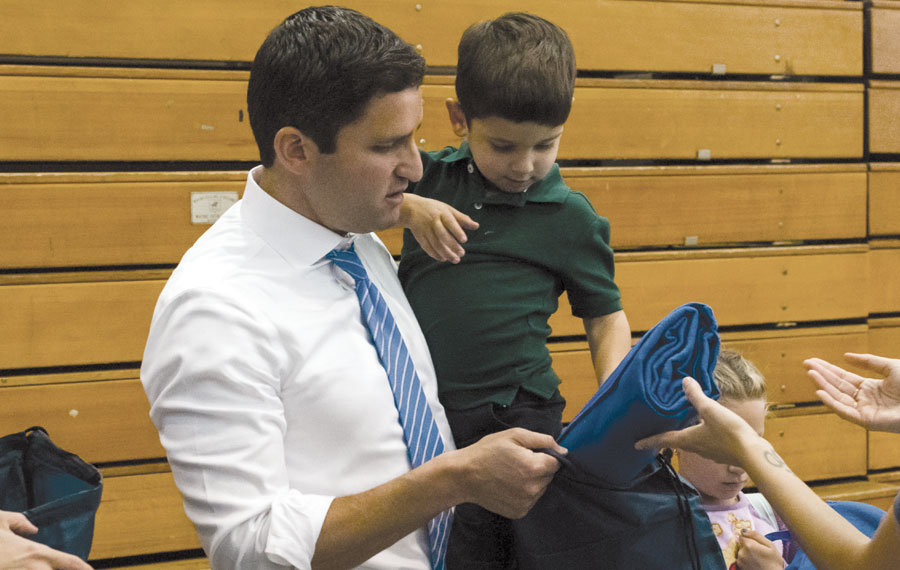
Following his swearing-in ceremony, California State Assemblyman Jesse Gabriel, who was elected in June, helped pack hygiene kits for homeless people.
(Photo by Jenna Freeman)

State Assemblyman Jesse Gabriel was sworn in to office on Sept. 16 during a ceremony at Reseda High School. 

Gabriel, a constitutional rights attorney and member of the Jewish community, won a special election this past June to represent Assembly District 45, which includes most of the western San Fernando Valley, including Encino, Woodland Hills and Tarzana. 

Los Angeles Mayor Eric Garcetti delivered the keynote address. 

“Jesse Gabriel is the right leader at the right time to help advance our most important work — from fighting for more affordable housing to protecting all Californians, no matter who they are or where they come from,” Garcetti said.

California Secretary of State Alex Padilla, Congressman Brad Sherman and state Assembly Speaker Anthony Rendon also spoke. Former City Controller Wendy Gruel emceed.

Following the ceremony, participants took part in a service project, in partnership with LA Family Housing, that involved packing 600 kits with essential hygiene products for homeless people.

“It was important that this event include an element of service, because giving back is at the core of our work in the Assembly,” Gabriel said. “I am grateful to be serving the people of the 45th Assembly District, for placing their trust in me. I will strive every day to honor that trust and to serve you with integrity.”

The Assembly seat was vacated in December by Democrat Matt Dababneh, who resigned after a lobbyist alleged he had sexually assaulted her. Dababneh denied the allegation.


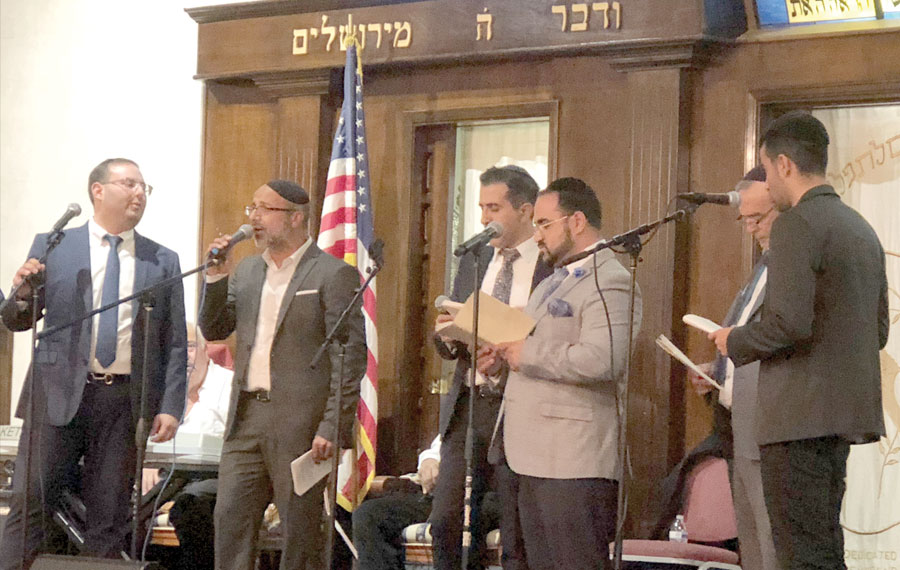
A selichot concert held by the Sephardic Educational Center at the Kahal Joseph Congregation featured six hazzanim from Israel and four Arabic musicians.
(Photo courtesy of Sephardic Educ. Ctr.)

The Middle East met West L.A. when the Sephardic Educational Center (SEC) held its annual Selichot concert on Sept. 16 at Kahal Joseph Congregation.

The concert featured six hazzanim from Israel and four Arabic musicians from Lebanon, Syria and other Middle Eastern countries.

About 150 people enjoyed the program, including the SEC’s director, Rabbi Daniel Bouskila, and its President Neil Sheff.

The SEC, which has its historic campus in Jerusalem’s Old City and has various Diaspora branches, is committed to strengthening Jewish identity in youth and young adults. 


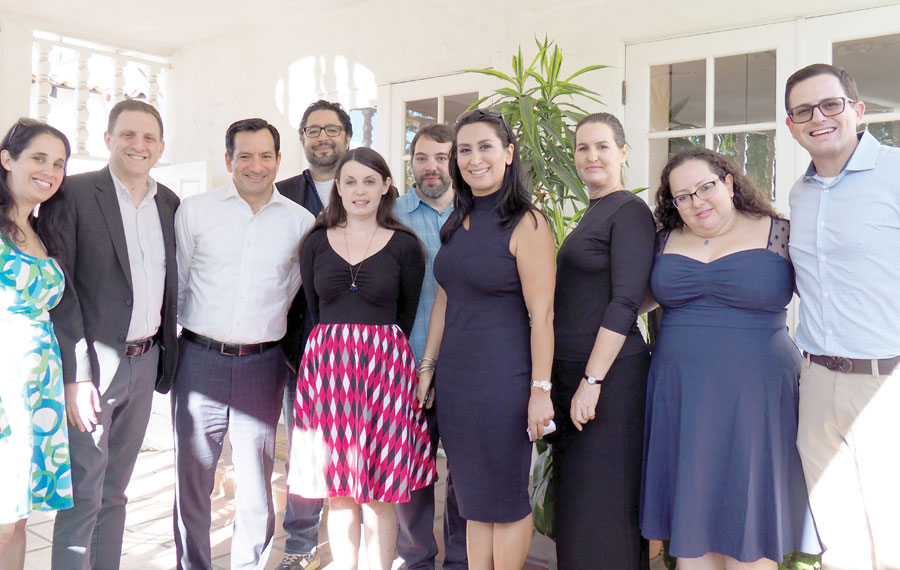
From left: Debbie Paperman, Democrats for Israel Los Angeles (DFILA) President Andrew Lachman, State Assembly Speaker Anthony Rendon, Rami Frankel, DFILA Vice President Michelle Elmer, Micha Liberman, Sunny Zia, Amanda Mintz, Nitzan Harel and Leeor Alpern attended the DFILA garden party.
Photo by Ryan Hughes

Democrats for Israel Los Angeles (DFILA) held a garden party Sept. 16 at the Beverly Hills home of Dan and Myra Demeter that honored state Assembly Speaker Anthony Rendon and Jewish Democratic Council of America finance chair Ada Horwich.

At the event, attended by about 100 people, Rendon discussed how lessons learned from Israel’s water conservation practices have influenced California’s water policy. Horwich addressed her support of Israel and the importance of supporting pro-Israel Democratic candidates.

Others who spoke included Assembly members Jesse Gabriel and Laura Friedman; Eitan Weiss, deputy chief of mission at the Consulate General of Israel in Los Angeles; and Eric Bauman, chair of the California Democratic Party.

Attendees included DFILA President Andrew Lachman and Vice President Michelle Elmer; L.A. City Controller Ron Galperin; L.A. Councilman Paul Koretz; Long Beach Community College District board member Sunny Zia; Democratic Assembly candidate Josh Lowenthal, Beverly Hills Unified School District Board candidate Rachelle Marcus and members of the DFILA board. 

DFILA, according to its website, supports pro-Israel Democratic candidates for local and federal offices, fights anti-Semitism and the delegitimization of Israel, and promotes progressive Jewish and Zionist values. 


Want to be in Movers & Shakers? Send us your highlights, events, honors and simchas.
Email ryant@jewishjournal.com

Movers & Shakers: Bel Air Affaire, Garden Party, High-Tech Tashlich Read More »

Putting Krav Maga on the Map in L.A.

There are many martial arts, but somehow Krav Maga, the self-defense and fighting discipline created by the Israel Defense Forces (IDF), has emerged as a huge hit worldwide. 

Amir Perets, a 44-year-old self-defense and defensive-tactics expert who holds a fourth-degree black belt in Krav Maga, is the man who has been instrumental in popularizing the discipline in Los Angeles. 

Perets, who has lived here for the last 22 years, told the Journal that despite Krav Maga literally meaning “contact combat,” the description is misleading.

“[It’s] a self-defense system that lives by a very simple, basic rule: Don’t get hurt,” he said. “It doesn’t matter whether you are a civilian, a law enforcement officer or a soldier. [Krav Maga] doesn’t promote violence; it’s just the opposite. It’s so one can walk in peace.”

According to Perets, 80 percent of Krav Maga is preventative measures, while 20 percent comes down to tactics should you come under attack. In order to protect yourself without ever going into combat mode, Perets said it’s important to be situationally aware. “A little bit of awareness can be the difference between life and death,” he said.

“Krav Maga is a self-defense system that lives by a very simple, basic rule: Don’t get hurt.” 

— Amir Perets

That awareness can include simple things like not looking at your phone when you’re walking to your car. When you do, “you’re distracted and oblivious, and that makes you an easy target for an attacker,” Perets said. “If instead you come out, eyes up, you are better able to recognize potential threats.” Also, he said, the attacker is more likely to realize you’re not an easy target and move on.  

Perets said he became interested in how people protect themselves at an early age.  “I didn’t like the whole concept of being in a position of disadvantage,” he said. “It spiked my curiosity about the concept of well-being. It started with interest in [general] life-enhancing methods and then it went through life-saving methods.”

In 1992, at the age of 18, Perets became Israel’s full-contact heavyweight martial arts champion and received awards of distinction for physical education. That same year, he began his compulsory IDF training, where he excelled in Krav Maga and combat fitness. He then went on to instruct infantry and special forces, honing and reshaping the Krav Maga training that we see today in local studios.  

After completing his military service, Perets spent a few months in Thailand, where he learned Thai boxing. When he moved to the United States in 1996, Perets began teaching Krav Maga and gradually started to build a name for himself. 

“Always in my mind was, ‘What are the best answers to the threats of today? How can someone keep himself safer?’” he said. That, he added, was coupled with the bigger picture of well-being: “How do you overcome emotional and physical hurdles? How can you grow and form a better version of you?”

Today, Perets is called on to train those in the military, federal agencies and law enforcement. 

“[Krav Maga] boils down to balancing the physical, emotional, mental and spiritual concepts that constitute the person,” he said. “I call this the philosophy of four horses. Imagine you are tied to four horses and each horse is running in its own direction, so it pretty much tears you apart. But if you are disciplined and they are all running in the same direction, then you can run full force and do your tasks in a more efficient way.”  

Putting Krav Maga on the Map in L.A. Read More »

Shalhevet Students Meet With Koolulam Founder

Every morning, Or Taicher, one of the founders of Israel’s social flash mob-style sing-along craze Koolulam, opens his email in search of inspiration to start his day. A few months ago, a message sent by Shalhevet High School administrators did the trick. 

“That’s the reason I’m here today,” Taicher told more than 200 Shalhevet students gathered in the school’s gymnasium the day before erev Yom Kippur. An online link led Taicher to a Koolulam-inspired video of Shalhevet’s student body, aided by live instrumentation, singing Matisyahu’s “One Day” in honor of Yom HaAtzmaut, Israel’s Independence Day. 

“I was truly moved by what I saw,” he said. And that’s saying something. 

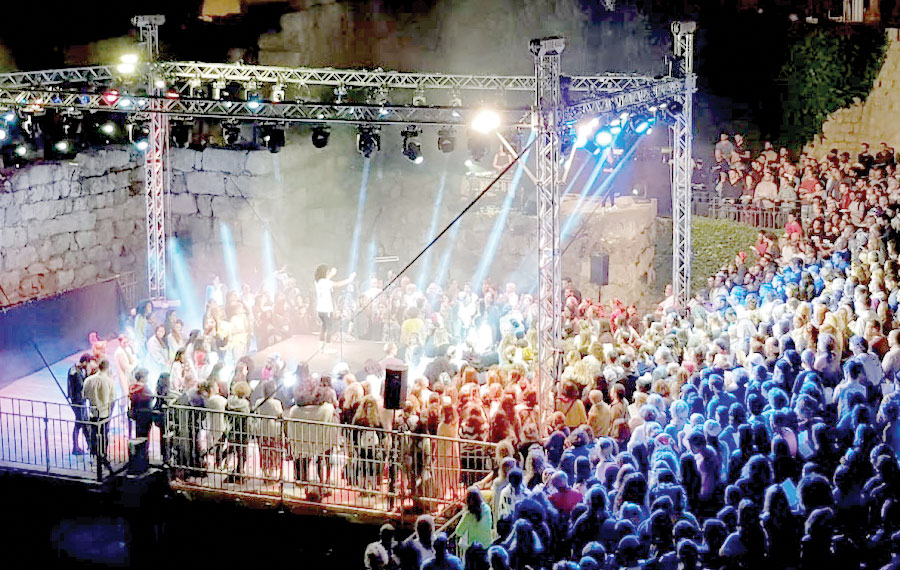
Since kicking off in Tel Aviv last year, Koolulam — a play on the English word “cool,” the Hebrew words “kulam” (everyone) and “kol” (voice), and “kululu,” a festive ululation of Sephardic Jews — has soared in popularity throughout Israel. Thousands of tickets to take part in arena-filling Koolulam events are sold in minutes. Swaths of strangers come together … to sing. 

Koolulam partners with nongovernmental organizations and local municipalities to reach every sect of Israeli society. To date, more than 100,000 people from diverse backgrounds have attended to learn musical arrangements (which take about an hour) and sing well-known songs in English, Hebrew and Arabic. The videos garner millions of online views, making Koolulam an international phenomenon. 

During Taicher’s recent visit to Shalhevet, proceedings kicked off with 30 seconds of silence in honor of Ari Fuld, the American-Israeli terrorism victim who was stabbed in Gush Etzion on Sept. 16. The Shalhevet choir then sang “One Day” for Taicher before 17-year-old Lucy Fried interviewed him.

“It all started with curiosity,” Taicher said. “Two years ago, I saw a video of thousands of people praying at the Wailing Wall. I was so moved, so inspired. I asked myself, ‘How can I pass that along? How can I inspire others?’”

Taicher, a filmmaker, recalled brainstorming ways to help unify a fractured Israeli society marred by a lack of constructive political dialogue. He immediately considered the international language of music. 

“I wanted to do something that could make connections instead of separating people,” he said. “This is how it began. I feel that music has a lot of power. It can open hearts and build bridges.”

Beyond bridging ethnic and religious divides in Israel, the mass singing sensation has proven to be a diplomatic tool. Earlier this summer, Kyai Haji Yahya Cholil Staquf, the secretary general of the world’s largest Muslim organization, Nahdlatul Ulama, which is based in Indonesia and has more than 60 million members, called Taicher on his cellphone and confessed to being a Koolulam fan. 

“I wanted to do something that could make connections instead of separating people. This is how it began. I feel that music has a lot of power. It can open hearts and build bridges.” — Or Taicher

“I hung up. I thought it was a joke,” Taicher said. But it wasn’t. Taicher and his two co-founders, Ben Yefet and Michal Shahaf Shneiderman, set off to plan a truly majestic event for Staquf’s Jerusalem visit slated for mid-June. The 800 available tickets sold out in six minutes. The attendees included Muslim, Jewish and Christian leaders. The crowd convened at midnight in the courtyards of the Tower of David in the Old City of Jerusalem to sing Bob Marley’s “One Love” in English, Hebrew and Arabic (the Journal reported on this story in its June 29 edition).

Shortly after the Koolulam event, Indonesia, a country with no previous diplomatic ties to Israel, opened its borders to Israeli passport-holding tourists. “This showed me that what we’re doing, our movement, it’s working,” Taicher said. 

He also noted that Koolulam receives Facebook messages from Arab fans around the world. Some even contain apologies for harboring unfounded hate of Israel. 

Koolulam’s founders will receive the 2018 Asia Game Changer Award in New York next month, which Taicher called “an unbelievable honor.” Fellow honorees include the founder of the Syrian White Helmets and the Thai rescuers who saved a dozen teenage soccer players in a flooded cave earlier this year.   

Ari Schwarzberg, Shalhevet’s dean of students, told the Journal that initiatives like Koolulam help frame conversations on Zionism divorced from politics. 

“I think that the way our school views the value of Zionism, one of the ways we deeply feel it, is demonstrating that Israel has the great potential to be a place that models the best version of the Jewish people,” he said. “It gets complicated with politics. But this seemed to be one of those initiatives that represents the best of the Jewish people and a way to show our students and our community a way of deepening the understanding of what Zionism is.” 

Taicher told the Shalhevet students it was an uphill battle to get Koolulam off the ground, saying he heard the word “no” a lot. “You can’t let it stop you,” he said. “Now we have over 100 people working for us and we’re making a change.”

He also spoke about Koolulam’s expansion plans, which he said may involve opening branches in Los Angeles, New York, South Africa and Abu Dhabi. A South African event is scheduled for November. 

“It was really cool to get a chance to talk with [Taicher],” Fried said following the discussion. “It’s really inspiring that he created something so powerful despite all the rejection he faced.” 

Many Shalhevet students expressed interest in attending a potential future Koolulam event in Los Angeles. Tobey Lee, 16, told the Journal the idea sounded fun, but it’s not the singing he’s drawn to.

“Koolulam is something bigger than just singing a song,” he said. “It’s creating something bigger than music. It’s really cool that it’s creating peace.”

Shalhevet Students Meet With Koolulam Founder Read More »

Roseanne: Between the ‘Sacred and the Profane’

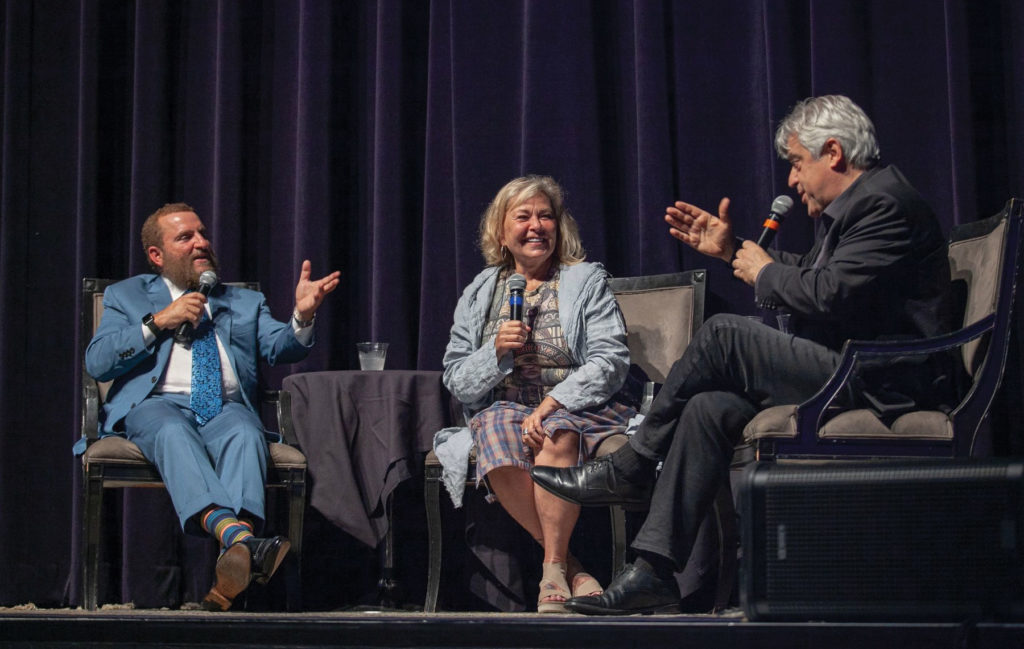
On Sept. 17, the night before Erev Yom Kippur, at the same time as the 70th Primetime Emmys Awards ceremony, comedian and actress Roseanne Barr was participating in a discussion titled, “Is America a Forgiving Nation?” 

Appearing at the Saban Theatre in Beverly Hills, Barr addressed the event that torpedoed her career: In May, Barr wrote a racist tweet about former President Barack Obama aide Valerie Jarrett. 

During the onstage discussion at the Saban with Rabbi Shmuley Boteach, which was moderated by Journal Publisher and Editor-in-Chief David Suissa, Barr said the fallout from the tweet, including ABC’s cancellation of its hit reboot of her show “Roseanne,” was devastating.

“It was so hard I thought I was going to die,” the 66-year-old said. “And it physically defeated me, and I was just leveled. And still it has been two months … but I still can’t. I feel like I have been psychically attacked and I have trouble staying awake. I went into a really bad place.”

Barr said her tweet arose from frustration with former President Barack Obama’s administration’s handling of the Iran deal, among other things. 

The sympathetic audience of close to 200 people applauded when Barr said, “I apologized for the hurt it caused people, but also I tried to clarify it and this has been quite a battle in which the right to clarify what I meant has been denied to me.”  

“That’s what I regret,” she added, “that I was not absolutely clear in what I meant.”

Boteach, who has been a friend of Barr’s for 20 years, and regularly studies Torah with her, said he reached out to her in the wake of the fallout, because of the strength of her Jewish character. 

“I wish people could be exposed to the depth of the conversations that Roseanne and I have had over the past few months,” he said, “because America knows Roseanne as an extremely funny woman, who created one of television’s most successful sitcoms and last season dominated the ratings, but what they don’t know is what a profound student of Torah she is. I mean, profound.” 

Boteach added, “She is a phenomenal, ferocious lioness for the Jewish people, and she deserved our steadfast support while making it clear she should make this right, because we Jews have values.”

Much of the evening centered on Barr’s commitment to Judaism. Raised in a Jewish home in Salt Lake City, Barr said Judaism plays a central role in her life. “My main passion and joy and compulsion is the study of Torah,” she said.

When Suissa asked how Barr reconciles her love of Torah with her irreverent comedy, Barr said her life is a balancing act between “the sacred and the profane.”

Roseanne: Between the ‘Sacred and the Profane’ Read More »

Local Mensches Do Lunch

The venue was a conference room in the Jewish Community Foundation building on Wilshire Boulevard, the occasion was a luncheon, and the 10 invited guests were all past honorees of the Jewish Journal’s Mensch lists.

To date, the Journal has published 12 annual Mensch lists that spotlight extraordinary Jewish Angelenos who donate their time, energy and passion to making the world a better place. However, this is the first year a luncheon has been held for honorees. 

The honorees at the Sept. 13 event came from the past three years’ lists and included Fruit for a Cause’s Bruce Rosen; SOVA Community Food and Resource Program volunteer Michael Ullman; lead architect of B’nai David’s twice monthly homeless lunch program David Nimmer; Swipe Out Hunger founder Rachel Sumekh; attorney Alana Yakovlev, who works with the homeless and mentally ill; the Child Safety Pledge’s Rochel Leah Bernstein; Mini Therapy Horses founder Victoria Nodiff-Netanel; Board Chair for Tower Cancer Research Foundation and Beit T’shuvah, Nancy Mishkin; Betty Cohen, a 97-year old Holocaust survivor who volunteers with multiple organizations; and Jewish-American Hall of Fame creator Mel Wacks (and his wife, Esther).

“Just sitting at the table beside such amazing and dedicated people was one of the most humbling experiences,” Yakovlev told the Journal. “Their actions demonstrate the epitome of chesed, and we should all continue to be a beacon of light.” 

The Foundation came up with the idea to honor the Mensches shortly after this year’s list came out in January, which seemed a natural extension of the organization’s mission to help build enduring legacies and strengthen the Jewish community. 

In 2017, with the support of 1,300 donors, the Foundation distributed a record $100 million to Jewish and nonsectarian causes locally, nationally and in Israel.

Foundation President and CEO Marvin Schotland told the Journal at the luncheon, “The people who are on the [Mensch] list are really doing very much the same thing that our donors are doing. They are not necessarily doing it through us, but it doesn’t matter. They are helping build community.” 

He added that introducing the Mensches to one another was a way for them to share their values and experiences, and relate to and learn from one another. Although many of the Mensches were meeting for the first time, they quickly bonded over lunch. 

“I give in limited doses during my spare time, so it was totally inspirational to be amidst people who dedicate their whole lives to helping others.” 

— David Nimmer

“People were attentive, sharing, interested in what other people were doing,” Schotland said. “None of that would have occurred but for the fact that they were in this room. And the starting point for that was the Jewish Journal.”

“I give in limited doses during my spare time when I can,” Nimmer said, “so it was totally inspirational to be amidst people who dedicate their whole lives to helping others in the most meaningful fashion.”

During the lunch, the Mensches asked the Foundation to connect them all via a shared email list, and made plans to stay in touch.  

“It was such a privilege and pleasure to attend the luncheon and meet all these incredible Mensches and hear their moving stories of compassion, kindness and positive action,” Foundation Executive Vice President Dan Rothblatt said. “They are truly inspiring people and epitomize the best that our community has to offer.” 

The Foundation’s Vice President of Marketing and Communications Lewis Groner added, “And what better time of the year than to do it at the start of the Jewish New Year to recognize the accomplishments of all of these Mensches around the table?  

Local Mensches Do Lunch Read More »

Yom Kippur ‘On Air’

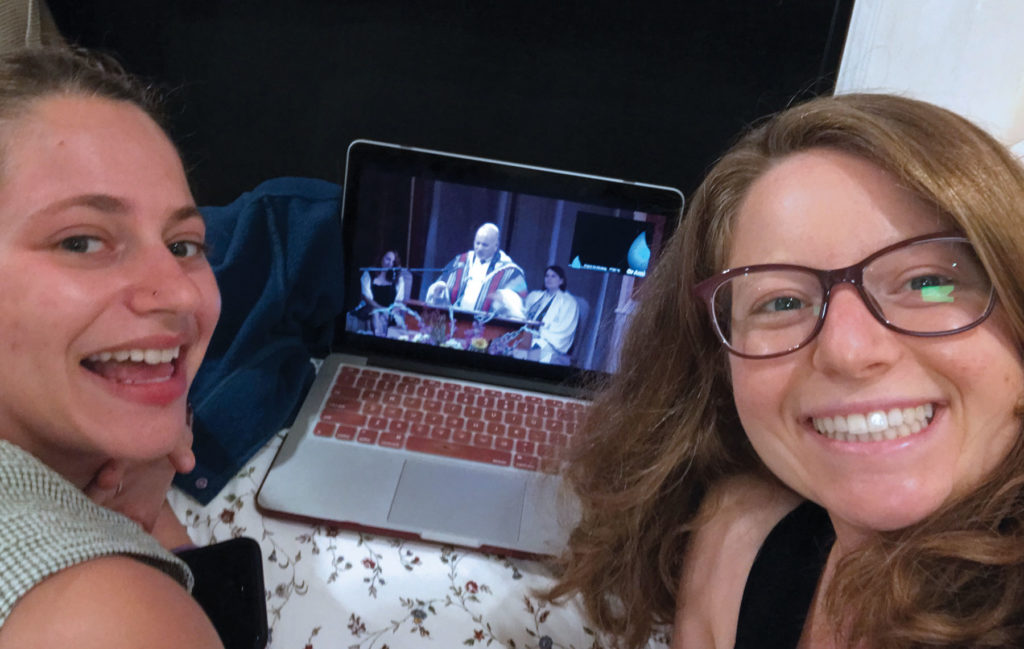
While many Jews head to services over the High Holy Days, there are some who, for a variety of reasons, can’t or don’t wish to attend synagogue. For these people, there are ways around this obstacle in the 21st century: welcome to streaming online services.

In Los Angeles alone, synagogues from Koreatown’s Wilshire Boulevard Temple to Congregation Or Ami in Calabasas live-streamed their services. 

Rabbi Naomi Levy, of Nashuva, has been leading Kol Nidre Live online for 10 years. The services began as a webcast on the Jewish Television Network (JTN) before Nashuva partnered with the Jewish Journal, when Levy’s husband, Rob Eshman was editor-in-chief. 

Levy was originally approached by JTN’s then-president and now Jewish Federation of Greater Los Angeles President and CEO Jay Sanderson, about doing the broadcast.

“My first [thought] was worrying, ‘Will people think it’s sacrilegious?’” Levy told the Journal by phone. “But then we thought about all the people who are either homebound or in some way turned off to Judaism, and it might just be a window for them. Even from the first webcast we realized that there were tens of thousands of people out there starving for a way to have a Yom Kippur experience who weren’t able to come [to services] physically.”

After receiving an email from a family in a country that doesn’t permit the public gathering of Jews, Levy said, “I could not figure out where they were, but they said, ‘We’re not allowed to practice Judaism publicly, and we’re here with you [online] and we can’t tell you what this means. We’re just sitting here in tears, to be able to experience Yom Kippur with you.’”

Over the years, Nashuva’s services have earned long-time followers. Felicia Goldring wrote on this year’s live-stream page, “I actually just came home from shul, and I looked forward to the second Kol Nidre of the night — watching, listening and singing to this.” 

“From the first webcast we realized that there were tens of thousands of people out there starving for a way to have a Yom Kippur experience who weren’t able to come [to services] physically.”
— Rabbi Naomi Levy

A woman named Louise posted, “I found this service a few years ago when I was ill on erev Yom Kippur, and now I choose it over my regular shul.”

Or Ami has been live-streaming the High Holy Days for six years. “You are not watching, you’re worshipping,” Rabbi Paul Kipnes told the Journal. “For those people who cannot be in shul because their kids are too young or because a loved one is ill or because they’re required to work, to be able to worship with us has been transformational for them. It’s incredibly rewarding to be able to touch their lives even when their lives don’t allow them to stop and get into shul.”

Online worship also appeals to those who haven’t found a synagogue that works for them. 

“I received a beautiful note from a guy back East who said he hadn’t been to a synagogue since he broke with his past shul,” Kipnes said. “He found us online and said, ‘I felt like something that was closed off has opened up, and I feel connected once again to the Jewish community and with God.’”

San Francisco resident Tracey Gersten told the Journal she prefers Or Ami’s online services to attending the synagogue by her home. “And it’s not just [because of] parking and traffic. There are all these distractions that happen when you’re in a room full of 500 people,” Gersten said. “Not only is the spiritual connection deeper, it allows me to get all of the other responsibilities that go along with the holidays.”

Don Levy, director of marketing and communications for Wilshire Boulevard Temple, said he watched the synagogue’s live-streaming services in 2015, before he began working there. 

“Two of my sons were out of town, so we were all able to virtually be there together,” he said. He added, that many of Wilshire Boulevard Temple’s online viewers are former congregants who have moved to other cities. “They are grateful,” he said, “that they can participate in a synagogue they love.”

Yom Kippur ‘On Air’ Read More »

My Magical Jewish Morocco Mystery Tour

My husband, God bless him, has many crazy ideas. But unlike most people with lofty dreams, he actually follows through with them.

Own a rooster? Check. Have a comedy festival in our backyard? Yup. Reside off a dirt road in Florida for three weeks and live like old people who dine exclusively on buffets and watch “Everybody Loves Raymond” before falling asleep at 9 p.m.? That was us.

So earlier this year, Daniel and I decided we’d go to Morocco after his monthlong stint performing stand-up at the Edinburgh Fringe Festival in August. 

To prepare for our trip, we watched “Casablanca,” (which was filmed in Burbank), and connected with our Moroccan-Jewish friends to learn about life there, including Journal Publisher and Editor-in-Chief David Suissa.

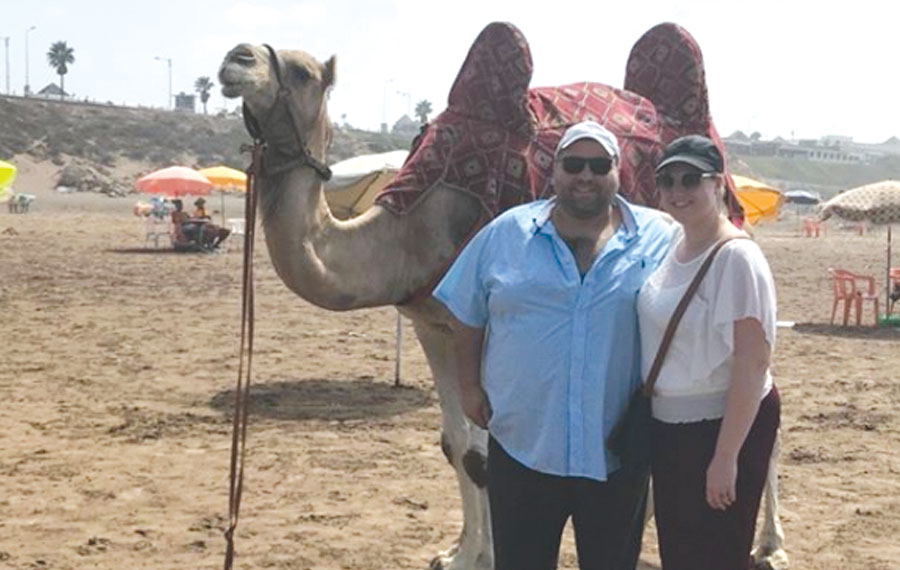
After arriving in Casablanca, we headed to our hotel by the beach, passing Moroccan McDonald’s, Muslim women in head coverings and huge white mansions owned by kings. We went to the beach, where a camel growled at Daniel. We hung out in a hammam — a Turkish bath and steam room. I lasted about five minutes, because being hot and claustrophobic is not my thing. 

We visited Rick’s Café, a tourist spot made to look like Rick’s Café Américain from the film “Casablanca,” went to Hassan II Mosque — the second largest mosque in Africa that can hold up to 25,000 worshippers, and hired a tour guide to take us around Jewish Casablanca. 

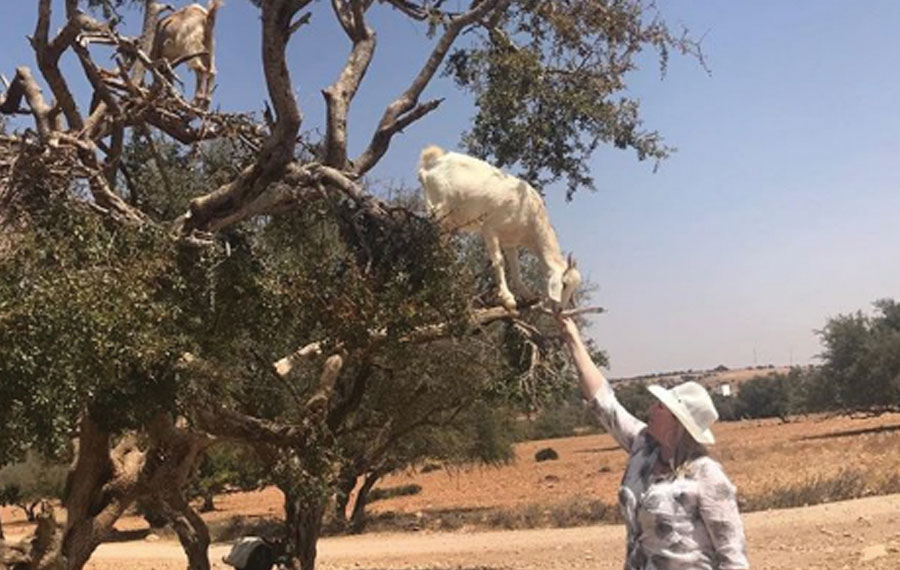
With the Argan tree goats

Although our guide was Muslim, he worked with other Jewish tour guides and knew where to take us. Our first visit was to a small Jewish museum, which contains a shul no longer in use. Then it was on to a kosher bakery in a hidden alleyway to buy treats for Shabbat. We then made our way to Temple Beth-El synagogue, which today is used for special occasions including weddings and bar and bat mitzvahs. 

We learned that before the founding of the State of Israel in 1948, Morocco had an estimated 350,000 Jews. Today, there are only a thousand or so who remain in Casablanca. Nonetheless, the city still boasts 22 synagogues, at least four kosher restaurants, 10 kosher butchers and a few bakeries. We went to one of those 22 synagogues at 5 a.m. to say Selichot, and the men (and one woman) there offered us coffee and tea. 

Shabbat dinner was spent with a family friend’s cousin, Armand, where we ate his mother-in-law’s tuna casserole and talked with his son about why he didn’t like visiting Los Angeles. “Hollywood Boulevard sucks,” he said. “I agree,” I said. 

From Casablanca, we flew to Marrakech, where there are about 500 or so Jews. When we arrived, I immediately noticed three things: How beautiful and colorful it is; how entire families whiz through town on motorbikes; and how old the city felt. When we arrived at our riad (hostel), we realized we were in the old part of town full of tiny, historic alleyways and scores of cats. 

“Returning home, I felt incredibly sad. No more culture shock. No more donkeys. No more beautiful lamps and colorful doors and kind, French-speaking cabdrivers.”

Our first stop in Marrakech was the vast, historic souk, Djemaa el-Fna. The indoor section is a huge maze and it’s easy to get lost. We certainly did. Many times. Wares are cheap by American standards and haggling is de rigueur. We quickly purchased a variety of trinkets including a Moroccan tea set, lamps, tagines, pashminas and jewelry. Over the course of the next four days, we returned to the market because it’s impossible to see everything in one day. 

We were, however, two of the very few white people in the market, and every few minutes, someone would try to get us to sign up for a tour, buy a souvenir or ask us for money. 

We saw the famous performing monkeys on chains, the snake charmers, who apparently sew their snakes’ mouths shut, and a sad owl chained to a cage filled with small squirrels. There were hundreds of chickens in cages, waiting to be slaughtered, and sheep’s heads being roasted on the street. As an animal lover, it was certainly painful to see, but there was nothing I could do except remind myself that I treat my own dogs, chickens and tortoise like family. The sad owl, though, still haunts me.

We took a dirt bike tour of the Marrakech desert. It was bumpy, dusty and magnificent. Our ride took us to a Berber hut, where the family there made us Moroccan tea, and as is custom, tried to pour the tea from the highest height possible. 

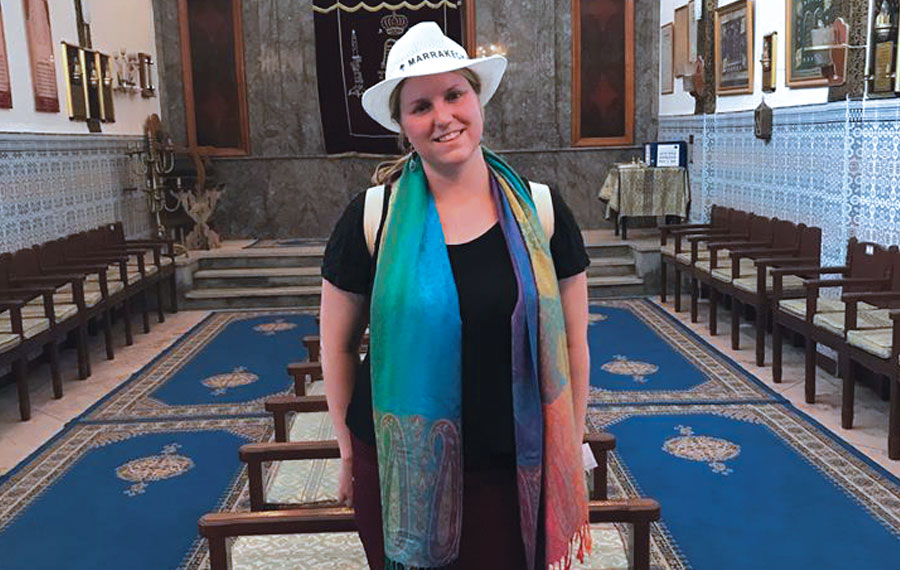
In the Marrakech synagogue

We also visited Essaouira, a port town about three hours from Marrakech. 

I Googled “Jewish Essaouria,” and there was an article about the only Jew  — a man named Joseph Sebag, who owned a store called Galérie Aida. It took several attempts with different guides to finally find Sebag and his antiques store. We said, “Shalom” and bought a wood piece from Senegal from him. Sebag ordered us orange juice and offered for us to stay in his flat the next time we were in town. 

Other highlights in Marrakech included a meal at the city’s only kosher restaurant, which had a picture of the Rebbe — the late Lubavitcher Rabbi Menachem Mendel Schneerson — on the wall; visiting the graves of tzadikim and meeting the Muslim man whose family has guarded the cemetery for three generations; and purchasing our first shofar, which we blew on Rosh Hashanah.  

Returning home, I felt incredibly sad. I was back to reality. No more culture shock. No more donkeys. No more beautiful lamps and colorful doors and kind, French-speaking cabdrivers. Besides Israel, Morocco is the most enchanted place I’ve ever visited. I miss it every day. I understand now why Jews were there for so long, and why there are a few who choose to stay to this day. 

We may miss that beautiful magical country, but by golly, we’ll always have Morocco.

My Magical Jewish Morocco Mystery Tour Read More »

‘The Leftovers’ and God’s Cosmic Hug

The month of Tishrei had always been a riddle to me until I saw HBO’s television series “The Leftovers.” 

In the heart-racing opening scene of the pilot episode, two percent of the world’s population suddenly disappears in a rapture-like event called “The Departure.” The show then immediately jumps ahead to the three-year anniversary of The Departure and exquisitely explores the struggles of those left behind after The Departure.

Their core struggle can be distilled into the following: “Are you OK?” “I am OK.”
“It is going to be OK.” “You are going to be OK.” Everyone is broken by The Departure and feels a profound sadness that threatens to destroy them. There is no escape from this sadness. There is only trying to “be OK” with it. 

This is the soul of “The Leftovers.” It is also the soul of real life.

Societies are built on the faith of tomorrow. Without faith that today’s work will pay off in the future, work becomes an overwhelming burden. People are driven by the need to feel they are going to be OK. We dress up our opinions with fancy arguments and airtight logic, but in the end we choose the option that makes us feel safest.

“Societies are built on the faith of tomorrow. Without that, the work becomes an overwhelming burden.”

Pro-gun rights activists believe they are safer with fewer restrictions on gun ownership. For gun-control activists, the reverse is true. The racist is motivated by the (false) conviction that safety can be found only by living with his or her own race. The pro-diversity progressive is motivated by the conviction that we are safer when all people are treated as equal.

“The Leftovers” distills this idea by raising the stakes. Someone who feels safe now would have a much harder time feeling so if 140 million people suddenly disappeared.

Only one thing in “The Leftovers” can unburden others from their debilitating anguish: a hug. Holy Wayne, a cult leader and pedophile, exorcises the demons of ambiguous loss with a genuinely compassionate hug, as if to say, “I feel your pain, I share in your pain and I am here to help carry your pain. I cannot tell you everything is going to be OK, but you are not alone.” 

Like everything in “The Leftovers,” it is unclear if the hugs are magical or a placebo. Regardless, they work.

The month of Tishrei begins with the High Holy Days funneling Jews into their synagogues for long days of prayer and introspection. I call Rosh Hashanah and Yom Kippur indoor holidays. A few days later, Sukkot flings us outdoors. For one week, there is a mitzvah to eat, drink and sleep — to live — in a flimsy hut. Sukkot is an outdoor holiday.

The two halves of Tishrei are also a contradiction of emotions. Rosh Hashanah and Yom Kippur are somber days as the fate of the world hangs in the balance. Who will live? Who will die? Then, a few days later, Sukkot flips the mood completely. The Bible calls Sukkot “The Festival of Joy.”

How do such opposing pieces fit together in one single month?

Praying for our lives as we stand in judgment can leave us with a lingering sense of dread and fear. The melodies are haunting, the liturgy is dark and apocalyptic. Worst of all, our verdict is sealed in the Book of Life but we have no idea if we are written in it. We try to have faith that the coming year will be a good one but we do not know if we will be OK. The existential ambiguity can be paralyzing.

A few days later, when we enter the sukkah, we are surrounded by mitzvah, enveloped by its makeshift walls and meager thatched roof. The sukkah is God’s cosmic hug. God is not going to tell us we are going to be OK, but God’s hug has the power to unburden us.


Eli Fink is a rabbi, writer and managing supervisor at the Jewish Journal.

‘The Leftovers’ and God’s Cosmic Hug Read More »