fbpx

September 26, 2018

The Legacy of the Last Sturgeon Queen

The food landscape abounds with various categories of purveyors, ranging from trendy to hipster to traditional, but few and far between those classifications lie the legends. And in the Jewish food category, there is Russ & Daughters, a name that holds so much significance in what’s known as the “appetizing” world.

Anne Russ Federman, the last living daughter of Joel Russ, founder of Russ & Daughters, died last week at age 97, but not before she was recognized for her contributions to the Jewish-American experience in the book “The Women Who Made New York” by Julie Scelfo, and lived to see two of her grandchildren become the fourth-generation champions of the namesake business she began working in when she was only 14.

When it comes to the American-Jewish experience in New York, Jewish soul food comes in the form of what’s known as “appetizing” — what their website describes as “a variety of smoked and cured fish including salmon, sable, whitefish and sturgeon as well as a salads, cream cheeses, caviar and generally food one tends to eat with bagels.”

Appetizing originated from the Jewish laws of kashrut, which dictate that meat and dairy cannot be eaten or sold together. So, two types of stores were created to cater to the Jewish population, which mostly hailed from Eastern Europe in the early 1900s: delicatessens and appetizing shops. 

While delicatessens sold cured and pickled meats, shops that sold fish and dairy products were known as appetizing stores. Before the middle of the century, appetizing shops could be found in abundance in every borough of New York and in large concentration on the Lower East Side, to cater to the Eastern European Jewish immigrants who concentrated there. There in 1907, a Polish immigrant named Joel Russ started to sell what was known as schmaltz herring out of a barrel, eventually working his way up to a pushcart, then a horse and wagon, and finally a legitimate storefront business. Schmaltz herring was a predominant and cheap food back in those days, so named for the fat that came off the brined fish that could be smeared on bread and eaten as a meal in itself. 

By 1920, Russ had a shop on Houston Street, in the location it sits to this day, that had already blossomed into an active fish emporium, having moved from its original location on Orchard Street. With no sons to pass down the torch to, Russ enlisted his three teenage daughters — Hattie, Ida and Anne — to work in the store.

Business flourished when customers lined up to see the young, beautiful and charming sisters masterfully slicing the salty strips of belly salmon famously described as “so thin you could read The New York Times through it.” Then, in 1935, in what was surely the most pro-feminist act of the day, Russ made his daughters full partners and changed the name of the business to Russ & Daughters, probably the first business in the United States to have “& Daughters” in its name, a move that was unheard of at the time. 

“In 1935, in what was surely the most pro-feminist act of the day, Russ made his daughters full partners and changed the name of the business to Russ & Daughters.”

In 2013, Russ & Daughters became the subjects of the documentary “The Sturgeon Queens,” produced and directed by Julie Cohen (whose film “RBG,” about Supreme Court Justice Ruth Bader Ginsburg, came out this year). In the film, luminaries like Ginsburg, journalist Morley Safer and actor Maggie Gyllenhaal speak for most New Yorkers when they talk about what the store means to them. Two of the sisters, Anne and Hattie, describe their father’s hard-driven approach to the business. 

Instilling the father’s love of the business in future generations was certainly not a given. The credit goes to the sisters. In the film, Anne’s son, Mark Russ Federman, talks about having a law career before coming back and taking over the family business in 1979, when the daughters and their husbands were ready to retire. Far from pressuring their children to join the company, the sisters simply let their life’s work speak for itself.

After 30 years of running the business, Mark Russ Federman’s daughter Niki and her cousin Josh Russ Tupper took over ownership in 2009, after successful careers outside the family business and even outside of the food sector. On the store’s 100th anniversary, they opened the first Russ & Daughters café in the original location of the store on Orchard Street. They computerized the ordering system, added some modern twists to the menu, began running herring pairing events, and created  sandwiches and platters named after their grandmothers and their great-grandfather.

It’s estimated that 10,000 orders for items ranging from smoked fish, caviar and chopped liver to rugelach and babka are placed from the Rosh Hashanah period to the Yom Kippur break-fast. On the day before the Yom Kippur fast, early in the morning, there was a line wrapped around the block from East Houston Street all the way to Allen Street. It began at 6 a.m. and grew as the day progressed. 

Witnessing the jovial banter that goes on in the line, older men and women who come to get an authentic taste of their lost youth mingling with young couples with children and hungry throngs of tourists, it’s all but impossible not to feel a certain genetic Jewish connection to this place. In all my years in New York, this was usually my last shopping stop before going home to my parents in Washington, D.C., and bringing them a small but poignant reminder of the taste of the New York of their youth, when they, too, were new immigrants. In that line is a feeling of home and tradition, cultural identity and, yes, even a sense of belonging. Imagining the fierce work ethic and pride that must have been coursing through Joel Russ’ veins in that era seems to be contagious even many decades later. 

The late chef, author and TV personality Anthony Bourdain once said, “Russ & Daughters occupies that rare and tiny place on the mountaintop reserved for those who are not just the oldest and the last — but also the best.” It’s hard to fathom the struggle and commitment necessary to have created a business that remained viable and flourishing through the ups and downs of the Lower East Side. That it made it through the Great Depression and out the other side of the ’70s drug wars and the ’80s helter-skelter of crime in the neighborhood is miraculous. A business that began as a barrel full of fish pushed on a cart by a Polish immigrant in 1907, yet still holds cachet and relevance in a Starbucks-saturated and trend-driven food landscape — a full four generations later — is almost mythological. 

While Manhattan is blessed to be a city that boasts establishments proclaiming their founders to be “Sturgeon King” and the “King of Sturgeon,” those three little girls whose father had the foresight to designate them as the “Queens of Sturgeon” are featured in a large street mural art project celebrating them as “Lower East Side heroines.” Indeed, not only did they successfully navigate a harsh male-dominated world of appetizing to keep their business thriving, perhaps even more extraordinary is that they raised their heirs to love and cherish it, making them the coolest rulers of them all.


Yamit Behar Wood, an Israeli-American food and travel writer, is the executive chef at the U.S. Embassy in Kampala, Uganda, and founder of the New York Kitchen Catering Co. 

The Legacy of the Last Sturgeon Queen Read More »

Table for Five: Sukkot Shabbat

One verse, five voices. Edited by Salvador Litvak, Accidental Talmudist

I will remove My hand, and you will see My back but My face shall not be seen. 

— Exodus 33:23


Rabbi Zoe Klein Miles
Temple Isaiah 

Moses sees God’s back, rather than God’s face, because God is in motion, moving forward. We are designed to be in motion. 

Astrophysicist Karel Schrijver teaches: “We are quite literally not who we were years, weeks or even days ago. Our cells die and are replaced by new ones at an astonishing pace. What persists over time is not fixed, but merely a pattern in flux.” 

We are made in God’s image, which does not mean we look like God and God looks like us, rather, we are patterned after the moving pattern of God. At this season, we talk about return. But when we say return, we do not mean “go backward.” We mean returning to the path that will take us forward. 

The whole Torah is about a movement, from the exile from Eden to the exile from Egypt, and we never really arrive. Greek Philosopher Heraclitus said, “The only constant in life is change.” He also said, “No person ever steps in the same river twice.” So, when we roll Torah back to the beginning, it is not the same Torah, nor are we the same people. 

There is a reason the most meaningful part of the bar mitzvah ceremony is the passing of the Torah. There is a reason the prayer that brings the most people to tears is L’Dor va-Dor (from generation to generation). Because it touches on the essence of what we are. We are the river. 


Rabbi Benjamin Blech
Professor of Talmud, Yeshiva University

Job wasn’t the first biblical character to ask the question that more than any other challenges our faith. Philosophers call it theodicy. Simply put: Why do bad things happen to good people? 

How can we believe in a kind and compassionate God — his very name in English is a contraction for the word good — when we are so often witness to the unfairness of life and the injustices of the world around us? Doesn’t reality give the lie to religion? 

According to the Talmud, it was Moses who had the nerve to pose the question to the Almighty. Right after God forgave the Jews for the sin of the golden calf and defined his essence by way of the 13 attributes of mercy, Moses said, “Show me, I pray you, your glory.” And that is when God responded, “And you will see my back but my face you shall not see.” Surely Moses knew that God has no body. What Moses wanted was the ability to understand God’s glory in spite of his apparent indifference to human suffering. 

The answer has not only been key to my faith but has numerous times proven itself to be the explanation for some of the most trying moments in my life. “You will see my back!” 

Soren Kierkegaard put it beautifully when he said, “Life must be lived forward but can only be understood backward.” To see God’s back is to recognize that our lives make sense — but only in retrospect. 


Rabbi Mark Blazer
Temple Beth Ami

Moses, God’s strongest conduit to the people throughout much of the Torah, wants what nearly every human wants: To see more of God. 

Even Moses, who had a relationship with God unique in its closeness, can’t completely know God. Later prophets also strove to see more of God. The Bible and later Jewish tradition frequently teaches us that we are on a different wavelength than God, which makes a complete knowledge of the Divine impossible. As Isaiah is told: “My thoughts are not your thoughts.” 

We may view glimpses of God in this life through the natural world, in intellectual, spiritual and artistic expressions, and creations of those who try to make the Divine manifest in this world. Most importantly, we see God in the people around us. Humanity. Every one of us. 

The Torah teaches us in the very beginning, that we were created B’tzelem Elohim, in the Divine image, as reflections of God. Through our meaningful interactions with humanity, with each person on this planet, we gain a deeper understanding of God, each reflection giving us another glance at an aspect of the Divine. 

As we synthesize these visions in our desire for understanding of the One-Who-Is-Everything, we are confronted by how challenging this yearning is. Yet in our striving to know and experience the highest and deepest aspects of this existence, we are comforted to know that even Moses was frustrated by what he couldn’t see. 


Rabbi David Lapin
Rabbi and scholar

Bitachon (faith) and emunah (belief) are different. Bitachon gives meaning to the future; emunah gives meaning to the past. 

We try to predict the future, yet despite our sophistication, our ability to predict the future is limited. We try to predict markets, the weather, election results and the futures of our children but in the final analysis, we need faith to stride into the future with confidence. 

The past, however, is factual and doesn’t need faith. When viewing the past, whether our own pasts or history, we have a choice. We can interpret past events as random, we can understand them in terms of direct results of prior human choices, or we can discover a Divine latticework of interconnected events that gives our pasts meaning. This discovery of the Divine hand in the unfolding past is emunah. 

In our verse, HaShem blindfolds Moshe as He approaches. As HaShem passes, he removes the blindfold “and you will see My back, but My face shall not be seen,” forcing Moshe to turn back and look over his shoulder to encounter God. 

We too, need to pause and look over our shoulders at our own pasts to discover God and engage with Him. 


Rabbi Chanan (Antony) Gordon
Motivational speaker

Picture this scene: As you walk down a hall, you notice through a keyhole in the door of one of the rooms what appears to be a masked man, knife in hand, bearing down on what appears to an innocent, sleeping kid. Your jaw drops as you involuntary blurt out, “Murder!” 

What if I were to tell you that the hall was in a hospital and behind that closed door was a world-renowned surgeon about to remove a growth to save the child’s life? 

All of us experience pain in life. Our reflex human reaction is to scream bloody murder. If, however, we had a broader perspective than the limited view of trying to interpret life events through a “keyhole,” we would acknowledge that we do not see the full picture. More often than not, we understand some of our toughest setbacks only in hindsight, by looking back after the benefit of the passing of time and with a greater perspective. 

The notion of only fully appreciating life events in retrospect is one of the profound lessons the Almighty relayed to Moses, and, in turn, to all of us in the oft-cited Chapter 33 of Exodus, verse 23: “I will remove My hand, and you will see My back but My face shall not be seen.” We are finite beings locked in time … God is Infinite and outside of time and he alone knows what is good for us in the end. 

Table for Five: Sukkot Shabbat Read More »

Dancing with the scroll

To turn the page in a book
All you need is one hand,
A motion like a tiny rainbow.

On a screen, kal v’chomer,
A single finger-swipe
Will suffice.

But a Torah scroll
Is heavy, its
Wooden handles
Remember the tree they
Came from, its parchment
Still marked with the patches
Of a once-living animal. 

And when you stand
To chant from the scroll,
Your body curved at the top
Like the letter vav,
You feel the tree, the animal;
You feel the hours of love
Some forgotten scribe poured
Into this small patch of the world,
Marking it with letters
To make it infinite, from the
Simple meanings to the
Secret ones, from the first
Stirrings of creation to the mountain
Where Moses saw, but did not enter,
The Holy Land. 

In fall, the time comes
To rewind back to the first bet
Of beginning, that letter open
Only to the future. We open
The ark, we gather;
You cannot turn a scroll alone.

Each year we perform this dance,
Holding the stories God gave us
With the bodies God gave us.

We wrap the scrolls like babies
And carry them into the streets.

Then our feet begin to move, too.
With a story this heavy, this beloved, 

Who can read without dancing?


Alicia Jo Rabins is a writer, musician and Torah teacher. Her most recent book of poetry is “Fruit Geode” (Augury Books). 

Dancing with the scroll Read More »

Can You Be Normal on Simchat Torah?

At a Chassidic minyan where I regularly hang out and sometimes teach, it’s Simchat Torah on every Shabbat and Yom Tov of the year. It all takes place in a karate dojo on Pico Boulevard. Which is a good thing — this minyan needs strong walls. 

I’m serious. Even Rosh Hashanah is Simchat Torah. The people are literally bouncing off the walls. And it’s a heck of a lot of fun. 

Sometimes I can’t help but to stand back to watch the singing, the dancing and the celebration, and wonder, “What are we happy about? Is this reason or madness? Is this normal?”

Of course it isn’t. And neither are the Jewish people. Or any of our holidays. And most of all, Simchat Torah is certainly not normal. 

Really, tell me if this is normative behavior: Once a year, Jews take out all the Torah scrolls in their places of worship and dance with them. In many places, they dance with them through the streets. 

Scrolls are books. Books are for reading. For understanding. For discussing. But dancing? Really? You call that normal?

It goes further. These are God’s books. Holy scrolls. Divine work to be treated solemnly, with respect and awe. How dare Jews dance with the divine!

“Grab a Torah and dance your heart out. Bounce off the walls and onto the street. Go nuts.”

On Passover night we ask, “Why is tonight different than every other night?” — just because we’re crunching on flat bread and dipping a veggie in salt water. On Simchat Torah, we’re hopping around in circles, dancing wildly with books — yet nobody asks a thing.

Why? Because everyone understands. This is a Jew: Someone who dances with God’s book.

“There is a crack in everything,” sung Leonard Cohen, the Jewish bard of Montreal. “That’s how the light gets in.”

No, it’s not the Jew that’s cracked. We’re OK, thank God. It’s the Torah. We see the cracks within. Through those cracks we see the light. And in that light we see our Beloved Above.

Sometimes the light gleams its brightest in the darkest bowels of hell. Like in the gas chamber of Auschwitz, where a group of young yeshiva boys, stripped of their clothes, knew full well what was coming next. 

There was one boy who sprang up and shouted: “Brothers! Today is the holiday of Simchat Torah. Before we die, let us celebrate Simchat Torah one last time.”

“We do not possess anything,” the boy continued. “We do not have clothes to cover us, nor a Torah scroll with which to dance. So let us dance with God Himself before we return our souls to Him.”

They danced with God in the gas chamber. 

We dance with Him in the synagogues and in the streets.

For that is a Jew: One who embraces the Author within the book, the Teacher within the teaching, God within a scroll. 

And it is with Him that we dance.

And yet, there is a point when the Jew could become lost — when the One wrapped up within the scroll is lost. 

When the Jew ceases to see beyond the black ink on parchment; when the Jew no longer feels a living covenant and an eternal bond with the infinite; when the Jew finds only curious legends, quaint stories and archaic laws, and dissects the Torah as though it were the frozen cadaver of some Ice-Age creature; then God is lost in translation, and the Jew is lost in a sea of oakwood pews.

“Why should the souvenirs of your Jewishness be solemnity, self-searching, starvation and proper decorum? Let it be circles of joy and explosions of song and dance.”

The shtiebel becomes a “house of worship,” the chazan becomes a cantor, Yom Tov davening becomes “The Festival Service,” and we just sit there watching, obeying commands to rise and be seated, sitting quietly through the rabbi’s sermon. We and the Torah become mutual strangers and the synagogue becomes a place where you meet God as one might meet one’s ex once a year over a coffee.

A Jew must be on fire. Torah is an all-consuming flame and the Jew is its red-hot coal. Cool down the coals and the flame disappears back to the place where all fire hides. All madness is lost, love gives way to reason, and the marriage is on the rocks. 

Please, fellow Jews, let us go beyond Rosh Hashanah and Yom Kippur. Why did we choose the most serious days of the year to reaffirm our Jewishness? If it’s going to be only one day a year, make it the most joyous day. Bring your family, your children, your friends for Simchat Torah. Grab a Torah and dance your heart out. Bounce off the walls and onto the street. Go nuts. 

Why should the souvenirs of your Jewishness be solemnity, self-searching, starvation and proper decorum? Let it be circles of joy and explosions of song and dance. Embrace fellow Jews you never saw before, jump and twirl with them in celebration of … what were we celebrating again? Oh yes! The plain and simple fact that, hey, you’re a Jew and there’s no stopping you!

You don’t have to know the words wrapped up in that scroll. And if you do, you don’t need to know whether you agree with them or not. You need only to dance with that scroll, as a married couple dances through life together despite their differences, despite all the unresolved baggage, despite all vicissitudes — because they are one, because their love cannot be extinguished, and so they cannot part. 

“You don’t have to know the words wrapped up in that scroll. And if you do, you don’t need to know whether you agree with them or not. You need only to dance with that scroll, as a married couple dances through life together.”

So too, you and your God are one, and the Torah is the marriage that binds you and has bound you for the journeys of 3,300 years. It is our birthright, this Torah, and as long as we can dance the birthright dance, the Torah will remember us. 

We need to change the way we pray, the way we teach our children, and the way we meet with our Beloved Above. We need to make the entire year a wild and joyous year of Simchat Torah. We need to dance our way to the liberation of our souls. We need to dance with a book.

Stop pretending. Jews are not normal.


Rabbi Tzvi Freeman is senior editor at Chabad.org and teaches at West Coast Rabbinical Seminary and The Happy Minyan. His published works include “Bringing Heaven Down to Earth” and “Wisdom to Heal the Earth,” to be released this fall.

Can You Be Normal on Simchat Torah? Read More »

Voting for the Heart

Municipal elections will take place in Israel on Oct. 30. And you probably don’t care much. Why would you? 

Let me give you one possible reason: The mayoralty of Jerusalem is on the line.

Oh, Jerusalem. 

Two years ago, I was part of a team that conducted a comprehensive study on the connection between the Jews and Jerusalem. The results showed that Jews are still very attached to the city. They call it, for good reason, “the center of our history” and “the heart of the Jewish people.”

They also are concerned about where the city is going. Most of them say it’s headed in a negative direction. Those surveyed have two main concerns: First, they want Jerusalem to be a Jewish city and have a Jewish majority, and second, and they’re uncertain if such a majority isn’t in danger. They also have concerns about the “Charedization” of the city. Most Jews surveyed believe that the more frum the city becomes, the less pluralistic it is, and the less economically viable.

There you have it: If Jerusalem is important to you — and how could it not be? — and if you are worried about its direction — which most Jews are — you have a stake in at least one race in Israel’s municipal election. 

This race is interesting, tight, fitful. But battle lines in Jerusalem are almost always the same. The demographics of the city dictate a certain path. 

About one-third of the city’s residents are Arab. They don’t vote in the election although they have the right to. Why? It’s a political statement. They don’t want to recognize Israeli rule over Jerusalem. For 50 years, they have forfeited their ability to have a huge impact on the city’s direction. 

Of Jewish residents, about one-third are Charedis, another third are religious and traditional, and another third secular. More than half of Jerusalemites (53 percent) are observant. So it is no wonder that most of the significant candidates running for mayor are observant. And yet, the current mayor, Nir Barkat, was elected although he is secular. This gives hope to the secular candidate in this race, Ofer Berkowitz, a local activist and politician. 

With a population divided how it is in Jerusalem, there are four basic options: vote for a representative of the Charedi sector, of the religious sector, of the secular sector or for a candidate with the ability to convince the voters that he or she trumps identity politics. But that’s never easy. What usually happens is a complicated dance of deal-making. Candidates attempt to gain the support of the Charedis, who tend to vote as a unified bloc. And when one candidate succeeds in earning this bloc of voters, the ones who don’t have no choice but to run against Charedis “taking over” the city. 

These are the basic dynamics that we see in Jerusalem today. The Charedis toyed, as they almost always do, with the idea of fielding their own candidate. Then they decided, also as they almost always do, against it. It’s easier for them when a non-Charedi candidate is doing their bidding. So they gamble on Lion, a former director-general of the prime minister’s office. Lion failed to unseat Barkat five years ago. Lion is now trying to succeed him. 

The two other main candidates must fight each other for the other two-thirds of Jewish voters. Berkowitz does that by being the only secular in the race — the one candidate who did not even attempt to win the Charedi contest. His main rival, Minister Zeev Elkin of the Likud Party, is a non-Charedi religious Zionist. He will argue that the way to manage Jerusalem is neither by surrendering to Charedi power (that’s Lion’s turf) nor by waging war against Charedi power (that’s Berkowitz’s turf). Elkin wants to be the candidate of the center. 

Complications in this race are many, but the most important is that no candidate is likely to get the 40 percent vote needed to win in the first round. Thus, the current race is all about getting to the second round. Lion probably will be there, having won the most reliable bloc of one-third of the voters. As for the other two, and for the final outcome, all bets are off. Our worrying heart is still waiting for a surgeon.

Voting for the Heart Read More »

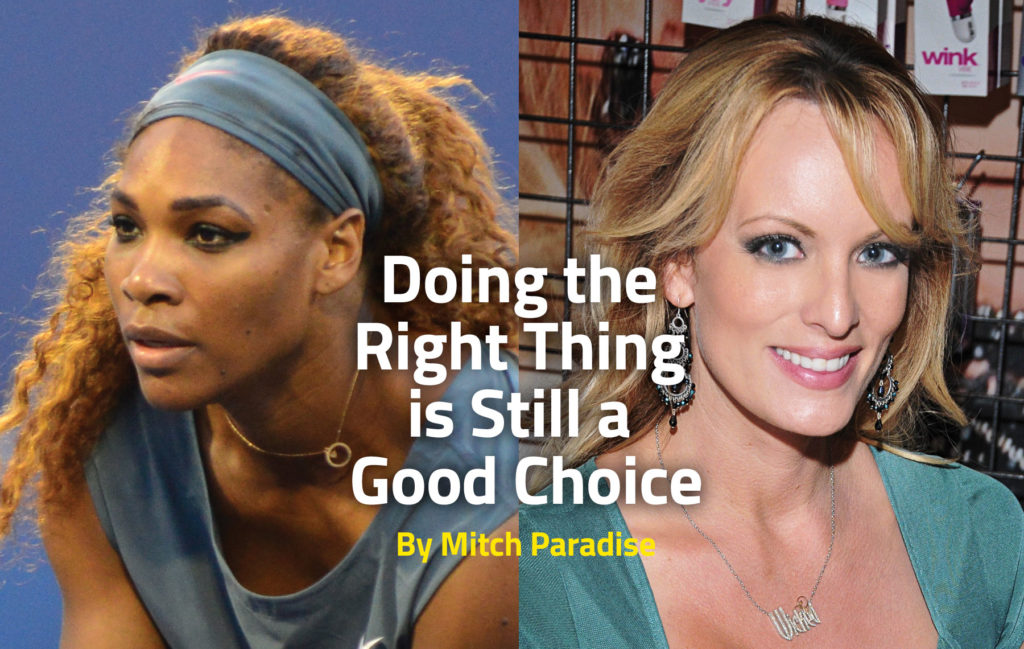
Doing the Right Thing Is Still a Good Choice

Not long ago, I caused a bit of consternation in my modest social media world when I suggested that there might be another way to look at Stormy Daniels, aka Stephanie Clifford, other than as a strong and brave feminist icon. I pointed out that she had an adulterous affair with a married man whose wife had just given birth and Daniels hadn’t done a damn thing about it until circumstances created an opportunity for her to leverage a little blackmail gelt. In doing so, and by keeping the money and failing to go public about the payoff in real time, she became uniquely complicit in the corruption of a U.S. presidential election. She didn’t appear to me to be doing the right thing.  

More recently, at the U.S. Open, Serena Williams demanded the head of an umpire who had the temerity to enforce the rules. First, the umpire warned her (for receiving coaching), then he docked her a point (for racket abuse) and, finally, he penalized her a game after her verbal outburst toward him became abusive (she called him “a thief,” among other things). She went on to lose the U.S. Open match, a Grand Slam final — 6-2, 6-4 — and received minor fines for each infraction.  

Williams immediately made this a “feminist” cause celebre, arguing that no male player would be treated the same way. She said the umpire’s taking a game away for her calling him “a thief” was “sexist.” Tennis icon Billie Jean King jumped to Williams’ defense, tweeting: “When a woman is emotional, she’s [considered] ‘hysterical’ and she’s penalized for it. When a man does the same, he’s ‘outspoken’ & and there are no repercussions.”

After the tennis match, Williams’ coach admitted he had been “coaching on every point” by signaling to her from his seat in the stands, even though coaching is strictly prohibited in Grand Slam events. “Everyone does it,” he said. However, after having been thumped in the first set by her opponent, 20-year-old Naomi Osaka, and even after the first warning, Williams was leading, 3-1, and in control of the second set — but apparently not of herself. So, it was the 37-year-old, 23-time Grand Slam victor who melted down and cost herself the match, and it was first-time champion Osaka who had her moment in the sun stolen by the player she idolized, a player who also went on to tell the umpire, “You will never, ever, be on a court of mine as long as you live.” Interestingly, in the age of the #MeToo movement, that kind of threat should sound ironically familiar here in Los Angeles, where it almost always comes from men of power, directed at women of less power.  

It would seem, then, that perhaps it’s power, not gender, that rules our emotions. And when we lose control of ourselves, even the best of us will say and do the worst things.

Williams is probably the greatest women’s tennis player of all time, and those of us who are huge sports fans have applauded her exploits for two decades. Just the fact that she was out there in a Grand Slam final at the age of 37 — not to mention a year after giving birth and after multiple surgeries for blood clots — testifies to her fortitude and skill.

“Wouldn’t it be better if everyone just abided by the rules and the rules were uniformly enforced?”

But she screwed up. She didn’t become “hysterical,” just as in all the years John McEnroe berated officials did I hear anyone refer to him as “outspoken.” He was a “brat” and a “jerk” and, by the way, he defaulted his way out of the 1990 Australian Open, a Grand Slam event, for an escalating variety of abuse toward an umpire. And it’s not Williams’ first time violating the abuse rules. In her 2009 semifinal match at the U.S. Open, she lost on a penalty point after berating a lineswoman.

In the cases involving Daniels and Williams, people will continue to debate who did the right thing. Was it Daniels for standing up to Donald Trump after the election, or should she have told what she knew when it might have made a difference in whom would govern the land? Was it Williams for standing up for herself, or the umpire for upholding the rules and not allowing himself to be abused?

Daniels broke no laws. She sued Donald Trump to get out from under a nondisclosure agreement she believed was negotiated in bad faith; just because the target of her actions is Trump doesn’t make it right. For Williams, she broke the rules and then doubled down and made her violations worse. There’s a rule against coaching during Grand Slam events. Is “everybody does it” a reasonable defense? Did it work with your mom and dad when you were 12? Probably not. Wouldn’t it be better if everyone just abided by the rules and the rules were uniformly enforced? Heck, in golf, an official walks the course with every group, and if he misses something, the players call the penalties on themselves.  

We just concluded observing Rosh Hashanah and Yom Kippur. On the former we say it is written, and on the latter it is sealed. We think about the life we lived in the previous year, the decisions we made, how we treated people, what kind of success we prioritized, and to what extent we lived up not to our own expectations but the expectations of halachic-based rules — objective standards set for us, not by us. We ask not to be judged according to what other people did or did not do but by what we did or did not do in the eyes of God, and we promise to try to do better in the next year.

Those are tough rules, and the best of us fall short every year — which doesn’t make the aspiration any less valuable or the rules any less important.


Mitch Paradise is a writer-producer and teacher in Los Angeles.  

Doing the Right Thing Is Still a Good Choice Read More »

The Man Who Makes Tech Go ‘Boom’

Editor’s note: This interview was conducted before the death of Fuld’s brother, Ari, who was stabbed by a Palestinian terrorist on Sept. 16. Fuld tweeted shortly after Ari’s murder: “He lived as a hero and died as a hero. My big bro is gone. Thanks for the messages. Really. Just looking for oxygen now …”

In the summer of 2014, Steve Wozniak ­­— the man who helped develop the personal computer — visited Israel for 24 hours. He invited Hillel Fuld, a keen-eyed, peppy Jerusalemite who takes the term “tech aficionado” to a new level, to a breakfast meeting at the David InterContinental in Tel Aviv. It was the height of the Gaza War, and in the middle of their meeting, a siren blared, warning of an incoming missile.

“I had to rush the founder of Apple to the bomb shelter,” Fuld breathlessly recounted. “It was so surreal.”

Wozniak is one of Fuld’s 34,200 followers on Twitter, along with Ellen DeGeneres, Yoko Ono, Ashton Kutcher, Arianna Huffington, Twitter co-founder Jack Dorsey and a host of brands including Coca Cola, Tommy Hilfiger, United Airlines and Windows. 

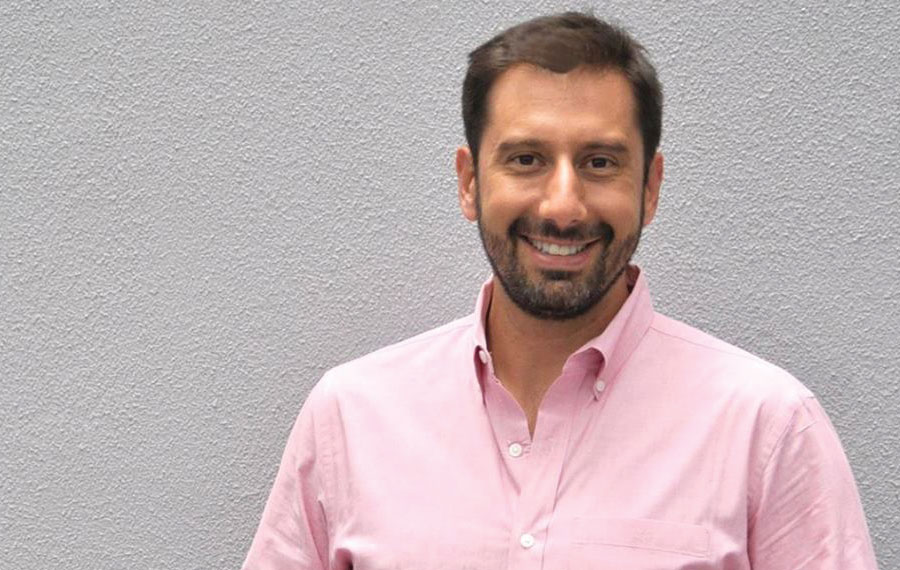
Today, Fuld is the strategic adviser to around 20 Israeli tech companies, advising on all things growth, from social media, content, PR and fundraising, to the art of pitching. He also collaborates with tech giants including Google, Oracle and Microsoft as a mentor and influencer. 

 “I help Israeli tech go ‘boom,’ ” is Fuld’s self-styled tagline. 

When he was 15, Fuld made aliyah from Queens, N.Y., to Jerusalem. For as long as he can remember, he has had a passion for technology, although his wife prefers the term obsession. After completing his military service and receiving a degree in political science anthropology, Fuld wanted to pursue something in the tech arena. At the suggestion of a friend, he took a job as a technical writer at Comverse Technology but was totally unaware that the position entailed drafting user manuals. 

Still, his experience at Comverse — which at the time was the biggest tech company in Israel — was invaluable, he said. At the same time, he began scribbling his thoughts on tech for what he called a “diary on the internet.”

“Today we call that a blog and it turns out that was set to become a thing,” Fuld noted. He amassed a large following and entrepreneurs soon began approaching him for advice. He had no business model and refused to take a dime. “People kept telling me to monetize but I said no. I’m happy to help and money will follow,” he said. 

“I had to rush the founder of Apple to the bomb shelter. It was so surreal.” — Hillel Fuld

He kept his job at Comverse and blogged on the side. “In time, those two things merged and my job became my passion and my passion became my job,” he said. 

“Now I’m living my dream,” Fuld said. “I wake up in the morning, I head to Tel Aviv and meet with truly legendary entrepreneurs who are building world-changing technology. It still makes me pinch myself that they’re taking my advice.”

He credits Twitter for contributing to his success. “I was able to leverage Twitter’s culture of openness 10 levels above what I ever could have dreamed of,” he said. Through the social media giant, Fuld met and interviewed his idol, Marc Andreessen, the billionaire entrepreneur credited with inventing the first web browser. He also met his teenage crush, “Who’s the Boss?” actor Alyssa Milano, with whom he talks regularly. He was recently named the 15th most influential tech blogger on the internet.

“The amount of influence that you can have sitting in your living room wherever you are in the world is phenomenal,” he said.

Fuld is selective about the companies he chooses to work with but said the most important aspect is the people. “At the end of the day, technology doesn’t win, people win.”

Where does he plan to go from here?

“If I won the lottery tomorrow, I wouldn’t change a thing,” he said.

The Man Who Makes Tech Go ‘Boom’ Read More »

Reform Judaism Doubles Down on Zionism

In June, the Reform movement decided to resist the headlines announcing the growing, “unprecedented” rupture between American Jewry and Israel by doubling-down on “our ties to Israel,” in the words of Union for Reform Judaism (URJ) President Rabbi Rick Jacobs. The URJ’s North American board meeting passed a resolution re-affirming the Jerusalem Program, the basic articulation of the Zionist Idea. As the “official platform of the World Zionist Organization and the Zionist Movement,” the Jerusalem Program proclaims that “Zionism, the national liberation movement of the Jewish people … views a Jewish, Zionist, democratic and secure State of Israel to be the expression of the common responsibility of the Jewish people for its continuity and future.”

It’s outrageous. With one move, that darned movement defied three stereotypes distorting the Jewish — and American — conversation about Israel. How dare the Reform movement affirm its loyalty to Israel and Zionism when everyone knows its members are liberal traitors who prove that liberalism and Zionism are incompatible. How dare the Reform movement refute the claim that relations between American Jewry and Israel are deteriorating. And how dare those Reformers resist the universalist and anti-Israel drift everyone insists is sweeping American Jewry!

Apparently, such insolence runs much deeper than a quick, easy resolution. Rabbi Josh Weinberg, the young, dynamic head of the Association of Reform Zionists of America (ARZA), reports that ARZA and the URJ are deepening their institutional ties. “Increasingly,” Weinberg said, “we will be building programming, in North America and increasing our support for our movement in Israel, in the pews, in our camps, and in Israel’s streets, reflecting a basic commitment of every Jew to God, Torah and Israel.” Acknowledging that we’re living through “exciting and challenging times,” Weinberg said, “we’re looking to enhance our connection to Israel and to make Israel a central part of every Reform Jew’s identity.”

Rabbi Josh Weinberg
(Photo from Facebook)

Sarcasm aside, the Reform movement is doing precisely what it should be doing. This valued member of the Zionist movement won’t be defined by its enemies — either within the Jewish world or beyond. True, Reform Jews are overwhelmingly politically liberal. But anyone who knows anything about Zionism knows that Zionism without liberalism ain’t Zionism. Israel’s Declaration of Independence — and daily realities — bring liberal nationalism to life.

Even a brief history of Reform Zionism goes deeper. It proves how Zionist the Reform movement has become. It shows how much closer American Jews and Israeli Jews are than they once were. And it suggests that Reform particularists should have an upper hand in the intellectual civil war they must win against universalists.

“Judaism is fundamentally national,” the Cultural Zionist Ahad Ha’am insisted in 1910, denouncing “the ‘Reformers’” efforts “to separate the Jewish religion from its national element.” Initially, Reform Jewry rejected peoplehood and Palestine. America’s Reform rabbis distorted Jewish history and ideology — anticipating today’s ultra-ultra-Orthodox Jews — in their 1885 Pittsburgh Platform when they declared: “We consider ourselves no longer a nation, but a religious community.”

“Anyone who knows anything about Zionism knows that Zionism without liberalism ain’t Zionism.”

The Holocaust erased any doubts that we are one people, intertwined. In 1937, the Reform movement’s Columbus Platform affirmed the “Jewish people” and their “obligation … to aid” in “up-building Palestine as a Jewish homeland.”

Three decades later, the process peaked. The 1967 Six-Day War’s impact surprised many Reform Jews, deepening, as Reform theologian Eugene Borowitz recalled, “a very personal existential sense of the particularity of what it is to be a Jew, the specificity of being a Jew as a member of an ethnic community.” When “Old Jerusalem was captured and was somehow, to use that marvelous word, ‘ours,’ ” Borowitz wrote, “it hit us with an impact which we couldn’t imagine, and suddenly we realized the depths of roots we had in a very specific place.”

Rabbi Richard Hirsch has made “Zionizing” Reform Jewry his life’s work. A progressive activist who lent his Washington, D.C., offices to Rev. Martin Luther King Jr. during the 1960s, Hirsch moved to Jerusalem in 1973. In establishing the Hebrew Union College’s magnificent campus overlooking Jerusalem’s Old City, Hirsch said the movement was marrying history.

In 2000, Hirsch articulated Reform Jewry’s “Declaration of Interdependence”: “of people and faith, of Jewish tradition and contemporary needs, of the universal and the particular, of Israel and the Diaspora, of each Jew with all Jews. ” The “establishment, protection, and development of the State of Israel are integral premises of Progressive Jewish belief,” Hirsch wrote. “This eternal covenant between God and the people of Israel is inseparable from the Land of Israel.”

Rabbi Richard Hirsch
(Photo from Vimeo)

While ideological rivals, Borowitz and Hirsch affirmed peoplehood and land — not just religion and ethics — as central to Reform Jewry. Rabbi David Ellenson has continued Hirsch’s teaching, demonstrating that the best way to be a good universalist is to be a proud particularist. Dismayed that too many secular Israelis build their identities solely on national and communal lines while too many American Jews build their identities around “individual choice and religious voluntarism above peoplehood and nationality,” Ellenson challenges all Jews to embrace their “national and religious foundations.”

An academic with deep Los Angeles roots, currently serving as interim president of Hebrew Union College-Jewish Institute of Religion, Ellenson celebrates the Jewish people’s “return to history” as an opportunity to apply high ideals developed over millennia in a modern state. “Reform Zionism needs to know and affirm the religious significance of this [political] fact,” he wrote in 2014. Ever balancing, Ellenson explains: “Our Zionism must be built upon the dialectical foundations of universalism and particularism and the interplay between them.”

This is the proud legacy the URJ affirmed. This is the ideological vision it must embrace. I invite Reform Jews to join Jews throughout the world in hosting Zionist salons this year. Read Reform Zionist texts like these, which appear in my book “The Zionist Ideas.” Read other religious Zionists and compare their visions. Discuss progressive Zionists with whom you agree — or even right-leaning Zionists you might dislike.

Let’s jumpstart a modern Zionist conversation, house by house, boardroom by boardroom, synagogue by synagogue. And let’s embrace “identity Zionism,” not only asking what we can do for Israel, but understanding what Israel, land, peoplehood, Zionism, do for us —  individually, collectively, existentially.


Recently designated one of Algemeiner’s J-100, one of the top 100 people “positively influencing Jewish life,” Gil Troy is the author of the recently released “The Zionist Ideas” (Jewish Publication Society), an update and expansion of Arthur Hertzberg’s anthology “The Zionist Idea.” A distinguished scholar of North American History at McGill University, Troy is the author of 10  books on American history, including “The Age of Clinton: America in the 1990s.” www.zionistideas.com

Reform Judaism Doubles Down on Zionism Read More »

Trump Backs Two-State Solution in Press Conference With Netanyahu

President Trump voiced his support for a two-state solution in the Israel-Palestinian conflict in a Wednesday press conference with Israeli Prime Minister Benjamin Netanyahu at the United Nations General Assembly.

Trump was asked by a reporter if his peace plan would involve a two-state solution, prompting Trump to respond, “I like two-state solution.”

“That’s what I think works best,” Trump said. “I don’t even have to speak to anybody, that’s my feeling. Now, you may have a different feeling — I don’t think so — but I think two-state solution works best.”

Trump later added that his peace plan would be presented in two-to-four months and that he hoped to accomplish a deal between the two sides before the end of his first term as president.

The president also said during the press conference that he was confident that the Palestinians would come back to the negotiating table, pointing out that the United States has leverage by zeroing out funding to the Palestinians and that the biggest roadblock to a deal, Jerusalem, has now been taken off the table.

“By taking off the table the embassy moving to Jerusalem, that was always the primary ingredient as to why deals couldn’t get done,” Trump said. “I spoke to many of the negotiating teams, and they said they could never get past the embassy moving into Jerusalem and all of what that meant, which you know what that meant. That meant everything. And now, that’s off the table.”

Netanyahu later told reporters that any deal would allow Israel to maintain its “security control from the Jordan River to the Mediterranean Sea,” according to the Times of Israel.

“Make no mistake: Israel will not give up on security control west of the Jordan as long as I am prime minister,” Netanyahu said. “I think the Americans accept that principle.”

Trump Backs Two-State Solution in Press Conference With Netanyahu Read More »