fbpx

June 20, 2018

In Israel, Hard Cases Make Bad Laws

The Israeli Ministerial Committee for Legislation on June 17 approved a bill proposed by Knesset member Robert Ilatov, chairman of the Yisrael Beiteinu party, entitled “Prohibition against photographing and documenting IDF Soldiers.” If hard cases make bad law, this is indeed a case in point.

Here is what this bad law concerning the Israel Defense Forces (IDF) proposes: “Anyone who filmed, photographed and/or recorded soldiers in the course of their duties, with the intention of undermining the spirit of IDF soldiers and residents of Israel, shall be liable to five years’ imprisonment.” 

First of all, from the practical point of view, even if this law is passed, it will be impossible to enforce. With almost everyone carrying a smartphone today, who will chase the originators of IDF pictures and videos, which will easily spread on social media?

Worse still is the phrase “with the intention of undermining the spirit of IDF soldiers and residents of Israel.” What kind of Orwellian thought police will Israel have to create in order to establish the motives of people who might take pictures of, film or record IDF soldiers? 

Imagine photojournalists these days doing their job on the Israel-Gaza border. And imagine that their cameras catch a Palestinian being killed by an Israeli sniper — obviously a picture or video that, if published or broadcast, might arouse strong reactions. On the one hand, Israelis and Israel supporters might vindicate it by arguing that if Palestinians break through the fence into Israel, it will result in a massacre in the neighboring Israeli kibbutzim. On the other hand, some might argue that there must be better ways to stop the Palestinians short of shooting at them. This is a healthy debate, one which shouldn’t be hampered by self-defeating legal intervention. 

If the IDF is “the most moral army in the world,” then there is no need to hide anything.

Take for instance the case of Elor Azaria, the former Israeli soldier convicted of manslaughter for killing an incapacitated Palestinian terrorist. Surely Ilatov, the initiator of the current bill, had this incident in mind. Indeed, the release of the video of the shooting caused a turmoil. Without it, however, Israelis would have been denied the knowledge that there was a rotten apple in their cherished IDF, and things like that could have been repeated without the punishment and condemnation they deserve. 

And why stop at photos and video? What about print? Surely, the reports for The New York Times that Neil Sheehan sent from Vietnam during the war were unsettling, but would anyone seriously think about prosecuting him for “undermining the spirit of American soldiers and residents of the United States”?

Also, this ill-conceived move goes against the trend in other areas, like the monitoring of police conduct. Most studies on the use of body cameras by police officers show an improvement in transparency, trust of the public in the police and easing of tensions. Why must Israel single itself out as a reactionary force?

This ill-conceived bill is part of a greater scheme by the Israeli government aimed at harassing people who oppose its policies. Recently, some human rights activists were deported from Israel upon arriving at Ben Gurion Airport. Instead of doing that, Israel should let anyone enter and then debate with them. At the age of 70, our country should be self-confident enough to do that. The more people know about Israel from first-hand experience, and the more they meet real Israelis, the more nuanced their perspective of Israel becomes. 

Personally, I think that in the current Gaza violence, the IDF’s conduct is reasonable, and that probably no other democracy in the world would have come up with better solutions for this kind of challenge. However, I wouldn’t like my government to chase or imprison people who beg to differ. 

Defense Minister Avigdor Lieberman, who praised the bill proposed by his party member, has called the IDF “the most moral army in the world.” If this is true, then there is no need to hide anything. Let the world see for itself. It is our job, then, to give context to the pictures and the films.

Uri Dromi is the director general of the Jerusalem Press Club. From 1992-96, he was a spokesman for the Israeli government.

In Israel, Hard Cases Make Bad Laws Read More »

From My Female Gaze 

Lately, reviewing life through the prism of the #MeToo movement, I’ve grown sensitized to the uneasy alliance young women make with the male gaze.

Ordering a hamburger at Hooters, I scoff at the owl’s eyes logo that are its decoys, that the waitresses’ skimpy garb is consensual, and the food an afterthought. The menu’s enticements sour my appetite: “go boneless;” “naked thighs;” “it’s love at first bite;” “don’t let your main dish be lonely.” Oh, c’mon. How can a person digest when men are encouraged to drool over the servers?

I’ve eaten at Eggslut, suspicious of its offering of “cage free, coddled eggs.” The workers dress modestly and seem free-range, but a company that shames an innocent, infertile egg for being promiscuous strikes me as warped. It’s always crowded with lusty diners of all genders, so maybe it’s just me.

Isn’t the TV show “SMILF,” created by Frankie Shaw as a vehicle for herself, a blatant invitation to males to see her in that salacious way? (For those who don’t know what that acronym means, Google it.) Does her objectification of her lovely young mother’s body appeal to any female viewers? Does Showtime even care? These encouragements for boys to behave badly make me nervous at how mixed our messages are.

But the deaths of Philip Roth and Hugh Hefner, two brilliant voices for the penile perspective in our culture’s last century, has me flashing back on my own dances with the male gaze.

Maybe it was my father’s smarmy male friends who first caused me double vision. I learned to feel both how they were seeing me and see them at the same time. My self-image got blurred and I became a wary, self-conscious girl. Like most young women at that time, I intuited that men’s attentions could be manipulated with the only marketable currency we had.

Phil Spector discovered me doing the Watusi (before that was revealed to be a racial slur) at a bar mitzvah, and hired me to be one of two white go-go girls for the Crystals, whom he was trying to crossover to larger markets. Forget baby-sitting. There was no way I could have earned meaningful money at 15 without trading on my appeal and I relished the exchange. In cold and drafty concert halls, guys’ eyes on my exhibitionism kept me warm.

Maybe it was my father’s smarmy male friends who first caused me double vision. I learned to feel both how they were seeing me and see them at the same time. 

My first professional acting role was as a prostitute in “The Threepenny Opera.” Using the character for comic effect made me feel safer and set me on a clear career path. As an actor in comedy, I played many roles that satirized men’s attraction to women. I confess I liked being the butt (and breast) of the jokes on them.

All the celebrity women duos participating in “What a Pair,” benefiting breast cancer research, received fluffy Bunny slippers from Playboy, a benefactor that owed breasts bigtime. We accepted their whole swag bag, knowing we were whores for a good cause. Inspired, I created a celebrity kissing booth to benefit the Women’s Clinic of Los Angeles. With squares of pink saran wrap serving as a prophylactic with each smooch, at $50 a pop, I was proud, not only that our kisses could earn free mammograms for impoverished women, but of the sanitary nature of each saliva-free transaction.

So, am I growing sourer in my grapes because I’m entering the adolescence of old age, and am objectified less? Am I arrogant because I now have enough money in the bank and enough husband in the bed to not have to succumb to exploiting my body for male approval?

Am I a hypocrite because I still try to play up my desirability wherever I go?

Yes … And …

Playing a victim of a gang rape in Eve Ensler’s “Vagina Monologues”; howling at Amy Schumer’s parody of Hooters, in which waiters at a restaurant called O’Nutters wear revealing tights to celebrate their testicular contours and cleavages, I revel in the vaginal viewpoint getting validated. I celebrate female stand-ups, writers and directors giving louder voice to the woman’s side of stories. I thrill that the girls growing up today have a better shot of developing a healthy, unified vision of their bodies and their worth that doesn’t get blurred by their boyfriends or employers.

And that I will get to experience an evolution in understanding and behavior, including my own, that I believe can happen now.

Melanie Chartoff has acted on Broadway and on TV series, and is featured in “Chicken Soup for the Soul: My Crazy Family.”

From My Female Gaze  Read More »

German President Discusses Iran Nuclear Deal and Anti-Semitism

In a discussion with Jewish leaders at the Simon Wiesenthal Center’s Museum of Tolerance on June 18, German President Frank-Walter Steinmeier discussed a range of issues, with a focus on the Iran nuclear deal and the rise in anti-Semitism in parts of Europe.

On the Iran deal, Steinmeier acknowledged it would be difficult for Europe to continue to uphold the deal because President Donald Trump, in walking away from the agreement, had laid out secondary sanctions on companies doing business with Tehran. He also said he didn’t think the Iranian mullahs would relinquish their grip on power anytime soon.

Steinmeier was Germany’s chief negotiator when the Iran deal was forged in November 2013. In October 2015, Steinmeier hailed the agreement as “an opening for further diplomatic endeavors.” On May 6, Steinmeier told ARD, a German public news outlet, that former U.S. Secretary of State John Kerry was correct in saying that the deal avoided war.

“One has to remember what could happen if this agreement collapses again and new re-armament takes place in the Middle East,” Steinmeier told ARD.

Two days after Steinmeier made those remarks, Trump announced the U.S. was exiting the Iran deal, arguing that it enriched and emboldened Iran’s reign of terror in the Middle East. After his announcement, Simon Wiesenthal Center Dean Rabbi Marvin Hier and Associate Dean and Global Social Action Director Rabbi Abraham Cooper praised Trump’s decision.

“Leaving the status quo with Iran awash with billions of U.S. taxpayers’ cash would only ensure a growing circle of violence and terrorism in the region and ultimately could help pave the way for a nuclear arsenal that could reach our shores,” Hier and Cooper said in a statement.

During his visit, Steinmeier, together with a German delegation that included Germany’s ambassador to the U.S. and 10 members of the federal parliament, took a tour of the museum led by Hier, Cooper, the Wiesenthal Center’s Executive Director Rabbi Meyer May and Board Chairman Larry Mizel. 

Steinmeier became the first German official to read a letter at the museum written by Adolf Hitler in 1919, in which Hitler first outlined his plans for the annihilation of the Jews.

Steinmeier became the first German official to read a letter at the museum written by Adolf Hitler in 1919, in which Hitler first outlined his plans for the annihilation of the Jews.

Hier told the delegation that Hitler wrote the letter when he was working for the Bavarian army’s propaganda section. Asked to respond to a Bavarian army undercover agent – — Adolf Gemlich — whether Jews were responsible for backstabbing Germany during World War I, Hitler wrote a four-page letter to Gemlich that read in part: “Anti-Semitism stemming from purely emotive reasons will always find its expression in the form of pogroms. But anti-Semitism based on reason must lead to the systematic legal combating and removal of the rights of the Jew, which he alone of the foreigners living among us possesses (legislation to make them aliens). Its final aim, however, must be the uncompromising removal of the Jews altogether. Both are possible only under a government of national strength.”

About 22 years later, Hier said, those words became a “horrifying reality for Jews in Germany.” 

In response to today’s rise in anti-Semitism, including a June 8 Al Quds Day protests in Berlin with 1,600 protestors showing support for the Iranian regime and calling for the destruction of Israel, Steinmeier said that Germany expects newcomers to understand Germany’s past and to abide by the laws of the nation, including the protection of its Jewish minority.

At the end of his visit, Steinmeier told reporters: 

“Germany and the United States are bound by our eagerness to develop democracy, so we are looking not only backward to the past, we are looking to the future where digitalized communication will influence our daily life and our societies, and will change for sure the liberal democracies.”

German President Discusses Iran Nuclear Deal and Anti-Semitism Read More »

How an Israeli Movie Became a Tony-Winning Musical

A 2007 Israeli movie about Egyptian musicians who take the wrong bus and end up in a tiny Negev desert town is now Broadway’s biggest sensation. 

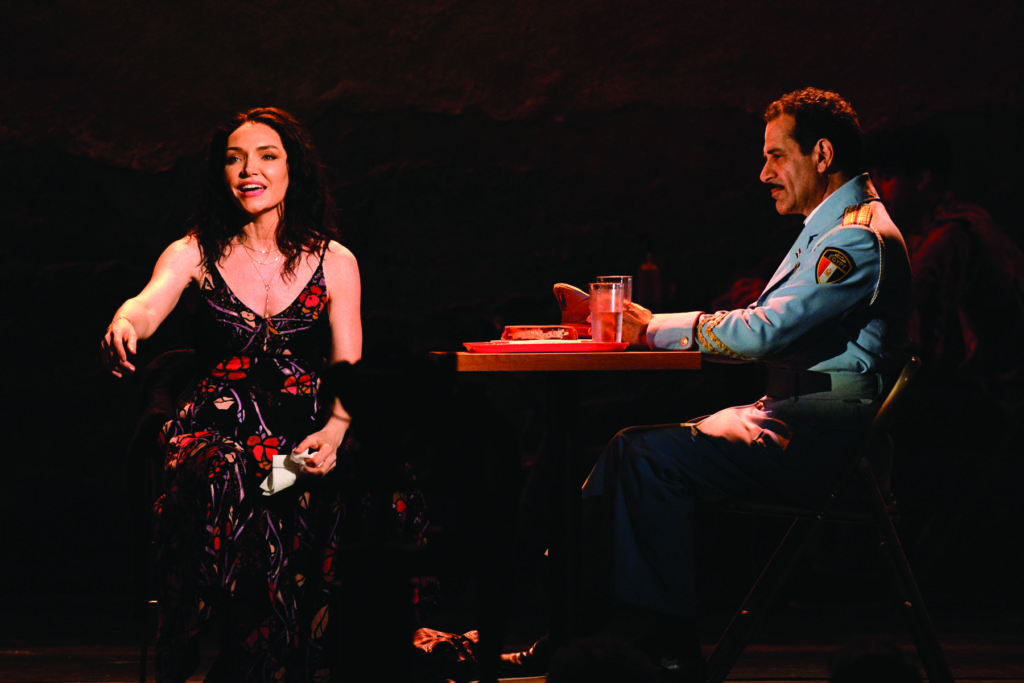
“The Band’s Visit” dominated the 72nd annual Tony Awards, winning 10 of the 11 categories in which it was nominated, including best musical.

“I’ve had almost a week to process it, and it’s beginning to feel real,” best book of a musical winner Itamar Moses said in a telephone interview. “I wasn’t counting on me winning and I never thought we would win close to 10 [Tonys]. It was an insane and wonderful night.” After a round of celebratory parties, “I was in bed by the reasonable hour of 3 a.m.” 

The show “definitely did get a box office boost after the Tonys,” Moses confirmed, but it has been an audience and critical favorite since it opened in November 2017. 

“When we first started working on it, we thought we were making something idiosyncratic and small and unusual but also very poetic and emotional,” Moses said. “We thought it would find its audience but it arrived at a political moment when audiences were hungry for [its] messages, the idea that we’re enriched when we don’t close ourselves off to love and connection, and in a larger sense, close off our borders and shut people out. Its hyper-specificity resonates and allows it to be universal.”

Best Musical goes to The Band’s Visit at THE 72nd ANNUAL TONY AWARDS broadcast live from Radio City Music Hall in New York City on Sunday, June 10, 2018 on the CBS Television Network. Photo: John P. Filo/CBS

Moses first watched “The Band’s Visit” in late 2013 when producer Orin Wolf proposed making the movie into a musical. He began writing a draft, without songs, and then collaborated with composer David Yazbek to figure out where those songs would go. Modifications and additions were made in workshops and during the off-Broadway versions of the show. 

Although the basic story remained the same, Moses replaced elements that wouldn’t come across on stage and fleshed out some characters that appear only briefly in the film. 

The idea of hostile governments matters less when you strip it down to a bunch of strangers needing something to eat and a place to stay. It reminds us that we’re all just human.” — Itamar Moses

There are some small moments of wariness on both sides “that gesture toward political reality,” Moses said. “Like the movie, it has an enormously political message in the absence of overt politics. The idea of hostile governments matters less when you strip it down to a bunch of strangers needing something to eat and a place to stay. It reminds us that we’re all just human.”

Casting actors of Middle Eastern descent as the Egyptian musicians made sense and “was the right thing to do,” Moses said. Ari’el Stachel, who won the Tony for best supporting actor, is the California-born son of a Yemeni-Israeli father and Ashkenazi Jewish mother from New York. Iranian Dariush Kashani temporarily has replaced Tony-winner Tony Shalhoub as bandleader Tewfiq, but Iraqi actor Sasson Gabay, who played the role in the movie, will take over the role on June 26.

The show’s creators also have Middle Eastern heritage. David Yazbek’s father is Lebanese and his mother is Italian and Jewish. Moses, who was born in Berkeley in 1977, has Israeli-born parents who met in the military. His mother’s parents left Poland for Palestine in the 1920s and became kibbutzniks, and his father’s family — assimilated German Jews — were in denial about the Nazis and ended up escaping Germany just in time. 

Moses was brought up in a “hippie Northern California version of Judaism” that involved a Jewish day school, a Jewish youth group and Jewish friends who are still in his life today. “I went to Yale and now I work in the New York theater. I’ve always moved in spheres with a big Jewish presence,” he said. “There’s also something about the way I think and the way I write that feels Jewish. There’s something talmudic about playwriting. It’s about wrestling with a question that’s somehow unanswerable, considering all sides of it and, in the end, then throwing up your hands at the audience and saying, ‘What do you think?’ That’s very Jewish.” 

Best Book of a Musical goes to Itamar Moses for The Band’s Visit at THE 72nd ANNUAL TONY AWARDS broadcast live from Radio City Music Hall in New York City on Sunday, June 10, 2018 on the CBS Television Network. Photo: John P. Filo/CBS

Inspired by his interest in sci-fi fantasy novels, Moses wanted to be a writer as a kid, but discovered theater late in high school and continued to pursue it in college and in his post-graduate studies at New York University, concentrating on playwriting. His credits include “The Four of Us” and “Fortress of Solitude” on stage and “Boardwalk Empire” and “Men of a Certain Age” on television.

His new play, “The Whistleblower,” about a television writer who has a nervous breakdown and starts telling the unvarnished truth to everyone in his life, will premiere in Denver next year. 

Meanwhile, plans are in the works to launch a national tour of “The Band’s Visit” in late spring 2019. “I assume L.A. is on the list,” he said, noting, “we’ve gotten inquiries” about taking it to Israel. “Of course we want to go. Our producer is also optimistic about other places in the Middle East.”

For Moses, winning the Tony for his first Broadway show is his greatest achievement since he learned for the first time that a regional theater would produce one of his plays. “A career in theater is very up and down,” he said. “This is one of those once-in-a-blue-moon moments that feels like things have changed in a permanent way.”

How an Israeli Movie Became a Tony-Winning Musical Read More »

Simon Wiesenthal Center SMACKS Child Separation Policy Critics for Invoking Holocaust Comparison

The issue of separating children from their parents at the border has sparked an intense, emotional debate throughout the country over the past few days, even causing some to compare the policy to Nazi Germany. The Simon Wiesenthal Center has had enough of those comparisons.

Among those who have made the Nazi comparison include former CIA director Gen. Michael Hayden and former CNN host Soledad O’Brien:

Sen. Dianne Feinstein (D-CA) also seemed to invoke the comparison on June 19, telling MSNBC’s Chris Hayes: “This is the United States of America. It isn’t Nazi Germany, and there’s a difference. And we don’t take children from their parents until now and I think it’s such a sad day.”

Additionally, MSNBC’s Joe Scarborough ranted on June 15 that the children at the border “are being marched away to showers,” adding that “the Nazis had said that they were taking people to the showers and then they never came back.”

The Simon Wiesenthal Center’s Rabbis Marvin Hier and Abraham Cooper condemned such comparisons in a June 19 statement, saying that while the child separation policy is “unacceptable,” comparisons to the Holocaust are “sickening.”

“All they achieve is to demean the memory of 6 million Jews murdered by the Nazis and confuse young people who know little or nothing about history,” Hier and Cooper said. “Our border guards and Homeland Security personnel are the opposite of Nazis. Critics should stop slandering them. We live in the world’s greatest democracy. Our elected officials have the tools to fix what’s broken and our national debate shouldn’t be tainted by Holocaust revisionism and misappropriation.”

On June 20, President Trump announced that he would be signing an executive order to end the policy. His action is expected to be challenged in the courts, as it contradicts a 9th Circuit Court decision. The administration is hoping that Congress can change the law.

Simon Wiesenthal Center SMACKS Child Separation Policy Critics for Invoking Holocaust Comparison Read More »

Pixar’s Questions and Answers About Jewish Identity

I have learned a lot from Pixar films. They have a special ability to create incredibly entertaining films with deep lessons about humanity, empathy and love. 

Initially, I thought “Incredibles 2” was consciously pushing back against Pixar’s established reputation for meaningful, animated films; that it offered up only entertainment without a sense of enlightenment or emotional impact.

The deep message of the film became clear to me only after I understood its connection to the Pixar short that preceded it, a poignant film called “Bao.” 

“Bao” tells the story of a lonely, middle-aged Chinese immigrant mother’s relationship with her American-born son, portrayed as an adorable bao -— a steamed bun with a meat filling.

The story arc is familiar to American Jewish families because it was also our story in the early to mid-20th century. As much as his mother tries to Chinese-ify her bao son, he rejects his ethnic background in favor of the American melting pot. The final straw for his mother is when he marries a very white, very blond, very American girl. Mother and son eventually reconcile and the film ends with the mother, her son and her enthusiastic daughter-in-law learning to make bao.

“Bao” asks a question that has always been important to Jewish Americans: How do we pass on Jewishness to our children without swallowing them whole?

The answer is actually found in “Incredibles 2.” There is societal backlash against superheroes. It is against the law for them to save anyone and “supers” are even described as “illegals.” The Parr (aka the Incredibles family) children must feel conflicted about their existence. They are “supers” but there is shame and anxiety attached to their inherited identity. Their parents basically relegate them to glorified baby sitters and this creates additional resentment. As such, there are echoes of “Bao” in “Incredibles 2.” And yet, the Parr children do not rebel or reject their identity. They embrace it. 

Empowering our children is the superpower we need in order to repair our world.

When Mr. and Mrs. Incredible are captured and unable to save themselves, the Parr children promote themselves from baby sitters to superheroes, rescue their parents and save the world. 

If we want our children to embrace their heritage and identity, they must be promoted from observers and consumers into builders and creators. We need to empower them. Youth groups and teen minyans are not enough. Trips to Israel for teens and young adults are insufficient. Those are experiences manufactured by adults for their children to enjoy. They teach. They preach. They do not empower.

Jewish institutions often wonder how to “attract” millennials and members of Generation Z. They do not need to be attracted. They need to be empowered. Include younger people in important conversations. Value their voice. Give them real leadership roles. Hear what they say about Jewish identity and practice. Give them a seat at the adult table at Shabbat dinner. Allow them to help shape family customs and rituals. Really listen to them.

The Torah commands parents to teach their children about the Exodus in several places. In Deuteronomy, it says, “Tell the story to your children and you will know that I am your God.” But it should say “and they will know.” When we talk to our children about important things — and we listen to their responses -— it helps us understand. This is the secret to Jewish continuity.

Empowering our children is the superpower we need in order to repair our world.

Eli Fink is a rabbi, writer and managing supervisor at the Jewish Journal.

Pixar’s Questions and Answers About Jewish Identity Read More »

What Can We Learn From the Altalena?

The Altalena affair has gone down in the annals of Jewish history as the moment a civil war was averted. A mere five weeks after declaring statehood, Jew was fighting Jew. It was Palmach vs. Irgun. David Ben-Gurion vs. Menachem Begin. Pragmatist vs. idealist.

The Altalena — carrying arms, volunteers and Irgun men — was docked off the coast of Tel Aviv when, soon, the bullets started to fly. This was just as the British anticipated. They warned that after they vacated the land the Jewish people would be too opinionated and too fractured to band together. 

And yet, Begin made a startling decision: “Do not shoot back!” he told his men. That Begin chose to sublimate himself and his organization to the will of the newly founded state is perhaps one of the defining moments in modern Israeli history and broader Jewish history, and he deserves credit for transcending his beliefs in the service of a cause bigger than himself.

In fact, it was not the first time Begin resisted the retaliatory instinct. In 1944, when Ben-Gurion decided to support the Allies (including the British) against the Nazis, Begin was determined to rebel against the British. Ben-Gurion would not allow for such dissidence and even turned in some Irgun fighters to the British. Begin, instead of responding in kind, told his men to restrain their desire for revenge against Ben-Gurion. “Ki Yehudim anachnu,” he said. “Because we are Jews.” 

It would not be intellectually honest, however, to revere Begin as someone who invariably placed the preservation of the Jewish state above his personal convictions. Just three years after commanding his men not to shoot during the Altalena affair, he took a radically different approach when it came to the issue of reparations from Germany.

No matter where we fall on the ideological spectrum, we all ought to internalize the mantra of Begin. Let’s put down our arms. A Jew does not shoot at a Jew.

In 1951, Israel’s economy was in a precarious state. Israel had a severe shortage of housing for the waves of new immigrants, there was food rationing and the country was in a desperate place. On Sept. 27, 1951, West German Chancellor Konrad Adenauer offered assistance to Israel to bring about a solution to “the problem of material restitution” after Israel absorbed so many homeless refugees. Begin, whose parents were killed by the Nazis, was incredulous that such an offer could even be considered from a country that murdered 6 million Jews.

On Jan. 7, 1952, he unleashed an impassioned diatribe against his archnemesis, then-Prime Minister Ben-Gurion, that would result in his three-month suspension from the Knesset. “There will not be negotiations with Germany, for this we are willing to give our lives. It is better to die than transgress this. There is no sacrifice that we won’t make to suppress this initiative. This will be a war of life and death. Today, I shall give the order: Blood!” 

Still, when push came to shove, there was no blood from Begin. In the end, the Knesset voted to accept the reparations from Germany — despite Begin’s protestations — and Israel’s economy greatly benefited from this decision.

As an educator, when I study Begin’s decision not to shoot back at the Palmach during the Altalena affair and his resistance to German reparations, I am fascinated by the implications for the Jewish community as a whole. So many complex questions come to mind: 

When do we sacrifice? 

When core values collide, how do we determine the right course of action? 

When do we follow pragmatism, and when is idealism not just the preferred approach but the ethical one?

What is our North Star? 

Which principles are existential red lines that we dare not cross? 

As individuals, when do we drive our decisions not by what is in our personal best interest but rather by what serves the interest of the greater good of our community and nation? 

When is survival and self-preservation the primary value, and when is self-transcendence in service of a larger cause ideal?

As a teacher, this is what I ask myself and my students to ponder.

And yet, despite all the complexity, I still see a point of clarity. Yes, Ben-Gurion was the first prime minister and the founding father of the modern state of Israel. In my mind, though, it is the clarity of Begin’s vision that has penetrated more Jewish souls. 

No matter where we fall on the ideological spectrum, whether we’re Likud or Labor, we all ought to internalize the mantra of Begin. Let’s put down our arms. A Jew does not shoot at a Jew. It’s as simple as that. No equations, no proofs, nothing. Why?

It’s a simple maxim: “Ki Yehudim anachnu.” “Because we are Jews.”

Dr. Noam Weissman is senior vice president of education at Jerusalem U.

What Can We Learn From the Altalena? Read More »

Sinking the Altalena

The affair defined and galvanized the ethos of Israel’s right-wing minority. But today it plagues and derails the ethos of the new right-wing majority. After 70 years, it is time to forget.

Seventy years ago this week, on June 21-22, 1948, Israel got as close as it ever has to a civil war. Patriotic Jews fired on patriotic Jews. Battle-ready Jews bombed battle-ready Jews. The enemy was attacking and trying to destroy a very young country. But for two days, its defenders were busy fighting and killing one another. Some wounds never heal, Israel’s President Reuven Rivlin said recently about this short affair. Rivlin was not even 10 years old when the “holy cannon” fired on the beach of  Tel Aviv.

This affair has a name, short and easy to remember. Just say the word “Altalena” and everything comes back to life: David Ben-Gurion, then-prime minister and the leader in charge; Menachem Begin, leader of the victims and a future prime minister; Yigael Yadin, future Israel Defense Forces (IDF) chief of staff and defense minister; and Yizhak Rabin, future IDF chief of staff, defense minister, prime minister — and the future victim of a civil-warlike atmosphere. Say “Altalena” and emotions surface,  pitting the Labor movement against the “revisionists,” and pitting the secular, socialist Israel against the traditional, Sephardic nationalists of the “second Israel.”

The Altalena was a ship, and its name invokes a defining moment in Israel’s history. 

Originally a U.S. Navy landing craft used during World War II, the Altalena was purchased for the Etzel, better known in English as the Irgun. The Etzel was an armed Zionist organization that operated in pre-state Palestine from 1931 — an organization that began as an offshoot of the Haganah, the armed faction of the Zionist movement. While the Haganah was dominated by Labor Zionists, Etzel was a group of Revisionist Zionists who based their philosophy on the writings and ideology of Zeev Jabotinsky. Altalena was Jabotinsky’s pen name. 

Some wounds never heal, Israel’s President Reuven Rivlin said recently about this short affair. Rivlin was not even 10 years old when the “holy cannon” fired on the beach of  Tel Aviv.

The Altalena was loaded in a French port with refugees and volunteers — almost 1,000 men and women. It also was loaded with tons of arms and explosives intended to assist the young state that was fighting for its life in a bloody war of independence.

But there were complications. An agreement was signed in early June to absorb all Etzel units in the newly formed IDF — as the state needed a unified military and not the fighting forces of different pre-state factions. A United Nations-mandated cease-fire was declared as the Altalena was leaving France. Because of the cease-fire, a debate ensued over both the timing of the ship’s arrival and the destination of its arms cache. Ben-Gurion believed that the state owned all arms and hence had the authority to decide how the weapons would be distributed. Begin wanted to arm the units of former Etzel members within the IDF, which was poorly equipped and dismissively treated by the high command. 

More complications have entered into the story today, with perspectives often tainted by the ideology of and sympathy for — or antipathy toward — the leaders involved.

Begin at some point did not want the ship to sail, and there was a power struggle within Etzel concerning the ship’s fate. Begin, some believe today, was forced by his colleagues to board the ship. Mistakes were made during the crisis. Misunderstanding might have been the reason the first shot was fired. And of course, it was all shrouded in great animosity between people who fought for the same goal — guarding a state that was just born — while keeping an eye on their ideological rivals. 

To say that Ben-Gurion disliked and distrusted Begin would be an understatement. Thus, when Capt. Monroe Fein and military commander Eliahu Lankin steered the Altalena to the shores of Kfar Vitkin on June 20, 1948, Ben-Gurion issued an ultimatum that was handed to a military officer on the scene. The Etzel commanders were given 10 minutes to consider it: “I was authorized to demand that you hand over the weapons for safekeeping, and also to ask you to contact the supreme command. You are required to carry out this order immediately. If you decline to carry out the order, I shall use all the means at my disposal and implement the order.”

Begin did not accept the demand. The ship was then attacked but escaped. Its next destination: Tel Aviv — where Begin and some of his friends believed the atmosphere would be safer and calmer for negotiations. 

This was not to be. Suspicion and animosity derailed all such attempts. Some senior members of Etzel believed that the government was determined to assassinate Begin. But Ben-Gurion was determined to prevent what he perceived as mutiny.

A few years ago in an interesting, thought-provoking article,  historian Moti Golani argued that Ben-Gurion’s true fear was not the Etzel, a relatively small, relatively weak fighting force. Rather, he was more worried about the activist left — political rivals from within the establishment who had much more effective means to challenge his authority. So, Ben-Gurion made this show, when the city was watching, to make it clear that only one man was issuing orders to the armed forces of the new state, Golani wrote.

Ben-Gurion gave orders to block all attempts to unload the ship. When such attempts were made, an exchange of fire ensued. He then decided to use a cannon to sink the ship. Yadin requested the order in writing. He got it. At 4 p.m. on June 22, the ship was bombed and engulfed in flames. The people still aboard — many had disembarked earlier — jumped into the water.

Altalena was a seminal affair that we must remember and retell as we educate the next generation of Israelis. It is also a long-ago affair that should no longer play a role in Israel’s political arena. 

Rabin was standing on the beach, watching the scene. “The members of Etzel on the beach are hysterical,” he wrote in his diary that day, describing the events. “They are crying ‘Begin is on the ship! Begin is on the ship. Save Begin.’ … I do not know if Begin is in the ship. I do know that the ship is burning and that this affair is over, and that we don’t need more casualties.”

Begin was not hurt. An order to arrest him was issued, but he managed to escape. A ship was sinking and a legend would be born — a multifaceted, intergenerational legend. For the establishment, it was the legend of the “holy cannon” that stopped an armed rebellion. For the opposition, it was a legend of oppression and libel. 

The ship’s burned-out hull sat on the Tel Aviv coast for almost a year, until Ben-Gurion ordered the navy to drag it out to sea and sink it.

The event left a deep scar that is still evident. The old establishment is no longer in power. It was toppled in 1977 by Begin, a knight of democracy who would never raise a hand in rebellion against the elected government of the Jewish state. Begin took Rabin’s seat, then passed it to his successors, members of the Likud Party. The Altalena was for many years their battle cry — the political fuel that ignited great fire. In 1959, when Begin was a reviled opposition leader boycotted and mocked by Ben-Gurion and his colleagues in power, he spoke out to accuse them of murder:

“Mr. Ben Gurion,” Begin declared on the Knesset podium, “from this stage you accused me of planning and organizing an armed rebellion. This is a very serious allegation. I — compatible with the truth — accuse you of false charges and blood libel. I accuse you of conspiracy and of secretly conniving to kill and destroy. … I accuse you of an attempt to ignite a civil war in Israel while the enemy is upon us. I accuse you of a murder of 20 volunteers, pure and holy.”  (Actually, 19 were killed during the Altalena affair — 16 Etzel fighters and three IDF soldiers.) 

As Begin continued his accusations, the speaker of the Knesset — Beba Idelson, a member of Labor —  demanded that he stop.

Idelson: “I am very sorry. I cannot let you say such things.” 

Begin: “Not a single word will be taken back.”

Idelson: “You said, ‘murder.’ ”

Begin: “Madam speaker, that is the truth, and one does not take back a word of truth.”

Idelson: “I will demand to erase this from the protocol.” 

Begin: “I will not agree to it. I will not erase a single word from the protocol.”

Was the attack on the Altalena murder? A few years ago, an invitation to the official ceremony commemorating the event contained the word “murdered,” referring to the victims. Then-Defense Minister Ehud Barak ordered a corrected invitation be issued. But the 1959 debate between Begin and Speaker Beba Idelson never died. A second and third generation of Likud Party members consider the Altalena affair “murder.”

A few years ago, when Prime Minister Benjamin Netanyahu argued that the Altalena affair was the result of a mistake made by a young government, Minister Yariv Levin, the nephew of Altalena’s commander, challenged him: “We need to say it clearly,” Levin said. “The 16 victims of Altalena were murdered by their own brothers.”  

Likud members also consider the Altalena affair proof that their leader was morally superior to Ben-Gurion. Begin, according to multiple testimonies, was standing on the ship’s deck, warning his friends not to return fire, so as not to start a civil war. They consider it proof that their political rivals will do everything to retain their positions of power.

Thus, the Altalena affair lives. The decendants of its dead and wounded are no longer the hunted minority, their leaders are no longer lepers cast aside, their ideology no longer considered a fringe insignificance. Still, these decendants often engage in self-righteous pity, bombast and populism of the weak. They often act as if they are a struggling faction pitted against a mighty establishment armed with “holy cannons.” From 1948 to 1977, the Altalena affair defined and galvanized the ethos of Israel’s right-wing minority; from 1977 until today, the Altalena affair has plagued and derailed the ethos of Israel’s right-wing majority.

An especially ugly demonstration of this derailment came after the assassination of then-Prime Minister Yizhak Rabin. Almost 50 years after the Altalena affair, Rabin’s murder was another painful reminder that Israel was not immune to internal violence. It was also, for some, a reminder of the role Rabin played in the Altalena affair. As the nation was mourning, conspiracy theorists whispered a legitimizing argument hinting that the assassination was a payback for him sinking the Altalena. In fact, some scholars believe that the Altalena story was instrumental in legitimatizing Rabin as a target for assassination even before the murder.

As is usual for such theorists, the campaign against Rabin involved truth and lies, historical facts and historical fabrications. And it slowly creeped into the narrative that mainstream Likud members are willing to repeat, as fact or at least as a question. “The Jew who pulled the trigger, later a prime minister, scarred the history of Zionism,” Minister Ophir Akunis said at an Altalena commemoration ceremony, no doubt referencing the myth that Rabin was the operator of the holy cannon. 

Rabin was not the operator of the cannon. Historian Shlomo Nakdimon detailed his exact participation in the battle. Rabom threw a grenade, as he admitted in his diary. He demanded that soldiers obey the orders — when some of them hesitated to shoot. But his role in the affair was incidental and marginal. His role was exaggerated, manipulated and distorted to achieve a political goal — to delegitimize him and his legacy, and even to legitimize his bitter end. 

So, the Altalena affair is, indeed, a cautionary tale. It cautions Israel against letting itself deteriorate into such a situation. It cautions potential rebels against challenging the government. It cautions the government against using violence when other means are available. It cautions politicians that using aggressive means against a rival can have long-term, unexpected consequences. It cautions citizens against succumbing to peculiar theories of little validity. 

It also cautions — or ought to caution — against having too long a memory. Altalena was a seminal affair that we must remember and retell as we educate the next generation of Israelis. It is also a long-ago affair that should no longer play a role in Israel’s political arena. The establishment no longer threatens the revisionist minority. The government is no longer fragile and in doubt. Hence, the inclination of a certain political faction to keep utilizing the story of the Altalena as justification for keeping a fight alive is becoming dangerous.

Because, in these people’s eyes, Israel seems like an ocean, and all its disliked institutions — the media, the courts, the nongovernmental organizations, the opposition,
the critics, the leftists, you name it — seem like sinkable ships.

It is one thing, when one is in the minority, to derive energy for a political fight by utilizing a shared, agonizing memory. It is quite another to utilize the same story of victimhood and injustice when one has been, for quite some time, a majority.

At 70, it is time to let this history be history.

Shmuel Rosner is senior political editor. For more analysis of Israeli and international politics, visit Rosner’s Domain at jewishjournal.com/rosnersdomain.

Sinking the Altalena Read More »

The Gaslighting of Jews

Women are being told to show rapists “some empathy”; to have “compassion” for abusers; to “humanize” harassers.

Oh, wait. That’s not what we’re being told at all. In fact, women are being told to name and shame our abusers. If anyone dared to tell a woman to show empathy toward a rapist, that person would be rightfully vilified. But another group is being told to do this. Jews are being told to have compassion for those who want to kill us. To show terrorists some empathy. To humanize them. 

This is called gaslighting, and in line with typical patterns of abuse, it’s now increasingly being done by Jews themselves.

Gaslighting is a form of psychological manipulation that seeks to sow seeds of doubt in a targeted group, making people question their memory, perception and sanity. Using persistent denial, contradiction and lies, gaslighting attempts to destabilize the target and delegitimize the target’s beliefs.

The gaslighting of Jews has a long and sordid history, of course, culminating in Nazi Propaganda Minister Joseph Goebbels’ masterful deceptions. But Goebbels would be floored (and perhaps a bit jealous) by the way Hamas and the Palestinian Authority (PA) have been able to con the international media and academia into repeating this century’s version of the Big Lie: Israel exists on “stolen” land. 

Suicide bombers are thus “freedom fighters”; keffiyeh-clad thugs with machetes and kite bombs are nothing more than “peaceful protesters.” Genocide, occupation, apartheid, organ harvesting — Jews are hearing these lies starting in middle school (and now at Jewish summer camps) and are bullied into silence if they dare voice the truth. Is it any question why insecure, status-obsessed Jews have turned on Israel? Why their kids are pulling away from Judaism itself?

In recent years, the Big Lie has moved into Jewish culture. Heritage? What Jewish heritage? The Jews stole everything from the Palestinians. The PA has successfully made UNESCO an integral part of its propaganda machine. The next target: the Dead Sea Scrolls. Soon, UNESCO will declare Yom Kippur a Palestinian holy day.

Compared with all of this, the Empathy Now! folks may not seem so bad. What’s so wrong with showing a little love for terrorists? But in some ways, this is the deepest psychological manipulation of all. Imagine telling the great-grandson of slaves — slaves who were hung on trees and tortured — that he really should read about Klan members’ early lives — you know, to give their evil “some context”: to understand why his great-grandparents were “complicit” in their own destruction.

In recent years, the Big Lie has moved into Jewish culture.

The Empathy Now! folks have clearly never had to deal with abusive people in their lives. Because those of us who have know that abusive people aren’t suddenly “fixed” if you respond to abuse with empathy. On the contrary. Abusive people take that empathy and turn it into more rage and abuse.

Exhibit A is the Israel-Palestinian conflict. More than a dozen times, Israel has tried the compassion route in multiple ways, only to have that compassion twisted and hurled back at Israel in the form of stabbings, rockets and bombings.

Because the root of this conflict is racist hatred: anti-Semitism. And racist hatred — as the “social justice” crowd well knows except when it comes to Jews — is immune to rational argument, let alone compassion. 

Yes, the Palestinians have been victims as well — first of the Arab world and then of their leaders. These leaders have refused every opportunity to create healthy communities, depositing all funds into their own pockets or terrorism. Has Israel had to instill innumerable security measures? You bet. Daily suicide bombings will trigger that.

Perhaps the most amazing aspect of all of this is that so few Israelis are angry or tortured souls. In part, Israelis know that they don’t have the luxury of being angry or tortured. But if there is ever a case for a people returning to their sacred land and, well, becoming more sacred as a result, this is it. 

As for Jews in the Diaspora who have made the Big Lie a part of your self-esteem: Get help. Please. Because of the “success” of gaslighting, the narrative now has shifted from “the Occupation” to all of Israel. The international left is consumed with the Big Lie, which now includes an “Israelis are Nazis” blood libel. This is advanced gaslighting — emotional terrorism. 

It’s well past time to say: Enough.

Karen Lehrman Bloch is an author and cultural critic.

The Gaslighting of Jews Read More »

Struggling With Our Demons

Our memory plays tricks on us. We remember what we want to remember. We remember what makes us feel good. It makes me feel good to remember only the great times from my summers at Jewish camp — the canoe trips, the sports, the laughter, the music. That time a fellow camper made fun of my immigrant English? That’s a memory I’d rather suppress.

Our selective memories rise to the occasion when it comes to anniversaries. If you’re at a party honoring a long marriage, who wants to rain on the parade by recalling moments when the couple almost divorced? Who needs dark memories when we’re celebrating the glorious passage of time?

Countries are no different. This year, Israel turned 70. All year long, it’s been one celebration after another — and why not? The rebirth of the Jewish state after a 1,900-year journey in exile qualifies as a bona fide miracle. All celebrations are justified.

And yet, in the midst of the euphoria, there’s also shame. We tend to forget that something extraordinarily dark happened in 1948, just as Israel was fighting its War of Independence. This has become known as the Altalena Affair, named after the armed Jewish ship that was bombed by the newly minted Israel Defense Forces.

In the spirit of seeking truth and facing up to our demons, we decided to make this 70th anniversary of the Altalena Affair the subject of our cover story this week by political editor Shmuel Rosner. He writes:

How could this happen? How could such division plague the country in the midst of an epic war? How could an Israeli prime minister order the bombing of a Jewish ship?

“On June 21-22, 1948, Israel got as close as it ever did to having a civil war. Patriotic Jews fired on other patriotic Jews. Battle-ready Jews bombed battle-ready Jews. The enemy was attacking and trying to destroy a very young country. But for two days, its defenders were busy fighting and killing one another.”

How could this happen? How could such division plague the country in the midst of an epic war? How could an Israeli prime minister order the bombing of a Jewish ship? As you’ll see in our story, it was a perfect storm of circumstances that led to an emotional escalation that reached a tragic breaking point.

If it were a novel, Altalena would be a relentless thriller full of intrigue. But it’s not. It’s real life. It’s a cautionary tale of what can happen when our passions get the better of us.

Rosner calls it a “defining moment in Israel’s history.” I call it a reminder that we’re always vulnerable to our darkest demons, even when the moment calls for our highest selves.

One of the benefits of success is that we can afford to look back on our failures and study them. The failures no longer threaten us. We overcame them. Israel overcame the horror of Altalena and won the war. It prevailed.

That’s why I don’t feel guilty raining on Israel’s 70th anniversary parade. Israel is strong enough to look back and reflect on the hard lessons of Altalena.

One of the benefits of success is that we can afford to look back on our failures and study them. The failures no longer threaten us.

My friend Noam Weissman, who’s an educator at Jerusalem U, has his own take on Altalena: It is Menachem Begin’s decision not to “shoot back” that is his defining moment. As he writes as part of our cover story: 

“Menachem Begin made a startling decision: ‘Do not shoot back!’ he told his men. That Begin chose to sublimate himself and his organization to the will of the newly founded state is perhaps one of the defining moments in modern Israeli history and broader Jewish history, and he deserves credit for transcending his own beliefs in the service of a cause bigger than himself.”

Whichever way you look at it, Altalena is worth struggling with, however painful the memory. But Rosner reminds us that memory can also go too far; that certain elements of Israeli society use the Altalena as justification for keeping destructive political fights alive. “In these people’s eyes,” he writes, “Israel seems like ocean and all its disliked institutions — the media, the courts, the nongovernmental organizations, the opposition, the critics, the leftists, you name it — seem like sinkable ships.”

The murder of Yitchak Rabin was a ship that sank, a moment of national shiva that was even darker than Altalena.

Maybe that’s the best reason to remember Altalena in the midst of all the celebrations — to remind us how much better it feels to party than to grieve.

Struggling With Our Demons Read More »