fbpx

December 13, 2017

Chasidic ‘New Year’ Used as Avenue for Learning

To many, the 19th of Kislev — Dec. 7 this year — is just another day. But to Rabbi Danny Yiftach-Hashem, it’s a watershed moment.

Known as the “New Year” of Chasidism, the date represents when Rabbi Shneur Zalman of Liadi, the founder of the Chabad Chasidic movement, was released from prison by czarist Russia in 1798, allowing the movement to grow.

“The holiday has its significance in general for the entire Jewish people,” said Yiftach-Hashem, director of Chabad of Marina del Rey and Bais Chaya Mushka, a Chabad Chasidic day school for girls in Pico-Robertson. “The 19th of Kislev represents the renaissance that came about.”

All around Los Angeles, Chabad institutions celebrated the holiday by learning from Zalman’s seminal work of Jewish wisdom, the Tanya, and holding fabregens, gatherings filled with inspirational speeches, dancing and singing.

Yiftach-Hashem said that, historically, Zalman’s release came at a critical juncture — Jews were divided during his imprisonment — and that the leadership provided by his movement after he gained freedom helped Jews facing pogroms and other challenges.

“We were experiencing massacres and pogroms around this time,” Yiftach-Hashem said. “Jewish people in communities all over the world had somewhat fallen apart. Leadership had declined. Judaism would not be what it is what is today without chassidus [the practice of Chasidism].”

To celebrate the holiday, Yifatch-Hashem attended a fabregen at the Chabad Persian Youth Center on Pico Boulevard with 100 other people. While there, he gave a speech about how God conceals himself in this world so that people can have freedom of choice. At Maayon Yisroel in the La Brea-Beverly neighborhood, he said, hundreds of Chasidim meet every year to hold their own fabregen.

The students of Bais Chaya Mushka learned about the 19th of Kislev through presentations, with eighth-graders teaching the younger girls about nine concepts from the Tanya.

According to Geula Newman, principal of the school, the students discussed questions from the text like, “Who am I, my Godly or animalistic soul?” “What is the point of giving a small amount of tzedakah every day instead of one lump sum yearly?” and “Should the heart obey the mind? Or vice versa?”

“The girls related to the teachings in so many different ways,” Newman said. “They learned that the mind rules over the heart. Teenagers go by what’s in their heart. They can be sad or anxious or worried. But they learned that they could use the mind to control it. It’s very empowering.”

Every day, the students at Bais Chaya Muska study the Tanya in a more theoretical way, and the presentations they gave helped them bring the concepts to life, Newman said.

Chabad institutions celebrated the holiday by learning from Rabbi Zalman’s seminal work of Jewish wisdom,
the Tanya.

For instance, the girls constructed a miniature city exhibit because the Tanya compares a person to a small city in which two kings, the good and Godly one and the animalistic one, are battling constantly.

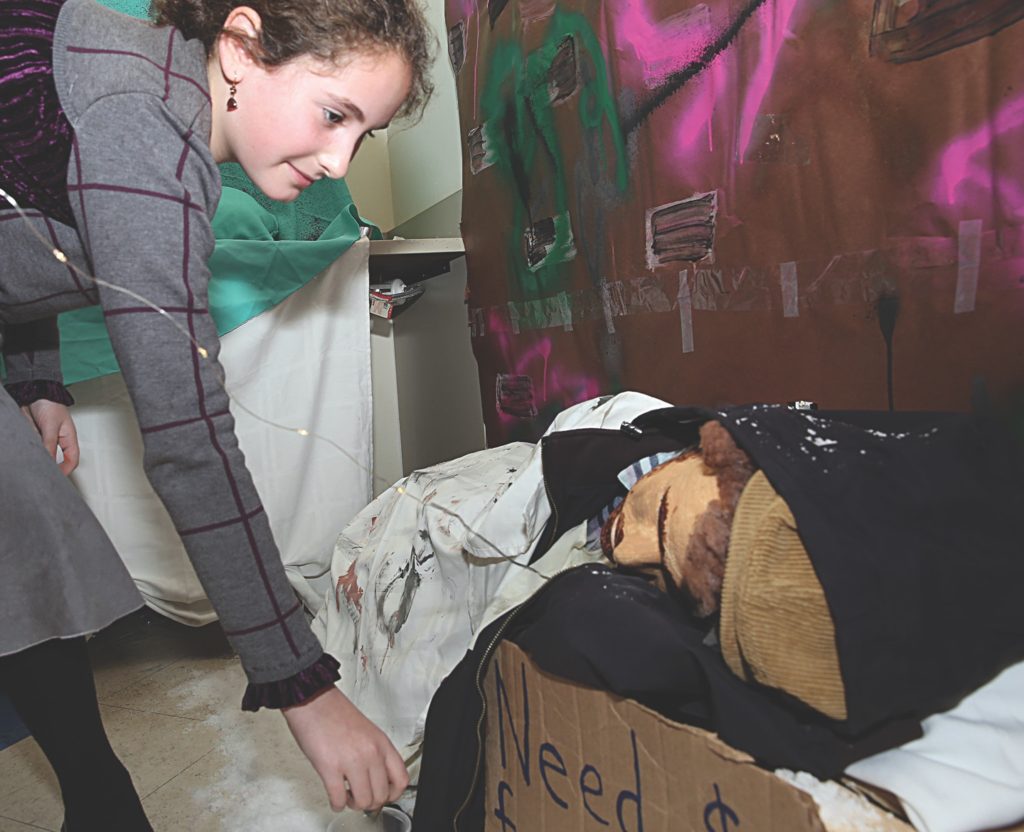
Another exhibit the eighth-graders built and presented included versions of three human beings: a homeless person, a Bais Chaya Mushka student and an affluent woman with her baby. Newman said this demonstrated that although they all look different, these people are twins and have the same soul.

“Once you focus on your own Godly soul and nurture it, it becomes so easy to see it in others, and [makes] it natural to love them and care for them.”

One parent, Sara Mayberg, said the 19th of Kislev presentation gave the students the opportunity to foster achdus, or unity. “It’s incredible to see the girls working together bringing chassidus to life,” she said.

Jewish unity is one of the big themes of the holiday, and one that permeates beyond Chasidic culture and into the Jewish community as a whole, Yiftach-Hashem said.

“One of the main foundations of chassidus is brotherly love — to love one another, even strangers. We try to increase acts of goodness and kindness to others.”

Chasidic ‘New Year’ Used as Avenue for Learning Read More »
Holy Fire

Sometimes in the midst of destruction, there is holiness. Sometimes in the smoke and ashes, there is kindness, love and meaning.

Kalonymus Kalman Shapira was the leading rabbi of the town of Piaseczno in central Poland during World War II, when he was sent, along with many of his followers, to the Warsaw Ghetto. There he worked tirelessly at great personal risk to support Jewish life. He operated a secret shul, arranged for mikveh immersions, and conducted weddings.

He became best known for the inspiring sermons he would deliver each week. Although the rabbi ultimately was murdered by the Nazis in 1943, many of his teachings from that period were rather miraculously saved and later published in a volume that came to be called “Esh Kodesh” — Sacred Fire.

In a sermon he delivered in August 1941, immediately after Tisha b’Av, the darkest day in the Jewish year, Rabbi Shapira taught:

“There are calamities for which it is possible to accept consolation. A person may have had an illness from which he recovered. Although he had been in great danger and in tremendous pain, when with God’s help he was healed, he was immediately consoled for all the pain he endured. Similarly, if money was lost, then when God restores the lost fortune, consolation follows quickly. But when lives are lost, it is impossible to accept solace. It is true that when the pain is due to the loss of family and loved ones, or to the loss of other Jewish people because they were precious and are sorely missed, it is possible to take comfort in other surviving relatives and different friends. But any decent person mourns the loss of others not simply because he misses them; it is not only his yearning for them that causes pain and distress. The real cause of his grief is the death of the other — the loss of life.”

Those who have been affected by these fires will be comforted in the arms of friends and in the embrace of a loving community.

What an amazing teaching for the moment in which we find ourselves right now. (And, by the way, part of the extraordinary glory of our tradition is that the wisdom of a man taken from us prematurely some 74 years ago can still teach and guide us today.)

We have suffered losses in recent days in Southern California. We have lost sleep. It has been difficult at times to breathe. Some of us have been evacuated from our homes. Some of us have had to remove our Torah scrolls for safekeeping. Property has been damaged. Homes have been destroyed. But, thankfully, injuries have been few and, so far, there has been only one death attributed to these devastating fires.

And so let us be consoled. What has been destroyed will be, with our help, with our hearts and hands, rebuilt. Those who have been affected by these fires will be comforted in the arms of friends and in the embrace of a loving community.

In the midst of destruction, there is goodness. As we were removing the Torah scrolls from our temple last week, three rabbis in our Los Angeles community phoned to offer their assistance. Congregants and board members called to see how they could help. From all over the world, we have been contacted by friends reaching out to express their love and concern.

Fires rage, but eventually they go out.

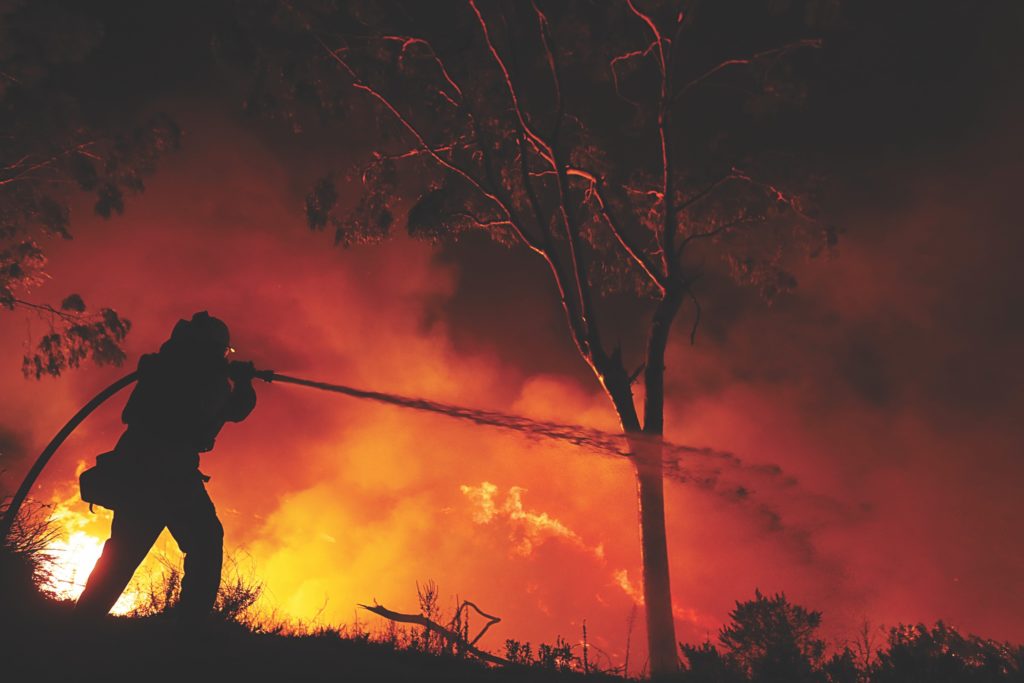
Those who risk their own lives to protect others from the flames bring holiness to the fire. Those who reach out in love to help others rebuild bring holiness to the fire. Those who cry out for support and are met with a loving embrace bring holiness to the fire.

Let us be consoled and let us console one another.


Rabbi Yoshi Zweiback is the senior rabbi at Stephen Wise Temple.

Holy Fire Read More »

The Other Russia Mystery

Syria is a front in need of attention. It is a front where Israel might risk war.

Two weeks ago, Israel reportedly — it did not officially comment — attacked south of Damascus. A week and a half ago, Israel (reportedly) attacked again. In both cases, there was an aura of vagueness surrounding the targets. An “Iranian base,” it was said. A “Syrian military facility.” Why were these specific targets attacked? What is it that bothers Israel about them — assuming it really was Israel that attacked?

Then, on Dec. 11, Russian President Vladimir Putin unexpectedly landed in Syria and declared victory over ISIS and announced the withdrawal of Russian forces from Syria. “Friends, the Motherland is waiting for you,” Putin told his troops. “You are coming back home with victory!”

Why now and not two weeks ago or two weeks from now? Only Putin knows. In recent weeks, Russia backed the Syrian narrative, according to which the regime is close to winning the war, while the U.S. argued that these declarations of an impending victory are premature. So maybe Putin was just making the point by putting his money — or military forces —  where his mouth is.

Russia seems to be pleased enough with such victory. Putin is rightly satisfied.

In many ways, this debate is about semantics. Define “victory”; define “Syrian victory.”

The Donald Trump administration believes that a vast majority of the forces fighting in support of the Syrian government — the regime still under the control of the ever-doomed-to-departure President Bashar Assad — is made up of foreign forces. A victory? Maybe. But this will not be a victory of Syrian forces under Assad. It will be a victory of Lebanon’s Hezbollah, of Iraqi militias and, most of all, of Iran’s Revolutionary Guard.

Russia seems to be pleased enough with such victory. When its leader decided to jump into the Syria swamp, his goal was to fill a vacuum created by American inaction, save his ally Assad and keep Russian interests in the country unharmed. Looking at these three objectives, Putin is rightly satisfied. He was able to demonstrate to Middle Eastern and other world regimes that Russia is an ally no less — or maybe more — reliable than the United States. He was able to guard Russia’s interests in the country (among them, military bases). He was able to save Assad, for now. In the summer of 2011, President Barack Obama first called for the Syrian president to step down. The Russians said no. The Russians had their way.

Israel was disturbed by many of these developments. Having Russia, rather than the U.S., as the main power broker in the region does not seem appealing. Having Assad becoming an Iranian proxy does not seem appealing. Having Assad win the war as an Iranian proxy does not seem appealing.

Israel warily watches as payback looms. Iran won the war for Assad, and is now expecting a reward: military presence in Syria, not too far from the Israeli border.

Israel declared such development a red line. Speaking in a video message to the Saban Forum in Washington, D.C., last week, Prime Minister Benjamin Netanyahu was clear: “We will not allow a regime hellbent on the annihilation of the Jewish state to acquire nuclear weapons. We will not allow that regime to entrench itself militarily in Syria, as it seeks to do, for the express purpose of eradicating our state.”

So, after the attacks (allegedly by Israel) in Syria, one has to assume that the goal is in line with this message. Sabotage all the Iranians’ attempts to entrench themselves in Syria. Destroy their facilities and disrupt their plans, sending them a message of warning.

This message is aimed at Iran and its allies, but no less at Russia and the U.S. The superpowers can let the situation deteriorate by letting Israel and Iran conduct a war in Syria’s territory. They also can choose to prevent it by taking a side. The potential problem for Israel is obvious: What happens in case Russia takes Iran’s side — that is, insist that Israel cease from attacking in Syria — while the U.S. remains on the sidelines?

Israel can do what’s necessary to stop Iran from entrenching in Syria. But opposing the Russians is a lot riskier. Thus, the reduction of Russian presence on Syrian soil puts Israel in a position more convenient for free action.

On the other hand, the Russians are leaving and an even larger vacuum must be filled. Iran seems ready to try to fill it. Israel seems ready to not allow it. So, a proxy war becomes even more likely today than it did a few weeks ago.


Shmuel Rosner is senior political editor. For more analysis of Israeli and international politics, visit Rosner’s Domain at jewishjournal.com/rosnersdomain.

The Other Russia Mystery Read More »

The Great Gun Debate

It’s been almost a year since I drove to the Los Angeles Gun Club and shot a gun for the first time. I remember how I trembled at the awesome power of the little weapon I could hold with one hand: What if I made a mistake? What if the gun backfired? What if the person next to me was careless?

It was my first time near a gun, and I was terrified.

Although the only real risk that day was posed to paper targets, it made me aware of how vulnerable human bodies are to bullets. Because accidents happen. In fact, “unintentional gun deaths” is a statistical category of its own, which accounts for hundreds of deaths in the United States each year. But who wants to talk about that?

Independent of a major mass-shooting catastrophe, gun violence is a neglected topic. For some bizarre reason, it requires a dreadful calamity in which scores of people are bloodied and murdered for the news cycle to pick up on gun violence and for American citizens to vent outrage and demand change.

But indeed we do, each time it happens, for about a week — longer, if children are involved. Then, absent the enduring trauma of surviving a shooting incident or the eternal tragedy of losing someone we love, we simply forget and move on.

We were lucky, weren’t we? We dodged a bullet.

Way too many Americans die needlessly each year from gun violence and not enough of us care.

Since that dark night on Oct. 1 when a deranged gunman opened fire on a crowd of concertgoers on the Las Vegas strip, killing 58 other people and injuring hundreds more, there have been an additional 55 mass shootings in the U.S.

I’m not talking homicides — I’m talking mass shootings, which, according to the FBI, is when four or more people are shot and/or killed in a single incident, not including the shooter. You want homicide stats? On average, about 30,000 people die every year from gun violence. Something like 12,000 of those deaths are “conventional” homicides, where one person shoots and kills another, but the majority are suicides.

The statistics are dizzying. And the bottom line is this: Way too many Americans die needlessly each year from gun violence and not enough of us care. Instead of marshaling the will to pressure our elected officials every single day until sensible gun control laws are passed, we surrender to a stupor of cynicism and apathy.

“Looking back, I’m embarrassed about the fact that I didn’t pay a lot of attention to the issue of gun violence until Sandy Hook,” Sen. Chris Murphy (D-Conn.) said during an interview last week about the shooting in his home state five years ago that claimed the lives of 20 children.

On Dec. 17, Murphy will join Los Angeles City Attorney Mike Feuer at Temple Emanuel for a discussion on gun violence sponsored by the literary salon Writers Bloc.

Feuer also had an “aha moment” regarding guns.

“I was on City Council in the 1990s when there was a bank robbery in North Hollywood where the police were outgunned by the robbers,” Feuer told me.

That was a Dayenu moment, as well, alerting Feuer to the ease with which criminals could access guns. “Then, the North Valley JCC shooting happened.” That was 1999. Dayenu. Again.

Feuer has spent the better part of his career advocating for tougher gun laws in California, helping to write legislation requiring background checks, banning high-capacity magazines and requiring gun microstamping to help law enforcement identify gun purchasers.

“This is becoming a more and more important issue for voters every single day … but it’s going to take the modern anti-violence movement a long time to become as powerful as the gun lobby,” Murphy said.

The Nation Rifle Association has ensured that there is no issue more intractable in current American politics than gun control. Despite the fact that 90 percent of Americans support universal background checks, the NRA’s relentless fearmongering about infringement on Second Amendment rights and concomitant personal liberties handicaps lawmakers.

Some argue that the specifics of potential gun legislation wouldn’t do enough to curb gun violence since there already are hundreds of millions of weapons on the streets of America. Banning assault rifles or high-capacity magazines would have a negligible effect on total gun homicides — saving hundreds of people per year, not thousands.

But that’s hundreds of people! We can throw around all kinds of numbers and statistics, but in Judaism, all we need is one: If you save a single life, you save the world.


Danielle Berrin is a senior writer and columnist at the Jewish Journal.

The Great Gun Debate Read More »

Machal Fighters Get Memorial in Jerusalem, Seven Decades After Volunteering for Israel

Nearly 70 years after volunteers from five continents left homes and jobs to fight for the newly proclaimed State of Israel, their deeds will be honored and memorialized on Dec. 17 at a historic site in Jerusalem.

The 4,922 volunteers from 59 countries were part of Machal — a Hebrew acronym for Overseas Volunteers — and 123 of them died in the line of duty. Less than a dozen elderly survivors are expected to attend the dedication of the massive memorial, located across the Ammunition Hill national memorial site.

The memorial is 10 feet long and 8 feet high, made of stone, concrete and steel, and inscribed in Hebrew with the words of Yitzhak Rabin. In a tribute to the volunteers, the late general and prime minister said, “You came to us when we needed you most, during those dark and uncertain days of our War of Independence.”

Dignitaries will include Jerusalem Mayor Nir Barkat; national Housing and Construction Minister Yoav Galant; Jeffrey Margolis, president of American Veterans for Israel Legacy Corp.; and Harold (Smoky) Simon, the World Machal chairman. The afternoon events will include a torch relay from the city center to the dedication site, honor detachments and music from the armed forces, and a Hanukkah lighting ceremony.

Before and during the War of Independence, which began in 1948, the largest contingents of volunteers came from the United States, South Africa, the United Kingdom, Canada and France. Almost all — including 168 gentiles — had fought for their home countries in World War II and brought valuable experience and skills, particularly to the Israeli air force and navy, which had to be built from scratch.

Over the decades, the contributions of the volunteers to the outcome of the war either have been ignored in Israel and their home countries, or overblown, Hollywood-style.

A blunt and only slightly exaggerated description came from California novelist Harold Livingston, who flew for the Israel Air Transport Command and who described “Ben-Gurion’s Foreign Legion. They took anyone. Misfits from America, English communists, South African Zionists, Soviet army deserters, Polish noblemen, ne’er-do-well soldiers of fortune.

“If you want excitement and adventure, come on over. … If you want to write a book. If you’re running from the police. If you want to get away from your wife. If you want to prove that Jews can fight. If you want to build a new land.”

Perhaps Machal’s most important contribution was to lift the morale of Israelis, knowing that their Diaspora brethren were with them.

The motives always were mixed. My time as an American infantryman in France and Germany during World War II had left me restless, my early exposure to Zionism in a Jewish school and youth organization in Berlin during the mid-1930s had left an imprint, and since a new Jewish state arises only every 2,000 years or so, I figured I probably wouldn’t be around for the next time.

My past military experience qualified me to serve as squad leader in an “Anglo-Saxon” anti-tank unit, composed entirely of English-speaking volunteers, who spoke the mother tongue in a variety of often-incomprehensible accents. In this unit, the men from the highly organized and supportive Jewish communities of South Africa formed the most stable element; the Americans, Canadians and Brits were somewhere in the middle, while two teenage Australians arrived fairly late in the game after a slow ship ride from Down Under.

Machalniks served in all branches of the Israel Defense Forces — army, navy, air force, Palmach shock troops and medical corps — as well as Aliyah Bet, composed of men and women who ran the British blockade in 1946-47 to bring “illegal” Jewish immigrants to pre-state Palestine.

The single largest Machal contingent came from the United States. Its given numbers have varied acceding to time and source, some running as high as 1,400. In the most current compilation, Machal world chair Simon has downsized the figure to 805. Of these, 263 served in the air force, with many hailing from the Los Angeles area.

But given the size of the American Jewish community at the time, this number lags well behind the contribution of every other English-speaking country proportionally. For example, the South African contingent was almost as large as the American, with a Jewish population one-fiftieth that of the U.S.

Americans gave freely of their money, and a few lost their citizenships for illegally sending arms and planes to Israel.

But the disparity in the number of American volunteers reflected the differences in communal attitudes and civic courage. South African Jews — and Britain’s to a slightly lesser degree — set up their own selective service systems, complete with physical and psychological testing, and rallied fully behind their young men and women heading for the battlefield. By contrast, organized American Jewry, fearful of the dreaded accusation of double loyalty, generally averted its collective eyes and prayed silently that those crazy kids going over would not prove an embarrassment.

Whatever the Machal contributions, on the ground — where ultimately wars are still won — the Israelis did most of the job themselves and paid a high price. The War of Independence claimed the lives of some 6,200 Israeli soldiers and civilians.

Perhaps Machal’s most important contribution was to lift the morale of Israelis, knowing that their Diaspora brethren were with them.

One of the key initiators and backers of the Machal memorial has been Jerry Klinger, a son of Holocaust survivors, retired first vice president of Merrill Lynch and president of the Jewish American Society for Historic Preservation.

Klinger, who lives in Boynton Beach, Fla., has made it his mission to cut red tape and to fund and affix signposts and markers across the the world to draw attention to Jewish contributions and pioneering enterprises. He was instrumental in erecting a memorial in Haifa to the fabled refugee ship Exodus,  as well as 66 historical markers throughout the West and the United States.

To Klinger, looking back on all his historical markers, the one honoring the men and women of Machal may be the most important. “If we let them be forgotten,” he said, “we are denying their tomorrows and our yesterdays.”

Machal Fighters Get Memorial in Jerusalem, Seven Decades After Volunteering for Israel Read More »

Soup DNA: The Secret Behind the Best Chicken Soup

Soup is the culinary equivalent of love. I know that’s a pretty bold statement, but I fiercely stand behind it.

I once read that Chinese families used to keep a pot of soup on the stove — for generations. They would top it off all day with vegetable and meat scraps, bones and herbs, and keep it on the stove simmering away ad infinitum. This means that every time they ate soup, they ate a part of their ancestry. Imagine always having your grandmother’s and great-grandmother’s soup DNA in there nourishing you.

As a half-Ashkenazi Jew, the concept of a perpetual pot of soup on the stove is very appealing. After all, have you ever met an Ashkenazi who didn’t begin his or her meal with soup? This hardy stock of folks historically has been raised on hardy stock — literally.  In the frigid winters of Eastern Europe, a nourishing and comforting bowl of soup was the difference between life and death.

One day, on a trip to visit family in Israel, I was invited to lunch by one of my mother’s Romanian cousins. I walked into the house and was almost struck speechless by an incredible smell. A nearly visceral image of my grandmother came to mind, and I rushed into the kitchen to see what was cooking.

“Leustean,” my cousin Beatrice said, laughing. “I put it in the chicken soup. Your grandmother used it — all Romanians do.”

And there it was, that special smell and flavor I had been chasing for my entire life summed up in a word I’d never heard.

“Leustean?” I asked, sticking a spoon in the pot to taste.

“Leustean is Romanian for lovage,” my smarty pants uncle chimed in.

I called my mother to tell her that I had finally found a clue to safta’s soup. We ordered a pound of dry lovage and added it to our chicken soup. Suddenly, my mother’s face lit up.

“Leustean,” she said. “I’ve been chasing this taste for years.”

Since the day my grandmother reached down through the great divide to remind me about lovage, I’ve never made chicken soup without it. Lovage, an herb from the dill family, is what is used to flavor bouillon cubes. Surprisingly, even though it’s one of the most ubiquitous taste profiles, most of us don’t have a name for it, and I’ve yet to find a customer who can identify it.

So now that you know the secret to great chicken soup, here is my “recipe” for chicken stock. This is the quintessential Jewish mother’s remedy to everything that ails you — from a cold to heartbreak.

If there is one thing you learn to do in the kitchen, learn to make stock. It will fill your home with the aroma of your ancestors, it’s a bowl of vitamins in disguise, and it will earn you a lifetime of accolades from admirers who can’t quite figure out why your chicken soup tastes so special. And if you have kids, this just doubles the incentive because there is never a time when I make chicken soup that I don’t hold my mother and my grandmother in my heart and mind the entire time.

If that’s not love in a bowl, I don’t know what is.

WORLD’S BEST CHICKEN SOUP STOCK
Bones of at least 3 chickens or 1 whole chicken
1 head garlic, unpeeled
3 carrots, washed, peeled and cut into chunks
8 ribs of celery, washed and roughly chopped
2 parsnips, washed, peeled and cut into chunks
1 sweet potato, peeled and chopped
1 whole celery root
2 large yellow onions, unpeeled, washed
and cut into quarters
1 small green pepper, washed, deseeded
and cut into quarters
Handful parsley stems
Handful cilantro stems
Handful dill stems
Handful lovage stems (or 2 tablespoons
dry lovage)
6 whole black peppercorns
1 inch fresh ginger
1/2 teaspoon turmeric powder
1 hot green pepper left whole (optional)

BEFORE SERVING
Salt to taste
Black pepper to taste
Sugar to taste
1 tablespoon finely chopped leaves of parsley
and dill, for garnish

Put all ingredients into a large pot. Cover all with cold water and turn the heat to high. Skim the scum that rises to the top of the pot as it heats and discard.

At the first boil, lower the heat to a slow simmer and partially cover pot for a minimum of 2 hours — 4 is better. If you used a whole chicken, feel free to remove the meat after a few hours and leave the bones in the pot to continue simmering; that’s where the flavor comes from, anyway.

And there it was, that special smell and flavor I had been chasing for my entire life summed up in a word I’d never heard.

When your stock is done, turn off the heat and let the liquid cool until you can handle it. Take a large sieve and put it over another pot and strain out all the solids. At this point, you should have a dark, yellow, fragrant stock and a heap of mushy vegetables and bones in the strainer. If you didn’t remove your chicken and you enjoy stringy boiled chicken — I sometimes do — then pull the chicken out and keep it in the refrigerator to add back into the stock later. If not, feed this resulting mush to your pets; they will enjoy it much more than you will. (Warning: Dogs should not eat onions or garlic, and never give a dog poultry bones.)

Strain the stock one more time. (The French strain 7 times, but I don’t. The clearer you want your stock, the more you strain.)

Leave your stock in the fridge to jell overnight. The stock will separate and the fat will rise to the top in a hard yellow layer. This is the gelatin and collagen from the bones and marrow of the chicken, and it’s great for your hair, nails and skin, and part of the reason that chicken soup is a wonder drug for the flu. Keep this golden schmaltz and use it to cook rice or vegetables or to fry latkes or sweet potato fritters.

You can put some stock in the freezer in jars or continue on and make any type of soup you fancy: lentil, split pea, black bean or tomato. Do you want to make chicken soup? Add back some chopped raw carrots, chicken breast and some snips of fresh herbs — and maybe even some matzo balls or noodles. Important to note, this is unseasoned stock.

When you are ready to serve, be sure to season your stock with salt, black pepper and a touch of sugar to taste.


Yamit Behar Wood, an Israeli-American food and travel writer, is the executive chef at the U.S. Embassy in Kampala, Uganda, and founder of the New York Kitchen Catering Co.

Soup DNA: The Secret Behind the Best Chicken Soup Read More »

Winter Trees

The winds come
and the trees are left
naked.

They seem to
carry the air of
ghosts.

A blanket of
white comes to
purify.

Born once more,
their color returns
with time.

Stronger, older,
wiser, they grow
skyward.

Oh, how many deaths
have these sages
undergone?


Hannah Arin is a junior at Pitzer College pursuing a double major in religious studies and philosophy.

Winter Trees Read More »

Finding the Family He Never Knew

As a child, my father’s family was an abstraction to me.

His parents and six brothers and sisters existed mainly in sepia-toned photographs on fading and dog-eared pages of an old album. From the little I was told, they lived in a small town in Poland, where all but my father and his youngest sister died at the hands of the Nazis.

But until I ventured to that town with the help of the nonprofit Forum for Dialogue, all I knew was of their deaths. I never fully grasped their lives.

In September, I spent a day with a group of Polish junior high school students whose major project — launched last year under the Forum’s School of Dialogue program — was to study the Jewish history of Grodek, my dad’s hometown.

It turned out to be a day I’ll never forget.

Grodek is a small village in far eastern Poland where the population numbers fewer than 3,000. Back in the 1930s, it could have passed for Anatevka, the fictional hometown of Tevye, the Dairyman from the Broadway musical “Fiddler on the Roof.” At one time between the world wars, Jews comprised nearly 75 percent of Grodek’s population. Today there are none.

After the Nazi invasion of Poland, what was left of the Jewish community vanished one morning. At 5 a.m. Nov. 1, 1942, horse-drawn carriages took those who had survived the initial Nazi onslaught to the nearby city of Bialystok.

There, they were herded into trains headed for the notorious Treblinka death camp, where the Germans learned how to industrialize murder with brutal efficiency. They killed a staggering 900,000 Jews and 200,000 Gypsies in only 15 months.

Two years ago, my wife, Lee, and I made our first trip to Poland, joining with others in a Forum study tour that took us all over the country.

We visited large cities and small towns. We spoke with ordinary people, school kids, academics and top officials. We saw the Warsaw Ghetto and what had been the Jewish quarter in Krakow. In a solemn and emotional ceremony, we said Kaddish for all the souls lost to Nazi genocide at the frightening Auschwitz and Birkenau concentration camps.

We even ventured off alone to Grodek in hopes of learning something of my family’s fate. We discovered that the street names had been changed and houses renumbered since the war. We were shown the boundaries of its ghetto and located the town’s abandoned and neglected Jewish cemetery. It’s the only enduring reminder of its Jewish past.

But we learned little of my family’s life.

My trip back to Grodek in September was different.

Despite Poland’s reputation for having been indifferent, or worse, to the fate of Jews during the war, the students I met were genuinely enthusiastic about honoring the town’s Jewish past.

The day began with a ceremony, led by the mayor, to honor a Jewish physician who was a beloved mainstay of Grodek in the 1930s and was murdered by the Nazis. Two students spoke eloquently about what Dr. Lew Cukierman meant to the community. I was given the honor of briefly speaking to the crowd, which included many adults and the entire student body.

After the Nazi invasion of Poland, what was left of the Jewish community vanished one morning.

From here, the students led me on a journey through the streets of Grodek to paint a picture of what life was like before and during the war. They not only told these stories but also acted them out — wearing clothing from the era and wielding implements used in daily life. At one stop, they even prepared food like that served in the 1930s. The table was set in front of a former restaurant where my family almost certainly had gathered for meals.

Other stops included the boundaries of the ghetto, the location of textile mills that drove the town’s economy, the Jewish school that my family likely attended, a drugstore that had been run by a Jewish pharmacist and the outdoor market where residents bargained for their groceries and other daily needs.

Along the way, I chatted with noted Polish contemporary artist and local activist Leon Tarasewicz, who happened to be in town and joined our tour. I had lunch with the principal and her staff of teachers.

The last stop was outside the one-time home of Josef Abramicki. He seemed like a man for all seasons. He ran a barbershop, a photography studio and directed the local Jewish drama group.

The name Abramicki rang a bell. He had been mentioned in an old letter as a close friend of the family. Among his photographs displayed by the students was a dark portrait of an actor in his Yiddish theater. To my amazement, she turned out to be Chaya, one of my aunts.

As I walked the dirt backstreets of this town, I felt the family’s presence.

Back in the classroom later in the day, the students asked me questions about Jewish life in the United States. I asked them more about their project.

I also shared with them the story of my only surviving aunt. She had escaped the Nazis by fleeing into the forest that surrounds Grodek. There, she joined with Russian partisans in guerrilla warfare against the Nazis and was wounded in battle. In 1958, she returned to Grodek. In a brief account of her life written for Yad Vashem, she declared: “I am the last Jewish girl of our town.”

After hearing the story, one student openly wept.

For these youngsters to care so deeply about people very different from themselves who died generations before they were born is truly remarkable.

It gives hope that someday we might rid ourselves of the kind of prejudice that sparked the Nazi genocide, killing 6 million Jews — most of whom lived in Poland. It also attests to the power and importance of programs like the Forum’s, which has dedicated itself to forging connections between contemporary Poland and the Jewish people.

I know I’ll return to this town. I now feel bonded to it as if it were my own.

And, of course, in a different reality, it could have been just that.


Leo Wolinsky, a Los Angeles journalist, has served as managing editor of the Los Angeles Times and editor of Daily Variety.

Finding the Family He Never Knew Read More »

The Bukhari Renaissance Woman

The living room in an apartment in Tel Aviv’s Florentine neighborhood was heaving with people, young and old, most of whom had tears streaming down their cheeks from laughter. Their host, Eti-Jon Eliezerov, had just finished a skit impersonating a Bukharian Jew cooking up a storm.

According to Bukhari tradition, a woman’s worth, jokes Eliezerov in a sing-song voice, is measured by whether she can peel a potato in one go.

“The peel has to be a single coil and must remain thin,” Eliezerov emphasizes.

At the age of 13, her father fell in love with her mother after observing her chop a carrot with dazzling agility.

Eliezerov was born and raised in the house in Florentine where, today, she hosts evenings celebrating Bukharian Jewish heritage. She returned to live there in 2011 after a 32-year absence, during which she married — much to her parents’ chagrin — an Ashkenazi. Together, they had three children.

Eliezerov’s parents arrived in Palestine in 1935 from Samarkand, modern-day Uzbekistan. Along with hundreds of thousands of their Jewish brethren in Central Asia, they spoke a Jewish dialect of the Tajik-Persian language. It was a grueling, two-year trudge by foot to the Holy Land, with multiple tragedies and pitfalls along the way, including a stint in an Afghani prison and the death of Eliezerov’s older sister.

When speaking of her parents, Eliezerov’s voice oozes unbridled adulation. Her mother, a dancer, and her father, a musician, traveled the world together giving traditional Bukhari performances. But little Eti, at 6 years old, paid a steep price for their wanderlust. At a loss for what to do with her, her parents put Eliezerov in an ultra-Orthodox orphanage in the coastal town of Netanya for a year and a half while her parents took off on a tour to Paris. Later on, she was moved to another institution in the town of Bnei Barak. It was only in fourth grade that Eliezerov returned to her parents’ home in Florentine.

“My mother was devastated. She whined to me: ‘But his eyebrows aren’t even black!’ ” — Eti-Jon Eliezerov

Eliezerov said she feels no bitterness toward them. “I’m not angry. I was never angry at them. I’m not able to get angry at them.”

“My parents were the warmest, most hospitable people,” she says.

She credits her up-and-down childhood in her later choice to become a therapist, specializing in psychodrama and gestalt.

These days, though, Eliezerov says her calling is to restore the Florentine neighborhood to its heyday. Today, the neighborhood, which hugs Jaffa on one side and the fancy Neve Tzedek district on the other, is a haven for hipster millennials. The Florentine that Eliezerov remembers from her childhood, though, brimmed with a fusion of culture and Jewish tradition.

“There was a lot of love in this neighborhood, everyone’s door was always open. It was colorful,” she says.

Eliezerov already has gotten the Tel Aviv municipality on board with bringing back the long-dead tradition of a parade through the streets on Simchat Torah. She also spearheaded an initiative called “Florentine in a Pot,” creating a bridge between the neighborhood’s old and young populations in which the elderly give cooking workshops infused with storytelling to their young neighbors.

And in her own house, Eliezerov is living her dream by hosting monthly evenings celebrating Bukhari culture. She wears traditional Bukhari garb and serves her guests Bukhari food, such as Plov, a rich rice dish embellished with meats and carrots. Armed with a doyra, a Bukhari drum, Eliezerov dances and sings lyrics that hark back to bygone days in Samarkand.

Although she is a born and bred Sabra, Eliezerov said she felt “just like I’d arrived home” when she traveled to Uzbekistan as a guide on a roots trip.

It’s a wonder, then, that in her early 20s she rebelled by marrying an Ashkenazi of Polish descent.

“My mother was devastated,” she said. “She whined to me: ‘But his eyebrows aren’t even black!’”

Eyebrows, it seems, are not inconsequential in Bukhari tradition. Despite her choice of partner, Eliezerov was adamant to preserve some of the Bukhari traditions relating to marriage and as such she insisted on a Koshchinon, the traditional eyebrow grooming ritual. According to Eliezerov, Bukhari women are forbidden from touching their eyebrows – which, she points out, is often a unibrow – until they are about to get married. A few days before the wedding, and prior to immersion in the mikveh, the bride is surrounded by married friends and relatives who watch as the Koshchin – the eyebrow groomer – shapes her brows using a special blade and string. The Koshchin usually doubles as a comedienne, stage whispering in the bride’s ear crass nothings about what awaits her in matrimony. Special songs are sung at the occasion, and in keeping with Bukhari tradition, endless trays of food are served. To gasps of oohs and aahs, the mother of the bride also presents her daughter’s dowry, consisting of flowing gowns and dresses and bedsheets.

Nevertheless, after a 30-year marriage, Eliezerov divorced her husband. He was, in her words, too far from religion. Especially after her adult son became religious, she realized just how much she missed the faith of her childhood. These days, Eliezerov, who returned to being an observant Jew, feels like she finally has found her place in the world.

“I’m in my childhood home, making people laugh, making them cry, using my talents to move people,” she says.

“All my life, I’ve waited for this.”

The Bukhari Renaissance Woman Read More »

ARTIST OF THE WEEK: Iris Cohenian

“Friends,” by Iris Cohenian

Muslim girls chat on the roof of the Austrian Hospice of the Holy Family, a popular place to see friends in the Old City of Jerusalem. The hospice opened its doors in 1863 for pilgrims. Today, it is a guesthouse that aims to bring together different cultures through art and music.

“Friends” is part of the book and international exhibition “Passage to Israel” (passagetoisrael.org).

ARTIST OF THE WEEK: Iris Cohenian Read More »