fbpx

December 13, 2017

Alex Borstein and Her ‘Maisel’ Character: ‘We’re Both Like Little Bulldogs’

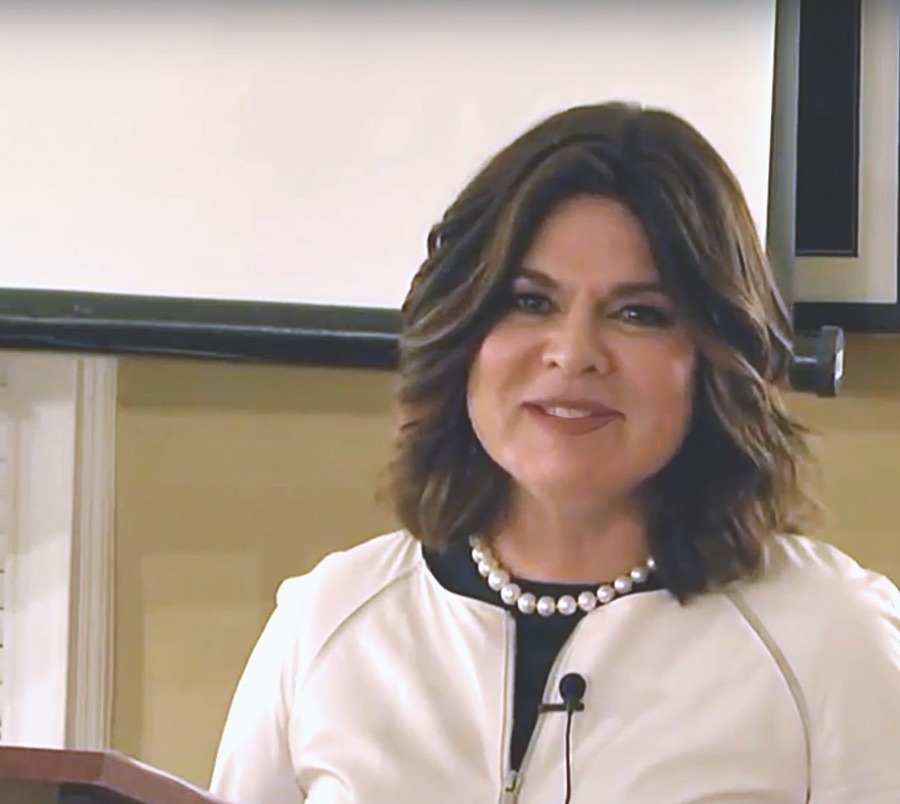
Actress Alex Borstein plays Susie Myerson, a wannabe stand-up comedy manager on Amazon’s “The Marvelous Mrs. Maisel,” the most Jewish new show on TV. The gruff Susie’s sole client is Miriam “Midge” Maisel, a 1950s upper-middle-class Jewish housewife who’s obsessed with planning the perfect Yom Kippur break-the-fast meal until her husband, a failed stand-up comic, dumps her. On a drunken rampage, Midge then takes the stage at her hubby’s comedy club, riffs on their breakup, exposes her breasts and catches Susie’s eye with her ribald act.

The Journal caught up with the 46-year-old Borstein — previously known for her work on TV’s “Family Guy” and “Getting On” — by telephone from her home in Barcelona, Spain.

Jewish Journal: You attended the Abraham Joshua Heschel Day School in Northridge. But your parents have very different Jewish backgrounds.

Alex Borstein: My father was raised Orthodox in Atlanta, Ga., and my mother is a child survivor of the Holocaust. She was born in Budapest at the time when they were lining Jews up and shooting them into pits. My grandmother gave my mother in her bassinet to a cousin, who was around 8 or 9, and the girl just walked out of line and kept walking. There were stories of holes in their shoes and lice in their hair, but they got out alive.

None of us would survive now, because we’re all such [wusses]. We’d be shot because my 9-year-old boy would be like, ‘Does anyone have an iPad?’ ”

JJ: You started doing stand-up at 16 in a small club in the Valley, with your parents accompanying you because you were underage. Did your family’s Holocaust background have anything to do with your budding sense of humor?

AB: It’s that old adage of Jews being survivors; you’ve just got to laugh or else you’re going to cry. But we also had these medical dramas going on because my brother is a hemophiliac. It was just kind of wanting to provide comic relief in the emergency room since everyone was so uptight and scared.

“It’s that old adage of Jews being survivors; you’ve just got to laugh or else you’re going to cry.”

JJ: Does Susie remind you of anyone in your own family?

AB: My grandmother, a Holocaust survivor, was very funny, very dark and bitchy. My mother went back to school later in life to get her MSW or MFT psychotherapy degree, one of those f—— series of letters with a bunch of “m’s” in it. They were tough broads who kept reinventing themselves, and there’s a piece of Susie in there.

JJ: Why were you drawn to your character?

AB: She’s ballsy and she’s got a foul mouth but she’s really vulnerable. She has qualities that are considered masculine: She’s ambitious, assertive and not afraid to say “no.” But it’s not that she feels like she was born in the wrong gender … We’re both like little bulldogs and unapologetic in some ways.

JJ: What does Susie think when Midge shows her breasts onstage?

AB: She’s shocked but she also sees it symbolically — that this woman is really willing to expose herself emotionally. Midge tells the truth: She admits that her husband left her, talks about sex and enjoying sex. And Susie admires that kind of raw honesty.

JJ: Why did you move to Barcelona, of all places? After all, the Jews were expelled from Spain back in 1492 and there are only 6,000 Jews in the country today.

AB: Well, some time has passed. (Laughs.) My show “Getting On” was canceled two years ago and it just broke my heart. So I thought I was done with on-camera TV, and I just felt that I would go out gracefully. I always wanted to live abroad so I thought, the time to do it is now. We have a small but lovely Jewish community. My kids and I attend the Atid Reform temple here. And I haven’t encountered any anti-Semitism. Then again, I’m not running around wearing a yarmulke or dancing with a Torah outside.

JJ: Your character on “Mrs. Maisel” is Jewish, even though we don’t know much about her background except that it is quite different from Midge’s. Were the Tribal aspects of the show a draw for you?

AB: They feel very comfortable, like coming home and putting on a pair of sweats. I’ve been on so many shows where they’re like, “It’s time for the Christmas episode.” I have no problem with that, but it’s really nice when you see your own reflection in something on TV.

Alex Borstein and Her ‘Maisel’ Character: ‘We’re Both Like Little Bulldogs’ Read More »

Smashing Idols in Tinseltown and Beyond

According to the familiar Midrashic legend, Abraham’s father, Terah, was a craftsman and salesman of idols. But Abram (Abraham’s original name) scoffs at the adults who worship idols. Having watched his father make the sausages, so to speak, he can’t worship them.

While Terah is away, Abram smashes all of the idols except the largest one, placing an ax in its hand. When Terah returns, he’s furious. Abram explains that the idols had brawled until one idol emerged victorious. Terah is incredulous: “Idols don’t destroy idols,” he says, “people do.” Abram smiles. “Exactly,” he says. “So, why worship them?” Terah hauls Abram to the royal court of Nimrod, where he is sentenced to death by fire. According to the legend, God saves Abram from the crucible.

Idol smashers are courageous and strong. Many Abrams have emerged from the current cultural crucible. These heroes break false cultural idols. They slay producers like Harvey Weinstein, directors like Brett Ratner and actors like Kevin Spacey. As we overturn boulders, the hideous creatures hiding beneath are scurrying blindly into the sunlight. We’re experiencing a massive cultural revolution — listening to victims of alleged abuse and believing them.

Today’s idol smashers are shaking Hollywood, and its edifice is wobbling. To some, Hollywood is a cesspool of vice run by vile, abusive men. As Hollywood idols are smashed, only debris remains. And the scornful public’s instinct is to discard Hollywood’s art, once beautiful and inspirational.

But there’s a more optimistic view.

Hollywood isn’t monolithic. It’s comprised of more victims of alleged abuse than reputed abusers. For every Hollywood villain, there are many heroes, people who succeed without harming others.

Hollywood also has its superheroes, people trying to change the world.

Gal Gadot is Wonder Woman in the DC Extended Universe. In real life, she stood up to Ratner, who has been repeatedly accused of sexual misconduct. Gadot made it known that she wouldn’t work on a “Wonder Woman” sequel if Ratner were involved as a producer. Warner Bros. responded by dropping Ratner from the film.

Today’s idol smashers are shaking Hollywood, and its edifice is wobbling.

When Jimmy Fallon returned to the “Tonight Show” a week after his mother’s death, he told viewers that his mom “… would squeeze my hand three times, and say, ‘I love you.’ Last week, I was in the hospital, and I grabbed her hand and squeezed. ‘I love you.’”

During the same broadcast, Taylor Swift debuted her song “New Year’s Day,” which happened to include the lyrics, “You squeeze my hand three times in the back of a taxi. … ”

Swift wasn’t a scheduled guest. Producers had invited her to add a special touch to Fallon’s return show, and she agreed without hesitation. When she serendipitously sang “squeeze my hand three times,” there were tears all around. Afterward, the two stars embraced, overwhelmed with emotion. Swift’s brilliant performance and unbridled support for Fallon were heroic.

Drake may be the biggest superhero of all. Performing on Nov. 15 in Sydney, the artist was mid-song when he stopped to chastise a man for reportedly groping women in the audience. Drake’s righteous indignation and public calling-out is the stuff of superheroes.

If you need further reassurance that Hollywood is not a cesspool, see the feature film “Wonder,” a remarkable 100-minute sermon on kindness, acceptance, love and magnanimity. “Wonder” grabs you by the soul and, in the words of Henry Ward Beecher — used beautifully in the film — “carries up the most hearts.” It’s a reminder that no one does inspirational and powerful storytelling better than Hollywood.

One by one, false idols are falling. Morality pundits at Fox News, hypocritical politicians (left and right), Silicon Valley misogynists and Hollywood Neanderthals have been exposed and destroyed.

After Abram smashed the idols, he discovered God, the Creator. Not made of stone, wood or clay, Abram’s God was the maker of stone, wood and clay. Abram partnered with the Creator to teach morality and kindness, and together they changed the world.

We should celebrate the destruction of Hollywood’s false idols, but we should not discard Hollywood and all of its culture. Instead, let’s replace those idols with the Hollywood stars who light up our world with love and kindness.


Eli Fink is a rabbi, writer and managing supervisor at the Jewish Journal.

Smashing Idols in Tinseltown and Beyond Read More »

CyberSem Clicks With Jewish Women Eager to Learn Online

With her CyberSem Jewish education service, Chavi Goldberg has taken religious women’s empowerment online.

“I saw that boys can get smicha [ordination] online but girls can’t go to seminary online, so I set out to change that,” the Toronto-based educator said.

Goldberg was in Los Angeles on Nov. 16 to meet with parents and students of YULA Girls High School to discuss her online seminary for young women — the first and only seminary of its kind. CyberSem, which officially launched in 2014, enables Jewish women of all ages and backgrounds to continue their Jewish education via online courses.

Goldberg said the idea came about when she was undertaking her doctorate in distance education and realized that online learning in many schools was part of student course requirements in everything from nursing and medicine to engineering and accounting. So, why not Jewish education for women?

CyberSem features everything from Jewish history to Tanakh and Gemara.

CyberSem features everything from Jewish history to Tanakh and Gemara. There currently are 10 courses on offer — including practical courses on Shabbat, family purity and kashrut laws — that run for 12 weeks at a time and cost $350. The next semester begins Jan.1.

Goldberg said she’s particularly excited about a course currently in development based on the Jewish day school curriculum at elementary schools.

“There are many women who send their children to day school but they themselves didn’t attend day school,” Goldberg said. “When their children start learning Humash, the mothers have no way to help them.”

Another course offered focuses on the women in the Bible, not from the Torah but from the Prophets and Writings, who many people don’t know about.

There are a variety of women she thinks could benefit from the online seminary’s offerings, including young women who have attended seminary in Israel between high school and college.

“The girls come back from their seminary [in Israel] and they look at their mothers and their fathers and their old principals and say, ‘Now what do you have available for me?’ And it’s basically blank stares,” said Goldberg, whose own daughter currently attends a seminary in Israel.

“I’m there for the girl who has finished her Israel-based seminary and I’m there for when she comes home,” she said. “I’m also there for the girl who isn’t going to go to seminary.”

And the reasons a young woman might not be going to seminary could be anything from financial constraints to the fact that they’re working or going to a secular college or university, Goldberg said. “CyberSem is an opportunity for them to continue their Jewish subjects, and they can gain transfer credits toward their degrees.”

Goldberg is excited that CyberSem will help women to move forward in their careers while also keeping up their Torah learning.

“As this gains traction, it’s going to make a difference in people’s lives,” she said, “because their learning will continue on a continually sophisticated level.”

She also spoke about how the courses enable women to connect with their Jewish ancestry, which will help them navigate the world of the 21st century.

“The content is structured so that the girls are delving into additional texts and they’re delving into themselves in relation to the people they’re learning about,” she said. “The women were the same as we are. We need to be able to look at them and be inspired by the role models that they are for us. And that they’re not old fogies; they are like women of all times. We share that feminism with common goals and aspirations. That relevance is in all our courses.”

Goldberg hopes her recent visit to the West Coast will help more women of all ages to continue their Jewish educations.

“I’m sure there are many girls who are past seminary stage who would appreciate taking classes on Jewish subjects,” she said. “It helps keep them connected to the Jewish world.”

CyberSem Clicks With Jewish Women Eager to Learn Online Read More »

Robotics Competition Kicks Student’s Creativity Into Gear

Participants from 88 countries take part in FIRST Lego League (FLL) regional tournaments around the globe — presenting functional robots and comprehensive research on real-world issues such as food safety, recycling and renewable energy.

And thousands of those competitors and their mentors — from at least 52 of those countries — rely on the online resources created by Jared Hasen-Klein, an 18-year-old senior at Milken Community Schools, to prepare.

“I just created stuff that didn’t exist for me,” said Hasen-Klein, who began competing in FLL as a 9-year-old. “It’s really cool to see all of the countries on a map when I look at my analytics.”

Hasen-Klein said he created his website, hub.jaredhk.com, in 2015 to serve an important need for competitors in the distinguished science and robotics program dreamed up by the toymaker Lego and the nonprofit For Inspiration and Recognition of Science and Technology (FIRST). Together, they’ve held more than 1,400 competitions since 1998 for kids ages 9 to 14.

The problem: a lack of resources made available online for competitors to help with understanding the rules and improving performance. Hasen-Klein’s site not only features the rules — which often take too long to be updated on the competition’s website, he said — but offers games to test knowledge of the rules, printable resources like scoring sheets that teams can use during practice sessions, and scoring calculators.

There’s even an online form that competition referees started using on their phones to transfer scores electronically rather than using pen and paper and running notes over to scoring panels.

On a recent weekend, Hasen-Klein even hosted an all-day workshop at Milken for 65 visiting students and teachers taking part in local FLL regional tournaments to provide an overview of the judging process and answer questions.

“What really sets Jared apart is his initiative to go a step further and offer help wherever it’s needed,” said Stephen Shapiro, Hasen-Klein’s robotics manager at Milken.

Wendy Ordower, Milken’s director of service learning, said Hasen-Klein is prone to this type of selfless donation of his time. He volunteered as a digital expert giving whatever spare time he had to Milken’s school paper, The Roar, for two years before eventually writing for them.

“He does all of this because he just says it’s fun,” she said.

No one pays Hasen-Klein to provide these FLL resources, including the constant updates he makes to his website in advance of regional tournaments that take place each November. Still, he shrugged off the notion that he goes above and beyond.

“I’ve made it a priority to do this stuff. It’s rewarding knowing that people are using my resources. If I’m able to do it, why shouldn’t I do it?” he said.

As a fifth-grader at Abraham Joshua Heschel Day School in Northridge, Hasen-Klein stumbled upon his school’s robotics team when he realized sports and after-school acting programs weren’t for him.

“One of FIRST’s slogans is that robotics is the varsity sport where anyone can go pro. It’s so fun and it shows kids that maybe don’t necessarily fit in somewhere that there’s something for them,” he said. “You don’t have to come in with natural talent. You can learn it. It’s fair to say that was me.”

Now, besides competing in the FIRST Robotics Competition (FRC), also operated by FIRST, for high school students with his Milken team, he co-coaches the Heschel team he first captained seven years ago. He also volunteers as a judge at competitions on many fall and winter weekends, including the FLL world championships, where he meets kids who use his site.

“When I attend the world championship, I walk around to the pit areas and do ‘market research,’ and it is always fun to hear from the teams that found my website,” he said.

Hasen-Klein’s expansive involvement with robotics has earned him several awards, including the Los Angeles Area Volunteer of the Year Award given to him by FIRST at last year’s FRC world championship in Houston.

Kathy Reynolds, who was Hasen-Klein’s first robotics coach at Heschel and now coaches with him there, gushed over her former pupil-turned-colleague.

“We are very proud of Jared for the gifts he brings to these organizations in the enormity of invested time, his generosity in sharing his expertise, and mostly his humble dedication as a role model,” she said.

One of the things Hasen-Klein finds most rewarding about helping kids prepare for FLL competitions is the potential impact he is having on kids passionate about science, technology, engineering and mathematics (STEM). FLL boasts on its website that its worldwide competitions essentially are producing “tomorrow’s innovators.” Hasen-Klein sees something similar at competitions he attends where youngsters tackle real-world issues.

“Being a judge at these competitions has been so cool. When you see the global innovations they are coming up with, it’s amazing and you wonder when they will be adopted by professionals. One that stuck out was do-it-yourself water filters for people in Third World countries or those affected by natural disasters,” he said. “These kids are getting real skills to go get STEM jobs in the future. It’s such a great starting point.”

As for his potential future in the STEM world, Hasen-Klein was mum.

“I still have no idea what I want to do,” he said. “I guess I’ll figure it out eventually.”

Robotics Competition Kicks Student’s Creativity Into Gear Read More »

A Skeptic Meets Her Faith

Sensational, poignant stories about ultra-Orthodox Jews leaving behind their communities are in style right now.

The new Netflix documentary “One of Us” examines three ex-Chasidic Jews trying to find their way in the secular world. In 2015, Shulem Deen’s “All Who Go Do Not Return: A Memoir” received media attention from Jewish and secular outlets. And this past March, The New York Times published a story headlined “The High Price of Leaving Ultra-Orthodox Life.”

But there aren’t so many tales about people having positive experiences in the religious Jewish community. Author Judy Gruen aspires to help change that with her new book, “The Skeptic and the Rabbi: Falling in Love With Faith” (She Writes Press, $16.95).

Gruen, an Orthodox Jew who lives in Pico-Robertson, was raised in a non-observant home in Los Angeles. It wasn’t until she met her husband, Jeff Gruen, in the 1980s and started attending the Pacific Jewish Center (PJC), also known as the Shul on the Beach, that she became a ba’al teshuvah. “The Skeptic and the Rabbi” is all about Gruen’s roller coaster of a journey toward Orthodoxy, and her eventual decision to become observant.

“My goal for the book was to dispel a lot of myths and misconceptions about what it’s like to live an Orthodox life,” Gruen, 57, said. “Even the word ‘Orthodox’ is a problematic one. Are the ‘Orthodox’ the Charedim? … [Are they] women who wear pants and don’t cover their hair but go to a Modern Orthodox synagogue? It’s a huge umbrella term.”

“Frankly, I was just afraid of what my exposure to Orthodox teachings might lead to.” — Judy Gruen

Gruen was exposed to some cultural and religious aspects of Judaism as a child; her grandparents were stringent about rituals. But she truly didn’t experience Orthodoxy until adulthood. “I carried a lot of myths about what my Orthodox life would look like,” she said. “Was I wrong about everything? No. But I was wrong about most things.

“My biggest fears were that there would be a stifling uniformity to the people I met, which was not at all true,” she continued. “The PJC community in Venice in those days included artists, actors, writers, lawyers, psychologists, the whole gamut. While you could, of course, find some ‘group think,’ you also find group think in any group.

“I just want to create a little more understanding,” she said of her memoir.

The book covers Gruen’s childhood, her college days, and her courtship and eventual marriage to Jeff, as well as all the messy situations, reluctant thoughts and confusing questions she had along the way to becoming observant. She attempts to explain her new lifestyle to her family and friends while straddling the secular and religious worlds.

Unlike other religious articles and books, which might skip over the more challenging aspects of faith, Gruen doesn’t spare any details in “The Skeptic and the Rabbi.” Early on, she worried that because her rabbi “was Orthodox and South African, he would be both sexist and perhaps racist. I had zero exposure to Orthodox teachers and had intuited, unfairly, many stereotypes about all things Orthodox. Frankly, I was just afraid of what my exposure to Orthodox teachings might lead to.”

She also highlights an incident where she accidentally served a Shabbat guest something nonkosher.

“The book is “not sugar-coated,” Gruen said. “I talk about what I didn’t understand, and about what’s hard.”

Ultimately, Orthodoxy started to make sense to Gruen. She enjoyed Shabbat, saw how the religion solidified her relationship with her husband and felt her soul awakening through practice.

Gruen, a mother of four, a grandmother of three and a member of The Community Shul (formerly Aish HaTorah), has contributed to publications including the Journal and The Wall Street Journal.

She’s authored humor books such as “The Women’s Daily Irony Supplement” and “Till We Eat Again: A Second Helping.” “The Skeptic and the Rabbi” will be translated into Spanish and is up for a Sophie Brody Award for outstanding Jewish literature.

Although the book has received mostly positive responses within the Orthodox community, Gruen wrote it for anyone trying to connect to a higher purpose. She said she once received a Facebook message from a first-generation, Indian-American man who found the book inspiring on his own path.

“That was very meaningful to me,” she said. “I want people to feel empowered in their journeys to faith, whatever they are.”

A Skeptic Meets Her Faith Read More »

City of Peace

“This sacred city,” declared President Donald Trump last week, “should call forth the best in humanity.”

It was somewhat of a Nixon-in-China moment, as Trump is not exactly known as a beacon of moral clarity. And yet it was very much a moment of essential truth. Not just that Jerusalem is the eternal capital of Israel, but that Jerusalem — Israel — can arouse the best within us.

In the days that followed, despite fervent calls for mass hysteria, mass hysteria did not ensue. Could some Arabs and Muslims actually have been inspired by Trump’s words, which were notably translated into Arabic on the White House’s website? Are they finally beginning to see that they’ve been exploited by their leaders for nearly a century?

The fact is, no one is born with hate in their soul.

Perhaps this moment of truth will ignite a new beginning for the Arab world — a time to move beyond hate, to get their own houses in order, to begin creating magnificence again.

As we know in our own politics, the loudest voices don’t necessarily represent the majority, and the extremes are rarely sane. My three closest Muslim friends — two Egyptian, one American — are more than ready to get beyond this achingly difficult place. They scoff at the left’s bigotry of low expectations: They don’t want to be seen as victims or conquerors.

In stark contrast to the fanatical statements from Turkish, Iranian and Palestinian leaders, Muslim reformer Zuhdi Jasser had this to say about Jerusalem: “The path to peace will always be through treating Arabs and Muslims as adults, without appeasing the militant Islamist hectoring veto.”

On a micro level, I have been watching this play out on the Facebook page of my book and exhibition “Passage to Israel.” Nearly one-third and sometimes one-half of the “likes” on the photos I post are from people with Arabic names. Even when I explicitly write “Jerusalem, Israel,” or “Hebron, Israel.” Even when I post photos of the Israel Defense Forces.

Beautiful imagery, of course, can bypass ideology and make a beeline for the soul. I carefully chose photos that are emotionally captivating. But my primary intent had been for Jews in the Diaspora to reconnect with Israel, for everyone to see the inherent beauty and diversity of the country that the mainstream media rarely shows.

At some point, enough Muslims will say to their leaders: “Stop treating us like children. Stop teaching us to hate.”

I have been surprised that Arab Israelis are responding so positively, but maybe I shouldn’t have been. We are all human. Just as I am moved by Islamic art and design — even after a terrorist attack — so, too, the layered beauty of Israel cannot easily be ignored, no matter how much hate you’ve ingested since birth.

We each rise and fall to the expectations of others. When you treat a group of adults like toddlers, unable to control themselves, they will act like toddlers. At some point, enough Muslims will say to their leaders: “Stop treating us like children. Stop teaching us to hate.” That will be the day the Muslim world begins to blossom again.

The night of Trump’s speech, I posted on Facebook a beautiful rendition of “Od Yavo Shalom Aleinu.” A spiritual song of peace and hope, its soulful melody brilliantly tears down all defenses, clears out negativity and anger. One of my Egyptian friends was the first to “heart” it.

In my book, I wrote that Israel is a mirror to one’s soul. Despite the anti-Semitism that permeates the Arab and Muslim world, I do believe there is a familial love underneath the anger and frustration. A love that can be tapped through personal connections, shared experiences and raised expectations. A love that could flourish through rational compassion — a compassion that’s not self-denigrating.

In the Talmud it is written: “Ten measures of beauty descended upon the world, nine were taken by Jerusalem.”

Can an undivided Jerusalem — a city that’s been destroyed twice, besieged 23 times, attacked 52 times, captured and recaptured 44 times — ever be the City of Peace, as it was once called, ever be our true connector to God, one another and the best within us?

Perhaps the better question is: How can it not be?


Karen Lehrman Bloch is a cultural critic and author. Her writings have appeared in The New York Times, The New Republic, The Wall Street Journal and Metropolis, among others.

City of Peace Read More »

Orthodox Teen Lifts Weights, Peers’ Hopes

In the documentary “Supergirl,” Naomi Kutin, a Modern Orthodox tween, grunts as she hoists a barbell almost three times her body weight. Her face reddens, her veins pop and her eyes bulge with the effort.

It’s part of her training for yet another competition since she set the world record for women in the 97-pound-and-under class in 2012, when she squatted 215 pounds and beat the reigning 44-year-old champion.

What makes Kutin unique isn’t just her age or her jaw-dropping lifts (she set her first American record by squatting 143 pounds when she was just 8). She’s also an observant Jew who, in the film, is seen attending a yeshiva middle school while preparing for her bat mitzvah and picking out the perfect dress for that rite of passage.

Prompted by her father, Ed Kutin, who has powerlifted since his college days at MIT, Naomi began lifting weights in the third grade. “It makes me feel empowered,” Kutin, now 16, said in a telephone interview from her home in Fair Lawn, N.J.

When she first began to participate in the sport, it was a way for her to have fun and to bond with her father. These days, however, “I [also] try to realize that the strength I have comes from God, and I’m very thankful for it,” she said.

Jessie Auritt, the documentary’s filmmaker, was drawn to Kutin’s story after reading an article about her in the Forward newspaper in 2013. “It was the fact that she was from a Modern Orthodox family but yet was competing in this very nontraditional sport for young girls — particularly in my understanding of the Orthodox community,” said Auritt, who is Jewish and lives in Brooklyn. “Yet she was breaking these gender stereotypes in the very male-dominated sport of power lifting. I wanted to understand the juxtaposition of those things.”

In the film, her rabbi even compares her strength to that of the biblical Jacob.

As Auritt filmed Kutin from ages 11 to 14, she captured the challenges the family faced as observant Jews in the sport. Since most of the women’s competitions take place on Shabbat, Naomi had to obtain permission to lift with the men on Sundays. The family brings coolers full of kosher food to meets; one scene shows the Kutins celebrating Havdalah in their hotel room.

Then there is the matter of the singlet competitors are required to wear; the lower portion ends mid-thigh. Naomi “would never wear a skirt that short,” her mother, Neshama Kutin, said. “She wouldn’t be let out of the house that way.” But, she added, the competition rules are strict, and it would be dangerous to wear longer pants that could get caught on a weight during a lift.

Naomi’s Jewish community has been supportive of her powerlifting efforts; in the film, her rabbi even compares her strength to that of the biblical Jacob, who once rolled a boulder off the top of a well.

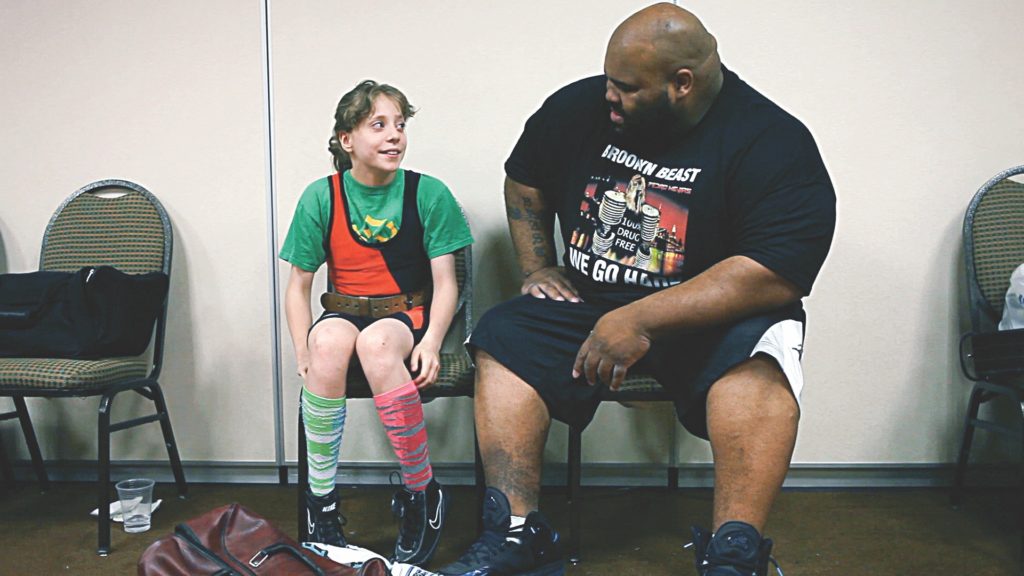
Naomi speaking to a fellow lifter at a contest
Credit: Carmen Delaney/Supergirl Film LLC

But some people have left snarky comments on Naomi’s Facebook page, referring to her as “butch” or faulting her parents for allowing her to lift such heavy weights at a young age, assuming that it could harm her health. Neshama Kutin told the Journal that she and her husband have been vigilant to ensure that Naomi’s health is on track.

Of the internet trolls, Naomi said, “at first they were just a shock. But then I realized that these people aren’t important in my life.”

The film also recounts how, while in the seventh grade, Kutin started to suffer from excruciating migraines that doctors did not associate with her lifting. “They were so painful,” she said. “I missed so much school, and there were times I couldn’t get off the couch.”

After almost a year of agony, doses of magnesium cured Kutin’s headaches.

She began weightlifting again in earnest, and even set records at the Pan American Games in Florida in July — including deadlifting 363 pounds while she weighed only 121 pounds.

All the while, she’s been volunteering for Jewish organizations that help children with special needs (her younger brother has autism). Kutin recently also traveled with her Orthodox youth group to Houston and New Orleans to help with hurricane relief efforts.

She’s considering majoring in exercise science when she attends college. No matter what happens next, she wants lifting to continue to be an important part of her life.

“I hope I can empower young women to see that following your dreams is a good thing,” she said.

“Supergirl” airs on KOCE, Southern California’s PBS station, at 10 p.m. Dec. 18.

Orthodox Teen Lifts Weights, Peers’ Hopes Read More »

Ancient Heroine Lights the Way for Our Time

For centuries, Jewish women across the world have told the story of Judith during Hanukkah season.

In this cultural moment, it could not be more appropriate. So, let’s join the tradition!

Judith is a young widow, stuck in the state of mourning after her husband unexpectedly has died three years before. She wears her sackcloth and ashes in a city under siege. But when she sees the children beginning to starve as supplies dwindle, and hears the men in power declare that surrender must be God’s will, Judith asks the men to let her try one thing first.

She takes off her sackcloth and ashes, dresses in her finest clothes, and along with her maid, leaves the city under cover of darkness. They walk straight into the enemy camp and pretend they are planning to defect, winning the trust of the army. Over the course of a few nights, Judith works her way into the tent of the enemy general himself, Holofernes. He’s charmed by her, and invites her to a private feast the next night.

Judith returns for the feast in her best dress, with a bag containing a skin of wine and a chunk of salty cheese. She feeds him cheese until he is thirsty, then wine until he is sleepy. As he drifts off, she takes the sword from his bedside and, with her maid, cuts off his head.

Finally, Judith takes the head and impales it on the city gates, and in the morning, the enemy army wakes up, sees their general’s lifeless head, and flees en masse, ending the war.

“What would happen if one woman told the truth about her life? The world would split open.” — Muriel Rukeyser

What a story. Not surprisingly, it’s a favorite of artists, including a female Old Masters painter, Artemisia Gentileschi, the subject of a seven-month sensational rape trial that rocked the 17th-century world; when she painted the scene, many think she gave Judith her face, and the head of Holofernes’ the face of her rapist.

Judith’s story upends the expectations of young women in the ancient world — or ours for that matter. Her victory is not just personal; it’s a triumph for her city, her culture, her people. You could say it’s a miracle, but you could also just say it’s a really smart new strategy.

And a new strategy is needed. After all, in this story, the established power structures have failed. God is not swooping in to save anyone, and the army is powerless to win. Only these two brave women can save their people.

Over the centuries, Jewish women have claimed Judith’s story as part of their living tradition. She’s often associated with Hanukkah, perhaps because of the near-miraculous military victory, or because both the holiday and Judith’s story are apocryphal, not included in the Hebrew Bible.

North African Jewish women celebrated Judith with a Chag HaBanot (Festival of the Daughters) or Eid al-Banat on the seventh night of Hanukkah; Ashkenazi Jewish women told Judith’s story in Yiddish on the eighth night of the holiday; Sephardic women in Turkey read the story of Judith to their children during the festival, as well.

And what about us? Right now, at this moment in American culture, women are beginning to speak the truths in our lives, challenging the structures of power that would keep us silent. We continue to unravel the violence that patriarchy causes women and men. We begin to hold those in power accountable. Judith leads the way, standing in solidarity with us as we discover our voices.

As poet and political activist Muriel Rukeyser wrote in 1968, “What would happen if one woman told the truth about her life? The world would split open.” Judith invites us to do precisely that: to tell the truth about our lives. Through her courage, she reveals our own. A bravery not necessarily predicted by our past actions, a bravery that might call for some reinvention, a bravery that might shatter what is expected of us and rearrange the world in a new structure.

Whether we use this courage for political action, or to carry out important changes in our personal lives, or to speak long-hidden truths, it is time. Time for us to tell the truth about our lives. And in this season of lights, Judith lights the way for us, as she has for so many before.


Alicia Jo Rabins is a writer, musician and Torah teacher who lives in Portland, Ore.

Ancient Heroine Lights the Way for Our Time Read More »

Klezmatics Bringing Message of Social Justice to Hanukkah Concert

The Klezmatics are rolling into Southern California once again to celebrate Yiddish culture as well as to perform festive Hanukkah songs penned by American folk legend Woody Guthrie. In what has become a seasonal favorite, the iconic New York City-based neo-klezmer troupe will perform songs from its two albums of Guthrie originals and other traditional holiday fare on Dec. 16 at the Valley Performing Arts Center in Northridge.

In their more than 30 years as a band, the Klezmatics have become the standard-bearers for Eastern European Jewish music, while bringing in other influences like Latin, Celtic, Afro-Caribbean and folk music. They are largely credited with helping to revive interest in Yiddish music and culture among a younger audience by drawing on the musical legacy and social activism of turn-of-the-century Jewish immigrants.

So, how did Guthrie, the non-Jewish Dust Bowl balladeer from Oklahoma and writer of “This Land Is Your Land,” come to write songs for Hanukkah?

The father of American folk music became involved with the Jewish community at Coney Island soon after he moved to Brooklyn in 1942. His third wife, Marjorie Mazia, was born Marjorie Greenblatt and was a dancer in the Martha Graham Dance Company. Marjorie’s mother, Aliza Greenblatt, was a well-known Yiddish poet and an early, committed leader in Zionist and Jewish women’s organizations. Many of her poems also were set to music and recorded by artists such as Theodore Bikel.

“We’ve drawn a lot of material from these great Yiddish socialist traditions.” — Frank London

Guthrie had a unique working relationship with his mother-in-law, who lived across the street and served Friday night Shabbat dinners to the family. They bonded over a shared love of culture and social justice, and she likely inspired him to write a batch of Hanukkah songs in 1949 for parties at the local Jewish community center. The songs are a combination of children’s tunes and more serious ballads about Jewish history and spiritual life.

In “The Many and the Few,” Guthrie recounts the life stories of key characters in Jewish history, including King Cyrus, Alexander the Great and Judah Maccabee. The Maccabee song ends with the lyrics: “Eight candles we’ll burn and a Ninth one too / Every new year that comes and goes / We’ll think of the many in the hands of the few / And thank God we are seeds of the Jews.”

Some of the songs are sentimental, like “Hanukkah’s Flame,” in which Guthrie writes: “Now as I light my first and my last / Of all nine candles to guide you past / Through these winds of blowing snows / To take you to your Hanukkah home.”

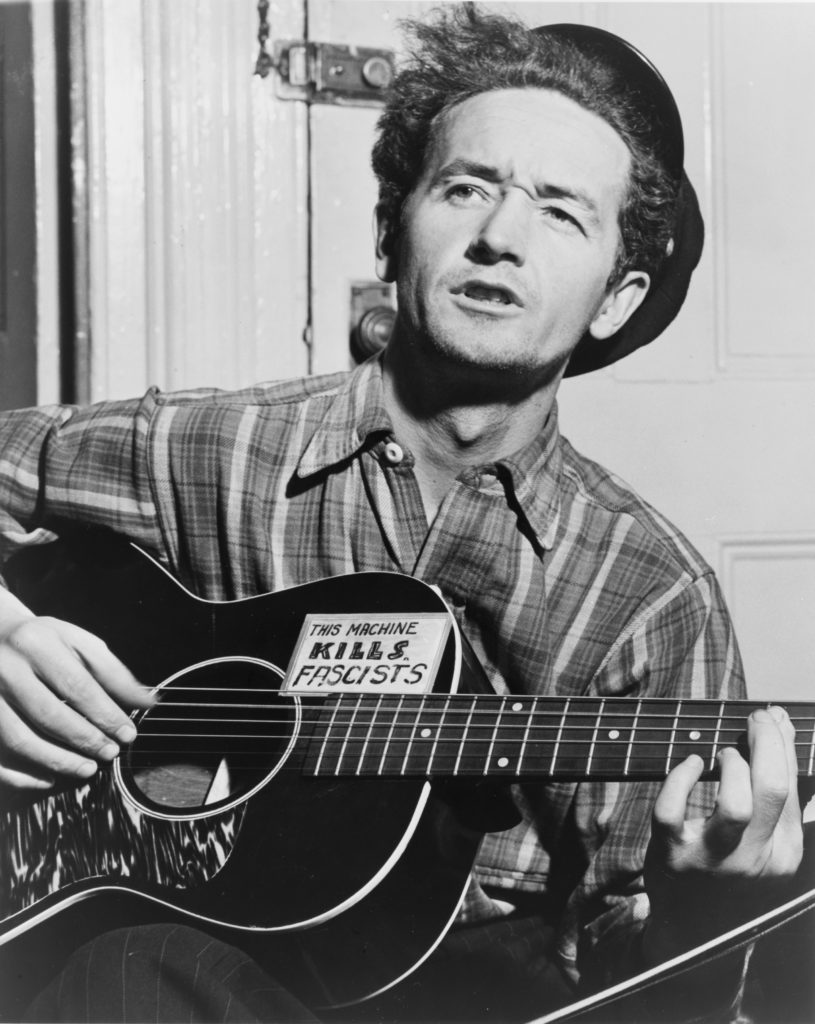
Woody Guthrie. Photo from Wikipedia

Others are playful, such as “Hanukkah Dance” (“Tippy tap toe! Happy Hanukkah! / Round you go! My little latke!”) and “Honeyky Hanukkah” (“It’s Honeyky Hanukkah, brushy my hair / Let’s dance a big horah and jump in the air.”)

The songs were never set to music and, after Guthrie’s death in 1967, sat untouched for decades. That is, until Nora Guthrie (Woody’s daughter and Arlo Guthrie’s sister) discovered a box of her father’s unpublished lyrics and poems. She approached the Klezmatics in 1998, after their concert at Tanglewood with violinist Itzhak Perlman, told them about her father’s collection of Jewish songs, and invited the band to record them.

The songs became the basis for The Klezmatics’ 2006 album “Happy Joyous Hanukkah.” Frank London and his bandmates set the words to melodies, a melding of Yiddish nigunim (traditional Chasidic melodies), folk, bluegrass and gospel arrangements.

Another set of Guthrie’s lyrics, which were anti-fascist and pro-labor, ended up on the Klezmatics’ 2006 Grammy Award-winning world music album, “Wonder Wheel.”

“If you look at ‘Wonder Wheel,’ it’s Jewish-y but in a more oblique way,” London said.  “We do the material from ‘Wonder Wheel’ all year round in our concerts, but the Hanukkah material is for now.”

London, who sings and plays trumpet and keyboards, is one of three original members still on board, along with Lorin Sklamberg (lead vocals, accordion, guitar, piano) and Paul Morrissett (bass, tsimbl). The ensemble also includes longtime members Matt Darriau and Lisa Gutkin.

The Klezmatics generally sing in Yiddish, though the two Guthrie albums are in English. But London said Guthrie did occasionally drop Yiddish words into his songs.

“A knish. … Calling a girl a meydeleh,” London said. “[Guthrie] didn’t speak or write in Yiddish. But it’s kind of cute that Woody Guthrie, the guy that wrote ‘Grand Coulee Dam,’ is dropping words like blintz.”

The Klezmatics are known as outspoken human rights advocates and have long been influenced by the radical socialist history of Yiddish poetry and music.

“We’ve drawn a lot of material from these great Yiddish socialist traditions,” London said.  “Yiddish culture is filled with respect and love for basic human dignity, and Woody’s music likewise.”

As America once again grapples with rising anti-Semitism, fascism and a restructuring of society to benefit the wealthy, London says Guthrie’s songs will resonate with audience members.

“This is a very difficult time we live in,” he said. “And I believe that one of the good aspects of music and the music the Klezmatics make, whether we’re doing our more political stuff or not, is that having people come together and sing together … will give people the strength to do the work necessary to resist some of the horrors of our contemporary moment.”


The Klezmatics will perform at 8 p.m. Dec. 16 at the Valley Performing Arts Center in Northridge. Tickets for “Happy Joyous Hanukkah” start at $33 and can be purchased by calling (818) 677-3000 or visiting valleyperformingartscenter.org.

Klezmatics Bringing Message of Social Justice to Hanukkah Concert Read More »

Peace Through Raising Expectations

I support the plan to move the U.S. Embassy in Israel from Tel Aviv to Jerusalem. I acknowledge this is a controversial topic, and I will observe the talmudic principle of stating the primary, opposing viewpoint before my own:

“The American Embassy in Israel shouldn’t be moved from Tel Aviv to Jerusalem at this time because it will result in violence, impair the Israeli-Palestinian peace process and further destabilize a region already beset with violence and chaos.”

I disagree with this view because it expects the worst from Palestinian Arabs and Arabs in general. I believe it is racist to assume that these groups will become violent merely because something happens that displeases them.

It is true that actions by Israel and the United States have met with violence in the past. If we dig deeper, however, we find that the real obstacle to peace is a Palestinian leadership that benefits financially from the ongoing cycle of violence. One need look only at the personal fortune of Yasser Arafat at the time of his death — a stash worth more than $1 billion — to grasp the profound impact of the leadership’s corruption on the Palestinian people.

Fourteen years later, Arafat’s successors continue to hire protesters for suicide missions by offering lifetime payments of $3,000 a month to their families, distributed through the Palestinian Authority Martyrs Fund. Thousands of families receive these payments, funded entirely by foreign aid. Needless to say, the politicians take a huge cut for themselves.

The real obstacle to peace is a Palestinian leadership that benefits financially from the ongoing cycle of violence.

It’s a simple cycle: incite violence against Israelis, exploit the predictable military response for publicity, receive payments from sympathetic nations and skim for personal gain.

The leaders of this operation are not motivated to imagine peace with Israel because it would take money out of their pockets. Bypassing such leaders is the key to forging the elusive peace.

In announcing the intention to move the embassy, President Donald Trump noted that 1) the modern State of Israel declared Jerusalem its capital decades ago and has thus governed itself ever since; 2) the American pretense that Tel Aviv is Israel’s capital has not contributed to peace in the region; and 3) most importantly, Jerusalem is the eternal capital of the Jewish people.

This truth has never been taught in Palestinian schools. The fact that Jerusalem is mentioned by name 622 times in the Torah and has been the focus of Jewish prayer for 2,000 years, and has never been the capital of any other nation, doesn’t matter if such facts are not communicated to the population that is being manipulated into violence.

The proposed embassy move, which carries tremendous symbolic weight, bypasses the Palestinian Authority gatekeepers and communicates to the Palestinian-Arab people that Israel and Jerusalem will never be parted. It brings us closer to peace by respecting them enough to assume that violence is neither their only form of communication nor negotiation, when presented with actual facts.

In its coverage of the embassy story, however, the Los Angeles Times noted on its front page that the president’s announcement sent “a sense of anger and apprehension coursing through the Arab world.”

This is the racism of low expectations. How can relocating the diplomatic office to reflect a historical and practical reality create apprehension for Arabs? Who is threatening them? It’s as if the L.A. Times already is justifying the violence it expects from the Arab world.

If more violence comes, and I pray it does not, it will not be because the United States respects Israel’s right to determine its own capital like every other nation. Such violence would arise from the same corrupt leadership that has always benefited from it. If we recognize these leaders and hate peddlers for what they are, we may well hasten the day when new leadership arises that seeks to build a genuine peace and more hopeful future for Palestinians.

This kind of revolution can’t happen if we don’t engage with the people directly. Let’s assume they want peace and they’re open to new ideas. Let’s raise our expectations.

Such assumptions won’t make the road to peace a smooth one,  but at least there will be a road.


Salvador Litvak shares his love of Judaism every day  at facebook.com/accidentaltalmudist.

Peace Through Raising Expectations Read More »