Sensational, poignant stories about ultra-Orthodox Jews leaving behind their communities are in style right now.
The new Netflix documentary “One of Us” examines three ex-Chasidic Jews trying to find their way in the secular world. In 2015, Shulem Deen’s “All Who Go Do Not Return: A Memoir” received media attention from Jewish and secular outlets. And this past March, The New York Times published a story headlined “The High Price of Leaving Ultra-Orthodox Life.”
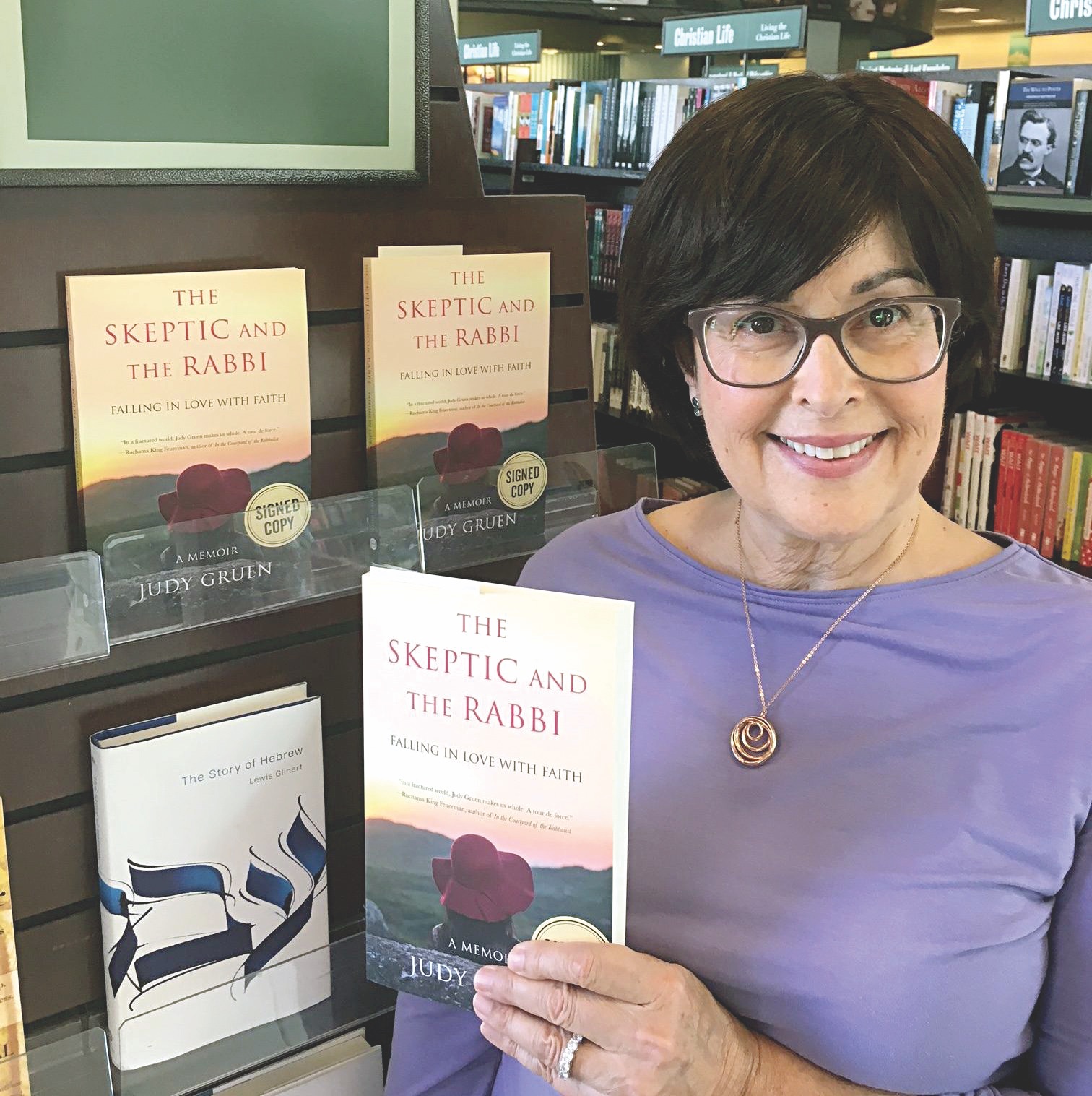
But there aren’t so many tales about people having positive experiences in the religious Jewish community. Author Judy Gruen aspires to help change that with her new book, “The Skeptic and the Rabbi: Falling in Love With Faith” (She Writes Press, $16.95).
Gruen, an Orthodox Jew who lives in Pico-Robertson, was raised in a non-observant home in Los Angeles. It wasn’t until she met her husband, Jeff Gruen, in the 1980s and started attending the Pacific Jewish Center (PJC), also known as the Shul on the Beach, that she became a ba’al teshuvah. “The Skeptic and the Rabbi” is all about Gruen’s roller coaster of a journey toward Orthodoxy, and her eventual decision to become observant.
“My goal for the book was to dispel a lot of myths and misconceptions about what it’s like to live an Orthodox life,” Gruen, 57, said. “Even the word ‘Orthodox’ is a problematic one. Are the ‘Orthodox’ the Charedim? … [Are they] women who wear pants and don’t cover their hair but go to a Modern Orthodox synagogue? It’s a huge umbrella term.”
“Frankly, I was just afraid of what my exposure to Orthodox teachings might lead to.” — Judy Gruen
Gruen was exposed to some cultural and religious aspects of Judaism as a child; her grandparents were stringent about rituals. But she truly didn’t experience Orthodoxy until adulthood. “I carried a lot of myths about what my Orthodox life would look like,” she said. “Was I wrong about everything? No. But I was wrong about most things.
“My biggest fears were that there would be a stifling uniformity to the people I met, which was not at all true,” she continued. “The PJC community in Venice in those days included artists, actors, writers, lawyers, psychologists, the whole gamut. While you could, of course, find some ‘group think,’ you also find group think in any group.
“I just want to create a little more understanding,” she said of her memoir.
The book covers Gruen’s childhood, her college days, and her courtship and eventual marriage to Jeff, as well as all the messy situations, reluctant thoughts and confusing questions she had along the way to becoming observant. She attempts to explain her new lifestyle to her family and friends while straddling the secular and religious worlds.
Unlike other religious articles and books, which might skip over the more challenging aspects of faith, Gruen doesn’t spare any details in “The Skeptic and the Rabbi.” Early on, she worried that because her rabbi “was Orthodox and South African, he would be both sexist and perhaps racist. I had zero exposure to Orthodox teachers and had intuited, unfairly, many stereotypes about all things Orthodox. Frankly, I was just afraid of what my exposure to Orthodox teachings might lead to.”
She also highlights an incident where she accidentally served a Shabbat guest something nonkosher.
“The book is “not sugar-coated,” Gruen said. “I talk about what I didn’t understand, and about what’s hard.”
Ultimately, Orthodoxy started to make sense to Gruen. She enjoyed Shabbat, saw how the religion solidified her relationship with her husband and felt her soul awakening through practice.
Gruen, a mother of four, a grandmother of three and a member of The Community Shul (formerly Aish HaTorah), has contributed to publications including the Journal and The Wall Street Journal.
She’s authored humor books such as “The Women’s Daily Irony Supplement” and “Till We Eat Again: A Second Helping.” “The Skeptic and the Rabbi” will be translated into Spanish and is up for a Sophie Brody Award for outstanding Jewish literature.
Although the book has received mostly positive responses within the Orthodox community, Gruen wrote it for anyone trying to connect to a higher purpose. She said she once received a Facebook message from a first-generation, Indian-American man who found the book inspiring on his own path.
“That was very meaningful to me,” she said. “I want people to feel empowered in their journeys to faith, whatever they are.”