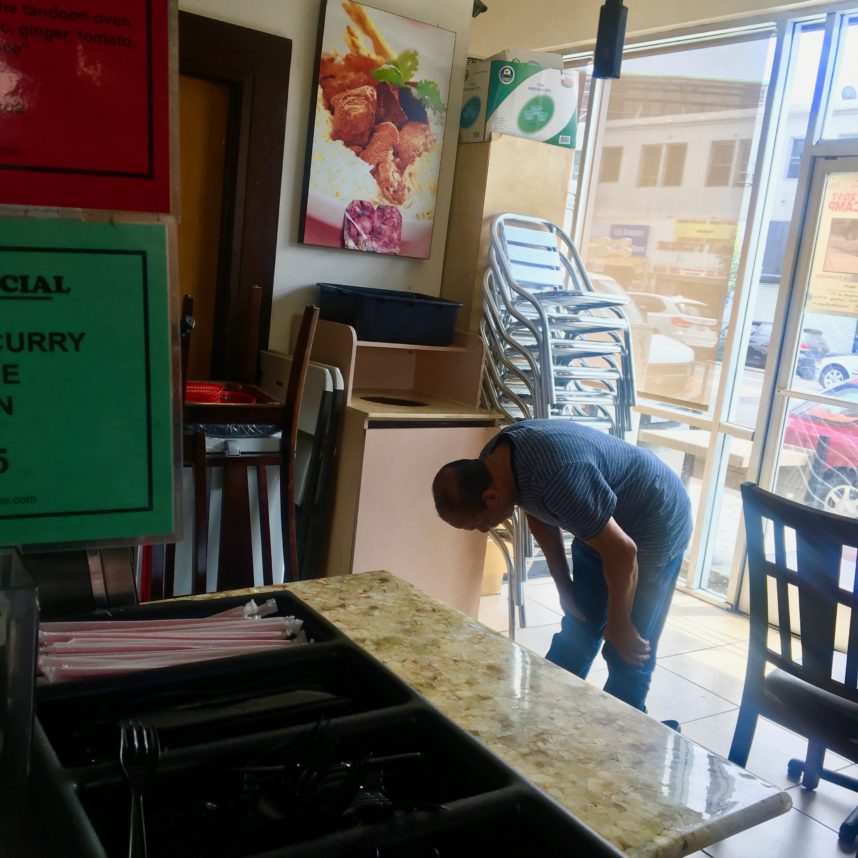
When we walked into Biriyani Kabob House in a Koreatown strip mall, the owner was on the floor, head down, in Muslim prayer. The Latino cook pointed at him. “Wait for him,” he said.
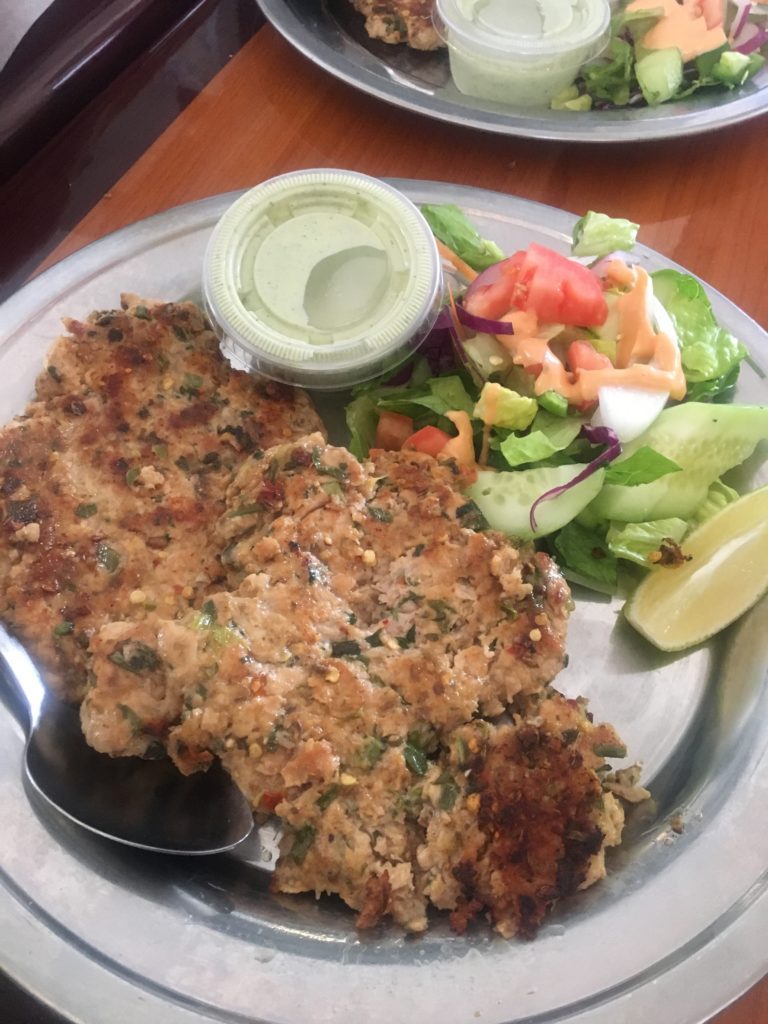
Jake Tapper was on a large, loud TV, talking about the hate march in Charlottesville. My guest was a Pakistani journalist. We ordered chapli kebab, which is ground chicken with chili and coriander, pressed flat on the grill.
“Where are you from?” he asked the owner.
“Bangladesh.”
The journalist told me Bangledeshi chapli would not be as good as in his native Punjab. “People go there just for the chapli,” he said.
The Latino cook made fresh naan, then the kebab. He plated it with a lime green yogurt cilantro sauce and salad. We ate. It was hot, with fresh chili, minced garlic and onion, and fragrant with coriander and parsley.
“So is it as good as home?” I asked the journalist. He smiled. “It’s very good,” he said.
It was. We watched footage on TV, people fighting over the kind of America they wanted. I had my answer. I was sitting in it.
I was in Charlottesville on Saturday. I felt called to go because white supremacy is a hateful ideology that has murdered millions throughout history and continues to kill.
I went because my family and ancestors suffered at the hands of anti-Semites throughout history, because I bear their scars on my DNA, because the Jewish day school where I teach received a bomb threat this spring, and I cannot let Nazi flags fly in my state without response.
I needed to go as a rabbi because I am tired of conservative white Christians controlling the narrative of what it means to be religious in this country, and using that narrative to drive out, silence and forcefully assimilate non-Christians and the religious left.
I am proud that I was able to go as part of the group sent by T’ruah: The Rabbinic Call For Human Rights, and that the clergy-led response against hate can show this country what theology really looks like. I was immediately heartened to see the number of clergy of all denominations in their religious garb. A Muslim women in her headscarf, a handful of rabbis in their tallitot and many, many denomination of Christian clergy in their collars, stoles and robes.
A group of clergy started the morning off at Emancipation Park, where the white nationalists gathered. Volunteers wandered about the First United Methodist Church supplying water and emotional and spiritual support, and a few clergy were stationed at hospitals around the city, prepared for emergency chaplaincy.
I chose to serve in a support role, bringing water and snacks to protesters (a role Congregate C’ville, an interfaith group, called “care-bears”), rather than participating in any of the direct actions, including the very non-confrontational clergy-led response. I’m still within a six-month sort of probationary period from a previous political arrest (the result of another T’ruah action) and was nervous about being involved in any “unlawful assembly” at this time. I believe this choice also helped keep me safe from violence.
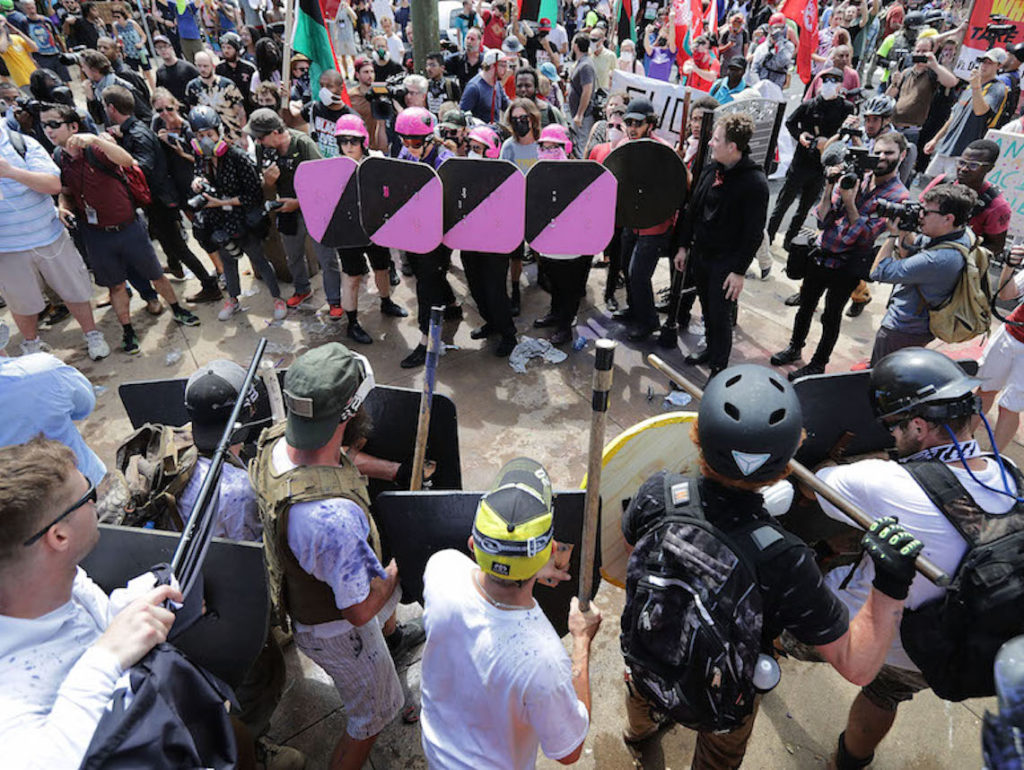
When I got in to Charlottesville, I immediately checked in at the church and gathered the supplies to bring out to people. Together with some other “care-bears” I know through IfNotNow, I walked the few blocks toward Emancipation Park. The crowd of anti-racist protesters was huge, and the white nationalists were mostly confined within the park. I wasn’t able to see much going on inside the park, but I could clearly make out Identity Evropa, Nazi and Confederate flags.
One of my fellow care-bears said she saw a Kekistan flag, a concept I’m vaguely familiar with as a racist rallying banner of the alt-right online culture, but not an image I would recognize. Twice while we were milling through the crowd handing out waters, clumps of white nationalists walked up the steps into the park, greeted with much cheering and thumping of flagpoles on the ground from those in the park. They appeared to take a conspicuous route past the counterprotesters, to announce that they had arrived.
We had been there about an hour when the police closed Emancipation Park and things got chaotic. My fellow care-bears and I would follow the sounds of shouting or the thump of a police helicopter, or get information from Twitter and texts from friends around the city, to locate counterprotesters and provide them with water.
At one point, we came across a large group, containing many of my friends involved with more radical anti-fascist organizations, marching down toward the downtown mall, and we handed out all our supplies to them as they stormed past. We headed back to the church to restock, and had no sooner filled our bags than we heard about the car that had rammed into a crowd of anti-racist activists gathered at the mall. By the time we got there, the ambulances had already arrived.
We handed out more water and snacks to the traumatized folks who had witnessed the terror attack, and when we were out, again returned to the church, only to learn that the church had just been put on lock down. A white nationalist with a gun tried to harass and intimidate the sanctuary workers, and were scared off by antifa — anti-fascist activists — who had ringed the parking lot of the church and were regularly running off would-be aggressors. Again, we had narrowly missed a terrifying moment. It seems that happens to me often, and I am so, so grateful for those near-misses.
I felt a similar providence at the Disrupt J20 protests, where I joined others in protesting the inauguration of President Trump and found myself to be in the right places at the right times and narrowly avoided violence multiple times throughout the day. It could be coincidence but being a spiritual person, I choose to believe it was by the grace of God.
And I thank my God, the bountiful spirit of the universe, who in inscrutable ways has watched over me and granted me abundant kindness by shielding me from great harm.
I can’t speak to why this same gracious God did not protect Heather Heyer, who was killed when the car, driven by a 20-year-old white supremacist, mowed through the crowd of demonstrators. She, like so many before her, died standing up against hatred and bigotry. All I can do is repeat the words uttered in the book of Job in the face of unfathomable loss: “God gives, and God takes, Blessed is God.” That does not mean her death is acceptable. Her life and her fight will not be in vain. Her memory will be for a blessing. We will not forget her and we will keep fighting back against white supremacy.
The Torah portion that Jewish communities around the world will read this week includes the commandment to rejoice at appropriate times. I say that because although now is not that time, that time will come. Now we mourn the loss of life white supremacy has wrought and we pray for the healing of mind, body and spirit of all those harmed by this weekend’s events and others like them.
But next week we go back to work, and some day, we will win this fight, and we will have reason to rejoice, to celebrate, to feast — and we will do it together.
Rabbi Lizz Goldstein is a rabbi in Northern Virginia and a proud member of T’ruah: The Rabbinic Call for Human Rights.
I’ve spent a good part of this morning thinking about yesterday’s toppling of the Confederate statue in Durham, NC.
At Duke University, where I work as an administrator, students have written asking me to send a message celebrating this action as evidence of courageous activism. But yesterday we also witnessed the vandalism of the Holocaust memorial in Boston. As a child of Holocaust survivors, I can’t avoid making a connection between the two acts. Why, I wonder, do we think of one as activism and the other as vandalism? Some would argue we can and should. But I’m not able to accept that reasoning.
Let me explain. I absolutely want memorials to racism, hate and prejudice removed. They should be either destroyed, or relegated to museums with appropriate historical representation. But, I want their removal through legitimate, law-abiding processes. Yes, I understand that unethical government actions (like North Carolina gerrymandering) stack the deck against progressive movements. But that just means we have to fight harder to change those laws, however long that may take. We need active voters and they need inspiration to vote– like getting monuments to hate removed.
I’m also aware that many people legitimately feel overwhelmed by persistent acts of violence, oppression and hate. For them, delaying immediate action, or redirecting it into interminable political processes is equivalent to inaction. I’m certain that in Germany in the 1930’s, my parents and many others would have preferred anarchy to what transpired. But, I’m more optimistic that, partly because of these memories and because of my belief in an America that cares, effective and legal actions will ultimately prevail.
Rabbi Abraham Joshua Heschel, whose works are now archived here at Duke University, said that, “morally speaking, there is no limit to the concern one must feel for the suffering of human beings, that indifference to evil is worse than evil itself, that in a free society, some are guilty, but all are responsible.” I take this charge seriously. I hope that what we saw in Charlottesville this week and throughout the country in the last few years will serve as a wake-up call for each of us and for our nation.
I’m old enough to remember effective grass roots movement in the 1960’s and 1970’s in support of civil rights and in opposition to the Vietnam War. Certainly, these efforts preceded today’s social media campaigns laced with anonymous diatribe. But, we have ample evidence of the power of thoughtful, intelligent and focused efforts to counter oppression and injustice. Without a doubt, what’s needed today will require far more time, money and energy than simply posting on Facebook and Twitter will suffice. We need young people committed to supporting candidates and willing to run for elective office themselves. And, yes, sometimes these days, we need protests and vigils and rallies. But, lest we emulate those whom we decry, we need our actions to be mindful of safety, ethics, and laws. When we take the laws into our own hands, we also legitimate the same behaviors by those who seek to harm us.
So, in good conscience, I can’t endorse yesterday’s behaviors. I hope that we focus our collective actions on having every elected seat up for challenge in the 2018 elections filled with people who decry white supremacy, anti-Semitism, racism, and every form of bias and hate. Our future depends on it.
Larry Moneta is Vice President for Student Affairs at Duke University.
I spent last Saturday night — the night of the neo-Nazi rally and the tragic murder — at the Pacific Resident Theatre in Venice, watching a fine performance of Eugene Ionesco’s “Rhinoceros.” The play takes place in a French village, where the drunkard Berenger is witness to something bizarre: slowly, the townsfolk are turning into rhinos. Ionesco, whose mother was from a Sephardic Jewish family, wrote the play based on his experiences in Romania in the 1930s, when, one by one, his social circle turned on him and embraced fascist leaders and their ideologies.
I was still reeling from the astonishing fact that President Donald Trump had just equated white supremacists, neo-Nazis and the KKK with the people who took to the streets to stop them. Earlier that day, Trump refused to name and shame these people even after one of them allegedly rammed his car into a crowd of peaceful protesters, killing 32-year-old Heather Heyer.
What was happening onstage paralleled the world outside.
Onstage, the protagonist Berenger explains to his girlfriend, Daisy, one way the rhinos multiply.
“Sometimes one does harm without meaning to,” he says, “or rather one allows it to go unchecked.”
And when Berenger’s co-worker dismisses accounts that the streets are now filled with citizens-turned-rhinos, Berenger shows him the morning headlines.
“I never believe journalists,” Botard says. “They’re all liars. I don’t need them to tell me what to think; I believe what I see with my own eyes.”
The audience didn’t know whether to clap, laugh or groan — I heard all three.
By the end of the play, all the townsfolk but Berenger become rhinos. Some because that’s what they want. Some because the radio is broadcasting nothing but rhino messages. Some because everyone else is. What appeared grotesque in Act 1 seems perfectly normal by Act 3.
“We must adapt ourselves and try and get on with them,” Daisy says when only she and Berenger are left unchanged. “After all, perhaps it is we who need saving. Perhaps we are the abnormal ones.”
It was no accident the PRT chose to mount Ionesco’s 1959 classic. In his recent treatise “On Tyranny,” historian Timothy Snyder uses the play as his proof text of how democratic societies go dark.
“Ionesco’s aim was to help us see just how bizarre propaganda actually is, but how normal it seems to those who yield to it,” Snyder writes. “By using the absurd image of the rhinoceros, Ionesco was trying to shock people into noticing the strangeness of what was actually happening. The Rhinoceri are roaming through our neurological savannahs. … And now, as then, many people confused faith in a hugely flawed leader with the truth about the world we all share. Post-truth is pre-fascism.”
When the play originally came out, it was a sensation in Israel — a country whose populace was still reeling from a European outbreak of “rhinoceritis.” Soon, there was even a Hebrew word, hitcarnfut, from the root for “horn,” to describe someone who falls under the spell of any beastly ism. The Jews figured there needed to be a word for it, since what are the odds it wouldn’t happen again?
After the cast took a much-deserved curtain call, I went home and stared at the images of the neo-Nazis who marched and killed in Charlottesville. It made what the president said – and kept saying— even less excusable.
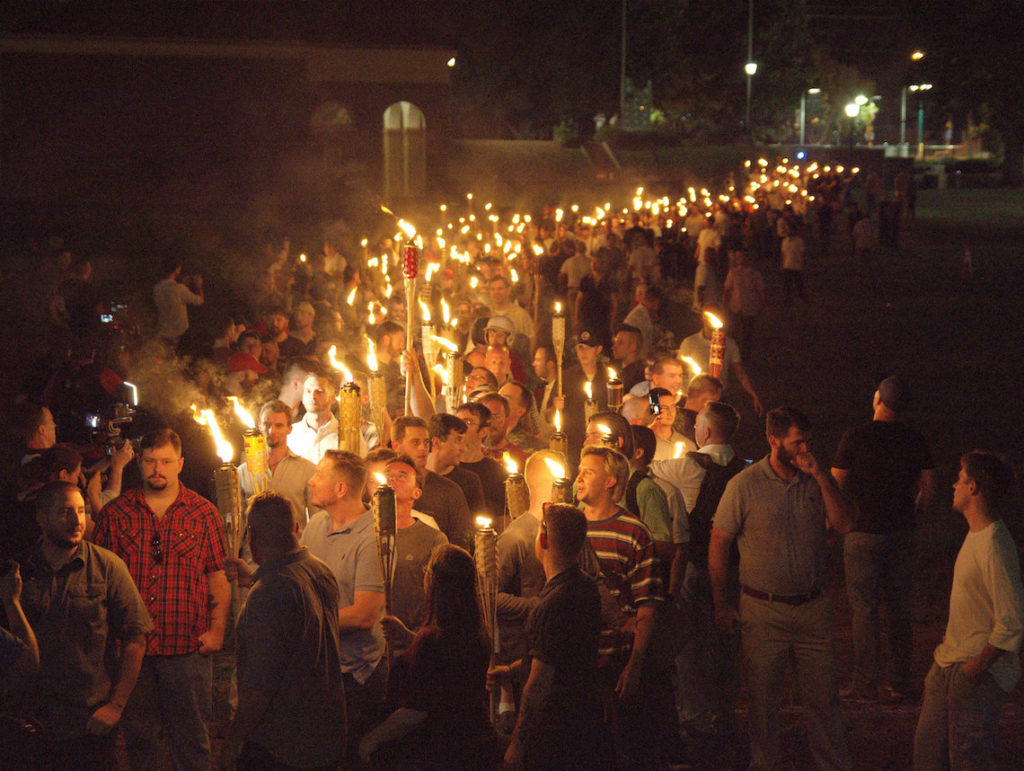
It was a march organized by a nationwide group of white supremacists, neo-Nazis, America Firsters and Confederate throwbacks that spurred the violence in the first place. They converged on Charlottesville sporting swastikas and swaddled in Confederate flags, emblazoned with the latest in 1930s Fascist emblems. They carried semi-automatic weapons and sported militia costumes. Their ostensible cause was to protest the long-planned transfer of a statue of Confederate Gen. Robert E. Lee from a town square to a town park.
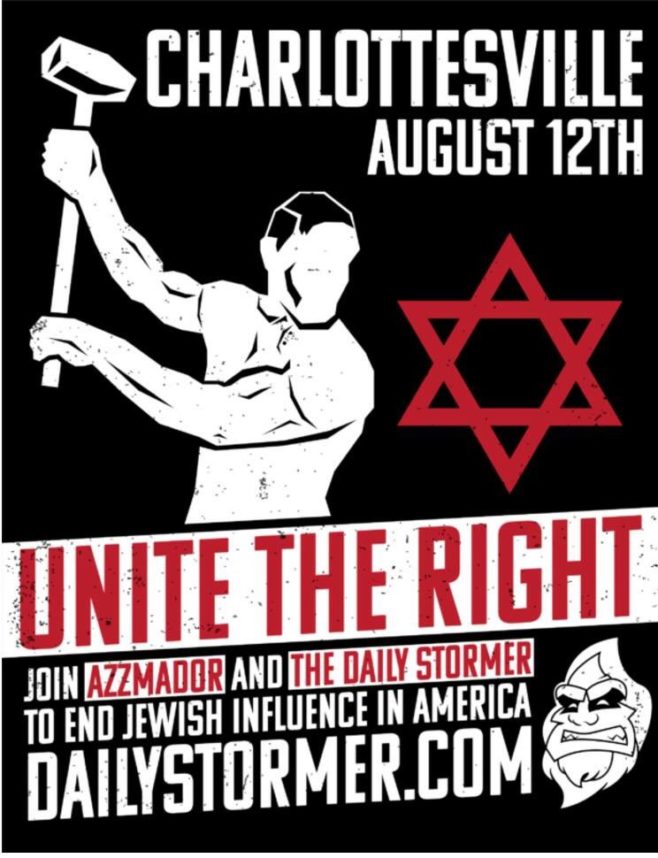
The marchers alternated chants of, “You will not replace us!” with “Jews will not replace us!” They intimidated Jewish reporters and chanted the Nazi straight-outta-Nuremberg slogan “Blood and Soil!” One of the flyers that brought out the crowds featured a “Unite the Right!” slogan and a Star of David.
When counterprotesters came out to thwart them, things got ugly. Maybe it would have been cleaner had the counterprotesters stood by and waited for the wannabes to pass, but Jews tried that in the 1930s and it didn’t work out so well. That fact alone gave the president a perfect opportunity to pick sides: either the guys with swastikas and Nazi slogans and guns, or the people standing up to them.
In the immediate aftermath, Trump refused to choose.
After waiting far too long, he made a statement. He condemned violence “on many sides.” If it wasn’t clear that he was apportioning blame equally between the people who marched in support of slavery and killing Jews and those who opposed them, he repeated that phrase, “on many sides.”
Trump — the father and grandfather and father-in-law of Jews — refused to blame the neo-Nazis.
“I’m here to spread ideas, talk, in the hopes that someone more capable will come along,” rally co-organizer Christopher Cantwell told VICE News, “somebody like Donald Trump who does not give his daughter to a Jew…. I don’t think you can feel about race the way I do, and watch that Kushner bastard walk around with that beautiful girl.”
These were the people Donald Trump, best friend of the Jews, refused to hold accountable. Refused to threaten them with anywhere near the fire and fury he uses to lash out at North Korea, James Comey, Sen. Mitch McConnell, CNN or The New York Times.
It was no less than a betrayal.
I’ve disagreed with other presidents, Democrats and Republicans. I’ve protested their policies. But I never felt that any of them betrayed me. This wasn’t a close call. It was lob across home plate, which in this case stands for human decency and patriotism.
But Trump couldn’t do it.
Instead of slapping back the instigators of all this violence, my president gave them cover to go on. The protestors were able to tell themselves, “We’re no worse than them — even the president said so.” In one statement after another, Trump leveled the playing field between good and evil.
It was a missed opportunity. The movement, such as it is, is still miniscule. There weren’t that many of them — maybe 1,000? The amount of media attention they sucked up was far out of proportion to their importance or danger. That same weekend, nine people were killed and 30 others were wounded in shootings across Chicago. Zero national coverage.
But that even made the president’s task more important. Calm the country, call out these miscreants for what they are, and focus our attention on more pressing matters. This was the time to brush them back, to rally the better angels before things get out of hand.
The reaction to Trump’s shameful statement was swift and bipartisan.
Republican Sen. John McCain tweeted, “White supremacists aren’t patriots, they’re traitors — Americans must unite against hatred & bigotry.” Republican Sen. Ted Cruz called for a federal hate crime prosecution.
The Simon Wiesenthal Center, whose founder Rabbi Marvin Hier gave a benediction at Trump’s inauguration, said in a statement, “We call upon all American leaders, whatever their political affiliations, led by President Trump, to specifically condemn the extreme alt-right and white nationalists who sow seeds of hate, distrust and violence.”
“”When I was a kid,” the actor Joshua Malina tweeted, “the Nazis were the bad guys.”
For years, Trump and his supporters accused President Barack Obama of refusing to use the phrase “radical Islamic terrorism.” Although Obama repeatedly condemned the terrorists — and put a bullet through the head of their leader, Osama bin Laden — he opened himself to the entirely valid criticism that by not naming the problem, you avoid the problem.
But here Trump was doing the exact same thing, refusing to name and condemn the terrorists in his own backyard.
Forty-eight hours after his first statement, Trump read off his second. The headline in The New York Times — two full days after Charlottesville — read, “Trump, Bowing to Pressure, Rebukes White Supremacists.”
I read it twice. It’s 2017. And everything you need to know about what’s sideways about America is between those two commas: “Bowing to pressure.”
What does it say about the president of the United States of America that getting him to name and shame white supremacists is like getting him to say “uncle?”
“Racism is evil,” President Trump read from his TelePrompTer from the White House, “and those who cause violence in its name are criminals and thugs, including the KKK, neo-Nazis and white supremacists, and other hate groups who are repugnant to everything we hold dear as Americans.”
It was better, like any do-over. But the white supremacists on the internet said he was doing it just to calm the critics or to kowtow to them.
“He said EVERYONE INVOLVED will be prosecuted to the fullest extent of the law. that includes Antifa and BLM,” one pro-Trump Reddit user wrote, referring to anti-fascists and Back Lives Matter.
“By ‘other hate groups,’ ” wrote someone on the neo-Nazi Stormfront site, “he means the real hate groups in America, the Anti-White ones.”
This was something the neo-Nazis and the rest of humanity agreed upon: Trump’s second statement was for show, the first for real.
John Podhoretz, writing in Commentary, ventured a guess as to why. These same protesters, he said, represented the solid core or Trump’s supporters, the people who gave him the initial oomph in his race for president.
And that core, Podhoretz wrote, “is governed by rage, hatred, a sense of being wronged, and the loathing of others due to race and national origin. They are numerically insignificant to a man who secured 63 million votes in November 2016. But he … seems to feel they are necessary to the constitution of his core. And he basically let them off with a mild warning.”
They are young — the murder suspect himself was just 20 years old. Their world is a digital echo chamber. On Facebook and Reddit, their posts and comments are a Freudian playground of thwarted desire and sexual insecurity. Everyone not them is “gay” or a “faggot” or “cuck,” the alt-right put-down meaning cuckold. In their sexual obsession, their need for belonging and their delusions of Jewish dominance, these young men are not so different from the lost, horny and hate-filled ISIS fighters they must despise.
And why the Jews? How did we get dragged into a dispute over Robert E. Lee? Yes, Charlotteville Mayor Michael Signer, who stood up to the mob and showed the president what leadership looks like, happens to be Jewish. But that’s a coincidence; the obsession predates him. In fact, it’s astonishing that no matter how the leaders of the alt-right try to pretty up the movement, its true, ugly credo wills out. It’s the Jews’ fault.
A day after the violence, far-right talk radio lunatic Alex Jones claimed that the right-wing protesters who caused the violence were actually “Jewish actors,” who infiltrated the ranks to make the movement look bad.
“Nothing against Jews in general,” Jones said, “ but there are leftist Jews that want to create this clash and they go dress up as Nazis. I have footage in Austin … where it literally looks like the cast of ‘Seinfeld’ or like Howard Stern in a Nazi outfit… it’s all just meant to create the clash.”
These were the voices Trump bowed to on Tuesday, Aug. 15, when he took to the microphone again – to double down on his original equivocation.
“You had very fine people in both groups,” he said at a press conference at Trump Tower in Manhattan.
When reporters repeatedly pressed him on whether he was equating neo-Nazis and the counter-protesters, the President made it clear: he was.
“What about the alt-left that came charging at ’em – excuse me,” he said.
Was Trump on to something? No. According to an Anti-Defamation League study, of at least 372 murders that were committed by domestic extremists between 2007 and 2016, 74 percent were committed by right-wing extremists and 24 percent by Muslim extremists. Left-wing extremists? 2 percent.
Later, Trump compared Robert E. Lee, a traitor who fought to tear apart the United States that Trump is president of, with George Washington, who fought to liberate and create the country.
When it was over, KKK leader David Duke couldn’t have been happier.
“Thank you President Trump for your honesty & courage to tell the truth about #Charlottesville & condemn the leftist terrorists in BLM/Antifa,” he tweeted.
There’s no real way to explain this lunacy other than to look back. A not especially creative crowd can’t invent a new enemy, so it steals an old one.
“The rats are still down there in the sewers, brooding,” says Jean Tarrou in Albert Camus’ “The Plague,” “and the Plague is still down there with them, and that Plague will one day again send up its rats to die once more on the streets of a free city … ”
You don’t get rid of hate; you just have to be prepared, always, to fight it. It appears we now have to do battle with a feckless president. Will he ever develop a spine? Will he ever stand for the values of his party, much less America?
Or will he continue to equivocate as the plague spreads to engulf us all? Who knows? As Ionesco himself once said, “You can only predict things after they have happened.”
President Trump reverted to blaming left-wing counterprotesters as well as white supremacists for the violence that erupted at a far-right rally in Charlottesville, Virginia.
In startling, off-the-cuff comments at a press conference Tuesday, the president appeared to backtrack from his statement Monday that explicitly condemned neo-Nazis and white supremacists for the violence on Saturday. On the day of the rally, Trump’s initial statement condemned “hatred, bigotry and violence, on many sides, on many sides,” a statement that shocked members of both parties for neglecting to call out white supremacists.
On Tuesday, Trump called out “the left, that came violently attacking the other group.”
“I think there’s blame on both sides,” Trump said at the news conference Tuesday in New York. “What about the alt-left that, as you say, came charging at the alt-right? Do they have any semblance of guilt?”
The “Unite the Right” rally Saturday saw hundreds of people on America’s racist fringe converge in defense of a statue of Confederate General Robert E. Lee and brawl with counterprotesters. After the rally was dispersed by police, a white supremacist, James Fields, rammed his car into a crowd of counterprotesters, killing one woman and injuring at least 19. Two police officers also died when their helicopter crashed while monitoring the rally.
Attendees at the rally waved Nazi and Confederate flags, and shouted anti-Semitic and racist chants, in addition to giving Nazi salutes. But Trump said at the press conference that not all of the attendees were white supremacists.
“I’ve condemned neo-Nazis,” he said. “I’ve condemned many different groups. but not all of those people were neo-Nazis, believe me. Not all of those people were white supremacists by any stretch. Those people were also there because they wanted to protest the taking down of a statue of Robert E. Lee.”
The president also appeared to equate Confederate generals with the founding fathers in questioning the drive to remove statues and other symbols of the Confederacy. He noted that George Washington owned slaves.
“This week it’s Robert E. Lee,” he said. “I noticed that Stonewall Jackson is coming down. I wonder, is it George Washington next week and is it Thomas Jefferson the week after? You really have to ask yourself, where does it stop? George Washington was a slave-owner.”
David Duke, the former Ku Klux Klan leader, thanked Trump on Twitter “for your honesty & courage to tell the truth about #Charlottesville & condemn the leftist terrorists in BLM/Antifa,” references to the Black Lives Matter movement and Antifa, a loose movement that combats white supremacists, sometimes violently.
But Congressional leaders shot back at Trump’s comments, calling for an unequivocal condemnation of white supremacists. Speaker of the House Paul Ryan, a Republican, called white supremacy “repulsive” while Senate Minority Leader Chuck Schumer, a Democrat, criticized Trump for sowing division in America.
We must be clear. White supremacy is repulsive. This bigotry is counter to all this country stands for. There can be no moral ambiguity.
In Fiddler on the Roof, Tevya’s daughters pressed his boundaries as their marriages called Jewish protocol into question. He would weigh the options, looking to the sky saying, “On the one hand, XXX. On the other hand, YYY. But on the first hand, ZZZ.”
But there came a time when he was pushed too far, and he finally shouted, “There is no other hand!”
As we look to the incident in Charlottesville, VA, the racists, Neo-nazis and fascists have been compared to those who oppose them. Let’s be clear: granting the two groups moral equivalency reveals a complete moral bankruptcy. And while we often strive to find credence in multiple points of view, there are times when there is no other hand. This is one of those times, and it should take no explaining. If you march with neo-nazis, you are not a “fine person.”
There will be those who criticize this message. But I neither ask for permission nor do I apologize. If we can’t stand up against racism, then we relinquish our role as a Light to the Nations.
And if we can’t oppose anti-Semitism, then what are we at all?
This weekend, alt-right rallies are being planned in cities throughout the country, including in Los Angeles. These participants feel emboldened. We can’t expect the moral tone of our nation to come from above. So we need to start here on the ground.
How?
1) I encourage you to go to the website of the Souther Poverty Law Center, an organization that identifies and tracks hate groups in the United States. Consider making a donation. Encourage others to do the same.
2) Get involved politically on a local level, so that good voices can surface and make a difference.
3) Don’t be alone. Important relationships are vital, be it a friend, a family member, a pet, a religious community …. We all need each other right now.
Friends, I have hope. I believe that the foundation of our country is stronger than what we are enduring right now. I believe that the voice of goodness is mightier than the voice of evil. I believe that justice will survive.
But none of it will happen unless we take this moment in time to do something about it. Right here. Right now. Today
With all my love,
Rabbi Zach Shapiro
Rabbi Zach Shapiro
A change in perspective can shift the focus of our day – and even our lives. We have an opportunity to harness “a moment in time,” allowing our souls to be both grounded and lifted. This blog shows how the simplest of daily experiences can become the most meaningful of life’s blessings. All it takes is a moment in time.
Rabbi Zach Shapiro is the Spiritual Leader of Temple Akiba, a Reform Jewish Congregation in Culver City, CA. He earned his B.A. in Spanish from Colby College in 1992, and his M.A.H.L. from HUC-JIR in 1996. He was ordained from HUC-JIR – Cincinnati, in 1997.
Yehuda Glick, a lawmaker from the Likud party, held office hours outside an entrance to the Temple Mount to protest an ongoing ban against Knesset members visiting the holy site.
Glick, a longtime activist for Jewish prayer rights at the Temple Mount, told reporters that the action Monday would only last one day.
“I’m here to protest the fact that the prime minister won’t enable police to allow us to enter the Temple Mount,” he said. “I suffer every day I can’t enter the Temple Mount.” “There’s no reason in the world to think that my entering the Temple Mount will stir trouble.”
In 2014, a Palestinian terrorist shot and nearly killed Glick for his Temple Mount activism.
Since capturing the Temple Mount from Jordan in 1967, Israel has controlled access but allowed Jerusalem’s Islamic authority to manage the site, which is holy to Jews and Muslims alike.
In November 2015, Prime Minister Benjamin Netanyahu ordered lawmakers to stay off the Temple Mount amid a wave of Palestinian terrorism linked to claims that Israel was trying to change the status quo. Israel denied the claims. After Glick filed a petition against the ban, Netanyahu in early July decided to allow lawmakers to visit the site on a trial basis.
However, on July 14, before the decision went into effect, three Arab Israelis shot dead two policemen on the Temple Mount. Israel responded by suspending the plan and installing walk-through metal detectors at the Muslim entrances to the site. Amid prayer sessions, riots and regional pressure, Israel eventually removed the metal detectors. But the ban on visits by lawmakers remains in place.
Still, in July, some 3,200 Jewish Israelis visited the Temple Mount — more than in any month since the state took control of the site.
It was a rare and dramatic moment of Congressional foreign policy activism. On June 26, Senator Bob Corker (R-TN), Chairman of the Senate Foreign Relations Committee, singlehandedly blocked all U.S. weapons sales to Saudi Arabia and five other Arab regimes until the public feud between those countries and Qatar ended. With no resolution in sight, Corker’s decision to withhold consent has prevented the White House from shoring up military ties with Saudi Arabia. Corker’s move came just two weeks after 47 of his Senate colleagues objected to arms sales to Riyadh in a tight vote, with many citing human rights violations and the country’s “indiscriminate killing” in Yemen. At the time, Corker insisted that Saudi Arabia had not intentionally bombed civilians and sided with 52 other lawmakers to proceed with the arms deal.
The rollercoaster month highlighted how a lawmaker from Tennessee, with a worldview distinct from the neoconservatives who typically dominate GOP foreign policy, wields significant influence over U.S. diplomacy. Welcome to Senator Corker’s realpolitik foreign policy doctrine: maintaining strong ties with U.S. allies while rejecting arguments to prioritize human rights concerns when implementing sensitive international agreements.
During a sit-down interview with Jewish Insider in his Senate office, the affable Corker explained that he is neither “an ideologue or a neo-con” but rather a “pragmatic realist.” The Chairman emphasized that foreign governments have their owns strategic needs, which must be met before reaching any agreement. “I am a business guy and want to constantly figure out ways of advancing our national interest, but I am not locked into an ideological frame,” he said.
Corker’s approach — privileging national interest and realism over ideology — has disappointed some human rights activists. Stephen Mclnerney, Executive Director of the Project on Middle East Democracy (POMED), explained, “Human rights in the Middle East and North Africa in general have never really been a priority for Senator Corker.” Unlike Senators John McCain (R-AZ) and Lindsey Graham (R-SC), Mclnerney says Corker has withheld significant public pressure against the Egyptian government for its political repression, and hasn’t held a single committee hearing in the 115th Congress to highlight President Abdel Fatah al-Sisi’s human rights violations.
Henry Nau, Professor of Political Science at George Washington University and an expert on foreign policy realism, explained that a reluctance to lambast Cairo on human rights is consistent with the realist viewpoint citing former Secretary of State Henry Kissinger as a model. “Don’t mess around the internal affairs of other countries. That just makes it more difficult to cope with conflicts and stabilize the status quo,” Nau asserted.
The clash between democratization and realism reached a tipping point in March when the U.S. lifted human rights restrictions on a weapons deal and permitted the sale of F-16 fighter jets to Bahrain. For Corker, this was a welcome change. “We have had a longstanding position in our office that human rights should be dealt with separate and apart from arms sales,” he noted in a bid to prioritize Washington’s security ties with Gulf allies. Human Rights Watch has assailed Bahrain for jailing opposition activists along with security forces’ “disproportionate” use of violence in its ongoing crackdown on dissent. Mclnerney believes that arms sales could be used as leverage to propel change from authoritarian regimes regarding human rights violations. But Corker has a different view: “We have just tried to compartmentalize the sales of arms as not part of a human rights issue.”
A balancing act on Israel and Iran
Corker has tried to adopt a more realpolitik strategy putting aside ideological concerns in favor of maintaining productive ties with both Israel, its neighboring Arab states and international institutions. In contrast to conservative lawmakers — Senators Ted Cruz (R-TX) and Marco Rubio (R-FL) — Corker declined to co-sponsor legislation that would defund the United Nations after the 2016 United Nations Security Council resolution (UNSC 2334) criticized Israeli policy. The Tennessee lawmaker has not supported S.11, legislation demanding the transfer of the U.S. Embassy from Tel Aviv to Jerusalem, a move many Arab states oppose. As Chairman of the Senate Foreign Relations Committee, Corker could have advanced either bill but never gave the legislation a markup opportunity or committee vote.
At the same time, Corker marshalled support in recent months to advance the Taylor Force Act out of committee, legislation that would cut U.S. economic aid to the Palestinian Authority until they cease payments to families of terrorists. “This legislation will force the P.A. to make a choice: either face the consequences of stoking violence or end this detestable practice immediately,” Corker stated in support for the bill. The Taylor Force Act passed Corker’s committee earlier this month by a 17-4 bipartisan margin and has since gained the backing of Senate Minority Leader Chuck Schumer. Former Senator Norm Coleman (R-MN), who previously served with Corker on the SFRC, praised the Senator’s commitment to gaining bipartisan support for the legislation. Coleman commended Corker for “bringing a deep commitment (to Israel) but always proceeding in a thoughtful, pragmatic way, which I respect.”
Despite working to advance the Taylor Force Act, Corker’s rhetoric on the Middle East is distinct from the neo-conservative wing of the Republican Party. “Having a military presence in the West Bank ad infinitum–forever–by Israel is really something different than a two state solution,” Corker cautioned. Corker does not expect a quick resolution of the Israeli-Palestinian conflict and sympathized with the challenges facing the Jewish state. “I understand that we are not going to move to no security in the West Bank,” Corker added.
As Chairman of the Senate Foreign Relations Committee, Corker worked to block the Obama administration’s nuclear agreement with Iran. The Chairman cited the 2015 Iran review bill, which required the White House to submit the nuclear deal before Congress for a vote of approval before sanctions could be lifted. “We were able to pass a law 98-1 that gave us the ability to try to vote and stop it,” he recalled. “It put in place a 90 day delay in the agreement being implemented, which infuriated the Obama administration and forced them to come forth with all of the details of the agreement in advance. That was the first time that I can remember in the ten and a half years that I’ve been here, that we took back power from the executive branch.”
However, some Republicans argue that Corker did not fight hard enough against the deal. “Corker took a middle of the road approach on Iran, being very careful not to the rock the boat in any direction,” a former GOP staffer, who spoke on condition of anonymity, asserted. “As a ranking member and then as a chairman, he never did all he could to hold the line against the Obama administration to try to prevent a bad deal with Iran.” The Congressional aide recalled a 2014 Republican effort to vote on an additional Iran sanctions bill to thwart the agreement. Corker was one of three Republican Senators who declined to sign a letter to then-Senate Majority Leader Harry Reid (D-NV) demanding a vote. Nonetheless, earlier this year Corker pushed forward bipartisan legislation backed by AIPAC that tightened sanctions against Iran and protested Tehran’s ballistic missile program.
Juggling independence and close ties with the Trump administration
Corker, who was in the running for Secretary of State in the days leading up to the inauguration, has sought to establish a close working relationship with the Trump administration. Jared Kushner, a senior White House advisor and the President’s son-in-law, told Jewish Insider in an emailed statement, “Senator Corker is a leading voice on some of the most serious issues facing our country and provides valuable guidance, advice and input both when he agrees and disagrees with us. It has been a tremendous honor to work with him on various projects including the President’s first international trip.”
After Trump’s overseas trip to the Middle East and Europe in May, Corker noted, “I could not be more pleased with his first trip. The trip was executed to near perfection.” Yet, the Tennessee lawmaker has since offered subtle criticism of the President’s foreign policy across the globe. Although Trump has repeatedly tried coercing North Korea to give up its nuclear program by boosting sanctions, Corker cautioned, “The intelligence community would likely tell you that there is no amount of economic pressure that you can put on Kim to get him to change trajectories.” Furthermore, after Trump divulged classified intelligence to Russian officials — originally obtained from Israel — Corker acknowledged that the White House was in a “downward spiral.” While the Trump administration pressured lawmakers to dilute sanctions against Russia after Moscow’s meddling in the 2016 presidential elections, Corker remained firm. He worked with both Republicans and Democrats to pass a sanctions bill targeting Russia, Iran and North Korea.
Last month, in the midst of negotiations to advance the Taylor Force Act, Corker metwith Jason Greenblatt, Trump’s envoy for Middle East peace. Recalling the discussion, Corker appeared to lack the Trump administration’s enthusiasm to invest the White House’s limited resources on Israeli-Palestinian talks. “It’s interesting to me that they are pursuing it (Israeli-Palestinian peace), but there are a lot of other issues that I think could be resolved and are resolvable. I don’t think this one, in the short term, is one of those,” Corker asserted. While some in the Trump administration may be trying to secure the “ultimate deal” for ideological reasons, Corker’s focus on pragmatic goals in the turbulent Middle East highlights his realism doctrine.
When Corker initially entered Congress, “he questioned the value of being in the Senate,” noted Coleman, who currently serves as Chairman of the Republican Jewish Coalition. “I don’t know if he found the Senate that exciting: there was a lot of talk and not a lot of action.” Yet, Corker’s rise to Chairman of Foreign Relations has now offered him a substantive and influential role in shaping U.S. foreign policy.
By all accounts, Eilon Bdil has no personal interest in marijuana.
But as the business manager of Kibbutz Elifaz, he’s a big believer in the herb. Bdil sees medical marijuana as a unique opportunity to revive his remote Negev community.
“This cannabis gold rush has to pan out for us,” he said. “There’s simply no other choice. We need young people with good minds to come here, and medical cannabis is what can draw them.”
Elifaz is one of dozens of kibbutzim – and hundreds of local companies — seeking to join Israel’s new medical marijuana industry. After decades of stagnation, the collectives are betting that the move can revitalize their finances and even their way of life.
Israel’s gold rush – or “green rush,” as some are calling it – took off after the government in February threw its support behind legislation that would allow the export of medical marijuana. The Knesset is expected to pass the measure into law this summer — some industry insiders say as soon as this month. If that happens, Israeli companies would suddenly have access to a rapidly growing multibillion-dollar global industry.
Export is part of a larger government plan to make Israel a world leader in medical cannabis. Yuval Landschaft, the director of the Israeli Medical Cannabis Agency, said well over 700 companies have applied for official permission to grow, produce, distribute and dispense medical cannabis. By the end of the year, he said, the agency would give the OK to the first new medical marijuana farms and factories.
“We are really about to enter the medicalization of the Holy Land,” Landschaft said. “The Torah once spread out from Israel. Now medical cannabis will spread out from Israel.”
After playing a powerful role in founding and building Israel, the kibbutzim slid into social and economic crisis during the national financial crisis of the 1980s. Many young members decamped for the cities. By shifting away from their socialist roots — embracing differential salaries, members working off the kibbutz and non-members working on it — the kibbutzim, which number about 250, have largely stabilized.
Elifaz, located in the Arava Desert valley in southern Israel, is the only kibbutz that is already growing medical marijuana. It is one of just eight farms the government licensed to do so in 2010 as part of a limited system that will be replaced by the new one. (Recreational marijuana use is illegal in Israel, though it was recently largely decriminalized.)
So far, the medical marijuana business has not been particularly lucrative for Elifaz’s more than 100 members and children. The vast majority of its income still comes from date and pomelo farming and tourism. Just last year, the kibbutz began paying differential salaries to its members, a reform most of the once rigidly collective communities have made.
But Bdil, 42, who was born on Elifaz and returned to raise a family here, expects the years of experience to pay off when the exporting of medical marijuana starts. He said Elifaz also would benefit from its close ties with other kibbutzim. In the same way the kibbutz produces date honey and date liquor as part of a kibbutz conglomerate, Bdil said, it would one day manufacture cannabis products like extracts, creams and oils.
According to Nir Lobel, 37, Elifaz’s secretary, the kibbutz voted to get into the medical cannabis business in part because it seemed like a natural way to update the traditional kibbutz ethos — and hopefully attract a new generation of members.
“We’re pioneers, and this is a new journey. We’re farmers, and this is agriculture. We care about values, and this is a way to help people who are suffering,” he said.
However, Hagai Hillman — one of Israel’s eight licensed cannabis growers, who co-owns a marijuana-centered pharmaceutical company called BOL Pharma — says most of the kibbutzim and companies rushing into the industry are being overly optimistic.
“For those kibbutzim that don’t have money, medical cannabis is not going to be the answer. To survive in this market you need very deep pockets, and without vertical integration you’re lost,” he said, suggesting that profitable companies will control the medical marijuana supply chain from farm to pharmacy.
“A lot of farmers think it’s like growing melons. But the future of this industry is medicalization.”
Kibbutz Gezer, a largely American immigrant community located south of Tel Aviv, is exploring joining Elifaz in a medical cannabis business partnership with an Israeli pharmaceutical company. Laura Spector, a 62-year-old New Jersey native who immigrated to the kibbutz in 1977, is a leader of the project.
Spector said Gezer had only recently paid off the debt that it, like most kibbutzim, wracked up during the Israeli financial crisis in the 1980s, and was ready to invest. She shares Bdir’s interest in making a principled profit.
“I believe in medical marijuana because I believe in the plant, which can help in so many different ways,” she said. “At the same time, I think there will be a huge financial advantage to Kibbutz Gezer.”
According to Spector, Gezer’s main asset is its land, which is located in the center of the country and is licensed for mixed use. As such, it would be relatively easy to build processing facilities near the crops — a major advantage many kibbutzim have over other farms.
In contrast with Elifaz, Gezer is not motivated by a need for more members. The kibbutz is about 240 strong and expanding. It is building 16 houses for the founders’ children and new members, with plans to add 22 more in the coming years.
Rather, Spector said, she wants Gezer to enter the medical marijuana industry to create communal employment opportunities. For young people, the business could mean a career close to home, and for pensioners, it could provide the purpose and extra income of part-time work, she said.
“I was one of the people who pushed privatization on the kibbutz, but I think there’s a certain social and economic spirit that we should keep in some ways,” Spector said. “I mean, we came here for a reason.”
Few kibbutzim embody the spirit of the movement better than Kibbutz Ruhama, which was established near the border of the Gaza Strip in 1943, several years before the State of Israel’s founding. Today, the kibbutz’s main business is the struggling KR Hamivreshet brush factory, and most of its some 200 members are of retirement age.
According to kibbutz secretary Ran Ferdman, a 40-year-old third generation member, Ruhama voted overwhelmingly to partner with researchers to enter the medical marijuana industry, mostly in hopes of filling up their pensions funds, which were emptied during the kibbutz debt crisis.
“They believed the kibbutz would exist forever, and the younger generation would take care of the older one,” he said. “But everyone has to take care of himself these days.”
The neo-Nazi and white supremacist site The Daily Stormer has moved its domain to the dark web after Google and GoDaddy forced it offline.
Google booted the site, known as one of the internet’s most prominent anti-Semitic outlets, from its domain name service on Monday for running an article smearing Heather Heyer, the victim of the car ramming at the far-right rally in Charlottesville, Virginia, over the weekend. The GoDaddy domain platform, which Daily Stormer had been using since 2013, had done the same on Sunday. Both said the site violated their terms of service.
On Tuesday, Motherboard reported that some Twitter users were sharing links to a dark web version of the site.
“The dark web site seems to function in much the same way as the original, with posts on recent events and other content,” Joseph Cox reported.
Users may have to download Tor software, which gives access to certain anonymous sites on the dark web — the collection of networks that use the internet but function outside the realm of normal domain name providers — to find The Daily Stormer in its current form.
The Daily Stormer’s article on Heyer, 32, drew waves of criticism for calling her a “fat,” “childless” “slut.”
Andrew Anglin, the site’s founder, has not publicly commented on his plans for the site, which played a role in organizing Saturday’s protests.
On August 13, Daily Stormer was supposedly hacked by Anonymous, a collective of worldwide hackers who gained national attention in 2008 when they hacked the Church of Scientology website. The Daily Stormer hacking job was made public with a post, which read:
HACKERS OF THE WORLD HAVE UNITED IN DEFENSE OF THE JEWISH PEOPLE YOU SHOULD HAVE EXPECTED US
A few hours later, Daily Stormer founder Andrew Anglin posted a follow-up:
Anglin Here. I’ve Retaken Control of the Site. The Daily Stormer Never Dies.
Since the fiasco, Anonymous has taken to Twitter to rebuke the claims of an alleged hack. “Seriously, suck less,” they tweeted to Daily Stormer in response.
If goal of Daily Stormer was to get us to celebrate a BS claim, it backfired. Seriously, suck less.
The Independentwas the first to note that the “hacking job” came after the neo-Nazi website was notified by its server GoDaddy that it would be shut down in 24 hours after violating their terms of service.
On August 13, Daily Stormer posted a hateful article about Heather Heyer, a victim of the white supremacist rally in Charlottesville, titled: Heather Heyer: Woman Killed in Road Rage Incident was a Fat, Childless 32-Year-Old Slut.
.@GoDaddy you host The Daily Stormer – they posted this on their site. Please retweet if you think this hate should be taken down & banned. pic.twitter.com/fqTtGoTbmn