fbpx

May 10, 2017

Bernie Sanders promotes his ‘revolution’ in Beverly Hills speech

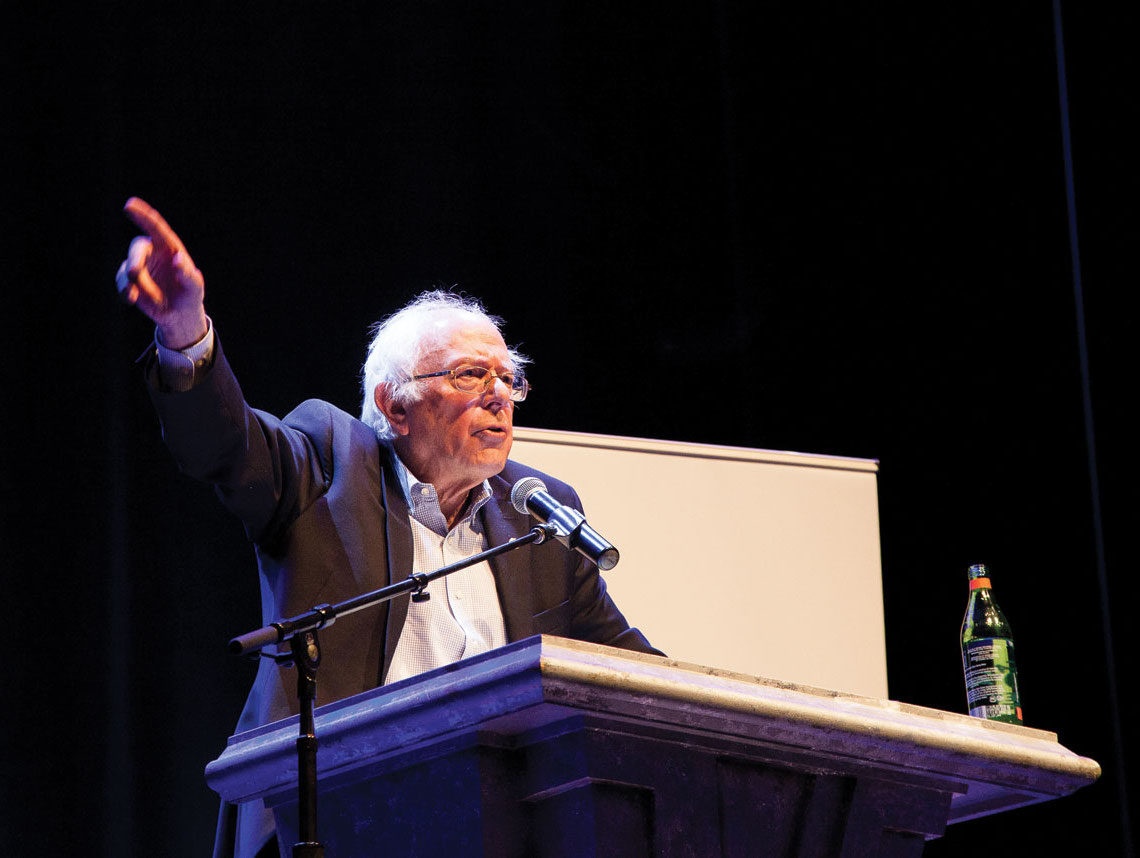
The line stretched around the block to see Bernie Sanders at the Saban Theatre in Beverly Hills on May 7, and the independent senator from Vermont did not disappoint a sold-out crowd of 1,700.

The former presidential candidate combined what sounded like a stump speech with a postmortem on the 2016 election and a battle cry for progressives moving forward under a Republican presidency.

Part of the reason President Donald Trump won the election is that “Democrats and the media did not fully appreciate or feel the pain being experienced by many, many millions across the country,” Sanders said.

The speech signaled that even after losing the Democratic primary to Hillary Clinton, Sanders intends to remain active in national politics. He was the first Jewish candidate to win a state in a major party nominating contest, taking 23 in all. Clinton won 34.

The event was hosted by Writers Bloc Presents, a local nonprofit that showcases authors and books. Previous guests have included former Vice President Al Gore and Supreme Court Justice Sonia Sotomayor.

The speech promoted Sanders’ new book, “Our Revolution,” about his presidential campaign. A political organization of the same name seeks to use the momentum from his run for the White House to support progressive candidates and issues.

In his speech, Sanders took aim at the health care bill approved May 4 by the House of Representatives, calling it “one of the most disgusting pieces of legislation ever passed” and “a death sentence for thousands.”

“That legislation will never pass the United States Senate,” he said, earning some of the loudest applause of his speech.

He also referred to a number of legislative accomplishments he hopes to see through, including a $15 national minimum wage and a universal health care system.

Sanders began his speech by congratulating “our French brothers and sisters” for defeating nationalist candidate Marine Le Pen earlier that day in a landslide that elected centrist Emmanuel Macron to be president of France.

“The people of France said no to racism, no to xenophobia and no to anti-immigrant hysteria,” Sanders said.

What followed was a high-voltage speech that drew on some of Sanders’ favorite talking points from the campaign, such as the need to protect the environment, the lack of affordable housing in major cities and mounting college debt among young people.

He returned repeatedly to his signature message about the unequal distribution of wealth and the influence of big-donor money in politics.

“This country is rapidly on its way to becoming an oligarchic form of society … owned and controlled by a very small number of individuals,” he said.

Sanders’ speech came several days after he defended Israel from criticism by the United Nations and decried the idea of a “one-state” solution to the Israeli-Palestinian conflict in a May 3 interview with Al Jazeera.

“I think if that happens, then that would be the end of the State of Israel, and I support Israel’s right to exist,” he told Al Jazeera. “I think if there is the political will to make it happen and if there is good faith on both sides, I do think [the two-state solution] is possible, and I think there has not been good faith, certainly by this Israeli government, and I have my doubts about parts of the Palestinian leadership, as well.”

He added, “People will do what they want to do, but I think our job as a nation is to do everything humanly possible to bring Israel and the Palestinians — and the entire Middle East, to the degree that we can — together, but, no, I’m not a supporter of [the one-state solution].

“What must be done is that the United States of America is to have a Middle East policy which is evenhanded, which does not simply supply endless amounts of money, of military support to Israel, but which treats both sides with respect and dignity, and does our best to bring them to the table.”

In the same interview, he also criticized the U.N. for singling out Israel for human rights violations when other countries in the region are guilty of similar acts.

Developer and philanthropist Stanley Black was in attendance at the speech. He said he’s active in Temple of the Arts, and that he was a fan of Sanders, but didn’t donate to his campaign because his daughter is close with Clinton.

“He should have been the [Democratic] candidate,” Black said. “He’s a knowledgeable, smart guy.”

Writers Bloc Presents will host Sen. Al Franken (D-Minn.) on July 7 at a to-be-determined venue in West Los Angeles.

Bernie Sanders promotes his ‘revolution’ in Beverly Hills speech Read More »

Religion finally heard at TED Talks

The TED conference has become famous because of the TED Talks broadcast throughout the world, and available online. The talks have beguiled and instructed, with a wide range of topics from the workings of the human mind to the outer reaches of technology to social innovation. For several years, I have attended the conference, but at last month’s annual gathering in Vancouver, B.C., something happened that to me was unprecedented and remarkable.

TED stands for Technology, Entertainment, Design. Some of the most eminent people in the world speak and attend: Bill Gates, Elon Musk, Al Gore, Bono, actors, educators, financiers, scientists, psychologists and so forth. This year, former world chess champion Gary Kasparov spoke about the intersection of human intelligence and technology.

In the eight years I attended TED, with the exception of the curator of the Vatican Museums, I never ran across another member of the clergy — not a priest, minister, imam or rabbi. Despite the many Jews who attend TED who have distinguished themselves in their fields, I never saw another kippah apart from mine. Although I was often approached in a friendly way to answer questions about my religious convictions, people seemed amused or even astonished that a rabbi would be at TED. I always was puzzled at the double-sided neglect: Why weren’t more religious people interested in the remarkable advances that TED showcases, and why wasn’t TED more interested in the power of religion?

Each year, I would talk to people about this question, which troubled me. If religion is to enter the modern world, it cannot ignore the kind of learning and teaching that goes on at TED. And although some at TED are plainly hostile to religion — I’ve had (always amicable) exchanges there with such prominent atheist writers as Sam Harris and Daniel Dennett — I maintained that others would benefit from understanding more about religion. After all, I argued, if you want to change the world, religion is the army with the greatest number of troops on the ground, scattered throughout the world, able to help. When I volunteered a few years ago to help rebuild an orphanage in Haiti, almost everyone else I met there, many of whom had been working in the country for years, were Christian aid workers.

Yet, so far as I could see, since Pastor Rick Warren’s address in 2006, religion had been banished from TED. And then, this year, something remarkable happened.

On the first day of the conference, Rabbi Jonathan Sacks, former chief rabbi of the United Hebrew Congregations of Britain, addressed the attendees. He spoke about identity and otherness, the promise of America, reaching out, welcoming the stranger, acts of goodness and how the Jews managed to maintain their identity by telling their story. It was a message pitched to the TED audience but one that would not have been out of place in a synagogue, except for the omission of overt theological motifs. It also was eloquent and beautifully delivered. When Rabbi Sacks concluded, the hall erupted in a sustained standing ovation.

The following day, we were told a surprise world leader would address us. The rumor swept across TED that former President Barack Obama would appear. When the time came, however, speaking via video transmission was Pope Francis.

The effect was electrifying. Once again, the pope’s message was not unexpected. He, too, spoke about care for others, how technology must be fashioned to serve human ends, and the importance of peace. It is fair to say that neither Rabbi Sacks nor the pope conveyed essentially new information or ideas. Rather, they beautifully packaged old truths.

But as I walked the halls afterward, these were the two speeches everyone was talking about. Amid the technologists and historians and innovators, representatives of these two ancient traditions struck the deepest chord.  

As one would expect, the people who attend TED are future oriented. They trust the promise of technology, striding around halls studded with virtual reality booths, next generation car designs and a variety of high-tech displays. Sometimes, however, the seductions of tomorrow blind us to the power of the past.  

Suddenly in a hall of visitors sporting jeans, sneakers and mobile devices, we witnessed tradition’s capacity to spark hearts. Data-driven social scientists rose to acknowledge the cogency of telling the Passover story. People who spend their lives working on gene sequencing cheered language about shaping souls. A moment of convergence swept the hall, when technological transformation bowed its head to ancient, shared truth.

The pope asked the people gathered there to use their gifts for the benefit of humanity and to take care not to leave the less fortunate behind. In a gathering of privilege, those words struck a chord; among people who are filled with dynamism and the desire to do good, here was an ancient affirmation that they are valued and needed. And it came from a place that many had long since dismissed. 

This year, the modern world of Silicon Valley briefly clasped hands with ancient Jerusalem. The wired world was strikingly rewired: TED took the bold step of demonstrating that the wisdom of tradition has much to add to the power of innovation.


David Wolpe is the Max Webb Senior Rabbi at Sinai Temple. His most recent book is “David: The Divided Heart” (Yale University Press).

Religion finally heard at TED Talks Read More »

‘Happy’ not part of Mother’s Day for everyone

Years ago, as I was checking out at my local grocery store, the clerk gave me a rose and wished me a Happy Mother’s Day. I choked back tears, grabbed the last bag of groceries and shoved the cart toward the nearest exit.

At the time, I had been trying to conceive at age 37 and, after many failed attempts, was very worried that it wasn’t going to happen. As a lesbian and someone who didn’t have $40,000 in the bank to start adoption proceedings, I was terrified that I would never become a mother. I hated Mother’s Day with a particular kind of passion that year.

The truth, though, is that Mother’s Day always has been complicated for me. As an adoptee, the holiday brought up deep feelings about the woman I would never know who gave birth to me and who gave me up to give me a better life than the one she could provide. It triggered sadness for the newborn I had been, lying in a hospital bassinet with no mother for my first five days of life, but it also filled me with gratitude for the woman who eventually became my mom.

When I was young, I was very close with my mother. She was affectionate, funny, strong, beautiful and committed to many righteous causes. As a child, I did all of the usual things kids do for their mothers on this holiday — I made tacky, awful tchotchkes for her in school, made terrible drawings into cards for her and, later, bought her things she didn’t need and pretended to like because I bought them special for her with my own money.

My parents divorced when I was 8, so it was on me and my younger sister — who also was adopted — to make Mother’s Day special for our single working mother. We would make her breakfast in bed, bring her our gifts and smile as she cried reading our cards. Mother’s Day always was textured but OK back then.

It took many therapists and knowledgeable friends to help me understand that my mother suffers from borderline personality disorder with narcissism as a large component of her personality. As my sister and I individuated and as our mother’s options dimmed, she became more difficult and even cruel. I would go for long periods of time without contact with my mother and carried a great deal of guilt and anger about our relationship, which was so fraught with pain.

Wise mentors and teachers helped me to understand that my mother loved me as best she could and that the problem lay within her own tortured childhood (at the hands of her mother) and not with me. It is a lesson I struggle to relearn all the time — again and again and again.

I have never spoken about this publically but feel it is time, as my mother has suffered a massive stroke and no longer can be hurt by what I write or say. We have been estranged for years after a particularly vicious incident, and Mother’s Day once again is terribly painful for me.

I write this for all of the people who dread this holiday for so many reasons. There are women who desperately want to be mothers and can’t for whatever reason, mothers who grieve for lost children, people who were close to their mothers and are trying to figure out how to live in the world without them. There are those of us who long for what we’ll never have with our mothers, who love them as only children can love a parent and who feel deeply betrayed by them at the same time.

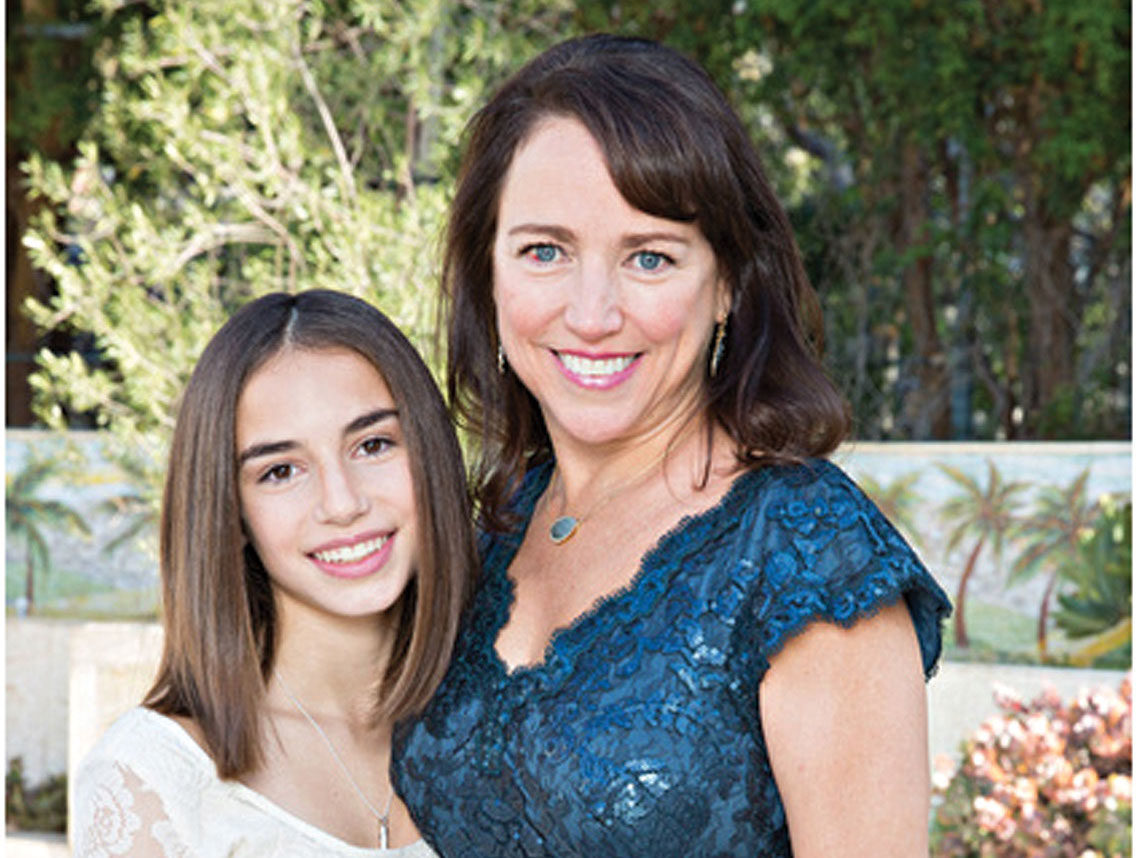
As the mother of a beautiful 13-year-old daughter, I treasure the tacky tchotchkes, the terrible drawings made into cards, the gifts my daughter buys me with her own money that I actually do love because she bought them special for me. I cry every year as she sits at the foot of the bed watching me read her cards.

This Mother’s Day, I ask that we not assume that every woman we encounter is a mother, that not every one of us wants to talk about our mothers, and realize that many people find this day particularly painful. It’s a lesson I’ve learned about every holiday — we serve each other best when we assume people’s relationships to loaded days and times are loaded.

If we can approach everyone on days like Mother’s Day with well wishes but with no assumptions, if we can regard one another with a deep and loving curiosity rather than a blithe “Happy Whatever,” we open up the possibility of allowing people to be seen and acknowledged as we honor the complex set of contradictions that make human life so difficult and so interesting.

Our tradition tells us that God created human beings because God loves stories. This Mother’s Day, may we regard each person we encounter as someone with a story, and may we have the courage to tell our own.

More Mother’s Day stories:

Sharing wisdom from the mothers we’ve lost

Searching for my broken heart


RABBI AMY BERNSTEIN is senior rabbi at Kehillat Israel Reconstructionist Congregation of Pacific Palisades.

‘Happy’ not part of Mother’s Day for everyone Read More »

#IamAPreexistingCondition

So it turns out that not even late-night TV host Jimmy Kimmel’s emotionally wrenching story about his newborn baby’s heart defect and subsequent life-saving surgery was enough to persuade three more GOP House members to vote against the latest version of the American Health Care Act (AHCA). Kimmel’s baby, like millions of other Americans, now has a “pre-existing condition” that insurers traditionally have treated almost as a badge of shame, and subject to increasingly high insurance premiums and deductibles.

That’s because the AHCA, as it presently stands, will allow states to apply for a waiver to the Obamacare requirement that insurers must charge all people the same rates, no matter their medical histories. Removing that requirement means that insurers will be able to charge exorbitant premiums if you have a pre-existing condition and have let your insurance lapse, which, in practical terms, can lead to financial ruin in trying to keep purchasing insurance coverage.

The “big 10” of patient advocacy groups, including the American Cancer Society Cancer Action Network, American Diabetes Association and American Heart Association, came together to oppose AHCA, saying in a joint release, “Weakening protections in favor of high-risk pools would also undermine the ban on discrimination based on health status. The individuals and families we represent cannot go back to a time when people with pre-existing conditions could be denied coverage or forced to choose between purchasing basic necessities and affording their health care coverage.”

The last-minute GOP solution to address the issue of people with pre-existing conditions was to add in $8 billion more for patient “high-risk pools,” which were used by 35 states before Obamacare and often came with high premiums, high deductibles and sometimes capped enrollment. A just-released independent analysis from the health consultancy firm Avalere Health showed that the $23 billion earmarked by the bill for those pools would cover only 110,000 Americans, a mere 5 percent of the 2.2 million enrollees in the individual insurance market today with some type of pre-existing chronic condition.

With such a large gap between the available funding and the number of impacted Americans (that will only grow as our population ages), it means that if one of the larger states receives a waiver, there will be even less money to go around. As the summary of the Avalere Health study states: “For example, Texas alone has approximately 190,000 enrollees in its individual market with pre-existing chronic conditions, nearly 80,000 more people than the funds earmarked for the entire country would cover. Florida has 205,000, nearly 95,000 more than the funds allotted nationally amounts would cover.”

What exactly are these pre-existing conditions? Sen. Sherrod Brown (D-Ohio) took to Twitter to list many of them, from AIDS/HIV, acid reflux, acne, ADD, addiction, Alzheimer’s/dementia, anemia, aneurysm and angioplasty to skin cancer, sleep apnea, stent, stroke, thyroid issues, tooth disease, tuberculosis and ulcers. In the hours after the House vote, the No. 1 trending hashtag on Twitter was #IAmAPreexistingCondition, with individuals listing their diagnosed conditions, such as TashiLynnCA writing, “In 2010 my 10 year old brother was diagnosed with stage III Hodgkin’s Lymphoma. This is for him.” Older adults and veterans also shared. “‘I’m a disabled veteran that suffers from PTSD” tweeted RedTRacoon.

Friends of mine on Facebook are sharing that some doctors already are getting calls from worried patients, asking that their diagnoses be expunged from their medical records because they are fearful of having a paper trail documenting their conditions. People will be scared to go to emergency rooms, afraid that they will be identified as having one or more conditions on the list.

For the 20 percent of Americans who have some type of disability covered under the Americans With Disabilities Act of 1990 (ADA), this potential change in how much people with pre-existing conditions can be charged for health insurance hits hard. @LCarterLong from Washington, D.C., wrote, “Born three months premature. Weighed 2 lbs. Alive b/c of an incubator. Have cerebral palsy. Use orthotics to walk.” Alice Wong, founder of the Disability Visibility Project in San Francisco, tweeted, “Wheelchair and vent user. Born with spinal muscular atrophy. Docs told my parents I wouldn’t live past 30.”

This sharing of pre-existing conditions is paradoxically bringing together a very disparate group of Americans who may not have felt much in common before this vote, and who now are being prompted into action. Disability advocacy groups that usually find themselves competing with one another for attention and funding are finding common cause in opposing the ACHA. Republican House members who voted for the bill will be wearing targets on their backs in the 2018 election. As Japanese Admiral Isoroku Yamamoto said after the 1941 attack on Pearl Harbor, “I fear all we have done is to awaken a sleeping giant and fill him with a terrible resolve.”


MICHELLE K. WOLF is a special needs parent activist and nonprofit professional. She is the founding executive director of the Jewish Los Angeles Special Needs Trust. Visit her Jews and Special Needs blog at jewishjournal.com/jews_and_special_needs.

#IamAPreexistingCondition Read More »

Searching for my broken heart

My mom died last summer. Although she was elderly, she was in pretty good shape, so her death, while not untimely, was unexpected.

We sat in the rabbi‘s office and shared stories to prepare for the memorial. Everybody laughed. Everybody cried. Everybody except for me. I felt nothing. After the meeting, I asked to speak to our rabbi alone. I told him something was wrong with me. I felt no emotion — no sadness, no loss, no heartbreak. He said I was in shock.

“I’m not in shock,” I said. “I feel fine.”

“It’s sort of like being in shock,” he explained. “Your subconscious is not ready to deal with the loss of your mom.”

I had trouble with this explanation. “I’m sorry, rabbi, but that doesn’t make sense. I should be devastated. I should be sobbing. I cried more when my dog died.”

“It’s normal,” he assured me. “Your broken heart is somewhere. Give it time; you’ll find it.”

I left feeling skeptical. In a daze, I went through the motions, playing the role of dutiful daughter. I took care of arrangements, hovered over my father, prepared food for visitors, wrote my speech. At the service, I spoke with confidence, laughing in the right places and not crying when I should have. The tears of people in front of me, some who didn’t even know my mother, failed to move me. All I wanted to do, what I needed to do, was take care of everyone else.

The Friday night after the memorial, we went to services. We said Mourners Kaddish and I tried to cry. Nope. People visited me, brought treats and gave comfort. It was nice, and I appreciated it, but still no tears. Yom Kippur came and went. Nothing. I took my mother’s things home with me — her nightgown, her cuddle pillow, some half-used cosmetics, the red scarf she wore every day because she always was cold. It held the faintest scent of her.

I prepared myself for the worst Thanksgiving of my life and my birthday the same weekend. The proverbial first “fill in the blank” without my mom. We ended up having a wonderful Thanksgiving. And my birthday, well, I don’t really remember it.

I stopped searching. Maybe I was the kind of person who would weather the death of a parent without feeling loss. Maybe I was so relieved not to be worrying about her anymore that the relief outweighed the sadness. Maybe I didn’t care as much as I thought I did. Oh, God, maybe I should go back to the rabbi or see a therapist.

I had a plant of my mom’s. It was ugly. I think it once had been two plants that she stuck into a pot of dirt without much thought. One piece was a wispy fern and the other a more hearty-leafed thing. I liked the pot, so I brought it home intending to plant something that flowered. But the ugly plant my mother created seemed healthy, so I left it alone. I did nothing to it, only a bit of water now and then. It thrived. Ugly as ever, it just kept living.

Then one day, my dogs made a plaything out of it. I went outside and found my mother’s ugly plant knocked over and ripped apart, the wispy fern shredded, the hearty leaves scattered across the grass. I stared at it for a moment or two, and my eyes filled with tears.

The tears ran down my cheeks like streams of melting snow. The sob that came out of me scared away the birds, and my heart broke apart. I frantically gathered what was left of my mom’s plant and tried to find one root that could be salvaged. I yelled at my sweet dogs who had torn up the plant because I had left it where they could. It was all my fault. My fault the plant was dead. My fault my mother was gone.

Intellectually, I know that’s ridiculous. My mother was old. She had many health issues. But I’m a second-guesser, a “what if” kind of girl. What if I had done just one thing differently?

Now the tears come easily — when I see her handwriting; when I walk by Chico’s and think, “Mom would love that top”; when I see her little soap dish and remember how she washed her hands; when I bake the cookies we used to make together; when I scroll through pictures on my phone and her big smile lights up the screen.

Mother’s Day is coming. Another “first.” The first Mother’s Day of my life that is not about my mom. I cry just thinking about it.


JULIE MAYERSON BROWN is an author and freelance writer. To read more of her articles and her blog, visit juliemayersonbrown.com.

Searching for my broken heart Read More »

Ariel Levy’s “Rules” addresses motherhood, feminism and guilt

When The New Yorker writer Ariel Levy was 38 years old and five months pregnant in late 2012, she boarded a flight to Mongolia. The journalist had accepted an assignment to report on that country’s mining business and “wanted one last brush with freedom” before becoming a mother, she explains in her new memoir, “The Rules Do Not Apply.”

But on her second day in that country, Levy found herself in agony, squatting on the floor of her hotel bathroom after suffering a placental abruption, in which the placenta separates from the wall of the uterus. “And then there was another person on the floor in front of me, moving his arms and legs, alive,” she writes.

Her 19-week-old son was “as pretty as a seashell,” but he lived for only about 10 minutes. Levy took a photograph of him to remind herself that he had ever existed.

Back in New York, her grief was so intense that, at times, she would clutch at a kitchen counter or a subway pole to keep from collapsing. Her guilt back then was profound, even though doctors had told her that air travel was safe for pregnant women up until the third trimester, and that the miscarriage was inevitable and could have occurred anywhere. “I had boarded a plane out of vanity and selfishness, and the dark Mongolian sky had punished me,” she writes.

In the aftermath, Levy’s wife, Lucy (a pseudonym the author uses to refer to her in the book), continued her own downward spiral into alcoholism — something she had been battling even before the miscarriage — and their marriage soon was over. “In the last few months, I have lost my son, my spouse and my house,” Levy writes.

She will discuss “The Rules Do Not Apply” on May 13 at Book Soup, and with author Maggie Nelson (“The Argonauts”) on Mother’s Day, May 14, at the Skirball Cultural Center.

Levy first wrote about her experience in her award-winning essay, “Thanksgiving in Mongolia,” which was published in The New Yorker in 2013. She expanded on the story to pen her memoir, which came out in March.

“I realized that I wasn’t done,” she said in a telephone interview from her one-bedroom walk-up apartment in Manhattan. “I had more to say … about being a woman … my initial ambivalence about motherhood, about my wanderlust, about the meaning of marriage [and] the fundamental human conflict between the desire for adventure and novelty and stimulation on the one hand and intimacy and home and safety on the other.

“And also the maturation process by which a person realizes that everyone doesn’t get everything, and you will bump up against limits. … The book is really a coming-of-age story about figuring out what the limits of life are.”

For Levy, those limits include the fact that she has not been able to bear children, even though she tried to get pregnant via fertility treatments for two years in the aftermath of her miscarriage.

The prospect of not becoming a mother is “hugely painful,” she said. “It’s been the great sadness of my life. But it’s also the case that I get a lot of other things. … Anyone can spend his or her life thinking about what he or she doesn’t have, but that’s not how I want to live.”

Levy, now 42, grew up in a culturally Jewish home in Larchmont, N.Y., where her mother attended feminist consciousness-raising groups and her father worked for liberal organizations, including the National Organization for Women and Peace Now.

As a girl, she was often told she was “too loud, too much. … My notebooks were the only place I could ‘talk’ as much as I wanted, whenever I wanted,” she told the Journal. “That’s part of what drew me to writing — communicating exactly what I thought with no limits.”

A career in journalism enabled Levy not only to write for a living, but also provided a means for her to travel the world and experience the adventures she craved. In 2005, she published her book “Female Chauvinist Pigs: Women and the Rise of Raunch Culture.” As a staff writer for The New Yorker several years later, she journeyed to Africa to write about a controversial champion female runner, and in 2010 met conservative politician Mike Huckabee at the Western Wall in Jerusalem while he was leading a tour group of evangelical Christians to Israel. She also wrote about lesbian separatists, gender and race, among other subjects.

Levy’s “Thanksgiving in Mongolia” essay and her memoir have resonated with other women who also have lost a baby, she said. “I’ve yet to speak to a woman who hasn’t felt horribly self-recriminating after a miscarriage,” Levy explained. “The hormonal letdown is oceanic, but normally if you’re lucky, you have that letdown and you also have a baby.”

Delivering her child on that hotel bathroom floor “did feel like an Old Testament world of barbaric suffering,” she said. “It also felt biblical in the sense that I cannot overstate the volume of blood that was part of this experience — giving birth to a baby and watching him die.”

Although “The Rules Do Not Apply” has received many laudatory reviews, Charlotte Shane, writing in the New Republic, critiqued the book in a piece titled “Ariel Levy’s Infuriating Memoir of Privilege and Entitlement.” In the article, Shane takes to task Levy’s statement that “Women of my generation were given the lavish gift of our own agency by feminism … a belief that we could decide for ourselves how we would live, what would become of us.” Shane wrote, “The conviction she’s describing actually belongs as much, if not more, to whiteness than to mainstream feminism — which is also called ‘white feminism’ for this very reason. It’s unlikely many Black women or Arab women or undocumented women would presume a similar degree of permission and mobility, regardless of their exposure to Gloria Steinem and Betty Friedan.”

In response, Levy said, “Essentially, what [Shane is] critiquing isn’t the book; it’s the system in which privileged white women’s experience takes up more space in the public discourse than underprivileged women of color. … But if you really look at it, the problem isn’t with the book, but with culture at large. If I hadn’t published my book, it’s not like that would change society such that suddenly everything would be egalitarian.”

Levy added that she has “spent 20 years writing about unconventional women, so the idea that silencing me is what needs to happen is … just silly.”

At the end of her memoir, Levy writes of her budding friendship with Dr. John Gasson, the South African physician who treated her after her miscarriage. But she does not reveal that their friendship eventually blossomed into romance and an engagement to be married. The couple “may very well still consider” adoption, Levy wrote in an email to the Journal.

Writing about her new relationship in the memoir would have “actually been misleading to the reader, because it would imply that I fell in love with a man who sort of solved everything; like he saved me,” she said. “And that wasn’t really what happened. Falling in love with him didn’t take away my grief about my son … [or] at the dissolution of my last marriage. I really felt like falling in love with him was the beginning of the next story in my life, not the end of this one.”

For more information about Levy’s Book Soup event, visit http://www.booksoup.com/event/ariellevy-discusses-and-signs-rules-do-not-apply-memoir.  For reservations and information about her Skirball appearance, visit http://www.skirball.org/programs/words-and-ideas/ariel-levy-rules-do-not-apply.

Ariel Levy’s “Rules” addresses motherhood, feminism and guilt Read More »

Sharing wisdom from the mothers we’ve lost

Because I lost my mother six years ago, Mother’s Day hits me differently every year.

First, there’s the rage over the onslaught of emails reminding me to make plans or reservations or purchases to show my mother how much I love her. (If only I could.) That feeling yields to grammatical frustration over the name of the day, where the apostrophe goes or if there should be an apostrophe at all: “Mothers Day”? “Mothers’ Day”? “Mother’s Day”? After a while, it all looks wrong.

This is the kind of editorial debate I would have had with my mother, I recall, noting the beginning of the next emotional transition into something approximating the fusion between deep sadness and calm reflection.

I miss my mom often even without national days, but as Mother’s Day photos appear on Facebook, I’ll be thinking about the last decade or so of my mother’s life, when her illness left her profoundly uncomfortable with the prospect of being photographed. I wish I had more photos with my mother.

The Jewish tradition does “immediate grief” very well, especially in the first year after a loss. The community supports emotionally uprooted mourners, and Jewish holidays also provide built-in liturgical opportunities, like the Yizkor service, to remember those we’ve lost.

But beyond a year of grief or Jewish calendar celebrations, there’s a more mundane, longitudinal kind of grief, a mostly dulled type that enables us to be more functional, but can be energized to a fever pitch at any moment by dozens of triggering stimuli that even the mourner herself may not be consciously aware of. And one of those stimuli is very likely the media push around the so-called Hallmark holidays, including Mother’s Day.

I am not alone, of course. It is the natural order of things for children to lose their parents, and although it is universal to the human condition, the grief experience is also remarkably personal and individualized. There’s no one way to grieve or to be comforted: Some find themselves healthiest in solitude, while others rely on the support of friends, family or community.

I mourn privately and publicly. There are moments that I share with very few, my nearest and dearest only. And there are those I write about and convene community around. Last year, as Mother’s Day approached, I felt the need to convene. Reaching out through my local network and the Dinner Party network — a group of mostly 20- and 30-somethings who have experienced significant loss — I invited friends and friends of friends who had lost their mothers to my home for brunch. The idea was to provide a safe space to celebrate our mothers, to sample the flavors of our respective and diverse childhoods, and to share the wisdom that we learned from those who gave us life. I called it the “Remembering Our Mothers (Day) Brunch.”

I set the table with flowers, orange juice and champagne, chips and dips, as well as French toast and chocolate chip pancakes that recalled the Mother’s Day breakfasts my brothers and I used to prepare for our own mother (for years before she told us that she didn’t like chocolate chip pancakes).

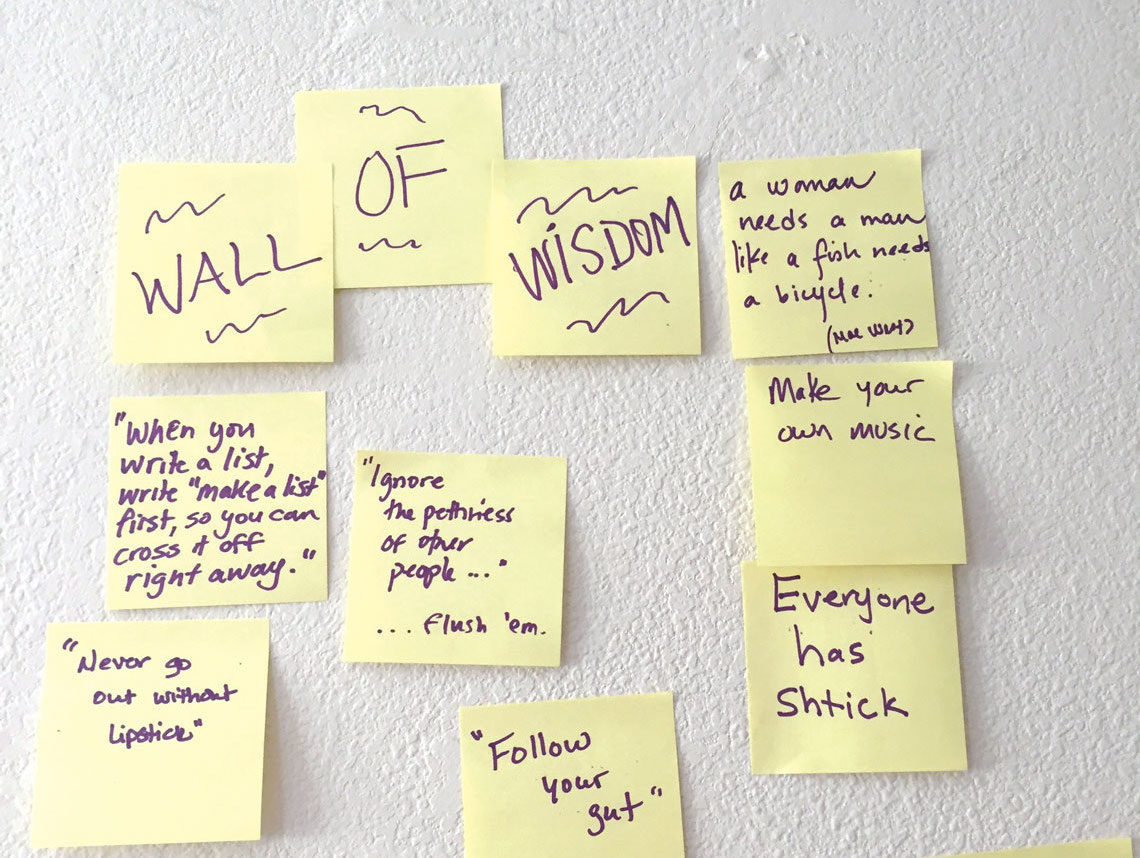
Nine people from different backgrounds came to my house, bearing breakfast treats of their own in answering my call for “foods of calm, comfort and connection”: bagels, yogurt parfaits, a potatoes au gratin dish, fresh breads and a fancy cheese platter. The wall was designated as a “Wall of Wisdom,” where I invited guests to put up a Post-it, bearing specific pieces of wisdom from their beloved mothers. Sayings included “Crumbs have no calories,” “Never go out without lipstick,” “A woman needs a man like a fish needs a bicycle” and “Make your own music.”

Once underway, the brunch was a bit of an emotional journey. In the room were women (unintentionally, this event was all women) who had varying years of experience in mourning their personal losses. For some, the loss was decades old; for others, only a few months had passed. About half of them knew me, but the others walked into a stranger’s house, not knowing what to expect. This was an act of courage for them and an act of trust in me, that I would create a safe space to embrace them, to provide them with comfort and community.

This was an act of courage for them and an act of trust in me, that I would create a safe space to embrace them, to provide them with comfort and community.

There was no official program. We milled about the space, in and out of conversations with other guests, writing wisdom on the wall, eventually sitting down with our food in what became a sharing circle.

Seeing a look of panic come over one woman’s face — not everyone is ready for a group-therapy type situation that comes out of nowhere while she is eating a bagel — I made the sharing optional. I am used to telling stories about my mother and about her death, I told the group, but they should feel free to talk or not talk, according to their comfort level. In the end, everyone spoke, although some longer than others, and there was a lot of supportive back-and-forth that made it feel more organic, like more of a conversation than a group confessional.  

When I was younger, I might have looked at that gathering of honest and emotionally raw people and hoped or predicted that it would lead to magical long-term friendships, forged in grief and expanding beyond that. While some of my connections with guests deepened, others walked in, got what they needed and walked out. But that’s OK with me.

Sometimes these spaces are one of a kind, with circumstances binding us intensely for a short period of time before we all rejoin the flow of mostly anonymous humans making their way in the world. This is not a failure of the space itself, which fulfilled its purpose marvelously; it’s part of the transition back from intense grief with a dedicated space to a less-rooted grief that isn’t contained by a space and time, but follows us as a dull hum in our daily lives.

Some communities are temporary, but give us exactly what we need at exactly the right time.

Sharing wisdom from the mothers we’ve lost Read More »

Denial of War Crimes: The Perspective of a Survivor

Last February was certainly one of the most difficult times in my life as a survivor. It was 25 years ago in February that as a 20 year old young woman I was tortured, beaten, kicked in the belly and thrown into a trash can for dead. It is also when my friend Anar, as an 8 year old boy, ran for his life as he watched and heard his family members being murdered. Then we read the denialist opinion piece by Christopher Atamian and Haykaram Nahapetyan, published in the Huffington Post on March 11, 2017, and titled “When “Yes” Means “No” or Failure, Success: Azerbaijan and Fake News”. Our hearts sank, and both Anar and myself, shuddered thinking that people can be so influenced by special interests and politics that they will deny human tragedy, using words like fake and failure. It’s just mind boggling that our personal pain and that of many other survivors, the wounds that we carry every day, can be so dismissed and trivialized.

In their misguided critique, they claim that the horrific traumas and tragedies we each endured are “fake news”. Having survived such a tragedy, it is traumatic to see any person, in this case Mr. Atamian and Mr. Nahapetyan, deny that during those days and nights of February,1992, Armenian soldiers used my helpless body for sport and targeted the life of someone as young and innocent as Anar. What happened to us was not “the spoils of war” or an effort to free a country; this was sheer evil.

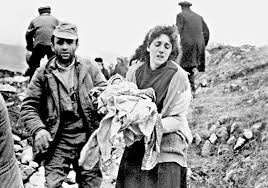
I was 20 when our town Khojaly in Azerbaijan’s Nagorno-Karabakh region fell under Armenian siege, and Anar was only a boy of 8. We both grew up in close knit families, and we both lost many relatives on that ruthless night on February 25-26, when Armenian soldiers invaded our town and murdered indiscriminately. We both ran into the night, through the forest, and into the killing field, as bullets sprayed in all directions. Anar was moved from his basement shelter, from town to town, relocating at the pace of the increasing invasions. I was captured and sent to an Armenian torture camp, where I endured and witnessed unspeakable depravities, violence and cruelty. We both managed to survive, while 613 unarmed Azerbaijani men, women, children and the elderly from our small town did not.

Considering our own tragic experiences of enduring and surviving the Khojaly Massacre, the piece by Mr. Atamian and Mr. Nahapetyan is an attack on our humanity, on the deepest parts of our hearts, our trauma and our memories. It revises a documented and proven tragedy into something political and frivolous. It is, in no uncertain terms, a piece written to deny crimes against humanity. Even the current President of Armenia, Serzh Sargsyan, has admitted what happened in Khojaly, stating “Before Khojaly, the Azerbaijanis thought that they were joking with us; they thought that the Armenians were people that could not raise their hand against the civilian population. We were able to break that stereotype. And that’s what happened”.

Today, I am a mother living in Baku, and Anar is attempting to build his own business in California. We are each in our own way scarred for life, inside and out, and moving forward as best as we can, with hopes for a better future.  As Elie Wiesel famously said about his own experience in the Holocaust, “For the dead and the living, we must bear witness.” Anar and I both reached out to Huffington Post to share our side of the story, but we were greeted with silence.

But reading the editorial hurt more than Anar and I; it is also an assault on the basic tenets of truth and a distortion of more than history. It attacks a current reality that is very important in our day and time. In 2015, a synagogue in the heart of Los Angeles hosted a memorial for the victims of Khojaly, and since then our dear friends from the Jewish community have continued to share in our memorial each year.

The Human Rights Watch has called the Khojaly Massacre “the largest massacre in the conflict” between Armenia and Azerbaijan, placing direct responsibility for the massacre of civilians with the Armenian forces. The European Court of Human Rights has also confirmed the facts about Khojaly in its ruling from 2010, and over 10 countries have officially recognized the massacre. The United Nations Security Council has passed four resolutions condemning the illegal occupation and ethnic cleansing of the entire Karabakh region of Azerbaijan.

To deny the Khojaly Massacre is evil, and to allow political and special interests to create falsehoods and spread such hate and distrust is something that we must stand up against. Never has remembrance of the cruelty of the past been more important and never has the need for friendship and hope for peace been so great.

Denial of War Crimes: The Perspective of a Survivor Read More »

Daily Kickoff: King David Hotel prepares for Trump | Rod Rosenstein’s office sign: “Don’t tell me what I want to hear” | Rep. Gallagher interview

Have our people email your people. Share this sign up link with your friends

DRIVING THE DAY — “After Comey’s ouster, Democrats press for independent probe of Russia’s meddling in election” by Ed O’Keefe: “All Democratic senators have been asked by Minority Leader Charles E. Schumer (D-N.Y.) to be in the Senate chamber when the legislative day formally begins at 9:30 a.m. Wednesday. The rare early-morning appearance by the entire Democratic caucus is a symbolic attempt to sit, watch and listen as Senate Majority Leader Mitch McConnell (R-Ky.) makes his traditional morning speech… Schumer is expected to use his morning floor speech to call out Republicans for supporting Trump’s controversial move. Schumer also plans to convene a caucus meeting Wednesday morning so that Democrats can discuss a more formal response, aides said… Under one scenario, the boldest, most extreme step Democrats could take is to drag the Senate to a halt. They could refuse to allow consideration of any legislation or nominees awaiting confirmation votes until Trump agrees to appoint a special prosecutor.” [WashPost]

The one who formally recommended Comey’s removal: “Officials released a Tuesday memo from the Deputy Attorney General, Rod Rosenstein, laying out the rationale behind Comey’s dismissal. “The FBI’s reputation and credibility have suffered substantial damage, and it has affected the entire Department of Justice,’’ Rosenstein wrote. “I cannot defend the director’s handling of the conclusion of the investigation of Secretary Clinton’s emails, and I do not understand his refusal to accept the nearly universal judgment that he was mistaken. Almost everyone agrees that the director made serious mistakes; it is one of the few issues that unites people of diverse perspectives.’’” [WashPost; DailyBeast]  

From a 2011 Profile of Rosenstein: “In his downtown Baltimore office, Rosenstein keeps a pristine desk. On one recent visit, it held five papers organized in a neat cascade, and two coffee mugs, one with a DOJ insignia and another depicting Theodore Roosevelt. He has a few photographs of himself with his wife, Lisa Barsoomian, 43, a lawyer at the National Institutes of Health. There is also a photo of a young Rosenstein chipping away part of the Berlin Wall. On prominent display behind his desk is a sign: “Don’t tell me what I want to hear. Just tell me what I NEED TO KNOW.” [WashPost

BEHIND THE SCENES: “Before James Comey’s Dismissal, a Growing Frustration at White House” by Rebecca Ballhaus, Michael Bender and Del Quentin Wilber: “Mr. Trump grew unhappy that the media spotlight kept shining on the director. He viewed Mr. Comey as eager to step in front of TV cameras and questioned whether his expanding media profile was warping his view of the Russia investigation, the officials said. One White House aide, speaking after Mr. Comey’s dismissal, described him as a show horse.” [WSJ; Politico]

Prof. Alan Dershowitz on CNN Tonight with Don Lemon: “Comey lost his credibility… He should have looked in the mirror and said to himself, ‘I am not trusted by Democrats, Republicans, by the American public’ and should have resigned.”

Republican Rep. Mike Gallagher: “Like many Americans, I have serious concerns and unanswered questions about the timing of Director Comey’s dismissal.” [Twitter]

JI INTERVIEW — The Pro-Israel Arabic-Speaking Marine Veteran in Congress — Rep. Mike Gallagher (R-WI) discussed his military service and shared his views on the Iranian threat and the Israeli-Palestinian conflict in an interview with JI’s Aaron Magid. After studying Arabic at Princeton University, the Green Bay native enlisted in the US military and served seven years on active duty including multiple tours in Iraq. Gallagher served as a counterintelligence officer under H.R. McMaster, currently the White House National Security Advisor, for a year. After leaving the military, Gallagher worked as the lead Republican staffer on the Senate Foreign Relations Committee covering the Middle East.

On Trump’s push for Middle East peace: “It’s necessary to recognize that Iranian destabilization of the region, as well as ISIS, are far more important issues than Israeli-Palestinian peace. If Netanyahu and Abbas were on the White House lawn tomorrow with an agreement, we could live with — it might help — but the broader strategic picture in the Middle East would probably remain largely unchanged. Syria would still be a safe haven. ISIS would still have a caliphate. Iran would still be expanding its influence at the expense of Israel and threatening its existence. Understanding that and getting out of the trap that so many presidents fall into, which is to say that the Israeli-Palestinian issue is the focal point which everything else turns, which of course it does not is how this administration needs to view it.”

Gallagher’s foreign policy mentors: “My first professor on the Middle East at Princeton was a guy named Mike Doran and he provided a gateway into the region and remains a close friend and mentor and we talk all the time. He was incredible. He wrote me my first recommendation to the Marine Corps. H.R. McMaster, I worked for him for a year. He’s the reason I stayed in the military.” Read the full interview here[JewishInsider]

PALACE INTRIGUE: “The Knives Are Out for Lt. Gen. H.R. McMaster” by Kate Brannen: “It’s true that it hasn’t always been smooth sailing for McMaster and Trump, but, in many ways, that friction was built into the job from the start. “[McMaster] will always be on the outside looking in from so many circles,” the senior intelligence official said. “He isn’t family. He’s not a Bannon guy, and he’s still surrounded by Flynnstones.” … The NSC is not walled off from the internal power politics of the Trump White House, and staffers reading the tea leaves see they still need to curry favor with people like Bannon and Trump’s son-in-law, Jared Kushner, if they’re to have their voices heard and survive in what one source described as the White House’s “Game of Thrones for morons.”” [FP]

IRAN DEAL: “The World Didn’t Agree to a Nuclear-Armed Iran, Even in 10 Years” by Max Singer: “President Trump does not have to solve the Iranian nuclear-weapon threat during his first term. The deadline for building the coalition with the strength and determination to stop Iran will come after 2020. But he would be wise to use the term to develop the American and international understanding and policies that can create the will and power to stop Iran.” [WSJ]

TRUMP’S ISRAEL TRIP — partial itinerary: The President’s first stop after a welcome ceremony at Ben Gurion Airport will be a “family visit” to the Western Wall followed by lunch at the King David Hotel. Trump will then attend a reception at President Reuven Rivlin’s residence. In the evening, Trump and Netanyahu will have a working dinner at the Prime Minister’s residence. On Tuesday, Trump is expected to deliver a policy speech at the Masada desert fortress, followed by a visit to Bethlehem to meet with Palestinian Authority President Mahmoud Abbas.

Dan Shapiro: “Upside to Trump’ speech at Masada: iconic images, strong message on Israeli security. Downside: Herod comparisons that write themselves.” [Twitter]

— “Questions remain about his visit to Yad Vashem. Ahead of the visit, the Israeli side emphasized the importance of such a visit, despite the fact that Trump is not obligated to do so… The Americans did not sound enthusiastic about the possibility of the president visiting Yad Vashem. At first, they announced that they would be able to allocate about half an hour for such a visit. On the Israeli side, they made it clear that there was no such possibility, as a visit to Yad Vashem would take at least an hour and fifteen minutes. But the Americans insisted. In Israel, they were very disappointed with the answer and still hope that they will convince the Americans to retract it.”[Ynet]

“No red carpet at the King David for Trump” by Greer Fay Cashman: “Confirmation that Trump would be staying at the King David was not received till late last Friday afternoon…  The Americans have made no special requests with regard to how the suite should be set up or what special foods should be served… The Americans have ordered more than a thousand rooms in total which has necessitated closing two other hotels in the Dan chain; the nearby Dan Boutique Jerusalem and the even closer Dan Panorama… Some of the Americans will be staying in other Jerusalem hotels but Trump’s daughter Ivanka and her husband, Jared Kushner, will be staying at the King David along with Secretary of State Rex Tillerson, Secretary of Defense James Mattis and National Security Adviser H.R. McMaster… Among the guests who had to be moved out of the hotel were… Mike Huckabee who had scheduled a large dinner party.” [JPost]

“The curious case of Donald Trump’s 1989 (non-)visit to Israel” by Raphael Ahren: “Oded Eran, a veteran diplomat who worked in the [Israeli] embassy, said he had never heard of Trump coming to Israel. And their boss at the time, then-foreign minister Moshe Arens, also told The Times of Israel that he does not remember ever having been involved in or hearing of plans to host Trump in Israel. The fact that, last year, three decades later, Trump the aspiring politician did not mention having been to Israel during any of his election campaign speeches further seems to suggest that the visit never took place… Neither the Associated Press nor the Israeli Government Press Office photo archives carry any images of Trump in Israel.” [ToI]

“Trump Administration Will Not Move Embassy In Israel To Jerusalem: Report” by Avaneesh Pandey: “Israeli news outlets Arutz Sheva and the Jerusalem Post reported Wednesday that the prime minister’s office had not received any notice from the United States about a decision to not move its embassy to Jerusalem. The reports quoted a statement from the prime minister’s office which said: “Israel’s stance is that all the embassies belong in Israel’s capital of Jerusalem, and the U.S. Embassy should be one of the first to move.” Earlier on Wednesday, Israeli news website NRG reported, citing unnamed sources, that the U.S. government had decided to not move its embassy in Israel from Tel Aviv to Jerusalem, and that the Israeli government had been informed of the decision.” [IBTimes]

Charles Bronfman—author of a new memoir, Distilled—on Trump and Bibi — by Mark Oppenheimer: Do you like Bibi Netanyahu? He’s not my favorite. Never has been. Look, I believe in proactively pursuing the two-state solution because I feel deep in my heart and my guts that failing the two-state solution there is no future for Israel… And yet, Netanyahu has been, is, and will no doubt continue to be a real believer in Birthright! … What do you think of Mr. Trump? Strange person. We don’t know because every day it’s a different Trump. There are things coming out of that White House, and you don’t know what to believe… I obviously wish him well. I really don’t know him. I have never done business with him. I played a round of golf with him. He was a damn good golfer.” [Tablet]

HEARD YESTERDAY – Senator Marco Rubio at the ADL conference in Washington, DC: “In a disturbing echo of Germany’s anti-Jewish boycotts of the 1930s, we also see today’s boycott, sanctions, and divestment movement (BDS), which engages in economic warfare against the Jewish state… These days, as you are probably well aware, it’s difficult to find much that everyone can agree upon in this city. But, the one issue that you will find a united voice on Capitol Hill is on the need to eliminate discriminatory behavior against Israel at international organizations. Senator Chris Coons (D-DE) and I recently led a bipartisan effort to the UN Secretary General that was signed by all 100 members of the US senate urging him to counter the anti-Israel bias at the UN.”

JI PLUG — ADL CEO Jonathan Greenblatt during a panel ‘Decoding the News: Navigating Conspiracies, Infotainment & Evidence Free News’: “I am going to make a plug for Jewish Insider, by the way.” Fellow panelist Jeffrey Herbst, CEO of the Newseum: “And I get the Jewish Insider push also.”

“The Princeling in the West Wing” by Jill Abramson: “The oligarchy emerging on Pennsylvania Avenue today is something not seen before. The president, Ivanka Trump and her husband are the three most powerful figures in the White House, and they still profit from companies with billions at stake in global real estate deals… Part of why Donald Trump won is that voters had extreme fatigue about the Clinton family’s ethical problems. His promise to end big-money corruption in Washington was taken seriously by his base. He could put his electoral future at risk by reneging on it.” [NYTimes] • Who is Nicole Kushner Meyer? [TheRealDeal]

“Anthony Scaramucci Thinks The Media is Too “Nosy” For its Own Good” by Bess Levin: “Scaramucci… blamed the hot water Kushner’s family recently landed in on the press being “nosy.” … Every day, Scaramucci told CNN’s Chris Cuomo, journalists “wake up . . . take a dozen eggs out, and say, ‘O.K., who are we going to throw these eggs at today?’ ” Over the weekend, he explained, they decided to throw the eggs at “the Kushner family.”” [VanityFair

“New Veterans Affairs Chief: A Hands-On, Risk-Taking ‘Standout’” by Dave Phillips and Nicholas Fandos: “Dr. [David] Shulkin, by his own admission, is an unlikely choice to overhaul veterans services under President Trump. The son of an Army psychiatrist, he is not a veteran — a first for the head of the agency. And when Dr. Shulkin led the medical side of the department in the Obama administration, Mr. Trump regularly criticized the agency — and by association Dr. Shulkin — as corrupt and incompetent… He was recommended by Mr. Trump’s ambassador to Israel, David M. Friedman, who knows Dr. Shulkin personally, according to a White House official familiar with the process.” [NYTimes]

** Good Wednesday Morning! Enjoying the Daily Kickoff? Please share us with your friends & tell them to sign up at [JI]. Have a tip, scoop, or op-ed? We’d love to hear from you. Anything from hard news and punditry to the lighter stuff, including event coverage, job transitions, or even special birthdays, is much appreciated. Email Editor@JewishInsider.com **

BUSINESS BRIEFS: Ziel Feldman’s HFZ Capital Group closes on $1.25B construction loan for Chelsea megaproject [TRD• The Nakash family and New York investment firm Gindi Capital bought the Smith & Wollensky building in Las Vegas for $59.5 million [ReviewJournal] • Dealmaker Weinberg Cracks Ranks of Best Paid Executives for 2016 [Bloomberg] • Hank Greenberg loses appeal over AIG’s 2008 bailout [NYPost• Israeli defense firm opens new national HQ in Howard County [BizJournals] • Billionaire Carl Icahn Loses $179 Million on Hertz Double Down [Bloomberg]

“Democratic Senators call for probe into Icahn’s biofuel credit dealings” by Timothy Gardner, Chris Prentice and Jarrett Renshaw: ““We are writing to request that your agencies investigate whether Carl Icahn violated insider trading laws, anti-market manipulation laws, or any other relevant laws based on his recent actions in the market for renewable fuel credits,” the senators said in a letter to the heads of the Securities and Exchange Commission, the Commodity Futures Trading Commission, and the Environmental Protection Agency… Icahn became an unpaid adviser to Trump on regulation shortly after November’s presidential election.”[Reuters

“On Goldman alums in government, Blankfein says he worries about how it might look” by Evelyn Cheng: “I’m “a little apprehensive about it because for fear of how it might look,” Lloyd Blankfein, chairman and CEO of Goldman Sachs, said on CNBC… Still, Blankfein is proud that President Donald Trump chose so many former Goldman bankers for his administration… “My blink reaction is a sense of pride that again another person who wasn’t necessarily friendly to our institution in his campaign recognized the talent of these people,” Blankfein said.” [CNBC]

“Inside The Employment Agreement Of Secretive Hedge Fund Renaissance Technologies” by Nathan Vardi: “A research scientist and senior level employee who worked out of his Pennsylvania home, [David] Magerman’s base salary at Renaissance was $251,212. Magerman claims his algorithms made billions of dollars for Renaissance and the bulk of his compensation came from the bonus he was paid semiannually, two installments based on the firm’s performance made on June 30 and December 31… His noncompetition agreement prevented Magerman from working for one year after leaving Renaissance for any firm engaged in the business of mathematically-based trading of futures and securities. Magerman also agreed that upon being terminated he would immediately hand over all of Renaissance’s confidential information in his possession, including models and algorithms.” [Forbes

Michael Bloomberg talks to Katie Couric about the challenge of saving the world — KC: What was one of the first causes you remember getting involved in? MB: “Johns Hopkins. I had gotten interested in Hopkins and public health. And then when I became chairman of the board I really became interested in it. My love of Hopkins is that, number one, they gave me an education, obviously. Number two, I’ve always respected what they do for the community and what they do for the world. Hopkins has a defense laboratory, one of the biggest in the country. We have an obligation as Americans to help defend this country, and a lot of universities would walk away from that kind of stuff, but Hopkins never did.” KC: They must be pretty jazzed that they accepted a young Mike Bloomberg. Best decision they ever made! MB: “They’re going to set up three statues: one to Johns Hopkins, one to me, but the biggest to the admissions officer who took me.” [Town&Country

PROFILE: “This Jewish attorney general is leading the Trump resistance” by Ron Kampeas: “My work for justice is very much grounded in what I see as the Jewish tradition’s commitment to justice,” [New York AG Eric Schneiderman] told JTA recently in his lower Manhattan office. Schneiderman switched handily into Hebrew and used the two biblical terms for justice, saying that “’mishpat’ and ‘tzedek’ are spoken of in the books of Moses.” … Schneiderman, who attends services at B’nai Jeshurun, an independent Manhattan synagogue, works closely with the city’s Jewish establishment. Rabbi Joseph Potasnik, the executive director of the New York Board of Rabbis, said Schneiderman was always thoroughly prepared before taking on an adversary. “He looks at the Torah, the weekly portion, and he also looks at the haftarah,” the reading from the books of prophets, Potasnik said, using a metaphor for studiousness.” [JTA

KAFE KNESSET — Mabat’s unexpected finale — by Tal Shalev and JPost’s Lahav Harkov: James Comey was not the only one who received a surprise dismissal notice on Tuesday. Last night, less than an hour before the Israel Broadcast Authority’s nightly TV news program Mabat was set to go on the air, its workers found out that the broadcast was going to be the finale for the show that has been on the air since 1968. In a Knesset meeting working on the public broadcast reform – final vote is tonight – David Hahn, who is responsible for dismantling the IBA, announced it would stop regular TV and radio broadcasts and most of its workers would be going home immediately.

The IBA workers thought they would have until Monday, when the Israel Broadcast Corporation is supposed to take the IBA’s place, so they were stunned. Veteran anchor Geula Even-Sa’ar was hosting the news magazine before Mabat when the news came in and broke down in tears; the program had to switch to a pre-recorded segment. During Mabat, almost every reporter had something to say, and the broadcast ended with the journalists and crew singing “Hatikvah.” The general consensus was that the way the IBA was shut down, at the last minute with no warning, was cruel. So much so, that the Prime Minister’s Office sent out a clarification that Netanyahu had nothing to do with the “undignified and disrespectful” way that it was done, only found out about it from the media, and that the PM did not have the authority to change it. Read today’s entire Kafe Knesset here [JewishInsider]• Israeli government shutters state news show with just an hour’s notice [WashPost]

TALK OF OUR NATION: “Holocaust Survivors in Poland Find Restitution Claims ‘Like a Carousel’” by Nina Siegal:“Poland is the only European Union nation that has not established formal procedures to resolve claims made by people whose property was seized during the Holocaust, according to a new report by the European Shoah Legacy Institute, based in Prague.” [NYTimes]

“ACLU files lawsuit against corrections, demanding kosher meals for Jewish inmates” by Ruth Brown: “The lawsuit, filed by four Jewish prisoners, asks the judge for what’s called a preliminary injunction, which would require IDOC to provide kosher meals immediately… The ACLU reported that during Passover last month, two of the plaintiffs ate only fruit and matzo because IDOC allegedly did not provide meals that were kosher for Passover… The class action lawsuit claims that IDOC has violated the prisoners’ constitutional rights to free exercise of religion and to equal protection, claiming that IDOC provides meals that meet the dietary requirements of all but the Jewish religion.”[IdahoStatesman

SPORTS BLINK: “Park School goalie Sam Cordish continues lacrosse family tradition” by Glenn Graham: “His grandfather, David Cordish, the CEO of Cordish Cos., played three years for Hopkins and was a key member of the 1959 national championship team. Sam had a great-uncle, Joel, who played goalie for the Blue Jays… When [Sam] Cordish steps on the field next spring at Penn, he committed there in October, he’ll not only be the second Cordish to play for the Quakers, but the second Cordish named Sam to play goalie there. While his brothers chose to play close to home at Hopkins, the original Samuel Cordish, who goes by his middle name, Mike, was an All-Ivy goalie at Penn in the late 1960s and early ’70s. Now residing in Israel, where he teaches religion, Mike Cordish is proud his great-nephew has chosen to follow in his footsteps.” [BaltimoreSun]

DESSERT — Blue Moon Brewing Company has obtained an OU (Orthodox Union) Kosher certification for all of its beers in 1995 and has placed the OU Kosher logo on its packaging ever since, the company announced yesterday. Its newest brewery in the River North (RiNo) neighborhood in Denver – which was officially opened in July 2016 – has now been certified as OU Kosher, a move that the company says will benefit more than 10.5 million people in the U.S. “We have worked with Blue Moon for more than 20 years and are pleased that they continue to partner with us as they expand their beer offerings to the kosher community,” said Rabbi Menachem Genack, CEO of OU Kosher.

“Crown Heights Now Artisanal Kosher Haven” by Chaim Levin and Hannah Dreyfus: “Crown Heights has become a bastion of kosher culinary delights,” said Gabriel Boxer, founder of thekosherguru.com, a popular kosher dining website. And, while quality kosher restaurants are in no short supply in other Orthodox neighborhoods, what Crown Heights is offering is qualitatively different, he said. “It’s a chill vibe,” Boxer said, unlike the “high-end, elegant places in Manhattan. You never had that before. People used to come [to Crown Heights] for religious reasons — now they’re trekking [there] for culinary reasons.” [JewishWeek]

BIRTHDAYS: Shopping center developer and former US Ambassador to both Australia (1989-1993) and Italy (2001-2005), Melvin Floyd “Mel” Sembler turns 87… Billionaire real estate developer (majority owner of The Related Companies), and principal owner of the Miami Dolphins, Stephen M. Ross turns 77… Rabbi of a Connecticut congregation, media entrepreneur and educator, creator of RTN (a Russian language TV channel) and Shalom TV (a Jewish channel), Mark S. Golub turns 72… Leading Democratic pollster and political strategist who has advised the campaigns of Bill Clinton, Al Gore, John Kerry and many other candidates both within and outside the US, Stanley Bernard “Stan” Greenberg turns 72… British film, theatre and television actress, on the editorial advisory board of Jewish Renaissance magazine, she has become a harsh critic of the British Labour Party’s anti-Israel members, Maureen Lipman turns 71… Israeli businessman and philanthropist, his family founded and owned Israel Discount Bank, Leon Recanati turns 69… Ed Brill turns 67…

Anchor for SportsCenter and other programs on ESPN since 1979, Chris “Boomer” Bermanturns 62 (condolences to Chris on the tragic passing of his wife Kathy) … Former NBA player, whose career spanned 18 seasons on 7 teams, Danny Schayes turns 58… Brazilian businessman, serial entrepreneur and partner with Donald Trump in Trump Realty Brazil, Ricardo Samuel Goldstein turns 51… Associate Rabbi of Houston’s Congregation Beth Yeshurun, Brian Strauss turns 45… Israeli rock musician, singer, songwriter, producer, keyboardist, and guitarist, Aviv Geffen turns 44… Actress who has appeared in 12 films and starred in three television series, Halston Sage(born Halston Jean Schrage) turns 24… CEO of Medical Reimbursement Data Management in Yanceyville, NC, Robert Jameson… Mollie Harrison

Gratuity not included. We love receiving news tips but we also gladly accept tax deductible tips. 100% of your donation will go directly towards improving Jewish Insider. Thanks! [PayPal]

Daily Kickoff: King David Hotel prepares for Trump | Rod Rosenstein’s office sign: “Don’t tell me what I want to hear” | Rep. Gallagher interview Read More »

James Comey, fired by Trump and reviled by Democrats, had admirers among Jewish security officials

“You make us better,” James Comey told the Anti-Defamation League in his final public speech as FBI director.

Judging from the applause in the conference room at the venerable Mayflower Hotel here, the feeling was mutual.

Mired in investigations of the scandals of 2016 (Hillary Clinton’s relationship with her email server) and 2017 (Donald Trump’s relationship with Russia), not a lot of love ended up being lost between the FBI director and either party.

Democrats called for Comey’s firing last year when a week and a half before the election he reopened the Clinton case because of emails found on the laptop of former congressman Anthony Weiner in an unrelated case.

President Donald Trump, who repeatedly praised the FBI director as a candidate, fired Comey on Tuesday, ostensibly because Comey treated Clinton unfairly last July — he excoriated her for her email habits in a news conference, but recommended against legal action.

The firing was drawing attention for its timing: Comey is delving into ties between the Trump campaign and transition officials who may have had ties to Russia.

Among the folks whose business it is to keep Jews safe – like those gathered Monday in the Mayflower for the ADL’s leadership summit – admiration for Comey was fairly unequivocal. To a degree greater than most of his predecessors, he made the Jewish story central to the FBI mission.

Comey required all FBI staffers to undergo a tour of the U.S. Holocaust Memorial Museum.

“Good people helped to murder millions. And that’s the most frightening lesson of all,” he told a museum dinner in 2015. “That is why I send our agents and our analysts to the museum. I want them to stare at us and realize our capacity for rationalization and moral surrender.”

Comey, already known as a persuasive speaker, was especially adept at understanding what moved Jewish Americans. In his ADL speech this week, he recalled meeting a man who was not far from the scene when a gunman opened fire last June at a gay nightclub in Orlando, Florida.

“My name is Menachem Green and I’m Jewish,” Comey quoted the man as saying, pronouncing Menachem impeccably, and went on to say that Green was pleased to tell him that he ran toward the shooting alongside a police officer he learned was a Muslim.

“We were Jew and Muslim and Christian and white and black and Latino running to help people we didn’t know,” Comey recalled Green saying.

Comey also noted the “Muslim activists who raised over $100,000 to repair Jewish headstones in St. Louis and Philadelphia – that makes us better.”

The now former FBI chief also embraced one of the ADL’s signature issues, improving reporting of hate crimes by local authorities.

“We must do a better job of tracking and reporting hate crime to fully understand what is happening in our country so we can stop it,” he said.

Just a week earlier, Comey was due to receive a recognition award from the Secure Community Network, the security affiliate of the Jewish Federations of North America. Paul Goldenberg, the SCN director, said Comey was to be recognized for his work with the community in tracking down the perpetrator of dozens of bomb hoaxes on JCCs and other Jewish institutions.

“Director Comey put in extraordinary resources and showed tremendous commitment to the American Jewish community,” Goldenberg said, noting that the FBI had deployed agents to Jewish communities across the states.

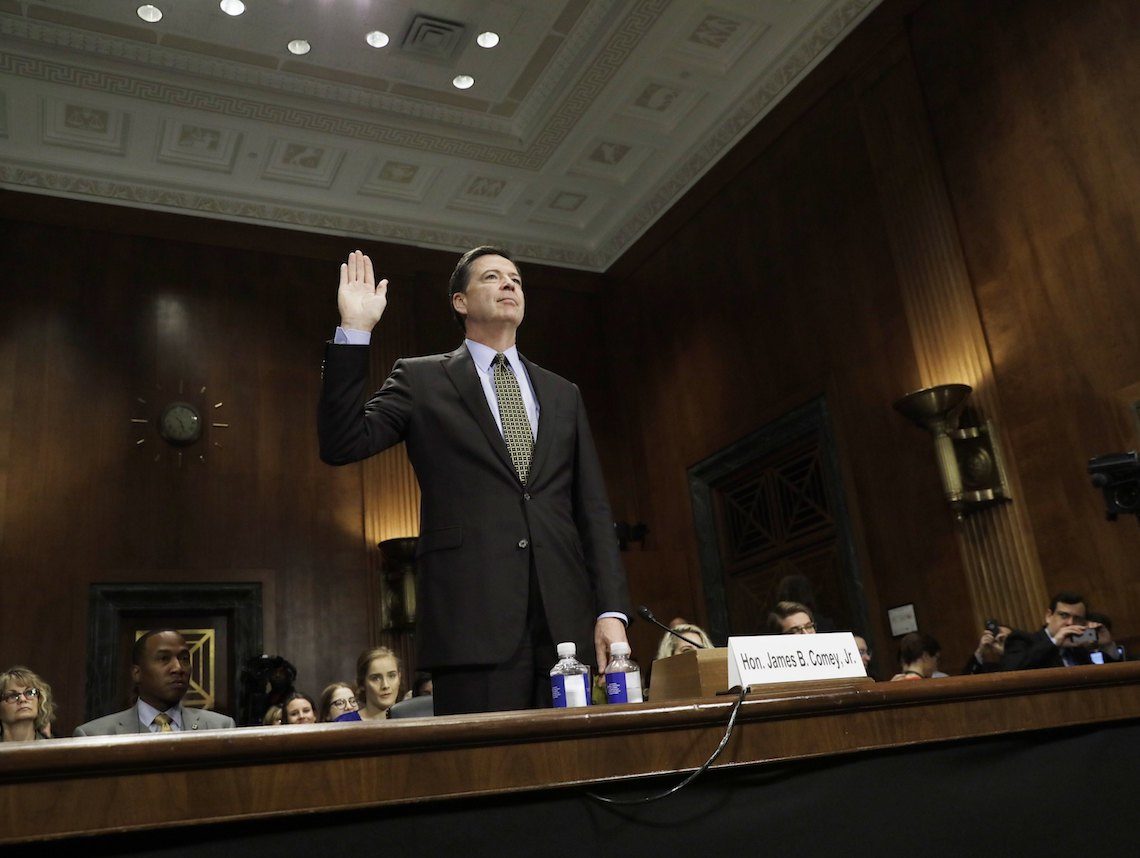
Comey could not personally accept the recognition, and SCN delivered it to a surrogate, because Comey was on the Hill testifying to the Senate about how he handled the email and Russia scandals.

In his testimony, he noted one of the FBI triumphs of recent months as a defense of the agency – helping to solve the JCC bomb threats.

“Children frightened, old people frightened, terrifying threats of bombs at Jewish institutions, especially the Jewish community centers — the entire FBI surged in response to that threat,” Comey said in his opening remarks Wednesday to the Senate Judiciary Committee.

In March, an Israeli-American teen was arrested in Israel on suspicion of calling in more than 100 bomb threats. Last month, the U.S. Justice Department charged the teen, Michael Kadar, with making threatening calls to JCCs in Florida, conveying false information to the police and cyberstalking.

“Working across all programs, all divisions, our technical wizards, using our vital international presence and using our partnerships especially with the Israeli national police, we made that case and the Israelis locked up the person behind those threats and stopped the terrifying plague against the Jewish community centers,” Comey said.

Comey may be gone, but the shock among Democrats – and some congressional Republicans — at his departure means his memory is unlikely to fade anytime soon.

“We must have a special prosecutor,” Sen. Charles Schumer, D-N.Y., the minority leader in the Senate, said in a statement delivered at a briefing for reporters late Tuesday. Schumer said he told Trump in a phone call that firing Comey was a “very big mistake.”

Trump fired back on Twitter, recalling that Schumer had said recently that he did not have confidence in Comey.

“Then acts so indignant,” Trump said, calling the New York lawmaker “Cryin’ Chuck Schumer.”

Rep. Adam Schiff, D-Calif., the ranking Democrat on the U.S. House of Representatives Intelligence Committee, which is also probing the Trump campaign’s Russia ties, said there was no contradiction between being appalled at Comey’s handling of the Clinton case and at his firing.

Schiff noted that Attorney General Jeff Sessions, who has recused himself from the Russia investigation because he had met with a Russian diplomat during the transition, had signed off on the firing.

“The decision by a president whose campaign associates are under investigation by the FBI for collusion with Russia to fire the man overseeing that investigation, upon the recommendation of an attorney general who has recused himself from that investigation, raises profound questions about whether the White House is brazenly interfering in a criminal matter,” he said.

James Comey, fired by Trump and reviled by Democrats, had admirers among Jewish security officials Read More »