fbpx

May 10, 2017

Jewish students at SFSU decry hostility

San Francisco State University (SFSU) has had a problematic reputation for decades in certain Jewish circles. The campus has been considered unfriendly to Zionism and, at times, to Jewish life in general.

Jewish faculty and community leaders now say the problem has grown worse. And they hold the university responsible, accusing the SFSU administration of unequal treatment, silence and delay in protecting the safety and free speech rights of Jewish students.

The critics also contend that anti-Zionist animus over the last year has at times crossed the line into anti-Jewish acts and expression, and that the administration has been tepid in response.

In an April 12 email to SFSU President Leslie Wong, members of San Francisco Hillel went so far as to accuse the university of “institutional anti-Semitism.” Some lay the blame directly at Wong’s feet. They say bias against and ostracizing of Jewish and pro-Israel students on campus has intensified during Wong’s tenure, which began in 2012.

Wong and other SFSU officials deny those accusations, saying they take the community’s concerns seriously.

“I am concerned about our Jewish students,” Wong said. “I do worry about anything that would convey any attempt to silence anyone. Not only is the campus tense in terms of anti-Semitism, it’s tense around a lot of ‘isms’ on campus. I wouldn’t pick anti-Semitism as saying it’s our only problem, but I think it is a significant issue we are trying to confront.”

The critics, however, insist that Wong has failed to provide leadership.

A watershed moment occurred on April 6, 2016, when anti-Israel protesters led by the General Union of Palestine Students (GUPS) shouted down Jerusalem Mayor Nir Barkat during a Hillel-sponsored appearance, chanting through megaphones, “Get the f— off our campus.”

Police and administration officials on the scene issued verbal warnings to protesters, which were ignored; they did nothing else to intervene, allowing the disruption to continue unabated.

Wong, 67, publicly decried the incident and ordered an independent investigation, whose findings were published last August. The report chided SFSU student affairs for not consulting with Hillel and others in advance, and for allowing similar disruptions in the past “without ramifications for the offenders.” But no protester faced disciplinary action.

Jewish voices on campus and off spoke out against the administration’s perceived inaction. In an effort to repair the damage, Wong met a half-dozen times with prominent figures from SFSU’s Jewish studies department and the broader Jewish community.

J.-The Jewish News of Northern California (jweekly.com) has acquired dozens of documents dating from April 2016 to April 2017, including correspondence between Wong and Hillel students, memos, emails, agendas and unofficial minutes of meetings. The documents suggest that Wong, though sympathetic to Jewish concerns, resented the amount of time they took up, even as Jewish leaders pressed him to take more decisive action in protecting Jewish students and to publicly denounce what they see as a de facto policy of anti-normalization of Zionism on campus — which, they say, prevents positive views of Israel or Zionism from being freely expressed.

“We have been trying to get the president of the university to take a clear and public stand that anti-normalization has no place on campus,” said SFSU Jewish studies professor Marc Dollinger. “It’s, in fact, against the very mission of the university. If the approach is not to talk to someone with whom you have a political disagreement, then we’re not a university.”

Of anti-normalization, whose proponents refuse to acknowledge or “normalize” the State of Israel or Zionism, Wong said, “I am the first to say it is an issue,” adding, “I told [Dollinger] I need to read more about this anti-normalization so I can ask about the limits of this.”

Jewish concerns have been marginalized at the school, critics charge. As an example, Dollinger and his colleagues point to a Feb. 28 information fair on human rights called Know Your Rights. They claim event organizers surreptitiously changed the registration cutoff date in order to exclude Hillel from participating. The matter is under investigation by the university.

“Many of us feel a tremendous sense of urgency,” said Luoluo Hong, SFSU vice president of student affairs. “I feel personally responsible when we have students who express distress or concern about campus climate. There are definitely Jewish students who have expressed stress.”

Critics also slam the slow progress on procedural changes mandated after the 2016 shout-down of Barkat; they say it’s taking too long to implement those changes.

Wong disagrees. “I don’t know if it’s taking so long,” he said. “We’ve been pretty rigorous about looking at the policy and asking ourselves where did it come up short, where does it need to be updated and how does it comply with [California State University] system rules. We’ve initiated staff training, we have an emerging leaders program. We’re not done.”

Jewish students at SFSU decry hostility Read More »

Fight against Le Pen must continue

As a young girl who fled Iran, I lived in France for several years during the mid-1980s before coming to the United States. I attended a French public middle school, one of only three Iranian students in the entire school. The tension between “Arab” and “French” people was palpable on a daily basis.

Despite the external challenges, I was enduring my own internal cultural conflicts, or, perhaps I should say, tectonic shifts. I had escaped the tumult of the Islamic Revolution and a country where I was forcibly covered from head to toe on a daily basis, only to find myself now exposed to a new environment where women comfortably walked the beach without even a bikini top! I remember the images of men and women casually socializing, holding hands, even kissing in public.

It was overwhelming , but I cherished the freedom France offered. I was a young girl, liberated from the hijab that covered not only my hair, but also my dignity and identity.

In those years, the National Front movement led by Jean-Marie Le Pen — whose daughter Marine Le Pen succeeded him as head of the party and just lost the French presidential election to Emmanuel Macron — was just beginning to pick up steam. It was particularly gaining popularity among troubled students who I knew. These teens expressed their disenchantment by greeting one another with straight-arm salutes, shaving their heads, donning army attire and boots, and occasionally harassing and spitting at Arab students.
Before too long, they discovered I was an easy target as a young Middle Eastern Jewish girl, barely able to communicate in French and still adjusting to my new surroundings. So they teased and harassed me, yelling “Arab!” at me. I tried to reason with them, explaining that I’m not an Arab, I’m Iranian — Persian! I once said Iranians are of the Aryan race, hoping to score points, but they still saw me as I was — a dark-skinned Middle Eastern girl, a despicable foreigner, “the Other.” The fact that I was Jewish enabled me to seek refuge within Jewish community life, but it proved little more than a liability with the Le Front National.

As a vulnerable teenager, life was hard. Beyond the Jewish community, I never was included in any social activities with peers, never invited to parties, never received phone calls from friends after school. I do recall one time when the phone rang. It was a classmate asking for me. Flattered, I picked up the receiver to hear the voice of Florence, a girl from school. I always thought she was friendly, not too cool or snobby. But as soon as I said hello, Florence said, “Tu es une sal Juive Iranienne — You’re a dirty Iranian Jew — and hung up the phone.

This was a painful but clarifying moment. In an instant, I realized that, no matter how much I boasted about my Iranian (not Arab) culture or my Jewish roots, I still would always be “the Other,” the undesirable threat to their heritage.

It’s undeniable that terrorism and radical Islamists pose real challenges to French society. But white nationalism and neo-fascism are real problems, too. I have experienced this threat firsthand. I know the pain and it causes. I know the anger it breeds and the destructive cycle it sustains.

I’m grateful for my life in the West. I freely can practice my religion, express my opinions and, yes, freely expose my hair and dress however I wish. But I would never align myself with fascists with the false hope that I could preserve these freedoms. Empowering these authoritarians by ignoring and excusing their behavior is immoral, futile and self-defeating.

For those people seeking a quick fix to the decades-long problems of France and the radicalization of elements of its Muslim population, Marine Le Pen’s idea of banning religious attire and head-coverings might have some initial appeal. To Persian-Americans, it might seem reminiscent of Reza Shah’s revolutionary mandate to forcibly remove the hijab from women in an effort to catapult Iran toward rapid secularization. But we live in a vastly different world today.

Ask the majority of French Jews residing in Israel today who voted against Le Pen. They know that Jews — along with other religious minorities, including Muslims and Hindus — all would suffer serious consequences with a ban on the hijab. Despite what the neo-fascists might say, this would not be the end, but rather the beginning, of religious oppression for people of all faiths.

After her defeat, Le Pen apparently is seeking to “rebrand” the National Front party. Such marketing strategies may ameliorate Le Pen’s image, presenting a softer side and a more patriotic mission that may increase her appeal in some quarters. I can imagine that a new generation of voters may develop new impressions of this movement.

Some might be drawn to Le Pen because of a lack of better alternatives, others because their hatred for radical Islamists and foreigners is far stronger than their love for their democratic values and fellow French citizens. And yet, those of us who are familiar with Le Pen must raise our voices. We should not accept such distortions.

Some are saying that Le Pen has lost the battle but the war is yet to come. For this reason, we must be prepared to fight. With our votes and with our voices, we must speak out, because we cannot afford to yield an inch in the fight against fascism. This is a fight for ourselves. ”


MARJAN GREENBLATT is a human rights activist and founder of the Alliance for Rights of All Minorities (ARAM), Iran.

Fight against Le Pen must continue Read More »

Raising the bar (mitzvah): Why you should visit Israel

My oldest son became a bar mitzvah in November. We had a congregational Kiddush luncheon in his honor and a small party for him and his friends that evening. Instead of having the grand blowout party that seems to be the general expectation in my New Jersey suburb, we opted to go to Israel instead. It was the best decision I possibly could have made for these reasons (among others):

Visiting Israel is not just any trip

Sure, we could have gone to Paris or to see penguins in Antarctica, for that matter. But the trip to see the Jewish state is a special one, and one I wanted to save as a special one to honor my son becoming a bar mitzvah. The implicit message I wanted to send to my son was: “You have just pledged yourself as a full member of the people of Israel. We happen to live in an era of history in which Jews not only live in, but also govern, Israel. You, my son, are part of this history. The lives of the people who live here are inextricably intertwined with yours; the history that happened here is your history. Let’s go see your world.”

You get to focus on the mitzvah rather than the bar

When you take your kid to Israel, you don’t have to stress about the alcohol per head at your event. Instead, you get to think about the good deed you are doing by taking your child somewhere truly important and showing your kid that the world is bigger than the small sphere carved out for them at middle school. When your child attends a school where there are many lavish parties, the “bar” for the parties keeps getting set higher and higher. Worrying about the party takes an inordinate amount of the time, effort and money when planning for a child to become a bar or bat mitzvah. I was very grateful to take that worry out of the equation.

The math works in your favor

For the complete cost of a lavish four-hour party for 200 or more guests, you can have a weeklong vacation in one of the most fascinating places in the world. The photos you will take on your iPhone of your family in front of the Western Wall will be more precious to you than the professionally taken photos of your guests with cocktails in hand. The stronger sense of self and history that comes from this trip is, of course, priceless.

Israel is delicious

Whatever caterer you may find cannot equal the pleasure of Israel’s food. Whether you want to try kosher gourmet street food at Crave in Jerusalem, incredible gelato at Anita’s in Tel Aviv or savory falafel with hummus and tahini basically anywhere, you will be happy and full.

More time equals more memories 

While I am sure we would have wonderful memories of my son and extended family and friends at a blowout party, I will say I am profoundly grateful to have made the decision I made to go to Israel instead. While in Israel, we did everything from sample a Chanukah sufganiya (doughnut) per day (at least!) to arguing about the definition of terrorism. We learned about wild horses in a geological landform known as a makhtesh (what’s a makhtesh? Go to Israel and find out!) and about the Israeli Declaration of Independence in the hall where it was signed. The memories forged in Israel are profound.

Israel is family

In going to Israel with my children, I wanted to set the scene that Israel is more than a backdrop for a one-off family trip — it is a place where I hope they will return, with me and other family members and friends, to learn, to travel and to grow. I took a picture of them in front of the Western Wall and told them, “Every time you come here, you stand right here and take a picture of yourself, so that you will see how the stones don’t change and how you do.” And when they take those pictures, they will be able to frame them next to the pictures of their own mother standing in the same spot as a 13-year-old, as a 16-year-old, etc.

Nobody will miss your party

Look, I am a huge proponent of celebrating simchas, but not a single person has said to me, “You know, I feel bad you decided to go to Israel instead of having a party. I really missed the opportunity to look at you in an expensive dress and shout over a DJ as I eat elaborate hors d’oeuvres while drinking themed cocktails.” And I didn’t miss it, either. While I love celebrating with my friends at their parties, I have to say that I felt relieved to not have had to think or worry about my own.

The weeks go by and my son goes to several parties like this a month. I am not sure he really will be able to distinguish one from another when all is said and done — and when he is, it is usually because the spending was so extreme. At the end of the day, I don’t want to impress my friends and neighbors — I want to impress upon my son what it means to be part of the Jewish people. And for that goal, this trip was a great success.

Kveller is a thriving community of women and parents who convene online to share, celebrate and commiserate their experiences of raising kids through a Jewish lens. Visit Kveller.com.

Raising the bar (mitzvah): Why you should visit Israel Read More »

A Jewish response to ‘13 Reasons Why’

“I hope you’re ready, because I’m about to tell you the story of my life. More specifically, why my life ended. And if you’re listening to these tapes, you’re one of the reasons why.”

— Hannah Baker, “13 Reasons Why”

The Netflix series “13 Reasons Why” is about Hannah Baker, a teenage girl who kills herself and leaves behind 13 tapes for her peers, explaining the reasons why.

Over the past month, this show has gone viral, and in turn it has brought the issues of suicidal ideation, rape, mental illness and, especially, bullying — which are central to her reasons for ending her life — to the forefront of our community.

Some feel the show glorifies suicide by giving it an element of revenge and that it inaccurately portrays mental illness. Others feel validated by it and are grateful it is finally giving a real and raw voice to what have been taboo issues. Regardless of where you fall, the truth is that the success of the show merits a response. And when we as Jews face what certainly are the most serious social issues in the lives of our preteens, teens and young professionals (though not limited to them), we need a Jewish way to respond.

The Gemara relates that one day Rebbe Ami and Rebbe Asi were debating a verse from Proverbs 12:25, “Anxiety in the heart of a man weighs him down.” One of them said the word ישחנה should be read not as “weighs him down” but as “he should push it down from his mind,” and the other disagreed and said it means “he should talk about it with others.” Their disagreement was around the root of the word ישחנה — is it derived from the word “to push down” or “remove,” or from the word “to discuss”?

But Rebbe Ami and Rebbe Asi’s disagreement is not just linguistics. It is fundamentally about how we respond to worries, anxieties and problems in our lives. Is it best to push them down and move on or do we actually need to talk about them with another person?

This debate raises the same concern that “13 Reasons Why” has challenged us with: How can we constructively respond to our own struggles and the struggles of others? What do we do when we are feeling depressed and hopeless or when we are perhaps filled with dread for the well-being of our child who is being bullied at school?

Certainly when it comes to personal coping, it is true that Rebbe Ami and Rebbe Asi’s two answers resonate equally with different people. Some of us cope by doing deep introspection alone, by pushing it down to move on, others by talking it through with another person. But when it comes to suicide and bullying, the interpretation can be applied only one way: When we are faced with hurt and hopelessness, we must talk about it with others.

When I spoke with seniors at Shalhevet High School and YULA Girls High School about “13 Reasons Why,” I heard two powerful reactions over and over again. First, frustration with the lack of communication both from the girl who killed herself and from her peers and teachers who either failed to notice warning signs or who actively contributed to her hurt and isolation. And second, acknowledgement that the show was prompting us to talk about issues that until now we were not discussing — or that, for some, were being lived alone in silence without any support.

It is clear that communication (ישחנה לאחרים) is the response that can literally save a life in the face of suicidal ideation and any self-harm or self-injury. The Los Angeles County Department of Mental Health underscores this in its training programs “Mental Health First Aid” and “Suicide Prevention,” both of which we have held at B’nai David, and from which we have resources available to our shul. Practically, we learned that if we suspect a person may have suicidal thoughts, our communication should follow three steps, known as QPR, which stands for Question-Persuade-Refer — Question a person about suicide; Persuade the person to get help; and Refer the person to the appropriate resource.

We cannot shy away from asking, “Are you having thoughts of suicide?” or “Do you have a plan?” Using the word “suicide” will not put the idea into the person’s mind but instead will express empathy, respond to the plea for help and join the person in identifying an issue that is almost always already known to them.

If just one person had done QPR in “13 Reasons Why,” the show and the book it was based on may have had a very different ending.

Preferably, of course, we don’t want a person to get to the stage of suicidal ideation. For someone who is being bullied, safety and communication must begin before the crisis. We need to decide as a community — as students, as parents of teens, and as Jews obligated to love our fellow as ourself — that we have zero tolerance for bullying. This means establishing the expectation that lashon harah (idle gossip) and harmful and exclusive social media are just not part of how we function. Instead, we love each other as we are and look for what is holy in each other. I cannot tell you how many kids or parents have told me about the devastation that has happened on a Snapchat. The solution does not require the elimination of social media, but it does require a refocusing on the Jewish ethics of communication and the separation between self-worth and an online profile.

Our Torah, our moral and ethical code, is very straightforward. As we just read in Parashat Acharei Mot-Kedoshim, “Do not cut your flesh or self-harm,” “Do not oppress your fellow,” “Do not stand on the blood of your friend.” Suicide is about destroying one’s own life in order to end pain, while bullying is about destroying another’s life so that the bully can avoid his or her own pain. Our holiness is contingent on how we treat ourselves and one another, especially in the midst of human vulnerability, for the life God has given us is precious.

And so, our job as a community committed to cultivating holiness is to respond to hurt and hopelessness with holy conversation. When we ask a friend about possible suicidal thoughts, we must be calm and speak without preconceived judgments. To provide just one such example of holy conversation, students at a high school in Michigan recently made a list of “13 Reasons Why Not,” which included public thank you’s at school to peers who were there for their friends in times of hurt and hopelessness, and reasons why suicide cannot be an option.

I have lost two friends to suicide and have cared for countless others in moments of suicidal ideation, including my brother. This past week, my best friend was hospitalized for a suicide attempt. I felt crippling helplessness, heart-wrenching anger, and unresolvable fear and guilt. I felt terror. I wanted to protect her, to watch her every move and make sure she was safe. I wanted to get rid of her depression and anxiety and yell at her colleagues who had been bullying her at work.

I wanted to fix it all. But I couldn’t. All I could do was talk to her, hear and hold her pain, and sit in silence when that was what she needed.

I reminded myself of Rebbe Ami and Rebbe Asi’s profound conversation and the Jewish response that HaShem has given us through them: ישחנה לאחרים — talk to each other, be there for each other no matter what, because your words and your listening ears can save a life.


RABBANIT ALISSA THOMAS-NEWBORN is a clergy member at B’nai David-Judea
Congregation in Los Angeles.

A Jewish response to ‘13 Reasons Why’ Read More »

In ‘Master of the House’ at AJU, husband and wife butt heads

“Master of the House,” the new production of the Jewish Hebrew Stage, tells the story of a marriage in crisis.

The piece — which is presented in Hebrew, with an English translation running on a screen just above the stage — won the 2003 Israel Theater award for best play and opened to a full house on April 27 at the American Jewish University (AJU) in Los Angeles. It will run through May 28 at the Macha Theatre Company in West Hollywood.

“We chose a play that touches on things that speak to everyone — family, relationships, old age and infidelity,” said Ori (Dinur) Teyer, the theater’s co-founder.

Written by Israeli playwright Shmuel Hasfari, “Master of the House” starts with a disagreement between a husband and wife who live in Tel Aviv. Nava, an attorney, wants to renovate the house. Her husband, Yoel, a columnist who writes about nostalgia and architecture, is not interested. This is his parents’ house, the one he grew up in, and he likes it the way it is.

Nava, though, is not deterred. She hires a handyman to fix a clogged toilet and instructs him to create enough damage in the house so remodeling will be inevitable. There is a battle of wills, but behind the arguments whether to remodel or not lies a bigger story and a great pain that is revealed later in the play.

We also are introduced to Yoel’s parents, who live in a retirement home. His father, Shaia, is at the early stages of dementia, and his mother, Tzipa, is doing her best to hide it from the staff, fearing he’ll be sent to an assisted living facility.

This isn’t the first American production of Hasfari’s play. “Master of the House” played in English at the Laguna Playhouse in Orange County 10 years ago before 16,000 people, an impressive achievement for an Israeli play that presents Israeli culture and is set in Tel Aviv.

“It was quite amazing to see how the American audiences laugh at the same place and cry at the same place,” Hasfari said in a previous interview, speaking of the 2007 performance.

The Jewish Hebrew Stage, established in 2006, is a volunteer theater sponsored by the Israeli American Council that brings together a combination of actors, both seasoned and inexperienced. Yoram Najum (Yoel), theater co-founder, is a swimming pool contractor. Shirly Schwartzberg (Nava) worked as an actress in Israel before becoming an attorney. Shoshi Rose Strikowski, who plays Yoel’s sister-in-law, is an office manager at her husband’s plumbing company. Yuval Palmon, a mechanic, plays Yoel’s brother, and Levy Meyer (Shaia) is a real estate investor. Avigdor Mizrahi, who plays Kadosh, the contractor, is a professional actor, a veteran of shows such as “The Unit” and “Saving Amy.”

Gita Zeltzer, who directs all of the theater’s productions, plays Tzipa, who is eager to find the gold that her husband has hidden in the walls of the house.

“It’s been a while since I played onstage — 40 years — and it felt so natural,” she said. “Not everyone in the cast had experience as an actor. Some of them never played before, and it took them time to relax and be able to move around onstage. They had some resistance, but I let them show me how they see their character and I built around it while giving them my input.”

One new actor is Palmon, 50, who owns his own auto repair shop. He ended up at the theater by accident, after a dune buggy trip in 2015.

“I made a bad turn, which made me flip over,” he said. “My arm was severed completely. The doctors were able to reattach it, but of course, it’s not the same. So far, I have had seven operations and I’m going to have another one soon. I decided the play will be a good distraction from my pain and preoccupation with the injury.”

Strikowski, who works with her husband at his plumbing business and at a senior home where she organizes events and activities, said juggling her daily work with the demanding rehearsal schedule has been challenging.

“There were many times I was getting back home at 11 p.m., but still, my husband and children were very supportive and excited to see me onstage,” she said. Her role as the sister-in-law inspired her to audition for — and win — a guest appearance as an Israeli mom in the Amazon series “Transparent.”

Schwartzberg acted in Israel before her mother persuaded her to study a “real” profession. She enrolled in law school and became an attorney before moving to the United States five years ago. Still, the acting bug didn’t leave, and when she saw a Facebook post about the new play, she picked up the phone.

“I called Ori thinking it would be fun to do some theater,” she said. “It had been a while since I acted. I mainly take care of my two young children today.”

The opening night — sponsored by AJU’s Whizin Center for Continuing Education — drew mainly an Israeli audience, but Teyer is hopeful that the American-Jewish community will find its way to the theater, as well.

“Our aim is to bring the Jewish community closer to the Israeli community here,” Teyer said. “There is a total disconnect between the communities. It will also allow Israeli-American couples to enjoy an Israeli cultural event together.”

“Master of the House” plays through May at the Macha Theatre Company in West Hollywood. For information about dates and times, call (818) 689-6563.

In ‘Master of the House’ at AJU, husband and wife butt heads Read More »

May Is Here, My Dear

temperature in the seventies
weekend approaching
blithe and friendly
and meanwhile close
to the ground
around a tree
broadway traffic going by
a small girl in a smocked dress
squats to pet a pink
impatiens blossom
with her forefinger very
carefully


Alicia Ostriker has published 14 volumes of poetry, most recently “The Book of Life: Selected Jewish Poems, 1979-2011” (University of Pittsburgh Press, 2012). Ostriker received the National Jewish Book Award for Poetry in 2010, and has appeared in numerous Jewish literary journals and anthologies.

May Is Here, My Dear Read More »

‘Wrestling Jerusalem’ makes leap from stage to screen

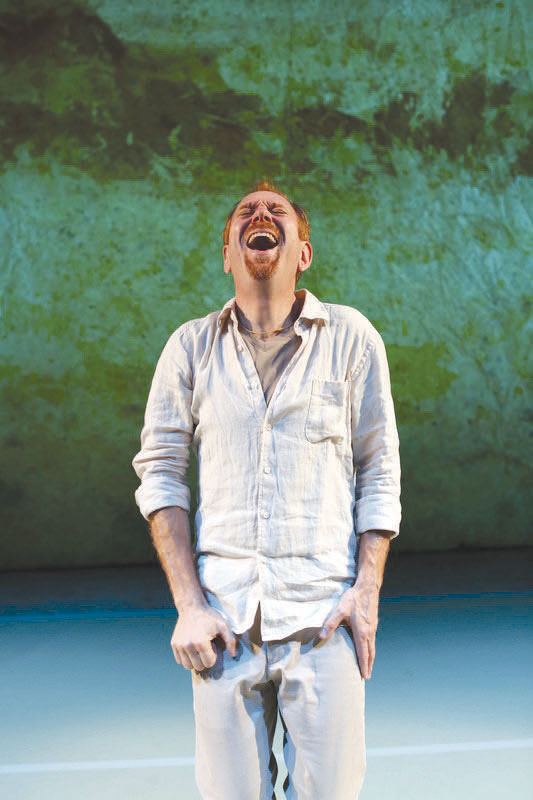
Aaron Davidman plays 17 characters from the U.S., Israel and the West Bank in the film “Wrestling Jerusalem.” Photo by Ken Friedman

It’s not easy to adapt a one-man play to a feature-length film. The intensity of a live performance can get lost in such a visual medium as cinema. Yet somehow, “Wrestling Jerusalem,” which conveys the complexity of the Israel-Palestine conflict through a series of dramatic monologues, manages to translate to the big screen.

Writer and performer Aaron Davidman, the only actor in the film, plays 17 characters from the United States, Israel and the West Bank. These voices offer unique political, social and religious perspectives on a long-simmering feud in a volatile corner of the world.

There’s Jacob, an older American who rails at the double standard Israel is held to; Ibrahim, a Palestinian whose family’s orchards were destroyed to build the separation wall; and Arnon, an Israeli special forces commander who explains why civilian casualties are regrettable but unpreventable. There’s also a farmer, a physician and a United Nations worker.

For each character, the redheaded, goateed Davidman speaks with a different accent and cadence; some suggest reasons to be hopeful and others offer only anguish and despair.

“Cinema is just a totally different art form,” he said, comparing the new film to the stage version. “It was exciting to explore the subtleties of the close-up, and the intimate, internal lives of these characters that you can’t get to in the theater.”

There also are scenes in vast desert landscapes, which on a big screen conveys the emotional journey of these characters. “Film can hold the epic nature of this conflict and the searching questions that are in the middle of the conflict,” Davidman said.

The play premiered at Intersection for the Arts in San Francisco in March 2014. Davidman toured with it for a year before it was filmed by director Dylan Kussman. He and Davidman have been friends and collaborators for more than 25 years. They considered casting actors to play the different characters but ultimately decided against it.

“The power of it is that all these characters are in one person,” Kussman said. “And it’s ultimately this statement about multiplicity, about simultaneously holding conflicting ideas within ourselves, and why that’s a powerful tool for advancing a conversation about a very difficult and complex subject.”

The movie was shot in 10 days in 2015. Half of that time was spent in the Mojave Desert, which served as a stand-in for the Negev. The other scenes take place at Marines’ Memorial Theatre in San Francisco. They shot for two days in a dressing room, in which Davidman addresses himself in the mirror, and three days onstage, including a performance in front of a sold-out crowd.

The movie is shot simply, using three cameras, with lighting and sound design adding to the drama. The props include only a few pieces of furniture in the desert: a row of bus seats, a desk and a chair, and a table with an umbrella. Throughout the film, Davidman wears only a tan button-down shirt and khaki pants, causing him to nearly disappear amid the sand and rocks.

Davidman and Kussman both found inspiration in another screen adaptation of a solo show, Spalding Gray’s “Swimming to Cambodia,” directed by the recently deceased Jonathan Demme. That film, made 30 years ago, shows Gray seated at a desk in a theater, recounting stories over a soundtrack composed by Laurie Anderson.

Without that film, “there would be no ‘Wrestling Jerusalem,’ ” Kussman said. “I really believe that. Because when we went through the really gut-checking conversation of, ‘Can you translate a one-man show to film?’ I kept on saying to myself, ‘Demme did it.’ ”

“That movie was so important in the theater world, of [showing] look what you can do,” Davidman added. “Of course, we wanted to go beyond that, we didn’t want to just be sitting in the theater … but that was a point of departure, for sure.”

Davidman and Kussman are developing another film project, which Davidman described as “a psychological thriller involving white nationalism and the re-emergence of Jews in Poland.”

Davidman also has been working with Google’s executive training department, screening “Wrestling Jerusalem” and leading discussions with global executives as part of a series of workshops called “Leading in Complexity.”

“They’ve got complex problems they’ve got to solve,” he said. “To look at this piece, not so much because it’s Israel-Palestine, but because it holds multiple perspectives, because it has compassion for people that are different from you, and because it models one person embodying so many points of view, that’s what they’re really excited about and interested in.”

Davidman estimates he has performed the show live 142 times. He always ends with an audience discussion about the issues at the heart of “Wrestling Jerusalem.” Allowing people to take time to reflect, listen and engage with others who may not share their perspectives is the most profound aspect of the project, he said, and several of the film screenings also will end with discussions.

“I see myself as a vessel for the audience, who want to dig deeper, or have questions, or feel moved, or are upset, or whatever they are,” Davidman said. “I don’t want to explain the movie, but I’m happy to help take the conversation further … especially now. We’re not doing that in public. We’re dismissive of people that don’t agree with us. We’re contemptuous of the other side. We don’t have time for it. And I’m asking people to enter into this narrative with me and then be brave enough to stay curious.”

“Wrestling Jerusalem” will screen from May 12-18 at the Laemmle Music Hall 3 in Beverly Hills. The official L.A. premiere will be on May 13. For more information about showings, go to wrestlingjerusalem.com.


‘Wrestling Jerusalem’ makes leap from stage to screen Read More »

Trump acts on politics in the pulpit with executive order

President Donald Trump’s executive order to weaken a prohibition against religious and other nonprofit organizations from endorsing political candidates has driven a wedge between Jewish religious leaders. Some cite it as a victory for First Amendment rights while others view it as a threat to the separation of church and state.

The prohibition is a 1954 provision to the federal tax code known as the Johnson Amendment, which bars nonprofit organizations from certain political activities.

On one side of Trump’s action are clergy, such as Rabbi Marvin Heir, founder and dean of the Simon Wiesenthal Center in Los Angeles, who argue that religious leaders should speak out on issues they support. Hier once was censured by the Federal Elections Commission for violating the prohibition.

“We should fully honor the separation of church and state, but that has nothing to do with giving a sermon,” said Hier, who led the prayer at the White House ceremony on May 4 when Trump signed the order and who spoke at the president’s inauguration. “When you’re a rabbi or a priest, and you feel strongly about an issue, you can name names! And you can say don’t vote for him! It wouldn’t be such an aveira,” he said, using the biblical Hebrew word for sin.

Other Jewish leaders and institutions, however, expressed dismay at the order, saying it sanctioned oppressive behavior and undermined the role of clergy as unifying figures. The Religious Action Center of Reform Judaism (RAC), a social justice advocacy group representing 900 Reform congregations across the United States, called the order “dangerously broad.”

Rabbi Joel Simonds, the RAC’s West Coast director of policy and associate rabbi at University Synagogue, said that while the pulpit should be used to rally against injustice, “justice isn’t partisan.”

“There are plenty of organizations and communities that can be partisan and that can speak out,” Simonds said. “But we have a unique place in our society and in our community to not dehumanize the other … and to preserve that safeguard [between church and state].”

The Johnson Amendment is named for then-Sen. Lyndon B. Johnson (D-Texas), who later became vice president and president. It forbids nonprofits from endorsing or opposing candidates, contributing to election campaigns or otherwise influencing legislation with public statements. Violating organizations may see their tax-exempt status revoked — although the Internal Revenue Service has seldom enforced the rule.

It does not prevent religious organizations from expressing views intended to support one side of an issue.

The president’s executive order, titled “Promoting Free Speech and Religious Liberty,” instructed the Treasury Department not to single out religious organizations for speaking “about moral or political issues from a religious perspective” when similar activity would not be considered a violation by a secular nonprofit.

The language used in the order was a relief for those concerned that Trump favored granting religious institutions even wider latitude. In February, he had vowed to “get rid of and totally destroy” the amendment at the National Prayer Breakfast. (Only Congress can fully repeal it.)

For those who had anticipated a more drastic measure, there still was plenty to dislike about the president’s action.

“I’m concerned about what drove this executive order,” said Rabbi Sharon Brous, founder and senior rabbi of the synagogue IKAR. “I believe that if this administration were really concerned about religious freedom, that this would not be the step that one would see.”

Brous pointed to the rising tides of anti-Semitism and Islamophobia as issues of religious freedom that demanded action from the White House.

“There are actual vulnerable religious minorities in the country right now that need protection, and this executive order is a bit of a dance with the players who created the ‘War on Christmas’ in order to play to the [conservative] base, and to create the sense that we are getting the back of those religious figures,” she said.

The order also directs federal agencies to consider amending the mandatory inclusion of birth control in health insurance policies offered by private employers, a change widely sought by the religious right.

The Orthodox Union (OU), a national organization that supports the Orthodox Jewish community, applauded the order for giving people the right to incorporate personal religious views into workplace policy.

Nathan Diament, the group’s executive director for policy, said supporting religious freedom had been a White House priority until Barack Obama took office in 2009.

“[President Trump] is reasserting religious liberty as a primary consideration for how the executive branch implements law and policy,” Diament said. “We don’t have as Jews the same view [as Christian groups regarding contraceptive coverage]. But we do believe religious freedom needs to be protected — and the Obama administration could have but chose not to.”

Diament added that the OU supported the Johnson Amendment and likely would not have supported the executive order had its language been more aggressive. “We’re concerned about rabbis in synagogues being pressured into taking political stances that they may not want to take and may divide their community,” he said.

Hier pointed out that clergy making political statements is already a fact of life, an assertion that Brous agreed with. Moreover, Hier said, if someone came along who really was threatening — a candidate who was anti-Israel or a supporter of Louis Farrakhan, leadero of the Nation of Islam, were his examples — there would be an obligation to speak out.

When Jesse Jackson ran for president in 1984, Hier found himself in such a scenario. Jackson had referred to New York City as a “Hymietown,” using a derogatory term toward Jews.

“We condemned it and basically said that nobody should vote for him because it indicated to me the commitment to anti-Semitism,” Hier said.

Shortly thereafter, the Simon Wiesenthal Center, a nonprofit organization, received a warning letter stating that it had breached the Johnson Amendment. That encounter informs Hier’s opinion of the law today.

Brous agreed with Hier that clergy should not shy away from bad political actors. But she disputed the need to oppose them at the pulpit. “There’s a candidate that’s been trafficking in racism and bigotry and misogyny of all forms, and I did not need to stand up ever and say vote for this person or vote for the other person.

“It’s enough to say, this is about democracy versus authoritarianism, this is about decency versus indecency, this is about moral right versus moral wrong, without having to hold people’s hands and pull the lever in the voting booth.”

Still, Hier conceded, if Congress repealed the amendment, he doubted that a rabbi would have much influence over his congregants: “People don’t adopt policies based on what the rabbi says. That we have to leave for the time of the Messiah.”

He said that he would not weigh in on future elections from his station. But for those who don’t want to hear about politics when they go to pray, Hier joked “they shouldn’t join a shul.”

Trump acts on politics in the pulpit with executive order Read More »

Wallace Shawn finds perfect time to bring his play ‘Designated Mourner’ to Los Angeles

In Wallace Shawn’s 1996 play, “The Designated Mourner,” three artist-intellectuals recount how their country gradually slid into political uncertainty, anti-intellectualism and totalitarianism. Sound familiar? In an era when falsehoods are spun as alternative facts and the media are branded as the enemy of the people by the president, the production feels as relevant as ever.

“We all, I suppose, dream of finding ways to resist the authoritarian tide,” Shawn said in an interview with the Journal at the Millennium Biltmore in downtown Los Angeles. In a corner of the hotel bar, he sipped iced tomato juice and spoke slowly, carefully weighing his words.

“Complacency is an incredibly powerful, compelling force in my life,” he said. “I experience very few moments when I’m not aware of the suffering that’s going on and my own role in it.”

REDCAT in downtown Los Angeles is hosting 10 performances of “The Designated Mourner” through May 21 as part of its “Urgent Voices” series. The cast is the same as in the show’s 2000 run in New York, featuring Shawn, Deborah Eisenberg and Larry Pine, directed by longtime Shawn collaborator André Gregory.

Pine plays Howard, a venerated poet. Eisenberg (an acclaimed fiction writer and Shawn’s longtime companion) plays Howard’s daughter, Judy, and Shawn plays her husband, Jack. They deliver a series of intersecting monologues that over the course of three hours touch on existential questions of morality and identity.

An esteemed author and performer, whose nonfiction collection “Essays” was published in 2009, Shawn leads something of a double career. Many know him as a highbrow playwright and the co-star (with Gregory) of 1981’s “My Dinner with André,” the Louis Malle-directed film that consists entirely of a nearly two-hour dinner conversation between two old friends. Many more know him as the owlish high school teacher Mr. Hall from “Clueless” and Vizzini from “The Princess Bride.”

Shawn seems to move easily between the sanctified world of theater and the mass-market entertainment of animated films. He draws these comparisons in “The Designated Mourner,” in which his character reflects on his disenchantment with Judy and Howard’s intellectual airs, and admits to relief at no longer having to pretend to be cultured.

Shawn’s own intellectual pedigree is unassailable, and he speaks candidly about his own privileged upbringing in Manhattan. His parents were William Shawn, the longtime editor of The New Yorker, and journalist Cecille Shawn. He studied history at Harvard, and philosophy, politics, economics and Latin at Oxford. He taught English in India as a Fulbright scholar.

He writes in “Essays” that his parents were “completely (some might say excessively) assimilated American Jews.”

“They moved from Chicago and left their Jewishness completely behind,” Shawn said.

Shawn refers to himself as an atheist, though he acknowledges that the issues he probes in his writing, such as what it means to be a moral person and how to address the suffering of others, are integral to Judaism, “almost stereotypically so,” he said, saying both of his parents also were preoccupied with such issues. “If I’d come from a different background,” he said, “I wouldn’t be remotely me.”

Shawn’s politics tend to be far left of center. He identifies as a socialist and is critical of United States intervention in foreign countries, as well as of many of President Donald Trump’s policies.

“There’s no question that a lot of people disapprove of him. But people have to figure out how to oppose these things, how to oppose open racism, how to oppose the destruction of the environment,” Shawn said. “I don’t believe in immigration quotas or in passports myself. I don’t really believe in the nation-state itself. Let people go where they need to go.”

But just as he finds Trump himself disconcerting — “his views are so malleable” — he also laments the lack of dialogue that takes place among people with opposing political views.

“I think it’s a very shocking fact that so many of us, such as myself, live in some kind of bubble where we don’t ever argue with people who think that, I don’t know, a big wall should be built on the Mexican border,” he said.

Shawn also has been a vocal critic of Israel’s occupation of Palestinian land. He serves on the advisory board of Jewish Voice for Peace, a group that has endorsed the Boycott, Divestment and Sanctions movement, and in a 2008 op-ed in The Nation wrote that “the future of the Jews looks increasingly dim” if the occupation continues.

Shawn predicts “the United States won’t support Israeli interests when it becomes too clear that it would conflict with American interests. … It seems that [Israeli Prime Minister Benjamin] Netanyahu and those who are even further to the right are trying to prevent a Palestinian state. … The sort of apartheid, one-state solution is inherently unstable. I don’t think that’s going to produce happiness for anybody.”

As he discussed the Israel-Palestine conflict, a young man approached the table, pointed at Shawn and said, “Inconceivable!” — Vizzini’s catchphrase from “The Princess Bride.” Shawn nodded and replied, “Oh, ha ha, that’s it!” and smiled graciously. He’s heard it repeated back to him countless times in the 30 years since the film’s release.

How does he make sense of this dual career — on the one hand, writing cerebral experimental plays like “Aunt Dan and Lemon” and “The Fever,” while also lending his lisping, nasal, New York-accented voice to characters in “Toy Story,” “The Incredibles” and “Cats & Dogs: The Revenge of Kitty Galore”?

Shawn admits he’s confused at times. “I suppose my life would seem to some people to be actually at war with itself,” he said. He thinks of himself as a “low-level intellectual” and “a groupie of intellectuals.”

At an event last month at the New York Public Library, Shawn interviewed the linguist, philosopher and political theorist Noam Chomsky. In the publicity material for the evening, he said, “the implication was that a humorous minor celebrity was interviewing professor Chomsky, an actor who was funny and well-liked by some people.”

It made him wonder: “Did they invite me because I’m a well-qualified minor intellectual, or did they invite me because I was an amusing cartoon actor who would provide an interesting contrast to the usual interviewers?”

Shawn realizes that he always may be remembered as the actor who repeatedly blurts out “Inconceivable!” and does cartoon voices, even if he sees himself as a writer and playwright who somehow, strangely, found a side career in Hollywood.

“The public doesn’t know about me as a writer,” he said. “There are a couple playwrights who are well known. I’m not one of them.”

“The Designated Mourner” opens on May 11 at REDCAT in the Walt Disney Hall Complex and continues through May 21. All performances are at 8 p.m. except for two Sundays, May 14 and 21, at 3 p.m. Tickets are $25-$55. For more information call (213) 237-2800 or visit www.redcat.org.

Wallace Shawn finds perfect time to bring his play ‘Designated Mourner’ to Los Angeles Read More »