fbpx

May 3, 2017

‘Batman & Bill’ unmasks the dark secret behind the Dark Knight’s creation

For a long time, the legendary character Batman harbored a secret darker than any of his comic book superhero counterparts: his true origin story.

In a New York apartment in 1939, Bob Kane and Bill Finger huddled over a drawing board and came up with what has become one of the most popular fictional characters of all time. But as author Marc Nobleman reveals in Hulu’s first original documentary, “Batman & Bill,” Kane went on to acquire fame and glory as Batman’s sole creator while Finger faded into obscurity, dying alone and penniless in 1974. As Nobleman says in the documentary, “Bill was Batman’s secret identity.”

“Batman & Bill” offers a compelling slice of pop culture history, charting  Nobleman’s journey as he researches material for his 2012 book, “Bill the Boy Wonder: The Secret Co-Creator of Batman.”

Kane and Finger had similar backstories of their own. Both the sons of Jewish immigrants, they changed their names to guard against the anti-Semitism of 1930s New York, giving them a better chance in the job market — Robert Kahn became Bob Kane and Milton became Bill.

As “Batman & Bill” showcases through artfully nostalgic comic book panels, Kane and Finger attended the same high school (though they met later in life, at a party) and both aspired to be cartoonists. Their paths diverged during the height of the Great Depression, as the unassuming Finger set aside his dreams to take a job as a shoe salesman, and the more openly ambitious, bombastic Kane snagged work at DC Comics, then known as Detective Comics.

Goaded by the success of “Superman,” the brainchild of two other children of Jewish immigrants, Joe Shuster and Jerry Siegel, Kane decided to cash in with a comic book invention of his own. “Batman & Bill” reveals that in his original design, the “Bat-Man” wore a red bodysuit and goofy-looking detachable wings, until he called his friend Finger to help brainstorm the rest.

Finger developed most of the elements of the character that are so recognizable today: Batman’s real identity as Bruce Wayne, the honorific “the Dark Knight,” Batman’s two-page origin story and characters such as Robin, the Joker, the Riddler and police commissioner Gordon, plus the name Gotham City.

But Kane claimed all the credit for himself and there was no way for Finger to contest it — no contract or paper trail of any kind.

“It was one man’s word against the other,” Nobleman says in the documentary. “It was two guys in an apartment in the Bronx in 1939, when most people had much bigger things to worry about than who’s coming up with this guy dressing up as a bat.”

Nobleman, a longtime comic book aficionado, felt a moral calling to get Finger the credit he deserved. “It became a crusade,” he says. But to challenge the juggernaut DC Entertainment for a Finger credit line, Nobleman needed to find a living heir for a legal pathway to redress. Channeling Batman, Nobleman used his detective skills to uncover Finger’s sparse family history, and that eventually led him to Finger’s only grandchild, Athena.

Born in Portland, Ore., Athena Finger grew up in Boston with her mother and now resides near Fort Lauderdale, Fla., with her son. She teaches math at the local college and produces oversized paintings on the side. “Just trying to be creative,” she said over the phone.

Athena’s parents separated when she was a baby, and she saw her father, Fred Finger, Bill’s only child, only on occasion before his death when she was 15.

“My dad would tell me about his father and what he did,” she said. “He would tell me about how his dad wrote all these great stories for Batman and how he created the character. He had fond memories of his dad writing.”

Though Fred and Bill’s relationship became strained when Fred came out as gay, Fred continuously strove to get his father public recognition as the co-creator of “Batman,” especially with the release of the 1989 Tim Burton film starring Michael Keaton.

But when Fred got sick, Athena explained, “he couldn’t spend energy trying to fight for something when he’d been told ‘no’ for so long. And that’s one of the reasons it took me so long to pursue getting him credit myself, because after my father passed away, I was told it was going to be extremely difficult and very consuming, [both] financially and emotionally.”

Growing up, Athena wasn’t involved in the comic book world, though she knew of her unique family history from her father and named her dog Bruce Wayne. Buoyed by Nobleman’s efforts and the fan support he had garnered, Athena reached out to the DC offices herself.

“Once Marc had approached me, I realized that there was actually a community of people who knew the truth,” she said. “And that was new for me.”

Several of these passionate and well-known fans are interviewed in “Batman & Bill,” such as filmmaker and podcaster Kevin Smith, producer Michael Uslan, pop culture psychologist Travis Langley and an array of comic book historians.

As a result of the collective efforts of the community of Batman fans, the morning of Sept. 18, 2015, brought some welcome news to Athena Finger and Marc Nobleman: DC resolved to add Finger’s name as co-creator of the original Batman character in the credits for the television show “Gotham” and any future Batman-based projects.

“Batman v Superman: Dawn of Justice,” which opened in theaters four months later, was the first big-screen adaptation to carry the new credit line: “Batman created by Bob Kane with Bill Finger.” Asked how it felt to see her grandfather’s name in its rightful place, Athena paused. “How do you describe that?” she mused, and it’s clear that the moment is bittersweet.

“It was exciting,” she said, “but I wish there were other people here to see it.”

The moment came with mixed feelings, but it represented a triumphant moment for the underdog — and the successful pursuit of justice. Just the way Batman would have intended.

“Batman & Bill” debuts May 6 on Hulu.

‘Batman & Bill’ unmasks the dark secret behind the Dark Knight’s creation Read More »
How to help save Syrians

Why did we go?
As images of the Syrian refugee crisis played out on our TV and computer screens, we, like so many people, felt helpless and horrified. 

We wanted to help, and fortunately for us, we knew where to turn.

Both of us had met Yotam Polizer, co-chief executive of IsraAID, Israel’s largest humanitarian nongovernmental organization. Working with Muslims, Christians and Jews, IsraAID has provided lifesaving disaster relief and long-term support in nearly every humanitarian crisis of the 21st century — setting a good example for Israel in the process.

The group currently is working in 17 areas of the world, including South Sudan, Nepal, Haiti, Jordan, Kenya, the Philippines, Colombia, Peru and Greece, where Syrian refugees are landing to flee a civil war now in its sixth year.

IsraAID has been working in Greece since September of 2015.  By now, fighting between the Syrian government and opposition groups has resulted in the deaths of 470,000, by some estimates, and displacement of over 6 million more, according to the United Nations. Greece has become a primary way station, from where refugees hold out hope that they will reach Germany, a “promised land” of sorts that has absorbed the most Syrian immigrants — more than 600,000 — among all countries in Western Europe.

As mothers, grandmothers and psychotherapists, we fell in love with IsraAID’s mission to respond immediately to people facing natural or man-made disasters, even those from countries like Syria that have declared Israel its enemy.

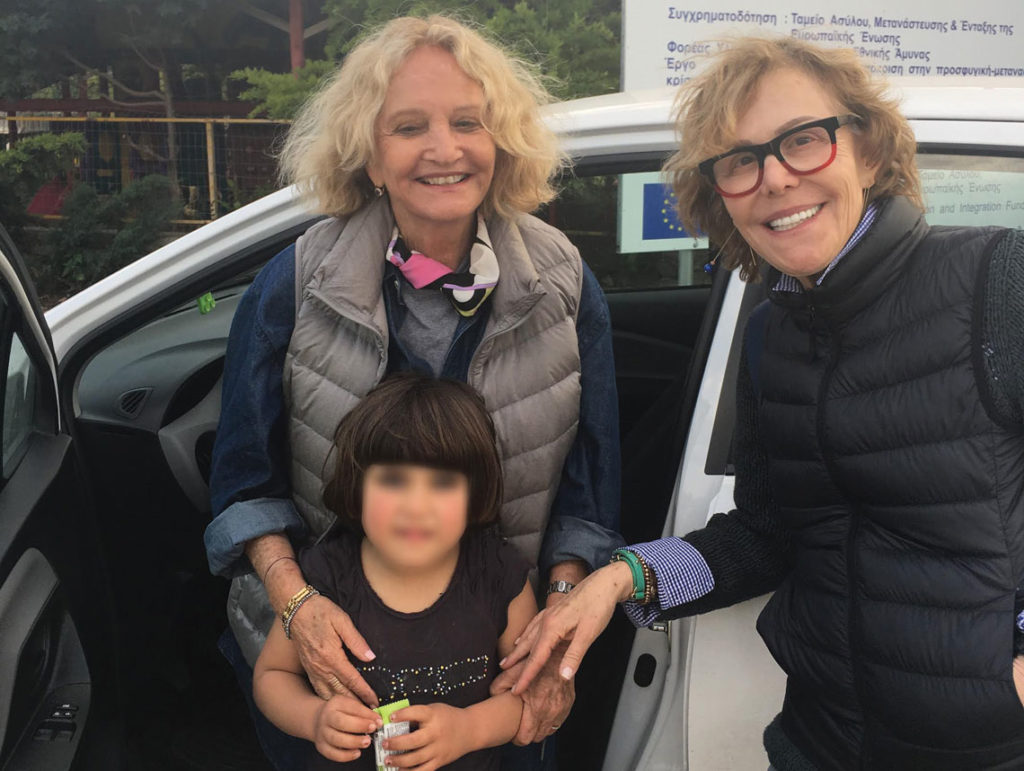
Polizer invited us to see firsthand the magnitude of the crises and the work IsraAID has been doing in Greece.  And, because of our training, we were asked to be consultants to the staff for the eight days we visited. IsraAID has sent 120 Arab and Jewish-Israeli professionals to provide support for the refugees, focusing on long-term trauma counseling for about 750 refugees.

IsraAID works in seven refugee shelters and camps around Greece, providing psycho-social support through therapeutic groups for women, men, children and adolescents, as well as individual counseling and specialty needs for others, such as art therapy for women and children.

Most organizations either save lives or change lives. IsraAID does both. Polizer invited us to visit IsraAID’s project in Thessaloniki, the second-largest city in Greece, which has a long Jewish history. There, at the northwest corner of the Aegean Sea, we met members of his team: Sigalit, a Jewish Arabic-speaking psychotherapist; Anat, a Jewish Arabic-speaking art therapist; and Khaled, an Arab-Israeli occupational therapist.

We visited three sites where the refugee families are housed: An abandoned high-rise, a rundown hotel in the countryside and a converted factory with no private kitchen or toilet facilities. Each site is supported by NGOs from Greece, Italy, Great Britain and elsewhere, offering various services, such as facility management, facility construction, education and recreation.

All the refugees in Thessaloniki had arrived by boat after observing drownings and illnesses on their journey from Syria. After first living in tents, suffering a terribly cold winter, they were moved to more “permanent” shelters, like the ones we worked in. Most of the families were not intact, separations caused by deaths and relocation: three or four children with no father, fathers with no children, children with no mother.

What did we do?

On days that we were with children, we observed their need for attention and affection and an eagerness to learn English, play, do art projects, dance and throw around balls. We spent hours facilitating play and communication skills as children described their treacherous sea journey by holding their tummies and pretending to shiver.

We sat in women’s groups led by Anat and Sigalit. As they slowly built up trust, the women became open to new challenges facing them: How to parent in new lands with new cultures, how to encourage education for their children, and how to speak up for their needs and express their feelings. Some of the mothers even forgot how to play with their children. The leaders helped them to remember.

We watched Khaled, age 26, who did not appear old enough to be a father but was old enough to reach the adolescent boys, helping them to express their feelings and cope with undue stress and aggression. Without speaking the language, we recognized in the boys hope, excitement and connections. For instance, Amid, 12, began the session sitting apart from the other boys but with Khaled’s skills and encouragement, moved next to another boy and even left the session speaking with some of the other kids.

Often, we were invited in for a cup of tea with the families in their meager surroundings. Despite their circumstances, their culture of hospitality remained.

We met Fatima from Aleppo, a mother of four. Her youngest child is only a year old and has never met her father. He was able to relocate to Germany and hoped that would hasten the family’s permission to move there. So far, there is no indication that the move will happen. While Fatima attended a women’s group, we sat with her children and played games.

Each refugee family is given an allowance for food and necessities, and Fatima’s small apartment was immaculate despite her limited resources. Due to traumatic experiences walking from Syria to Turkey and crossing the water in a dangerous lifeboat, she insisted her children stay inside. We had hoped to take them outside to meet others, but she was too frightened.

Susi, 7, was living in the rundown hotel with a depressed aunt and her father, whose culture did not teach him parenting skills. Her mother relocated to Germany, hoping to speed the family’s reunification. Susi was in perpetual motion due to her high level of stress, depression and separation anxiety caused by being away from her mother. She hugged us as we entered the grounds, pulling us away from others in a desperate attempt to find comfort and affection. When we had to leave, Susi ran after us and jumped into the car. Our hearts were broken, not knowing what to do. We drove away but the sad memory has stayed with us.

Mohammed, 16, was living in the concrete factory. We first saw him body-building in a parking lot. Although he looked quite healthy as the leader of a group of adolescent boys, led by Khaled, we learned later that he has had two heart surgeries since arriving by lifeboat.

As we observed him in the group, we realized Mohammed’s anger and aggression were transformed into leadership and role-modeling. It was hard to imagine that he recuperated in this rundown facility without private bathrooms and quiet surroundings. We couldn’t help but wonder what his future will be. We pray for his future.

Realizing the need for important supplies, we went shopping and bought personal items for the women, formula and diapers for the babies, and soccer balls and art supplies for the children. We also bought colorful wooden chairs to add to the community’s limited supply. IsraAID distributed the items for us.

As these families wait for relocation, which may take one or two more years, if ever, we felt grateful for the work of IsraAID in making the delay less difficult.

There are many reasons to despair while watching the darkness descending on Syria. But don’t ignore the light.

How to help save Syrians Read More »

Bright ‘Tomorrow’ is a fresh take on today’s world

Many science fiction films depict a future that is colder and more oppressive than our present day — dystopias like those in movies ranging from 1927’s “Metropolis” to 2012’s “The Hunger Games.” But Israeli-born writer-director Ela Thier prefers to consider the opposite possibility.

“I wanted to turn that paradigm on its head,” she said during a telephone interview from her apartment in New York’s East Harlem. “What if the future is exactly what we’d want it to be … a world that is built on compassion? We’re taught in subtle ways to believe that’s impossible — that greed, violence and shortsightedness are inevitable. But I wanted to create a film to make us question that assumption.”

The result is Thier’s new comedy-drama, “Tomorrow Ever After,” spotlighting a historian named Shaina (played by Thier), who accidentally gets transported from the year 2692 to New York City circa 2015. Hers is a benevolent society where loneliness and even national borders have been eradicated. So in the early 21st century, she experiences a profound culture shock as she is mugged, encounters cynicism and realizes that people often ignore one another. The film follows Shaina’s struggle to comprehend this alien world, as well as the effect that her own kindness has on a diverse group of New Yorkers.

The citizens of 2015 are immersed in a period that Shaina’s contemporaries refer to as the “Great Despair.”

“In many ways, we’re so used to feeling discouraged that we don’t even notice it,” Thier said. “Like the fact that you can live next door to someone for years and never even know their name. And we say this is an isolation that our culture views as normal. The film tries to get people to consider that something else is possible.”

Thier believes filmmakers “can play a really important role in helping to create the world that the movie describes. For me, being an artist is doing my part in tikkun olam [repairing the world].”

Thier, 45, believes “Tomorrow Ever After” is a film she could make precisely because she’s Israeli. She traces her point of view to growing up in the working-class town of Yavne.

“We were one of only two white families at the time. It was mostly Jews of color, from North African and other Arab countries,” she said. “I absorbed tremendous wisdom living there — a sense of generosity and hospitality — that our culture today often can dismiss or overlook.”

Yet in 1982, Thier, then 11, and her family were dispirited upon the onset of the Lebanon War. Thier’s uncle was killed by friendly fire during the conflict and the filmmaker vividly recalls “the tension in our home waiting every day to find out that my father was still with us.”

“My dad had been in several Israeli wars at that point, and he was not OK joining another one,” she said. “My parents didn’t think of that war as being a war of defense and they didn’t want to participate.”

And so the family left Israel in 1982 and moved to West Hartford, Conn., where Thier, like the fictional heroine of “Tomorrow Ever After,” experienced a deep culture shock. Her classmates often ostracized her, and one of them even asked her if any Israeli girls were pretty.

Thier eventually befriended the only other immigrant girl in her class, a student from Vietnam, and the preteens bonded over their shared struggle to adapt to life in America.

In 2009, those memories prompted Thier to make a short film, “A Summer Rain,” and then a 2012 feature, “Foreign Letters,” about her days as an Israeli newcomer in the United States.

In “Tomorrow Ever After,” Thier deliberately reveals that her character is Jewish. “That was a shoutout to my people to let them know that I don’t see us going anywhere,” she said. “As far as the future goes, Jews are going to be around, and thankfully so.”

Thier, meanwhile, is devoted to creating her own sense of artistic and geographical community in New York. She has mentored a diverse group of filmmakers through her Independent Film School, which she founded in 2006.

And since moving to East Harlem about two months ago, she is trying to get to know her new neighbors.

“I’d love to … have a local community of people that supports each other in their personal lives,” she said. “That’s going to be my project for the next 10 years.”

“Tomorrow Ever After” opens in Los Angeles on May 5. 

Bright ‘Tomorrow’ is a fresh take on today’s world Read More »

Play’s rape case not as simple as black and white

In Anna Ziegler’s two-person play “Actually,” Amber Cohen (Samantha Ressler) is a Jewish freshman at Princeton University who is smitten with an African-American classmate, Tom (Jerry MacKinnon). She’s insecure yet winsome, while he’s charismatic and a bit of a player. On their first date, both drink to excess, Amber takes off her shirt in a bar and then willingly joins Tom in his bed.

But at some point during their rendezvous, Amber appears to have second thoughts, even though she never actually tells Tom to stop. Through a series of ensuing events, she comes to believe he raped her.

A school inquiry follows. Under the federal Title IX law, officials can prosecute Tom if a preponderance of the evidence suggests he is at fault.

In “Actually,” the characters move backward and forward in time and often directly address the audience, whose sympathies change from scene to scene.

“The play explores what constitutes consent, but I deliberately keep things foggy,” Ziegler, 37, said during an interview at the Geffen Playhouse, where “Actually” will have its world premiere on May 10. “My plays ask more questions than provide answers. So I’m making a very strong effort not to take sides.”

The play resonates at a time when sexual misconduct on college campuses has gained wider attention in the media. Consider the public outrage that ensued when former Stanford University student Brock Turner served only three months in jail after his sexual assault conviction in 2015.

Ziegler was thoughtful and soft-spoken in conversation, where the award-winning playwright was almost talmudic as she pondered her characters’ complex motivations.

She said she got the idea for “Actually” several years ago, when her husband, Will Miller, an attorney, began overseeing sexual misconduct cases at New York University. Miller also was on a team that was responsible for rewriting NYU’s sexual misconduct policies under Title IX.

“It’s a very tricky balance,” Ziegler said of the law. “We’re trying to make sure that women who have been assaulted are able to come forward and are not rebuffed when they do. And we’re also trying to keep the system fair all around.

“But in ‘Actually,’ what really happens is a matter of interpretation,” she added. “And both the characters are flawed.”

Amber’s Jewish background has imbued her with the paranoia that she could be rounded up and killed at any moment. Even so, she flippantly tells Tom that he must have been accepted to Princeton because he is African-American. If her comment seems racist, Ziegler insists that Amber is, rather, a bit naive.

“She never intentionally tries to offend anyone, or to be malicious,” the playwright said. “She’s just unfiltered, so she says what she thinks are facts and doesn’t think about how that’s going to land on someone.”

Tom, meanwhile, recalls being stared at as the only Black student on the dance floor at all the bar and bat mitzvahs he attended in the eighth grade. “I don’t think he’s saying anything about casual racism among Jews so much as casual racism among white people,” Ziegler said.

“I really wanted to get to the heart of what our unconscious biases are, because here we have a case where a Black man has been accused of rape by a white woman, which is charged in many ways,” Ziegler added. “But I think our hearts go out to both of the characters: the Black man who may be unfairly accused and the woman who may or may not feel empowered enough to speak about being raped. And I sort of pit them against each other, which I thought could be powerful in a play.”

The director of “Actually,” Tyne Rafaeli, praised Ziegler for her insight. “Anna has a unique ability to reflect the complexity and the contradictions of human psychology and the human heart,” Rafaeli wrote in an email. “Her commitment and fascination with the gray — with always seeing the other side of any given human impulse — leads to eye-opening, bitingly funny and poignant insights into the human psyche.”

Ziegler grew up in a Reform Jewish home in Brooklyn, just a few blocks from where she now lives with Miller and their two young sons. After graduating from Yale and NYU’s Tisch School of the Arts, she taught English at a Jewish day school in Rockville, Md., where she befriended a Muslim colleague, whose students constantly peppered her with pointed questions about Islam.

That inspired Ziegler to write one of her early plays, “Dov and Ali,” about the fractious relationship between an Orthodox Jewish teacher and his Muslim student. A subsequent play, “Another Way Home,” revolves around a Jewish family whose son goes missing at summer camp. Ziegler interviewed members of her own family to write “The Spivaks,” which examines the complicated relationship of American Jews and Israel. And her drama “Photograph 51,” which starred Nicole Kidman in London in 2015, spotlights the true story of Rosalind Franklin, a British Jew and DNA scientist. Ziegler said she was drawn to Franklin’s story, in part, because of the sexism and anti-Semitism the scientist encountered in the 1950s.

Of why she often writes Jewish characters, Ziegler said, “It’s a way for me to explore what I feel about Judaism and the complicated relationship I have to it — sort of desperately wanting to be part of a community but not wanting to be a minority. There’s a tension there.”

Did Ziegler have trepidations, while writing “Actually,” about creating an African-American character who is likable but distinctly flawed? “Absolutely I did, and I still do,” she said. “It was just the fear that I wouldn’t get it quite right. But I’ve workshopped the play now with a number of Black actors who’ve been very helpful. My sense is that no one has felt that I created a caricature or have gone too far astray.

“We’re living in a moment where there’s lots of talk about cultural appropriation and about what a writer or artist should be encouraged to create,” Ziegler added. “I feel pretty strongly that we have to have the freedom to try … to see our way into other people’s experiences. We won’t learn anything about the world around us if we don’t try.”

“Actually” will premiere at the Geffen Playhouse. For tickets and information about the play, visit http://www.geffenplayhouse.org.

.

Play’s rape case not as simple as black and white Read More »

Be careful: Fake Google Docs emails are circulating the internet

If someone invites you to edit a file in Google Docs today, don’t open it — it may be spam from a phishing scheme that’s been spreading quickly this afternoon. As detailed on Reddit, the attack sends targets an emailed invitation from someone they may know, takes them to a real Google sign-in screen, then asks them to “continue to Google Docs.” But this grants permissions to a (malicious) third-party web app that’s simply been named “Google Docs,” which gives phishers access to your email and address book.

For more information on how to protect yourself, visit theverge.com.

Be careful: Fake Google Docs emails are circulating the internet Read More »

Israeli clarinetist brings Jewish style to Brazilian music

It’s no great novelty when a jazz musician announces a foray into Brazilian music. American players, in particular, have been investigating the music of the bossa nova songwriters for well over 50 years.

But rather than a samba excursion or yet another program of Antonio Carlos Jobim tunes, clarinet virtuoso Anat Cohen’s new album, “Rosa Dos Ventos” (Anzic), delves into Brazil’s choro style.

Choro (a Portuguese word pronounced sho-ro) is a string and flute instrumental music made by small, informal ensembles. It’s a kind of Brazilian bluegrass — or klezmer — with a tradition that dates back to the late 19th century in Rio de Janeiro. It’s lively and exuberant, yet, as Cohen shows, it has the capacity to incorporate different musical forms.

This is music made in the corner café, rather than the concert hall. Like the sounds of Cuba, the Caribbean and Africa, it found its way to America’s biggest 19th-century port city, New Orleans. Cohen’s interpretation comes to the Blue Whale in downtown Los Angeles on May 6, as part of a 15-city tour that stretches from Seattle to Milan and takes in Germany, France and the Czech Republic.

Born in Tel Aviv and a longtime resident of New York, Cohen is no stranger to Los Angeles, having played Disney Concert Hall with Cuban diva Omara Portuondo and been featured at the Playboy Jazz Festival.

“Rosa Dos Ventos” (literally “wind rose,” or weathervane) features her horn coupled with Trio Brasileiro, a choro group with whom she recorded in Rio.

“What I love about choro is that it’s open to different influences. I love the mix of Afro-Brazilian roots, samba, baiao, even rock,” she said in a recent interview. Indeed, over the swirling guitar and bandolim (Brazilian mandolin) lines and rhythms, her clarinet exults in soaring joy and heaves in chalumeau sorrow — one minute an ecstatic wedding ensemble, the next a cantor with the sorrows of the world on his brow.

Cohen began on the clarinet but was a multireed player in New York when she discovered choro in 1999. “After years of playing the saxophone, it made me want to play the clarinet again,” she said. “I started to play this music weekly.”

She met bandolim player Dudu Maia at a choro workshop in Port Townsend, Wash. “We were both teaching,” Cohen said. “We met and we played, and I felt right at home.”

Broadcaster Sergio Mielniczenko’s radio shows on KPFK-FM (90.7) are a beacon to Southern California Brazilians and lovers of his country’s music. He has played Cohen’s recordings on his “Brazilian Hour” show.

“She’s excellent,” he said, “because she not only has the feel of choro but she interprets it.”

Reminded of the parallel elements heard in choro and klezmer, Mielniczenko added, “They’re so interestingly similar. Some Brazilian musicians of the late 19th century and early 20th century studied in Paris, and they surely brought back what they heard there. And there are a number of great Brazilian Jewish musicians, like pianist Daniel Taubkin and saxophonist Ivo Perelman.”

Told that the late clarinet great Artie Shaw was dismissive of klezmer music because, in his experience, the people who played it were amateurs, Cohen sounded surprised. “Traditional choro is like klezmer,” she said. “The people who played it originally were postal workers and dentists — anything but professional musicians. And like klezmer, it wasn’t written down, it was passed along from one person to another. It was only notated later on. But you need to have the right heart and the musicianship to play them both.”

“People might hear Jewish elements in everything I play, whether it’s choro, European or New Orleans music, or anything else,” Cohen said.  “I was taught to play like a cantor sings — with a strong sense of melody. I want to take a melodic line and express it as powerfully as I can. You hear that in all of the great Jewish jazz horn players, like Artie Shaw, Benny Goodman and Stan Getz.”

So, does an Israeli living in New York and playing Brazilian music feel American or something else?

“I’m a hundred percent Israeli,” Cohen said. “But when I go to Brazil or any other part of the world, I want to feel like I’m part of the local culture, and it’s the same in the U.S. You keep your individuality but respect the surroundings.”

The Blue Whale is a listening room and that seems to suit Cohen. “I’ve got no tricks,” she said. “I’m no magician. We’ve just got great music.”

Anat Cohen and Trio Brasileiro will perform at 9 p.m. on May 6 at the Blue Whale, 123 E. S. Onizuka St., Suite 301, Los Angeles. Tickets are $20. For more information, go to bluewhalemusic.com.

Israeli clarinetist brings Jewish style to Brazilian music Read More »

‘The Other Side’ uses psychology in experimental dance

Performers from Sophia Stoller’s “The Other Side.” Photo by Greg Simian
Performers from Sophia Stoller’s “The Other Side.” Photo by Greg Simian

In a dingy warehouse in South Los Angeles, nine dancers rehearse a series of movements as choreographer Sophia Stoller offers corrections. Video projections flash on the walls, ominous music fills the room and a lighting designer twists in fluorescent tubes. The group is busily preparing to stage an immersive dance theater performance called “The Other Side,” premiering May 5 at Gramercy Studios in Los Angeles.

The performance is based on a psychological research study similar to those of the 1960s and ’70s, such as the Stanford prison experiment, in which students assigned to be guards in a mock prison abused students assigned to be prisoners, and Milgram’s shock experiment, in which students meekly followed orders to administer electric shocks to other participants.

In “The Other Side,” the dancers, referred to as “assignees,” are divided into three groups. One group lives miserably and is denied all but basic needs. Another lives contentedly in an average setting. The third group lives an extravagant lifestyle in which every whim and desire are met.

At the beginning of the performance, actors playing the social science researchers, referred to as “executors,” welcome the audience members and treat them as VIP guests and possible donors. The experiment gradually devolves into a barbaric system and the “assignees” turn on one another before focusing their anger on the researchers.

The performance mostly takes place in one large room, with audience members free to move around the performance. In some scenes, the dancers disperse to three smaller rooms, and the audience is encouraged to move from room to room. Meanwhile, closed-circuit cameras connected to television screens allow the “executors” (and the audience members) to observe the “assignees” as they move about their rooms.

In the second half of the performance, the dancers come out of their rooms and begin intermixing. Their costumes make it clear which group each dancer belongs to. Coming together “gives them the realization they’re not each other’s enemy, and that it’s a manufactured situation,” Stoller said.

Stoller, a native of Northern California, is the artistic director for the Los Angeles-based Iris Company, which is producing “The Other Side.” Her father is a sculptor and her mother is a therapist, and her upbringing helped guide her interest in the arts and psychology.

Stoller’s fascination with social science experiments dates back to middle school, when her teacher re-created Jane Elliott’s famous and controversial “blue eyes-brown eyes” exercise. Soon after Rev. Martin Luther King Jr.’s assassination, Elliott divided her class based on their eye color and gave blue-eyed students privileges, like extra snacks, and brown-eyed students impediments, like having to sit in the back of the class. Their test results quickly reflected this treatment. The following week, Elliott reversed their roles and then had the students write about their experience with discrimination.

Stoller’s teacher used colored-dot stickers instead, but the lessons were the same.

“My experience of it was a little bit more tame, but … as seventh-graders, we turned entirely nasty,” Stoller said. “We bonded with our group. There was this sense of group identity that was formed very quickly, and friend groups broke up based on the group they were assigned to.”

Stoller went on to double-major in dance and psychology at UCLA, and studied “how psychological concepts can become embodied physically.” She then spent 10 months living in Israel, dancing full time in an apprenticeship program with Kibbutz Contemporary Dance Company. While in Israel, she also studied the repertoire of Batsheva Dance Company, Inbal Pinto and Vertigo Dance Company.

After returning to Los Angeles, she received her MFA in choreography from CalArts and began teaching at the Gabriella Foundation, a program that offers dance classes to low-income youth in Los Angeles.

The dystopian message of “The Other Side” reflects much of the nation’s current anxiety. Stoller says the 2016 presidential election shaped the story and convinced her to give the show a more political power structure.

“When audience members enter the space, they are shown a video of the experiment’s lead researcher, T.C. Hudson, a “very powerful, wealthy white male who is using his influence to gain more power and control, and framing it in a way that is manipulating the general public to feel that it’s a very good thing,” Stoller said. But as the experiment unravels and the research subjects rebel against the captors, the audience is given a vision of how to overcome oppressive power structures.

“Art needs to offer a beacon of hope in some way, and needs to be a way to inspire people toward a brighter future.” After the election, Stoller said, “that became important to me in a new way.”

“The Other Side” will make its world premiere on May 5, 6, 12 and 13 at Gramercy Studios, 2010 W. 62nd St., Los Angeles. For more information, go to sophiastoller.com/tickets.

‘The Other Side’ uses psychology in experimental dance Read More »

Moving & Shaking: Ed Asner at LAJFF, Skirball Cultural Center chief curator leaves, Louis Sneh Holocaust survivor and more

Ed Asner, the 87-year-old Hollywood actor and liberal activist, was the center of attention during the April 26 opening gala of the Los Angeles Jewish Film Festival (LAJFF).The event honored Asner — known for “The Mary Tyler Moore Show” and “Lou Grant” on television and, more recently, the films “Elf” and “Up” — with the Lifetime Achievement Award, in recognition of his “commitment to Jewish values and humanitarian causes.”

“I’m always pleased to show up somewhere where there’s popcorn,” Asner said in typical curmudgeonly fashion upon receiving the award, addressing a crowd assembled in the Ahrya Fine Arts Theater in Beverly Hills. His colleagues were more traditional in their praise. “There couldn’t be anyone in Los Angeles who is more deserving of this honor than my friend Ed Asner,” said actor Matthew Modine, who directed Asner in the 2016 short film “Super Sex.” That eight-minute comedy was shown along with the 2014 documentary about Asner, “My Friend Ed.”

A red carpet event kicked off the evening. Escorted by a small group of family and friends, Asner walked with a cane along the sidewalk of Wilshire Boulevard toward a group of eager photographers waiting in front of the theater. As they snapped photos of Asner, a man in a car passing shouted, “Ed!” The actor soaked it in, telling the Journal he was proud of being honored. Asked what Jewish historical figure he’d like to play onscreen one day, Asner said the late Zionist leader Vladimir Jabotinsky or the late Israeli military leader and politician Moshe Dayan.

A cocktail reception in the lobby of the theater followed the red carpet arrivals, which also drew actor Ed Begley Jr.; director Aaron Wolf, whose documentary “Restoring Tomorrow” spotlights the restoration of Wilshire Boulevard Temple; Ruby Modine, Matthew Modine’s daughter and co-star of  “Super Sex”; Shelley Fisher, who stars in the forthcoming theater production “The Hebrew Hillbilly”; Aimee Ginsburg Bikel, widow of the late stage actor Theodore Bikel; comedian Avi Liberman; and veteran actress and Hollywood blacklist victim Marsha Hunt. “Ed is a treasure because he cares so deeply about bringing the past into the present and keeping the values he absorbed throughout his life,” Ginsburg Bikel told the Journal.

Everyone gathered inside the theater for the award presentation, which included comments from Hilary Helstein, LAJFF director; actress Sharon Gless; Zane Buzby, actress and founder of the Survivor Mitzvah Project; director Sharon Baker; and Matthew Modine. Los Angeles City Councilman Paul Koretz offered words of praise, as well. The speakers emphasized Asner’s longevity in an industry where staying power is a rare thing, his unique commitment to standing up for the marginalized, and his warmth — underneath all that curmudgeonliness.

“That’s quite a grope,” Matthew Modine said as Asner posed for a photo with him, the latter’s hand invisible to the audience. “I’ve just had my prostate checked.”

“He doesn’t have long,” Asner quipped.

Buzby, who works with Holocaust survivors, described Asner as a “champion of compassion.”


Skirball Cultural Center Chief Curator Erin Clancey has left the Skirball museum after 18

Erin Clancey Photo courtesy of Erin Clancey
Erin Clancey
Photo courtesy of Erin Clancey

years, having accepted a position as the director of curatorial services at the National WWII Museum in New Orleans. Her final day was March 24.

Clancey, with a back-ground in antiquities, joined the Skirball staff in 1999 after working at the California Science Center.

“Because of my studies and my previous background at museums, it was a good fit,” Clancey said in March, prior to her final day. “And I thought, ‘OK, I’ll do this while I’m in school for a couple of years and then I’ll move on.’ But it stuck and I’ve been here for 18 years.”

Her first temporary exhibition at the Skirball was “Jewish Life in Ancient Egypt,” in 2004.

“Our attendance was not what it is today, but that show was just phenomenal,” she said. “I still think it was one of my favorite shows.”

Her final Skirball exhibition was “Paul Simon: Words & Music,” a traveling exhibition that originated at the Rock and Roll Hall of Fame in Cleveland, which will run through Sept. 3.

The Skirball Center, which describes itself as “one of the world’s most dynamic Jewish cultural institutions,” is conducting an open search for a curator, Clancey said.


Los Angeles nonprofit Friends of Sheba Medical Center (FSMC), Tel HaShomer held its annual Women of Achievement Luncheon on April 20 at the Four Seasons Los Angeles at Beverly Hills, bringing together women dedicated to the welfare of patients at Sheba Medical Center near Tel Aviv.

The event raised more than $375,000 for the medical center, which is the largest hospital in the Middle East, serving 945,000 outpatient visitors annually.

During the luncheon, FSMC honored Jenji Kohan, creator of the television comedy-dramas “Weeds” and “Orange Is the New Black,” with the Women of Achievement Award; and DeeDee Sussman, a volunteer with the organization for 40 years, with the Marjorie Pressman Legacy Award.

Dr. Shani Paluch-Shimon, head of the hospital’s Breast Cancer Service for Young

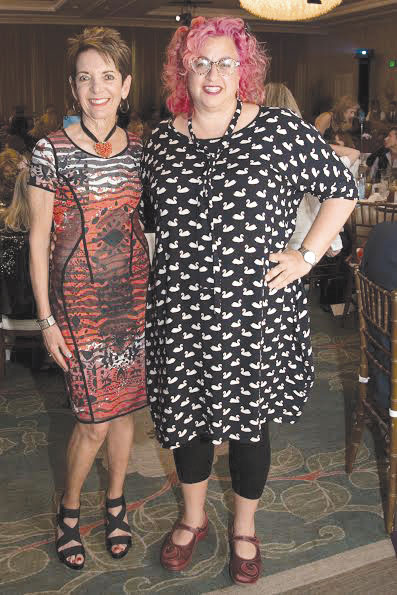
DeeDee Sussman (left), a volunteer with the Friends of Sheba Medical Center, and Jenji Kohan, creator of “Weeds” and “Orange Is the New Black,” attend the Women of Achievement Luncheon. Photo by Kyle Espeleta Photography

Women, the only program of its kind in Israel, served as the keynote speaker.

The event also included a fashion show presented by Maskit, the Israeli luxury women’s brand.

Cantor Gary Shapiro — who later died suddenly on April 27 (see obituary on Page 52) — sang renditions of “The Star-Spangled Banner” and “Hatikvah.”

In an interview, Adina Hepner, director of development at FSMC, said the gathering was a success.

“The event was absolutely beautiful and truly showcased the unique and extraordinary ability Sheba Medical Center has, not only to care for patients, but make them feel truly at home, like they are part of a greater human family,” she said.

— Kylie Ora Lobell, Contributing Writer


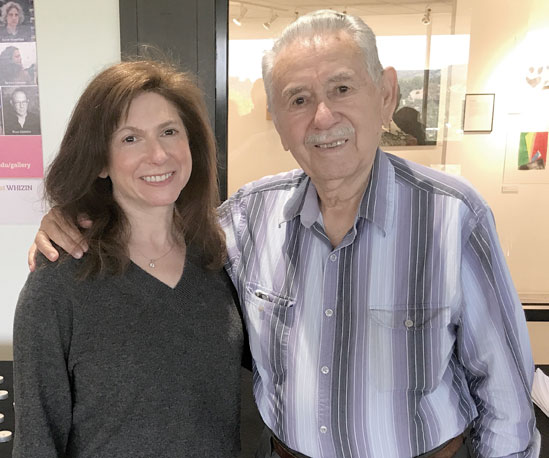
Rabbi Naomi Levy and Holocaust survivor Louis Sneh
Rabbi Naomi Levy and Holocaust survivor
Louis Sneh

Louis Sneh, Holocaust survivor and subject of the documentary “Last Train to Seeshaupt,” and Rabbi Naomi Levy were among the attendees at the Naftali Sneh Memorial Yom HaShoah Observance at American Jewish University on April 24.

Sneh was 16 when the Nazis marched into his home country of Hungary, and he and the Jews of his village were deported to Dachau. In the final weeks of World War II, the Germans closed Sneh’s subcamp and put the thousands of surviving prisoners on a train to Bavaria. When U.S. Gen. George S. Patton’s tanks rolled in, the prisoners stepped out onto the platform at the Seeshaupt station — free.

— Jewish Journal staff


Dan Schnur has been named the new director of the American Jewish Committee Los Angeles, succeeding Janna Weinstein Smith, who held the position
since January 2016. She is moving to Washington, D.C., according to an AJCLA press release.

“Dan Schnur’s prominence in our community and his sustained history of leadership make him uniquely qualified to lead AJC in Los Angeles,” said AJCLA President Scott Edelman. “We are thrilled to welcome Dan to lead our extraordinary team of staff professionals, and grateful for the many accomplishments of his predecessor.”

Schnur, an expert in political strategy, campaign communication and government reform, has worked on four presidential campaigns and three campaigns for governor of California, according to the press release.

Dan Schnur Photo courtesy of Dan Schnur

“I am honored to head the AJC Los Angeles office, to work with leaders in our community to build and strengthen relationships with those who share our core principles,” Schnur said in a statement. “I have spent years building support for the causes and issues that are most important to me, but nothing is more vital than the values that form the pillars of the Jewish community.”

In 2014, Schnur ran for California secretary of state, finishing fourth in the primary. He is a longtime advocate for reforming the California electoral system.

Schnur is an adjunct faculty member at the USC Annenberg School for Communication and Journalism and the USC Marshall School of Business, and a lecturer at UC Berkeley. He has previously served as the director of the Jesse M. Unruh Institute of Politics at USC.

He currently serves as the treasurer of the AJCLA executive committee.

A New York-based nonpartisan advocacy organization founded in 1906, AJC is focused on domestic issues and matters concerning Israel, operating 22 offices across the country.

Moving & Shaking highlights events, honors and simchas. Got a tip? Email ryant@jewishjournal.com. 

Moving & Shaking: Ed Asner at LAJFF, Skirball Cultural Center chief curator leaves, Louis Sneh Holocaust survivor and more Read More »

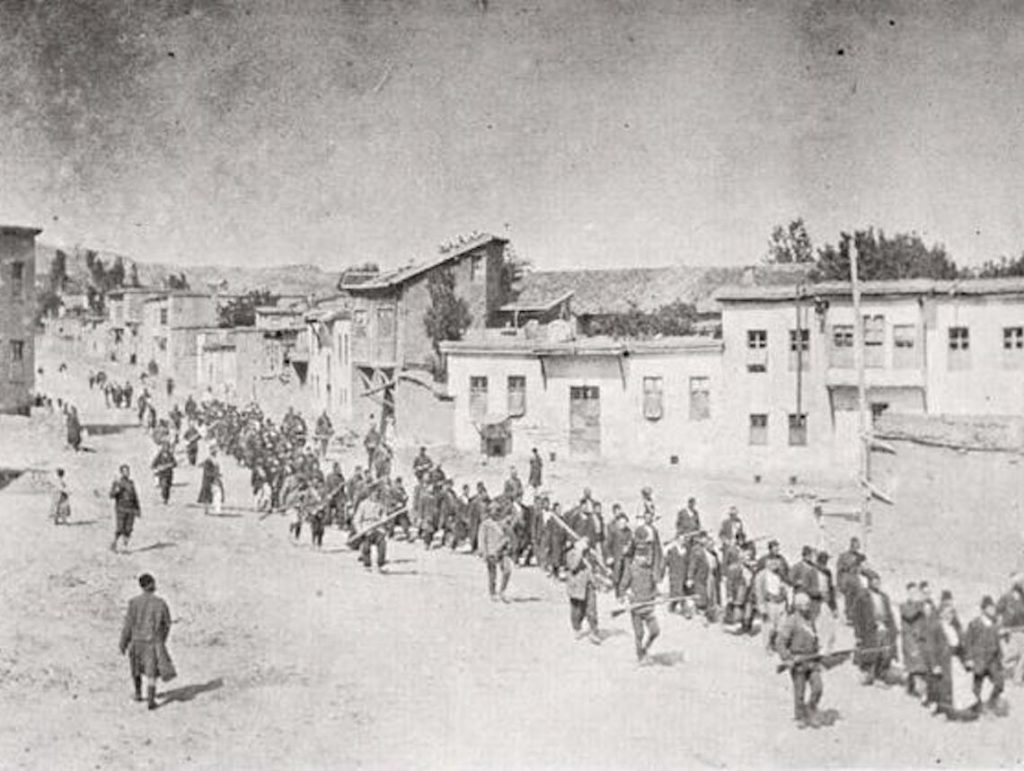
Who killed the Armenians?

The Journal’s editor-in-chief, Rob Eshman, recently wrote a column under the headline “Morgenthau’s Children,” about the film “The Promise,” whose subject is the Armenian genocide, and he addressed the subject of genocide in general. It was important to remind — or inform — people about the lesser-known genocides of the 20th century and the present century.

He noted the following genocides:

  • The Armenian genocide
  • “Those in Syria in Iraq”
  • The ISIS extermination of the Yazidis
  • “The failed state of Somalia”
  • The Myanmar government’s “persecution, deportation and starvation” of the Rohingya

But there is a word missing from all the genocides mentioned in Rob’s column.

That word is “Muslim.”

Every one of the genocides listed — with the exception of Myanmar (formerly Burma), where the victims are Muslims — was, or is being, committed by Muslims.

I don’t believe Rob intentionally omitted the fact that the perpetrators of all but one of the annihilations was/is Muslim. The fact is that with all the attention paid to the Armenian genocide, one always hears that the Armenians were mass murdered by the “Ottoman Empire” or the “Ottoman Turks” or the “Turkish regime” — but they are never identified as Muslims.

Rob rightly suggested that readers go to GenocideWatch.com for more information.

I took his advice, and here are headlines I saw on the site’s front page:

“Holocaust museum condemns ‘torture and killing of gay men’ in Chechnya”

“Violent Mortality in the Darfur Genocide”

“Syria: ‘Glimmers of humanity’ overshadowed by brutality of attacks on civilians”

“How Germany used Islam during World War I”

(Other headlines included news about Brazil, Auschwitz, Rwanda and Cambodia.)

Again, almost all genocide discussion was about Islam.

One of the least truthful major statements in the history of the modern American presidency was that of President George W. Bush, when he famously declared after 9/11 that “Islam is a religion of peace.”

I understand why Bush felt he had to say and keep repeating that line. But there is no excuse for all the academics and journalists who say it. Islam was a religion of war and violence from its inception, when Muslims forcibly converted surrounding tribes and then all of North Africa to Islam.

Muslims perpetrated the greatest slaughter of one group in history — the slaughter of about 80 million Hindus during the thousand-year history of Muslim rule in India. They even boasted about this slaughter by naming a large area of present-day of Afghanistan “Hindu Kush,” which means “Hindu-Slaughter.”

If Islam is to be reformed, as it needs to be, that reformation most likely will originate with Muslim Americans.

Jihad, or “holy war” — meaning the forcible conversion of non-Muslims to Islam — is part of the very fabric of Islam. The greatest Arab writer, and one of the world’s greatest writers, Ibn Khaldun, wrote in his seminal work, the “Muqaddima” (“Introduction to History”), that what distinguishes Islam from all other religions is its doctrine of jihad.

“In the Muslim community,” he writes, “the holy war is religious duty, because of the universalism of the Muslim mission and (the obligation to) convert everybody to Islam either by persuasion or by force.”

Nor was there a “Golden Age” of Muslim tolerance in Andalusia (Muslim Spain). Jews and Christians often were persecuted terribly there. They just weren’t killed in large numbers. Read the recently published “The Myth of the Andalusian Paradise” by Dario Fernandez-Morera, associate professor of Spanish and Portuguese at Northwestern University.

I note this not to incite resentment against fellow Americans of the Muslim faith. I regard them as precisely that: fellow Americans of the Muslim faith, deserving of the same respectful behavior that any other American deserves. More than that: If Islam is to be reformed, as it needs to be, that reformation most likely will originate with Muslim Americans.

The reasons it is vital to note that Islam is not simply “a religion of peace” are:

• To understand what the West is dealing with when it takes in additional millions of Muslims, especially from the Middle East, where Islam is most violent.

• To understand how much the left — most perniciously in Western universities — lies about Islam, or refuses to confront its negative aspects (while dwelling inordinately on the faults of Christianity).

• To understand why peace with Palestinians is unlikely. Palestinian society is first and foremost a Muslim society. That is why it honors suicide terrorists as the finest examples of the Palestinian people. The Arab and Palestinian conflict with Israel has always been caused by Islamic beliefs, not by a dispute over land.

• To understand why people whose hearts break for Syrian children nevertheless oppose bringing hundreds of thousands of Syrian refugees into America and Europe. One is importing a vast number of people, many of whom share few values with Western civilization, and who are the products of contemporary Arab culture, the most Jew-hating culture outside of Iran.

• And because truth matters.

So, to return to the beginning, Rob Eshman is right to remind us to remember the Armenian genocide. We also need to remember who perpetrated it.


Dennis Prager’s nationally syndicated radio talk show is heard in Los Angeles on KRLA (AM 870) 9 a.m. to noon. His latest project is the internet-based Prager University (prageru.com).

Who killed the Armenians? Read More »

Trump, Abbas link renewed peace talks to countering Islamic State

President Donald Trump and Palestinian Authority President Mahmoud Abbas said renewed Israeli-Palestinian peace talks would help bring about the defeat of the Islamic State terrorist group.

“I know President Abbas has spoken out against ISIS” and other terrorist groups, Trump said Wednesday at a White House ceremony welcoming Abbas, using one of several acronyms for the Islamic State. “We must continue to build our partnerships with the Palestinians’ security forces to counter and defeat terrorism.”

Abbas said a final status agreement that included a two-state solution would help defeat the terrorist threat scourging Israel’s Arab neighbors.

“For us to bring about a comprehensive and just peace based on the two-state solution, such matter would give a great impetus to the Arab Peace Initiative and the other international initiatives, as well as be able to fight and deter terrorism and to fight the criminal ISIS group … which has nothing to do with our noble religion,” he said.

The Arab Peace Initiative refers to the 2002 proposal by Saudi Arabia to trade an Israeli-Palestinian settlement based on the 1967 borders for a comprehensive Israeli peace with most of its Arab neighbors.

Trump, with the encouragement of Israeli Prime Minister Benjamin Netanyahu, has embraced the concept of a broader peace that encompasses both the Palestinians and other Arab neighbors, partly as a means to better confront the threats posed by the Islamic State as well as Iran.

The U.S. leader said he was optimistic that he could pull off the deal that has frustrated at least four of his predecessors, with the most recent collapse of talks in 2014 followed by the war between Israel and Hamas in the Gaza Strip.

“We will get it done, we will be working so hard to get it done,” Trump said.

Abbas’ remarks Wednesday underscored key differences, however. Netanyahu has not embraced the Arab Peace Initiative, in part because of the breadth of its compromise, based on the 1967 lines. Abbas said the 1967 lines remained the predicate for a peace deal. Abbas’ explicit citation of the two-state solution also suggests a nuanced difference with Trump, who has retreated from 15 years of U.S. policy favoring the two-state outcome.

Trump praised Israeli-Palestinian security cooperation, which the United States helps fund.

“They get along unbelievably well,” he said. “I was very impressed and somewhat surprised at how well they get along.”

Trump did not address — at least in the public portion of the meeting — a demand by Netanyahu that Abbas stop Palestinian Authority payments to families of terrorists killed or jailed by Israel. He did call on Abbas to address incitement.

“There can be no lasting peace unless the Palestinian leaders speak in a unified voice against incitement to violence and hate, there’s such hatred, but hopefully there won’t be such hatred for very long,” he said.

Abbas said his government was teaching its young people peace.

“We are raising our youth, our children and our grandchildren, on a culture of peace,” he said.

Trump, Abbas link renewed peace talks to countering Islamic State Read More »