fbpx

April 12, 2017

Passover and xenophilia

During the traditional liturgy of the Passover meal, the haggadah, we lift up the matzo and say aloud, “This is the bread of affliction, let all who are hungry come and eat.”

When I was a child, my particular affliction was literal-mindedness. My family followed the 3 + 1 branch of Judaism — going to synagogue on Rosh Hashanah and Yom Kippur, celebrating Chanukah, and holding a Passover seder. For Chanukah, there was no liturgy, and most of the words the rabbis and cantors mumbled during High Holidays were Hebrew — arcane and mysterious to me then.

But the genius of Passover is it brings the service to the home and fuses it to a meal. The congregation shrinks and the rabbi becomes that person whose questions or answers move you most. 

In that intimate setting, the words hit home to me. More than anything else, seders shaped my Jewishness. I had time to read and re-read the words and, as I was prone to do, take them seriously. When it said to question, I questioned.

Oy, did I question. My uncle, an observant Jew, ran a very traditional seder. I asked him, “Why do I have to wear a kippah?”  Why not a baseball cap?  Did God really find the Dodgers so offensive? 

Then it came to the part of the seder when we dipped our fingers in our wine glasses, then tapped our plates to symbolize our sorrow at the Egyptian blood God had to spill to free the Jews. Why, I asked my uncle, did he lick the wine off his fingers afterward — wasn’t that taking enjoyment from the Egyptians’ blood? That poor man. For years, he had to watch me make a show of wiping — not licking — the wine off my fingers like I was a murderer, erasing evidence.

Years later, I continued my antisocial habit. The haggadah declares, “Let all who are hungry come and eat.”  “Why,” I asked my college Hillel rabbi, “don’t we go out and invite all who are hungry to come and eat?” 

My liberal rabbi changed the subject.

Even more strange and mysterious than the Hebrew was why I believed some words I read to be true and others to be just fiction. I never thought for a second that the sea really parted, that the Nile turned to blood, or even that 600,000 Jews ran into the desert all at once.

Yes, what I’m saying is, much of the Passover story we just spent two days reading always struck me as fake news. The story lacks hard evidence. But I still believe in its meaning and guidance. 

At Passover, we 21st-century Jews slip into our pre-modern minds, when the facts of what happened don’t matter — there was no Wikipedia to record them, or Siri to recall them. What matters is the meaning.

“Since the eighteenth century, we have developed a scientific view of history; we are concerned above all with what actually happened,” Karen Armstrong explains in “A Short History of Myth.” “But in the pre-modern world, when people wrote about the past they were more concerned with what an event had meant. A myth was an event which, in some sense, had happened once, but which also happened all the time. Because of our strictly chronological view of history, we have no word for such an occurrence, but mythology is an art form that points beyond history to what is timeless in human existence, helping us to get beyond the chaotic flux of random events, and glimpse the core of reality.”

The genius of Passover is it brings the service to the home and fuses it to a meal.

When the haggadah tells us to remember the stranger because we were once strangers, I take it to heart. When I read that we have to think of ourselves as if we were slaves — even though there is no historical evidence we were — I embrace the ethical imperative of empathy. There is so much wiggle room for the facts in the myth of Passover, but none for the truth.

“A myth demands action,” Armstrong writes. “The myth of the Exodus demands that Jews cultivate an appreciation of freedom as a sacred value, and refuse either to be enslaved themselves or to oppress others.”

In a series of interviews with Laure Adler, published this month in book form as “A Long Saturday,” the philosopher George Steiner zeroes in on this essential truth of Passover.

“Don’t forget (people forget this all the time),” Steiner said. “In ancient Greek the word for ‘guest’ is the same as the word for ‘foreigner’: xenos. And if you were to ask me to define our tragic condition, it’s that the word ‘xenophobia’ survives, and is commonly used, everyone understands it; but the word ‘xenophilia’ has disappeared. That’s how I define the crisis of our condition.

This Passover, I am hoping we Jews do all we can to bring that word, xenophilia, the love of the stranger, back into existence — and do I really have to explain why?

The Exodus may be a myth, but when it comes to its lessons for this holiday, which comes to a close next week, it tells the God’s honest truth.


ROB ESHMAN is publisher and editor-in-chief of TRIBE Media Corp./Jewish Journal. Email
him at robe@jewishjournal.com. You can follow him on Instagram and Twitter @foodaism
and @RobEshman.

Passover and xenophilia Read More »

The making of Adam Schiff: Why is this man taking on the president?

This is hardly the first time Adam Schiff has had Russia on his mind.

Years ago, and long before he was elected to the U.S. House of Representatives, Schiff was a United States Attorney in Los Angeles who led the prosecution of an FBI agent  convicted on spy charges.

“Sex for secrets,” he recalled in a telephone interview with the Jewish Journal last month. “He was seduced by an attractive KGB asset named Svetlana — they’re always named Svetlana. I had to work extensively with the FBI even though it was the first time an FBI agent was ever indicted for espionage. … It’s so odd to be working on a case again involving the bureau and Russia. But it does feel like it’s come full circle.”

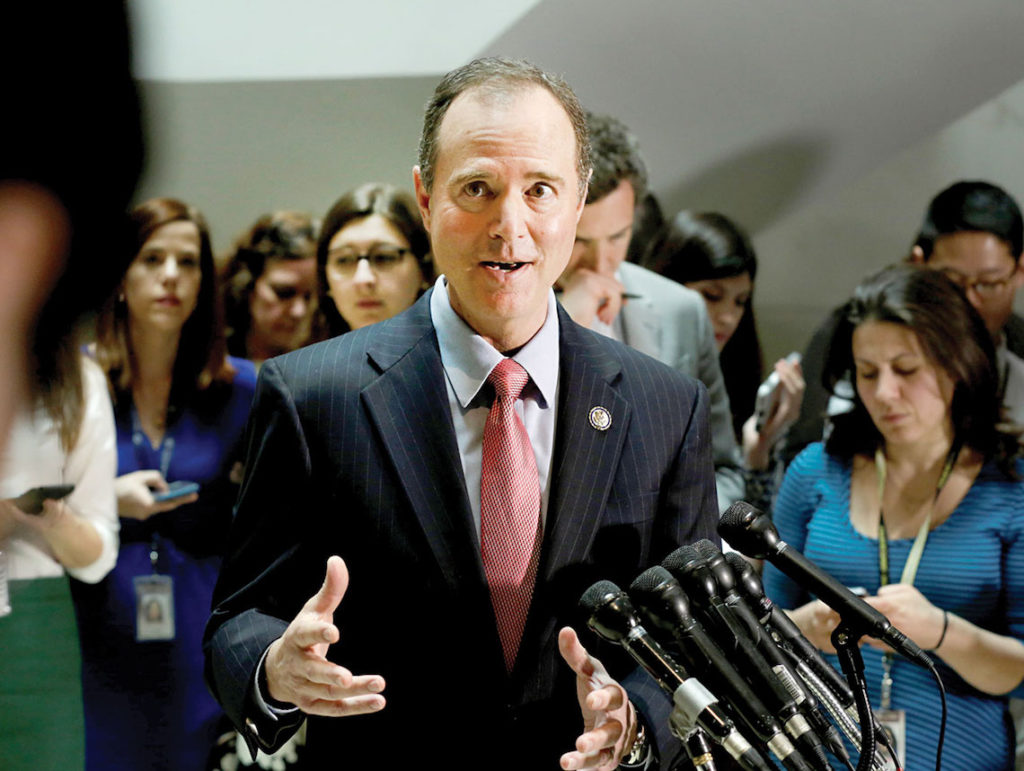
Congressman Adam Schiff, 56, is one of 18 Jews serving in the House, and these days, one of the most prominent of the chamber’s 193 Democrats. He’s been everywhere lately — a guest on CNN and MSNBC, a focus of stories in The New York Times and The Washington Post. His Twitter following is growing exponentially. Already, people are suggesting he could become a presidential candidate in 2020.

And all this for one reason: Schiff is the ranking member — the top Democrat — on the House Permanent Select Committee on Intelligence, which is investigating whether the Russian government interfered with the 2016 presidential election and whether anyone in the Trump campaign had a role in it.

With Democrats in the minority, Schiff has only so much power in setting the panel’s agenda. Nonetheless, he has emerged as a forceful counterweight to President Donald Trump’s defenders, who insist the current investigations into Russia’s election activities — the Senate and FBI are holding their own probes — are little more than politically motivated witch hunts designed to undermine the Trump presidency.

“The American people do have a strong center of gravity that will constrain [Trump’s] worst impulses, so I’m a believer in our democracy.” — Adam Schiff

Undaunted, Schiff is pressing ahead, an effort that draws together the most salient parts of a life in public service — his Judaism, his law background, four years in the California Senate and his 16-plus years in the House — not to mention his role as a Big Brother to a young African-American boy who Schiff’s father, Ed Schiff, says made Adam “a better person.”

It’s a foundation that also has cemented his confidence in American institutions despite the current chaos of Washington.

“I think our democracy is resilient enough; we’ll get through this, I think, even if the president doesn’t operate within established norms of office,” Schiff said. “The American people do have a strong center of gravity that will constrain his worst impulses, so I’m a believer in our democracy. I think we’ll get through this. But certainly, there are some rough roads ahead.”

Schiff was born in Boston in 1960, a few months before John F. Kennedy was elected president, as the younger of two sons to Ed and Sherri Schiff. Theirs was a mixed marriage: Ed, who now lives in Boca Raton, Fla. — “living the ‘Seinfeld’ life,” his son said — is a Democrat; Sherri, who died around 2009 of complications from Alzheimer’s disease, was a Republican.

Adam Schiff poses during his bar mitzvah in June 1973 at Temple Isaiah in Northern California. Photo courtesy of Ed Schiff

Ed Schiff was a businessman who moved around the country as a regional sales director for Farah, a men’s pants manufacturing company. Sherri, “bored with country club life … went into real estate, where her boss said, ‘You are wasting time writing copy. Why don’t you get into sales?’ ” Ed said.

After a few years of living in Arizona, the Schiffs moved in 1970 to Contra Costa County in the Bay Area, where Ed got out of the “rag business,” as he called it, and purchased a building materials yard.

In those days, Adam was a studious boy who, according to his father, always did his homework, adored his mother and had a friendly sibling rivalry with his older brother, Dan, a relationship Adam would later write about in a screenplay — never produced — called “Common Wall.” Adam became a bar mitzvah at Temple Isaiah, a Reform congregation in Lafayette, Calif., in June 1973.

“I certainly do remember making tape recordings of my [bar mitzvah] practice sessions on cassette tape with a little cassette recorder, and I think I may even have one of those,” Schiff said. “It’s funny to hear your voice back then.”

In 1978, he entered Stanford University. A pre-med student, he also studied political science, and upon graduation, he was unsure if he wanted to pursue law or medicine. He decided on the former and enrolled at Harvard Law School.

After graduating in 1985, he clerked for federal Judge Matthew Byrne, a Los Angeles native who presided over the trial involving Daniel Ellsberg and the Pentagon Papers. Later, Schiff spent six years as an assistant U.S. Attorney in L.A. During that time, he met his wife, Eve Sanderson Schiff — yes, they’re Adam and Eve — and prosecuted Richard Miller, the FBI agent convicted of espionage.

Schiff’s success against Miller, as well as Byrne’s influence, accelerated his interest in politics.

“After Adam convicted the FBI agent of treason, he called me and said, ‘Dad, can you imagine what it’s like to have representatives of the most powerful nation in the world calling you and offering to help you in any way they could? Dad, I will never have another case like that in my life,’ ” Ed recalled his son saying. “ ‘I’m going into politics.’ ”

Twice he ran unsuccessfully for the California Assembly but promised his supporters he would do better next time. In 1996, he was elected to the State Senate.

“Adam takes things in progression, and the learning curve … with each loss made it that much easier the next time,” his father said.

In 2000, Schiff ran for Congress to unseat Republican James Rogan in what was then the most expensive House race of all time. Rogan was a two-term Congressman who had his own national profile, in part, from working to impeach President Bill Clinton. Schiff sought help from his mother, asking if she’d make phone calls to voters on his behalf.

“He said, ‘Mama, I would like you to do something for me. I would like you to call these people and tell them a little about me and ask them to vote for me. She jumped into that for 2 1/2 years like it was eating ice cream,” Ed said. “Her spiel went like this: ‘Good evening. My name is Sherri Schiff. My son Adam is running for Congress in your district. May I tell you a little about him?’ ”

Schiff currently is serving in his ninth two-year term in the House, representing a district that now extends from West Hollywood to the eastern edge of Pasadena and from Echo Park to the Angeles National Forest. He has a reputation as a moderate who works with members of both parties. With a large constituency of Armenians, he has championed legislation that would formalize United States recognition of the Armenian genocide of 1915-17. He once delivered an entire speech on the House floor in Armenian and worked with the Armenian members of a hard-rock band, System of a Down, toward seeking recognition of the genocide.

Regarding Israel, which is never out of the headlines, he said, “I’m deeply concerned with a trend I’ve seen over the last several years, where the U.S.-Israel relationship, which always had been very bipartisan regardless of who was in office in Israel or in the U.S., has been trending toward a situation where you have a GOP-Likud relationship and Democratic relationship with other parties in Israel. I think that’s a very destructive trend.”

In 2015, as Jews became polarized over the Iranian nuclear agreement, Schiff considered both sides, then came out in favor of it. Recently, he expressed concern that in the event Trump believes Iran has violated the agreement by developing a nuclear weapon, the president’s outlandishness on Twitter and elsewhere will undermine his credibility in efforts to galvanize allies into action against Iran.

“I have been so appalled by this president’s conduct. I feel I have to vigorously oppose his efforts to undermine our system.” — Adam Schiff

“If they are cheating and the president calls them out on it and thinks there should be some response to it, will the country believe it?” he asked. “The allies we’d need to participate with us, would they believe us? The intelligence agencies that he’s maligning? This is the reason why presidential credibility is to be treasured and not squandered.”

Like Trump, Schiff uses Twitter to communicate his positions. One of his most shared tweets — more than 43,000 retweets and nearly 83,000 likes — addressed Trump’s tweet aimed at the “so-called judge” who had blocked his executive order barring individuals from seven Muslim-majority countries from entering the U.S.:

This ‘so-called’ judge was nominated by a ‘so-called’ President & was confirmed by the ‘so-called’ Senate. Read the ‘so-called’ Constitution.”

Tweets aside, Schiff’s 17-minute opening statement during the Intelligence Committee’s first public hearing on Russia on March 20 was less attack-dog and, befitting his usual public demeanor in television interviews, more lawyerly. He cited events of the presidential campaign that could suggest coordination between Russians and the Trump campaign, improving the Republican’s chance of victory.

“Is it possible that all of these events and reports are completely unrelated and are nothing more than an entirely unhappy coincidence? Yes, it is possible,” Schiff said, addressing FBI Director James Comey and Michael Rogers, director of the National Security Agency. “But it is also possible, maybe more than possible, that they are not coincidental, not disconnected, and not unrelated, and that the Russians used … techniques to corrupt U.S. persons. … We simply don’t know.”

In the interview with the Journal, he said, “I have been so appalled by this president’s conduct. I feel I have to vigorously oppose his efforts to undermine our system, and so, I certainly think there is more than a grain of truth to the idea this is a different kind of role for me.”

Rabbi David Wolpe of Sinai Temple in West L.A. met Schiff five years ago at a memorial service at Forest Lawn-Hollywood Hills. Wolpe was leading the service, and Schiff said he was impressed with how eloquently and powerfully he spoke. The two struck up a friendship, exchanging book recommendations via email. The first book Schiff recommended to Wolpe reflected Schiff’s earlier involvement with Russia. It was “Eugene Onegin,” a masterpiece by the Russian novelist Alexander Pushkin.

“When he’s in town, we have lunch,” Wolpe said. “I talk a little bit about politics, but we talk a lot about literature and life.”

“When I saw him at AIPAC [in March], I told him how proud I am of how he’s been conducting himself,” Wolpe continued. “He’s in a tricky position. This is a very fraught time and I think he has conducted himself with a great deal of dignity. I am not trying to take political sides; I try my best not to. I think he is a nice, thoughtful, decent, caring and very intelligent man, so I’m impressed with him.”

Schiff’s own rabbi concurs.

“I felt personally very proud that Adam has taken stances on issues that really move him personally, and he hasn’t backed down on that,” said Rabbi Baht Yameem Weiss of Temple Beth Ami in Rockville, Md., a suburb of Washington, D.C.

“From where I sit, I think he’s certainly one of the leaders in the Democratic Party right now.” — Ed Schiff, father of Adam Schiff

For all his supporters, not everyone appreciates his approach to the investigation.

“Adam Schiff is a bright guy. He’s a talented legislator, but right now, instead of focusing on the substance of the investigation, he’s focusing on politics and partisanship,” Ken Khachigian, a San Clemente-based Republican strategist and former senior adviser to President Ronald Reagan, told the L.A. Daily News last month.

Schiff and his wife, who is Catholic, are raising their two children, Alexa, 18, and Elijah, 14, Jewish. The family has belonged to Temple Beth Ami since 2010. They formerly belonged to Temple Sinai in Glendale. Alexa is involved with the Hillel at Northwestern University, where she is a freshman. She has traveled to Israel with a Jewish summer camp and will be working as a counselor at the camp this summer, Weiss said.

As a House member, Schiff said he draws on the Jewish tradition of tikkun olam (repairing the world) to influence his work in Congress.

“We have a responsibility to mend the torn fabric of the world,” he said.

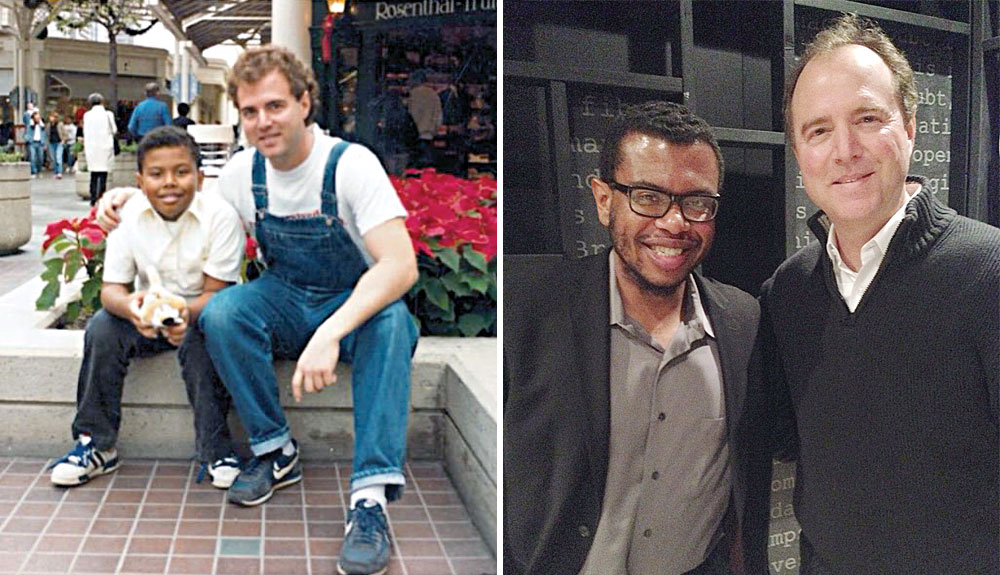
For all of his success as a prosecutor, state legislator and congressman, it might have been his experience with a Black kid from Inglewood that has shaped Schiff most. In his mid-20s, fresh out of law school, he volunteered to become a “big brother” through Big Brothers Big Sisters of Greater Los Angeles. He was paired with David McMillan, a child of a single mother who needed a male role model for her son.

The two hit it off immediately, bonding over “The Big Lebowski,” Billy Joel and the beach. Three decades later, they are still part of each other’s lives. McMillan, now a television writer and playwright living in Los Angeles, was in Schiff’s wedding and recently attended Elijah Schiff’s bar mitzvah. There, Adam’s father approached McMillan and said, “I want to thank you for making Adam a better person.”

“I certainly would like to hope my relationship has had a positive impact, not just in how he conducts politics but also as a human being,” McMillan said.

“My ‘big brother’ is leading the resistance and is emerging as a leader not just of the Democratic Party but of all people who care about our democratic institutions and making sure they just survive.”
schiff-bbbs

Left: In 1986, 25-year-old Adam Schiff gets together with David McMillan, his Big Brothers Big Sisters of Greater Los Angeles “little brother.” Photo courtesy of David McMillan
Right: Congressman Adam Schiff and David McMillan were paired 30 years ago through Big Brothers Big Sisters. The two would become lifelong friends. Photo courtesy of David McMillan

Speculation over Schiff’s future includes whether he might run for the Senate to succeed Dianne Feinstein, who is 83 and shares the same birthday, June 22, as Schiff. Feinstein, a senator since 1992, has not said whether she intends to seek another six-year term next year, but Schiff running to succeed her is a possibility his father won’t rule out.

“I think it would be a tremendous honor for him to step into the Senate if he wanted it, but I don’t know,” Ed Schiff said. “From where I sit, I think he’s certainly one of the leaders in the Democratic Party right now. And where that goes, how that goes, and so forth, I think it all depends on which way our country is going.”

In March, Schiff gave a speech at the Westwood home of Karl S. Thurmond, a friend of more than 30 years. In his 40-minute talk, Schiff denounced the president and expressed hope for the future of the Democratic Party before taking questions from the audience.
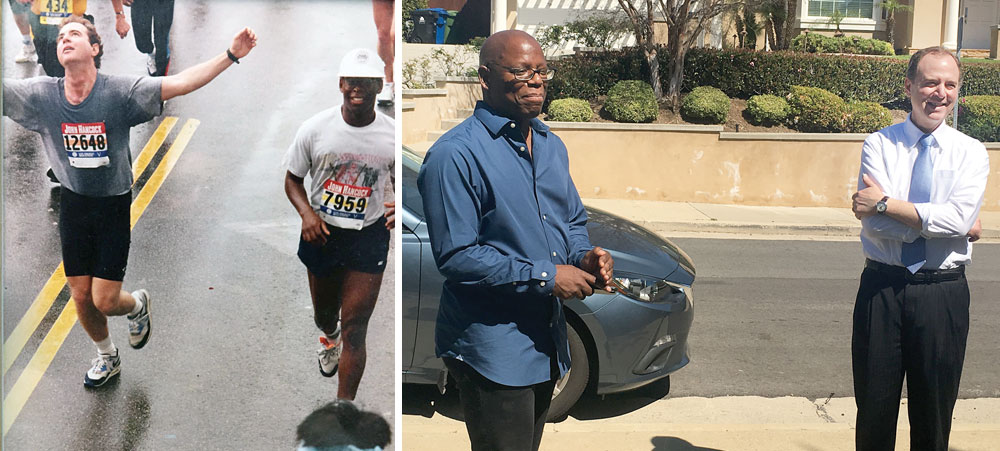
Left: Adam Schiff and his friend and former Harvard Law School classmate Karl Thurmond cross the finish line at the 1990 Los Angeles Marathon. Below: Nearly 30 years after running the marathon, the two appeared together at Thurmond’s Westwood home in March. Schiff spoke before 50 of his supporters and discussed the Trump administration, the future of the Democratic Party and more.

Left: Adam Schiff and his friend and former Harvard Law School classmate Karl Thurmond cross the finish line at the 1990 Los Angeles Marathon.
Right: Nearly 30 years after running the marathon, the two appeared together at Thurmond’s Westwood home in March. Schiff spoke before 50 of his supporters and discussed the Trump administration, the future of the Democratic Party and more.

Thurmond is an attorney and member of the Milken Community Schools board of trustees. He and Schiff were classmates in law school and both moved to L.A. after graduation, becoming part of a group that committed to becoming involved with a nonprofit to affect change. It was a pledge that led Schiff to Big Brothers Big Sisters.

They were 30 at the time, and Schiff was living in Venice. Training for the Los Angeles Marathon, he and Thurmond went on runs from Venice to Malibu and back, using the time to discuss career ambitions. Adam confided in Thurmond that he wanted to be president one day, to follow in the footsteps of his idol, John F. Kennedy.

“We would talk about our aspirations in life and one of his biggest from Day One was to run for political office so he could give back. His idol at the time, and I think still is, was President Kennedy,” Thurmond said. “I firmly believe, as he moves up, one day he will be running for president. And I can’t think of a better person to hold that office.”

For his part, Schiff declined to address his future.

“I don’t have much time even to eat lunch,” he said, “let alone think about anything other than what’s going on in the intelligence world.”

The making of Adam Schiff: Why is this man taking on the president? Read More »

From barley to holiness in 49 days

We have a tendency in the Jewish world to jump very quickly to the meaning of things. A good example is the tradition of counting the Omer, the 49 days from Passover to Shavuot. This odd ritual is loaded with symbolic meaning. You can read many commentaries on how the 49 days are a period of spiritual preparation for the awesome experience of receiving the Torah on Shavuot, how each day represents an opportunity to repair our impurities, and so forth.

But while I do enjoy the jump from ritual to meaning, there’s also something to be said for the value of a story itself. Where does this unusual ritual come from? And what can it tell us about our people and our tradition?

It turns out it all started with a little barley.

The Jews were very much a people of agriculture during biblical times. Their Whole Foods was really whole foods. Their ability to work the land, especially for the making of bread, was a matter of holiness and survival. It was an elaborate process: Oxen helped plow the land, seeds were sown by hand, grain was reaped with a sickle and brought to a threshing floor, where it was ground and then winnowed of debris, and so on until a beautiful loaf of bread was born.

There was a sense of miracle about all this. Our ancestors were intimately aware that growing food could never happen without the raw gifts from God, from rain and earth and wind, to the sun, fire and animals. Finding ways of thanking God was a dominant theme of the time, and bringing sacrifices to the Temple was one of the holier ways. It’s not well known that many of these sacrifices did not involve animals but agricultural produce.

The tradition at harvest times was to bring as an offering a part of that harvest. Each Jewish farmer, for example, was required to bring to the Holy Temple the first of each fruit that ripened on his farm.

Which brings us back to barley, the crop harvested at Passover at the beginning of the harvest season. To show gratitude to God and pray for continued blessings, on the second day of Passover, our ancestors would bring an omer (“sheaf”) of barley to the Holy Temple.

Forty-nine days later, on Shavuot, the kohanim (priests) would bring two loaves of bread as an offering to God. These loaves came from wheat, which was considered a higher-grade crop than barley. One interpretation for the ritual of counting the 49 days is that it was a way of ascending from the humble barley crop to the majestic loaf of bread.

It makes sense, then, that Shavuot would be the time to celebrate the receiving of the Torah. The Torah is God’s ultimate gift to our people — the spiritual loaf of bread that has kept us nourished for millennia.

The Jews were very much a people of agriculture during Biblical times. Their Whole Foods was really whole foods.

The power of this gift is not just that it is full of fascinating stories and moral ideas,  but that these stories and ideas are embodied in concrete rituals that keep us connected to God and our ancestors.

After the destruction of the Second Temple in 70 C.E., the Jews were faced with perhaps their greatest challenge: How do you continue a tradition of rituals without the physical structure upon which so many of these rituals revolved?

How do you suddenly shift to a new way of thanking God after doing it the same way for centuries? And who decides on this new paradigm?

The sages of the Talmud did. It was the centuries of talmudic debate and argument that created Judaism 2.0 and enabled the tradition to survive without its physical core.

One of the ways we bring offerings to God in our days is through prayers and the recitation of blessings. It’s not the same, of course, as bringing a sheaf of barley to a magnificent structure in Jerusalem, but that’s not the point.

The point is this: Holy Temple or not, can we still strive for holiness? And can we honor the rituals that help us strive for that holiness?

Finding personal meaning when we practice the rituals is one way to honor them. Another is to delve into the stories in which these rituals are rooted.

I love seeing how far our ancestors went to honor God. I love imagining the elaborate process they went through as they trekked from the fields to the Temple to thank their Creator for the simple miracle of barley.

And I especially love that a few thousand years later, we’re still talking about it.


David Suissa is president of TRIBE Media Corp./Jewish Journal and can be reached at davids@jewishjournal.com.

From barley to holiness in 49 days Read More »

Moses

Do you dream of Egypt? Or seek traces
of your journey before God lays you down like Isaac
at Moriah and takes away your breathing?
Do you remember Sinai where you were sorely tried?
Or seek evidence that the lengthy sojourn
in Pharaoh’s court was not of your imagining?
Do you feel the sea tearing in half? Or remember
those who dared to flee into its breach?
Perhaps your feet still move in a desert rhythm
and will not stop even here on Mount Nebo
though you watch the others cross a river beyond you.
Haven’t you pleaded for your life? What have
you to say, Bush of Burning who is not consumed? Mountain
of the Stone Tablets? And you, Moses, do you lie back
upon your rocky bed, close your eyes and feel
the cool kiss of God upon your lips, your soul drawn
out of your body like a hair drawn out of milk,
sons dispersed like seeds, no burial place?


From “Lithuania: New & Selected Poems.” Myra Sklarew, professor emerita at American University, also is the author of “Harmless,” “If You Want to Live Forever” and the forthcoming “A Survivor Named Trauma: Holocaust and the Construction of Memory,” SUNY Press.

Moses Read More »

A league of their own is a hit with Jewish youth baseball players

It’s a beautiful spring afternoon. And as on baseball diamonds across the country at this time of year, kids in North Hollywood are playing ball. But this isn’t Little League or Pony Baseball, the organizations that dominate the youth sport. This is the Blue Star League, a local baseball league that runs from January to June for Jewish kids ages 4 to 15.

At a glance, this could be youth baseball anywhere in America. There are kids in sharp uniforms, fielding and hitting on manicured fields. There are coaches shouting to their players and parents cheering the players on. There are hot dogs and french fries. In the words of Katherine Saltzberg, a Valley Village-based parenting coach whose son Eli, 11, has been playing in the Blue Star League for about a half-dozen years, “Baseball is baseball is baseball.”

But look a little closer and some things may not appear so universal. Some of the boys wear kippot under their caps and batting helmets, and tzitzit under their jerseys. The names on the backs of jerseys read like a Jewish phone book: Feldman, Hirsch, Lipsker, Ben-Gal, Lipman, Boboroff, Weiss. At a certain time in the late afternoon, men gather for afternoon prayer a few feet from the makeshift snack stand where volunteers grill kosher franks and burgers. And when was the last time you sat in the stands with a rabbi playing acoustic guitar?

Unlike Little League, which usually has Saturday games during the spring, Blue Star schedules games on Sunday afternoons to avoid conflict with the Sabbath or Sunday school. If it weren’t for Blue Star, many of these kids would not play at all.

The league got its start in North Hollywood nearly 30 years ago. According to its current commissioner, Valley Village resident Hershel Goulson, 45, who works for the Children’s Hospital Los Angeles foundation, it began as Emek Baseball League, started by parents of students at nearby Emek Hebrew Academy. It still has a loose relationship with the Orthodox private school, and many Emek students participate in Blue Star.

But nearly half of the 240 kids currently playing come from places outside the San Fernando Valley, including a large group from the Pico-Fairfax neighborhood. Some families come from as far north as Oxnard, as far south as Redondo Beach and as far east as Riverside.

“As far as I know, it’s the largest Jewish kids baseball league west of the Mississippi,” Goulson said.

Goulson got involved in the league as a coach in 2005, when his oldest son, now 16, was 4 and became eligible to play. And even though none of his five children, all boys,
is playing this season, Goulson stayed on
for his fifth year as the volunteer commissioner.

“I love kids and I love sports. And nothing brings me greater joy than to see kids having a great time playing sports that they love,” Goulson said. “Obviously, it started with my kids. That was a natural starter for me. To me, it’s all about the kids, and when the kids are happy, I am thrilled. That’s the only payment I need.”

Goulson played baseball growing up in Detroit. “Back then, in the ’70s, they did not have Jewish leagues,” he said. “We played in a non-Jewish league. So, many Jewish kids did not play on Saturdays. I think these kids are so lucky to have this league.”

For Daniel Harrison, 12, an Emek sixth-grader and die-hard Dodgers fan who has been playing Blue Star baseball for the past seven years, the Sunday game is one of the highlights of his week.

“This year, we aren’t such a good team,” said Daniel, who plays for the Reds. That doesn’t seem to have dampened his enthusiasm, however. He said he still is out there having fun and getting exercise. His goal for the season is to learn to stay more calm on the mound and increase his pitching speed and accuracy. “Sometimes when you get nervous, the ball goes off course,” he said.

Eli Saltzberg, an Emek fifth-grader and Daniel’s teammate, is equally gung-ho. According to his mom, Katherine, he wants to put on his uniform first thing in the morning on game days, arrive two hours early and stay after his own game to watch other games.

“The players have a great time,” she said, adding that she appreciates “the Torah atmosphere” of the games. The league requests, for example, that parents and family members dress modestly. “It’s good middos,” she said.

A few years ago, when Beverly Hills Little League switched its Saturday games to Sundays, Blue Star lost a large contingent of kids who attend Gindi Maimonides Academy. But the league’s numbers have held steady ever since, around 250, and the league always has more interest than roster openings.

Goulson said he hoped that someday lights would be installed on the East Valley fields where the teams play. That would allow the league to schedule additional games, with more teams and more players. But for now, the league is limited by the number of games it can squeeze in on the four fields between about 2 and 6 p.m.

So, could a future Clayton Kerhsaw — or rather, Sandy Koufax — be playing in Blue Star? Odds are against it. Nearly all of the kids who play Blue Star baseball are Orthodox. And as Goulson pointed out, you can’t be Orthodox and be a Major League player because you can’t play on Saturdays. But, he added, some players have gone on to play baseball in college, including at Yeshiva University. Ultimately, though, that’s not Blue Star’s purpose.

“This league is about providing a fun Jewish environment for kids,” Goulson said.

For that reason, he reminds managers at the beginning of every season not to sweat the small stuff. “I always share the old Jewish joke: Unless we are impeding your child’s chance to become a doctor, lawyer or CPA, it’s not worth getting upset about.”

A league of their own is a hit with Jewish youth baseball players Read More »

The rich rewards of frugal weddings

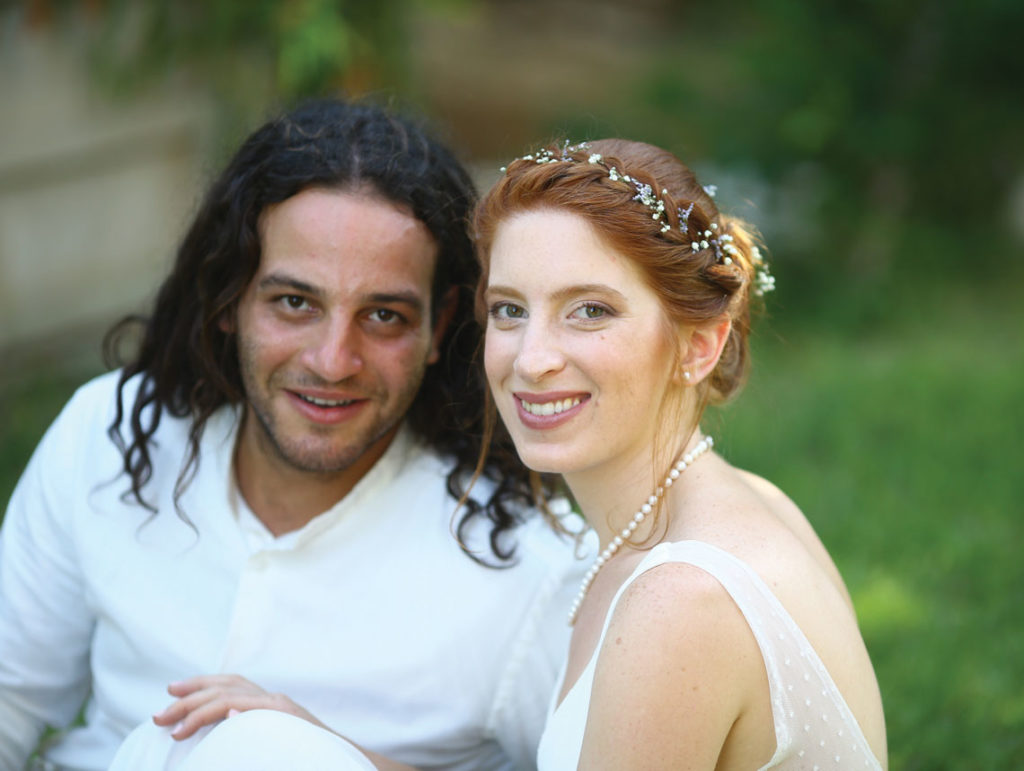
Tzipi Polisar and her husband could have held their wedding in an upscale wedding hall with catered food, but, like a growing number of young Israelis getting married for the first time, they opted instead for a frugal wedding.

“It was very important to us that our friends come to the wedding and enjoy themselves,” Polisar said, explaining that in Israel many couples use the money they receive as wedding gifts to pay for the event, and that guests feel obliged to cover the cost of their place setting.

“A lot of my friends are students,” said Polisar, who is in her 20s. “Every time they get invited to a wedding, they’re not excited because they know it will be expensive, and the closer a guest is to the bride and groom, the bigger the check. We wanted a celebration our friends and family would be happy attending.”

In contrast to the early decades of Israeli statehood, when food rationing and a socialist ethos meant that most weddings were very modest by Western standards, Israel’s higher standard of living, coupled with globalization, have spurred this generation of Israeli couples to throw much more sophisticated, formal weddings that typically start at $25,000 to $30,000 — a lot of money on an Israeli salary — and sometimes many times that amount.

Israeli weddings have become so expensive that various Hasidic sects have issued strict guidelines for the maximum amount a couple’s parents should spend on everything from the matchmaker to the band.

Now, a growing number of mainstream Israeli couples, like Polisar and her husband, Matan Ziv, are coming up with their own ways to throw a beautiful wedding on a very limited budget. 

In Polisar’s case, the bride told her guests there was no need to bring a gift but asked them to bring some food to the event. “It was a potluck wedding. Almost every one of our 180 guests brought food!” she said. “It was amazing.”

Ronit Peskin, administrator of the Frugal Israel Facebook group, noted that there always has been a “small minority” of couples who made less-expensive weddings than their peers. Now, however, “they’re more outspoken about it. My feeling is the more people talk about their affordable weddings, the more trendy it gets.”

Peskin said many couples, and especially those from English-speaking homes in Israel, want to celebrate the values they live by every day: “Frugality is green. It represents lack of wastefulness. Even those who can afford more may choose to spend less, for a variety of reasons.”

Polisar was able to save money by renting out a very basic event venue in her mother-in-law’s community. Her father-in-law, a rabbi, performed the wedding, her sisters made the desserts and a relative bought flowers from a florist and arranged the flowers herself.

Noa Hazony and her husband, Shimmy, also in their 20s, organized a potluck wedding on a synagogue balcony in a West Bank settlement, where events tend to be considerably less expensive. The balcony provided a stunning view of the desert. 

Like Polisar, Hazony said she has “a lot” of friends who question whether to go to weddings due to the associated costs. “I didn’t want my friends to think twice before coming. I made it very clear that I didn’t expect gifts,” she said. 

Hazony rented her wedding dress from a wedding gemach (a place that lends wedding gowns cheaply) and her mother’s friend, a seamstress, provided the tailoring as a wedding gift. Rather than buy flowers, the couple used potted plants they grew from seeds as centerpieces; a professional photographer who knew the couple photographed the ceremony as a wedding gift. The couple sent out invitations by e-mail.

“Music was the one thing we really wanted, so we hired a band for the [ceremony] and a DJ for the reception,” Hazony said. “We hired a wedding planner because arranging a pot luck wedding is a bit more complicated than a catered one.”

Hazony estimates she and Shimmy spent less than $8,000 for everything related to their nuptials.

Malki Ehrlich and her husband, Dan, said they “wanted a wedding we could easily afford to pay out of pocket because I can’t stand the crowd-funding wedding mentality in Israel, where you rely on your friends and family” to pay for the wedding costs.

Ehrlich, in her 30s, invited 70 guests, including children, to her wedding by the Mediterranean Sea.

“I wanted to get married next to the beach, so I approached a few restaurants and asked how much they would charge to rent out their place on a Friday afternoon. The place we chose was in Netanya. It was a beautiful venue and location.”

The summertime ceremony was held at noon and everyone went home by 5 p.m., in time for Shabbat.

Although Erlich kept the flowers to a minimum — with a view of the sea they seemed gratuitous — she  paid a chamber group to perform. She paid about $200 at a fancy dress shop for a $2,500 wedding dress that was custom-made for another bride who never wore it. Including her dress, Ehrlich’s wedding cost about $4,200.

Polisar, who is one of six children, and her husband, who is one of seven, said she is happy she chose to have a “community wedding.”

“We have other siblings who want to get married and didn’t like the idea of spending a fortune on only one day. Both our parents had the money to spend on a fancier wedding if we wanted one, but it was more important for us to save up to buy a home. It was definitely the right decision,” Polisar said. n

The rich rewards of frugal weddings Read More »

Moving & Shaking: American Friends of Magen David Adom, Central Conference of American Rabbis president and more


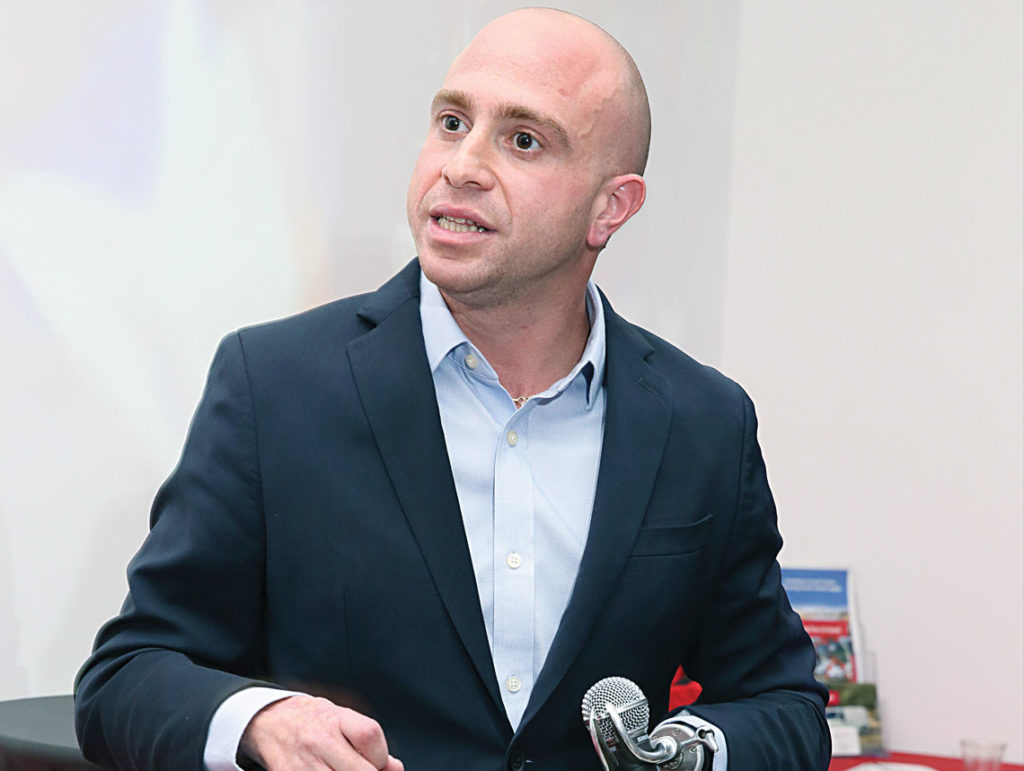
A March 27 American Friends of Magen David Adom (AFMDA) young professionals mixer at Ten Thousand, a new apartment complex on Santa Monica Boulevard in Los Angeles, featured guest speaker Capt. Ziv Shilon of the Israel Defense Forces (IDF), who was rescued by Magen David Adom after suffering a near-fatal injury in 2012.

Magen David Adom, Israel’s emergency-response organization, provides 100 percent of the blood for the IDF and 97 percent of the blood for the entire country, an AFMDA press release said.

Several years ago, Shilon received 52 units of blood, according to the release, after he was struck by an improvised explosive device while participating in a mission along the Gaza border.

“All were inspired by his story as they also celebrated his victory over the challenges that he faces, having lost limbs in Gaza,” the release said.

The event drew more than 230 attendees from entertainment, real estate, high-tech and other fields who mingled and enjoyed sushi, deli foods, dessert and martinis.


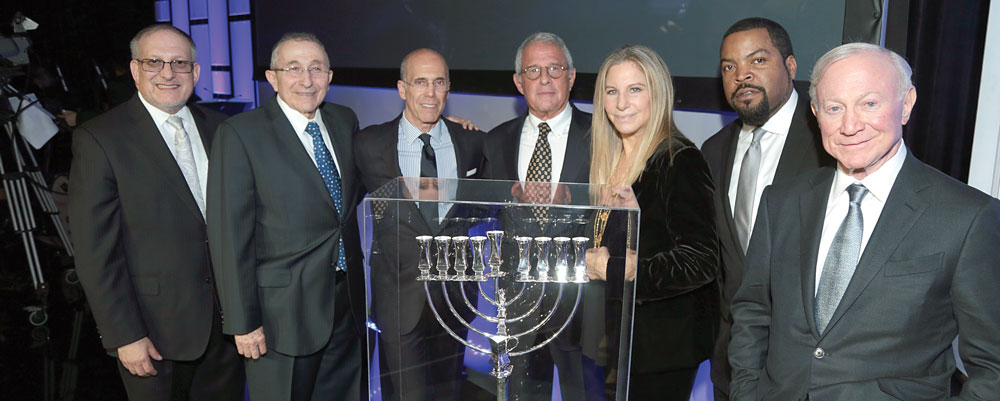
From left: Rabbi Meyer H. May, executive director of the Simon Wiesenthal Center (SWC); Rabbi Marvin Hier, SWC founder and dean; dinner chair and SWC trustee Jeffrey Katzenberg; honoree Ron Meyer; singer-actress Barbra Streisand; host Ice Cube; and Larry Mizel, chairman of the SWC board of trustees. Photo by Alex J. Berliner/ABImages

The Simon Wiesenthal Center/Museum of Tolerance 2017 National Tribute Dinner drew prominent guests and speakers to celebrate the center’s 40th year, including singer and actress Barbra Streisand, Jerusalem Mayor Nir Barkat and former DreamWorks Animation CEO Jeffrey Katzenberg.

But the name that jumped off the evening’s program was the emcee, O’Shea Jackson, also known as Ice Cube from the rap group N.W.A.

“I know I may not be the most obvious host for tonight’s events,” he said onstage at the April 5 dinner. “But we’re not living in obvious times.”

“Recent events have only made nights like tonight and this museum’s purpose more important,” he added.

The black-tie event filled the 1,300-seat ballroom at the Beverly Hilton, raising a record $2.65 million for the center — half a million dollars more than it has raised at similar past events, according to Larry Mizel, chairman of the Wiesenthal Center’s board of trustees.

The evening honored Ron Meyer, vice chairman of NBCUniversal, with the center’s 2017 Humanitarian Award.

Meanwhile, the center’s dean and founder, Rabbi Marvin Hier, presented a posthumous Medal of Valor to former Israeli President Shimon Peres and Roddie Edmonds, a U.S. Army officer and prisoner of war who saved 200 American-Jewish soldiers during World War II by refusing to give them up to his Nazi captors.

Reverend Johnnie Moore, who has helped rescue dozens of Christians from the Islamic State in Iraq and Syria, also received a Medal of Valor.

The dinner also drew politicians and government officials, including Consul General of Israel in Los Angeles Sam Grundwerg, former Los Angeles Mayor Antonio Villaraigosa, California Insurance Commissioner Dave Jones, State Senator Jeff Stone, and State Assemblymembers Dante Acosta and Laura Friedman. Other celebrity attendees included actors Michael Douglas and Tobey Maguire and actress AnnaLynne McCord.

Taking the stage to introduce Meyer, Streisand took aim at the Trump administration, saying the president “uses the bully pulpit to simply bully, offering no ideals and aspirations.”

“We must heed the warning signs of the past echoing in the discourse and the politics of the present,” she said, “for history has shown us the horrors of quiet whispers when we must all be shouting from the rooftops to say, ‘Never again.’ ”

Eitan Arom, Staff Writer


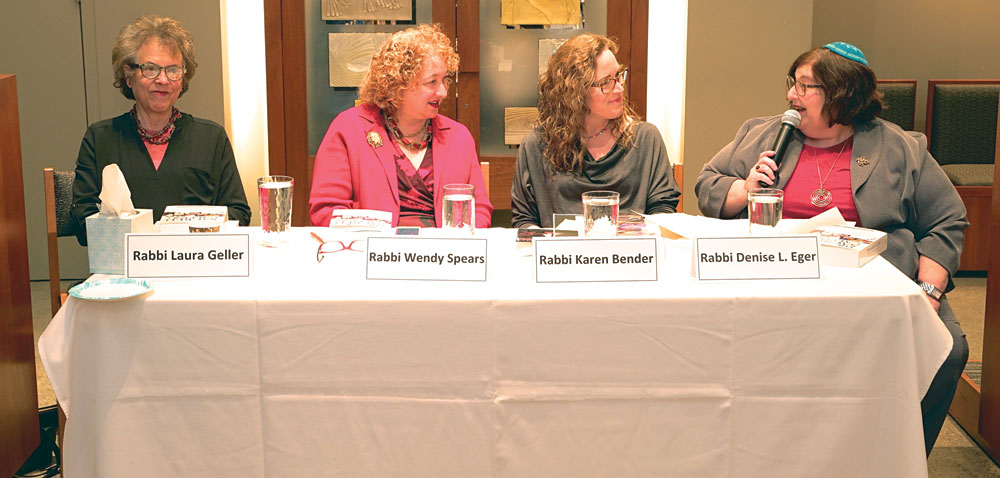
From left: Temple Emanuel of Beverly Hills Rabbi Laura Geller; Rabbi Wendy Spears; Rabbi Karen Bender and Congregation Kol Ami Rabbi Denise Eger participate in a panel commemorating the conclusion of Eger’s two-year term as Central Conference of American Rabbis president. Photo courtesy of Rabbi Denise Eger


Congregation Kol Ami Rabbi Denise Eger, the 60th president of the Reform movement’s Central Conference of American Rabbis (CCAR), has concluded her two-year term as CCAR president.

The March 20 CCAR annual convention in Atlanta marked the culmination of her term, which began in 2015 and was historic as Eger became the first openly gay rabbi to serve as the organization’s president. CCAR is the oldest and largest rabbinical association in North America.

Rabbi David Stern of Temple Emanuel in Dallas is succeeding Eger, whose synagogue, Kol Ami, is based in West Hollywood and conducts gay and lesbian outreach programs.

“This experience of leadership impacts my every day at Kol Ami,” Eger said in an email. “I learned a tremendous amount about how others are dealing with the same challenges and issues and complexities of Jewish life. I hope to bring that knowledge back and share it with my community.”

A Feb. 28 panel at Kol Ami commemorated the end of her term and explored the recent anthology “The Sacred Calling: Four Decades of Women in the Rabbinate.” Panelists were some of the most prominent women in Jewish life in Los Angeles: Eger; Rabbi Emerita Laura Geller of Temple Emanuel of Beverly Hills; Rabbi Karen Bender, director of spiritual life at the Los Angeles Jewish Home; community-based Rabbi Wendy Spears; and Cantor Aviva Rosenbloom, cantor emerita of Temple Israel of Hollywood.


From left: Los Angeles Museum of the Holocaust (LAMOTH) board treasurer Jamie Rosenblood, 3G at LAMOTH board member Bati Prince, Holocaust survivor Ester Tepper, Prince’s mother, and Jordanna Gessler, LAMOTH director of education. Photo by Katherine Semel


Nearly 200 people attended a Shabbat dinner on March 31 co-hosted by the Friends of the Israel Defense Forces (FIDF) and 3G at the Los Angeles Museum of the Holocaust (LAMOTH), which is a group of grandchildren of Holocaust survivors.

The event was held at the Beverly Hills home of Zachary Zalben. Cocktails and dinner preceded a parlor-style discussion about Israel and the Holocaust. Speakers included Ester Tepper, a Holocaust survivor and former Israel Defense Forces (IDF) soldier; Avi Arad, a former IDF soldier and son of a Holocaust survivor; and Itay Kohane, an IDF soldier and the grandson of Holocaust survivors.

The event raised approximately $20,000 for the FIDF’s Witnesses in Uniform program, which sends Israeli soldiers to Holocaust sites in Poland, and for LAMOTH’s Share Our Stories Project, which connects Holocaust survivors with under-resourced schools.

LAMOTH Director of Education Jordanna Gessler and Molly Soboroff, FIDF’s Western Region young leadership director, organized the event and delivered closing remarks.

Zalben, along with Guy Lipa and Galit Prince, co-chaired the event.

— Eitan Arom, Staff Writer


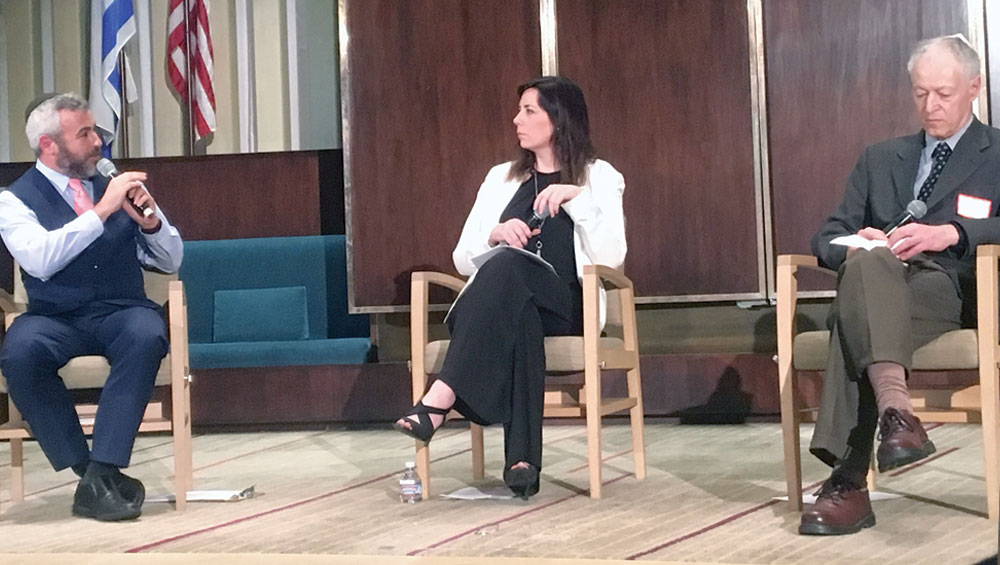
From left: Jewish community in Hebron spokesman Yishai Fleisher; Temple Emanuel of Beverly Hills Associate Rabbi Sarah Bassin; and Special Advisor to the President of J Street Alan Elsner participate in a panel titled “Competing Visions for Israel.” Photo by Mati Geula Cohen


During Temple Emanuel of Beverly Hills’ (TEBH) March 30 forum, “Competing Visions for Israel: J Street and a Settler in Conversation,” Jewish Community of Hebron spokesman Yishai Fleisher and Special Advisor to the President of J Street Alan Elsner discussed their opposing visions for the Jewish state.

“The 1947 partition plan was the idea of sharing the land, one state for the Jews and another for the Palestinians,” Elsner said. “The Palestinians rejected that, the Arab world rejected that, but in the 1990s, under the Oslo Accords, we finally got to a position where both sides were willing to talk about a division of the land, and I think that is the only way that you can actually end the conflict with a modicum of justice to those who have been dispossessed up until now.”

Fleisher argued for alternatives to the two-state solution.

“Before I get to them,” Fleisher said, “I have to deal with the calcified way we have been told for the longest time that the only solution is the two-state solution, when in fact it has been a historic, scientific failure, which has been tried over and over and over again with utter failure and utter war. And the two-state solution will do nothing for Israeli security. And that has been proven.”

One of the attendees, Natan Benchimol, president of Students Supporting Israel at Santa Monica College and a Zionist Organization of America campus fellow, told the Journal he connected with Fleisher’s position.

“As a college student leader who hears the same arguments going back and forth across campuses, it was refreshing to hear Yishai utilize his authentic, creative and insightful opinions to express his support for the Jewish homeland and alternative solutions,” Benchimol said.

StandWithUs CEO Roz Rothstein, philanthropist Nurit Greenger and TEBH Executive Director Eric Reiter also attended what was the third installment of the TEBH Behrendt Conversation Series, which features “discussions about politics, diplomacy, Israel and everything in between,” according to a TEBH press release.

TEBH Rabbi Sarah Bassin, the event’s moderator, said the conversation was necessary at a time when people crave healthy debate.

We have been living in an environment that has been increasingly polarized, where people speak to echo chambers and to their political sidelines, where we have lost our resilience to hear competing ideas with which we disagree,” Bassin said. “And tonight, here at Temple Emanuel, we are changing that culture. We are here to engage in difficult conversation.” 

— Mati Geula Cohen, Contributing Writer

Moving & Shaking highlights events, honors and simchas. Got a tip? Email ryant@jewishjournal.com. 

Moving & Shaking: American Friends of Magen David Adom, Central Conference of American Rabbis president and more Read More »

Episode 33 – Israel and Germany: An unsettled past with Eldad Beck

The words ‘Germany’ and ‘Israel’ probably raise many differing connotations in various people’s minds but one probably stands out among them all: the Holocaust.

Germany-Israel diplomatic ties began in 1952 when Germany finally offered to pay reparations to the survivors of the Holocaust. For obvious reasons, this relationship was not without its fair share of trials and tribulations. Over the years the challenges have persisted, often exacerbated by events such as the massacre of the Israeli athletes during the 1972 Olympic games in Munich.

As the chief correspondent for Yedioth Ahronoth in Germany, Eldad Beck has become well acquainted with German internal politics, diplomatic affairs and public opinion. He has written two books on the subject of Germany: “Germany, at Odds” and his most recent “The Chancellor”. Beck joins 2NJB to talk about the two countries’ strained relations and his career as a journalist.

Eldad Beck’s Facebook and Twitter

‘Germany, at Odds’ on Amazon

Direct Download

Episode 33 – Israel and Germany: An unsettled past with Eldad Beck Read More »

Lawmakers press Trump administration anew on bias crimes, anti-Semitism

Lawmakers in Congress continued to press the Trump administration to address perceived spikes in bias crimes in the United States and in anti-Semitism abroad, reflecting bipartisan concern that President Donald Trump remains insufficiently engaged on the issues.

The Senate resolution, approved unanimously late Wednesday, urged the Trump administration “to continue Federal assistance that may be available for victims of hate crimes” and “to continue safety and preparedness programs for religious institutions, places of worship, and other institutions that have been targeted because of the affiliation of the institutions with any particular religious, racial, or ethnic minority.”

Separately, top House of Representatives lawmakers introduced legislation that would elevate the role of the State Department’s anti-Semitism monitor.

Bipartisan backing for the initiatives suggests a rare example of an adversarial relationship between the White House and both parties in Congress. And they reflect concerns at Trump administration plans to roll back funding since the 9/11 terrorist attacks in 2001 for initiatives and positions that protect Jews and other minorities.

A number of Jewish groups have expressed alarm at Trump administration plans to roll back security assistance for nonprofits, currently at $20 million, into broader emergency planning funding, which they fear will see the program’s elimination. Lawmakers have called on the administration to keep the funding separate and to more than double it to $50 million.

The Senate resolution also urged federal agencies to improve the reporting of hate crimes, which anti-bias groups have said for years is uneven and at times unreliable, and calling for an interagency task force “to collaborate on the development of effective strategies and efforts to detect and deter hate crime in order to protect minority communities.”

Sens. Kamala Harris, D-Calif., Marco Rubio, R-Fla., Susan Collins, R-Maine, and Dianne Feinstein, D-Calif., initiated the resolution. Harris first announced she would introduce the resolution at last month’s policy conference of the American Israel Public Affairs Committee.

“We applaud the Senate for forcefully condemning hate in all its forms and for urging the federal government to take concrete steps to fight back against discrimination and bias-motivated crimes,” Jonathan Greenblatt, the Anti-Defamation League’s CEO, said in a statement. “Anti-Semitism and bigotry are affecting countries all over the world, and the U.S. is no exception. But the rigor of America’s response and the solidarity we demonstrate for each other across diverse communities is exceptional.”

Also Wednesday, Homeland Security Secretary John Kelly apologized during testimony for not yet responding to a letter sent last month by all 100 senators urging him and other top U.S. security officials to address bomb threats to Jewish institutions.

Sen. Gary Peters, D-Mich., asked Kelly during the secretary’s testimony to the Senate’s Homeland Security committee why he had failed to reply 29 days after the letter was sent to Kelly, Attorney General Jeff Sessions and FBI director James Comey.

“It should have been a long time ago, I’ll apologize and I’m on it,” Kelly said.

Since the letter was sent, an Israeli Jewish teenager believed to be responsible for the bomb threats has been arrested, but Kelly suggested a broader threat remained and extended it to mosques and African-American churches as well.

“I’ve told my people, let’s not just talk one religion, let’s not just talk terrorists for that matter, how about white supremacists?” Kelly said.

Separately on Wednesday, a bipartisan slate of House members introduced legislation that would elevate the position of State Department anti-Semitism monitor, a response to reports that Trump plans to scrap the position.

The legislation, introduced by Reps. Chris Smith, R-N.J., and Eliot Engel, D-N.Y., would elevate the position to ambassador level and ban “double-hatting,” or assign the position to someone who already has another assignment.

Jewish leaders testifying last month before a session of the House human rights subcommittee chaired by Smith urged the preservation of the position.

“Jewish communities here and abroad continue to be targeted for hatred and deadly violence,” Smith, who helped author the 2004 law creating the position, said in a statement. “The Special Envoy is critical to focusing and redoubling our leadership and this bill enhances the position.”

Engel, the top Democrat on the House Foreign Affairs Committee, in a separate statement noted recent attacks in Europe.

“Just this week, a Jewish Community Center in Sweden closed due to security threats, tombstones were desecrated at a Jewish cemetery in France, and vandals damaged a Greek Holocaust Memorial,” he said. “We continue to see the steady rise of anti-Semitic political parties in places like Hungary, Greece, and even France.”

Lawmakers press Trump administration anew on bias crimes, anti-Semitism Read More »

Letters to the Editor: Moses, Middle East, AIPAC and anti-Semitism

Recalling a Composition About Moses

Sergio Barer was not the first to write an oratorio about Moses (“Singing the Story of Moses,” March 31). In 1968, my late collaborator, Sebastian Temple, and I wrote and recorded “Moses in Story and Song.” It was a folk oratorio/musical midrash. It was a television program sponsored by the University of Judaism (now known as American Jewish University).

We did the same with the Book of Genesis. Subsequently, I was commissioned by the university to write an album about women of the Bible, which I recorded. All these were firsts!

Sarah Hershberg, Encino

A Middle East Peace Idea

Yishai Fleisher’s thought-provoking essay (“Five Alternatives to Designating Separate States,” March 24) had some interesting proposals, but I would suggest there is a sixth alternative worth considering. 

Israel, and its well-meaning friends, should consider buying land, both in Israel, through eminent domain, if necessary, and in Jordan on the East Bank. This peaceful transfer of land has worked in the United States — in 1626 with the purchase of Manhattan; the Louisiana Purchase in 1803; and the Alaska purchase in 1867. Jordan, especially the East Bank, could present a possible solution to a centuries-old problem. Jordan is more than 80 percent Palestinian and would likely welcome the financial help that would come with the residents. 

It is time to look for new solutions to this complex problem. Buying land in Jordan and fixing the tortured map of Israel might be the “best compromise” for future Middle East peace.

Jerry Levy, Los Alamitos

A Suggested Direction for AIPAC

Shmuel Rosner questions the feasibility of “many voices and one mission” (“AIPAC and the Battle for Unity,” March 31). Although I agree that this seems to be “Mission: Impossible,” there should be a direction for AIPAC to follow. It cannot follow the direction of the Israeli government. By promoting the government position, it is not only alienating about half of the Israeli electorate and its American supporters, but also Americans of the party associated with that position. This is the result of Israeli Prime Minister Benjamin Netanyahu’s regretful decision to engage in U.S. politics and, for the first time, overtly associate with one of our parties.

There is another way. AIPAC can have an agenda that promotes Israel as a society that is concerned with justice and human rights. In the least, this would lead to support for the two-state solution. In many other ways, it can support policies that ensure Israeli security and democracy, while seeking to draw a positive balance between security and human rights.

Michael Telerant, Los Angeles

Condemn Terror Incitement

David Suissa points out that the establishment’s refusal to criticize Islam virtually assures that Muslim oppression of women, gays and Christians, and anti-Semitism and terrorism will continue unabated (“London Terror: No. 30,499 in a Series,” March 31). Ironically, those hurt most by this are reform-minded Muslims.

No one wants to foment resentment toward law-abiding Muslim immigrants or hurt their feelings, but instability and incitement to terrorism in Muslim-run countries are the free world’s biggest problems — if we don’t condemn them, what will make them change? If the United Nations and the left criticized Islam a fraction as much as they demonize Israel, we might see real reform, without which an end to the Israel-Palestine conflict or the endless tide of Muslim refugees is unlikely. 

Reuben Gordon via email

On the Front Line of Anti-Semitic Threats

Dennis Prager owes an apology to all Jews who have been subject to the recent rise in anti-Semitic threats and attacks (“There Is No Wave of Trump-Induced Crime in America,” March 10).

It’s too bad Prager doesn’t “think” there is a dramatic rise in anti-Semitic threats and attacks in the United States without researching the facts.

For example, if he had checked with Jews in Whitefish, Mont., who were subject to a barrage of thousands of neo-Nazi anti-Semitic cyberterrorist attacks and an attempt by the neo-Nazi publication The Daily Stormer to have an armed march through the streets of Whitefish in December and January, he would have seen what was happening. State and local government officials, law enforcement and national and local organizations, including the Anti-Defamation League and the Southern Poverty Law Center, prevented the armed march. The FBI is tracking down the source of each terrorist email.

I was one of the rabbis from around the country who went to Whitefish to hear firsthand accounts of the cyberattacks, the fear those attacks caused, and how everyone supported those who were traumatized. Too bad Prager was not with this gathering of rabbis to see and hear what was happening. Maybe he would not have been so quick to deny the reality of these anti-Semitic attacks by neo-Nazis, white nationalists and others. Then again, maybe he just can’t hear and see what is right in front of him because he has made up his mind to his alternative reality and doesn’t want to be confronted by the facts.  

Rabbi Stan Levy via email

Letters to the Editor: Moses, Middle East, AIPAC and anti-Semitism Read More »