
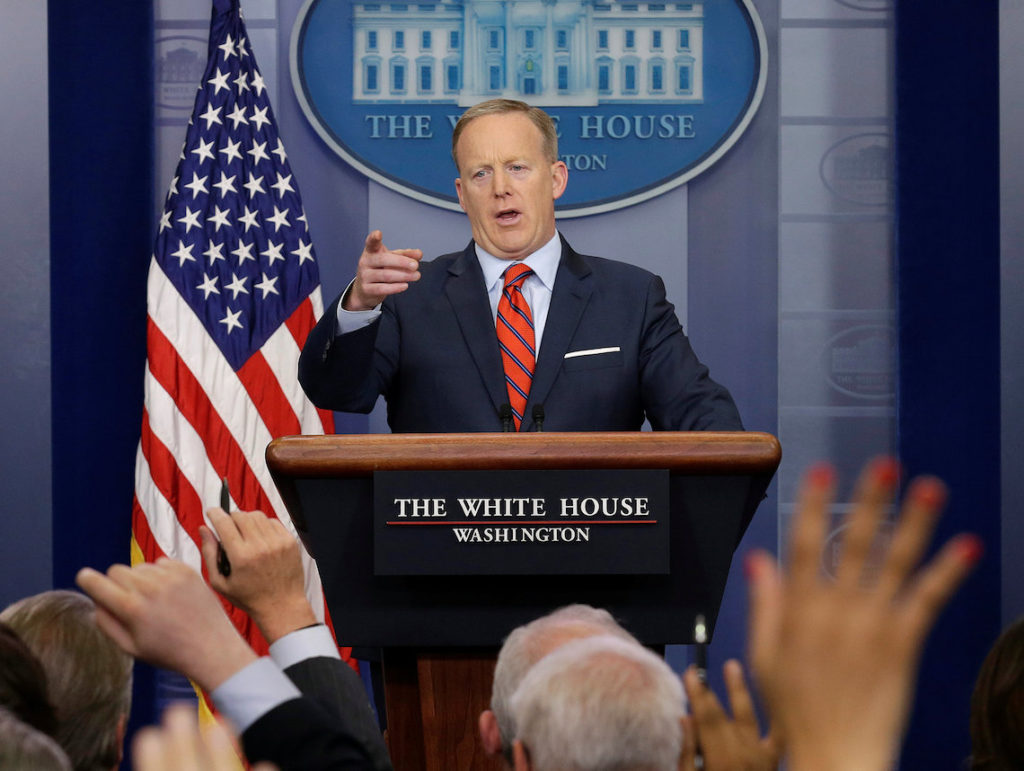
Sean Spicer apologizes for Holocaust remarks amid criticism from U.S. and Israeli Jews
White House Press Secretary Sean Spicer apologized for claiming that Adolf Hitler never used chemical weapons amid widespread criticism and calls for his job, including from U.S. Jewish leaders and Israeli politicians.
After repeatedly trying to clarify his comments, made Tuesday in a White House press briefing about last week’s chemical attack in Syria and Russia’s position on it, Spicer later in the day told CNN he was sorry to anyone he had offended.
“Frankly, I mistakenly made an inappropriate and insensitive reference to the Holocaust, for which frankly there is no comparison,” he told host Wolf Blitzer. “And for that I apologize. It was a mistake to do that.”
Sean Spicer: I mistakenly used an inappropriate and insensitive reference to the Holocaust, there is no comparison https://t.co/Jgc1ccgMeK
— The Situation Room (@CNNSitRoom) April 11, 2017
The press secretary also on Tuesday phoned Republican mega-donor Sheldon Adelson, whose office had reached out to him.
“Sean called shortly after and said he made a terrible mistake and apologized if he was offensive,” Adelson’s spokesman Andy Aboud said in a statement.
Spicer made the inaccurate claim about Hitler, which drew audible gasps from the Washington press corps, in an attempt to question Russia’s continued support for Syrian President Bashar Assad. The White House on Tuesday accused Russia of trying to cover-up the Syrian government’s role in the chemical weapons, saying U.S. intelligence had confirmed the Assad regime used sarin gas on its own people.
“We had someone as despicable as Hitler who didn’t even sink to using chemical weapons,” Spicer said. “So you have to, if you’re Russia, ask yourself is this a country that you want to align yourself with?”
The Nazis did not use chemical weapons in battle during World War II, but they used the gas Zyklon B in death camps to perpetrate the Holocaust, which wiped out some 6 million Jews. The Yad Vashem Holocaust museum said Wednesday that Spicer’s “inaccurate and insensitive” comments “strengthen the hands of those whose goal is to distort history.”
The Jerusalem-based center said Spicer displayed “a profound lack of knowledge of events of the Second World War, including the Holocaust,” and invited him to visit its website to educate himself.
U.S. Jewish groups were quick to respond Tuesday. The New York-based Anne Frank Center demanded that Trump fire Spicer for “Holocaust denial.”
Steven Goldstein, the center’s executive director, said in a statement that “on Passover no less,” Spicer had “engaged in Holocaust denial, the most offensive form of fake news imaginable, by denying Hitler gassed millions of Jews to death. Spicer’s statement is the most evil slur upon a group of people we have ever heard from a White House press secretary. President Trump must fire him at once.”
The AJC also called out Spicer and warned against comparing dictators to Hitler in general.
“What did the Nazis use to exterminate millions of Jews if not chemicals in their death camps?” asked AJC CEO David Harris in a statement. “Any comparisons between Hitler and other dictators, or between the Holocaust and other tragedies, such as Syria, are tricky and not advisable.”
Jeremy Ben-Ami, the president of the dovish Israel advocacy group J Street, took to Twitter to call Spicer’s comments “unforgivable.”
Today's @PressSec statements on Holocaust unforgivable. WH must address its issues recognizing Jewish suffering at Hitler's hands in WWII.
— Jeremy Ben-Ami (@JeremyBenAmi) April 11, 2017
Ben-Ami appeared to refer to the White House statement on International Holocaust Day, which did not refer specifically to the genocide’s Jewish targets. Spicer at the time called complaints about the statement “pathetic.”
Israeli politicians also had what to say Tuesday. Before Spicer apologized, Israel Transportation Minister Yisrael Katz demanded he do so or step down — a rare critique of U.S. President Donald Trump’s administration by an Israeli government official.
“Sean Spicer’s statement that Hitler didn’t use chemical weapons is severe and outrageous,” Katz tweeted. “We have a moral obligation that supersedes policy considerations. We must demand that he apologize, or resign.”
From the opposition, Nachman Shai, a Zionist Union lawmaker and the deputy Knesset speaker said in a statement that the White House “urgently needs a history teacher. “Where are the president’s tweets when you need them?” he asked, indirectly referring to the Holocaust Day Statement.
Several Democrats in Congress criticized Spicer Tuesday, and Minority Leader Rep. Nancy Pelosi joined the calls for Trump to fire his press secretary.
“While Jewish families across America celebrate Passover, the chief spokesman of this White House is downplaying the horror of the Holocaust,” she said in a statement. “Sean Spicer must be fired, and the President must immediately disavow his spokesman’s statements. Either he is speaking for the President, or the President should have known better than to hire him.”
Sean Spicer apologizes for Holocaust remarks amid criticism from U.S. and Israeli Jews Read More »