fbpx

March 31, 2017

Adoptive mom urges others to open their homes — and their hearts

It’s not surprising that irreverent Jewish comedian Sarah Silverman has a sister who knows how to work a crowd. But finding out her sister is a Reform rabbi, author, activist and mother of five living in Jerusalem might give some pause.

During a recent appearance at American Jewish University (AJU), Susan Silverman, the oldest of four sisters, mixed jokes with poignancy in discussing her book “Casting Lots: Creating a Family in a Beautiful, Broken World.” The book has drawn praise from actresses such as Mayim Bialik and Nia Vardalos, and authors such as “Jewish Literacy” scribe Rabbi Joseph Telushkin.

Silverman’s memoir focuses on her early years growing up secular with Christmas trees in the family’s suburban Massachusetts home, her unlikely path to ordination, and the ups and downs of fulfilling her childhood dream to adopt children.

Silverman and her husband — Yosef Abramowitz, CEO of Arava Power and one of the world’s foremost green-energy pioneers — live in Jerusalem with their three daughters by birth and two Ethiopian-born sons they adopted, all of whom range in age from 12 to 22.

For the event at AJU’s Burton Sperber Community Library, called “Coffee & Conversation,” Silverman talked with Jewish Journal columnist Danielle Berrin as an intimate crowd of a few dozen people on folding chairs sipped coffee.

“My husband always jokes that I never asked him about adopting kids,” Silverman said. “He always says, ‘You just brought home paperwork.’ ”

Silverman offered her best guess as to why she always had such an “unusual dream.” During her youth, Silverman’s parents took in foster children for temporary stints. One incident in which Silverman had to say goodbye to a foster child, a girl who stayed with the Silvermans for a few years and came to feel like an older sister, left an indelible impression.

“I remember waving goodbye to her,” she said. “She had three matching suitcases we got her as a gift to pack her stuff. I just remember waving and thinking what a weird gift: matching luggage. I couldn’t believe some people didn’t have families. That felt wrong.”

In 1999, after an exhaustive process of paperwork, interviews and waiting, Silverman flew to Addis Ababa to pick up her first adopted son, Adar, from an orphanage. Attendees at the event watched a moving video documenting the experience of getting Adar and bringing him home to meet his two older sisters and the rest of his new extended family. Afterward, Silverman addressed why she and her husband had settled on Ethiopia as an adoption site.

“Ethiopia was because we wanted to adopt from a country that had a natural Jewish connection. It didn’t matter if the kids were Jewish but we wanted something we could weave into our lives as Jews. So, it came down to Russia and Ethiopia — and we didn’t want to raise our kid as an anti-Semite — so we thought maybe we should go with Ethiopia,” she said to laughter. “Also my husband did a lot of work bringing Ethiopian Jews to Israel. It was really an instinctive draw.”

Silverman also showed photos of her multiracial family and answered questions about potential racism the family has had to deal with in Israel.

“Someone once asked if we were a camp,” she said of an experience here in the United States. “But no, no one in Israel is surprised to see an Ethiopian Jew. It’s not an issue.”

As a rabbi and lover of Jewish texts, Silverman believes adoption has a special place in Judaism. She referred to the bible, pointing out that many titanic Jewish figures are the result of adoption.

“Many of our Jewish heroes are adopted,” she said. “Moses was part of the first open adoption. Mordechai adopted Esther of the Purim story. Ruth was adopted by Naomi. Many major redemptive figures were adopted. It’s kind of amazing.”

“Casting Lots,” Silverman said, was written partly as an advocacy project to help raise the profile of her organization Second Nurture, which aims to support adoptive parents. Essentially a community organizing initiative, Second Nurture tries to make communities more adoption friendly by creating supportive factions that can address universal difficulties of raising children from troubled circumstances and by helping prospective adoptive parents navigate bureaucratic barriers in the adoption process.

“We need cohorts in communities, made up of experienced parents, social workers and other experts who are going to hold your hand so you’re not doing it alone,” she told the Journal. “We don’t want people to feel like they’re reinventing the wheel. You will have the support of other adoptive families and from the community. We are going to help communities reinvent themselves to reincorporate adoption as a part of the community.”

Silverman’s book tour included stops along the East Coast, Northern California and Canada. While in Los Angeles, she said she took time to meet with Jewish community leaders and rabbis to promote Second Nurture. So far, Silverman is cultivating her Jewish connections to promote her organization’s efforts in synagogues and other Jewish communities. She said she’d like to establish “second nurture communities” in collaboration with churches and other faith-based communities, telling the Journal, “We don’t care about whether or not they’re Jewish, just communities of good people.”

When Berrin implored Silverman to give her pitch for adoptive parents, she quipped that she had an “elevator pitch” at the ready for “floors seven to eleven” in case she ever runs into potential donors.

“There are 400,000 kids in the foster care system in the United States,” she said as the room fell silent. “One hundred and seventeen thousand of those kids are available for adoption right now. Kids who grow up in foster care are twice as likely to have PTSD (post-traumatic stress disorder) as war veterans. Internationally, there are between 8 and 12 million kids in institutions. Kids are generally released from orphanages, usually on a specific day. Every few months there’s a release. There are pimps waiting on the street outside. And these girls go with them because they have no place else to go.

“Can you imagine my 15-year-old being released, deaf, into the streets of Addis Ababa, Ethiopia, instead of being the excellent student award winner at his school, a runner and loved to the ends of the universe? It’s unthinkable.”

Adoptive mom urges others to open their homes — and their hearts Read More »

Leslie Gordon, disability rights activist, dies at 55

Widely known and beloved Bay Area activist Leslie Gordon died March 11th at the age of 55.

A native of Los Angeles, Gordon was born with cerebral palsy. She broke barriers for people with disabilities from a young age, with the constant support of a large and loving family.

A lifelong wheelchair-user, with speech and consequential motor challenges, Gordon’s search for knowledge, and what defined a life of meaning, was a constant in her life.

Gordon earned her BA from UCRiverside, a degree in counseling from SFSU, and an MA in Religious

Studies from the Graduate Theological Union in Berkeley.

Leslie Gordon was a poet, an actor, and an activist for the many causes she believed in, most recently the Women’s March in Oakland on January 21st.

She worked as a rehabilitation counselor for people with disabilities and as an interim director for EZDoesIt – an emergency attendant care agency in Berkeley.

A decades-long resident of Berkeley, who moved across the Bay from San Francisco in 1982, Gordon spent her early childhood in Sherman Oaks where her parents moved their family when they learned Leslie would have the best educational opportunities there. She spent many joyful summer vacations with family on Catalina Island where her grandparents had a home. Later she moved to a specialized residential school, Angel View, in Desert Hot Springs CA. While the facility was austere in many respects, Leslie was encouraged to live as independently as possible and her leadership skills were fostered.

Recognizing her extraordinary drive and talents, several teachers befriended and mentored Leslie into her years at Palm Springs High School where she was the first mainstreamed

student using a wheelchair.

Leslie also traveled as much as she was able, the most adventurous a two week trip to Israel.

In the mid 1980’s, Gordon participated in a demonstration at the Concord Naval Base, protesting the shipment of arms to Central America. A row of wheelchair users successfully faced down the police cars when the police came to make arrests. Gordon was also a frontline activist in the fight for the passage of the ADA and the California law (504) providing full access to public transportation for those with disabilities. This included the installation of let-downs  on public buses. Leslie was very proud of the work she – working with and as a part of the disabled community – accomplished.

Leslie valued her Jewish heritage and the study of Torah from her days at Angel View where she insisted on attending Sunday School.  After moving to the East Bay, many years later , she was the first woman Bay Mitzvah at Kehillah Synagogue. She later joined Congregation Netivot Shalom, participating in every aspect of synagogue services and programs.

The daughter of Robert and the late Joanne Gordon, Leslie z”l is also survived by her brothers Bruce (Tami),

Michael (Lauri), and nieces and nephews, all of Los Angeles, her sister Julie (Juan), of Long Beach CA, her cherished cat Goofy, and her valued and devoted care attendants Ingrid, Joy, Tonita, Sarah, Roxanne, Joylene, Mekayla, and Gabrielle, and many friends.

The Peer Program at CIL – Center for Independent Living in Berkeley was close to Leslie’s heart. Donations to this Program or the charity of your choice will be deeply appreciated.

Leslie Gordon, disability rights activist, dies at 55 Read More »

As Sea of Galilee’s level lowers, concerns rise over saline in the water

Almost every weather forecast in Israel ends with the level of the Sea of Galilee, or Kinneret, in Hebrew. Children learn songs and poems about it, and tourists take boat trips on the lake where Jesus was said to have walked.

The Sea of Galilee also provides a significant percentage of northern Israel’s water. Today, with the sea at one of its lowest levels in a century, Israel has cut back on the amount of water it gives to farmers, and there are fears that there will be ecological damage that may be irreversible.

“As the water level drops, the salt remains the same and it gets more saline,” Clive Lipchin, the Director of the Center for Transboundary Water Management at the Arava Institute, said. “In the south of Israel, farmers have access to treated wastewater but in the north, they still rely on fresh water.”

Israel already has five desalination plants, mostly in the south and along the coast. Until now there had always been enough rainfall in the north to ensure a reasonable supply. Rainfall all over Israel, but especially in northern Israel, is down significantly. At this time of year, after the winter, the water should be gushing into the Sea of Galilee, but it is hardly moving.

Earlier this month, the level of the Sea of Galilee was 13 centimeters (a little more than 5 inches) below the lower red line, the lowest level at which water can be safely pumped from the lake without endangering the pumps.

The salinity level is 298 milligrams of chloride per liter. Experts say that the natural salinity level was once 350 milligrams of chloride per liter, which made it difficult to use the water for irrigation. But a special water channel built in 1967 diverted the saline springs away from the lake, causing the salinity to decline and the water to be usable. Experts say that the current level of salinity will continue to rise until the next rainy season and is expected to reach 320 milligrams per liter.

One result has been that the shallows, which is where many of the fish lay eggs, have retreated. The number of St. Peter’s fish, one of the most important fish for maintaining the Kinneret ecosystem, is falling.

The Society for the Protection of Nature (SPNI) this week called on Israel to urgently address the growing water crisis in the Sea of Galilee by building a desalination plant in the Western Galilee. That would reduce dependence on the sea’s water, but it is an expensive solution. SPNI also called on the government to cancel plans to expand agriculture in the Golan Heights and the Upper Galilee as long as there are no alternate water supplies.

Israeli water experts say the main culprit is climate change.

“Of course it’s climate change,” Doron Markel, the manager of the Lake Kinneret Watershed Monitoring and Management Authority, said. “The annual amount of precipitation in the north is decreasing year after year. Rainfall has decreased over time in the eastern Mediterranean — Israel, Lebanon, Jordan and Turkey. This is the fourth successive weak winter.”

The low level of the Sea of Galilee comes as Israel already supplies 50 million cubic meters of water to Jordan as part of their 1994 peace agreement. Markel says Israel has no intention of reneging on this commitment despite the current water situation.

The main danger is ecological. Greater salinity could cause more algae blooms and cyanobacteria, Markel says.

“This type of algae makes it harder to filter it and could release some toxins in low concentrations,” he said. “Once you chlorinate and disinfect the water, you eliminate the toxins totally. However, we still treat it as a water quality issue and we don’t like this phenomenon.”

As Sea of Galilee’s level lowers, concerns rise over saline in the water Read More »

Letters to the Editor: Stephen Miller, Team Israel and grammar

In Defense of Stephen Miller

I am writing to respond to your story about my cousin Stephen Miller (“Stephen Miller’s Unlikely Journey,” March 17). Rather than highlighting Stephen’s courage to think freely and question the accepted groupthink in which he was raised — surely Jewish values — the tone of your article is depreciating. 

Let me be clear: Stephen Miller is a man of principles and integrity. He is a patriot. He believes America is great because it is a nation of immigrants, and that those who come here shall do so lawfully. Your vignette that he dropped a friend because of his Latin heritage is hearsay and besmirches his character. If you disagree with his politics, then please say that in plain language rather than writing an article under the guise of impartiality. 

In the spirit of fair and balanced reporting, I wish you had interviewed other relatives of Miller, aside from Larry Glosser. If you had, you would have found several family members who are proud to be related to him, who are inspired by his service to our country and who know that he exemplifies the Jewish value of Tzedek Tzedek Tirdof (Justice, Justice shall you pursue) — championing what is just even when it is unpopular to do so.

Sarah Miller Lipton via email

The intolerance of the Jewish left is clearly demonstrated in the piece on Stephen Miller, whose former rabbi, school acquaintances and faraway relatives berate him for rejecting the liberal dogma pushed upon him during his Santa Monica youth.

They seem genuinely perplexed that despite their intellectual beneficence, Miller became a conservative and — imagine — isn’t even shy about it. They lament their failure to instill in him empathy, respect and even the ethical standards of Judaism. And when he was 13, he put his greasy hand on a pizza slice! Oh, the horror. This man must be irredeemable. 

The left celebrates diversity, especially of gender, ethnicity and race, but will not tolerate diversity of thought. As David Horowitz says, “Once you break with the left, they want to kill you.”

Leslie Fuhrer Friedman, Culver City

The Homeless and the Budget

In response to the federal budget being presented to Congress, I have great concern about the poor and most vulnerable in our society. As the head of a homeless and poverty agency, I know that this is the time to increase, not decrease, funding in order to live up to our promise of a fair and decent country. We have talked about the need for permanent, supportive housing, affordable housing and working to get those who are homeless off the streets. Those of us on the ground each day trying to achieve those goals need the critical funding from our government to make this happen. City and county measures recently passed will certainly help greatly, but federal investment is also critical. Budgets are moral documents, and if we talk about our priorities and then don’t fund them, it is just empty talk. While I don’t deny that national defense and security are crucial, why do they need an increase now when our citizens are suffering so deeply?

Rabbi Joshua Levine Grater, Executive Director of Friends in Deed , Pasadena

Kudos to Team Israel

Mazel tov to Team Israel on its accomplishment (“Team Israel Aims for Hollywood Ending in Baseball Classic,” March 17). We are proud of you!

Aside from their goal of winning the World Baseball Classic (WBC), the goal is to train young Israelis to represent Team Israel by filling their rosters with Israelis in future WBC competition.

With this in mind, it is important to take the next step. I propose bringing young Israelis to the United States who have the passion and ability to excel in the game. We could bring and host young Israelis who want to improve their skills and knowledge of the game. While here, they can reside with families that are also passionate about baseball while exposing the visitors to the parks, fields and batting cages, and observe local amateur and professional teams. The youngsters could receive instruction from knowledgeable coaches who can conduct clinics and instill the necessary fundamentals to raise their game to the next level. 

Jon Blank, Director of the Jewish Baseball Western Wall of Fame via email

An Apology to Grammarians

Letter writer Geoff Neigher is absolutely right — fewer (quantity), not less (degree), is the correct usage; my apologies to grammarians everywhere (Letters, March 24). Kudos, Geoff.

Beryl Arbit via email


CORRECTIONS

A story about the Santa Barbara Jewish Film Festival (“Varied Explorations of Jewish Culture, History at Film Festival,” March 17) misidentified financier Michael Leven.

In a brief about a Friends of the Israel Defense Forces (FIDF) mixer (“Moving & Shaking,” March 17), certain statistics were misstated. FIDF supported 66,000 soldiers in 2016, including 14,500 who benefited from educational programs and 2,800 lone soldiers who received assistance.

Letters to the Editor: Stephen Miller, Team Israel and grammar Read More »

Anatol Josepho: The immigrant who introduced us to the selfie

At a time when we are obsessed with selfies, where would we be without Anatol Josepho, a Russian Jew from Siberia, who in 1925 invented the photo booth?

Josepho’s contraption, which for a quarter produced a strip of eight photos, introduced Americans to the immediacy of producing variations of one’s self-image. Today, his invention’s descendants still can be found in amusement parks and tourist zones, and they have morphed into a must-have for b’nai mitzvah parties.

When Josepho first came to Los Angeles in 1921 to gain experience in the city’s film industry, who could have predicted that the rough plans he brought with him for an automated photo booth would bring inexpensive photography to the masses, changing the way Americans saw themselves?

Anatol Josephewitz was born on March 31, 1894, in Omsk, Siberia, to a prosperous jeweler and his wife, who died when Anatol was 3, according to “American Photobooth” by Nakki Goranin. As a child, he showed an interest in cameras and photography, and attended a technical institute. In 1909, at age 15, with financial support from his father, he went to Berlin and talked his way into a job at a photo studio, where the owner trained him as a photographer. At 19, he opened his own studio in Budapest, Hungary. After the Russian Revolution and World War I, seeking a new life, he traveled to Shanghai, where he opened a successful photo studio around 1921. There, he drew up plans for his invention, but he knew he would need to go to the United States to realize his dream.

“I decided to come to America and hunt for backers,” Josepho told The New York Times in 1927. “I landed at Seattle. It struck me that I ought to go to Hollywood and get motion picture experience.”

Realizing he needed more funding for his invention, he traveled to New York. In March 1925, he filed a patent for “Developing apparatus for photographic film strips” (Patent No. 1,656,522 was granted in January 1928) and in September 1925, he opened his Photomaton Studio on Broadway a few blocks from Times Square.

“Almost since the studio was opened last September crowds have stood in line to put the quarter in the machine and take a strip of eight sepia photos of themselves,” The New York Times reported.

With his success, Josepho began courting silent film actress Hannah-Belle Kelhmann, known as “Ganna,” the daughter of a New York printer. On July 22, 1926, they were married.

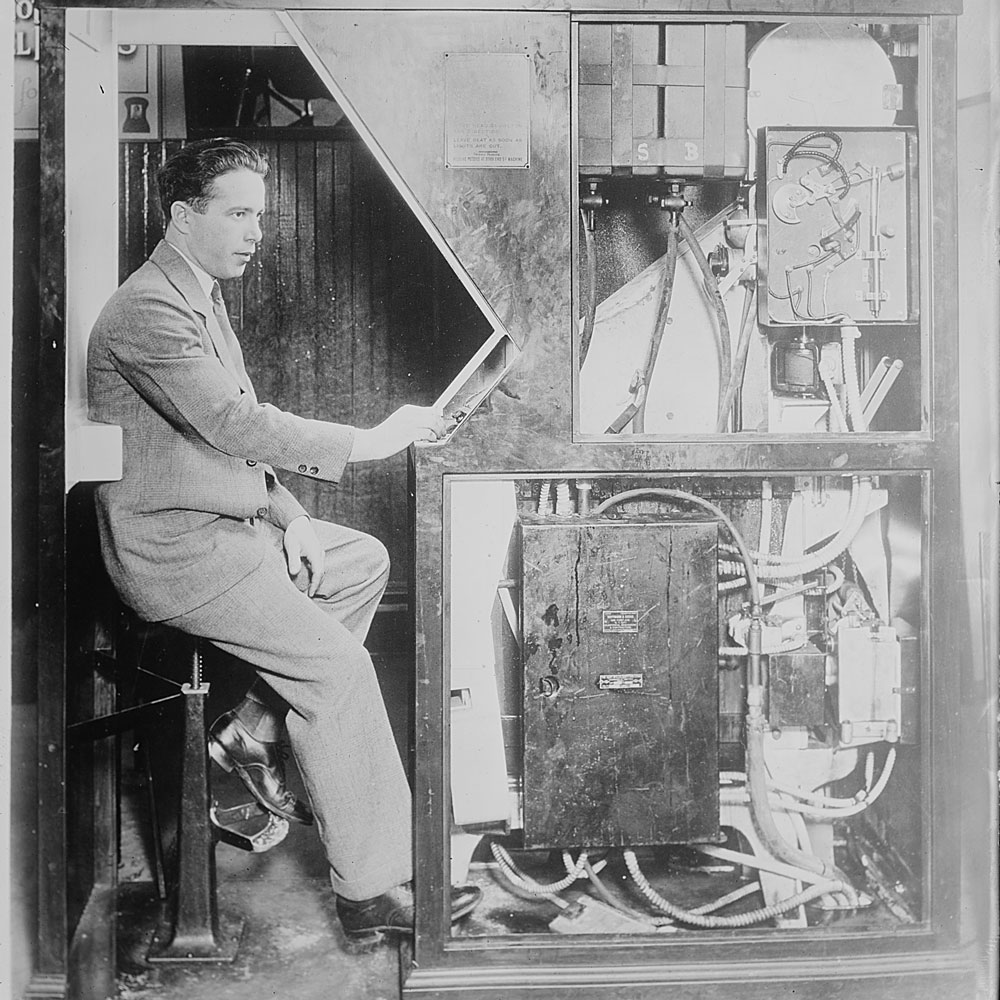
Anatol Josepho sits at the Photomaton photo booth he invented — eight photos for a quarter — which made its public debut in September 1925 in New York. Photo from Flickr Commons Project

With the Photomaton attracting customers (one source estimated 2,000 people per day) and press, in 1927 Josepho sold the North American rights to his invention for $1 million (more than $13.5 million in 2017 dollars) to a business group led by Henry Morgenthau Sr., a prominent Jewish New Yorker and former ambassador to the Ottoman Empire. “We will begin to dot strategic points in this country with studios at a rate slightly more rapid than one a week,” Morgenthau told the Times.

Pegged in the press as a “get-rich-quick genius,” Josepho nonetheless perplexed them with his altruism. He had a “plan to create a trust fund of half of the first million dollars to be devoted to general charity based along economically sound lines,” Josepho told the Times. In the same article, the paper labeled him a “Socialist,” which was echoed in other New York media during the Red Scare 1920s and was a potentially damaging epithet. Hardly considered was that Josepho’s generosity possibly had been motivated by his Jewish heritage — with a tradition of giving to the poor — or his exposure to the plight of other immigrants and refugees who had fled their countries in the post-World War I era.

In Josepho’s defense, a first-person column about his rise to success — under the headline “The Jewish World,” in the June 12, 1927, edition of the Syracuse Herald by Rabbi Jacob Minkin — stated: “[H]e is not a Socialist as has been declared; in fact, has no political affiliations whatsoever.”

In 1928, Josepho returned to California to stay permanently, moving with his wife into a home overlooking Mandeville Canyon. According to a book by Betty Lou Young, “Rustic Canyon and the Story of the Uplifters,” Anatol and Ganna often rode horses on the area’s mountain trails. On one such outing, Anatol found an area in Rustic Canyon near a spring that was suitable for a home site. The couple’s friend, famed humorist and actor Will Rogers, who owned property nearby and wanted them as neighbors, “even flew with him over the canyon in a plane and helped him plot out the site,” Young wrote.

Closing the deal, in 1932, Josepho bought 100 acres in Rustic Canyon from the Mountain Land Co., owned by Alphonso Bell (whose son later served eights terms as a congressman representing L.A.’s Westside).

After carefully clearing the land but preserving as many trees as possible, Josepho, who operated the steam shovel himself, contracted for a comfortable home, an “inventor’s cottage” and a barn to be built. He later called the ranch “Ganatolia,” after his wife.

In 1928, the couple had a son, Marco (who died in 2016). Two years later, they had a second son, Roy, whose birth was announced in the social column of the May 16, 1930, edition of the B’nai B’rith Messenger.

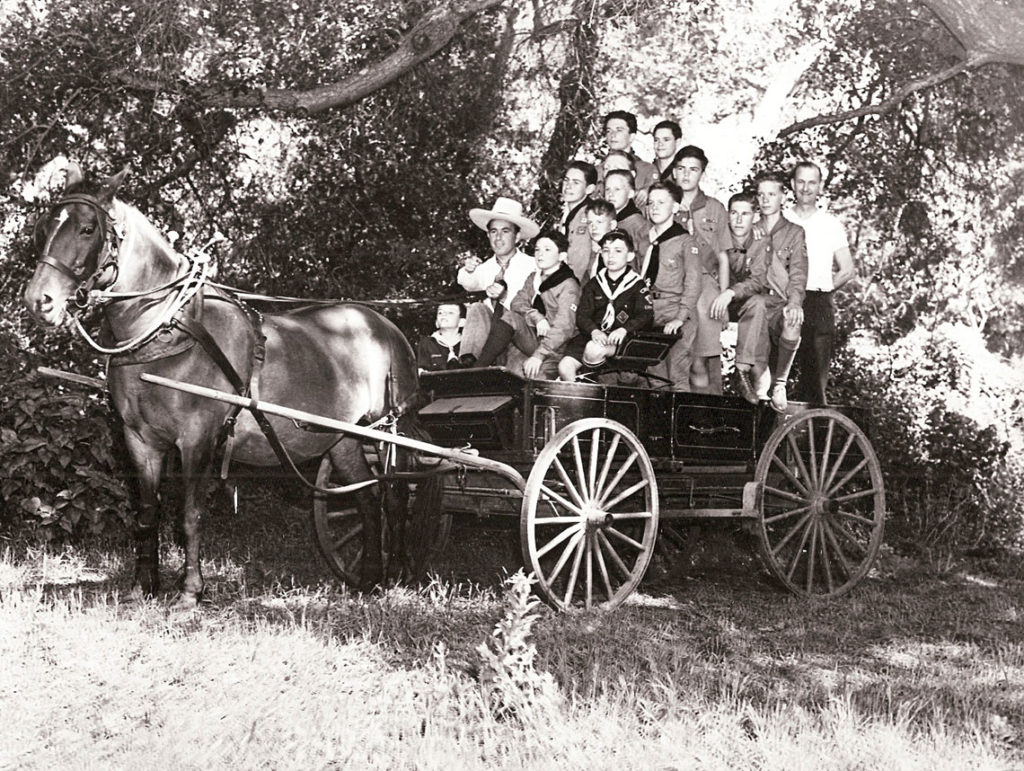
In 1941, Josepho purchased another 110 acres to the north of his property for what would become a Boy Scout camp. He may have given the land to the Boy Scouts (his sons were Cub Scouts) “to express his gratitude to his adopted land,” as Young wrote, or because he foresaw the property — if developed “with separate water tanks and access road” — could “act as a first line of defense,” buffering wildfires that came roaring down the canyon, as an article on the Crescent Bay Historical Project website speculated. Most likely, it was a bit of both. The land, plus an additional gift of $30,000, made Camp Josepho a reality that today has programs in moviemaking and robotics.

After their sons became teenagers, in 1946, the Josephos sold their home but remained in the L.A. area. Like a series of shots emerging from his photo booth, the next decades showed a series of images of the couples’ participation, leadership and contributions to the L.A. Jewish community and Israel.

In 1957, according to the B’nai B’rith Messenger, the first Anatol Josepho award, a Torah made in Israel, was presented by the Los Angeles Israel Bond Committee to Congregation B’nai David (today Congregation B’nai David-Judea): “In token of the congregation’s outstanding High Holy Day Israel Bond sales.”

In 1962, the Josephos, living at 1801 San Vicente Blvd., in Santa Monica, hosted a cocktail hour and dinner in their gardens saluting Ort’s Tel Aviv Vocational Training Center; and in 1966, Ganna was elected to the executive board of the Bay Cities Jewish Community Center.

Seeing that the Technion, Israel’s Institute of Technology in Haifa (established in 1912), was an institution focused on areas of innovation that had made his career, Josepho gradually became more involved with the Los Angeles chapter of the American Technion Society. In 1968, he was elected one of the national organization’s vice presidents .

In 1971, as a part of a California Day, a large delegation of Southern Californians, including the Josepho family, gathered in Haifa to participate in the dedication of the Ganna and Anatol M. Josepho Building on the Technion’s campus, a building for which they had made a major financial contribution. At the time, said an article in the Messenger, the building was “the largest on the campus.” Today, the nine-story building is called the Josepho Industrial Research Center.

Josepho died at a rest home in La Jolla, Calif., following a series of strokes, on Dec. 16, 1980.

As a place for new generations of immigrants — as well as Israel’s future technicians and scientists and those from developing counties — to dream and develop their own ways of picturing the future, the building he left behind at the Technion could not be more connected to the booth that Josepho had devised so many decades before.

Have an idea for a Los Angeles Jewish history story? Contact Edmon J. Rodman at edmojace@gmail.com.

Anatol Josepho: The immigrant who introduced us to the selfie Read More »

Tough love for David Suissa

This past week, David Suissa penned an article that misrepresented our movement, as well as the American Jewish community.

We, IfNotNow, compose a community that is motivated by Jewish traditions of fearless questioning and an uncompromising pursuit of tikkun olam. It is not, as Mr. Suissa articulated, the desire to “look like an anti-establishment rebel,” that motivates us; rather, it is the values of love and justice that inform our movement.

Our upbringings, grounded deeply in Jewish ethics, have prepared us for this moment in history, as the first year of a Trump presidency converges with the fiftieth year of an Israeli occupation of the West Bank.

In what one might term “tough love” for Suissa’s piece, Jewish Journal Editor-in-Chief Rob Eshman correctly declares that, “the occupation has twisted our communal soul.” Now, especially, is the time for bold opposition to hate-filled politics. Yet so many of our communal institutions, including AIPAC, have demonstrated the ease with which the pro-Israel establishment can be swayed by fearmongering tactics and Islamophobic sentiments. At last year’s AIPAC policy conference, Donald Trump’s speech – characterizing Palestinian society as bloodthirsty and anti-Semitic – was given a standing ovation by the majority of those in the room. Since then, AIPAC has continually failed to condemn the policies and rhetoric of Trump and his administration – policies that encourage racism, sexism, and even anti-Semitism – in the name of unconditionally rewarding those who promote the right-wing, pro-Israel party line.

Just as importantly, an unquestioning antipathy towards communities who criticize Israel is placing our communal institutions on the wrong side of history. Their pro-Israel criterion has not only prompted hostility towards disapproving members in the Jewish community, but also of other marginalized communities. One need not look farther than Mr. Suissa’s own track record to see this trend. Long before he appealed to the Jewish community to give IfNotNow a dose of “tough love,” Suissa called for, among others, “Tough Love for Islam,” “Tough Love for Black Lives Matter,” and “Tough Love for Obama.”

Not only do Suissa’s calls for “tough love” mischaracterize and dismiss communities, movements, and figures, but they also indulge in blatant bigotry. They minimize the struggle of communities who experience daily mistreatment by illustrating a world in which the oppressed are coddled. Suissa’s article advocating that the Jewish community “offer [Black Lives Matter] some tough love and constructive criticism,” for example, completely diminishes the often-violent sacrifices protesters make in order to bring attention to a dire reality. He also suggests that the difficulties faced by the Jewish community are equivalent to those faced by the black community — they are not.

Suissa asserts that Jewish organizations, out of fear of “losing” young Jews critical of Israel, are handling them with “kid gloves.” But one must ask: who is, in fact, doing this? Hillel at Ohio State has disbanded its Jewish LGBT support group because it participated in an event alongside Jewish Voice for Peace. The Conference of Presidents of Major Jewish Organizations refused to admit J Street, an explicitly pro-Israel organization that supports a two-state solution.

In Los Angeles a couple of weeks ago, AIPAC ensured the arrest of seven IfNotNow members for occupying its lobby. Many IfNotNow members have family who will not speak to them because of their work in our movement. Each of our members – many of whom love the country deeply and have family there –  risks a refusal of entry into Israel. We are regularly shouted at, told that we aren’t Jewish, or that we’re kapos. With such rhetoric, it is no surprise that the Jewish Defense League, a right-wing terrorist organization, attacked IfNotNow demonstrators and a Palestinian man during a peaceful action at AIPAC last week. So, we must ask again: who is handling us with “kid gloves?”

Suissa argued that our last action in Los Angeles simplified the issue of the Israeli-Palestinian conflict. He will get no argument from us when he says that it is complicated. Even now, Israel just approved the first settlement construction in the West Bank in over twenty years.

Every day that Israel denies Palestinians basic rights and freedoms is another day it cannot hope for any sort of security or an improvement in international standing. And, even more importantly, the chance of reaching a just and peaceful resolution grows increasingly slim.

We are under no illusions that ending the occupation will be easy. It is not “social justice on demand”; it will involve considerable risk. But the current methods by which alleged security is held in place are unacceptable, and we, as American Jews who are implicated in this violence, must work to end it.

In the face of this issue’s complexity, we ask a simple question – a question that our communal institutions have failed to answer for too long: Do we, as a community, believe that all peoples deserve freedom and dignity?

If the answer is yes, then we can no longer afford to advocate solely for ourselves. We cannot accept the vindication of a bigoted, xenophobic, and delusional leader based solely on his proclaimed support for Israeli policies. It is engrained in our Jewish heritage to stand with people in need. Will our communal institutions use their power to stand with those most targeted by a Trump administration? By a Netanyahu administration?

We reimagine an American Jewish community that fights for dignity and freedom for all, even if it goes against the policies of a particular Israeli government. We are building a community that is no longer complicit in upholding a system of violence against Palestinians. Mr. Suissa, join us!

The authors are members of IfNotNow.

David Suissa responds:

I stand by every word I wrote. By blaming only Israel for the absence of peace, the movement IfNotNow (INN) hurts peace. By ignoring Palestinian refusals to end the occupation, Palestinian teaching of Jew-hatred and Palestinian glorifying of terrorism, INN hurts Palestinians. And by ignoring the reality that Hamas and ISIS are likely to swoop in and massacre Palestinians after Israel leaves the West Bank, INN is dumbing down a complicated conflict. The community conversation is much healthier when everyone is challenged. Just as INN is free to challenge AIPAC and other groups, they should have no problem getting the same treatment. As they write, it’s the “Jewish tradition of fearless questioning.”

Tough love for David Suissa Read More »

Film Festival Season

The Los Angeles area film festival season starts soon!  Two outstanding ones include:

The Los Angeles Jewish Film Festival:  Always a favorite, this is expertly curated festival features wonderful films and runs from April 26th to May 3, 2017.  Founded in 2006, the festival’s Executive Director is Hilary Helstein, herself an accomplished film director.  It’s sponsored by the Los Angeles Jewish Journal, among others.  I’ll be there, and will post coverage as I do.  For more info. and tickets, visit lajfilmfest.org.

COLCOA French Film Festival.  If you are a fan of French cinema (and what self-respecting film buff isn’t?) you will enjoy the COLCOA French Film Festival, running April 24th to May 2.  For more info. and tickets, visit colcoa.org.

Many other festivals coming up, including the Los Angeles Film Festival, Dances with Films, Turner Classic Film Festival, and on and on.  Isn’t is great living in Los Angeles?

Film Festival Season Read More »

The art of the deal

Following Netanyahu’s visit to the White House, a leaked transcript of President’s Trump’s daring proposals about a final settlement between Israel and the Palestinians has come to light.

The White House has refused to comment, but Julian Assange of WikiLeaks said “more would be released very soon.” According to WikiLeaks, the following conversation took place on 22 February 2017.

Trump:” We’re gonna get the deal of the century…”

Pence:” Yeah…”

Tillerson: ”But what are we gonna do that’s new? Basically everything that’s been tried before hasn’t worked.”

Trump: “Can you summarise all the different proposals quickly, so we can review them?”

Tillerson: “Sure…hang on a minute please while I look them up.”

Trump: ”We’ll get a beautiful deal…a real beautiful deal, believe me, that will be the envy of the world.”

Tillerson: “We have the roadmap where Israel will retain major settlement blocs and the Palestinians establish a state in the West Bank and Gaza. We also have a situation where Israel trades land [in Israel] for land of equal size in the West Bank. Another scenario is Israel withdrawing completely to the pre-1967 cease fire lines in exchange for diplomatic relations with all Arab countries underwritten by American and European security guarantees. Another possibility is a single Israeli state from the Jordan River, and Jordan becomes Palestine. It already has a Palestinian majority and was Eastern Palestine before 1918. Or they can be compensated and go elsewhere—Chile already has a significant Palestinian community.

Trump: “Why did these proposals not work?”

Greenblatt: ”The Palestinians said that any agreement would not mean the end of the conflict as Israel had demanded and that they won’t recognise Israel as the nation state of the Jews. ..this was a key Israeli demand.”

Trump: That doesn’t make sense. How can you sign a final agreement that says that it’s not the end?”

Pence: ”There are a lot of things that don’t make sense Mr President.”

Tillerson:”So then, what are you proposing?”

Trump: “We have a scenario where Israel wants to be recognised as the Nation State of the Jews. The Palestinians refuse. They also want … actually I’m not really sure…but certainly they want some kind of state.”

Greenblatt: “Seems impossible to reconcile.”

Pence: “Yeah.”

Trump:” There will be a new country that can satisfy both parties. It will guarantee the aspirations of Israelis and the Palestinians. I am going to initiate a massive aid program like the Marshall Plan, but bigger. Ramallah will have the best golf course in the world…believe me…”

Greenblatt: ”With respect Mr President, massive aid projects have never worked with the Palestinians in the past.”

Trump:” They got it wrong…this will be different. I am going to get Jared to start a massive building scheme, run by a new subsidiary of Trump Towers called Trump Minarets…believe me…Ivanka will advise on fashions…stunning hijabs and burkas are going to be the envy of Paris…believe me. I will also make Palestine great again.”

Friedman:” And the Israeli demands for recognition as nation state of the Jews?”

Trump: ”I will pull of an amazing deal…believe me, just amazing.”

Tillerson: “How?”

Trump: “The new state will be called Palestein.”

Greenblatt: ”The Israelis won’t agree to that.”

Trump: Not Palestine, but Palestein… spelt differently as in s-t-e-i-n, that rhymes with Goldstein.

So, both should be happy. Sounds Jewish and retains the old name.”

Friedman: “What happens if the Israelis want to pronounce it Palesteen or Paleshtein?”

Trump: “They can pronounce it anyway they want…that’s the art of the deal. It’s about the spelling.”

Tillerson: ”And the territory?”

Trump: “All the pre-1967 West Bank and Eastern Jerusalem. That‘s what the Palestinians wanted.

And also include Israel too. It will all be Palestein.”

Greenblatt: “And the Israeli communities… settlements there?”

Trump: “They remain but will fall under the government of Palestein, which will be a federal system. There will also be a rotating system of a Jewish president and Palestinian prime minister, every four years.”

Friedman: “If the country is called Palestein, then what are the people going to be called?”

Trump: “Good question—Palesteins…rhyming with Philistines. Call Bibi and Babbi…Abbas… and tell them about our deal.”

Tillerson: “It’s already been leaked Mr President. They know.”

Trump: “What the hell..?”

Tillerson: “In fact, we already got a response from the Israelis. They say it’s an interesting idea and want to study it.”

Trump: “Great! Believe me that’s the art of the deal. A fair win for all!”

Tillerson: “Mr President, the Palestinians have already rejected it.”

Trump :”Huh?”

Tillerson: “They say Palestein sounds too Jewish.


Ron Jontof-Hutter is a Fellow at the Berlin International Center for the Study of Antisemitism and the author of the satirical novel, “The trombone man: tales of a misogynist.”

The art of the deal Read More »