President Donald Trump shouted down two reporters who asked him about rising anti-Semitism in America and said he “hates” being called an anti-Semite, although neither reporter called him one.
Trump, fielding questions at a contentious news conference Thursday about the multiple scandals and mishaps afflicting his young administration, said he wanted to take a question from a friendly reporter.
Jake Turx, a Charedi Orthodox reporter for Ami Magazine, volunteered, saying “I’m friendly,” and prefaced his question by saying his community did not regard Trump as anti-Semitic.
“I haven’t seen anyone in my community accuse you or anyone on your staff of being anti-Semitic,” Turx said. “We understand that you have Jewish grandchildren, you are their zayde,” or grandfather.
Trump appeared to understand what Turx was saying, thanking him.
“What we haven’t really heard being addressed is an uptick in anti-Semitism and how the government is planning to take care of it,” Turx continued, citing dozens of bomb threats called into Jewish community centers in recent weeks.
Trump interrupted and accused Turx of dishonesty.
“It’s not a simple question, not a fair question,” he said. “I am the least anti-Semitic person that you have ever seen in your entire life.” The president also said he was the “least racist person.”
Turx interrupted, saying he did not believe Trump was anti-Semitic, and Trump shouted him down, “Quiet, quiet, quiet.”
“See, he lied about, he was going to get up and ask a straight simple question, so, you know, welcome to the world of the media,” Trump said.
“I hate the charge, I find it repulsive, I hate even the question,” he said, going on to cite Israeli Prime Minister Benjamin Netanyahu’s statement a day earlier at a joint news conference that “there is no greater supporter of the Jewish people and the Jewish state than President Donald Trump.”
“You heard the prime minister, you heard Netanyahu yesterday, did you hear him? Bibi,” Trump said. “He said, ‘I’ve known Donald Trump for a long time,’ and then he said, ‘Forget it,’ so you should take that instead of having to get up and ask a very insulting question like that.”
Another reporter tried to raise a similar question, asking about “rising anti-Semitism,” some of it committed in his name.
Trump, again interrupting, replied that he thought a lot of the instances were his opponents trying to smear him by disguising themselves as his supporters.
“Some of that anger is caused by people on the other side,” he said. “It will be by people on the other side to anger people like you.”
Trump defended his record, saying the country was divided long before he took office and that it was his plan to unite it.
Turx on Twitter said he hoped the White House would understand that Trump “clearly misunderstood” his question.
“This is highly regretful and I’m going to seek clarification. #TrumpNewsConference,” he wrote.
President Trump clearly misunderstood my question. This is highly regretful and I'm going to seek clarification. #TrumpNewsConference
The Kushner family has dialed down its interest in buying the Miami Marlins now that reports have surfaced claiming the baseball franchises current owner will likely be named the U.S. ambassador to France.
Since Donald Trump’s son-in-law Jared Kushner is a senior adviser to the president, the Kushners reportedly are wary that the purchase would look like a corrupt ambassadorship-for-team trade.
Marlins owner Jeffrey Loria, 76, is expected to be announced for the post within days, The New York Times reported Thursday. He donated at least $125,000 to the Trump campaign last September.
Reports last week indicated that the Kushners, led by Jared’s brother Joshua, had been in talks to buy the Marlins for months. Loria’s asking price was $1.6 billion.
“Our family has been friends with Jeff Loria for over 30 years, been in business together, and even owned a AAA baseball team together,” Jared Kushner’s brother-in-law Joseph Meyer, who took over the Kushner-owned New York Observer when the 36-year-old moved to Washington, D.C., to become an aide to Trump, told the New York Post in a statement Wednesday night. “Although the Kushners have made substantial progress in discussions for us to purchase the Marlins, recent reports suggest that Mr. Loria will soon be nominated by the president to be ambassador to France.
“If that is true, we do not want this unrelated transaction to complicate that process and will not pursue it. The Kushners remain interested in purchasing a team and would love to buy the Marlins at another time.”
Loria, a Jewish art dealer from New York, owned the Montreal Expos (now the Washington Nationals) in the early 2000s. He purchased the Marlins in 2003 and the team went on to win the World Series that year. Since then, the Marlins have not reached the playoffs, and Loria has become unpopular among the club’s fans for meticulously keeping the payroll among the lowest in the league.
Like many people I know, I have always had liberal values, and I was born with white privilege.
Like others, I have verbally supported issues like women’s right to choose, LGBT rights, gun control, higher minimum wage, healthcare for all, and opposed institutional racism and bigotry, etc. However, our privileges still exist, and we haven’t done nearly enough. Many of us have been expressing our beliefs for years, but we haven’t shown up. We haven’t joined Black Lives Matter or anti-deportation or a myriad of other types of protests. We haven’t demanded action from our local representatives over and over again until they are forced to listen. We haven’t marched alongside those who are impacted the most by human rights violations and harmful policies that perpetuate institutional racism and bigotry.
Some don’t agree with the “liberal” concepts above, in which case you will write this off, and therefore I am mostly not speaking to you. But there is one glaring reason, as I see it, that our community of white privileged liberals has neglected to protest enough and therefore neglected those who needed our voices most. We are not personally impacted. Most of us have access to high quality healthcare, we were able to marry the person we chose, we do not live in areas with high rates of gun violence, we are not victims of discriminatory policing practices, we have educational opportunities that lead to higher paying jobs, we were born in the US and do not have to fight to live here, and so much more.
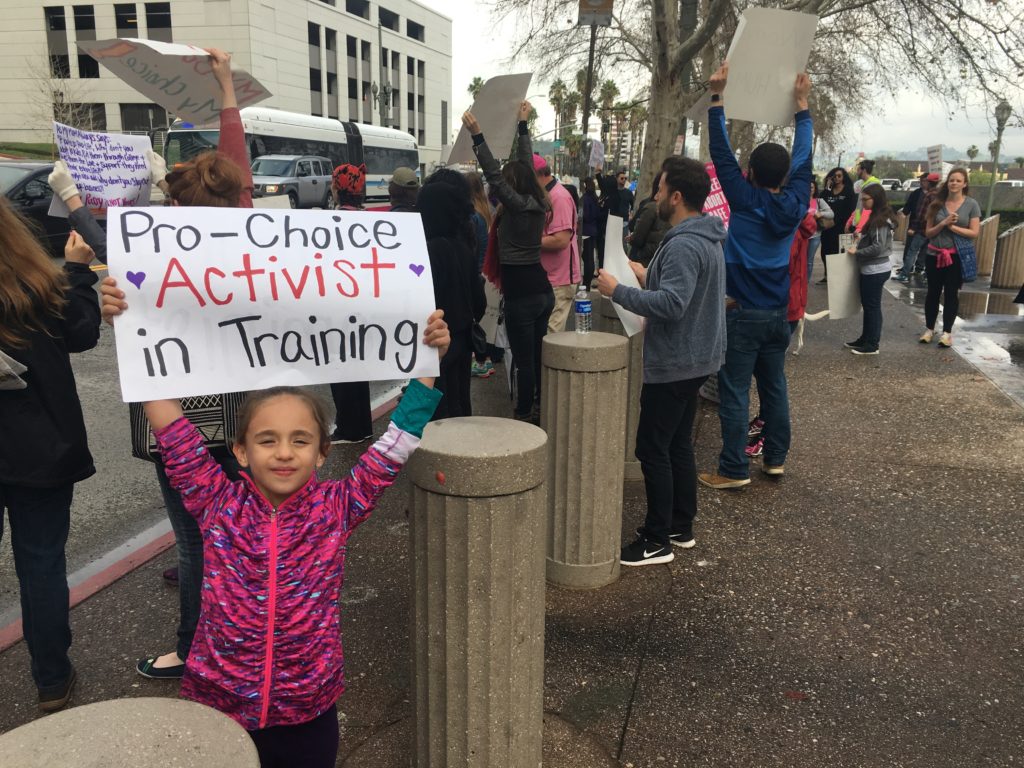
So why would we protest? When would we find the time? Standing in intersections with cardboard signs is unseemly, and uncomfortable, and maybe it’s just not our thing. This is the very definition of white privilege. It allows us to go about our day to day lives and believe in these liberal values but not sacrifice our convenience or comfort. Many write checks to charities that are doing the hard work, and that is wonderful but not enough. I am extremely new to the protesting world and have for many years been neglecting the people and causes I claimed to support. I have just recently taken part in the women’s march, the homeless count, the LAX protest against the Muslim ban, a pro Planned Parenthood rally, a Jewish event for welcoming refugees, a protest against deportations and anti-immigrant rhetoric/policies, and have been attending meetings with local advocacy groups. Now that I have started joining in, I can see in the eyes of those who have been protesting their entire lives, that they are resentful. They may not think it or say it out loud, but they know that when the protest is done, I can walk to my car and go home to a safe neighborhood and continue enjoying the privileges which they have never been afforded. They are wondering where we were before.
The recent presidential election and the aftermath of the inauguration have shaken something loose in many of us. I realize now, we should have been there all along, in the streets, working for social justice in ways that we didn’t have time for or that made us uncomfortable or that others didn’t approve or understand. It is too late to fix all that has already happened, we cannot truly atone for all our privileges, but we can try to stop being part of the problem. The liberal values for which we feel so strongly will not matter if we sit on the sidelines and let injustices continue. I claimed to be passionate, mostly by posting frequent political rants on Facebook, yet I allowed my privileges to get in the way of joining the protests. Violence is never the answer, but disruptive, inconvenient and uncomfortable protests are often the only way victims of these issues can be heard. And their voices will only get louder and more impactful if we join them. Donations are great and necessary, but if you look in the eyes of someone who is terrified of being deported, or being shot, or not being able to afford medicine, you may see that the money does no good if they are all alone when they literally scream for justice.
Protest-fatigue may be real, but you will never find it in those who have been fighting for their lives. I am now committing to do my best, which will still never be enough, to go outside my comfort zone, and to risk being judged by people who do not understand. I am committing to own my white privilege and my children’s white privilege, and to never deny it exists and that we are part of the problem. I am committing to chant in the street even when the person next to me wonders why I wasn’t there before. I am committing to inconvenience myself in a way that will never compare to what others experience thru racism and bigotry. I am committing to use this political climate for something good, and a positive change in my own actions, and to fight so that someday the people we have neglected can receive basic human rights and justice, and therefore my own privileges will no longer exist. I will protest.
Rachel Rosen is a health educator, wife and mother in the San Fernando Valley.
When it comes to Rachel Bloom, it’s hard to know whether to start with the sex or the Jewishness. Both seem to ooze out of her, like a classic starlet of the Yiddish theater in which burlesque comedy could arrive in a voluptuous feminine package.
Consider the music video “You Can Touch My Boobies,” which has more than 5 million views. Bloom plays a Hebrew-school teacher who appears in a dream to seduce her kippah-wearing bar mitzvah student, Jeffrey Goldstein. Clad in a black bustier and fishnets, she rides around in a toy car shaped like a giant breast — with a nipple for a hood ornament — crooning, “We’re gonna have some fun tonight.” No need to check the locks, she tells Goldstein, because — wink, wink to American Jewish dining habits — his parents are out at Benihana. But Jewish guilt is never far behind, and suddenly, Golda Meir appears to scold Jeffrey for his fantasies: “You have brought shame on your family and the Jewish people!”
In the tradition of Woody Allen, Bloom has deftly translated the American-Jewish experience — its neuroses, obsessions and culturally distinctive lexicon — into mainstream entertainment. As a writer and actress, Bloom routinely probes aspects of her identity — relishing, mocking, exuding sexuality and Jewishness — both in the prolific collection of music videos she posts on YouTube, as well as on the CW show “Crazy Ex-Girlfriend,” a musical romantic comedy that she co-created and stars in.
In Rachel Bloom, we have a female heir to the neurotic, outsider Jew who is constantly negotiating identity through sex and ethnic baggage. There are strains of Philip Roth in her work — a sex-obsessed Jew feeling ever out of place, trying to grow up and fit in. And what we gather from Bloom, a millennial, is that although political frissons have somewhat altered the American-Jewish makeup, a generation later, communal preoccupations are the same.
The 29-year-old is an expert at channeling the tropes of her male artistic and literary forebears, where sex and Judaism coalesce and collide as integral, paradoxical and indispensable to the human experience. But she upends theses legacies with something new and utterly transgressive: a female point of view.
“I think a lot about Fanny Brice’s aesthetic,” Bloom told me when we met for coffee last month in Silver Lake. “Her whole thing was Yiddish, Yiddish, Yiddish. I did 23andme [the genetic test] and I’m 97 percent Ashkenazi Jewish. Yiddish is what I connect to.”
The comparison to Brice (the comedian-actress immortalized in the movie “Funny Girl”) is apt — except for the fact that Bloom, unlike Brice, writes all of her own material. In just two seasons of “Crazy Ex-Girlfriend,” Bloom has written or co-written more than 80 original songs. “That’s more than four Broadway shows,” she said.
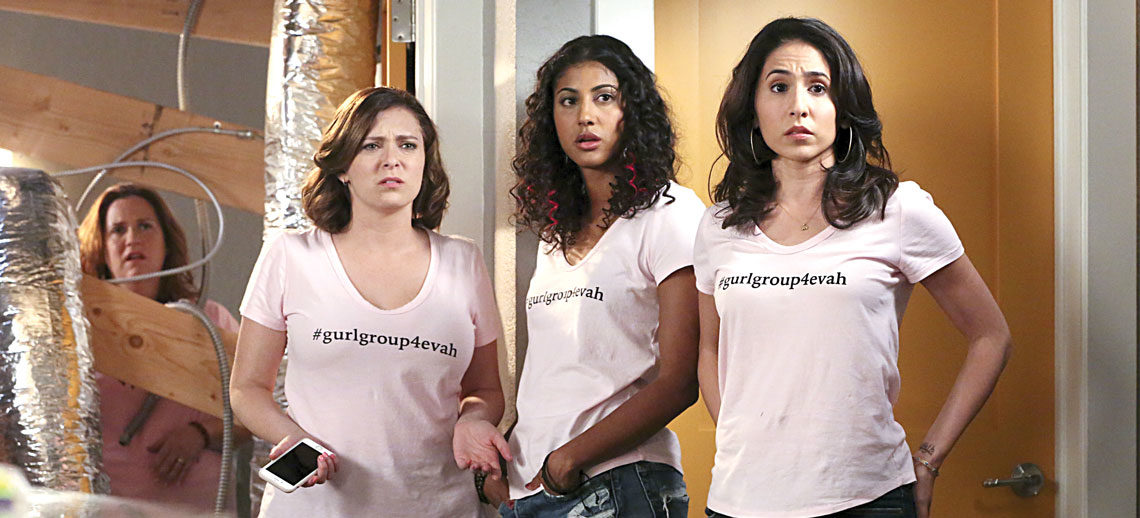
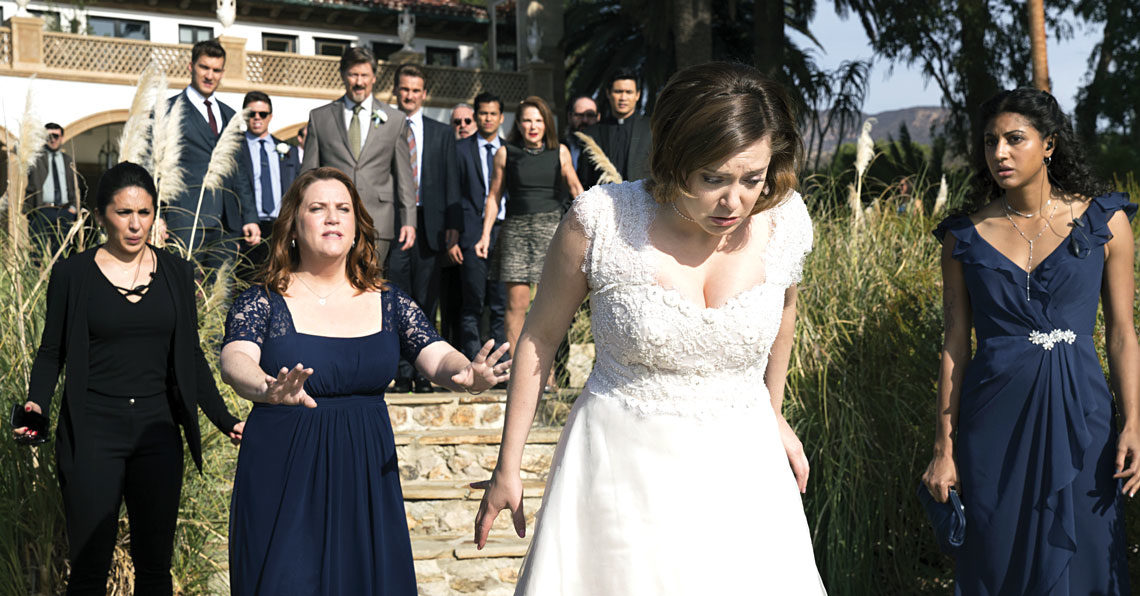
Rachel Bloom (second from left) is Rebecca Bunch in “Crazy Ex-Girlfriend.” Photo by Mike Yarish/The CW
“Crazy Ex-Girlfriend” tells the story of Rebecca Bunch, a tenacious, Harvard-educated Manhattan lawyer. After a chance encounter on a New York sidewalk with a guy she dated at summer camp, she becomes unmoored, determined to pursue her crush all the way to the West Coast. She walks out of her high-paid, partner-track job and follows the object of her affection to his hometown — West Covina. Last year, the role earned Bloom a Golden Globe award.
The day we met, Bloom had just wrapped the show’s second season, which is now available in its entirety on Netflix. She declared a recent episode “the most Jewish episode we’ve ever done.” In Season Two, Rebecca finally ensnares her lifelong obsession, the under-employed, none-too-bright Asian-American Josh Chan (Vincent Rodriguez III), and makes him her boyfriend. Before long, they’re heading together to Scarsdale for a bar mitzvah, and Rebecca frets nervously over how her family and friends will receive them. “Will Scarsdale Like Josh’s Shayna Punim?” asks the episode’s title.
What Rebecca does not expect is that her overbearing mother (played expertly, as always, by Tovah Feldshuh) warms quickly to Josh, learning to call him a “Pacific Islander” instead of “Oriental,” and teaching him how to make and pronounce challah. But rather than quell Rebecca’s anxiety, her mother’s acceptance intensifies it, as if to say: If a Jewish mother approves, something is definitely wrong. Rebecca’s anxiety then shifts from Josh’s outsider status to her own: At the bar mitzvah, it isn’t the non-Jewish Josh on trial, but Jewish tradition itself.
Far-fetched? More like autobiographical. Bloom herself never really felt she belonged.
“I’m a West Coast Jew, so there’s always this feeling of, like, ‘What are my roots?’” Bloom said of growing up an only child in Manhattan Beach. Religious observance was anathema at home, but, Bloom said, “We talked about being Jewish a lot, we talked about Christian oppression a lot, and for as long as I can remember, my father’s been telling me to read ‘The Protestant Ethic and the Spirit of Capitalism.’
“[My] family felt like East Coast Jews: I was not allowed to swim in the ocean because my mother was afraid I’d drown. My parents were wary of me being in the sun because of skin cancer. I loved musical theater, Stephen Sondheim, Woody Allen. Plus I had obsessive-compulsive disorder,” she said. “All of these things combined made me feel like an outsider living in a beach community where everyone is surfing and bleach-blond. They don’t even have a word for anxiety.”
During the episode in Scarsdale, which aired in January, Rebecca is on edge the entire time. At the bar mitzvah party, she is constantly rolling her eyes and whining about how “miserable and terrible” Jews are. When her childhood rabbi, played by Patti LuPone, asks if she’s found a synagogue in California, Rebecca replies that she doesn’t believe in God, so it’s not on her to-do list. “Always questioning,” the rabbi replies gleefully. “That is the true spirit of the Jewish people!”
Rebecca is most disheartened that the boy she brought to shield her from Jewish communal rituals is actually quite enjoying himself. She can’t understand why Jewish psychological mishegoss is not blatantly apparent to him.
“You don’t understand,” Rebecca tells Josh. “You are — forgive me — a non-Jew from the West Coast. Let me explain how it goes. East Coast: dark, sad. West Coast: light, happy. These people don’t understand what fun is. Trust me.”
Josh and Rebecca (Vincent Rodriguez III and Bloom) sing to each other in an episode where Josh later meets her family and friends at a bar mitzvah party. Photo by Scott Everett White/The CW
That’s when the horah begins — “a fun dance!” Josh exclaims — but while the traditional klezmer music plays and everyone happily clasps hands, Rebecca’s view that tragedy is never too far from the Jewish psyche is proven when the rabbi sings: “Now it’s time to celebrate / Grab a drink and fix a plate / But before you feel too great / Remember that we suffered.” The song, appropriately titled “Remember That We Suffered,” is not only the defining Jewish number of the series so far, but perhaps the most Jewishly astute musical number since “Fiddler on the Roof.”
Ironically, Bloom said it is the absence of personal Jewish suffering that has enabled Jewish exploration in her work.
“People who came over here from Europe watched their families being murdered because of Judaism,” she said. “They were terrified for their lives because of Judaism. And they came to an America that was still quite anti-Semitic, so of course they wanted to assimilate. I’ve never really suffered anti-Semitism. Sure, sometimes people call me a kike online or whatever — because people say horrible things on the internet to everyone. [But] I have never been afraid for my life because of my heritage. And that gives me the freedom to talk about it.”
Like most American Jews, Bloom fits firmly into an assimilated framework, describing her Judaism in mostly cultural, secular terms. Being Jewish is “Mel Brooks!” she said. “The feeling of being an outsider, the being cold in restaurants, the guilt, the anxiety.” She said her husband, Dan Gregor, grew up “Conservadox” on Long Island and attended yeshiva until eighth grade, but ultimately left the religious life. As a couple, they celebrate with occasional holiday meals, but a question about shul attendance got a deep, resounding “Noooo.” Not even on the High Holy Days?
“I love thinking about the fact that it’s the High Holidays,” Bloom said. “But at end of the day, he and I are both secular people. I do not believe the Torah is the word of God — I believe it’s very interesting, and that it informs my entire heritage, and there are things to be learned from it, but I do not believe the universe cares if I have a cheeseburger.”
Bloom earned her musical theater bonafides at NYU’s Tisch School of the Arts, where she led the school’s sketch comedy group, Hammerkatz. A year after graduating in 2009, she made a splash with the self-produced music video, “F— Me, Ray Bradbury,” about a young woman who fantasizes about the science fiction author and masturbates while reading his stories. Bloom’s character alternates between sex kitten — dressed like Britney Spears in “ … Baby One More Time” — and sci-fi geek, turning down a date to stay home and read.
“When I started doing musical comedy, I realized that a lot of pop music, even though I love it, does not represent how people actually are,” Bloom said. “Bradbury” was her attempt to “reconcile what I thought I should be like with what I actually was like. And I found more people [related] to the latter. More people feel like outcasts, and feel like they don’t fit in. All of us feel some form of imposter syndrome.”
After “Bradbury” went viral, Bloom continued to release a string of music videos, as well as the album “Suck It, Christmas,” a collection of Chanukah songs co-written and produced with her husband and her writing partner, Jack Dolgen. In “Chanukah Honey,” a parody to the tune of “Santa Baby,” Bloom again plays come-hither sex kitten to a Jewish love interest who “got an MBA from Penn — Amen” but, unfortunately for her, dates Japanese women. Replete with references to the JCC, bat mitzvahs and camp, Bloom tempts her crush to “Come and flip my latkes tonight” as she rolls around on the floor in a blue-and-white Santa outfit. Of course, with Bloom, being a good Jewish girl, sex isn’t all she’s after: “But seriously,” she asks as an aside, “do you want kids?”
In “Can Josh Take a Leap of Faith?” — the Season 2 finale — Bloom’s character, Rebecca (right), is all dressed up for her big day when complications ensue. Photo by Michael Desmond/The CW
On her first trip to Israel last year, Bloom said, she played her Israeli tour guide some tracks from the Chanukah album, thinking he’d get a kick out of it. “We wrote a song about cantors, but no one in Israel talks about cantors,” she observed. Bloom was surprised to discover that even though she “loved” visiting Israel, she didn’t really relate to it. “It was really crazy to be in a country for all Jews, but Israel is not my culture,” she said.
Because she is an Ashkenazi Jew, European persecution is much more her thing, and it pops up in the animated video “Historically Accurate Disney Princess Song,” a feminist send-up of Disney fairy tales. While searching for her prince, Bloom encounters little Jews hiding out in the forest. “I never did ask you, why do you hide in the forest? Oh, I see, to hide from people trying to kill you!”
The video caught the attention of screenwriter Aline Brosh McKenna, who penned “The Devil Wears Prada” and “27 Dresses.” She arranged to meet Bloom; together, they solidified the idea for “Crazy Ex-Girlfriend” and promptly sold the pilot. Bloom had her big break into Hollywood.
What followed was a crippling period of anxiety and depression. “Mental illness runs rampant in my family,” Bloom said, “and no one has ever dealt with it.” The actress speaks openly and publicly about her struggle with anxiety — and not the kind treated as a kitschy Jewish trait, but a debilitating affliction. To tame her illness, she does cognitive behavioral therapy and practices meditation. She also sees a psychiatrist.
“I think keeping things taboo, keeping things secret, for me, that’s when things get bad,” she said. “When you learn to deal with anxiety, you think about what you actually know to be true versus what you tell yourself. These catastrophic thoughts, do you actually think those things are going to happen?”
The angst dates back to middle school, where Bloom said she was bullied. “I never felt pretty,” she said. “I wanted to be pretty, but I felt disgusting. And people told me, ‘You’re ugly; you’re a loser.’ It was the way I dressed, I cut my own hair. Then in eighth grade, I started to get boobs and I got more positive attention. And that only continued to grow. So I feel like I have a perspective on being a sexual being, as someone who hasn’t always been that. I appreciate it, but I also see the absurdity of it: Suddenly I have value because sacks of fat on my chest grew?”
Bloom’s interest in the way sex shapes identity is a constant theme in her work, a trait she shares with male Jewish predecessors like Woody Allen and Philip Roth. But her approach to sex constitutes a radical departure from the conventions of Jewish sexuality that have been canonized in film and literature — mainly by men. Whereas Jewish men typically have dealt with feelings of extreme sexual alienation, Bloom offers the bliss of sexual possibility. Where her male counterparts were ensorcelled by sex, Bloom is determined to demystify it.
At the end of the “Bradbury” video, instead of allowing a reference to Bradbury’s book “Something Wicked This Way Comes” to serve as pun, Bloom trades the erotic for the mechanic: “And by come, I mean ejaculate,” she declares, as if giving a science lesson.
Sex gets the same biological treatment on her show, which has featured numerous musical numbers that deal with the more visceral, uncomfortable truths about sex. “The Sexy Getting Ready Song” is about the difficult, unpalatable things women do to groom themselves for a date — and includes a bloody scene of anal waxing. In the sardonic hip-hop number “Heavy Boobs,” Bloom salutes and ridicules her ample bosom by dressing as a scientist holding up plastic bags filled with breast fat. The song “Period Sex” needs no explanation.
“The reason I’m so open and honest and brassy and ballsy about this s— is because my goal, if there’s a goal that I have as an artist, would be to make us all realize we are all just animals on this earth made of guts, who are all just trying to survive and get along,” she said.
If the defining feature of Jewish sexuality until now was sexual inadequacy, Bloom has rewritten the script. A child of the post-feminist generation, she is fully awake to her sexual power. But rather than use it strictly to seduce, she subverts the male gaze by drawing attention to the body’s anatomical indignities. It’s as if she’s trying to warn young Jeffrey Goldstein that his sexual fantasy will likely end with a urinary tract infection.
“There might be a tiny part of me that’s still a little afraid of being sincerely sexy because then you risk looking foolish,” Bloom said. “It’s much easier for me to be brassy-funny-sexy because there’s a protectiveness to that, and I don’t want to feel taken advantage of. It’s all about control.”
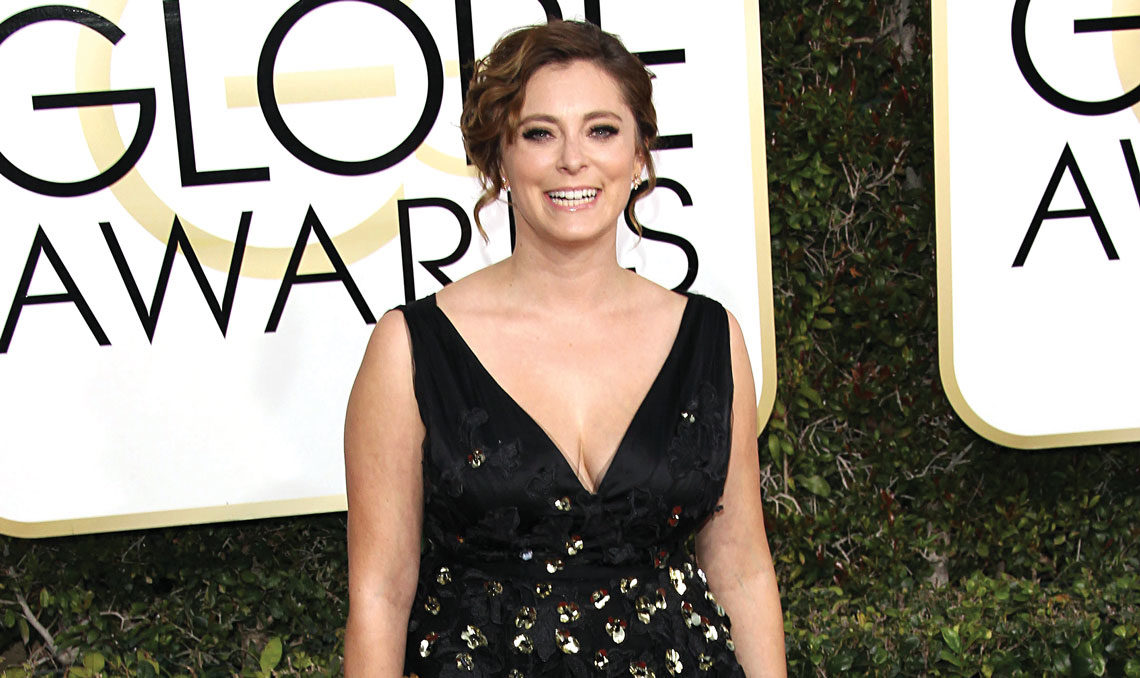
Bloom at the Golden Globes in January. Twice nominated for ‘Girlfriend,’ she won in 2016. Photo by Jen Lowery/via Newscom
With lipstick and a dress, Bloom can easily play the bombshell. But off-screen she’s content in a gray T-shirt and bomber jacket. When we meet, she isn’t wearing an ounce of makeup, another way she peels back the curtain on the many façades of being female.
“When I learned sketch comedy, I felt like I suddenly had to become a dude, because that’s the culture of comedy,” she said, lowering her voice to sound like man. “Dude, bro, f—.’ There is a certain adopting of a façade when you are anything other than the majority, and I think that gives you an understanding of others who are oppressed.”
If feminism bequeathed to her a creative benefit, Bloom said, it is “the freedom to say what I want.”
Her fearlessness certainly resonates with her Jewish audience, which goes bananas every time Bloom explodes an old stereotype. After she took on the meaning of Jewish American Princess in the “JAP Battle” rap, a female writer for the Jewish online magazine Tablet ecstatically declared, “I am FINALLY THE DEMO OF A THING. I have never been the demo of a thing!”
But ultimately, a Jewish audience may not be enough to sustain even a critically acclaimed show.
“I’m not afraid to make my show Jewish,” Bloom said, “but at the same time, my show is the lowest-rated show on network television. So while specificity is important to good art, I don’t know how much of a mass appeal there is in openly talking about Judaism.”
In the past, Jewish artists like Allen and Roth could be rueful about their Jewishness, perhaps a little bit ashamed. But not Bloom. Instead, she seems to revel in it. And she’s not prepared to stop anytime soon. At the end of our meeting, Bloom was rushing off to start work on Season Three. It’s not just a job for her, but a community, a purpose, a spiritual salve.
“For most of my life, I’ve kind of felt like I don’t really have a place, and the success of this show not only draws me to people who have also felt like that, but it makes me feel I have a place to fit in. It’s cathartic to realize I’m not alone.”
While Bloom preps young Jeffrey Goldstein for his bar mitzvah, he falls into a dream in which she reappears as a fishnet-clad vixen ready to make him a man.
Best line: A cameo appearance by “Golda Meir” in which she scolds, “You’re going to be a rapist!”
Views: 5 million+
‘Chanukah Honey’
YouTube (2013)
https://www.youtube.com/watch?v=7U0k_vHxc2k
In a parody of “Santa Baby,” Bloom wears a blue-and-white Santa outfit to try to seduce her Jewish crush by playing up their tribal bond and cooing, “Come and bless my challah tonight.”
Best line: “At the JCC / you play basketball / so tall! / You must be five foot eight.”
Views: 447,000+
‘JAP Rap Battle’
‘Crazy Ex-Girlfriend’ (2016)
https://www.youtube.com/watch?v=QcVwnSSrgxg
Rebecca Bunch (Bloom) and her childhood nemesis, Audra Levine (Rachel Grate), duke it out in the Jewish American Princess Rap battle. These two “She-brews from Scarsdale” drop crazy Jewish verse, insulting each other with references to Birthright, AEPi and seder plates.
Best line: “We’re liberals / duh / progressive as hell / though of course I support Is-ra-el.”
Views: 422,000+
‘Remember That We Suffered’
‘Crazy Ex-Girlfriend’ (2017)
At a bar mitzvah in Scarsdale, Rebecca’s childhood rabbi (Patti LuPone) and over-the-top mother (Tovah Feldshuh) prove that even during celebration, trauma is never too far from the Jewish psyche. This horah contains “the sweet and the bitter / Streisand and Hitler.”
Best line: “When I say ‘We,’ you say ‘Suffered’ / We — Suffered! / We — Suffered!”
Views: 112,000+
‘F—- Me, Ray Bradbury’
YouTube (2010)
Bloom proves she’s a person of the book with this explicit entreaty to “the greatest sci-fi writer in history.”
Best line: “I’ll feed you grapes and dandelion wine / and we’ll read a little Fahrenheit 69.”
Views: 3.7 million +
‘Historically Accurate Disney Princess Song’
YouTube (2013)
Bloom offers a feminist send-up of Disney fairy tales as she searches for her prince in a medieval village decimated by the plague where Jews hide in the forest out of fear for their lives.
Best line: “Oh look everyone! It’s my friends from the forest — The Jews! Hello Jews! … Tell me, have you ever had a dream you thought wouldn’t come true? Oh I see, your dream is that people won’t want to kill you. Well, that’s definitely a dream that won’t come true!”
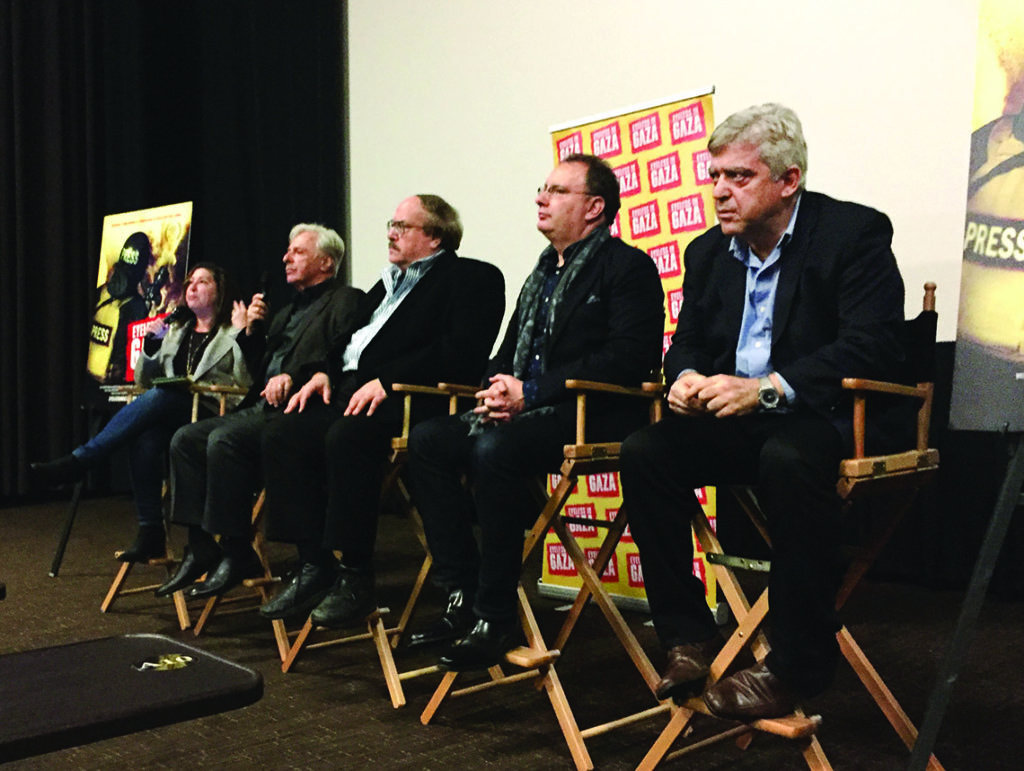
“Eyeless in Gaza,” a documentary that attempts to show how Israel suffered from biased media coverage during its 2014 war with Hamas in the Gaza Strip, had its Los Angeles premiere on Feb. 6 at the iPic Theaters in Westwood.
The film incorporates news footage of the war, including that of a media company capturing on camera Hamas fighters setting up rocket-launch sites in densely populated Gaza neighborhoods. Israel has long maintained that this is standard practice by Hamas and that it is part of the reason why Israel inflicts high civilian casualties on Gaza in the event of violent conflicts with the anti-Israel terrorist organization.
The 50-minute film also incorporates original interviews with Hamas officials; Israeli-Canadian journalist and author Matti Friedman, who formerly served in the Israel Defense Forces and pro-Israel attorney Alan Dershowitz. It delves into the history of Israel’s relationship with the Gaza Strip, beginning with Israel’s 2005 withdrawal and its dismantling of settlements in the region.
During the 2014 war, mainstream media depicted Israel as using disproportionate force against the Gaza people. Reporters cited the uneven death toll — 1,483 Palestinian civilians killed compared to five Israeli civilians, according to gazadeathtoll.org, which cites the United Nations Office for the Coordination of Humanitarian Affairs — as evidence of Israel’s brutality.
The film explains that Israel’s Iron Dome defense prevented Israel from suffering higher casualties despite the constant rocket fire on Israel from Gaza.
About 60 people attended the screening, including pro-Israel philanthropists Naty and Debbie Saidoff.
A post-screening panel featuring the film’s producer, Robert Magid; Hollywood journalist Alex Ben Block; Creative Community for Peace co-founder David Renzer; and Tribe Media Corp. President David Suissa examined the media’s portrayal of the Israeli-Palestinian conflict. Los Angeles Film Critics Association President Claudia Puig moderated the panel.
The film will be available Feb. 28 on iTunes, Google Play, Amazon Prime and Vimeo.
From left: U.S. Court of Appeals for the Ninth Circuit Judge Alex Kozinsky; Jewish Graduate Student Initiative (JGSI) Executive Director Rabbi Dave Sorani; NBC Universal Vice Chairman Ron Meyer; and JGSI Director of Operations Rabbi Matthew Rosenberg attend the Jewish Executive Leadership Conference. Photo courtesy of Jewish Graduate Student Initiative.
The Jewish Graduate Student Initiative (JGSI) on Jan. 29 drew the largest crowd ever to its Jewish Executive Leadership Conference, which was held at the Loews Santa Monica Beach Hotel.
More than 400 Jewish graduate students and recent college graduates attended the conference that featured 50 panelists and three keynote speakers.
The goal of the conference was “to create a forum for Jewish graduate students and young professionals to interact with high-level Jewish executives who share insights into their careers and industries while impacting upon them the importance of philanthropy and community leadership,” said Rabbi Matthew Rosenberg,JGSI director of operations. “Participants are then introduced to volunteering opportunities with a full range of L.A.’s premier Jewish nonprofits.”
The featured speakers addressed a variety of topics, including real estate, finance, law and the entertainment industry. The three keynote speakers were Scooter Braun, founder of the entertainment and media company SB Projects; Ron Meyer, vice chairman of NBC Universal; and Elaine Wynn, co-founder of Wynn Resorts.
“This year was our best-attended and most successful conference ever, with our best lineup of speakers to date,” Rosenberg said. “We look forward to hosting an even bigger and better event next year and getting even more young people involved in their Los Angeles Jewish community.”
— Mati Geula Cohen, Contributing Writer
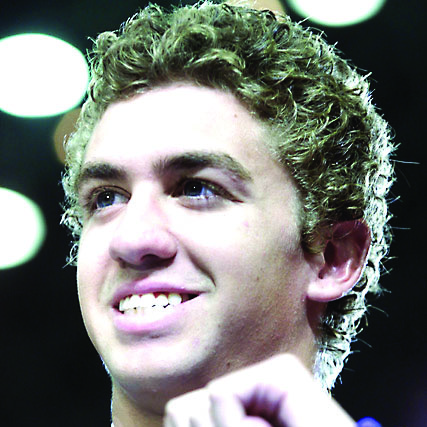
Olympic champion swimmer Anthony Ervin, a native of Valencia, is among inductees elected to the International Jewish Sports Hall of Fame for 2017.
Ervin captured a pair of gold medals at last year’s Olympics in Brazil in the 50-meter freestyle and the 4×100-meter relay. His performances were a near repeat of his gold- and silver-medal-winning efforts in the same events at the 2000 Games in Sydney, Australia. He now resides in Florida.
The other inductees to the hall of fame include two Americans, a Canadian, a Hungarian, an Israeli, a New Zealander and a Russian.
One of the Americans, who among all the inductees arguably has had the longest impact on spectator sports, was the late Albert Von Tilzer, a New Yorker who wrote the immortal baseball anthem “Take Me Out to the Ballgame” in 1908. The other American, Thelma “Tybie” Thall-Sommers, was a two-time world champion in table tennis. In 1948 she paired with Richard Miles to become the first Americans to win the world mixed doubles title. In 1949, as a member of the U.S. team, she won world championships in singles and doubles. She also won several national titles during her career.
The other inductees are:
The late Hy Buller of Canada, a National Hockey League star who played for the New York Rangers. He set a rookie record in 1951-52 for scoring the most goals, and ranked second for most goals among all NHL defensemen in three consecutive seasons.
The late Joszef Braun, who joined the MTK Budapest soccer club in 1916 at age 15 and three years later was named Hungary’s “Player of the Year.” His team won nine national championships through 1924. Braun perished in a Nazi forced labor camp in 1943.
Israel’s Lee Korzits, a four-time world sailing champion, who won her first Mistral-class title in 2003. After a long layoff due to injuries, the Hadera native won world gold medals in 2010, 2012 and 2013.
New Zealand sailing champion Jo Aleh, who won gold medals (with Olivia Powrie) in the women’s 420 Class event at the 2012 and 2016 Olympics, and at the 2007 and 2013 world championships.
Swimmer Semyon Belits-Geiman, a Moscow native who broke 67 Soviet national freestyle records, set a world 800-meter freestyle record in 1966, and the same year won two gold medals at the European championships. In 1999, he and his wife moved to Stamford, Conn.
The election results were announced in December by the hall of fame’s co-chairmen, Alan Sherman of Potomac, Md., and R. Stephen Rubin of London. Formal inductions are slated for July 4 at the hall of fame’s museum on the Wingate Institute campus in Netanya, Israel.
— Tom Tugend, Contributing Editor
Temple Israel of Hollywood (TIOH) Senior Rabbi John Rosove has announced his plan to retire from TIOH and become the Reform synagogue’s rabbi emeritus, effective June 30, 2019.
By the time he retires, Rosove will have served as senior rabbi at TIOH for 30 years and “will have completed 40 years of service to the Jewish people since my ordination” at Hebrew Union College-Jewish Institute of Religion in New York, in 1979, Rosove said in a Feb. 8 statement.
“Though my retirement is still two-plus years away, I am announcing now to give our Temple leadership the time necessary to thoughtfully establish a process that will ensure the best and wisest selection of my successor as Senior Rabbi,” he said.
Rosove assumed the position of senior rabbi at TIOH in 1988. The Los Angeles native graduated from the UC Berkeley in 1972.
He is the board chair of the Association of Reform Zionists of America; holds a seat on the Conference of Presidents of Major American Jewish Organizations; serves as a Jewish Agency for Israel committee member; recently was national co-chair of the rabbinic cabinet of J Street, a left-leaning, pro-Israel organization and more.
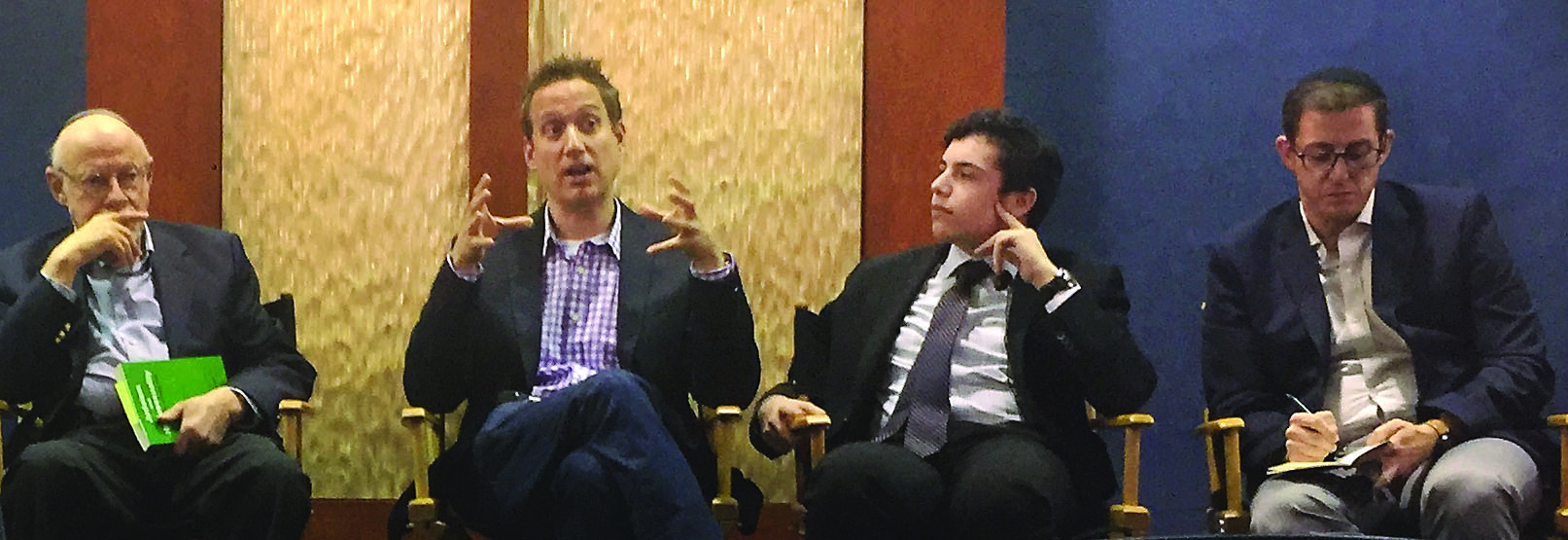
From left: Westwood Village Synagogue Rabbi Abner Weiss; actor and comedian Elon Gold; Shalhevet High School senior Micha Thau; and Shalhevet Head of School Rabbi Ari Segal participate in a discussion about Orthodox Judaism and the LGBT community. Photo by Eitan Arom.
In middle school, Micha Thau wanted to live what he called “the Jewish Orthodox American dream” — a future with a house in Beverlywood with a Honda Odyssey in the driveway, four kids and a pretty wife eight years his junior. When he realized he was gay, in eighth grade, “it spit in my face, robbed me of all motivation.”
Now a senior at Shalhevet High School, Thau spoke at Westwood Village Synagogue on Feb. 8 as part of a panel called “Modern Orthodoxy and LGBT: Navigating a Complex Reality,” alongside Shalhevet head of school Rabbi Ari Segal; actor and comedian Elon Gold; Westwood Village Synagogue Rabbi Abner Weiss; a clinical psychologist, and moderator Alexander Leichter.
In high school, Thau was ready to come out to his community. “It came to the point where staying in the closet was so much more painful than anything that could happen outside of it,” he explained to about 50 people who gathered at the synagogue, upstairs from Peet’s Coffee and Tea in Westwood.
Something clicked for Segal when he realized Thau had spent years worrying if Shalhevet would ostracize him for being gay. “I made a decision at that moment,” he said. “We were going to have a [gay-straight alliance], we were going to stop pretending that we don’t have gay kids at the school.”
After that, Segal wrote an editorial for Shalhevet’s newspaper calling LGBT acceptance “the biggest challenge to emunah [faith] of our time.” With Thau at the helm, Shalhevet issued a pledge Jewish schools can sign to commit themselves to supporting gay students. So far, Shalhevet is the only school to have signed it, Segal said.
Gold, an observant Jew, played a gay father in the web series “Bar Mitzvah.” He spoke about his brother, Ari, who came out at the age of 18. To this day, his brother doesn’t feel comfortable within the Orthodox community, Gold said. “He is a very proud Jew,” he said. “He just feels like he can’t stay observant. It’s too conflicting.”
— Eitan Arom, Staff Writer
Moving and Shaking highlights events, honors and simchas. Got a tip? Email ryant@jewishjournal.com.
Hate crimes against Jews have more than doubled in New York City since the start of the new year from the same period in 2016, police reported.
The city’s Police Department said 56 hate crimes were reported from Jan. 1 to Feb. 12, with 28 of the incidents targeting Jews, according to Politico. In the same period last year, the total number of hate crimes was 31, with 13 targeting Jews.
In December, the NYPD said it witnessed “a huge spike” in hate crimes following the election of President Donald Trump, with the majority of incidents directed at Jews.
JTA has reported on anti-Semitic incidents following the election, including acts of vandalism featuring swastikas in the New York subway and Donald Trump-related themes left in public areas as well as on the homes of Jewish individuals. Also, three separate strings of bomb threats have targeted Jewish community centers across the country.
On Wednesday, when asked by a reporter about “a sharp rise in anti-Semitic incidents across the United States,” Trump responded by boasting about his Electoral College win, pointing to his Jewish daughter’s family and promising that “you’re going to see a lot of love.”
A majority of Palestinians do not support a two-state solution to the conflict with Israel, a survey found.
The survey released Wednesday found that 44 percent of Palestinians back the two-state solution, a decline from 51 percent who supported this approach in a similar survey from June. The later survey had 59 percent of Israelis supporting two states, down from 55 percent in the earlier poll.
The survey, called Palestinian-Israeli Pulse: A Joint Poll, was released by the Tami Steinmetz Center for Peace Research at Tel Aviv University and the Palestinian Center for Policy and Survey Research in Ramallah with funding from the European Union.
The poll, which surveyed 1,270 Palestinians and 1,207 Israelis, Jewish and Arab, was conducted in December. It has a margin of error of plus or minus 2 percent.
It also found that just over one-third of Palestinians and a majority of Arab Israelis supported one state as well as a confederation, while 24 percent of Israelis backed one state and 28 percent a confederation.
Nearly identical numbers of Jewish Israelis (58 percent) and Palestinians (57 percent) said they supported a broader regional peace involving the Arab world and Israel.
The survey also found that 86 percent of Palestinians feel Israeli Jews are untrustworthy, while 71 percent of Israeli Jews do not trust Palestinians. In addition, 51 percent of Israeli Jews, 48 percent of Israeli Arabs and 68 percent of Palestinians agreed with this statement: “Nothing can be done that’s good for both sides; whatever is good for one side is bad for the other side.”
In addition, 66 percent of Jewish Israelis fear the Palestinians; among West Bank settlers the number rises to 72 percent. Nearly half of Jewish Israelis also fear their fellow Arab citizens of Israel, and 60 percent of West Bank settlers feel this way.
Some 43 percent of Palestinians said they fear Jewish Israelis in general, and 52 percent fear soldiers and armed settlers. Most Arab Israelis, or 82 percent, do not fear Jewish Israeli.
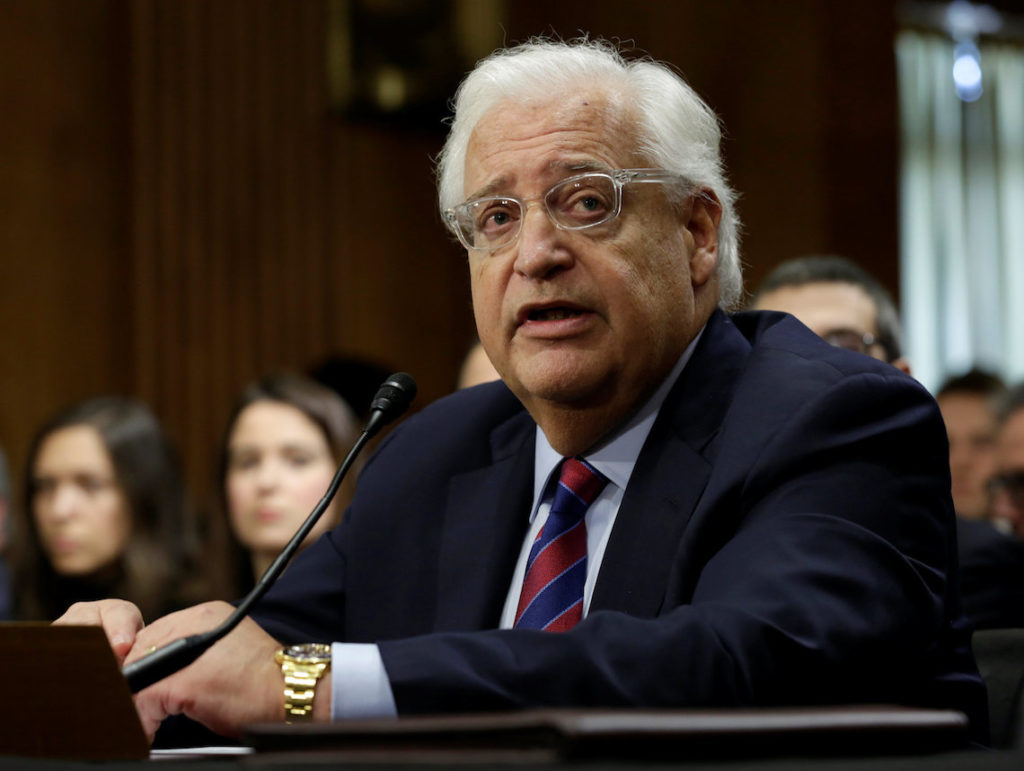
David Friedman at the launch of U.S. Senate hearings to confirm him as ambassador to Israel said there was “no excuse” for his past rhetoric targeting liberal Jews.
In his opening remarks, Friedman said his attacks were “partisan rhetoric” during a heated presidential election campaign. Friedman is Trump’s longtime lawyer and was a key surrogate to the Jewish community during the campaign.
He called the liberal Middle East policy group J Street “kapos” and the Anti-Defamation League “morons.” He also likened Sen. Charles Schumer, D-N.Y., to Neville Chamberlain, the British prime minister who appeased Adolf Hitler.
Sen. Ben Cardin, D-Md., the ranking member of the Foreign Relations committee, which must approve Friedman to advance his nomination to the full Senate, said the terms seemed to go beyond partisan rhetoric.
Cardin said he and Friedman had in common that “our parents were proud Zionists who worked and did everything they could in support for the State of Israel.” But noting his father was the president of a synagogue – Friedman’s was a rabbi – Cardin added, “My father taught me to respect different views.”
The Maryland lawmaker also noted that some of Friedman’s statements – particularly his attack on Schumer, made during the heat of the battle over the 2015 Iran nuclear deal – came before the campaign and in many cases were written comments.
“I’m having difficulty understanding your use of those descriptions and whether you really can be a diplomat,” Cardin said.
Friedman appeared chastened.
“I provided some context for my remarks, but that was not in the nature of an excuse,” he said. “These were hurtful words and I deeply regret them. They’re not reflective of my nature and character.”
Cardin also pressed Friedman about past statements that appeared to oppose a two-state solution addressing the Israeli-Palestinian conflict and noted his backing for settlements, including some deep inside the West Bank.
Friedman replied that he had been skeptical of a two-state solution, but would welcome any solution arrived at by the Israelis and Palestinians that ended suffering for both peoples.
Protesters interrupted the hearings at least three times, including by a contingent from the Jewish protest group If Not Now who sang as they were ejected “Olam Chesed Yibaneh,” “Build a world of kindness.”
People supportive of the two-state solution tend to forget that there is nothing sacred about it. It is – as its title hints – a “solution.” That is: a means to an end.
What is the end? Having Israelis and Palestinians live peacefully where they both feel at home. Or more accurately: for Israel it is having Israelis live peacefully where they feel at home. For Palestinians it is having Palestinians live peacefully where they feel at home. What is the end game for America? Having the Israeli-Palestinian conflict solved in a way that puts this distraction to rest.
It is important to remember that Israel has no interest in having a Palestinian State. Israel’s interest is to have a secure, thriving, culturally cohesive Jewish state. A Palestinian state is only a way for some Israelis to achieve this goal. But if a Palestinian state is not the best way for Israel to achieve this goal, Israel would abandon the two-state solution without much fanfare.
It is also important to remember that the US has no interest in having a Palestinian state. America’s interest is to get the “conflict” off the table as much as that is possible. If a Palestinian state is not the best way for the US to achieve this goal, then it would abandon the two-state solution without much fanfare.
This is essentially what President Donald Trump said yesterday. One state, two states, why would he care? If the two sides are happy with another solution, there’s no reason for the US to stick to the two-state solution as if this were some kind of sacred theology. There is no reason for anyone to complain about Trump’s refusal to stick to a certain solution. In fact, all supporters of peace ought to be delighted with Trump’s recognition of the fact that the two-state solution mantra turned this idea from a solution to a goal – it made it an obstacle.
2.
Killing the two-state solution as the only idea on the table is easy. Finding the alternative is tough. It is especially tough if one has in mind the goal that Trump has in mind:
I’m looking at two-state and one-state, and I like the one that both parties like. I’m very happy with the one that both parties like. I can live with either one.
The one that both parties like. That is the tough part. You can have a two-state solution that some people could like. You can have a one-state solution that some people could like. But having a solution that both parties like seems unachievable at the moment. Thus, what Trump was proposing yesterday is meaningless. If he is interested at brokering peace between Israel and its Arab neighbors as he says, the road ahead is clear up to a point: he will see what the parties say they want. He then will realize that there is no such thing as “the one that both parties like.” He will then have to reconsider his position.
He could decide: This is not for me – I am not ready to push these two peoples into something both of them do not want.
He could decide: I have to come up with a certain solution that I think is best for the two sides – because they will never be able to agree on anything on their own.
What will Trump choose to do? There was nothing in his performance yesterday that clarifies that. It depends on many variables, most of which concern matters that have nothing to do with Israel or Palestine. They have to do with Trump’s overall agenda, and the energy he will want to spare for dealing with the elusive Middle East peace.
3.
This morning I heard the leaders of the Israeli right getting used to the idea that Israel is going to restrain the construction of settlements in the West Bank. They are getting used to it without much protest. They are getting used to it without realizing that they got very little in return for a partial freeze. Trump should thank his predecessor, President Obama, for making things so easy for him with the Israeli right. The bar, following Obama, was set so low, that even a president who unceremoniously asks for a partial freeze of settlements is accepted with glee.
4.
Jewish critics of Israel’s policy – who are also Jewish critics of the new US president – please do not get confused: It is good for Israel to get along with the American president. It is good for Israel to have warm relations with the White House and to be able to coordinate its policies with a sympathetic administration. As you saw during the eight years of contentious relations between Israel and the Obama administration – such relations do not make Israel safer and do not make peace more possible. So maybe cutting Trump and Netanyahu some slack and letting them try a different approach would be wise.
And by the way:
Maybe it is time to stop the unhelpful (and politicized) hysteria concerning the US and Israel: Gallup just released its numbers, and they show that support for Israel in the US is as strong as ever.
Maybe it is time to stop the unhelpful (and politicized) hysteria concerning the US and anti-Semitism: PEW just released its numbers, and they show that Jews in America are still very well liked.
5.
A few words about the appointment of David Friedman as ambassador to Israel:
1. An ambassador should reflect and communicate the policy of a certain administration. Expecting Trump to appoint an ambassador in line with Obama’s approach is unrealistic and unwise. That would make the ambassador ineffective.
2. An ambassador does not make or break US policy. Friedman is not going to make peace more or less likely.
3. In fact, Friedman could be effective in a way similar to Trump in his performance yesterday: Israelis will trust his good intentions and hence will be more receptive if and when he voices certain criticism or makes certain demands on behalf of the administration.
4. I hear that a few former ambassadors argue that Friedman is “unqualified” to be ambassador because he has “extreme, radical positions.” But one ought to ask: radical compared to whom? Many Israelis would consider the views of some of these former ambassadors – Dan Kurtzer is a prime example – as much more radical than Friedman’s. In fact, a fair number of Americans – many of which are “tepid” (Gallup’s definition) on Palestinian statehood might find these ambassadors’ views more radical than Friedman’s.
5. The fight over Friedman sounds much like the fight over Trump: Those who do not accept the reality of Trump also do not want to accept the reality of Friedman. In other words: this is not about Friedman’s qualifications, it is about the boss’ qualifications. And it is misguided: Because no ambassador – not even the one most acceptable to J Street, or to the five former ambassadors, or to Haaretz Daily – is going to save America and Israel from Trump.







 O
O T
T