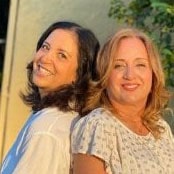
Sharon’s Turn: Hanukkah commemorates the miracle of the little crucible oil that lasted eight days and nights in the rededicated Holy Temple in Jerusalem. Hanukkah is a celebration of our continued faith in G-d and our dedication to Judaism. Hanukkah lights up our life when the days are short and the nights are darkest.
There is sheer joy in lighting candles, singing beautiful prayers, giving d’mei Hanukkah (Hanukkah gelt in Yiddish) and playing with the dreidel. Of course, there will always be “machloket” (disagreement) over whether Krispy Kreme or sufganiyot (Israeli yeast donuts) are better. And even fights between the custard lovers and the raspberry jelly advocates. But no one disputes that latkes are one of the best culinary inventions ever.
My mother makes the best latkes, patiently frying hundreds of them for our big family celebrations. She often makes some with sweet potato, which are also really yummy. That had me craving parsnip and heirloom carrot latkes. Rachel and I fried up a big batch and they were absolutely crispy, crunchy and delicious.
We topped them with a heavenly honey and ricotta spread and added caramelized onions to make them even more miraculous. (Mix 1 cup of ricotta with 1 tablespoon of honey. Caramelize onions til golden in color, and add a handful of raisins. Layer with ricotta, top with onions and sprinkle with toasted pistachios.)
 Parsnip and Carrot Latkes
6 medium heirloom carrots
2 large parsnips
1 large russet potato
1 large yellow onion
1/2 cup flour
1 teaspoon turmeric
1 teaspoon kosher salt
1/2 teaspoon freshly ground black pepper
Oil and carrot for frying
Peel and grate carrots and parsnips.
Wash any traces of dirt from the potatoes.
Grate the potatoes and place on a clean kitchen towel.
Squeeze the liquid from the potato into a small bowl and let sit.
Place the grated carrot, parsnip and potato in a large bowl, then add grated onions.
Spill out the clear liquid and add the starchy white liquid that remains at the bottom of the bowl.
Add the flour and toss to coat the ingredients.
Add egg, turmeric, salt and pepper.
Heat 2 inches of oil in a large skillet.
Add carrot to prevent oil from becoming brown.
Use an ice cream scoop to portion the mixture into the oil.
Flatten with a fork and fry till golden brown, about 3 to 5 minutes.
Flip and fry the other side.
Drain and serve with toppings of your choice.
Rachel’s Turn: Neil and I were on our honeymoon in Maui. It was Friday night and we had lit all the Hanukkah candles and the Shabbat candles. Housekeeping knocked on the door for turn down service. When she walked into the room, her face turned white and she looked like she had seen a ghost. She never said a word, but she must have thought we were doing voodoo or something sinister.
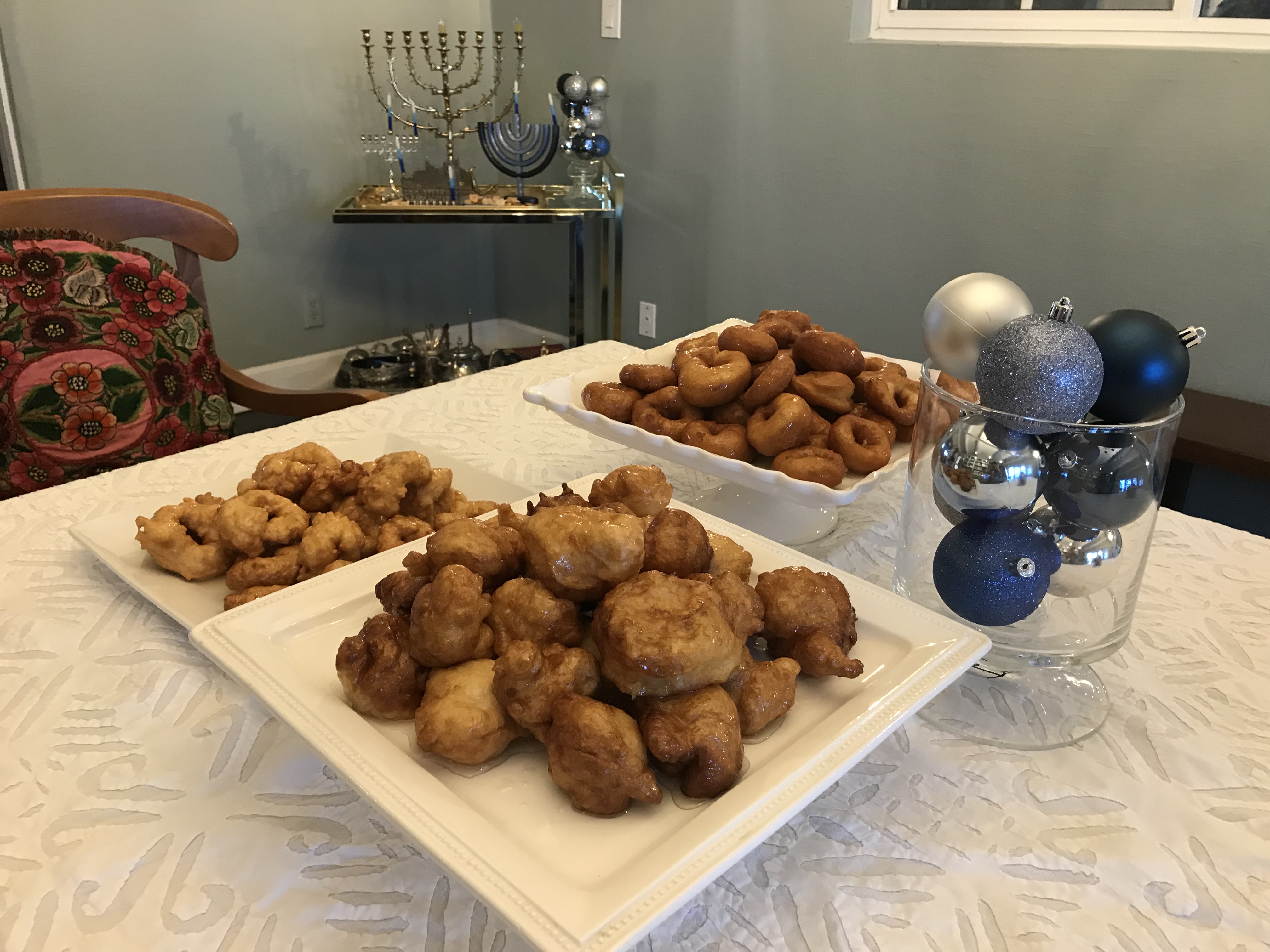
Our Hanukkah celebrations in the years since that tropical honeymoon have included a lot of frying. I have continued my mother’s Spanish Moroccan tradition of frying up a batch of rosquitas, a fried cake dough that is then dipped in a sugar syrup that is subtly flavored with lemon rind. And I learned my mother in law’s Ladino tradition of burmuelos, a looser fluffier fritter that is also soaked in a sugar/honey syrup. And of course, Moroccan Sfinge, an airy donut made from a yeast dough that is also dipped in a honey syrup or dusted with powdered sugar.
A couple of years ago, I was honored when the Jewish Journal featured an interview and video of me frying up this trifecta of delicious donuts.
Last year, my good friends and I did a Sephardic Educational Center Hanukkah cooking demonstration at Kahal Joseph Congregation. We fried over 200 rosquitas and every last one was happily devoured.
Try this Rosquitas recipe and they will definitely be devoured too.
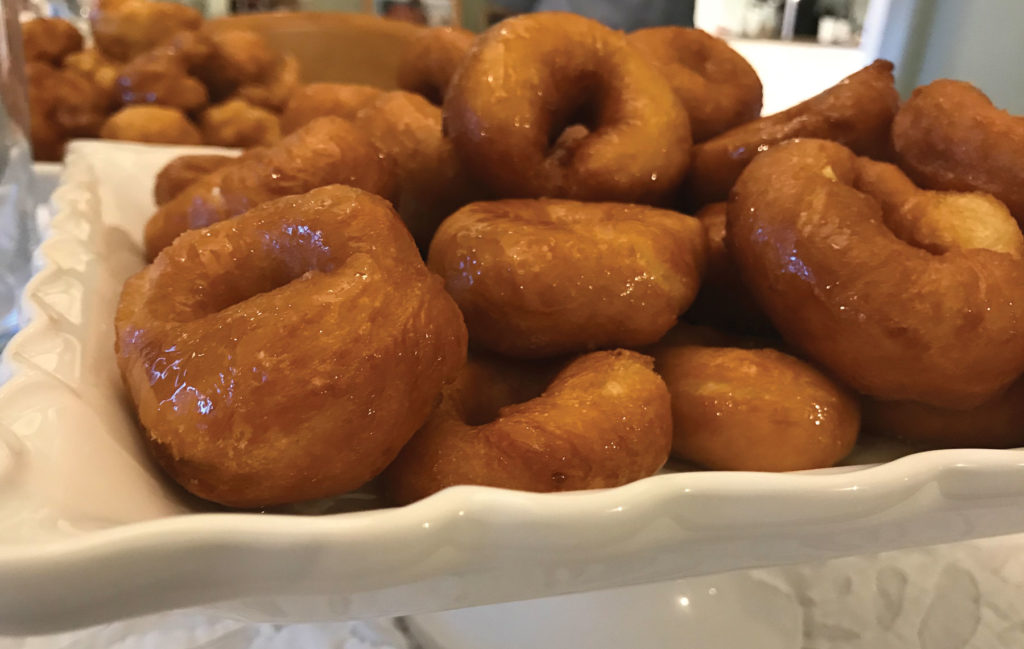 Rosquitas
3 eggs
½ cup sugar
½ cup oil
½ cup orange juice
Pinch of salt
Rind of one orange
1/2 Tblsp baking powder
Mix all ingredients and then start adding flour until you form a nice dough, not too firm not too sticky.
About 4-5 cups.
Let rise 2-3 hours.
Make golf ball size balls and form a long rope about two inches pinch two ends together to make a circle/donut shape, put on a cookie sheet, when you have formed them all start to drop into hot oil. Watch as they get golden, and flip. Place on a wire rack.
Make a syrup of 1 cup sugar, 1/3 cup water , and a piece of lemon skin or rind.
When sugar has melted and starts to thicken take off fire and dip the rosquitas into syrup with two forks, thru the center and trying not to pierce them.
Pile on a platter and wait a bit to dry.