When Babylonian King Nebuchadnezzar’s forces destroyed Solomon’s Temple when Jerusalem was conquered in 586 B.C.E., he forever changed the diets of Jews. For millennia, Jews have commemorated the destruction of the First Temple and Second Temple (by the Romans in 70 C.E.) with three weeks of mourning. It starts with the fast of the 17th of Tammuz and then the nine (mostly meat-free) days leading up to the fast of Tisha b’Av.
When Nebuchadnezzar took the House of Judah into exile, my ancestors were among those who sat and wept by the Rivers of Babylon. The vicissitudes of Iraqi Jewish history included the rebuilding of the temple by Ezra the Scribe; the incredible Jewish learning and compilation of the Babylonian Talmud; and the rise of the Islamic caliphate and Islamic discrimination. The Jews flourished again under the Ottoman Empire and by the early 19th century, the Jews of Baghdad were responsible for all the trade between Iraq and India.
For generations, the family of my great grandfather Yosef were the keepers of the tomb of Ezra, a shrine sacred to Jews and Shiite Muslims. Located in the village of El Azair on the Tigris River, the tomb, with its beautiful turquoise dome and tiled Hebrew lettering, was the site of many pilgrimages, especially for the holidays of Shavuot and Rosh Hashanah.
With the creation of the State of Israel in 1948, Jewish life in Iraq became increasingly difficult. The majority of Jews, including my family, left for Israel in 1951 and 1952 in Operation Ezra and Nehemiah. Two of my great-grandparents, Yosef and Tova, bought a beautiful Arab house on Emek Refaim in the German Colony of Jerusalem. After their deaths, my grandmother Aziza, Uncle Reuben, Uncle Naji and Uncle Nuri (they were my great-uncles but I called them uncles) moved to Australia to join their oldest sister, my great-aunt Naima, who had immigrated there via Bombay and Shanghai in the 1920s. They were all different, but they all had an innate dignity. One of my clearest memories as a young child was of my Uncle Nuri eating kitchri. In Iraq, kitchri was served for dinner most Thursday nights and always served the week before Tisha b’Av, when it is customary to eschew meat.
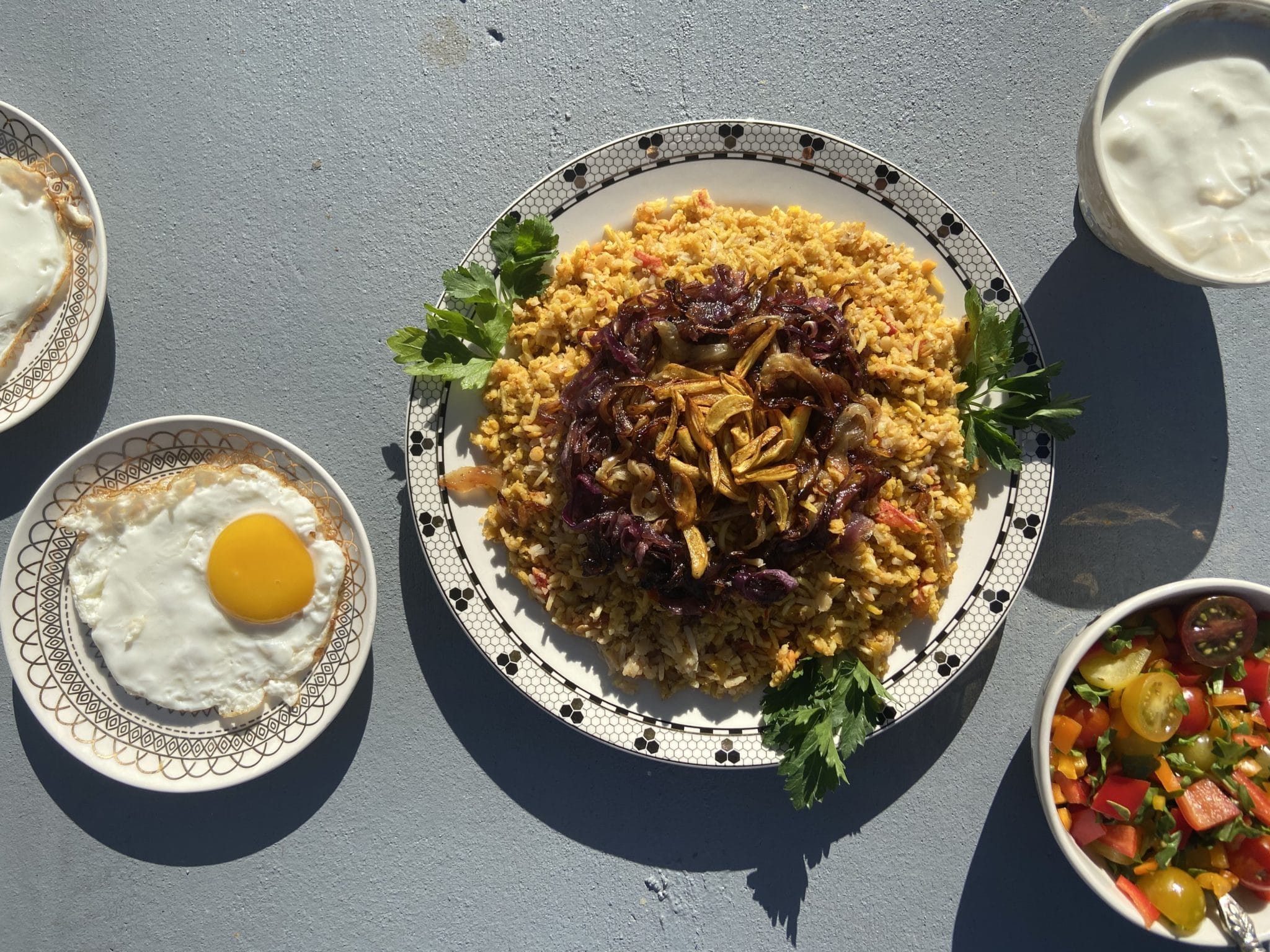
Inspired by the Indian rice-and-mung bean dish kitchari, Iraqi kitchri combines rice and lentils with cumin, sautéed onions and garlic. The addition of lentils, a traditional Jewish mourning food, made it a suitably humble meal to commemorate these days of mourning the loss of our beloved Beit HaMikdash (Holy Temple).
The combination of rice and lentils gives a nutty depth and makes this dish a source of complete protein. The meal can be rounded out with a fried egg, plain leben or kefir and a fresh tomato-and-cucumber salad.
SHARON’S KITCHRI
2 cups basmati rice
1 cup red lentils
4 tablespoons oil, separated
1 large onion, diced
2 tomatoes, diced
1 teaspoon salt
2 teaspoons cumin
2 teaspoons turmeric
3 tablespoons tomato paste
4 cups water
Garnish:
1 medium onion, thinly sliced
1 teaspoon cumin
8 garlic cloves, cut into slivers
Wash and drain rice.
Wash and drain lentils.
In large heavy-based pan, heat 2 tablespoons oil and sauté onion over low heat for 10 minutes or until golden.
Add tomatoes and sauté for 2 minutes.
Add rice and lentils and sauté for 2 to 3 minutes. Add salt, cumin and turmeric and stir for 1 minute.
Add tomato paste, stir well, then slowly add water.
Bring to boil, stir well lower heat to low and cover with tight-fitting lid.
Cook 20-25 minutes.
For garnish: In frying pan, heat 1 tablespoon oil, add onion and sauté until caramelized. Set aside.
Heat remaining oil, add cumin and garlic and sauté until slightly browned.
Garnish rice with onion and garlic mixture.
Serves 6-8.