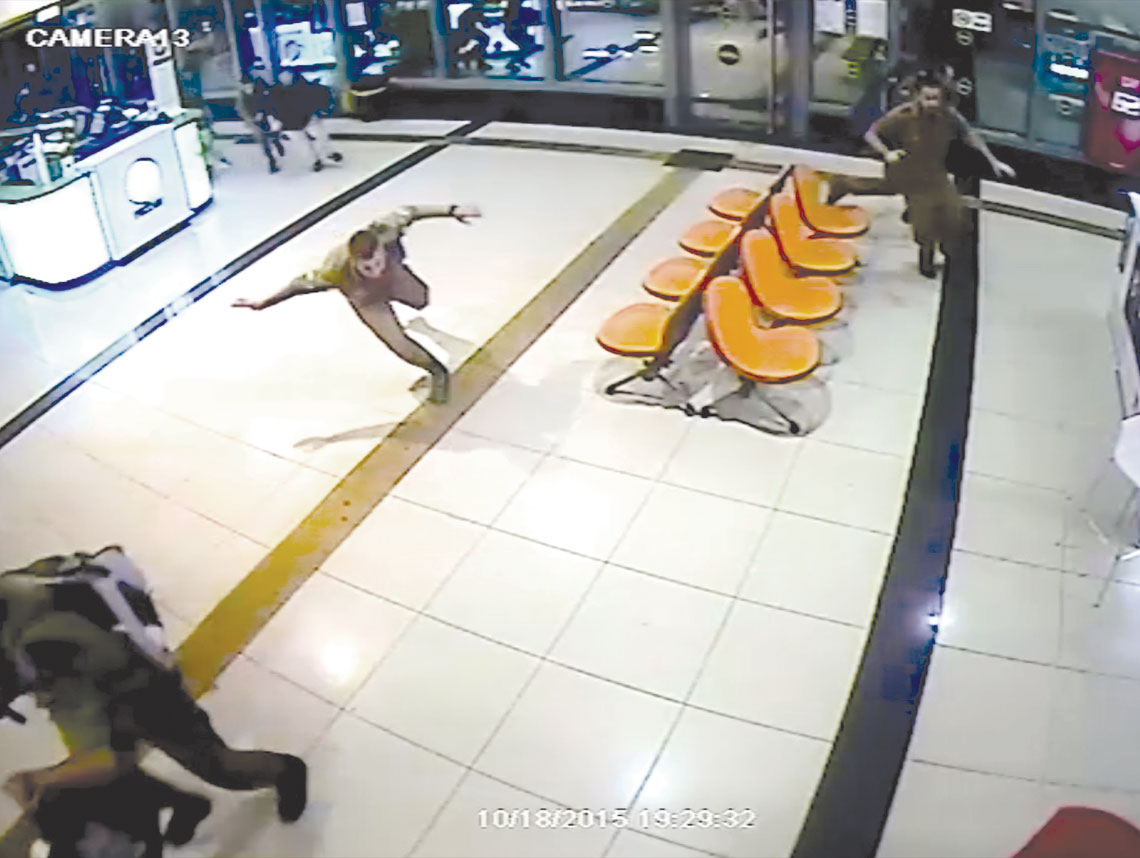
On Oct. 18, 2015, a terrorist began shooting inside the bus terminal in the Israeli town of Beersheba. Muhand Al-Aqabi, a Bedouin from a nearby village, shot and killed Sgt. Omri Levi, a 19-year-old soldier, and at least nine others. After a prolonged shootout, Al-Aqabi was killed by security forces.
But the shootout wasn’t the only carnage at the bus terminal that day.
A security guard shot an Eritrean asylum seeker whom he assumed to be the terrorist. As the Eritrean lie bleeding to death, Israeli civilians kicked and cursed him, and spat on him. The killing of Habtom Zarhum, a 29-year-old unarmed refugee, grabbed headlines around the world and provoked soul-searching within Israeli society.
The incident is the subject of “Death in the Terminal,” a new documentary that premieres Sept. 6 on the entertainment and media website Topic.com. In the film, directors Tali Shemesh and Asaf Sudry dissect the attack and the extrajudicial killing of Zarhum using cellphone video, footage from a number of security cameras and eyewitness interviews.
The documentary raises difficult questions: How does one make sense of a quickly unfolding situation in which one’s life is at risk? When should one act, and when should one gather more information? How do deeply held societal fears and prejudices affect those judgment calls? And what would each of us do in such a circumstance?
The film’s executive producers are Megan Ellison and Mark Boal, both producers of “Zero Dark Thirty,” and Israeli director Alma Har’el. It has received strong critical praise and numerous festival awards.
The filmmakers were drawn to the idea of telling the story differently than other media reports. “Nobody really looked into it,” Shemesh said. “It was so traumatic and terrible. After two days, three days, everybody forgot.”
The film reconstructs a minute-by-minute account of the 18 minutes after the attack. The eyewitnesses recall hearing the first round of gunfire, seeing -— even participating in — the beating of Zarhum, hearing a second round of shooting, and then realizing that Zarhum was not a terrorist.
“When we began, nobody wanted to talk to us,” Shemesh said. Through research, they were able to locate eyewitnesses to the incident.
The attack came amid heightened tensions, with stabbings and shootings of Israelis and Palestinians filling the day’s news.
“It was a very tense period of time,” Shemesh said. “People were panicked. … I was scared about my children. You think twice to go on the bus or not.”
The film begins with footage of the terminal. Cheerful Mediterranean music plays over the speakers as shoppers and soldiers stroll around. The normalcy is shattered by gunshots and panic as people run and seek cover.
The first eyewitness interviewed in the film is Daniel Harush, a soldier who was meeting a friend at the terminal. He recounts how they stopped to use a restroom when they heard the gunshots and hid. Harush says he went out and saw the dead soldier, lying in a pool of blood. He returned to hide with his friend in the restroom stall, but when they then decided to come out again, the terrorist shot Harush in the arm.
Lihi Levi, a clothing store worker and nurse also interviewed that day, helped treat a wounded soldier and is relieved that no one besides the terrorist appears to have been killed — until she and a paramedic are asked to treat the fatally wounded Omri Levi and are unable to revive him.
Meanwhile, a prison officer named Ronen Cohen hears the shots from outside the terminal and runs in as everyone’s running out. He sees the Eritrean man on the ground and people kicking him and becomes worried the man might have a gun or explosive belt. Cohen and a friend pick up a row of chairs and place it on top of the suspected terrorist to pin him in place.
The filmmakers manage to unfold the story without revealing Zarhum’s innocence until about halfway through the 52-minute film. The title could refer simply to the death of the Israeli soldier. Like Cohen and others, viewers are left to assume that Zarhum is “the terrorist” — until doubt creeps in.
Cohen and three others are now on trial for Zarhum’s killing. Even though Cohen was advised not to talk to the filmmakers, the filmmakers say he wanted to clear his name after media reports condemned him.
“We also thought Ronen [Cohen] was a kind of an animal. This is the way he was presented in the two-minute headlines in the news,” Shemesh said. “From the first time we met Ronen, we felt so differently about him. …
We gave the people on trial a chance to explain themselves.”
A voice of reason, or at least skepticism, in the film comes from eyewitness Moshe Kochavi, a kibbutz volunteer. He recalls seeing the “terrorist” on the floor and people hitting him and shouting at the crowd, “You’re savages!”
“I had to save these people. What do I mean by saving? People are corrupting, in this very moment, their souls,” Kochavi explains in the film.
We then see surveillance footage of Kochavi being pushed away from the scene, as a soldier comes and forcefully kicks Zarhum in the head.
“Everyone wants to be like Moshe Kochavi,” Shemesh said. “You wish you could be like him but you don’t know what you would do. … Most people would run away and hide.”
Kochavi admits in the film that “something didn’t feel right,” although he’s not sure what it was. He recalls bending over the man and saying, “How can you be a terrorist? You don’t look like one!”
A falafel-stand worker, Hosni Kombaz, shares that concern. He noticed that the suspected terrorist looked like a Christian Eritrean — and was wearing slippers. “I’d never seen a terrorist in slippers,” he says in the film.
Kombaz says he wanted to shout at the crowd to stop, that the man they were kicking and spitting on wasn’t the terrorist. But he didn’t, because he was worried he’d be attacked as well. “If I was Jewish I would have shouted it … but I was afraid because I’m an Arab, so I didn’t shout it,” he says.
Part of the film’s power comes from a universality to the story. No country is immune from terrorist attacks or racial and ethnic tensions. A vigilante mob could form anywhere, not just in Israel.
“This film came out amid all these immigration problems in Europe, and there were terror attacks in the U.S. Everyone opened their ears and eyes to this film because of that,” Sudry said. “Everyone is afraid of ‘the other’ now.”
The film ends as it began, with security footage of the terminal. Only this time, it plays backward, with panic being restored to normalcy. This time, the calm seems fraught with danger and the possibility of violence — an apt metaphor for life in Israel today.