Back in 2019, Sarah Meital Benjamin, the founder of the Memoria Di casting agency, saw Swell Ariel Or on a bus and decided to ask her something. “I was like, ‘hey, I don’t know if you thought about acting, but I’m making a film and I don’t know if this is weird, but here is my social media. She was like, ‘okay, cool,’ and we kept in touch. She hadn’t done acting before.”
Or stars in Benjamin’s Hebrew-language short film “Arava” premiering at the Palm Springs International Shortfest June 22, where it has been nominated for Best International Short. Avara is the Hebrew word for “willow,” a name for Jewish girls that gets its significance as being one of the species in the lulav, which is shaken during the holiday of Sukkot.
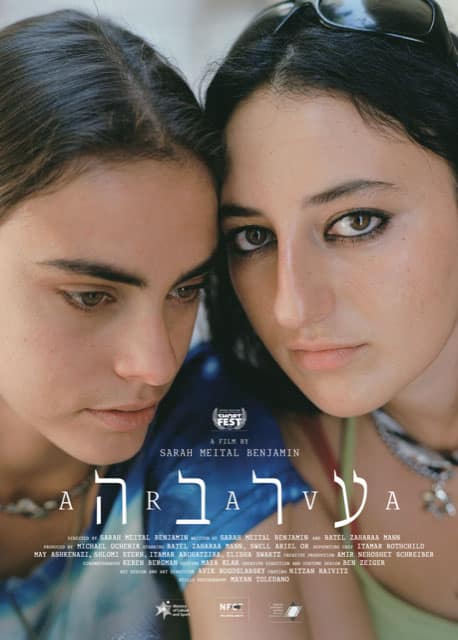 “Arava” follows two hitchhiking runaways, Tzipi (Or) and Arava (Batel Zaharaa Mann, who also co-wrote the script) who have a strong physical attraction to each other and share a desire to overcome the pitfalls of life. They crash for one night at the place of a musician who sells pomegranates.
“Arava” is a gritty, powerful, and timely film that lets the audience know the characters have been through the wringer. With a minimalist but artistic approach, the Jewish Israeli characters are trying to carve out a happy slice of life, knowing some may not believe they are entitled to the whole pie.
The film comes at a time where Jewish parents are re-evaluating what to do with children they deem off the proper path, OTD, or “Off the Derech.” This refers to children who wear immodest clothing, have tattoos or piercings, do not follow prescribed sexual rules, smoke, do drugs or drink alcohol and don’t observe the Sabbath or keep kosher. Some are thrown out of the house, while others come to a decision that reaching out may be more favorable than a rebuke.
“Who knows like you and I, how it feels to be distraught, how it feels to be alone, right?” the rabbi tells them, acknowledging that some might have been told to come to his gathering by a social worker.
Or is is sensational in the 27-minute film, she and Mann depicting a fiery relationship that is complex, full of chemistry and unpredictable.
“The film is based on something that happened in my life,” Benjamin said. “I was a religious teenager and I then I was a street punk. I got into fights, but I was small. I had a big mouth that my fighting ability couldn’t support.” She lived in Katamon, Jerusalem, until the age of 18, then moved to New York City, where she lived for the next decade.
When she was 11, her mother decided to become extremely religious. “I didn’t stay in it very long,” she said. “It was a complex experience. I wasn’t forced into it but I kind of had a journey of religion vs. faith.”

Photo by Anna Prokulevicz.
Benjamin has had tough times and never forgot the people that had open arms for her. “My brother died, and my dad wasn’t really around so I was kind of adopted by the neighborhood Chabad,” she said, adding that her mother has passed away. “I had crazy hair and tattoos and I remember sitting at Shabbat meals and there was no judgment. My uncle would say ‘come as you are’ and it kept me close to the community.”She has more than 30 tattoos on her skin, including a scorpion, and her mother’s name in Hebrew.
She said she was often teased. “I was messed with as a kid,” she said. “I went to a super-religious school, and I protected animals and that was weird to people. I have not been in a classroom since I was 12.” But she never shies away from an intellectual battle. “I was like, ‘my mom is smarter than you, I don’t need to be here,” she said of her mindset toward school when she was a child. “She was brilliant artist and poet. We used to call her Chana Del Ray because she had eyeliner and was beautifully dressed. We had books of Spinoza.”
She said she hoped people would not shut down conversation and label her as anti-religious as she has great respect or extremely religious people who were kind to her. “Secular society pushed my mom and me out a lot,” she said. “Chabad was a home that the secular bohemian Jerusalem society never gave us. I think my mother became religious because of the passing of my brother and how alone she felt. A lot of the time I feel more at ease with my Chabad aunts and uncles than with people in Tel Aviv, who you’d think, with how I look, that I have more in common with.
Now 31, Benjamin is writing a feature film that will be called “Lion’s Milk” that will also star Or. She said her father has seen “Arava” and liked it.
Or, she said, “is the most humble person. . She said ‘I’m doing this thing and I hope it will be big, but I don’t know.’ She is really my muse.”
“There is this rage in me that is powerful from not seeing myself in anything that came out of Israel,” Benjamin said. “It didn’t represent me, and I couldn’t relate to it or hook-up culture or whatever the hell most films highlighted. I wanted something that could represent my family and also the people I didn’t like, from school. I wanted to see myself and my loved ones somewhere and see that representation.”
She said that her identity includes being Israeli, a proud Jewish bisexual woman, a runaway and she is encouraged that the world can be a place where people are measured by their actions, rather than assigned labels. She added that people have a responsibility to themselves to both recognize their self-worth, find their talent, and work hard to achieve their goals.
She hopes people will see “Arava” and be inspired to reject the knee-jerk reaction of alienating people who might be different. “I think nuance and complexity are the most important components of the human heart and I think we should all make less judgments,” she said. “My Jewish identity is a living thing that develops with the times. I hope the community is inspired to understand the importance of an open mind. I think it is important to have debate and open conversations about things.”
While there are plenty of gatekeepers in the world of film, and she is aware there is a lack of female directors, Benjamin said a dangerous one is doubters who may be jealous and tell people it’s unreasonable to follow one’s dreams. “People told me I couldn’t do it, but I developed a rule,” she said. “If people try to slam a door in your face, you just work a few hours more that day and the next day,” she said.
The 29th Palm Springs International Shortfest takes place from June 20-26 with screenings at the Camelot Theatres in the Palm Springs Cultural Center.