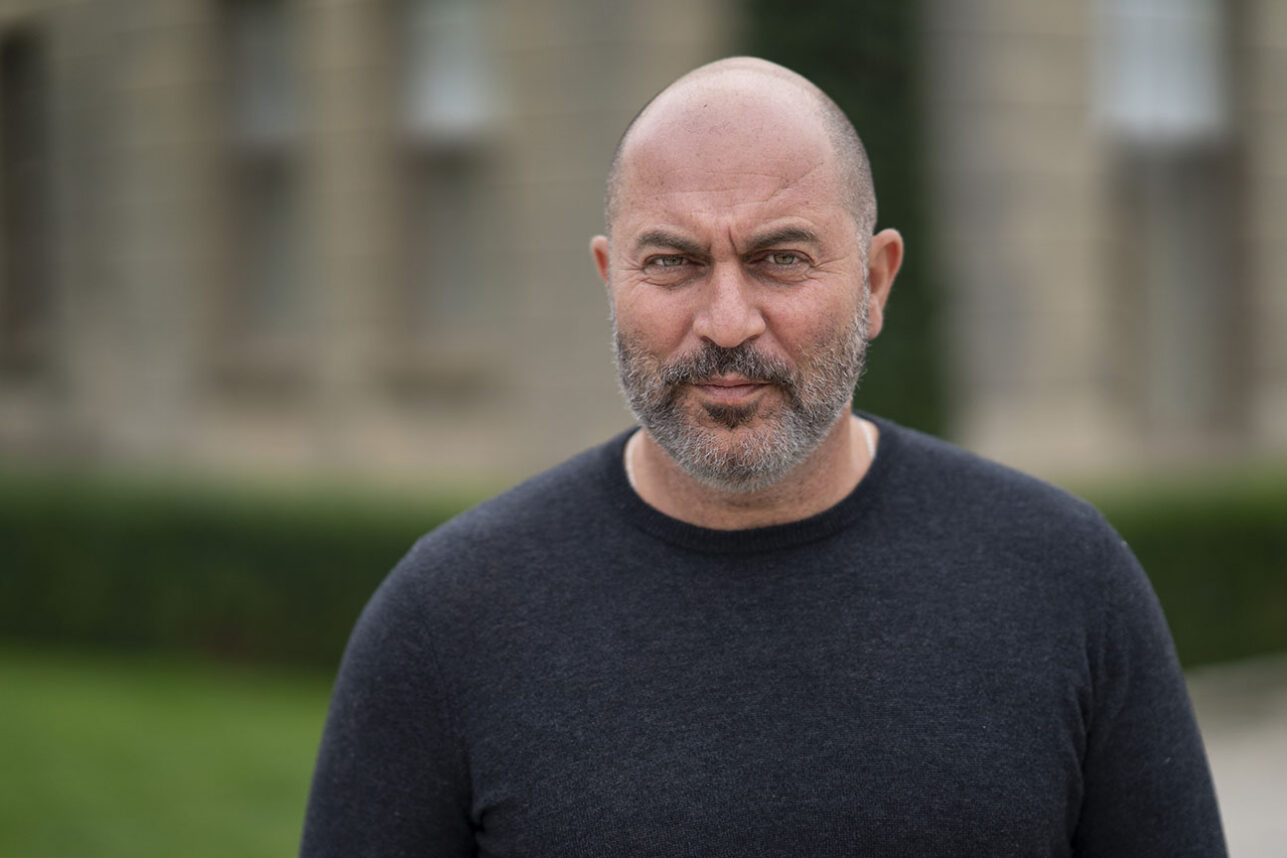
Peter Sollett’s ebullient romantic comedy, "Raising Victor Vargas," about Hispanic teens in the East Village, began as a short film about, well, himself.
While tackling his NYU thesis film five years ago, Sollett imagined a semiautobiographical piece about a "10- to 13-year-old Jewish boy, whose life was like my own at that age." Like "Vargas," it was to be a "first-kiss story" that started at a neighborhood pool on a summer afternoon. And it was to be set in a Jewish-Italian neighborhood reminiscent of his old block in Bensonhurst.
But when Sollett and his Barcelona-born producer, Eva Vives, tried to cast Brooklyn kids through agencies in 1998, he said they "saw actors who were just mimicking what they saw on TV." To find more natural performers, they hit the streets, plastering their lower Manhattan neighborhood with fliers inviting teens to audition.
"We weren’t thinking about the demographics, so we didn’t realize that most of the kids who would turn up would be Hispanic," the precise, articulate director said from his East Village apartment. "We started seeing actors, most of them nonprofessionals, who really blew us away, so we decided to make the film about them."
One of the most impressive teens to audition was Victor Rasuk, who inspired the filmmakers with an improvisation about confronting a bully who was tormenting his brother.
"I expected him to become threatening and aggressive, but instead he began talking about how much his brother meant to him and how hurt he’d be if anything were to happen to him," Sollett said. "But the subtext was that if anything were to happen, Victor’s behavior would become that of someone with little left to lose. He was complex and unpredictable, and our interest in him was immediate."
Sollett promptly cast Rasuk as Vargas; Rasuk’s brother, Silvestre, as Vargas’ onscreen brother, and the casting director’s 74-year-old aunt, Altagracia Guzman, as their cantankerous grandmother. When the short film, titled "Five Feet High and Rising," won top awards at Sundance and Cannes in 2000, he and Vives expanded the story into "Raising Victor Vargas," which used the same cast and was developed, in part, at the Sundance Screenwriters Lab.
Sollett’s shooting style would be as unusual as his casting methods. "The actors never saw the script," he said. Rather, he used the screenplay as a jumping-off point during a month of rehearsals, throwing out lines or situations to encourage his inexperienced performers to improvise. "I continually asked them, how would you react in a particular situation?" he says. "This put them in a vulnerable position in a way. If an actor looks surprised [in the movie], it’s because he was surprised when we were shooting. They’re not pulling faces on cue."
The script also began incorporating stories from the actors’ real lives: Like Rasuk, the fictional Vargas experiences sibling rivalry and clashes with his grandmother — his legal guardian and an immigrant from the Dominican Republic. The female leads, including Jude Marte as Vargas’ love interest and Melonie Diaz as her best friend, introduced "their own ways of dealing with an environment in which boys can be very sexually aggressive," Sollett said.
The result is the hyperrealistic "Victor Vargas," in which a self-proclaimed stud learns a thing or two about girls when he puts the moves on his wary neighbor, Judy (Marte). According to People, the low-budget comedy is a "rare film about teens that gets them right."
Sollett, for his part, grew up in a Reform Jewish home, where his father, a newspaper photographer, encouraged his interest in moving pictures. As an adolescent, he encountered the movies of Woody Allen, which he said helped him to discover "the culture of Manhattan and the world of art films.
"In Allen’s movies, characters debate about Bergman and Fellini, and if you’re 12, and don’t know who they are, you can pick up on those references and look into them," he said.
By age 16, he had his own Super-8 camera, although he wasn’t as cocky or handsome as the fictional Vargas.
"I wanted to be cool and to fit in, but I didn’t," he said of his high school years. After graduation, he was rejected twice from NYU’s film school before succeeding on the third try.
These days, however, Sollett has reason to be as confident as his "Vargas" protagonist. Among other kudos, "Vargas" was lauded by "About Schmidt" director Alexander Payne as the best American movie he saw last year. Its stellar reception at Cannes and Sundance may place Sollett among filmmakers, such as Darren Aronofsky ("Requiem for a Dream"), whose career kicked off on the festival circuit.
The Jewish director, who has become close friends with his actors, sees parallels between their Latino American background and his own. "There’s always a generation gap with relatives from the old country and a falling away of religious observance," he said. "So it’s not such a distant experience."
"Raising Victor Vargas" opens April 18 in Los Angeles.