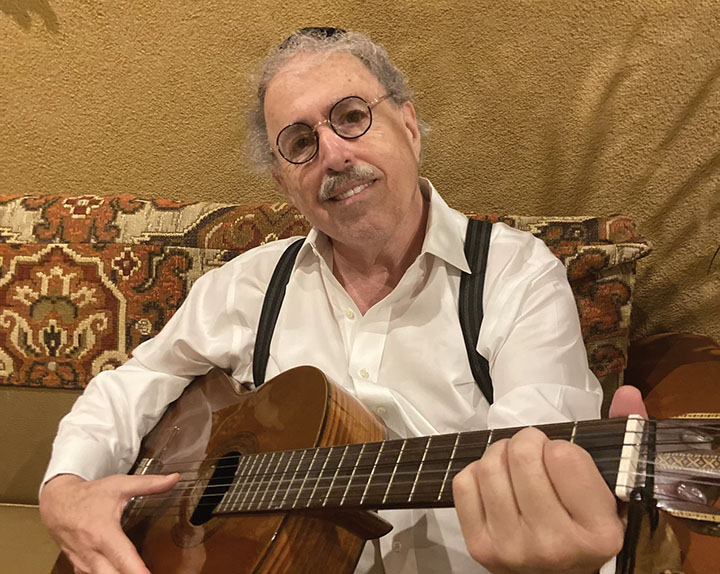
Thea Robertshaw suffered recurring nightmares long after her parents hid Jews in Nazi-occupied Holland. “They were always about ominous, faceless soldiers waiting in the dark,” said the artist, whose dream paintings are on display at the University of Judaism and the ElevenSeven Gallery in Long Beach.
The soldier-phantoms emerge from flaming red trees in Robertshaw’s autobiographical painting “Her Story.” They lurk behind skeletal birches in “Ode to My Father 2,” in which the young Thea clings to her father as he bicycles down a deserted lane. The trees cast long shadows reminiscent of prison bars.
The piece recalls a time when Robertshaw, 67, felt imprisoned by fear.
“Every day before I went off to school, I received a lecture from my mother and father,” she recalled. “It was ‘Don’t tell anybody about the [Jews hidden] in this house or how many people live here. If you do, we’re all going to die.'”
In 1943, Robertshaw’s devout Christian father became concerned about Jews who were disappearing from the family’s working-class neighborhood in Eindoven, Holland. Soon thereafter, three Jews moved into the family’s tiny brick row house. There was Franz, the psychiatry student; Mr. Fruhling, a portly, nervous little shoe salesman who chattered incessantly; and a young woman, Bep De Vries, a slender concert pianist who had taught at a famous Berlin conservatory.
Whereas Anne Frank’s family hid out in a secret annex in Amsterdam, Thea’s house didn’t have a special hiding place — only a tiny basement, which the refugees scurried to whenever a stranger rang the doorbell. Robertshaw knew the penalty for hiding Jews was death; her anxiety bothered her more than the malnutrition that caused boils to erupt all over her body.
Nevertheless, she formed a close friendship with Bep, who gave her music lessons on the family’s rickety upright piano. But about 18 months after the Jews arrived, Thea’s mother had a premonition of danger. She managed to secure alternate hiding places for the two Jewish men, but found nothing available for Bep. Three weeks later, Robertshaw came home from school to find two Gestapo agents in the living room. “They held their guns to my head, then they went straight to the basement,” she recalls. “I’ll never forget the sad, frightened look on Bep’s face as they took her away.”
Before long, underground contacts informed the family that Bep De Vries had been gassed at Auschwitz.
One pale, gaunt man with a shaved head ate ravenously at the dining room table. “I made him batch after batch of pancakes,” Robertshaw said. “I thought he was never going to stop.”
The war continued to haunt Robertshaw even after she emigrated to the United States at the age of 18. Her heart raced for no apparent reason, and she suffered from a psychosomatic ailment that paralyzed her esophagus.
Nightmares jarred her awake in the wee hours. Relief came only after she began to paint her dreams in the mid-1970s. For example, “Child on a Bridge,” reminiscent of Edvard Munch’s “The Scream,” depicts young Thea shrieking as a bomber approaches.
“Once I painted the dream, I never had it again,” said Robertshaw, an art professor at Long Beach City College. “I exorcised my nightmares by painting them.” Robertshaw also painted canvases that drew on her wartime memories, such as the time her mother locked her toys in a cupboard, then sold them off for food.
But it was only in the past few months that she mustered the courage to paint her most traumatic memory — the arrest of her beloved Bep.
She began the piece when she realized she was still obsessing over what she knew De Vries had endured in Auschwitz. Within a few hours, she had outlined the painting: Bep being led away as the dog-like figure of Anubis, the Egyptian god of the dead, snarls from under a piano. “I cried for days while completing the piece,” Robertshaw recalls. “Then I realized I had previously been too frightened to cry. This painting brought home the tragedy. I was finally able to feel the grief.”
Robertshaw is one of six artists whose paintings are displayed at “Dreams & Reality,” an exhibit through July 1 at the University of Judaism, (310) 440-1203. Her one-woman show, “Between Worlds,” is at the ElevenSeven Gallery through June 30, (562) 590-6535.