Marc Chagall, born Moishe Zakhavovich Shagall, was a mercurial artist whose turbulent emotions in love and on canvas are reflected in the play “The Flying Lovers of Vitebsk.”
The title’s aerial and passionate lovers are Chagall and Bella Rosenfeld, whose marriage from 1915 to 1944 spanned the violent era of World Wars I and II, the Communist revolution, the rise of Hitler and the beginning of the Holocaust.
It is well to keep in mind that personal and global turbulence when watching “The Flying Lovers” — performed at the Bram Goldsmith Theater at the Wallis Annenberg Center for the Performing Arts in Beverly Hills — for the scenes and emotions shift rapidly, demanding a viewer’s full attention.
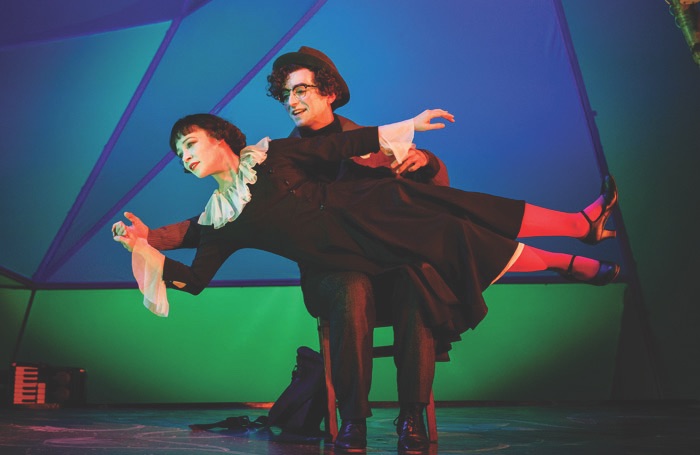
The two-person play, augmented by two participating musicians, stars the talented and highly acrobatic actors Marc Antolin as Chagall and Daisy Maywood as Bella, who strut, fly and embrace passionately.
It is not easy to convey the feel of the “The Flying Lovers,” but one example is the sight of Chagall’s large canvas of a rabbi, which suddenly comes to life when Bella’s hands wiggle through holes in the portrait.
An illustration of the artist’s single-minded focus on his art comes through in a rare confrontation with Bella, who gives birth to their daughter while her husband disappears for four days to work on a new creation.
One of Chagall’s paintings, “The Fiddler” (Le Violoniste, 1912-13), has taken on a life of its own as the supposed inspiration for the title of the enormously successful musical “Fiddler on the Roof.”
“The play is not biographical, but it accurately reflects the relationship between Chagall and Bella.” — Emma Rice
In any case, from Yiddish songs and dances to persecution by the czars, “The Flying Lovers” is pervaded by Jewish sounds and themes. However, both the play’s writer, Daniel Jamieson, and its director, Emma Rice, are British gentiles who “have been drawn to many things Jewish,” Rice told the Journal in a phone call from England.
In the early 1990s, the pair visited Paris and took in an exhibition of Chagall’s works. “The experience was a revelation of the magic realism of Chagall’s art,” Rice said.
Subsequently, the two not only collaborated in creating “The Flying Lovers,” but also played the two principals in the initial productions.
“The play is not biographical, but it accurately reflects the relationship between Chagall and Bella,” Rice said. “I believe the play will be around for many years.”
One hoped-for byproduct of the play, which was funded by Jewish philanthropists, will be to raise interest in Chagall’s life and works.
The artist, who lived for a turbulent 97 years, from 1887 to 1985, was born in Vitebsk, Belarus, a town of 66,000 inhabitants, where Jews made up half the population.
Throughout the artist’s life, he experimented and innovated in many styles — Naïve art, Surrealism, Cubism, Modernism, Symbolism and Fauvism. But whatever his experiments and explorations in style and material, Chagall “remained most emphatically a Jewish artist, whose work was a long dreaming reverie of life in his native village of Vitebsk,” wrote art critic Robert Hughes.
Another appraisal comes from Jackie Wullschlager, who, in her biography of Chagall, lauded him as “a pioneer of modern art and one of the greatest figurative painters … [who] invented a visual language that recorded the thrill and terror of the 20th century.”
“The Flying Lovers of Vitebsk” runs 90 minutes, without intermission, and will be on stage at the Wallis Center for the Performing Arts through March 11. For information and tickets, visit www.tickets.thewallis.org.