The Jewish Federation of Greater Los Angeles enjoyed another successful Super Sunday. The citywide fundraiser scored $5,089,627 — about even with last year’s $5,003,256 total. This despite the lingering residue of the disasters and debacles of 2001 (or perhaps because of them) and an L.A. Marathon that cut right across 6505 Wilshire, The Federation’s headquarters, and tied up traffic all over town.
During the afternoon, 6505 was graced by appearances from Los Angeles City Attorney Rocky Delgadillo, Assemblymen Paul Koretz (D-Dist. 42) and Robert Hertzberg (D-Dist. 40), State Sen. Sheila James Kuehl (D-Dist. 23), City Councilman Jack Weiss (Dist. 2), Los Angeles County Supervisor Zev Yaroslavsky (Dist. 3), and Terri Smooke, special assistant to Gov. Gray Davis.
William Bernstein, Federation executive vice president of financial resource development, was also on-hand, surveying the evening’s progress.
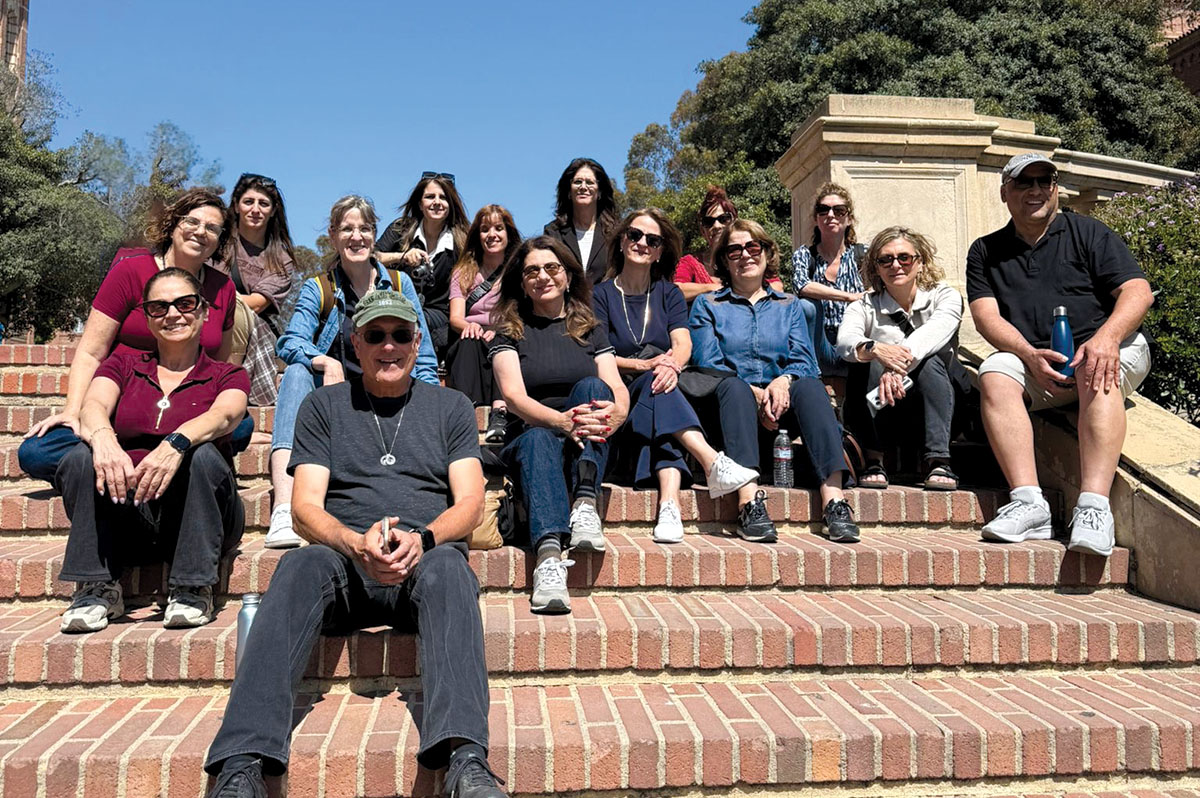
By the 6-9 p.m. shift at 6505, a group of nearly 100 people — mostly singles in their 20s and 30s — were working the phones.
Chair Harold Ginsburg, who bopped back and forth between 6505 and the two other Super Sunday sites in South Bay and West Hills, saw a contrast between the senior-heavy morning shift and the younger evening callers.
"Each session has a different kind of energy. This morning, the mood was electrifying and focused, but not noisy like this," Ginsburg said, as Super Sunday staff circulated with trays of pizza to hand to volunteers.
According to Ginsburg, the turmoil that capped 2001 — which included ongoing violence in Israel, a Jewish Community Centers meltdown, Federation layoffs, and, of course, the Sept. 11 attacks — the issue on many callers’ lips was a relatively recent one.
"Argentina has been the major motivational issue for many callers," said Ginsburg, chairing his very first Super Sunday. He added that he would love to helm the event again in 2003.
And now, it’s time for "Super Sunday — A Love Story: Part II." Several weeks ago, we reported that Ginsburg had met his second wife through a Federation event. As it turns out, Jeffrey Prince, head of volunteer training this year at 6505, met his wife, Michele, at Super Sunday ’96.
"We met helping set up the room," he recalled. "It was part of the young leadership. She was in my group, making signs."
Personal connections aside, there were plenty of success stories at 6505’s evening shift. Fifteen-year-old phone phenom Alex Miller drummed up a personal best — $64,000 — nearly doubling his totals from last year. A 26-year-old speech pathologist, who was on the phones for the first time since her teen years, fielded a $3,600 contribution from one donor. Real estate agent David Yashar received donations that ranged from $200 to $2,000.
"It’s a lot of fun, and a lot easier than I thought it would be," said first-timer Nancy Solomon, a 32-year-old attorney. She said that she will return again next year.
"It’s great to see friends and to feel that I’m supporting the Jewish community and bringing people into the community. Giving is a way to connect," Solomon added.
"I came here to help and it feels good," said Yashar, 32. "Hopefully, one day it will come back to me if I need it."