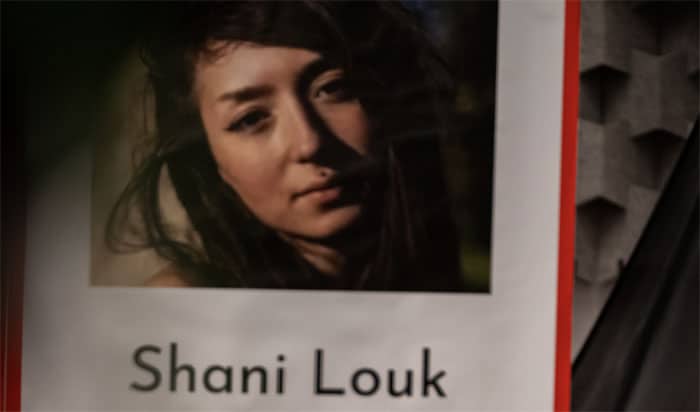
Unlike the “falling man,” who jumped to his death as the Twin Towers burned behind him on September 11, 2001, the woman in the truck, Shani Louk, who was kidnapped, raped, and brutalized by Islamic Hamas terrorists on October 7, 2023, was robbed of her will.
The falling man and the brutalized woman in a pick-up truck are separated by thousands of miles and decades of time. The falling man came to work early in the morning, and plunged to his death, “departing from this earth like an arrow.” The brutalized woman traveled with her friends to a music festival in the Negev Desert, close to the Gaza Strip, danced and rejoiced, her long dreads flowing with the rhythm of the music, was tortured, and most likely killed, departing from this earth like a trophy.
They paraded her body, her limbs twisted in an unnatural position, her head bloodied from what seems to be a blow to the head. They displayed her body in a pick-up truck in the streets of Gaza as men screamed “Allahu Akbar” (God is great) while others ran up to spit on her.
There are certain things, certain moments in one’s life that cannot be unseen. This was the moment for me. It chilled me. I called my mother. “Mama, what they did to her, only hell, only in hell this can be.” I watched as her mother appeared on German television and pleaded for her daughter’s life (I still cannot fathom how she was able to compose herself).
But the falling man and the brutalized woman, who never have met in real life, lost their lives to the same ideology, to the same religious movement that fuels Islamic terrorist organizations and cells all over the world: ISIS, Hamas, Hezbollah, ISIL, Taliban, Al-Qaeda, Boko Haram. There are more. There, from the darkness, you will not find sanctity for life; no sanctity for the child; no sanctity for the woman … none for the human being.
When Tom Junod’s essay, “The Falling Man” appeared in Esquire in 2003, many rushed to track the identity of the man; he remains anonymous. Similarly, the graphic pictures and videos of the brutalized woman sent me searching for her. I wanted to find her — most of all, I wanted to look at her when she was alive.
From her social media profile, Shani Louk and I most likely do not share a similar worldview. I gather her politics are very different from mine. In life, most likely we would not be friends. But as I looked at her pictures, at her love for life and most importantly, love for freedom, I saw a most precious woman. She was in every sense of the word, a free spirit. The brutal assault on Shani Louk was an assault on all free women, on our freedom to study, to paint, to dance, to follow our passions.
If anyone claims that Shani Louk was killed because she was a colonialist, tell them that she was murdered because she was a Jew; she was murdered because she was free.
If anyone claims that Shani Louk was killed because she was a colonialist, tell them that she was murdered because she was a Jew; she was murdered because she was free. She was killed for the very same reason the falling man died. Neither died on Arab soil; neither were military personnel; both died in their homeland and both for the same reason.
And if anyone claims that Hamas is an Israeli problem, a Jewish problem, let them know that the Jew is that proverbial canary in the coalmine. The criminal and immoral events of October 7, 2023 that transpired in Israel are to be read as a warning, a very costly warning — 1000 Jewish lives — to the so far free Western world.
Naya Lekht received her PhD in Russian Literature and wrote her dissertation on Holocaust literature in the Soviet Union. Naya is currently the Education Editor for White Rose Magazine and a Research Fellow for the Institute for the Study of Global Antisemitism and Policy.