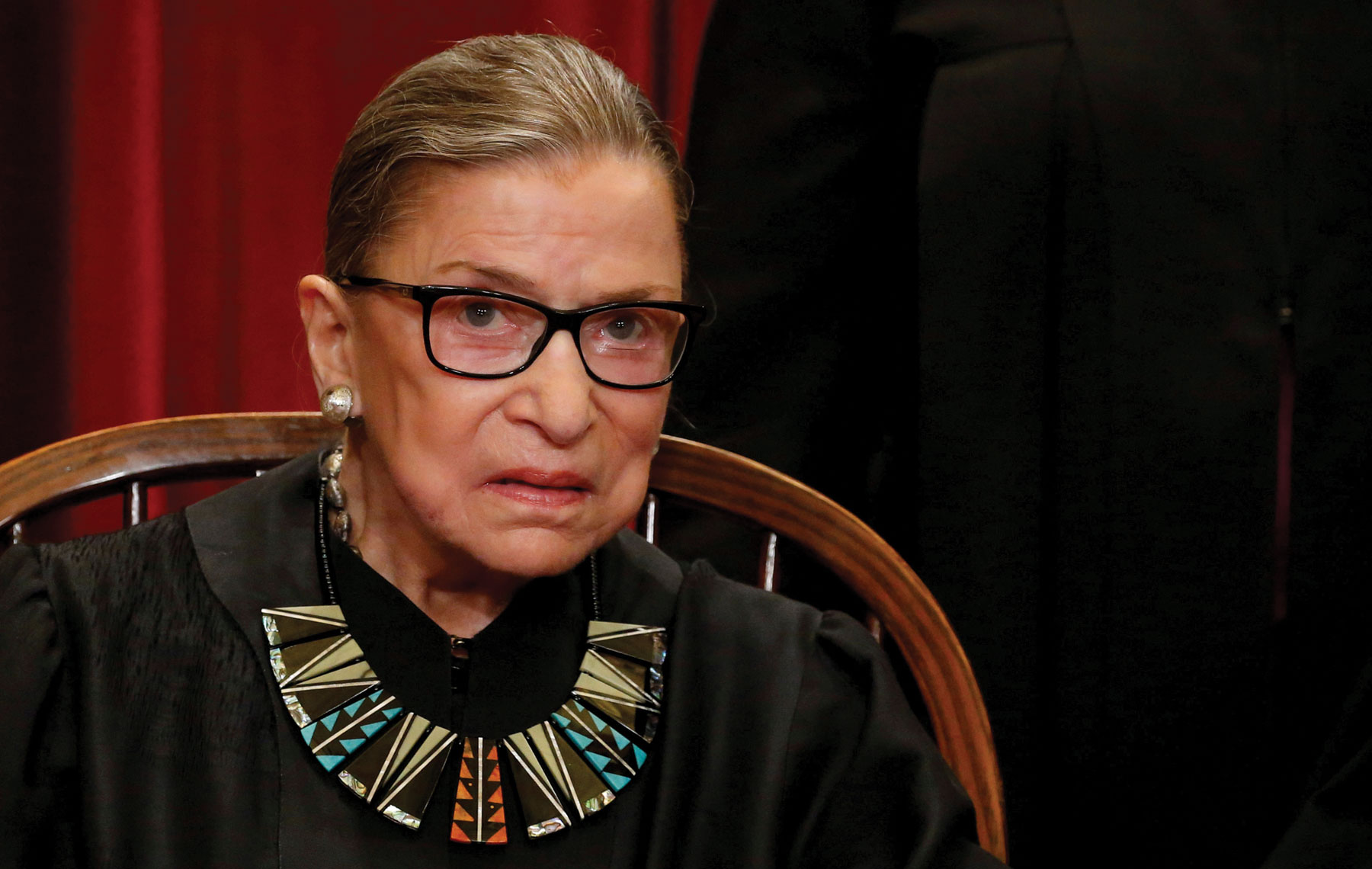
Now that Roe v. Wade has been officially overturned, and as it becomes clear that the pro-choice community doesn’t have any more of a plan on how to protect abortion rights than it did to protect Roe from its critics, it might be a good time for pro-choice believers to look for guidance from the strongest abortion rights advocate and most prominent feminist voice to ever serve on the Supreme Court.
So the question to now ask is this: WWRBGD? (What Would Ruth Bader Ginsburg Do?)
It’s not widely known that Ginsburg argued that the seven justices who voted in favor of Roe back in 1973 had acted imprudently and incorrectly.
Given Ginsburg’s strong credentials on this issue, it’s not widely known that she had consistently argued for most of her career that the seven justices who voted in favor of Roe back in 1973 had acted imprudently and incorrectly. Ginsburg’s disagreement was certainly not with the substance of their ruling: she strongly believed in the importance of establishing national protections for a woman’s right to choose to have an abortion. She also vehemently opposed the Texas law that would have banned almost all abortions that became the basis for Roe.
But Ginsburg also strongly believed that the Court should have stopped there, and that by not just reversing the Texas ruling but by also using the case to establish a nationwide right to an abortion, the justices dramatically overstepped. Her concern was that allowing the abortion debate to be resolved more gradually through the legislative process would have created a more durable and sustainable base of support for reproductive rights. And she worried that concluding such a divisive public argument so abruptly would balkanize the political landscape, effectively freezing public opinion on both sides of the issue.
Ginsburg has been proven correct: that’s exactly what has occurred over the last 49 years, until the smaller but better organized and more committed side of the dispute reversed the Roe decision in terms just as absolute as the original verdict. In the five years before Roe was decided, 16 states, with 41 percent of the nation’s population, liberalized their abortion laws. So the political winds were clearly blowing in that direction. But after the Court acted, the battle lines hardened, and progress that might have continued as politicians who reflected the views of their constituents negotiated further change instead froze in place.
(Ginsburg also believed that the Court should have based its decision not on the right to privacy but rather that it impeded gender equality. By basing the argument on the Equal Protection Clause of the 14th Amendment, the decision would have been better protected from the argument that the conservative justices used last week in overturning it. But that is a discussion for another day.)
Legislative decisions tend to identify middle ground compromise. Judicial fiats – in either direction – are usually much blunter instruments. Instead of both sides accomplishing some of their objectives, both Roe v. Wade and this month’s Dobbs v. Jackson case left the defeated faction angry, resentful and hell-bent on revenge.
So here we are, almost half-a-century later, facing a political landscape on which abortion rights will be debated by elected officials on a state-by-state basis, just as Ginsburg had suggested would be a more productive path forward. Our politics are much more polarized today than back in the 1970’s and abortion has become a much more partisan issue over the last five decades. So resolving these issues legislatively will be much more difficult now than it would have been when the case was originally decided.
But even given the additional challenges of a more divisive political era, the future of abortion rights in this country will now be determined by legislators rather than judges, through protracted and difficult negotiation rather than judicial edict. This will be a long, slow, and often frustrating process. It will be accomplished through hundreds of low-profile elections and thousands of bills in state capitols around the country. But it also means that while neither side will realize absolute victory, neither will suffer complete defeat.
In Ginsburg’s own words:
“You just have to move forward and get to work, step by step, case by case.”
Dan Schnur is a Professor at the University of California – Berkeley, USC and Pepperdine. Join Dan for his weekly webinar “Politics in the Time of Coronavirus” (www/lawac.org) on Tuesdays at 5 PM.