
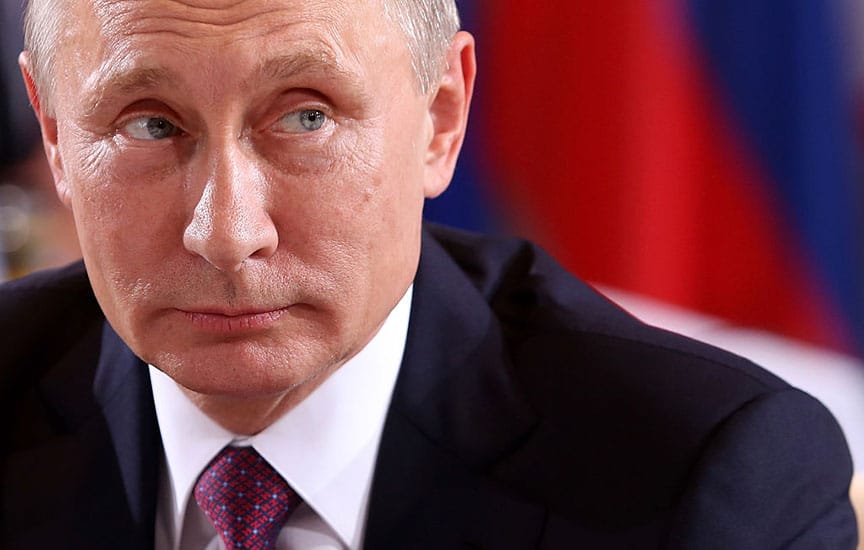
 Russian President Vladimir Putin (Photo by Adam Berry/Getty Images)
 It’s not often that you see a headline that begins with the words “Putin apologizes”. But both American and Israeli media have reported that Russian President Vladimir Putin offered an apology to Israeli Prime Minister Naftali Bennett for antisemitic slurs that one of his top advisors had made last week regarding Hitler and Jews.
Foreign Minister Sergei Lavrov had sought to justify Moscow’s stated goal of “de-Nazifying” Ukraine — which is led by a Jewish president — by claiming Adolf Hitler had “Jewish blood” and that “the most ardent antisemites are usually Jews.” There was strong international backlash against Lavrov’s insults, but the Russian Foreign Ministry originally reinforced his comments before Bennett and Putin spoke directly.
Putin hates backing down – to anyone at any time. So the question is: Why would he feel it necessary to mend fences with Bennett?
At the time this was written, the Kremlin had neither confirmed nor denied Putin’s apology, suggesting an effort on Putin’s part to avoid looking weak to his own people while avoiding a diplomatic blowup with Israel. But Putin hates backing down – to anyone at any time. So the question is: Why would he feel it necessary to mend fences with Bennett?
From the beginning of the war, Israel’s leaders have been forced to navigate an extremely difficult path to avoid antagonizing Russia. While Israel’s own democratic principles (and strong relationship with the United States) would have naturally aligned the Jewish homeland with Ukraine, Bennett has avoided provoking Putin for both domestic political reasons and international security considerations. Given ongoing provocations from Syria, Israel’s military must coordinate its actions closely with their Russian counterparts to avoid any unintentional conflict. Combined with the sizable population of Russian émigrés – and their considerable political clout – Bennett’s best available option has been to position himself as an intermediary between Putin and Ukraine President Volodymyr Zelenskyy.
But as Russian atrocities became more apparent, Israel’s support for Ukraine became more assertive. Bennett’s government has directed immense amounts of humanitarian aid, including medical equipment, clothing, food and other supplies to displaced Ukrainians. Diplomatically, Israel has moved off the sidelines as well, voting for recent United Nations condemnations of Russia after staying away from earlier resolutions. More recently, Israel’s military has taken its first steps toward engagement, sending helmets, flak jackets and other types of body armor for use by civilian and medical personnel.
Putin knows that Israel is also facing growing pressure to begin sending weaponry too, and given his own military’s underwhelming performance to date, it’s understandable why he would not want to see Israel’s wartime expertise deployed against his troops in Ukraine. It’s questionable whether Israel’s vaunted Iron Dome missile defense system would be effective against sophisticated Russian armaments, but Israel also possesses a wide array of other types of weaponry that could be extremely valuable to Ukraine’s troops. Even more important are the added benefits of Israel’s considerable cyberwar expertise, as well as its sophisticated military intelligence capabilities. The large number of Israel’s Russian and Ukrainian-speaking combat soldiers and reservists would also greatly aid training efforts.
Putin has watched and listened to the fierce response of Israel’s political leaders to Lavrov’s blunder, most notably Foreign Minister Yair Lapid’s statement that Lavrov’s comments had “crossed a line.” Within a day, Putin and Bennett were on the phone, ostensibly to discuss the evacuation of civilians from the Avostal steel plant in the Ukrainian city of Mariupol and for Putin to congratulate Israel for its Independence Day. But the timing of the call, and the rather tepid pushback from the Kremlin against Bennett’s announcement of a Putin apology, suggest that the Russian president knew exactly how important it was to defuse the situation.
It should not be forgotten that Ukraine is far from the top of Israel’s list of international concerns. But Bennett recognizes that the best way to maintain his influence in the Iranian nuclear negotiations – and to discourage too many American concessions — is to maintain as strong a relationship with the U.S. as possible. Stepping up Israel’s support of Ukraine is an effective and timely way to achieve that goal.
Dan Schnur is a Professor at the University of California – Berkeley, USC and Pepperdine. Join Dan for his weekly webinar “Politics in the Time of Coronavirus” (www/lawac.org) on Tuesdays at 5 PM.
















 More news and opinions than at a Shabbat dinner, right in your inbox.