fbpx

May 11, 2022

‘Edge of Tomorrow’ Program to Create Israeli Combat Soldiers of the Future

For more articles from The Media Line, click here.

“Edge of Tomorrow,” an innovative Israeli program, is set to revolutionize the concept of the infantry soldier.  The program was unveiled on Tuesday by The Directorate of Defense Research and Development (DDR&D) from the Ministry of Defense, and Elbit Systems, one of the main companies producing defense electronic devices in Israel.

The program incorporates networked warfare technologies for each and every soldier on an infantry combat team; it is also designed to improve the combat team’s modern urban warfare, according to Israel’s Defense Ministry.

“‘Edge of Tomorrow’ is an innovative program that is extremely unique thanks to our change in perspective. The program aims to enable optimal operational value for the ground forces combat soldiers by strengthening the synergy between them and their team. The program incorporates a wide array of advanced technologies used by the soldiers and their teams, leading to a whole much greater than the sum of its parts,” Lt. Col. Shlomi Buskila, head of the LWSOF Branch in the DDR&D, said in a statement.

Mayan Lazarovich, spokesperson for Israel’s Ministry of Defense, told The Media Line that the Edge of Tomorrow program has been “a multiple-year effort that has continually improved the infantry soldiers’ lethality, survivability, situational awareness, stamina and more.”

An industry source, who provided an in-depth explanation of the plan to The Media Line, described it as a suit which consists of a set of wearable technologies that include many connected subsystems.

He said that there will be specialized suits for every kind of soldier on a team.

“There are different roles within a team, so everyone gets his specific suit and it’s all connected. There is going to be a soldier suit, a commander suit, a sharpshooter suit, etc.,” he said.

The source added that this set of technologies includes many different devices such as display googles, a sleeve that helps with transmitting information within the group, computerized rifles, night vision systems, a component that can help with carrying weight, and fire detection capability. “The soldier can carry a very small device that can detect the direction of hostile fire so it can be spawned very quickly and very effectively,” he said.

He noted that looking back between 50 years and 100 years ago, there was only incremental change in the technological capabilities that were provided to an infantry soldier.

Now, he said, “what we are talking about is actually a step change trying to bring about, you know, real transformation technologically speaking. We’re looking at the infantry soldier and at the team level.”

He said that the plan will improve the individual infantry soldier and the team as a whole: “Not just a better rifle, a better weapon, better night-vision goggles, but we look at it as a comprehensive capability.”

Lazarovich said that the plan is still in development, and the timing of the launch of the program is still uncertain.

“The Edge of Tomorrow is a program focused on development. Decisions regarding the program’s launch will be made in the future,” she said.

‘Edge of Tomorrow’ Program to Create Israeli Combat Soldiers of the Future Read More »

Fantasy and Suspense Meet Jewish Mysticism in “The Hidden Saint”

It should come as no surprise that, while sitting in a local café, about to take in the final chapter of a book that includes mysticism, folklore, fantasy, and a story about a rabbi who creates a golem, and a lady at the next table says to me, “That looks like an interesting book,” I invite her to join me, we discover we have the same first name, and she tells me she is a painter who has painted … the golem. What are the chances?

Jonathan Kellerman called “The Hidden Saint” by Mark Levenson, “An ingenious, compelling mix of horror, fantasy, suspense and Jewish mysticism. Think Tolkien, albeit benefiting from a yeshiva education.”

Levenson is, indeed, an Orthodox Jew. I’ve read fictionalized books by Jews, about Jews or Judaism, that have disappointed. This isn’t one of those.

Levenson gives some of his sources – and motivation — in an Afterword, and others in a Zoom interview I did with him during chol hamoed (the intermediate days of Passover). One can also read his thoughts on this and other issues on his website: marklevensonbooks.com.

The stories about Rabbi Adam, on whom the story is based, took place in the Middle Ages, but [Levenson] moved him up to the 18th century, and spins a tale of ardent love, fear, ingenuity and adventure.

The stories about Rabbi Adam, on whom the story is based, took place in the Middle Ages, he told me, but he moved him up to the 18th century, and spins a tale of ardent love, fear, ingenuity and adventure.

The Story

Adam, a young man living in the village of Miropol in pogrom-ridden Europe, disappears from his wedding to his beloved childhood sweetheart, Rachel, when he runs back to retrieve the ring that has been left at home. His parents fear that if he goes alone, he won’t be under the protection of anyone from the evil spirits, a reference to the custom of not leaving a bride or groom alone on their wedding day – a practice that is still observed today, and an example of how Levenson weaves past and current traditions into the narrative.

Adam never returns.

We see Adam years later, in a less than loving marriage (from his side) with the righteous and devoted Sarah. He is the rabbi now of their town of Lizensk, and they are about to marry off their son Hersh. Rabbi Adam has no memory of his childhood and his youth, including fleeing his wedding. 

After the wedding ceremony, Hersh and Miriam are about to partake in a festive meal, in Hersh’s bedroom, as they have been fasting. But the bride is suddenly possessed by an evil spirit, turns into a monstrous creature, attacks her groom, and when she comes out of it, they both collapse on the bed in a stupor in which they linger between life and death.  

Rabbi Adam fears that there is something in his past that has led to this horrific situation. His son Mendel has also been abducted — apparently by an evil spirit — and Mendel’s twin sister, Leah, while looking for her doll in another room, was lured and then attacked by the same demon spirit, so she, too, has fallen into a deep stupor.

Rabbi Adam sets out to find his son. He believes that finding him will also cure the newlyweds and his daughter. 

What ensues is a story in which he creates a seven-foot golem out of mud, who hereafter thinks of Rabbi Adam as “the creator” to help him fight the evil spirits, that include, first and foremost, the evil Lilith. We hear the thoughts of Adam, the Golem and Sarah in the course of the book.

During his travels, Adam encounters a widowed inn-keeper, Shayna, who eventually reveals herself to be a “Lamed Vavnik” — one of the 36 tzadikim without whom the world could not continue to exist. If something happens to her, who will take her place?

Their adventures take them through forests and over rivers, occasionally having to struggle or fight with evil spirits, including the Yedoni. Levenson credits Rav Nathan Slifkin with introducing him to these creatures, who appear in his book, “Sacred Monsters: Mysterious and Mythical Creatures of Scripture, Talmud and Midrash.” They are warned against in Parshat Kedoshim (for the first time in Vayikra 19:31). 

The story includes not just danger, death, monsters, and a constant teetering between fear and fearlessness, but a great deal of introspection on the part of Rabbi Adam, and a seeking to regain his lost memory in order to strive toward teshuva, that he believes will help him find his son and overcome the evil spirits that have abducted him, which he believes will also lead to the healing of his son, daughter and daughter-in-law.

The frightening events are tempered by a healthy dose of tongue-in-cheek humor: “It struck him how little he knew about women, and what he knew about his mother was hardly of use.”

The frightening events are tempered by a healthy dose of tongue-in-cheek humor:

 “It struck him how little he knew about women, and what he knew about his mother was hardly of use.”

They reach a village and a woman sneers when she sees the golem, telling her son that no, it’s not a goblin, because goblins are better dressed.

Before his quest begins, Adam finds a book in his synagogue that gives him clues, and a black box with a mirror inside. “I need to seek the Lamed Vavnik and the mirror is showing me where to go,” he says to his wife, Sarah. When I asked Levenson if he was influenced by the magic mirror in “Beauty and the Beast,” he said, “Rabbi Adam is an actual Jewish folklore hero. He began to appear in the 16th century, early 17th century, and I moved him up a couple of centuries. In the original stories of Rabbi Adam he is said to have a magic mirror.” Indeed, a short search reveals that the Rabbi Adam stories preceded the original versions of Beauty and the Beast.

One is tempted to ask, like children, “Did these stories ’really happen’?”

“One is free to imagine that it was a real person or that it was made up,” says Levenson. “I don’t like calling it fantasy because it implies that it’s not true … Some rabbanim will say that everything in the gemara really happened and some of the aggada is meant to teach moral ideas. People believe different ways. The aggadata in the Talmud was a big influence on me, more than kabbalistic texts … the first golem stories are in the Talmud. There are wonderful ‘ghost stories’ in Masechet Brachot and one of them inspired the scene in the cemetery.

“I wanted it to work for general readers as well. You don’t have to come in with any particular knowledge; it’s an adventure story.”

Wise truisms are slipped in unobtrusively. Shayna is touched when the golem presents her with a bouquet of wildflowers. “Family, I suppose,” she says, “is sometimes where you find it.”

They reach Adam’s home village of Miropol, but it has been destroyed. Adam thinks that it’s all over. “’Over?’ [Shayna] said with a long shake of her head. ‘Not that. Never that. There is always a way. And it’s our job to find it.’” 

While there, Rabbi Adam meets spirits in a cemetery, in a world of Sisyphean limbo, including his Uncle Itzik and the Widow Baile, who lament to him that their tasks are never completed. The sewing always returns to the Widow Baile the next morning as it was before. Uncle Itzik continues to bake his pastries “but my sack of flour never empties, and my baked goods go forever uneaten…How can we leave this world behind us for the World to Come when there is no one left to remember us?” Adam says the Kaddish prayer, and the spirits fade away, conveying to us the importance of memory.

While seeking his beloved Rachel, Adam wonders, how could it be that “the woman with whom for twenty years he’d lived, slept, and had children, was a woman he was never meant even to know? That the angels had decreed otherwise forty days before he’d been born.” It is a metaphysical question about fate vs. choice.

How did this venture begin?

 “I was interested in fantasy from a very early age [and] my Jewish identity was always important,” says Levenson. He is an award-winning dramatist, screenwriter, and short story writer, as well as a longtime journalist for both Jewish and general publications. 

In 1986 he wrote a golem play that was produced.  “I’ve always had that sense of Jewish folklore so the journey began with that early golem play and in the years after that I wrote an adaptation of S. Ansky’s “The Dybbuk” for actors and puppets, an adult show… it toured nationally.” 

“The Hidden Saint” was originally conceived as a screenplay. It was runner-up in the Bruce Geller screenwriting competition hosted by the American Jewish University in Los Angeles. “The writing itself took nine years and then bringing it to publication, was another three. There were long periods when I got stumped and had to put it aside and come back to it.” He also had to break out of the original screenplay outline, which was limiting.  “And the novel is so much stronger than the original screenplay.

Levenson says the golem’s role, “Was not to be a Frankenstein monster or to supersede God but to better know God … the kabbalists created golems so they could draw closer to God, by being creators, but because they’re not God, their creation is less, by not having the power to speak.”

As to the source of the Rabbi Adam story, Levenson refers me to the book of Howard Schwartz, an award-winning author, anthology editor and English professor, who writes in “Elijah’s Violin, and Other Jewish Tales”: “Rabbi Adam is perhaps best known for his role as the transmitter of the fabled Book of Mysteries to the Baal Shem Tov in Hasidic legend, but there also exist several independent medieval tales … In each case Rabbi Adam comes to the assistance of his fellow Jews either by interceding with an evil king or by directly aiding a Jew in danger … The tales about Rabbi Adam also served as models for some of the legends of Rabbi Judah Loew of Prague, the creator of the Golem.  

Will there be a sequel?

“Yes, I’m researching a sequel now; it will take Rabbi Adam into some very different territory but I need to do more research and it’s a more complicated thought structure than the quest structure.”

I wondered if he had teachers or rabbis who were his inspiration. 

 “I had none among my teachers. I had was my mother, Jeanne Levenson, who absolutely inspired me. She had worked as a trade reporter before she was married and after repeated rejections, she stopped writing, but she had that in her blood and she certainly passed it on to me — a love of literature, books, theater — so I’m glad she did live long enough to see it written.”

Has there been any pushback from the Orthodox community? Levenson is a member of Young Israel of White Plains.

“I’ve received no negative responses. My wife and I were married by a Chabad Rabbi, Yakov Saacks. I asked him to read the book and he supplied a blurb; he loved it and he was certainly looking from an Orthodox perspective.”

On his website, Levenson writes, “Why does evil exist in the world? It’s a question that has occupied thinkers such as Maimonides throughout the ages. Evil exists to give man the ability to choose good. Evil exists for man to value life. For these reasons, the Almighty created a world with death and disease, war, wild beasts — and the evil at the center of The Hidden Saint.” 

At one point, when Adam is finally in a place to confront Lilith, he says, “You have no power over me because I give you no power over me.” For this message alone, this book is a worthy read. 

The next time you see your teenager, or student, engrossed in an 800-page secular fantasy tome, you can tell him, “Have I got a book for you…” 

“The Hidden Saint” is available on Amazon and Barnes and Noble and from May 24th will also be available as an audio book


Toby Klein Greenwald is an award-winning journalist, theatre director and the editor-in-chief of WholeFamily.com. 

Fantasy and Suspense Meet Jewish Mysticism in “The Hidden Saint” Read More »

A Taste of My Own Medicine

Long ago I learned that we medical doctors are cut from the same cloth as the rest of humanity. Some are overweight, don’t get enough sleep, eat junk food, and partake in the panoply of earthly sins. Although I’m aware that studies show that obesity is not simply a lifestyle choice, I still wonder how my overweight colleagues can counsel their patients on weight loss. I’m sure they must. Were I more sensitive, I might not imagine it as the elephant in the room. 

So, both to serve as an example and avoid the taint of hypocrisy, I try to follow the health practices I recommend. I maintain a reasonable weight, exercise, drink alcohol in moderation (mostly) and try (sometimes not hard enough) to get the right amount of sleep. If I sound a bit boring, yours would not be a unique observation. 

Time being relative, I soon learned the principle that time passes most slowly between paychecks and fastest between colonoscopies.

In line with the “follow my own advice” rule, I recently found myself in a colonoscopy suite. Colon cancer screening is one of the health maintenance issues “back burnered” by many during the pandemic. With survival at risk, we don’t think first of our colons. I had my first at age 50, as recommended at the time. Now, with the age of colon cancer diagnoses falling, we recommend starting at 45. My first revealed a tubular adenoma, a benign polyp. Such polyps confer higher cancer risk, so instead of ten years, I was told to have a colonoscopy every five. Time being relative, I soon learned the principle that time passes most slowly between paychecks and fastest between colonoscopies.

When I confessed to Dr. Ted Stein, my GI specialist, that I was some months overdue for my follow-up colonoscopy, he reminded me that as I’d had a normal interval colonoscopy, the current recommendation allowed for a seven-year interval. But, if I wanted to adhere to the old recommendation, that would be okay too.

A colonoscopy may not be the GI equivalent of a root canal, but I still don’t count off the days until my next, like I might for baseball’s opening day. Regardless, I opted to do it. Of course, there’s “the example thing.”  For the next year, I can tell my reluctant patients, “I just had one myself. No big deal!” A bigger reason is fear of irony. Irony hunts down physicians. In my mind’s eye (which remarkably also functions as an ear) I could hear colleagues and patients, the ghosts of Hanukkah future, whispering, “So unfortunate about Dr.  Stone and that colon thing. If only…”   

It was not yet 7 a.m. when the bright and smiling Dr. Stein greeted me at the colonoscopy suite. Fortunately, I’ve known Ted for over 30 years. He’s just a friend who does this strange procedure. He introduced me to Dr. Lo, the anesthesiologist who administered propofol. She commented that it would sting a bit as it flowed into my intravenous line. After that momentary sensation I was off to dream land, to emerge when the procedure was over. Again, the smiling Dr. Stein was there to reassure me that we were done and all was fine. Dr. Lo had explained a bit about propofol. It wears off not by leaving the body but by redistribution. It starts in the brain, causing loss of consciousness, then re-distributes elsewhere allowing the return of consciousness when enough leaves the brain. If one pays attention, it leaves a “soft landing” that fades pleasantly through the rest of the day.  

So, after my good experience, I’ll go back to being the pied piper of colonoscopy. (Though stool testing alone is a reasonable alternative for the procedure phobic.)  Colon cancer remains the most common cause of death among non-smoking Americans. So, it’s a big potential target. Even before the age recommendation dropped to 45, fewer than half of Americans were current on screening. Some people reading these words would probably add years to their lives if they picked up the phone and scheduled their colonoscopy. Even without a friend of 30 years to do the procedure, everyone’s plan is likely to have a smiling GI doctor and an anesthesiologist to deftly manage propofol. Now wouldn’t it be ironic if you missed a timely reminder like this?


Daniel Stone is Regional Medical Director of Cedars-Sinai Valley Network and a practicing internist and geriatrician with Cedars Sinai Medical Group. The views expressed in this column do not necessarily reflect those of Cedars-Sinai.

A Taste of My Own Medicine Read More »

Rosner’s Domain: The Coalition of Postponement

From Israel’s coalition point of view, the situation is clear: we must keep it going, for as long as possible. Nothing good is waiting for us, coalition members, if we crumble. No improvement is expected in circumstances, in jobs, in opportunities to have impact. Some parties will find themselves outside the Knesset. Some MKs will end a short, inglorious, career. It is better for the coalition to pull the limping cart. Better to pull and hope that something happens. Perhaps a turnaround in the Benjamin Netanyahu trial, perhaps a change in Mansour Abbas’ mood, perhaps a change in reality that will tighten the ranks again. Something.

From the point of view of Israel’s opposition, the situation is also clear: We must topple the coalition as soon as possible. Not all members of the opposition are enthusiastic about a government — another round of government — led by Netanyahu. But everyone has strong motivation to compromise on such outcome. The Zionist Religious Party wants to disband Bennett’s party and win over some of its electorate. The ultra-Orthodox parties want to regain their budgetary sway. The Arab Joint List has an interest in proving that Islamist Raam was wrong when it joined the coalition. 

What is the public’s interest? The public has political preferences. It also has non-political issues on its agenda. It has a long-term and substantial interest in a having stable government. Clearly there is no good coming out of a situation of volatile government that changes once a year. This is not good, even in the eyes of those who want the coalition to fall.

What is the public’s interest? It also has an interest in having a functioning coalition. It has an interest in having a coalition that is capable of governing, taking the initiative, planning ahead, legislating. A shaky coalition, which is mainly concerned with survival, and whose leaders are navigating it in dubious ways, mainly for the sake of survival, is not a coalition that serves the public. Not even the public that voted for it.

If this is a coalition doomed to collapse, and until then mainly engage in awkward maneuvering, it would probably be better for it to fall.

So, in a week that could determine the future of the coalition (as I write, I don’t yet know if an initial vote to have a new election has passed) the public interest includes two conflicting components. One in support of continuation of the coalition, one in support of its rapid dissolution. It all depends on the coalition’s prospects for staying in power. If this is a coalition doomed to collapse, and until then mainly engage in awkward maneuvering, it would probably be better for it to fall. If this is a coalition that has a way of surviving in the medium or long term, keep planning, keep legislating, it probably better survive. All this is the public interest, detached from political preferences. But as we know, every voter has a political preference that dictates his or her true will.

What do these voters want?

Opposition voters say that every day of the Bennett-Lapid government is a bad day.

Coalition voters say: Every day without Netanyahu is a good day.

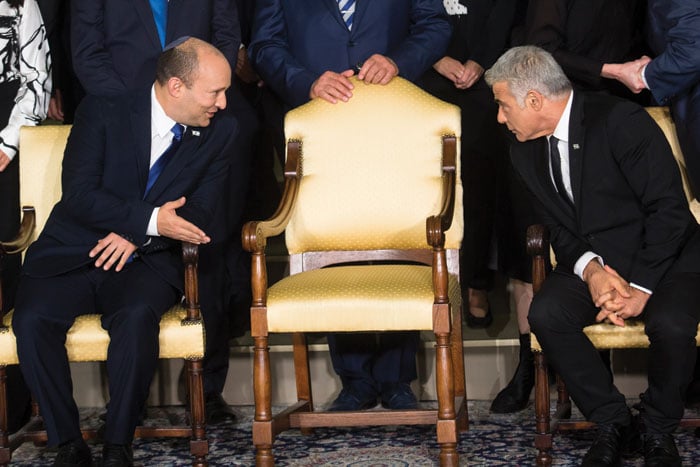
This is what is left of the Bennett-Lapid coalition. In fact, to begin with, the coalition’s main adhesive was the wish to remove Netanyahu. But as long as the coalition had a majority, it could set itself additional goals, such as changing budgetary priorities, or changing policies in other areas, or passing reforms that were not possible during the previous regime. But from the moment the coalition lost its majority, a few weeks ago, it lost the essential ability to set an agenda, to shape reality. All it was left with is the power to postpone. This remains the coalition’s purpose — postponing Netanyahu.

Is this a sufficient reason for having a coalition? Public opinion polls tell us that many coalition voters say yes. They support the coalition mostly for this reason — Labor and Meretz voters, who reconciled with the idea of a right-wing Prime Minister Naftali Bennett; right-wing voters who agreed to partner with Ra’am and Meretz. The voters of these parties believe that a semi-functioning government, a coalition on the edge, is better than a return to Netanyahu. They are willing to give up on all reforms, on long-term planning, on legislation, provided that Netanyahu does not return to being the Prime Minister. That’s how much they fear his return. That’s how much they despise him.

This is a challenging situation. A difficult and depressing situation for many of the coalition voters. If their wobbly coalition chariot disintegrates it’s not clear what they’ll do with their disappointment and despair. So, if more elections come, they will be bitter and nasty. They will be characterized by blatant rhetoric, dramatic warnings, and a looming sense of doomsday. Thus, if they come, there is no reason to rejoice in them. There is no reason — both for those who support the coalition, and for those who support the dissolution of the coalition. There is no reason to rejoice in them — for those who support the State of Israel.

Something I wrote in Hebrew

Here’s what I wrote on abortion in the U.S. and it’s relevance to Israel:

What is happening in America proves that the sanctity of the Supreme Court is an ideological fiction, promoted by those whom the court stands by at a particular moment. Here in Israel, the left sanctifies the court. Why? Because it seems to them that the court serves goals close to its heart and protects Israel from degenerating into a social and moral catastrophe. In America, the situation is reversed: The court is now a darling of the right. Why? Because it seems that the court serves purposes close to its heart and protects America from degenerating into a social and moral catastrophe. In both cases, it is not the institution that matters, but rather the contemporary position of its members. The Israeli left should remember that a very strong court can one day become a court that frustrates the left. The Israeli right should keep in mind that a weak court will not be able to rule in favor of the right when its members are more aligned with the right’s ideals. 

A week’s numbers

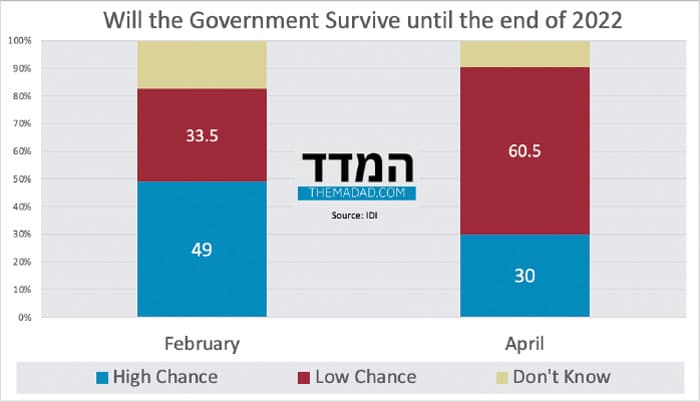
Will the current coalition survive until the end of the year? In February, most voters said yes; in April, most said no.

A reader’s response:

Miriam Davids writes: “Mr. Rosner, America is in big trouble. Israel mustn’t rely on us no more.”


Shmuel Rosner is senior political editor. For more analysis of Israeli and international politics, visit Rosner’s Domain at jewishjournal.com/rosnersdomain.

Rosner’s Domain: The Coalition of Postponement Read More »

Al Jazeera Journalist Killed During IDF Raid

Al Jazeera journalist Shireen Abu Akleh, 51, was killed during an Israeli Defense Force (IDF) raid of a Palestinian refugee camp in the West Bank village of Jenin on May 11.

It is currently unclear who shot and killed Abu Akleh. Israeli Prime Minister Naftali Bennett said in a statement that “there is a good chance that armed Palestinians, firing wildly, brought about the tragic death of the journalist.” A Palestinian health official told The Times of Israel (TOI)  that Abu Akleh was killed by Israeli gunfire and Palestinian witnesses also told TOI that they didn’t see any armed Palestinians nearby (TOI reported to have seen footage confirming this) and that Abu Akleh was outside of the area where the raid was taking place. 

American Jewish Committee (AJC) Managing Director of Global Affairs Avi Mayer noted in a tweet that Dr. Rayyan Ali, who heads the Palestinian Forensic Medicine Institute, has reportedly declared: “It cannot be determined whether [Akleh] was killed by Israeli fire or by a Palestinian bullet.”

IDF Chief Aviv Kohavi said in a statement that “the Palestinians carried out widespread gunfire at our forces — wild, indiscriminate fire in all directions. The journalist who was killed was present inside the area of the fighting. At this stage, it is not possible to determine whose gunfire she was hit by and we are sorry for her death.”

Israeli Foreign Minister Yair Lapid offered to conduct a joint investigation with the Palestinian Authority (PA) on the matter, but Bennett told the Knesset that the PA had rebuffed their request for a joint autopsy, per The Jerusalem Post. PA Minister Hussein Al-Sheikh denied in a tweet that the Israeli government had made overtures to them on a joint investigation and blamed Abu Akleh’s killing on the “occupation government.”

The Post also reported that Likud Member of the Knesset (MK) Gideon Sa’ar said on the floor of the Knesset that the IDF raid was conducted “to arrest suspects in the Jenin terrorist camp and other locations in the region,” as recent terror attacks against Israelis have involved Palestinians entering Israel illegally from Jenin. “The specific incident involved massive firing and explosives,” he added. “Thank God there were no casualties to our forces.”

StandWithUs Israel Executive Director Michael Dickson tweeted, “I’ve seen some influential blue-checks, decrying the tragic death of journalist Shireen Abu Akleh, blaming Israel before facts are known. I do not recall hearing their voices as each of the 19 innocent Israelis [were] murdered by Palestinian terrorists in the last several weeks.”

The AJC similarly tweeted, “We’re saddened by the killing of journalist Shireen Abu Akleh in a Jenin firefight. There must be a joint investigation, which has been proposed by Israel and rejected by the Palestinians. Until facts are established, presumptions of responsibility are premature.”

The New York Times described Abu Akleh, a Jerusalem-born Palestinian who had been working at Al Jazeera since 1997, as a “trailblazer” who was well known among Palestinians for her reporting. A funeral procession from the PA’s headquarters will be held for her on May 12 and Abu Akleh will be laid to rest the following day.

Al Jazeera Journalist Killed During IDF Raid Read More »

Why I won’t be an Elon Musk groupie

Elon Musk is the type of man that smart, healthy, attractive, feminine women want to date or sleep with or marry: the alpha male.

I speak from research and experience. As a woman and former singles columnist, I’ve studied “pick-up” artistry and even wrote a pamphlet under a pen name about the “pick-up” phenomenon known as the “Shit Test.” Sounds crude, but I didn’t give it that name. The pick-up community has its own lexicon, such as the one provided at the end of author Neil Strauss’ “Bible” on seduction, The Game. The “Shit Test” describes subconscious tests that desirable women give men to test their mettle, usually by giving them a hard time. In essence, a woman is testing how he handles the real world, because life can be one big “Shit Test.”

Musk has proven he has the ability to pass “Shit Tests” with flying colors because passing them requires qualities that pick-up coaches train men to achieve.

Confidence is the number one quality. Savvy women, especially those who rate 8 to 10 on the looks scale (to borrow again from crude pick-up lingo), don’t want weak men begging for their attention, as lapdogs, as AFCs (Average Frustrated Chumps). They want men who know they are worthy of their attention. On an evolutionary level, if he can “conquer” her—when she’s both fabulous but especially when she’s difficult–then he’s the type of man who can win wars and sustain the human race with the best genetic material.

Given his nerdiness, Musk may not be your typical alpha male, but he’s one of the most confident men on the planet (or thanks to him, in the solar system) if he seriously thinks he can get humans to Mars. Thanks to his vision, marketed in his the Netflix shows Return to Space and Countdown (what a way to “peacock”!), civilians have flown to outer space. He creates companies dedicated to solving world problems: Space X for space travel; Tesla for sustainable transportation, and The Boring Company for traffic. He’s a man who has literally mastered the universe. How sexy.

A confident man is skilled at banter, the kind of conversation needed to propel a man out of “friend zone.” Unless he looks like Henry Cavill, a hot woman doesn’t want a man who is clumsy beside her, who can’t hold his own. Being able to respond deftly and humorously to her subtle insults and verbal play suggests he is a man who is strong, creative, capable.

Musk is great at banter. For example, in an interview, he described once a date in college.

“The first question I asked her is: do you ever think about electric cars?” he said. She obviously didn’t. Then he added, with a smirk. “Recently, it’s been a bit more effective.” The crowd shot up in laughter, and I’m sure the interviewer in that moment wanted to hand him her bra.

Pick-up artists also teach men how they must control the frame of the encounter. Musk has proven, on Twitter at least, that he controls the frame. He takes a hit and punches right back, never getting off-balance. Take, for example, left-wing nutcase Alexandria Orcasio-Cortez’s swipe at him, when she tweeted that he’s a “billionaire with an ego problem.”

“Stop hitting on me, I’m really shy!” Musk answered with a “blush” emoji. He reframed her insult as a compliment to him. The perfect “neg”: a subtle, playful put-down of a woman to knock her off her pedestal. Flustered, AOC deleted the Tweet. Donald Trump Jr. posted a meme suggesting that Musk “owns” AOC, who, ironically, owns a Tesla vehicle. Journalist Megyn Kelly is a groupie, too, responding to one of his negs of mainstream media by saying: “So far I love the new Twitter.”

The conservative world fell head-over-heels for Musk when he bought Twitter and made it a fun space again for political and intellectual “Shit Tests” among friends and foes alike. In preserving free speech, he became the most special kind of alpha male: a hero.

These days, it’s not politically-correct to be an “alpha male,” especially among leftists and feminists. Actually, it’s not politically-correct to be male at all. “Alpha male” falls into the category of “toxic masculinity.” I wonder if the bestselling The Game would have ever been published in this climate. After getting married, Strauss even walked back his pick-up ways and renounced much of his teachings.

The Left had a crush on Musk when he was just an “alpha nerd” making electric cars instead of free speech. Since giving voice to the silenced conservatives, Musk is the male archetype the Left wants to destroy. They already tried to destroy Trump, another super alpha male. Trump was so good at passing the media’s “Shit Tests”  on Twitter, that the Left had to find a way to get him off the platform.

Ten years ago, I would’ve definitely been a Musk-groupie, in the romantic and intellectual sense. I too have been a victim of Big Tech “jail.” But it’s not the Left’s contempt for “alpha males” that have made me regard Musk with suspicion.

I’m older and wiser now. My heart has been broken by too many alpha males who are often valiant and smart when they go in for the “kill”–wining and dining you, thrilling you with inspiring conversation–but then leaving you with your broken heart on the floor by the bed when they get up to conquer the world again.

I’ve learned that while I still love confident men, their kindness, respect, and wisdom must now match their ambition, success, and wit.

Pick-up artists can teach men “openers,” but they’re awful at teaching men how to sustain relationships. (Strauss is now divorced.) Musk has “picked-up” the conservative and liberal “damsels in distress.” He has charmed us with his Twitter-banter. But what’s in his heart? How does he treat people? What are the philosophical values underlying his confidence and brilliance? Are his world-changing moves rooted in wisdom and an ethical long-term plan for human redemption–or are his rocket ships just toys of a brilliant big boy?

So I won’t let Musk sweep me off my feet me so easily. We need to know more about him than from his vanity Netflix documentaries, media interviews, or Twitter feed. He’s always aiming for the stars, but let’s go deeper, under the surface.

That said, I’m happy to meet him for a date when he’s in town to visit the Tesla factory in Berlin to help him out with that.

This article appeared first in German in Die Achse Des Guten (The Axis of Good).

Why I won’t be an Elon Musk groupie Read More »

German Airline Allegedly Bars More Than 100 Orthodox Jewish Passengers from Flight After Some Refuse to Wear Mask

The German airline Lufthansa allegedly prevented more than 100 Orthodox Jewish passengers from boarding a May 4 flight from Frankfurt to Budapest after a couple of passengers refused to wear a mask on their previous flight.

The Jewish Chronicle (JC) and Business Insider (BI) reported that the passengers had just landed in Frankfurt after flying from New York as part of their trip to Budapest to pay tribute to a late well-known rabbi. Per the reporting, the non-Jewish passengers from New York were allowed to board the flight to Budapest but the Jewish passengers were not. 

The JC reported that a video circulating on social media showed a representative from the airline telling a Jewish passenger who was questioning her as to why they couldn’t board the flight that “one” passenger didn’t wear a mask on the flight, so “everyone has to pay for a couple.” When pressed by the passenger, the representative said that it was “Jewish people … who made the problems.”

A couple of the Jewish passengers told Hamodia that the airline had subjected them to “antisemitic discrimination.” “Why should they ban everyone for just one or two people not wearing masks?” one of the passengers said. The Jewish passengers ultimately had to take different flights to get to Budapest.

A Lufthansa spokesperson told The JC that passengers were kept off the flight to Budapest because “some of the passengers with the planned onward journey to Budapest had repeatedly refused—even after repeated requests from the crew—to wear masks and to follow the safety regulations during the flight.” The spokesperson added that the airline is investigating the matter.

The American Jewish Committee (AJC) tweeted that the airline’s actions were “outrageous.” “Banning ALL Jews from a flight because of an alleged mask violation by some Jewish passengers is textbook antisemitism from @Lufthansa,” the AJC tweeted. “While this is infuriating, the airline’s apathetic response to this incident is equally shocking.”

StandWithUs Israel Executive Director Michael Dickson also tweeted in response to the video of the Lufthansa representative arguing with the Jewish passenger, “Replace the word ‘Jewish’ any other race or type. Does it hit harder? Because it should be equally unacceptable.”

Former New York Democratic Assemblyman Dov Hikind tweeted that the airline representative’s comments were “undeniably sick and antisemitic.” “What’s the excuse this time? ‘Just following orders’?!” he wrote.

German Airline Allegedly Bars More Than 100 Orthodox Jewish Passengers from Flight After Some Refuse to Wear Mask Read More »

A New Kind of FourPlay ft. Danielle & Julie

On the 10th episode of Schmuckboys, Marla, Maxine, and Libby are thrilled to bring you Danielle and Julie, the co-creators of the double-dating app, FourPlay. To start off, the schmuckgirls recap their visit to CT where they put on a live-podcast show for BBYO teens and celebrate Maxine finishing law school (clap clap clap). On this week’s episode the five ladies discuss why double-dating works, how FourPlay brings its users back to a simpler way to meet other singles, having expectations, choosing to date Jewish and more! The girls end with a game of “Cute or Cringe” and “Hot or Just Jewish?”

Like what you hear? Follow @schmuckboysofficial on Instagram and TikTok. Submit your questions, comments, concerns, crazy date stories, and advice requests to schmuckboysofficial@gmail.com

A New Kind of FourPlay ft. Danielle & Julie Read More »

Israel and the War in Ukraine

It’s not often that you see a headline that begins with the words “Putin apologizes”. But both American and Israeli media have reported that Russian President Vladimir Putin offered an apology to Israeli Prime Minister Naftali Bennett for antisemitic slurs that one of his top advisors had made last week regarding Hitler and Jews. 

Foreign Minister Sergei Lavrov had sought to justify Moscow’s stated goal of “de-Nazifying” Ukraine — which is led by a Jewish president — by claiming Adolf Hitler had “Jewish blood” and that “the most ardent antisemites are usually Jews.” There was strong international backlash against Lavrov’s insults, but the Russian Foreign Ministry originally reinforced his comments before Bennett and Putin spoke directly.

Putin hates backing down – to anyone at any time. So the question is: Why would he feel it necessary to mend fences with Bennett?

At the time this was written, the Kremlin had neither confirmed nor denied Putin’s apology, suggesting an effort on Putin’s part to avoid looking weak to his own people while avoiding a diplomatic blowup with Israel. But Putin hates backing down – to anyone at any time. So the question is: Why would he feel it necessary to mend fences with Bennett?

From the beginning of the war, Israel’s leaders have been forced to navigate an extremely difficult path to avoid antagonizing Russia. While Israel’s own democratic principles (and strong relationship with the United States) would have naturally aligned the Jewish homeland with Ukraine, Bennett has avoided provoking Putin for both domestic political reasons and international security considerations. Given ongoing provocations from Syria, Israel’s military must coordinate its actions closely with their Russian counterparts to avoid any unintentional conflict. Combined with the sizable population of Russian émigrés – and their considerable political clout – Bennett’s best available option has been to position himself as an intermediary between Putin and Ukraine President Volodymyr Zelenskyy. 

But as Russian atrocities became more apparent, Israel’s support for Ukraine became more assertive. Bennett’s government has directed immense amounts of humanitarian aid, including medical equipment, clothing, food and other supplies to displaced Ukrainians. Diplomatically, Israel has moved off the sidelines as well, voting for recent United Nations condemnations of Russia after staying away from earlier resolutions. More recently, Israel’s military has taken its first steps toward engagement, sending helmets, flak jackets and other types of body armor for use by civilian and medical personnel.

Putin knows that Israel is also facing growing pressure to begin sending weaponry too, and given his own military’s underwhelming performance to date, it’s understandable why he would not want to see Israel’s wartime expertise deployed against his troops in Ukraine. It’s questionable whether Israel’s vaunted Iron Dome missile defense system would be effective against sophisticated Russian armaments, but Israel also possesses a wide array of other types of weaponry that could be extremely valuable to Ukraine’s troops. Even more important are the added benefits of Israel’s considerable cyberwar expertise, as well as its sophisticated military intelligence capabilities. The large number of Israel’s Russian and Ukrainian-speaking combat soldiers and reservists would also greatly aid training efforts. 

Putin has watched and listened to the fierce response of Israel’s political leaders to Lavrov’s blunder, most notably Foreign Minister Yair Lapid’s statement that Lavrov’s comments had “crossed a line.” Within a day, Putin and Bennett were on the phone, ostensibly to discuss the evacuation of civilians from the Avostal steel plant in the Ukrainian city of Mariupol and for Putin to congratulate Israel for its Independence Day. But the timing of the call, and the rather tepid pushback from the Kremlin against Bennett’s announcement of a Putin apology, suggest that the Russian president knew exactly how important it was to defuse the situation.

It should not be forgotten that Ukraine is far from the top of Israel’s list of international concerns. But Bennett recognizes that the best way to maintain his influence in the Iranian nuclear negotiations – and to discourage too many American concessions — is to maintain as strong a relationship with the U.S. as possible. Stepping up Israel’s support of Ukraine is an effective and timely way to achieve that goal.


Dan Schnur is a Professor at the University of California – Berkeley, USC and Pepperdine. Join Dan for his weekly webinar “Politics in the Time of Coronavirus” (www/lawac.org) on Tuesdays at 5 PM.

Israel and the War in Ukraine Read More »

The Aspiration of a Jewish Democracy

Last week, I spoke at Park Avenue Synagogue (PAS) in New York City on the complexities of being a Zionist activist. I shared my own experiences of feeling ostracized from the progressive movement, feeling confused at the rhetoric surrounding Israel and Palestine on college campuses, and the implications of the BDS movement regarding contemporary antisemitism. In the audience, listening intently, was a cluster of teenage Hebrew school students from PAS, no doubt internalizing how they were meant to process this information ahead of their impending college career. When the panel was over, one of these students asked me: “What do you mean when you say Zionism is the goal of a Jewish and democratic state? Because when I hear that definition, it’s like, you cannot have one and another at the same time.”

How could I reconcile taking issue with the imprinting of “In God We Trust” on American money, or allocated time for prayer in public schools, while overlooking the blending of faith and politics when it comes to my own people’s civilization? 

One of the reasons I loved this question was because it was a notable departure from most audience queries at congregations or Jewish community centers. Rather than giving advice on how Jewish students can combat anti-Zionism on campus or how they can organize pro-Israel advocacy in their communities, I was now propositioned to address the root of a problem that many Jews struggle with, an issue that I myself struggled with when I first began thinking about the contradictions of a Jewish state. I remember pondering, at the height of my left-wing college days, how I could possibly fight for the separation of church and state in my own country while fighting for a specifically Jewish homeland overseas? How could I reconcile taking issue with the imprinting of “In God We Trust” on American money, or allocated time for prayer in public schools, while overlooking the blending of faith and politics when it comes to my own people’s civilization? 

If a Jewish student cannot answer this question sincerely and with enough conviction, it is pointless to expect them to stand up for Zionism. Therefore, I was sure to craft my answer with as much care as possible, highlighting simple truths that all in the public square can understand.

The idea to build a Jewish state is in part a secular idea to grant a nation the universal right to self-determination, especially considering the absence of this self-determination has borne the greatest human rights calamities our modern world has seen.

I first explained the fundamental difference between the Jewish people and the Christian, Buddhist or Muslim people. The Jewish people are an ethno-religion and a people, bound together by yes, religion, but also by national aspirations, common history, shared languages, and culture. The idea to build a Jewish state is in part a secular idea to grant a nation the universal right to self-determination, especially considering that the absence of this self-determination has borne the greatest human rights calamities our modern world has seen. But let’s say one points to the clear religious influence in Israel, from the growing Haredi population to their burgeoning representation in the Knesset. It is important to add that religion has a place in many of the world’s liberal countries, as seen by crosses on the flags of European countries or the tethering of various royal families to the Church. This is not to say the presence of the Church is completely compatible with democracy, but it does not cancel out our thinking of such nations as democracies. And then, there is the example of the Arab Spring.

A Jewish democracy is a place we need to get to, not a place in which we can already revel.

During the Arab Spring, multiple Middle Eastern countries rebelled against either theocracy, authoritarianism, or both. The world cheered on, as many in the West correctly assumed that liberalism was possible to integrate into even the most illiberal of circumstances. Even if the Arab Spring largely failed and plunged the region deeper into war, it did so because of anti-democratic forces such as fundamentalist militias despotic tyrants. The Arab Spring also did not fail everywhere, considering Tunisia, a majority Muslim country and a part of the Organization of Islamic Cooperation, now boasts a democratic republic with a President as Head of State and a Prime Minister. The valiant campaign to bend Islamic countries toward democracy while immediately casting off the principle of a Jewish democracy as an automatic impossibility is hypocritical, and indeed reveals a contempt for Jewish society in any form.

Next, like all the world’s “democracies,” a Jewish democracy is an aspiration, not a final status reality. A Jewish democracy is a place we need to get to, not a place in which we can already revel. One can argue that the United States was not a true democracy until the 1960s, for democracy is inchoate when Black Americans are prohibited from the ballot box by the millions and certainly when women, half the population, are banned from political participation. Yet the foundations of our nation are that of a republic, and within the words of the Constitution are the seeds to weed out tyranny, even if its writers were in part tyrannical. Or take, for instance, Great Britain and France, which have been considered “democracies” even while enslaving, plundering, and pillaging much of the planet. Germany was still considered a democracy when it decided to abandon democracy altogether at the start of the 1930s. As with many nations, democracy is a verb in Israel, a push and pull between conservative and liberal impulses that propulse a nation, albeit nonlinearly. 

Finally, when we continued the conversation after the panel was over, I explained that part of the foundation of a Jewish democracy is the argument over how much religious law should be heeded. If arguments are essential to representing a pluralist country, surely the advancement of one Israeli ideal over the other and vice versa just years down the line represent a struggle over power, not a one-party hegemonic rule. We discussed the implications of the Star of David on the flag, the lyrics to “Hatikvah,” and the “Law of Return” for Jews, conversations I am sure she doesn’t feel welcomed initiating in more establishment pro-Israel circles. I then informed her that we, right now in the moment, were contributing to Jewish democracy, simply by proposing ways in which we would like to see Israel better reflect our own political visions. 

I informed this student that I would be making aliyah in the autumn, as I feel so strongly in the principle of Jewish democracy that I cannot help but participate. “Every Jew, everywhere, has this right,” I told her. Truthfully, I hope more American Jews make aliyah in the coming years, considering there is no point in us constantly complaining when Israel disappoints us if we don’t have a direct stake in how the Jewish people form and reform our country and our destiny. A Jewish democracy is an aspiration, a dream, and as the founder of the modern idea of a Jewish democracy once promised, “If you will it, it is no dream.”


Blake Flayton is New Media Director and columnist at the Jewish Journal.

The Aspiration of a Jewish Democracy Read More »