
fbpx

May 11, 2022

Three Angelenos Among WRJ Women’s Empowerment Awards Honorees

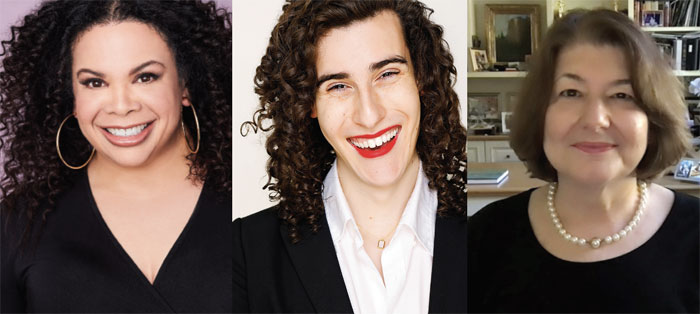
On Friday, May 13, the Women of Reform Judaism (WRJ) will honor Marra Gad, Eliana Rubin and Julia Weinstein, all from Los Angeles, at its 2022 Women’s Empowerment Awards. Established in 2019, this award honors women who strengthen the voices of others and promote progressive Jewish values.

“It is a tremendous honor to be lifted up as an empowered Jewish woman by the WRJ, and that is only made more special to me as, together with Tani Prell Epstein, we are the first women of color to receive this award,” Gad told the Journal. 

Gad is the  award-winning author of “The Color of Love: A Story of a Mixed-Race Jewish Girl”, a speaker and independent writer/producer who is committed to social justice and advocacy work.

“Representation matters, and to know that generations of other women and people will see themselves in this honor is the very definition of what it is to expand belonging.” – Marra Gad

“As a young Jewish woman, I never saw myself anywhere, much less being honored by the community,” she said. “Representation matters, and to know that generations of other women and people will see themselves in this honor is the very definition of what it is to expand belonging. I am humbled and very grateful.”

Jewish principles and traditions have always been a guiding force in Gad’s life. 

“As someone who is dedicated to the conversation around belonging, the concept that we are am echad b’Lev echad, one people with one heart, guides my writing, speaking and my everyday life choices,” she said. “That our texts and traditions give us beautiful guidance specifically around how we should treat one another is one of the many things that I love about being Jewish.”  

Eliana Rubin has been involved in the Reform movement since 2018, as a Theater Arts mentor at Union of Reform Judaism’s 6 Points Creative Arts Academy and a member of the JewV’Nation LGBTQ+ Fellowship Cohort. Rubin is an open trans-advocate and ally in a variety of Jewish and LGBTQA+ spaces.

“Judaism has impacted who I am in virtually all facets of my being,” Rubin said. “By discovering what my own Judaism looks like, I’ve been able to incorporate Jewish values and teachings into many corners of my life. My Judaism helps guide my actions and knowing my Jewish community is behind me is incredibly comforting.”

Rubin’s message to Jewish leaders of the future? Try new things, be comfortable being uncomfortable, be brave and be yourself.

Julia Weinstein, a member of Wilshire Boulevard Temple Sisterhood, told the Journal, “It feels very special to be honored by WRJ, a Jewish women’s organization that identifies spirituality as one of its core tenets and that emphasizes spiritual growth in its mission.” 

Through the WRJ, Weinstein has worshiped with Jewish women from around the world. There is great power when women gather together to pray – a unique spiritual quality enhanced by music and dancing that is very uplifting and joyful,” she said. 

With more than 20 years of leadership experience in the Reform movement, Weinstein’s focus on advocacy and education demonstrates her dedication to social justice and to WRJ.

“My work in the non-profit space for both WRJ and the Religious Action Center of Reform Judaism is based on Jewish values,” she said. “Jewish values teach us how to live, how to treat the world and how to treat others. By advocating for social justice, I am living and expressing my Jewish values.”

By harnessing the intellectual power and talents of women from all backgrounds, careers and stages of life, Weinstein believes the WRJ gives women a platform where they can continue to make a difference and grow personally and as leaders.

This year’s honorees also include Ellen Cohen (Congregation Beth Israel in Houston), Isabel “Liz” Dunst (Temple Sinai Women of Reform Judaism in Washington, D.C.) Becky Markowitz (Women of Shir Ami in Newtown, PA) and other leaders around the nation. 

“WRJ is proud to honor these inspiring women who have put their Jewish values into action for the greater good,” said WRJ President Sara Charney. “We are inspired by their stories of how they combine their strong leadership skills and passion for repairing the world –tikkun olam — to empower women and girls for generations to come.”   

The virtual ceremony, which features keynote speaker Dana Bash, CNN’s chief political correspondent, and musical guest Fourtelling, starts at 11 a.m. PST on Friday, May 13. For more information, visit www.wrj.org.

Three Angelenos Among WRJ Women’s Empowerment Awards Honorees Read More »

Can We Talk About Abortion?

One of my favorite television shows is the British series, “Call the Midwife,” set in the East End of London in the late 1950s. Now in its eleventh season, the show dramatizes the work and lives of the midwives serving the community, and the cultural and medical changes of the 1950s and mid-1960s that affected women’s lives in particular.

A baby is born in every episode, an occasion of much joy. New life is celebrated as the miracle that it is. But several episodes also focus on abortion, which was illegal during those years except when deemed necessary to save the mother’s life. The show’s writers treat every character seeking to terminate a pregnancy with wholehearted sympathy. Whether unmarried, married to an abusive man, or married but so impoverished that the thought of another mouth to feed sends a woman to her emotional breaking point, these women, and the risks they took to obtain illegal, amateur, dangerous “back alley” procedures that sometimes led to tragic, needless deaths, elicit our sympathy. 

“Call the Midwife” is set in a Catholic institution run by nuns who are also nurse-midwives, yet no one ever expresses any qualms about either abortion or the advent of birth control pills, which became available in 1961, both of which posed theological problems for the Catholic church. Instead, the show depicts abortion as an inarguable moral good.

The lack of nuance on the show mirrors the lack of nuance in the ongoing slugfest about abortion in the U.S. Now, with the anticipated overturning of Roe v. Wade by the U.S. Supreme Court, the arguments are at fever pitch. Abortion proponents are furious, declaring the highest court of the land illegitimate. Members of a group called Ruth Sent Us have protested in front of the homes of several Justices. Others have protested in front of Catholic churches. Planned Parenthood’s Facebook page shows a map warning that half the states will “quickly” move to outlaw abortion, predicting a domino effect from “fetal heartbeat” legislation in Texas and Oklahoma that would ban abortion as early as six weeks. 

Roe’s legal foundation was always shaky, finding a right to abortion based on the constitution’s right to privacy. Even abortion supporters including the late Supreme Court Justice Ruth Bader Ginsburg, whose name is invoked with religious fervor among this crowd, realized it was a faulty ruling. In his drafted opinion overturning Roe, Justice Samuel Alito quoted Ginsburg, who had said, “Roe … halted a political process that was moving in a reform direction and thereby, I believed, prolonged divisiveness and deferred stable settlement of the issue.”  

That said, a significant majority of Americans believe in the right to abortion within humane limits. This week’s YouGov/The Economist poll finds that 57% of U.S. adults support legal abortion in most or all cases, while only 14% approve of an outright ban. Yet among the hardliners, both rhetoric and actions have become extreme. The accepted position in the Democrat party used to be for abortion to be “safe, legal, and rare.” Now, abortion is legal up to twenty-four weeks in many states and calls for abortion on demand — even during the third trimester, when a fetus is viable — are growing. This week, the Senate begins debate on the Women’s Health Protection Act, which supporters say would only codify Roe v. Wade into law, but which those opposed say is overly permissive and would invalidate abortion restrictions legislated by individual states. The bill is not expected to pass. 

There has been a decided shift in the rhetoric surrounding abortion. It used to be about “a woman’s right to choose.” Now, we hear that “abortion is healthcare.” Ironically, the PC language police now insist on calling expectant mothers “pregnant people” or “birthing people” rather than “women.” This might make abortion tougher to sell as an inviolable right of women to have autonomy over their own bodies—something they were denied throughout most of human history.

The anti-abortion lobby has their own extremists, many of whom believe that life begins at the moment of conception. If life begins at conception, it follows that even first-trimester abortions are murder. Several states already severely limit access to abortion, and others seem poised to follow the lead of Texas and Oklahoma, outlawing abortion after six weeks or when a fetal heartbeat is first detected. But many women do not even realize they are pregnant until after that time. Given the growing calls for stricter limits on abortion in many states, fears about abortion restrictions  — if not outright bans — are understandable. But the rhetoric of “abortion is healthcare” and placards that insist, “My body. My rights. My choice. My voice” cover up uncomfortable truths. When a woman is pregnant, one body is in the process of becoming two.  Accountability requires that “My” becomes “Our.”  As the never-ending and emotionally charged arguments over abortion show, most people have a primal sense that a fetus is a human being in formation. 

Almost never discussed by proponents of abortion is the sorrow and even PTSD that some women experience after having abortions. Told by the abortion lobby that it’s “no big deal,” they are often unprepared for the emotional aftershocks. This hushed-up impact on women’s health is well-documented in the book “Unprotected: A Campus Psychiatrist Reveals How Political Correctness in Her Profession Endangers Every Student,” by Miriam Grossman, M.D., who was forced to first publish this book as “Anonymous,” for fear of retribution.

There are different Jewish views about when human life begins, but abortion unquestioningly has a place in Jewish law. 

There are different Jewish views about when human life begins, but abortion unquestioningly has a place in Jewish law. Even according to the strictest view that a fetus is a human life from the point of conception — a view expressed by the late Rabbi Moshe Feinstein, who is considered one of the 20th century’s greatest halachic decision-makers — if the mother’s life is endangered in any way, abortion is not only permitted but mandated. In Jewish law, the mother’s life always has primacy over the baby’s.

In response to the leak about the Supreme Court decision, the Orthodox Union issued a statement saying they do not support absolute bans on abortion, warning that any absolute bans on abortion “without regard for the health of the mother would literally limit our ability to live our lives in accordance with our responsibility to preserve life.”

The OU also does not support abortions on demand that aren’t deemed essential to a woman’s physical or mental health: “Jewish law places paramount value on choosing life and mandates — not as a right but as a responsibility — safeguarding our own lives and the lives of others by behaving in a healthy and secure manner, doing everything in our power to save lives, and refraining from endangering others. This concern for even potential life extends to the unborn fetus and to the terminally ill.” 

The Rabbinical Assembly (RA), the international association for Conservative/Masorti rabbis, also issued a statement: “Reproductive freedom is again under assault, this time from the highest court in our nation. The RA supports full access for all those who need abortions to the entire spectrum of reproductive healthcare and opposes all efforts by governmental, private entities, or individuals to limit or dismantle such access.”

The RA “has affirmed the right of a pregnant person to choose an abortion in cases where ‘continuation of a pregnancy might cause severe physical or psychological harm, or where the fetus is judged by competent medical opinion as severely defective.’ … Jewish tradition cherishes the sanctity of life, including the potential of life during pregnancy, but does not believe that personhood and human rights begin with conception, but rather with birth as indicated by Exodus 21:22-23.”

With such a gaping chasm between hardliners on both sides, how can we even talk about abortion? Extremes on one side of an argument inevitably lead to extreme reactions on the other. Abortion bans without regard to cases of rape, incest, or the physical or emotional health of the mother are cruel. Likewise, refusing to acknowledge that abortion is about more than a woman’s agency over her own body but about her responsibility to another life she helped create is also cruel.

Wouldn’t it be a good thing if we could all agree that sometimes, abortion is necessary, even as we acknowledge the loss of human potential? Wouldn’t it be a good thing if, indeed, abortion was safe, legal—and rare?

Both positions harden our hearts. Wouldn’t it be a good thing if we could all agree that sometimes, abortion is necessary, even as we acknowledge the loss of human potential? Wouldn’t it be a good thing if, indeed, abortion was safe, legal—and rare?


Judy Gruen’s latest book is “The Skeptic and the Rabbi: Falling in Love with Faith.” 

Can We Talk About Abortion? Read More »

How are Jews Supposed to Respond to Terrorist Attacks?

Last Thursday, I indulged in a rare day off. I went shopping, ate lunch at the park, and enjoyed a steak dinner. It was glorious. But when I arrived home, I read the horrific news that three Jewish men, all of them fathers, were brutally killed in the Israeli town of Elad. They were stabbed to death by two young Palestinian terrorists armed with knives and axes. 

Together, these fathers left behind 16 children. The names of those fathers were Boaz Gol (father of five), Oren Ben Yiftach (father of five) and Yonatan Habakkuk (father of six).

As a Jew who lives 7,500 miles away in glitzy Los Angeles, I instantly felt guilty about whatever I enjoyed, complained about or took for granted that day. 

When I hear such news, I’m sick to my stomach. But there’s something else: As a Jew who lives 7,500 miles away in glitzy Los Angeles, I instantly felt guilty about whatever I enjoyed, complained about or took for granted that day. 

That night, upon hearing that 16 children had been rendered fatherless, I felt bad about the steak dinner; I felt terrible that I had complained about how it’s getting harder to live in LA. And I felt remorseful that I had taken my parents for granted in a multitude of ways. 

I’ve always struggled with allowing myself to enjoy life after hearing about terrorist attacks anywhere, but particularly in Israel. There’s something about learning that Israelis were gunned down at a bar in Tel Aviv while you’re at Trader Joe’s, complaining that they’ve run out of baguettes again, that makes you feel small, petty and even guilty. The night after the ax attack in Elad, I sat down for Shabbat dinner, but each morsel of food seemed hard to swallow. All I could think about was how the previous Friday night was the last time that 16 children saw their father at the Shabbat table and felt his loving hands over their heads as they received the priestly blessing to safeguard them.

It’s not easy to move on with your day after hearing that innocent people in Israel were butchered in cities such as Beersheba and Bnei Brak. The fact that Jews can’t rely on the media to responsibly report the truth adds salt to wounds. The night that Jews were axed to death, news outlets such as CNN and Reuters used headlines about a “suspected terror attack.” I was confused. What’s the alternative to a “suspected” axe attack? An “axe-Jews-by-mistake” attack?

Many American Jews I know have been on edge since a new wave of terror began recently, in which 18 Israelis, including two Arab police officers, were murdered. But are we meant to shut down after hearing news of tragedy concerning Jews? I decided to ask a renowned psychotherapist and a sage rabbi (who served in the IDF during the First Lebanon War) about how we should respond to news of terror against Jews. 

The Psychological Lens 

“We’ve been dealing with all kinds of trauma from the news for the last several years,” Lori Gottlieb, a Los Angeles-based psychotherapist and author of the bestselling book, “Maybe You Should Talk to Someone: A Therapist, Her Therapist, and Our Lives Revealed,” told me. I shared with Gottlieb that I’m starting to shut down after hearing devastating news from abroad. “It can become overloading,” she said. “Our nervous systems can’t handle that much trauma.” Gottlieb reminded me that it isn’t helpful to ask yourself if you can experience joy if someone else is experiencing pain. “In order for us to be helpful,” she said, “we need to be able to experience our full humanity, including joy, and that doesn’t take away from the pain.”

Judaism is the greatest vessel for holding space for both joy and pain. It’s actually set up to balance the two.

I understood. For me, Judaism is the greatest vessel for holding space for both joy and pain. It’s actually set up to balance the two. Think about the Jewish marital ceremony beneath the chuppah: Immediately after being consecrated in marriage, the newly married couple holds space for one of the greatest tragedies in Jewish history—the destruction of the First and Second Temples in Jerusalem—when the groom breaks a wine glass beneath his foot. One moment after feeling wholeness with the other half of his soul, he breaks a vessel. 

I also asked Gottlieb how we can feel less helpless after hearing news of terrorist attacks. “One thing that can help is asking, ‘What can we do?’” she said. “We often say, ‘Well, I’m just one person,’ but there are lots of ways to get involved in change. You can’t change something by doing nothing.” And in doing nothing, said Gottlieb, we can feel even more depressed, which is why it’s so important to take action, whether individually or with others. 

The Spiritual Lens

“The Jewish people are unfortunately very experienced in responding to this kind of news; we’ve had 2,000 years of experience in how to respond,” Rabbi Daniel Bouskila, Director of the Sephardic Education Center (SEC) in Los Angeles and Jerusalem told me. As it happened, I called Bouskila while he was in Israel (he was in the country when the Elad attack occurred). From the serene terrace at the SEC campus in Jerusalem’s Old City, Bouskila observed that Jews are commanded to remember (“zakhor”). But had we historically responded to catastrophe and destruction by “exclusively mourning,” we would never have survived. “Twice, we lost the Temple and twice, we responded by mourning and then, re-organizing,” he said. “So to put it metaphorically, while Tisha B’Av (the ninth of Av) is our collective day of mourning, which we’ve been through many times and many terrible things happened on Tisha B’Av, the most important follow-up day for the Jews is the tenth of Av. Where do we go from there?” Bouskila compared it to something all Americans understand: “It’s almost like thinking about September 12 (after 9/11): What do we do the next day?”

I asked Bouskila what God wants from us when we hear news of calamity against Jews. “There’s no theology anywhere in Judaism that says, ‘This marks the end.’ I believe that God wants us to continue to live, whether those who survived the destruction of the Temples or the Holocaust or terror attacks,” he said. “God wants us to mourn, to remember and then to continue.” I also believe God wants us to refine ourselves and do better. 

As for Gottlieb, she connects moving forward with direct action. “What can you do in your community about antisemitism?” she asked. “Maybe you can’t do something about what happened in Israel, but maybe you can do something here. Start in your own community, so you don’t have to feel so helpless, and you can make a true difference. And talk to your children about hate.”

Recently, Bouskila spent time in Israel with relatives who had never visited the Jewish state. In a matter of days, they visited Yad Hashem, celebrated Israel’s Independence Day (with steaks at a barbeque), heard news of the Elad terror attack, and spent a beautiful Shabbat in the Old City. “I told them that they had just squeezed two-thousand years of Jewish history into three days,” Bouskila said solemnly. “As Jews, we’ve learned to carry pain with us as we persevere.”


Tabby Refael is a Los Angeles-based writer, speaker, and civic action activist. Follow her on Twitter @TabbyRefael

How are Jews Supposed to Respond to Terrorist Attacks? Read More »