On March 8, we celebrate International Women’s Day across the world. Considering the state of the world we live in today, I am especially grateful to be from Azerbaijan, and to raise my daughter in a country that not only celebrates and empowers women, but one that has an impressive history of high standards toward women, where over centuries women have been successful and breaking barriers in academia, art, industry, and government.
Azerbaijan was the very first Muslim country in the world to grant women equal voting rights, in 1919, an entire year before the United States and decades before many Western European nations; just one of countless examples of Azerbaijan’s history and standards toward women. Azerbaijan’s example for the rest of the world, set long ago, has never been more important than today, when women’s rights are on the center stage of global media.
With the global movement of #metoo, more have come to understand the experience of women in the world, and how discriminatory, violatary treatment of women is rampant, and come in many forms – some violent and shocking, others more subtle yet all the same impactful in pushing women back from realizing their worth and their best quality of life. As much as #metoo is about violence against women, it is also about attitudes against women. As a Muslim woman from a majority Muslim country, one that has long upheld women’s rights and ingrained in its national character an attitude of respect and awe for women, I am aware of how lucky I am.
Our country is best known as a beacon of tolerance, an “Oasis of Tolerance”, as Rabbi David Wolpe once wrote, and as a critical diplomatic force, capable of crossing aisles, breaking barriers and stereotypes, and succeeding in all ways despite dealing with a brutal war waged against us by our neighbor for the past 30 years. But some may not know that Azerbaijan has a remarkable history of women, leaders across art and industry, with women today in the highest levels of prestige across every field.
We have laws in place that assert the protections and respect for women across Azerbaijani society. For example, Article 25 and 34 were added in 1993 to Azerbaijan’s Constitution, and they guarantee full equality between men and women generally, and equality of men and women within marriage specifically. In 2006, Azerbaijan passed a Gender Equality Law which guarantees that women receive equal pay at work and prohibits discrimination in hiring and promotional practices.
The first secular school for Muslim girls anywhere in the world was opened in Baku, in 1901, and today, over 50% of PhD holders in Azerbaijan are women. The Judicial branch of government has many female justices, including the Honorable Tatiana Goldman, who is Jewish, and an Azerbaijan Supreme Court Justice. The legislative branch is not lagging behind in this regard: there are 21 women in Azerbaijan’s Parliament (out of 125 total), including Bahar Muradova, the Deputy Speaker. Our commitment to women’s equality has grown quickly: in 1990, women constituted merely 4.3 percent of parliament. Today this number is 17 percent, which is only slightly lower than the U.S. Congress with 19.8 percent. In Azerbaijan, we can boast that the Deputy Mayors of 71 out of 78 Administrative Districts, as well as many state committee chairpersons and deputy ministers are women. Only at Azerbaijan’s Foreign Ministry, 52 percent of all employees are women, including two ambassadors and an honorary consul (in Switzerland, Bulgaria and Australia).
There are so many examples to choose from, but I think you can see a lot about Azerbaijan by just looking at two of our famous women – current First Vice President Mehriban Aliyeva, and one of the most groundbreaking early female pilots in the world, Leyla Mammadbeyova, from the 1930s.
One of my favorite things to hear people say about First Vice President Aliyeva, is that she is known as “Kind Lady”, or Mehriban Khanim, as we say in Azerbaijan. The First Vice President is known for her generosity, her tireless humanitarian efforts in Azerbaijan and beyond as UNESCO Goodwill Ambassador, and her advocacy for health, women and children, among so many areas she works on to improve the world.
On the other hand, Leyla Mammadbeyova, who was called the “Mistress of the Skies”, was known for her daring, her strength, and her remarkable achievements as a pilot and mother to 6 children.
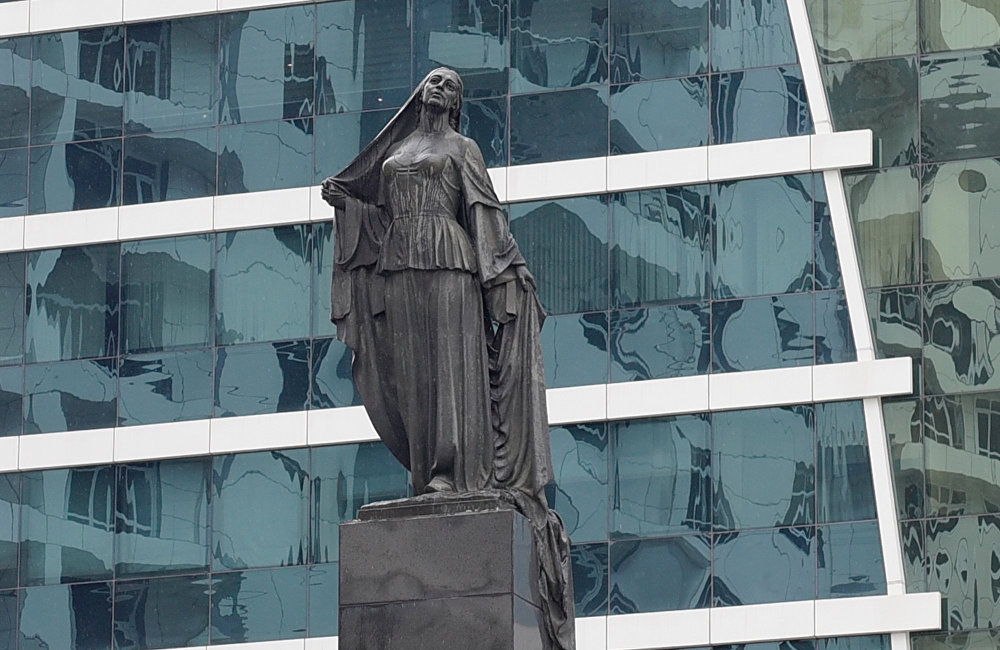
These diverse qualities of feminine heroism; kind and noble, daring and bold; all represent the history of positive attitudes toward women that hold strong in Azerbaijan. In the capital city of Baku, we have a famous statue, called the Statue of a Liberated Woman, and it depicts a beautiful woman, standing tall on a pedestal, casting her veil off her shoulders. I think this statue represents our attitude toward women in Azerbaijan; a celebration of our many strengths.
Hussein Javid, considered the “Shakespeare of Azerbaijan”, once said that “A country without woman is destroyed and remains helpless but in the hand of woman this world will only have bliss. She will exalt humanity.” My favorite part is the end, when Hussein Javid wrote, “She will exalt humanity.” I think of the First Vice President, and our famous pilot, both exalting humanity, literally raising it up, one with policy and charity, the other with wings – both with the courage to break barriers for women across continents. Happy International Women’s Day!