fbpx

March 7, 2018

Kid-Approved Camps

With so many Jewish summer camps to choose from, and with Westerners going east and Easterners going west, how does a family choose?

You can talk with campers, parents and camp representatives.

If upstate New York appeals to you, here is one perspective from Ithaca (population, 20,000):

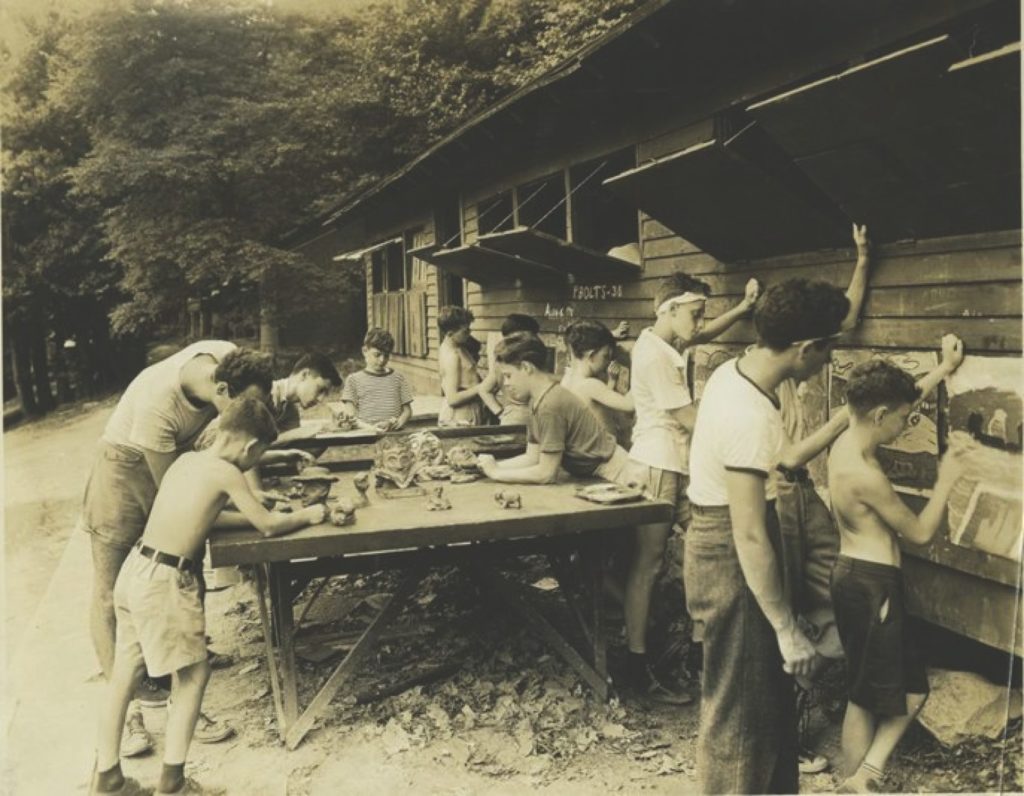
Each camp is different, but here is a list of ones in the area and what some local youths said about their Jewish camp experiences.

Adina, 10, attended Camp Young Judea — Sprout Lake for 3 1/2 weeks:

“My favorite thing about camp is Shabbat Rikud. On Saturday night, when we say goodbye to Shabbat, we do havdalah and then dance for hours. Everyone dances together. If you don’t know the dances, you just follow along and mess up and then you learn them as you go.

“I love Yom Kef (Fun Day). We went to Splashdown, a water park!

“The food at camp was absolutely delicious, on some days. My favorites were the lasagna, pizza, and gooberry mush (sour cream and yogurt and blueberries).

“Some of my bunkmates were from Israel. Some were from cities with a lot of Jews, some from places that don’t have a lot of Jewish people.” — Adina, 10

“Some of my bunkmates were from Israel. Some were from cities with a lot of Jews, some from places that don’t have a lot of Jewish people.”

Zoe, 13, attended Camp Sabra for four weeks:

“The best thing about camp is being with friends, going to the swim dock, tubing, and doing Jewish activities with the whole cabin.

“Camp is awesome!”

Sabine, 11, attended Camp Sabra for four weeks:

“My favorite thing about camp is having fun adventures on the lake. I love the water slide.

“Every day we say the prayers before and after the meals. On Shabbat we dress up and have services.”

Obie, 10, attended Camp Seneca Lake for two weeks:

“One of my favorite things is Movie Night on Saturday night. At camp we get to do hobbies — I like tennis.

“At camp we wake up early and are so tired by the end of the day. But we can sleep in for Shabbat.

“We say the Hebrew prayers at every meal. It’s easy to learn them when you do them every day.

“Camp is crazy and fun.”

Noah, 13, attended Camp Seneca Lake for four weeks:

“I really liked wakeboarding at camp. There is never a dull moment — there are so many activities!

“Each week we take a Shabbat walk, and then have Torah discussions on Shabbat afternoon.

“Camp is exciting.”

Raia, 11, attended Camp Eden Village for one week:

“I like how at camp there are so many different activities for everyone. My favorites are boating and the lake.

“We have Shabbat services outside, with lots of singing.

“At camp, I saw that there are so many ways for people to be Jewish.”

Elijah, 14, attended URJ Camp Eisner Institute for four weeks:

“I’ve been going to the same camp for seven years. The best thing about is it my friends. We all went to each other’s bar mitzvahs.

“I like all the sports and activities.

“We do Jewish learning every day.  It’s just part of every activity.

“I plan on being a junior counselor and then a counselor.”

Stella, 14, attended Camp Ramah for four weeks:

“My time at Jewish summer camp has greatly affected who I am as a person today. I am more confident, outgoing and I can connect with people much easier than I could before.

“Camp is a truly amazing place, where everyone, no matter who they are, can come together and create lasting bonds that you will have for the rest of your life.”

Kid-Approved Camps Read More »
My Camp Gave Me a New Career

Working at Jewish sleepaway camp was an amazing way to spend my summers.

I got to spend time with friends, learn new activities and find out something new about myself. I believe the experiences I had as a staff member apply to post-college jobs, helping prepare me for the real world.

I recognized the positive impact of camp during my junior year of high school.

While attending a different camp than usual, I wasn’t shy about meeting new people and creating friendships, which was only because of my previous experience at URJ Greene Family Camp in Bruceville, Texas. During my freshman year of college, I wasn’t quite ready to leave all of my high school friends. However, working at camp that summer allowed me to make an easy transition. Because of camp, I had more confidence when walking into my first day of classes and meeting new people at social events than I probably would have otherwise.

Not until recently did I realize the true worth of working at summer camp.

I’m graduating from college, and, in preparation for the real world, I’ve gone on a number of job interviews. In those interviews, I realized the impact working at summer camp had on me.

Many of the experiences I spoke about during my interviews were related to my time as a staff member at Greene Family Camp. Every employer I interviewed with was impressed by what I had accomplished while on staff, and the experiences I gained during my summers at camp.

Despite the popular belief that camp counselors lie around in the sun all day and run easy activities, like basketball or crafts, the job is so much more than that. I feel the experience I received during those four summers taught me far more about myself and the way I work than just having an internship.

At camp, one of the first lessons you learn is how to work with a team.

This is a great lesson: An employer will always ask you a question about your ability to work within a team.

At the camp where I worked, all counselors were placed with one to two other counselors to manage a kehillah (community). You learn to live and work together in a way you would never experience at an internship.

During my third year on staff, I had the opportunity to take part in a program that allowed third-year bunk counselors to take on a leadership role at camp and participate in an additional training seminar before the summer began.

As part of that fellowship, I took on a mentoring position. I helped first-year staff members transition into their roles as counselors.

My fourth summer, I served as an assistant unit head. I learned to manage a group of staff members and campers, some of whom are my friends. Though it was sometimes difficult separating friendship from the job, being just 21 years old in this position gave me the leadership and management skills I have today.

If it weren’t for camp, I don’t think that I would have been offered the job I’ll be starting next month: I will be working in the sales program of an engineering firm in Austin, Texas, employed by a company that emphasizes working as a team.

If it weren’t for camp, I don’t think that I would have been offered the job I’ll be starting at an engineering firm in Austin, Texas.

Again, I’m prepared for this opportunity because of camp. Of course, in this new role, I’ll be working with a lot of new people.

Camp taught me that, whether a friend or acquaintance, getting along with your co-workers will make your job easier — and make you more successful. It is so important to build relationships with co-workers so that working together is easier.

Something as little as learning what makes someone smile, or how they deal with stress, can have a tremendous impact on the way you work together. I have more confidence than I would if I had not worked at camp.

I wish I could be at camp again this summer. I know the positive impact that working at Jewish summer camp has on both campers and staff, and I know this summer will be no exception for all those campers and staff this year!


Zoe Bernbaum, a former staff member at Greene Family Camp, a Reform Jewish summer camp in Bruceville, Texas, wrote this essay in her senior year at the University of Texas at Austin.

My Camp Gave Me a New Career Read More »

In the Beginning, There Were Camps

The historical roots of Jewish overnight summer camps began with the rise of the American camping movement in the late 19th century.

This included YMCA and Fresh Air Fund camps, which worked to bring children, many of them immigrants, out of the overcrowded, sweltering cities into the open spaces and healthy air of the countryside.

I went to one of those camps for two summers, Camp Louise in Maryland’s Cascade Mountains. It was founded to cater to Jewish girls from inner-city Baltimore, a few already employed as factory workers.

Some immigrant Jewish children would have found the rustic camp experience familiar from Europe, where they belonged to organizations like Blau-Weiss, an early Zionist youth movement whose members — my great uncle among them — would trek through the mountains and countryside, mirroring their counterparts in German youth movements.

But although the youngsters at these then-philanthropically funded camps in America may have been Jewish, little was educationally Jewish. Most focused on acculturating immigrant children into American life. There were ideologically driven camps like Camp Kinderland in the Berkshires.

Founded by the Workmen’s Circle in 1923 with a leftist-socialist inspired ethos, Camp Kinderland became a target in the McCarthy era that prevails today. There were also Yiddish-speaking camps and Zionist camps modeled as training farms for kibbutz life.

The 1941 to 1952 era was a period that Jonathan Sarna, professor of Jewish history at Brandeis, a second-generation Jewish camper and alum of Camp Ramah Palmer, describes as the crucial decade of Jewish camping.

This is when it was discovered that camp can also be a venue for Jewish education, Sarna said.

“Back in the day, we came from shtetls and tribes. We have lost that, and we bring the village vibe back.”  — Yoni Stadlin

This also is when the denominational camps affiliated with America’s Reform, Conservative and Orthodox movements were launched, as well as other experiments in Jewish education, from Hebrew-immersion camps to camps that functioned as summer schools of Jewish learning.

Today, Jewish sleepaway camps are considered a cornerstone of Jewish education.

For example, Rabbi David Adelson, dean of the New York campus of Hebrew Union College-Jewish Institute of Religion, taught an elective at Camp Eisner in Massachusetts last summer on Jewish mindfulness practice. The camp also featured interactive activities that demonstrated the values of good behavior toward one another and the world, the concept of tzedakah, or charity, and justice.

Jeremy Fingerman, who heads the Foundation for Jewish Camp, likes to call such camps the laboratories of Jewish life.

On pick-up day in July at Camp Young Judaea-Sprout Lake in New York state, where my daughter spent her first summer session away, parents crowded into a sprawling white tent, happily reunited with their children after almost a month’s separation. Hebrew songs blasted from the loudspeakers as various bunks came up to show off newly learned line dances, and campers described highlights of their session, including volunteering at soup kitchens and making sandwiches for the homeless.

“Did we have fun? Did we make a difference?” Helene Drobenare, Sprout Lake’s director, asked the rows of campers sitting in the grass before her, noting the camp’s focus on social action.

Cheers and whoops rose up from the children in happy reply.

Specialty camps are the latest development in Jewish camping, echoing specialization seen in other camps around the country. Since the Jim Joseph Foundation gave a 2010 grant to the Foundation for Jewish Camp, 11 new such camps have opened. Their aim, in part, is attracting kids, particularly teenagers, who would not normally have chosen to go to a Jewish camp.

Among them are the Reform movement’s Six Points Sci-Tech Academy camp, in a boarding school north of Boston where 450 youngsters and teens spent the summer doing robotics, gaming and chemistry, along with celebrating Shabbat and other Jewish activities; as well as a Ramah camp of the Conservative movement, which boasts a rugged outdoor experience in the Rocky Mountains.

There are plans for a Jewish filmmaking camp and another one focused on the performing arts.

One of the first of these specialty camps was Eden Village, the first environmental, organic farm-to-table Jewish camp, which opened in 2009 in Putnam Valley, N.Y.

“We have the word ‘village’ in camp intentionally,” said Yoni Stadlin who co-founded the camp with his wife, Vivian Lehrer. “Back in the day, we came from shtetls and tribes. We have lost that, and we bring the village vibe back. These counselors are partnering with you parents, partnering to help raise your kids. That is the best thing about being part of a village.”

Campers meld caring for the earth with Judaism.

As Stadlin told the Israeli newspaper Haaretz: “We literally grow wheat in our farm and kids grow it, care, winnow, thresh, grind, make their own flour and bake their own challah. When that happens, you never need to convince a kid to make a bracha (blessing) over bread. They have a natural inclination.”

Campers also squeeze grapes for juice, make herbal medicines and create candles out of beeswax. All food at Eden Village is organic, locally sourced and prepared from scratch in the camp kitchen.

“We think a fundamental organizing principle of our religion is to be world fixers, to be caring citizens for the world,” Stadlin said.

Farming, cooking and herbalism are a vehicle that gets us to that bigger underlying principle.

Gene Meyer, a Washington, D.C.-area journalist and author, sent his two sons to Camp Moshava, which is run in Maryland by Habonim Dror, a Labor-Zionist youth movement. Meyer, president of the camp’s board for five years, marvels at the programming, planned and led by young people, with a strong focus on social justice and social consciousness. Hebrew is part of the daily vocabulary there, he explained, and the camp is rooted in progressive Judaism.

Habonim Dror camps received attention two years ago when they decided to create their own gender-neutral form of Hebrew to help make transgender campers feel included.

Camp alumni, Meyer said, don’t generally become corporate lawyers or developers.

“They tend to be teachers, social workers and get involved in effecting a positive society,” he said.

This essay originated in the Israeli newspaper Haaretz. 

In the Beginning, There Were Camps Read More »

After Parkland, a Message to My Summer Campers

To my dear campers at URJ Camp Coleman (Cleveland, Ga.):

After 17 people were murdered at Marjory Stoneman Douglas High School, including one of your fellow campers (Alyssa Alhadeff), I haven’t been able to think of what to say except for “I am so sorry.”

I am. I am so, so sorry.

I’m sorry that you lost a friend, and that two of you lost a sister.

I’m sorry that some of you were in the school when it happened, and that one of you had to watch.

I’m sorry that you do not feel safe.

I’m sorry for all of the horrible things that you are feeling.

I’m sorry that I can’t get in my car right now and go on a road trip to Charleston, and Atlanta, and Athens, and Tampa, and Miami, and Parkland, so that I can hug each one of you and tell you that it will be OK.

I also thought to myself: I’m sorry that we failed you.

I’m sorry that at camp, for one or two months of the summer, we were unable to prepare you.

I wrote programs for you about self-care, but I talked to you about eating healthy and managing stress, not about remembering to eat when you’re overwhelmed by grief or managing earth-shattering trauma.

From the bottom of my heart, I prayed that your biggest fears could vanish as quickly and easily as paper burns in a campfire, providing kindling for s’mores.

I’m sorry that I didn’t talk to you about writing letters to your senators, or talk to you more about tikkun olam, repairing the world.

But you are seventh graders. You spent the summer worrying about who would be color war captain, or who your buddy would be at the water park.

During your free time, you traded gum and worked on your friendship bracelets, not organizing a march on Washington, D.C., or writing poetry in memory of one of your bunkmates.

I wrote programs for seventh graders: I wanted to educate you on body image, and Jewish identity as you prepared for your bar and bat mitzvahs.

I wanted you to learn how to meditate and see the natural world around you anew.

I led all of you to a campfire in the woods so that you could write down your greatest insecurities on paper and then burn them to make them disappear.

From the bottom of my heart, I prayed that your biggest fears could vanish as quickly and easily as paper burns in a campfire, providing kindling for s’mores.

I’m sorry, instead, for sending you back into this world.

At camp, you are safe.

You go to bed each night in a cabin surrounded by your closest friends.

You know that your counselors are sitting on the porch, helping you feel protected and loved and secure as you fall asleep.

You get to try out new things in a supportive environment, whether it’s auditioning for the musical or playing roller hockey or hiking to a waterfall.

I was starkly reminded Feb. 14 that camp really is a bubble, an out-of-time reality that only exists for two months every summer.

When we send you home, we don’t know what’s waiting for you when you get back, and it’s so hard to let you go.

I could not have imagined this past August, though, that this is what we were returning you to.

Your country has failed you.

Adults have failed you.

We have failed you.

We didn’t make this world safe enough for you.

My hope for you is that your schools will feel as safe as your camp cabins.

I want you to be able to run, laugh, play, learn, and grow as freely as you could at camp, where your biggest fear is falling and skinning your knee.

I want you to not have to question whether the next time you talk to your friends will be the last time you’re able to.

I want you to be active and engaged citizens, like we teach you to be at camp, but I want you to do this out of a desire for good, not out of trauma and necessity.

Most importantly, I want you to just be kids.

I want you not to have to worry. I want you to have a childhood that lasts as long as possible, free from fear, free from pain, and free to always be as happy as you are at 201 Camp Coleman Drive.

And I promise, that, for the rest of my life, I will fight for your safety.

I will fight for your freedom from fear. I will fight in memory of Alyssa Alhadeff, and in honor of all of you, her peers who are so precious, loving, and good.

I will make this world better for you.

Visit www.rac.org/gvp for more information about preventing gun violence. 


Madeline Budman is a senior at Georgetown University, majoring in English and double minoring in Women’s and Gender Studies and Jewish Civilization. Last summer, she was the programmer for the Tsofim unit at Camp Coleman where she designed a curriculum for 150 campers entering seventh grade about self-care and Jewish identity.

After Parkland, a Message to My Summer Campers Read More »

Can We Please Start Over?

We are born unique, complex, imperfect.
Into the universe of nature, often moral, often unjust.
Into society, where we must sign a social contract to survive.
We are individuals, continuously striving to retain our individuality.

The first social unit we encounter is our family.
We desire acceptance but also crave respect.
The second is our religion, race, ethnicity.
Often, these add to our unique identities; sometimes, we are subsumed by them.

Next: School. From an early age, we try desperately to fit in, to be liked; it is here that we
first face the harsh realities of social acceptance.
We are cruelly pushed out of some groups and just as arbitrarily pushed into others;
parental pressures only add to the pain.
Our ability to navigate these early social rites informs how we deal with group acceptance
for the rest of our lives.

Finally, our political party.
Up until recently, aligning oneself with a political party did not create an impervious line
in the sand. Republicans and Democrats argued, to be sure, but they also could
socialize, see humor in their differences, compromise.
No more. The two groups hardly interact, and within each party, one must maintain
rigid conformity to a strict party line — The Orthodoxy — or you risk being publicly
humiliated.

I may agree with you on some issues, disagree with you on others. But unless you try to bully me into submission, I respect your right to your opinions, even if I find them odious.

Individuality, on both the left and the right, is dying; tribalism rules; obedience reigns.

Tribalism begets extremism; extremism begets hysterics. Social media lit the final match.

Can we please start over?

I am unique, complex, imperfect.

I may agree with you on some issues, disagree with you on others. But unless you try to
bully me into submission, I respect your right to your opinions, even if I find them
odious.

I don’t care which party you belong to; I don’t care which religion, race or ethnicity you
identify with. Unless you try to force me to follow your way of thinking or living.

I may try to get you to see an issue the way I do, but I would never bully you. We have lost
the distinction between arguing and bullying.

Issues are often complex; embrace the complexity. Totalitarianism offers instant
security; resist it.

Question dogma; rebel against irrationality.
Be brave but civil; break boundaries but remain decent.
Relearn to tolerate difference; to take comfort in diversity; to listen.
We each have the ability to create bonds of compassion, to sow seeds of accord, to bring
light back into the darkness.

But first, we need to reclaim our individuality.
I am unique, complex, imperfect.
I try to honor my quirks, idiosyncrasies, opinions, to let them inspire my dreams.
Heterodoxy: I think for myself; I don’t need the validation of others.

I am not a political party; I am not a group identity; I am me.


Karen Lehrman Bloch is a cultural critic and author of “The Lipstick Proviso: Women, Sex & Power in the Real World” (Doubleday). Her writing has appeared in The New York Times, The New Republic, The Wall Street Journal and Metropolis, among others.

Can We Please Start Over? Read More »

Thoughts On Diaspora

What does it mean to be home, and not home, at the same time?

I’ve been thinking about the idea of diaspora ever since I left the East Coast and moved to my husband’s adopted hometown of Portland, Ore., five years ago.

Let me pause for a moment to say: In an age of refugees and epidemic homelessness, having a safe and stable place to live is a privilege — although it should be a right. I know I am lucky to live here, to raise my children here.

But that’s the thing about diaspora: When one’s physical needs are met, the heart turns to the emotional ones.

I love many things about this town, and I’m certainly not here against my will, but every day I feel the distance from my family and old friends. Alongside the joy of new friends and the privilege of an actual backyard, there is a drumbeat of sadness. Two flights and nine hours of travel lie between me and my Baltimore-based parents. And so my kids see their grandparents only a few times a year. Being together on birthdays and holidays is a rare exception, and most of my oldest friends have never met my son.

The children of immigrants grow up as Americans who have never known another life, just as my children think of Portland as their only home.

I truly am grateful to make my home here. It’s just … really far from home.

I know I am not alone in this. If you merge your life with a person from another place, especially with kids in the mix, it’s fairly inevitable. Economics, love and school districts combine into a stark truth: someone’s going to be far from home.

And so here I am in the diaspora of the Diaspora. And in the way Jewish prayers long for Jerusalem, I find myself longing for New York, where I lived for 14 years. (Not that I necessarily want to move back there — just as many Jews pray to return to Jerusalem three times a day for decades, although they could just buy a plane ticket.)

Still, when I go back to visit, just walking down the street in certain neighborhoods is like watching a slide show of my life. It’s as if the city holds keys to my past: There’s the block where my grandmother grew up; there are the red brick buildings of my college; there’s the office building where I worked; and the cafes and bars where I talked for hours with friends, when we were young together. I see layers of places I loved; ghosts of lovers and teachers; doorways and corners and elevators and apartments where I became who I am now.

And yet, again, even in this nostalgia, I am fortunate. New York may be gentrified almost beyond recognition, but it is there. How many refugees think of the shops, streets, chimneys of their former homes, knowing they no longer exist at all?

There is another side to the story of this place where I now live, too. Two hundred years ago, this land was inhabited by Native Americans of the Multnomah tribe. They were almost entirely wiped out by disease in 1830, the remainder forced by the white settlers to live on a reservation two hours away.

And now, as rents continue to skyrocket, people who have lived in Portland for generations — primarily families of color —  are being displaced from the city center, fracturing their communities. I am part of this story, too.

I don’t know how to solve these complex equations of diaspora. All I can do is to try to be mindful of them as I make my way in this new home.

Meanwhile, time passes, and we grow into the places where we live. The children of immigrants grow up as Americans who have never known another life, just as my children think of Portland as their only home. And I, too, feel this place becoming part of me. Here my second child came into the world; here I make seder each spring and celebrate Rosh Hashanah each fall; here I teach Torah and plant my gardens and wake up each day a little more at home.

I think of the Jewish tradition of leaving part of a house unpainted in memory of the destruction of the ancient Temple, and the exile that followed. Perhaps this tradition is also a symbol of a larger truth.

Displacement, migration, diaspora: These are part of the human experience. We’re just lucky if we get some choice in the matter. A little heartbreak threads through every place we call home.


Alicia Jo Rabins is a writer, musician and Torah teacher who lives in Portland, Ore.

Thoughts On Diaspora Read More »

A Love That Never Dies

I’m one of those people who feel guilty reading a book twice. So it was with great surprise when my father told me, as we prepared to pack up his belongings, that he’d be taking many of his dust-covered favorites with him.

“But there’s so much out there still to be read,” I argued. “True,” he answered, “but I’ve reached a point in my life where I’d just like to spend the time I have left with some old friends.”

My father is 83 and getting ready to move into the Jewish Home for the Aging in Reseda. His words struck me for their lucidity — he’s been in failing health for years. And so I wondered: What other “old friends” would he be keeping now that he’d chosen to remove mortality’s rose-colored glasses?

A few weeks later, I again found myself at his house winnowing down a wardrobe accumulated over years, holding up various articles of clothing one at a time. Almost as if playing out some macabre Roman tableau, they’d either be given a thumbs up or thumbs down. My father was merciless in the application of his “old friends” rule toward whatever it was I happened to have in hand.

This went on for hours. I’d pull something off the shelf; he’d yea or nay it. The nays were tossed into a pile on the floor that, as the afternoon wore on, rose to the height of my chest. I’m 6 feet 1. The yeas either were returned to the shelf or hung back up and allowed to live another day.

When our days are numbered, I’ve learned that it’s love, above all, that shines the brightest.

For a while it was even fun. Who doesn’t feel the need to clear out their closet? Who hasn’t accumulated clothes they rarely wear? For my father, a retired Conservative rabbi, every item seemed to have a story, whether it was a T-shirt from a visit to the Great Wall of China, a galabeya picked up in Amman, or a sweat jacket given to him by The City of Hope hospital for his volunteer work. Heck, I even scored some stuff that was old enough to be hip (black corduroy jacket, anyone?).

Then we came to his uniform. My father served as a United States Air Force chaplain for four years in active duty and 28 in the reserves. I’m also, in military parlance, an Air Force brat, having been born on a base. We Kollin kids grew up climbing in and out of old bombers, going to air shows and watching space shuttles land. But that’s not what I remember most. The best part was always, always, watching the MPs salute my dad as we drove onto base (he retired as a lieutenant colonel). To this day, my respect and awe for our military personnel is entirely because of him.

I lifted his dress blues, carefully protected in a clear plastic garment bag, sure of which way Emperor Kollin’s thumb was going to point. But I was wrong.

“Dad, they’re your dress blues. You can’t.”

“And when,” he asked, “will I ever wear them again?”

We both knew the answer was never. This was not a book he could re-read and enjoy. This was the memento of a distinguished past he could never recapture. Experience was more powerful than memory.

By putting his dress blues in the “nay” pile, there was no denying the painful truth that my days with my father were numbered — that we were easing past the time of symbols and into the ineluctability of life.

There’s a beautiful song by Tim McGraw called “Live Like You Were Dying,” in which a man who finds out he has months to live, suddenly sees the world in a way he never had before. He loves, he laughs, he forgives and he accepts. And his ode to the world is that all people should learn to live like that, too. This, I believe, is my father’s song.

There’s another song, one by Patty Loveless, called “I Already Miss You Like You’re Already Gone.” That’s mine. Both songs take a hard look at taking nothing for granted like, say, the love between a father and a son.

When our days are numbered — which is true for all of us — I’ve learned that it’s love, above all, that shines the brightest. Love for old books, love for old friends, and love for all those we crave to spend more time with.


Dani Kollin is the award-winning co-author of the “Unincorporated” books and an advertising creative director in Los Angeles.

A Love That Never Dies Read More »

Azerbaijan’s Unique Appreciation and Celebration of Women’s Empowerment

Statue of a Liberated Woman in Baku, Azerbaijan, depicting a woman who decides to remove her veil.


On March 8, we celebrate International Women’s Day across the world. Considering the state of the world we live in today, I am especially grateful to be from Azerbaijan, and to raise my daughter in a country that not only celebrates and empowers women, but one that has an impressive history of high standards toward women, where over centuries women have been successful and breaking barriers in academia, art, industry, and government.

Azerbaijan was the very first Muslim country in the world to grant women equal voting rights, in 1919, an entire year before the United States and decades before many Western European nations; just one of countless examples of Azerbaijan’s history and standards toward women. Azerbaijan’s example for the rest of the world, set long ago, has never been more important than today, when women’s rights are on the center stage of global media.

With the global movement of #metoo, more have come to understand the experience of women in the world, and how discriminatory, violatary treatment of women is rampant, and come in many forms – some violent and shocking, others more subtle yet all the same impactful in pushing women back from realizing their worth and their best quality of life. As much as #metoo is about violence against women, it is also about attitudes against women. As a Muslim woman from a majority Muslim country, one that has long upheld women’s rights and ingrained in its national character an attitude of respect and awe for women, I am aware of how lucky I am.

Our country is best known as a beacon of tolerance, an “Oasis of Tolerance”, as Rabbi David Wolpe once wrote, and as a critical diplomatic force, capable of crossing aisles, breaking barriers and stereotypes, and succeeding in all ways despite dealing with a brutal war waged against us by our neighbor for the past 30 years. But some may not know that Azerbaijan has a remarkable history of women, leaders across art and industry, with women today in the highest levels of prestige across every field.

We have laws in place that assert the protections and respect for women across Azerbaijani society. For example, Article 25 and 34 were added in 1993 to Azerbaijan’s Constitution, and they guarantee full equality between men and women generally, and equality of men and women within marriage specifically. In 2006, Azerbaijan passed a Gender Equality Law which guarantees that women receive equal pay at work and prohibits discrimination in hiring and promotional practices.

The first secular school for Muslim girls anywhere in the world was opened in Baku, in 1901, and today, over 50% of PhD holders in Azerbaijan are women. The Judicial branch of government has many female justices, including the Honorable Tatiana Goldman, who is Jewish, and an Azerbaijan Supreme Court Justice. The legislative branch is not lagging behind in this regard: there are 21 women in Azerbaijan’s Parliament (out of 125 total), including Bahar Muradova, the Deputy Speaker. Our commitment to women’s equality has grown quickly: in 1990, women constituted merely 4.3 percent of parliament. Today this number is 17 percent, which is only slightly lower than the U.S. Congress with 19.8 percent. In Azerbaijan, we can boast that the Deputy Mayors of 71 out of 78 Administrative Districts, as well as many state committee chairpersons and deputy ministers are women. Only at Azerbaijan’s Foreign Ministry, 52 percent of all employees are women, including two ambassadors and an honorary consul (in Switzerland, Bulgaria and Australia).

There are so many examples to choose from, but I think you can see a lot about Azerbaijan by just looking at two of our famous women – current First Vice President Mehriban Aliyeva, and one of the most groundbreaking early female pilots in the world, Leyla Mammadbeyova, from the 1930s.

One of my favorite things to hear people say about First Vice President Aliyeva, is that she is known as “Kind Lady”, or Mehriban Khanim, as we say in Azerbaijan. The First Vice President is known for her generosity, her tireless humanitarian efforts in Azerbaijan and beyond as UNESCO Goodwill Ambassador, and her advocacy for health, women and children, among so many areas she works on to improve the world.

On the other hand, Leyla Mammadbeyova, who was called the “Mistress of the Skies”, was known for her daring, her strength, and her remarkable achievements as a pilot and mother to 6 children.

These diverse qualities of feminine heroism; kind and noble, daring and bold; all represent the history of positive attitudes toward women that hold strong in Azerbaijan. In the capital city of Baku, we have a famous statue, called the Statue of a Liberated Woman, and it depicts a beautiful woman, standing tall on a pedestal, casting her veil off her shoulders. I think this statue represents our attitude toward women in Azerbaijan; a celebration of our many strengths.

Hussein Javid, considered the “Shakespeare of Azerbaijan”, once said that “A country without woman is destroyed and remains helpless but in the hand of woman this world will only have bliss. She will exalt humanity.” My favorite part is the end, when Hussein Javid wrote, “She will exalt humanity.” I think of the First Vice President, and our famous pilot, both exalting humanity, literally raising it up, one with policy and charity, the other with wings – both with the courage to break barriers for women across continents. Happy International Women’s Day!


Azerbaijan’s Unique Appreciation and Celebration of Women’s Empowerment Read More »

What Is More Crucial for a Pre-Teen Girl?

Editor’s note: While the cleanup continues after the historic Tubbs Fire of last October that leveled the buildings at URJ Camp Newman, near Santa Rosa, this summer’s schedule has been shifted to the campus of Cal State Maritime Academy, Vallejo. Enrollment is nearly full at “Newman by the Bay.”

The summer after I finished fourth grade and my mother finished law school, my sister and I were shipped off to sleepaway camp in the mountains of West Virginia for four weeks.

My mother was studying for the bar exam, and she decided that this would go a lot better if we weren’t around.

In my memory, it went something like the scene from “Poltergeist” (“Get Out”), but, in reality, I’m sure it was a much gentler experience, where our parents deposited us at camp with loving hugs and promises to send care packages.

I loved camp. Living in a cabin full of girls my age, giggling and singing songs, doing scavenger hunts and washing our hair in the rain, was about as good as it could get.

Somehow, even making the bed didn’t seem like such a chore when it wasn’t your mother telling you to do it.

My daughter started going to sleepaway camp the summer after first grade. She started with three days of Girl Scout camp, then a week.

For the past two years, she has gone to Camp Newman, a Union of Reform Judaism camp that is a few hours away in Santa Rosa.

This camp had me at “Hello.”

It was everything that I liked about Girl Scout camps — the fun, the silliness, the friendship — but with a halo of Jewish values wrapped around it.

From Newman’s mission statement:

Our mission is to inspire campers and staff to take camp home and apply their Jewish learning to their daily lives, ultimately bettering themselves, their communities and the world.

We fulfill this mission by creating a spiritual oasis that bestows on campers and staff enhanced self-esteem, a more positive Jewish identity, a greater knowledge of Judaism and lifelong friendships. We create an enriching, enjoyable community of living Judaism for all ages, all seasons and all of life.

Last summer, my daughter had mixed feelings about going back. In fact, she was pretty much set against it. Although I had hastily shoed in her enrollment during one of her narrow windows of nostalgia, she reacted with horror when I told her that a slot had actually opened up for her.

“I don’t want to go!” she shouted, furious with me for actually doing what I said I was going to do.

“You’re going,” I replied. End of discussion. I wanted to wave my white scarf like the devil who wears Prada and say, “That’s all.”

I had my reasons. The weeks leading up to camp last summer involved a slew of emotional exchanges about how awful camp was going to be.

“Was I doing the wrong thing by forcing it on an unwilling child?”

“They make us pray all the time,” she complained. I bit my tongue, knowing full well that they were swimming and playing a lot more than they were swaying.

Nonetheless, I suggested that she might be more receptive to prayer in her life, being a year older, and that if she got bored with the prayers, she could just think about what was in her heart.

“That’s what prayer really is,” I reasoned.

She insisted that 10 days was too long to be away. I failed to correct her with “It’s actually 12 days,” figuring that once she was there, it would be hard to keep count.

Two days before she left, we were doing some last-minute shopping for a bathing suit. “Camp Newman has ruined my entire summer!” she screamed to all the shoppers in the Sports Authority parking lot.

It was an interesting observation, given that Camp Newman hadn’t even happened yet.

“What a great attitude,” I shouted back. “You’re right. If you’re going into it with that attitude, you’re definitely going to have a horrible time. Why don’t you spend the rest of your summer playing on Poptropica instead!!”

After I collected my Mother of the Year award, I started to feel pretty bad. I really believed in the Newman experience. But was I doing the wrong thing by forcing it on an unwilling child? Where did this fall on the list of decisions you do and don’t let your child make?

Fast forward to July 29, when we picked my daughter up from the bus. She was buzzing with excitement. She chattered the whole way home, sharing one story after another about her camp experience. She talked about the night they spent tent camping in the wilderness, the highlight of her week.

She described the games they played to build trust and teamwork. She recounted a beautiful and moving evening when each of the girls shared something about her personal fears.

“Everyone cried,” she told us.

She commended the chef for always making peanut butter an option. She proudly presented the beautiful candles she had made for a friend as a birthday present in arts and crafts. And she did so with such confidence and energy that I couldn’t help but feel proud.

“I want to go back for three weeks next year,” she said, unprompted.

I was trying to play it cool, but inside, I was ecstatic.

Why? Because Camp Newman is the closest thing my daughter has to living with a Jewish identity. Our home life, with the exception of ha-Motzi, is remarkably secular. Most of her girlfriends aren’t Jewish.

But for two weeks, my daughter lived a daily life that made her feel connected to and happy with who she is. For a preteen girl, I can’t think of anything more important.

She still silently plots the day when she will take revenge on me for making her go to Sunday School. She still refers to prayers in Hebrew as “a bunch of gibberish.”

But there are things I care much more about: Tolerance, kindness, humility, generosity, gratitude, respect for nature… all Reform Jewish values, and all things I see developing in her as she gets older.

Of course, they’re not exclusively Jewish values — but they’re not exactly cultural norms in today’s world, either.


Karen White is a startup executive, blogger and mother of two. She lives in the Bay Area.

What Is More Crucial for a Pre-Teen Girl? Read More »

Land of Milk and Funny

American Jews’ relationship to Israel can be complex and emotional, but in Avi Liberman’s case, it’s also humorous. Since 2001, Liberman has successfully arranged widely acclaimed stand-up comedy tours in Israel to help boost morale, while donating all of the proceeds to a charity. The successful “Comedy for Koby” tour is now a biannual event, benefiting the Koby Mandell Foundation, which runs therapeutic healing programs for the families of terror victims, in honor of teenage victim Koby Mandell, who was murdered in 2001.

A loving and hilarious portrait of one of these tours takes the form of Liberman’s upcoming new documentary, “Land of Milk and Funny.” It was screened for the first time “in 90 percent finished format” on Feb. 15 at the Writers Guild Theatre, presented by StandWithUs, a 16-year-old, international, nonprofit Israel education organization.

The idea for “Land of Milk and Funny” came to Liberman during a visit Israel in 2002, “when things were really bad there. I realized friends were not going out much, so the idea of a safe, fun night out came from that.”

That’s when StandWithUs, entered the picture. “I think co-founder and CEO Roz Rothstein is one of the great people on Earth and when the idea of the tour first started, I would trade shows for airline tickets. I’d put up a show at the Improv, for example, and whoever would sponsor it could keep all the ticket sales. In exchange, I’d want a ticket to Israel for one of the comics. Roz was the first person to ever take the risk of trying that. Her husband, co-founder and Chief Operating Officer Jerry Rothstein, and President Esther Renzer are also unbelievable people. Honestly, without StandWithUs being there from the beginning I’m not sure the tour would have ever continued.”

“I honestly never really had a frightening moment in Israel other than before shows hoping my material goes over.” — Avi Liberman

What does Liberman get out of all of this? “A way to combine what I do for a living with something positive for Israel. It’s fulfilling and, while it may not make me any more famous or advance my career in entertainment, the rewards outweigh any of that.”

Liberman’s bucket list includes getting “Land of Milk and Funny” out there and seen; having some of the screenplays he’s written produced; and obtaining an endowment that goes toward the comedy tour and the Koby Mandell Foundation that would ensure the tour’s future. He’d also love to do the comedy tours in countries that have an English-speaking audience.

When people ask about the danger in Israel, Liberman tells them to talk to the comics who’ve been there.  “I even tell them to talk to anyone who’s been to Israel, period. If they find just one person who said they didn’t feel safe while there, by all means don’t go, but I’m convinced they won’t.” At the same time, the film includes a segment during the tour, in Sderot, when a rocket attack occurred. Still, says Liberman, “I honestly never really had a frightening moment in Israel other than before shows hoping my material goes over.”

As to favorite moments, Liberman recalls an incident during the first tour when a girl came over after the show and thanked him, admitting it was the first time she was able to laugh in over a year. “But watching the comics go through being there is always interesting to me. Each group reacts to things differently and it’s always fascinating to watch what a particular comic will enjoy on the trip. Some love the history, some the religion, but all seem to really enjoy the crowds at the shows. They’re great audiences.”


Mark Miller is a humorist and journalist who has performed stand-up comedy on TV and written for a number of sitcoms.

Land of Milk and Funny Read More »