This has been a time of extraordinary challenge and change, not only for the Ziegler School of Rabbinic Studies of American Jewish University, but for every rabbinical school across North America. Those stresses reflect transformations sweeping across higher education, seminaries of every faith, religious denominations, and the demographic and technological landscape of our age.
Economic realities demand serious reckoning. But beyond finances, the world of the rabbinate and the world of congregations have been fundamentally remade. It’s not the same as it was 20 years ago. It is not the same as it was 40 years ago. Synagogues that don’t adapt will not survive.
Every single rabbinical school is confronting the reality that the old streams of rabbinical students have dried up. The person who went to a Solomon Schechter day school, spent summers at Camp Ramah, participated in a Year Course in Israel – that student has largely disappeared. That doesn’t mean there aren’t great people out there. It means we have to find them differently. Today, we are reaching people who never imagined becoming rabbis, who discovered Judaism and fell in love with mitzvot later in life, and who are looking for a path forward. That is a blessing — and it creates a profoundly different educational environment.
Technology and social media have utterly upended our expectations. A rabbi today must know how to command a room and command a social media feed. They have to know how to perform when they speak in public, they have to know that something they say in a synagogue adult education class to 15 people can reach 15,000 by morning. That means rabbis are having to learn an entirely different set of skills, including how to balance a budget, fundraise, partner with lay leaders, and supervise staff. There’s just an enormous number of skills that weren’t on the docket when I started rabbinical school, and we have to pivot to be able to provide that expanded mastery, without compromising the competence in scripture, rabbinics, preaching, counseling, and teaching.
These converging forces have upended Jewish organizational life at every level, prompting a comprehensive reassessment of what is needed for rabbinical education. Institutions that aspire to lead must dig deep, ask hard questions, and respond with bold courage.
American Jewish University’s Ziegler School of Rabbinic Studies is facing these shifting possibilities directly. We are blessed with visionary leadership, professional and volunteer, under the guidance of our new president, Jay Sanderson. This is a moment of great possibility and expansive vision. This is a moment for transformation and for change.
The challenge is how we can reinvent rabbinical training so that it’s not clinging to models that no longer work, is sustainable, and addresses the needs of today and tomorrow’s Jewish community. An honest assessment requires that we raise questions that were once forbidden or might make some people squirm.
For example, we didn’t used to have the capacity to provide training online. But I will tell you that many other noble institutions—including Hebrew Union College, Reconstructionist Rabbinical College, Hartman, and Hadar—are now actively offering hybrid rabbinical training in which there’s a significant component of learning online. AJU has to consider its own signature approach to these new tools. We have to examine a hybrid fusion of online and in-person approaches, both for pedagogical advance and to accommodate new sociological realities. And we have to embrace new possibilities for the sake of sustainability and meeting actual communal trends.
Denominational identity has shifted, and it helps to distinguish between two ways of thinking about it. On the one hand, denomination can refer to a particular nexus of bureaucracy (professional organizations), institutional networks (congregational umbrellas), and ideology. That particular form of denominational loyalty has been waning for some time, and is, frankly, uninspiring.
But if by denominational identity we mean, for instance, a deep commitment to the primacy of Hebrew and classical texts, to historical and liturgical continuity, rich mitzvah observance, to the question of training rabbinical students in a context that is explicitly Zionist and supportive of Israel, then to the degree that those interlocking commitments express what has been a denominational perspective, those remain front and center. These are all pressing values that must be on the table, shaping our desired outcomes.
All the big questions must receive consideration and analysis. All must be on the table. For that very reason, it must be stressed that no decisions have been made, except the decision to pursue rich, deep conversation to seek an emerging consensus. It means we need to be open to hearing the arguments others raise with us, so that even if we don’t buy their solution, we can craft a coherent, thoughtful response.
I know there will be substantive responses to many of these issues, and that the Ziegler School will not, at the end of the day, be the same rabbinical school it was 5, 10, or 25 years ago. All living things change, and we are committed to a thriving, living, superb rabbinical school at AJU. There will be a Ziegler School when the dust settles.
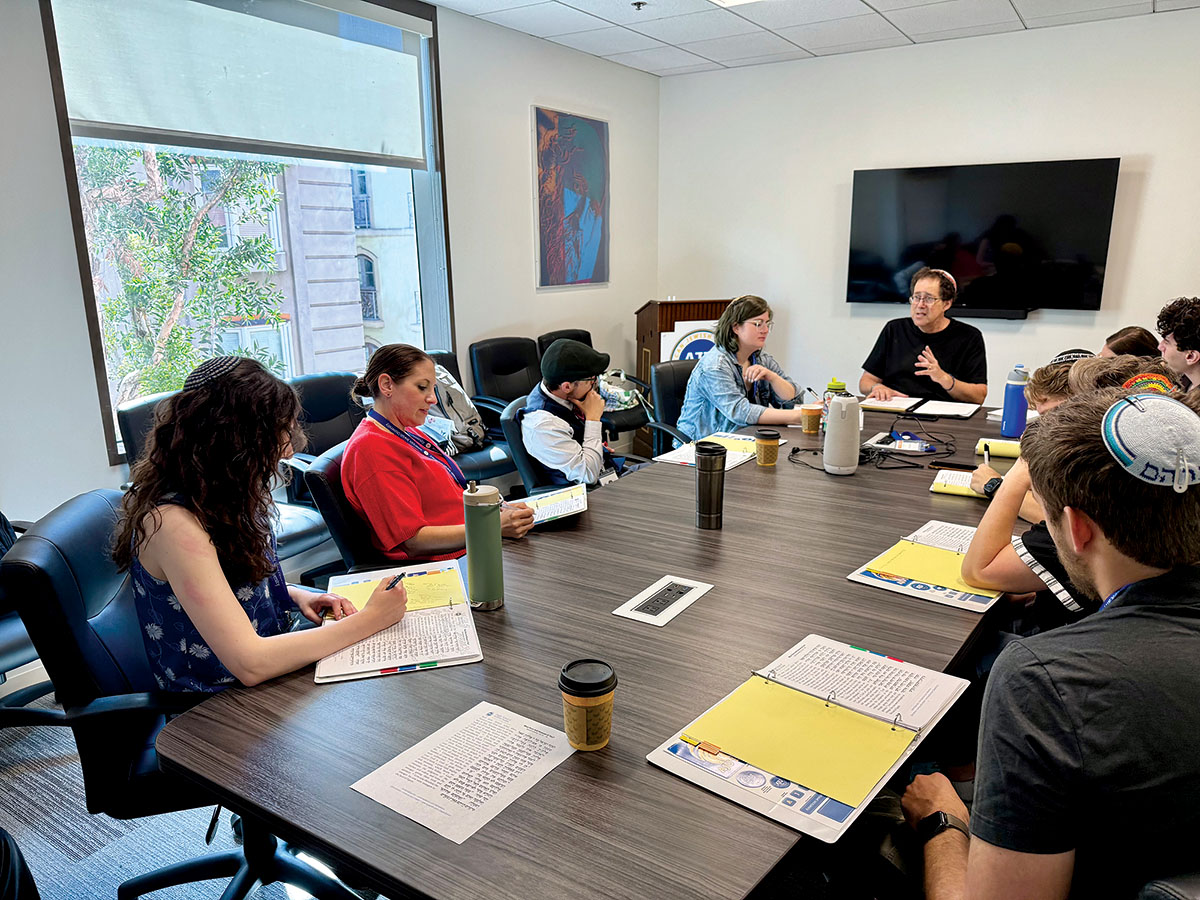
While AJU pursues this course of exploration, conversation, and rebuilding, it is simultaneously committed to ordaining and educating out the current batch of students. In a few weeks, the current students will register for Fall semester courses, which will continue to be offered at our AJU Beverly Hills campus. Learning will continue, and these students will receive a Ziegler ordination upon completion of their studies, which may lead to membership in the Rabbinical Assembly.
All change can feel like turmoil, I understand. But I affirm it is for the good. President Sanderson and the board are committed to strengthening the university’s fiscal strength, both for the university as a whole and for the Ziegler School, working together to eliminate the siloing of AJU’s various programs so they can work in symbiosis.
We are asking questions that we should have been asking for quite some time. The board is addressing itself to responsibilities with great seriousness, and Jay Sanderson is leading us toward transformation and growth. To partner with him, we need to stay engaged, stay involved, and participate in this exciting rebirth.
The best days of American Jewish University are in our future.
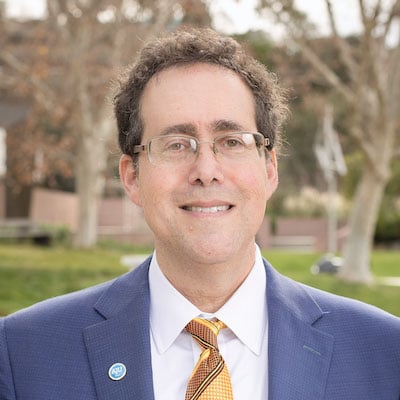
Rabbi Dr. Bradley Shavit Artson holds the Abner and Roslyn Goldstine Dean’s Chair for the Ziegler School of Rabbinic Studies of American Jewish University. Starting this July, he will step down as dean after 25 years and be promoted to the AJU Mordecai Kaplan Distinguished Scholar.