 The shadow haunts us – this is an inexorable truth we learn throughout the Days of Awe. In the first act of the Days of Awe, Rosh HaShanah, we commit ourselves to the values and virtues, truths and axioms that should govern our lives. Something is sovereign in our lives beyond the will of the ego self. Rosh HaShanah, which celebrates the Sovereignty of the Divine, is a crucial first step in returning to the path of truth, but only a first step.
In the Days of Returning between Rosh HaShanah and Yom Kippur, we try to seek out the inner parts that resist those same values and virtues, truths and axioms to which we commit ourselves. People see themselves by the values they hold, but often don’t see that they act in ways that are contrary to their values, even destructive of those values. A chronic example I see: people often say to me that their deepest value is family. When they carefully examine how they speak and behave, they often see that something inside of them has tenaciously dismantled that same value.
One thing that is hard for us to realize is that values require prodigious effort, great vision, will and skill. Saying that you hold a given value might help in creating a sense of identity, but asking yourself continuously how to realize that value is another matter altogether. We do have to commit ourselves consciously to values, but then we must also examine the parts of our ego selves that are not on board. In the days after Rosh HaShanah, culminating in Yom Kippur, we are asked to courageously enter into what Carl Jung called the shadow self, the grotto of the Yetzer HaRa (destructive patterns), where forces that defy our values live – and conspire.
Yom Kippur, the second act of the 10 Days, with its focus on confession, has us enter the shadow self. Bringing the light of consciousness into the shadow self can make us very ill at ease. We see things we may not want to see. Bringing light into hidden chambers may make us look at our life’s story differently; we may have to redefine ourselves, admit that we are flawed characters on the hero’s journey. Perhaps we are not at fault – some of us truly have been traumatized by life, oftentimes by other people. In the shadow of the brutalized self, though, there can be a hidden decision to stay depressed, injured, paralyzed. All rehabilitation is painful and we tend to avoid it, whether it’s the spine or the spirit.
Yom Kippur is not sufficient to have us work through the shadow, but that day, or some day like it, is necessary and can be a start. From rappelling down into that grotto and bringing the light of consciousness into its damp and eerie atmosphere, something beautiful can happen. Some damaged part of the soul can call out, “Heal me.”
If we can take at least one thing out of the shadow through our work on Yom Kippur, one can have the strange sense of a miracle beginning to happen, the miracle of transformation. As hard as we might work on whatever has been haunting us, nothing is guaranteed. There can be, however, an unexpected moment when the work translates into healing, or the beginning of healing.
For many of us, that experience of the truth of “tikkun ha-nefesh”, the repair of the soul, that experience of the truth of teshuvah, finding our way back to the true path, can fill us with extraordinary gratitude. Gratitude to what, exactly? To our tradition and its preservers for bequeathing to us these Days of Awe? To our teachers? For God’s guidance? For the beauty of the light, for the strength of our souls?
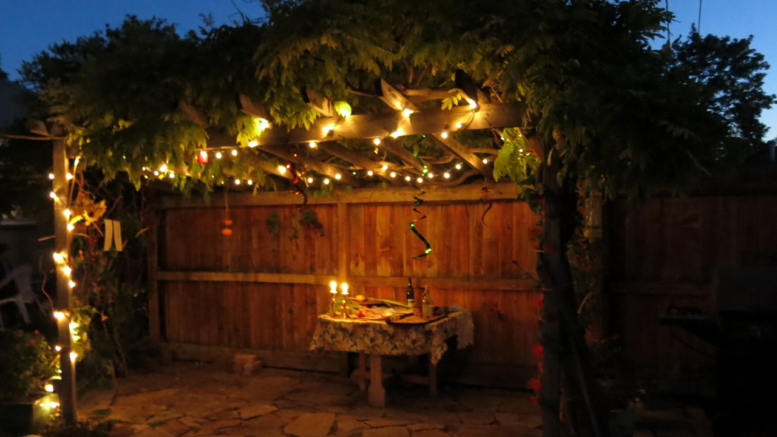
We spend Yom Kippur in the shadow, to guide us on how to do this work and remind us that we must do this work, and then move, in the third act of the 10 Days, from the shadow into the comforting shade of the Sukkah (Sukkot begins Sunday night, October 13). The spiritual tradition calls the Sukkah (in Aramaic) “tzilah d’heimanuta”– the Covering Shade of Faith. Physically, we don’t move from Yom Kippur directly into our homes and take up life as usual. Many of us actually build a Sukkah and spend some time there as a way station, a half-way house, from the exhausting work of the Days of Awe toward the Shade of Faith. In that way station of the Sukkah, we focus on acknowledgment, gratitude and joy. We rest a bit, connect with our spiritual home. Even if you don’t have a Sukkah, you can take this concept into your life. Maybe the beach, a park, a hike – as long as you don’t go right away back into your schedule. If you’ve done the work, you might feel a bit raw, a bit drained. We need a pause, a spiritual (or actual) spa, rejuvenating medicinal spring waters.
Each of our holidays contains its own teaching for ongoing spiritual work. Supreme among those days are the Days of Awe, which culminate in Sukkot, Shemini Atzeret and Simchat Torah. We are now entering the culmination of this holy season – from virtue and values, through the painful work of confronting the shadow, and now into the holy shade of gratitude and joy.
Shabbat Shalom,
Rabbi Mordecai Finley