fbpx

October 11, 2019

From the Shadow to the Comforting Shade – Thoughts Before Sukkot

The shadow haunts us – this is an inexorable truth we learn throughout the Days of Awe. In the first act of the Days of Awe, Rosh HaShanah, we commit ourselves to the values and virtues, truths and axioms that should govern our lives. Something is sovereign in our lives beyond the will of the ego self. Rosh HaShanah, which celebrates the Sovereignty of the Divine, is a crucial first step in returning to the path of truth, but only a first step.

In the Days of Returning between Rosh HaShanah and Yom Kippur, we try to seek out the inner parts that resist those same values and virtues, truths and axioms to which we commit ourselves. People see themselves by the values they hold, but often don’t see that they act in ways that are contrary to their values, even destructive of those values. A chronic example I see: people often say to me that their deepest value is family. When they carefully examine how they speak and behave, they often see that something inside of them has tenaciously dismantled that same value.

One thing that is hard for us to realize is that values require prodigious effort, great vision, will and skill. Saying that you hold a given value might help in creating a sense of identity, but asking yourself continuously how to realize that value is another matter altogether. We do have to commit ourselves consciously to values, but then we must also examine the parts of our ego selves that are not on board. In the days after Rosh HaShanah, culminating in Yom Kippur, we are asked to courageously enter into what Carl Jung called the shadow self, the grotto of the Yetzer HaRa (destructive patterns), where forces that defy our values live – and conspire.

Yom Kippur, the second act of the 10 Days, with its focus on confession, has us enter the shadow self. Bringing the light of consciousness into the shadow self can make us very ill at ease. We see things we may not want to see. Bringing light into hidden chambers may make us look at our life’s story differently; we may have to redefine ourselves, admit that we are flawed characters on the hero’s journey. Perhaps we are not at fault – some of us truly have been traumatized by life, oftentimes by other people. In the shadow of the brutalized self, though, there can be a hidden decision to stay depressed, injured, paralyzed. All rehabilitation is painful and we tend to avoid it, whether it’s the spine or the spirit.

Yom Kippur is not sufficient to have us work through the shadow, but that day, or some day like it, is necessary and can be a start. From rappelling down into that grotto and bringing the light of consciousness into its damp and eerie atmosphere, something beautiful can happen. Some damaged part of the soul can call out, “Heal me.” 

If we can take at least one thing out of the shadow through our work on Yom Kippur, one can have the strange sense of a miracle beginning to happen, the miracle of transformation. As hard as we might work on whatever has been haunting us, nothing is guaranteed. There can be, however, an unexpected moment when the work translates into healing, or the beginning of healing.

For many of us, that experience of the truth of “tikkun ha-nefesh”, the repair of the soul, that experience of the truth of teshuvah, finding our way back to the true path, can fill us with extraordinary gratitude. Gratitude to what, exactly? To our tradition and its preservers for bequeathing to us these Days of Awe? To our teachers? For God’s guidance? For the beauty of the light, for the strength of our souls?

 We spend Yom Kippur in the shadow, to guide us on how to do this work and remind us that we must do this work, and then move, in the third act of the 10 Days, from the shadow into the comforting shade of the Sukkah (Sukkot begins Sunday night, October 13). The spiritual tradition calls the Sukkah (in Aramaic) “tzilah d’heimanuta”– the Covering Shade of Faith. Physically, we don’t move from Yom Kippur directly into our homes and take up life as usual. Many of us actually build a Sukkah and spend some time there as a way station, a half-way house, from the exhausting work of the Days of Awe toward the Shade of Faith. In that way station of the Sukkah, we focus on acknowledgment, gratitude and joy. We rest a bit, connect with our spiritual home. Even if you don’t have a Sukkah, you can take this concept into your life. Maybe the beach, a park, a hike – as long as you don’t go right away back into your schedule. If you’ve done the work, you might feel a bit raw, a bit drained. We need a pause, a spiritual (or actual) spa, rejuvenating medicinal spring waters.

Each of our holidays contains its own teaching for ongoing spiritual work. Supreme among those days are the Days of Awe, which culminate in Sukkot, Shemini Atzeret and Simchat Torah. We are now entering the culmination of this holy season – from virtue and values, through the painful work of confronting the shadow, and now into the holy shade of gratitude and joy. 

Shabbat Shalom,

Rabbi Mordecai Finley

From the Shadow to the Comforting Shade – Thoughts Before Sukkot Read More »

German Suspect Confesses to Synagogue Shooting


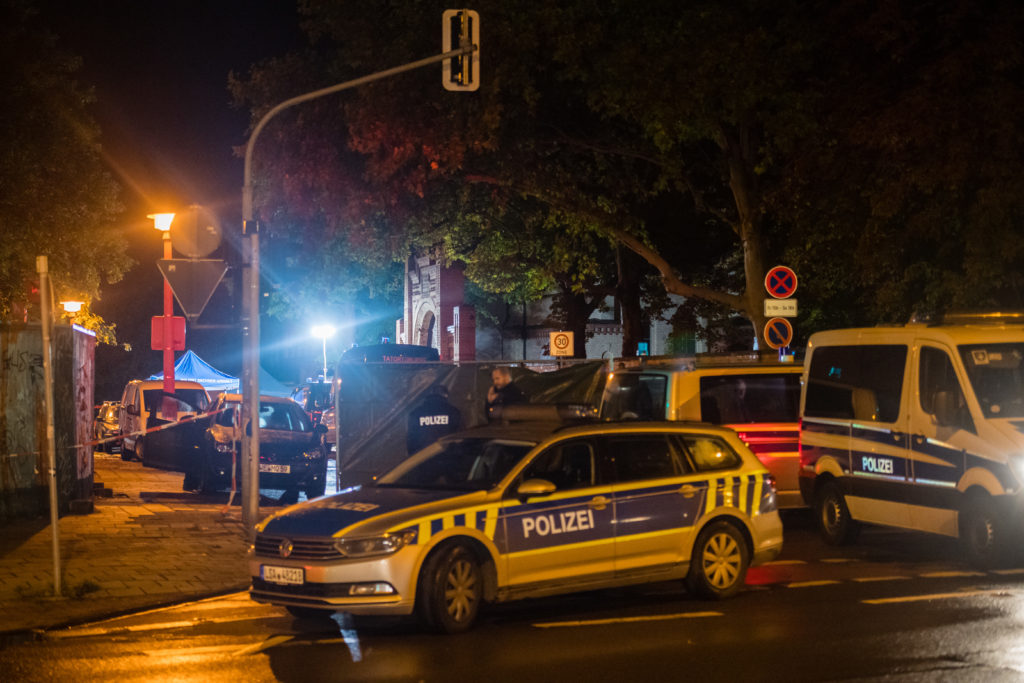
Stephan Balliet, 27, confessed to authorities on Oct. 11 for being the gunman behind the Oct. 9 shooting at a synagogue in Halle, Germany that resulted in two dead.

Agence-France Presse (AFP) reports that German federal prosecutors announced that Balliet gave “an extensive confession” that revealed his “far-right and anti-Semitic motives.”

Balliet’s lawyer, Hans-Dieter Weber, told Südwestrundfunk, a German public TV station, that it would have been “nonsensical” for Balliet not to confess to the shooting.

“In his view of the world, he blames others for his own misery and that’s what ultimately triggered his action,” Weber said.

However, Weber told the German publication Der Spiegel that Balliet is not a neo-Nazi.

Balliet had been living with his divorced mother since he was 14 years old; he was a hermit and spent most of his time online. Balliet’s father, who didn’t want to be identified, told the German newspaper Bild that he saw his son often but they always fought because his son “wasn’t at peace with himself or the world. He always blamed others.”

The shooting was livestreamed on Amazon’s Twitch platform; the shooter can be seen calling himself a “total loser” and a “f—ing failure” when he was unable to break down the door to the synagogue. He can also be seen shooting and killing a woman outside of the synagogue and calling her a “pig.”

Federal Prosecutor Peter Frank told reporters on Oct. 10 that the shooter “armed himself with many weapons, some possibly self-made, and had a large quantity of explosives” and “he wanted to mimic similar acts that happened in the past, and he also wanted to incite others to copycat his acts.”

Weber also told Der Spiegel that his client received $800 in BitCoin from an unknown person online before the shooting occurred, but maintained that he had acted alone.

German Suspect Confesses to Synagogue Shooting Read More »

40-Year-Old Music Lover and 20-Year-Old Soccer Fan Identified As Victims of Halle Synagogue Gunman

(JTA) — Jana Lange was a dedicated fan of German pop music. Kevin S. was a construction worker and decorator who loved soccer.

They have been identified as the two victims killed in the shooting by the gunman who tried to enter the Halle synagogue in Germany on Yom Kippur. Lange was 40; Kevin was 20.

An unidentified 40-year-old woman and a 41-year-old man were injured in Wednesday’s attack, according to Der Spiegel.

While 51 worshippers prayed inside on the most solemn day of the Jewish year, the gunman tried unsuccessfully to shoot through the synagogue’s door. Before she was shot, Lange reprimanded the shooter for being noisy near the synagogue during Yom Kippur prayer services.

According to The Times of Israel, “Lange was unable to work due to a medical condition, and devoted most of her time to attending shows and collecting autographs. Friends and German musical artists on social media mourned Lange, recalling her warmth, humor and dedication to the German pop music scene.”

https://twitter.com/Fjordfrau/status/1182534949481484288

After killing Lange, the shooter proceeded to a kebab shop, where he shot and killed Kevin S., who was described as “a dedicated worker and avid soccer fan.”

During a since-removed livestream on the platform Twitch, the shooter — identified as Stephan Balliet, 27 — said in English that “the root of all problems are the Jews” and began his attack. He had a camera mounted on his helmet during the attack.

In federal court Thursday evening, the accused gunman claimed anti-Semitic and right-wing motives for the attack.

40-Year-Old Music Lover and 20-Year-Old Soccer Fan Identified As Victims of Halle Synagogue Gunman Read More »

Gal Gadot to Play Holocaust Heroine Irena Sendler

Gal Gadot, known to millions as Wonder Woman, will play real-life heroine Irena Sendler in a movie about the Polish nurse and social worker who worked with the resistance to save hundreds of Jewish children during the Holocaust. Sendler helped to provide the children with false papers, smuggle them out of the Warsaw Ghetto, and place them with Christian families, for which she was eventually arrested and tortured by the Gestapo.

Gadot will produce “Irena Sendler” with her husband Jason Varsano and Marc Platt.

The Israeli actress next stars in “Wonder Woman 1984,” opening June 5, to be followed by Kenneth Branagh’s “Death on the Nile” in October and “Red Notice” with Dwayne Johnson and Ryan Reynolds in November. She and Versano are developing “My Dearest Fidel,” about journalist Peter Kornbluth and Cuban dictator Fidel Castro.

Gal Gadot to Play Holocaust Heroine Irena Sendler Read More »

Newsom Signs Law to Provide Security Funding for Jewish Institutions, Other Nonprofits

California Gov. Gavin Newsom signed a bill into law on Oct. 11 that provides security funding for Jewish institutions and other nonprofit organizations at risk of being the targets of hate crimes.

The bill, AB 1548, codifies the California State Nonprofit Security Grant Program into law, enabling eligible institutions to receive up to $200,000 a year in grants for security funding. The Democratic governor committed to providing $15 million to the fund in April after the Chabad of Poway shooting.

“In a world where hate crimes and anti-Semitism are on the rise, we need more than thoughts and prayers to keep us safe,” Assemblyman Jesse Gabriel (D-San Fernando Valley), who co-sponsored AB 1548 and is vice chair of the California Legislative Jewish Caucus, said in a statement. “This new law will provide critical resources to protect vulnerable communities and sends a powerful message that California stands firmly with those targeted by hate.”

Jewish groups praised Newsom for signing the bill into law.

“Thank you Governor Gavin Newsom for signing Assemblymember Jesse Gabriel’s Assembly Bill 1548, the California State Nonprofit Security Grant Program,” the Progressive Zionists of California said in a Facebook post. “It provides security funding to nonprofits at risk of hate motivated violence, like synagogues. It also allocates $15 million to the state’s budget for this purpose.”

https://www.facebook.com/ProgressiveZionistsofCalifornia/photos/a.244540719420265/559948044546196/?type=3&theater

Dan Mitzner, California Director of State Political Affairs for Teach CA, which is a project of the Orthodox Union, said in a statement, “The Jewish community is grateful for the creation of this program as our community faces increased anti-Semitic violence and rhetoric. This grant program allows access to additional State funding to secure our institutions, including our synagogues and day schools.”

AB 1548’s signature comes after the Oct. 9 shooting near a synagogue in Halle, Germany, that resulted in two dead. The California Department of Justice released a report on July 2 concluding that there was a 21% increase in anti-Semitic hate crimes from 2017 to 2018 in the state.

Newsom Signs Law to Provide Security Funding for Jewish Institutions, Other Nonprofits Read More »

ADL: Similarities Between Halle and White Supremacist Shootings

Anti-Defamation League Center on Extremism Director Oren Segal said the Oct. 9 shooting at a synagogue in Halle, Germany, followed a similar template to white supremacist-led shootings over the past year.

Segal made his comments based on the alleged shooter’s manifesto and his livestreaming of the shootings.

Authorites identified the man as 27-year-old Stephen Balliet, attempted to enter the synagogue during Yom Kippur services but failed because the synagogue’s metal door wouldn’t open. He shot and killed a woman outside the synagogue and a man at a nearby kebab shop. He was arrested later the same day.

While it’s unclear when he posted the manifesto reportedly linked to him, the manifesto did state he wanted “to kill as many anti-whites as possible.

“If I fail and die but kill a single Jew, it was worth it,” the manifesto reads. “After all, if every White Man kills just one, we win.”

In the live stream on Amazon’s Twitch, the shooter blames “Jews for feminism, declining birth rates, and mass immigration.” He also denies the existence of Holocaust, according to Time magazine.

Segal told the Journal that while the manifesto and video don’t specifically list the October 2018 Pittsburgh shooting, New Zealand mosque shootings in March, the Chabad of Poway shooting in April, or the August El Paso shooting as inspirations, the manifesto’s rhetoric and the shooter’s tactics followed the same template.

“When he talks about his opposition to immigration, feminism and the Jews, there is a through line in that ideology with what we saw in El Paso, in Poway and Pittsburgh and Christchurch,” Segal said. He added that the shooter’s “tactic of filming it and leaving a manifesto” was also part of the template. “It’s becoming all too common,” Segal said.

He added the alleged shooter’s worldview was likely partially formed from “the online ecosystem of extremism. People are able to engage in hateful tropes and activity and find hateful communities and sometimes it has these deadly results.”

Twitch took down the video on Oct. 9 but it is still being circulated on various online platforms, including on an app called Telegram. According to The Hill, white supremacists have been flocking to Telegram in recent months since it allows users to “post relatively unfiltered content,” but also provides “a private encrypted messaging service where people can communicate without fear of surveillance,” The Hill notes.

Segal said that Telegram has had to deal with extremists “for years, and it used to be that al-Qaeda and ISIS were the early adopters and now white supremacists are there in full force as well.” He added, “We would want Telegram to not allow what are essentially snuff movies to be accessed on their platform.”

Telegram did not responded to the Journal’s request for comment.

Segal praised Facebook, Twitter and Google for “creating a sort of counterterrorism consortium” to ensure videos of shootings don’t spread on their respective platforms. However, he said too many tech platforms haven’t done what is necessary to combat the rise of the extremism.

“It starts with a willingness to try to even deal with the problem,” Segal said, “and it seems like there are still a lot of platforms that are not willing to even deal with it.”

ADL: Similarities Between Halle and White Supremacist Shootings Read More »

German Synagogue Attacker Reportedly Admits to Receiving Anonymous Financial Support Online

(JTA) — The German man suspected of killing two people near a synagogue this week reportedly told German investigators that he received approximately $800 from an anonymous online donor prior to the attack.

The German publication Der Spiegel reported Friday that the accused, Stephan Balliet, had received the money in the form of the cryptocurrency Bitcoin from an unknown person with whom he communicated on the internet, according to his defense attorney Hans-Dieter Weber.

Weber also told the publication that Balliet denied being a neo-Nazi in his interrogation by German authorities. Balliet claimed to have acted alone and made the weapons used in the attack himself from cheap materials.

Balliet is accused of an attack Wednesday on a synagogue in the city of Halle, in central Germany. He tried to enter the synagogue with explosives but was stymied by its locked doors. He then turned his gunfire on a woman outside and a man in a nearby kebab shop, killing both.

The victims were identified Friday as Jana Lange, 40, and Kevin S., 20.

German Synagogue Attacker Reportedly Admits to Receiving Anonymous Financial Support Online Read More »

Your Turn:Standouts on the Diamond;Teaching Tolerance;Politics and the Pulpit

Standouts on the Diamond 

Yasher koach to Israel’s national baseball team, which has shocked the world by advancing to next year’s Olympics (“Israeli Baseball Team Qualifies for 2020 Olympics,” Sept. 27).

In 2017, Israel stunned the baseball world when the team and its “Mensch on the Bench” mascot reached the second round of the World Baseball Classic.

This year, perhaps even more remarkably, Israel placed fourth in the European Championships to earn a spot in the Europe/Africa regional Olympic qualifying tournament. Yet once there, Israel’s incredible run continued as it defeated Spain, the Netherlands, Italy and South Africa to win the tournament and earn one of just six berths in the 2020 Summer Olympics in Japan.

Who knew that when Cinderella took the baseball mound, she wore not only glass slippers but a kippah, too?  Stephen A. Silver, San Francisco

Teaching Tolerance

The story in the Oct. 4 edition about the U.N. made me stop and think (“UN Releases First-Ever Report on Anti-Semitism”).

As anti-Semitism grows with time, all over the world, more organizations recognize the problem. “The U.N. is finally recognizing the severity of the ages-old hatred against Jews,” observes the American Jewish Committee. Ronald Lauder, president of the World Jewish Congress, suggests that “Anti-Semitism is a virus that is rapidly spreading throughout the world.” 

So, I asked myself: Why do we have anti-Semitism and other forms of hate?

My answer: People are born with all sorts of traits which carry during their lives, including greed and jealousy. I believe these are natural characteristics of all living things — human, animals, etc.

Because of jealousy, it’s natural to seek out or imagine the “faults” of others, especially those people who have succeeded so well in life. And it’s easier to attack those minority groups who are so successful in various ways. 

For whatever reason — probably in an effort to overcome racial hatred and bias — Jews have become ingrained with the need for education and to develop various capabilities with significant payoffs, financial and otherwise, and become world leaders. (Like a typical Gaussian distribution, some more so than others.)
The solution: Teach people from birth, at every opportunity — at home, at school, in places of worship, at work, in law enforcement — to respect and love their fellow man, no matter their differences in religious or other beliefs. Most important, don’t be jealous. Instead, admire the success and accomplishments of others. Tell them so, with a sincere and big smile, and do your best to learn from them and follow suit, advancing your unique skills. 

Some may call this “brainwashing,” but it’s all to the better good. George Epstein, Los Angeles

As an observant Jew, I fully understand editor David Suissa’s point of view that Yom Kippur is a special day during which we should be concerned about ourselves and not about politics (“Can We Keep Trump Out of Yom Kippur?” Oct. 4). However, there have been times during our 5,780-year history when even our traditional holy days should have been altered.

I assume that during the 1930s in Europe, Yom Kippur was observed just as Suissa explains it should be, even as Hitler’s Third Reich was raging. Perhaps there were some rabbis who did not speak out against Hitler so as not to offend the members of their congregations who supported Hitler. Yes, I assume that some Jews supported Hitler in the early years because, after all, Hitler wanted to make Germany great again. Martin A. Brower, Corona del Mar

Attending Rosh Hashanah services has always been a very special time to reflect on the past year in a most spiritual setting at one’s chosen house of worship. One can hopefully forget about the troubling news we read every day in our country and around the world, and focus on our Jewish faith, family and the continuity of our people. This brings together our Jewish community.

Unfortunately, Suissa’s excellent editorial about trying to keep politics, and I would add, personal views on a host of controversial news issues, should have been written before Rosh Hashanah.

It was rather disturbing to be subjected to a sermon, the rabbi’s stated choice, about all the plastic debris in our oceans and the other dire consequences of climate change. Could topics of more concern to us as Jews be more appropriate — the rise in anti-Semitism in our country and around the world in the past year, or the boycott, divestment and sanctions movement against Israel are two examples.

Hopefully, rabbis will heed Suissa’s advice or they will surely see a decline in their temple membership. Janet Polak, Beverly Hills

She Stands With the Rabbi

Go with strength, Rabbi Lori Shapiro! (“Redeeming Judgment: Disagree With Me,” Oct. 4)

Because the blame game is a shame

got to look inside, see what we’ve done wrong

what we can do better, Yom Kippur the paradigm

for a society gone insane

Because children have to question,

think, know uncomfortable is OK

Striving for truth hurts

all ideas on the table, all the ways the world is

Because there shouldn’t be “safe spaces” in universities

Speakers prohibited because whole populations are sensitive

Never forget Nazis marching through Skokie past Holocaust survivors

Because the ACLU believed denying one group their right to march (or speak)

means others will be denied

freedom “sanitized”

Destroyed Mina Friedler via email

The Pineapple as Modern-Day Fertility Symbol 

The Journal’s website recently shared a New York Times story about pineapples as fertility symbols. Thank you for taking notice of the issue of infertility. However, Judaism actually has many symbols for fertility and the timing couldn’t be better to learn about them.

The tradition of the Sephardic Rosh Hashanah seder includes pomegranates (many seeds), apples (from Song of Songs), honey, and fish (which lay many eggs) specifically for fertility. Additional traditions surround the etrog used on Sukkot, garlic on Friday nights, and food shaped like stars to represent God’s promise to Abraham that his children be as plentiful as the stars. Many resources and rituals are right here in our Jewish tradition that provide meaning and support for infertility. I pray we can reach out and embrace the many people facing infertility and other family-building challenges that have for too long not received enough support from the Jewish community. Rabbi Idit Solomon via email

CORRECTION

A photo caption accompanying a story on Rep. Adam Schiff and the impeachment inquiry incorrectly cited the committee he chairs. He heads the House Intelligence Committee.


Don’t be shy. Send your letters to letters@jewishjournal.com Letters should be no more than 200 words and must include a valid name and city. The Journal reserves the right to edit all letters.

Your Turn:Standouts on the Diamond;Teaching Tolerance;Politics and the Pulpit Read More »

Table For Five: Sukkot

One verse, five voices. Edited by Salvador Litvak, Accidental Talmudist

And the Lord shall become King over all the earth; on that day the Lord shall be one, and His name one. From the Sukkot Haftarah, Zechariah 14:9


Rabbi Scott Bolton

Congregation Or Zarua, New York

This prophetic vision is not really about a time in the future or kingship grounded in history or empires or games of thrones. It is about the potential for realizing that we are more unified than divided. Even when we feel at political, spiritual and moral odds, to achieve unification without uniformity is on the horizon. It is a religious ideal. 

Our verse begets the question: What would we think, say and feel if we added a more expansive unity quotient to our life calculus? What if we asked, “How can I be the catalyst for one-ness here and now, baYom haHu today?” Words like “King” and “One” and “His name” are attempts to grasp the ineffable oneness of the Divine that is beyond a who, a what, a word or time. Hearing them chanted inspires shifts in perception. 

A certain percentage inside of us is linked to the immeasurable oneness of the universe. Beyond a Buberian I/Thou we arrive at a God/I/We/Every-thing-and-time concept that Heschel described by saying, “God is an afterthought.” Suddenly, our unity index climbs when we feel ourselves floating on seas of infinitude. We still need poetic verses like ours to be the oars for rowboats on the lakes of our lives. Hearing haftarah chanted is sublime, transcendent! We heighten our love and connectivity to our neighbors, our planet and our universe. We realize with thunderous calm that differences and distinctions we perceive today are part of the greater unfolding of a unified reality. One of our blessed roles is to actively unify. 


Rabbi Hillary Chorny

Cantor, Temple Beth Am

Six years and two kids into our marriage, we built our first sukkah last year. All four sides comprised our front patio: a retaining wall marked the east and south; a gate held the west; sliding doors straight into our living room abutted the north. Above us, schach and sky. I spent hours upon hours in the sukkah last year: sipping my morning coffee and letting the afternoon breeze kiss my neck as I nursed my newborn; watching the light of the Havdalah candle flicker in my toddler’s eyes as she searched the bamboo matting for gaps where the stars might shine through. Short of showering and actually sleeping through the night (which frankly never happened), we fully lived in that sukkah. 

Night and day in the sukkah. The Akeidat Yitzchak (15th-century Spain) comments on a verse from the haftarah on Sukkot Day One. Describing a vision of a messianic era to come, Zechariah preaches that there will be “one continuous day” (Zechariah 14:7) and on that day “God will be one” (Zechariah 14:9). The Akeidat Yitzchak hears in these verses an echo of creation: there was evening, there was morning; it was one day, or “day one” (Genesis 1:5). On Sukkot, our constant dwelling in sacred booths allows us to bask in the omnipresence of God as a taste of the world we strive to live in, one where we feel the touch of divinity at all times, in everyone we meet, and in everything we do.


Rabbi David Block

Associate Head of School, Shalhevet High School 

Why are we obsessed with God’s oneness? The holiest words that a Jew can say are those of Shema: “Listen, Israel … HaShem is One!” But why are we so adamant? Is there some sort of belief-in-polytheism epidemic going on? At least in 2019, these words feel meaningless. 

But they’re actually at the heart of the entire construct of our relationship with God. Monotheism vs. polytheism can simplistically be explained as one versus many. But as Rabbi David Fohrman notes, “The really significant differences between monotheism and polytheism are not quantitative, but qualitative.” It’s axiomatic to polytheistic systems that there is no one omnipotent “creator god.” If so, while these gods may be powerful, they are not all-powerful; they still have lacks and needs, as do we. So, humanity’s interaction to these gods is one of bribery, barter, quid pro quo. 

Monotheism revolutionizes the paradigm. If God is one, the Creator, it would be silly to barter with that Omnipotent Being. An interaction with God would be fundamentally different — it would be a relationship! It would be one of a creator and creation, like a parent and child. As Fohrman says, “The notion that a relationship is possible, and indeed desirable, between the human and the divine” — like monotheism celebrates — “makes little sense in the pagan system.” 

Thus, immediately following the words “HaShem is One” in Shema, we emphatically declare the implication of that Oneness: “V’ahavta — so, love your God.” That’s why we care about God’s oneness: It’s how we get to a relationship of love.


Rabbi Cheryl Peretz 

Associate Dean, Ziegler School

Zechariah’s words speak of great redemption when all will know and testify to the existence and oneness of God. These are the words that end the Aleinu liturgy said in every prayer service on the Jewish calendar. In an easy-to-miss phrase, the same prayer says, “V’hasheivota el levaveicha” — translated by many as “take God to heart” but really is a demand to actively put God on your heart. 

In Jewish thought, the heart has many functions. Kohelet Rabbah (the rabbinical commentary on Ecclesiastes) explains that the heart sees and hears, stands and falls, feels and knows, breaks and heals. Rabbi Yerucham Levovitz (1873-1936) says the heart is like a seismograph, recording every tiny tremor even if our conscious minds remain unaware of the impact. 

Today, we know that the heart is not the source of love — the ancients were mistaken. But doctors and scientists also tell us that the relationship between heart and emotions is extraordinarily intimate. Our emotions can actually change the shape and affect the operation of the heart. 

In life, we all live great joys and sorrows. It is in loosening the membranes surrounding the heart that we truly experience emotions leading to introspection, meaning and growth. This is the sacred invitation to place God on your heart and feel it in every moment — as a companion to the celebration, a comfort to the affliction, a renewal from the mundane. This is the fulfillment of the universal promise of redemption associated with Sukkot.


Salvador Litvak

Writer and director, AccidentalTalmudist.org 

Zechariah’s verse provides the last line of the Aleinu prayer, which concludes every prayer service on every day of the year. Why is this prayer so important, and why is this line its climax?

Tradition holds that Aleinu was written by Joshua as he led the Children of Israel into the Promised Land. In its first half, we praise God for distinguishing us from every other nation. Different how? We bend our knees and bow to the One God, Maker of Heaven of Earth. It is because we’re His servants that we know there is nothing else but God. We’re in God, but like fish swimming in water, we forget how much we owe to the transparent reality that sustains us. 

The second half looks to the future, when God’s presence will be as clear to everyone as it was to us when we ate manna from Heaven, took shelter from the desert sun under Clouds of Glory, and witnessed daily miracles. The path to that future includes one of the most misunderstood phrases in the Jewish world: tikkun olam. The verse reads “l’takein olam b’malchut Shadai,” the world will be perfected through the Kingship of the Almighty. In other words, the path to the repair and perfection of the world is knowledge of and bonding with God. 

God is already one. When we recognize that, His name will be one as well. Currently, too many people believe we’re alone and in charge. When we finally submit to the eternal values of the Creator and thank Him for the creation, the world will naturally transition to a paradise of peace, justice, beauty and equal opportunity for all. 

Table For Five: Sukkot Read More »

Decorate Your Sukkah With Leaf Printing

Every time Sukkot rolls around, I like to look for new ways to decorate the sukkah. This year, I’ve been experimenting with leaf printing and having so much fun. Leaf printing is actually a lot easier than it sounds. You simply apply paint to leaves, place the leaves on top of paper or fabric, and then transfer the paint onto the surface. It’s a stylish way to create placemats, table runners and artwork for the walls of the sukkah. You can also use this technique throughout the year to make beautiful greeting cards and stationery.

What you’ll need:

Leaves

Acrylic paint in various
colors

Paper plate

Paint roller or brush

Paper or fabric

Paper towels

Brayer or rolling pin

1. Collect your leaves. Look for leaves that are pliable and will lie flat. Rinse them in water and let them dry.

2. Pour some acrylic paint on a paper plate. Use one or two colors to start — and you don’t have to choose green. Apply the paint on a roller or brush.

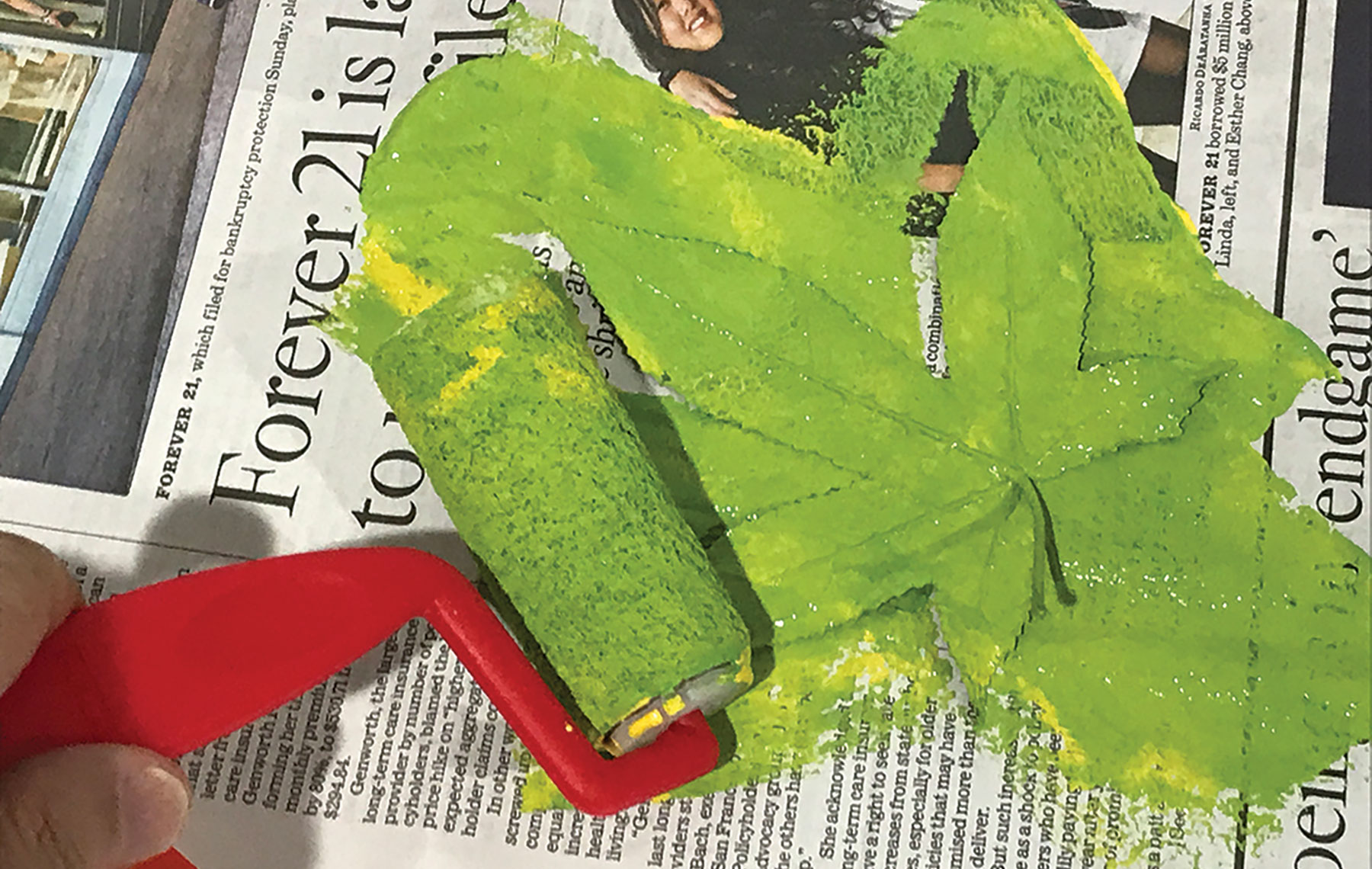
3. Place the leaf on a newspaper and roll the paint over it. Select the side of the leaf that has the most texture, i.e., the side with the veins.

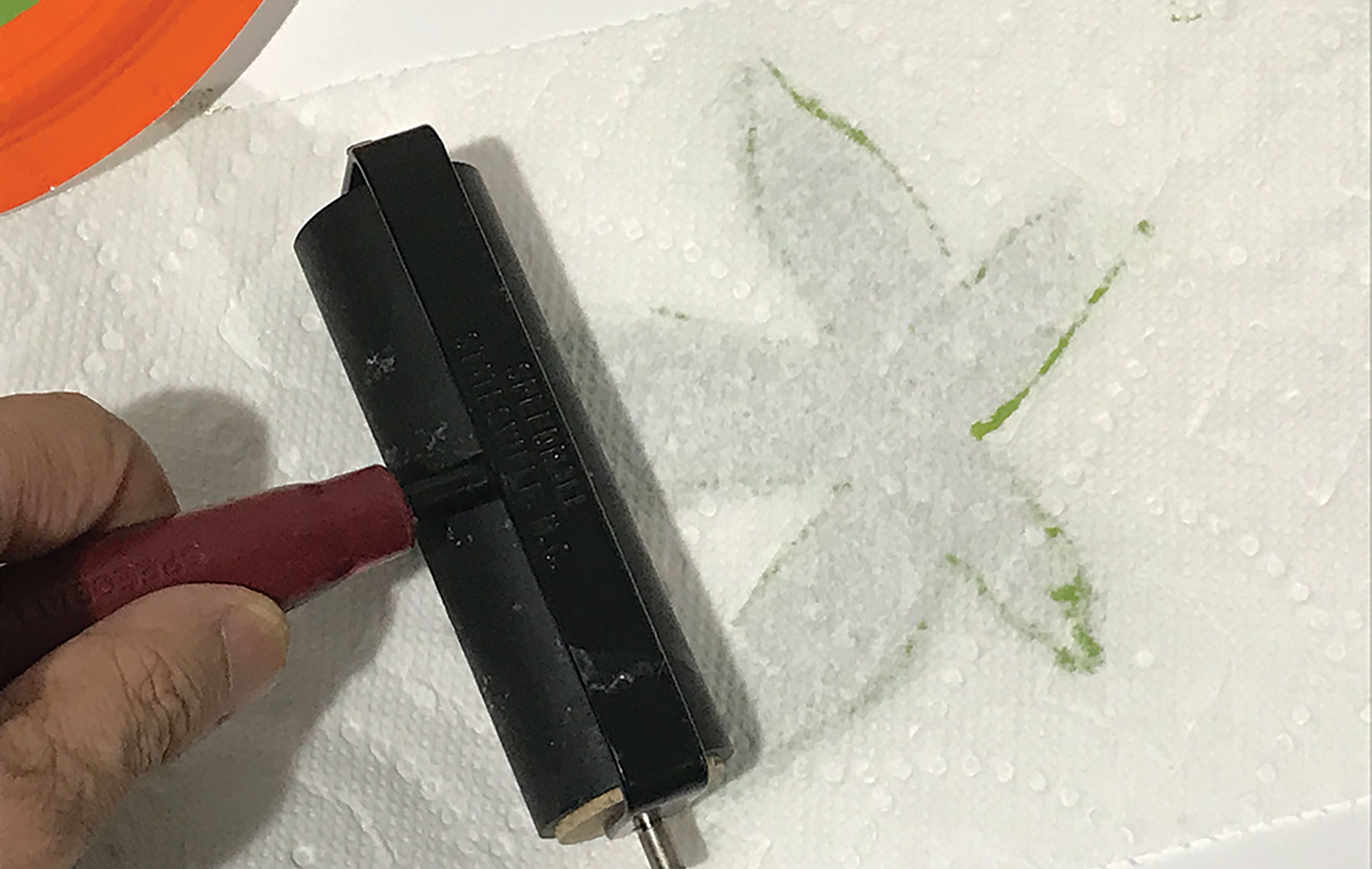
4. Position the leaf with the paint face down on your paper or fabric. Cover the leaf with a paper towel. Then press down on the leaf with a brayer or rolling pin. You can also use your fingers.

5. Lift the leaf off the surface to reveal your transferred leaf print. Don’t worry about mistakes. Imperfections make the artwork even better.

6. As you continue to print with other leaves, add different paint colors to your paper plate. The mixture adds beautiful depth to the colors.


Jonathan Fong is the author of “Flowers That Wow” and “Parties That Wow,” and host of “Style With a Smile” on YouTube. You can see more of his do-it-yourself projects at his website.

Decorate Your Sukkah With Leaf Printing Read More »